Ginkgo Biloba: History and Traditional Use
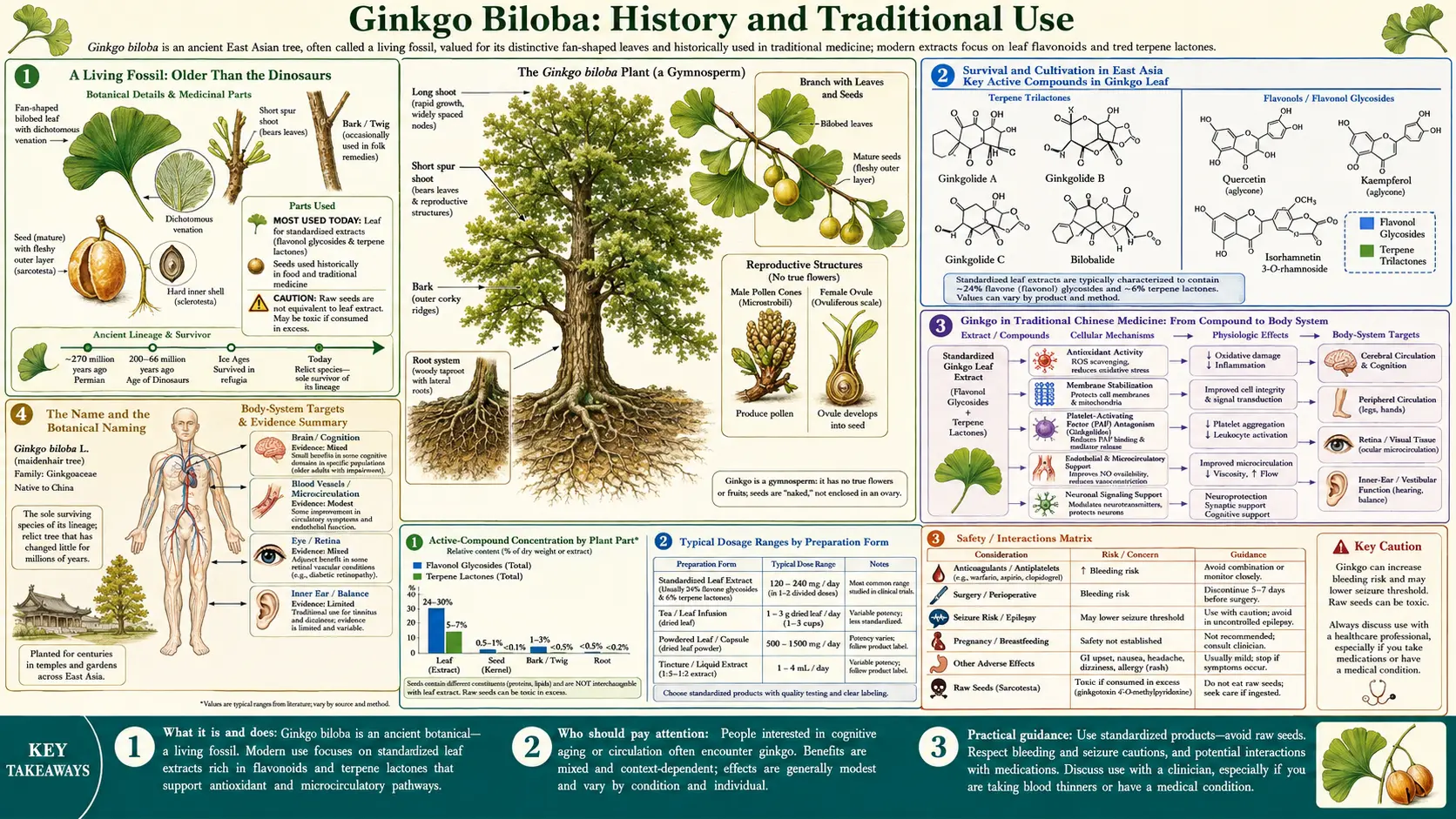
Few plants carry a story as long as the ginkgo's. The tree itself is a survivor from the age of the dinosaurs — the last living member of a plant lineage that stretches back more than 200 million years — and its more recent human history is unusually well documented: we can name the German physician who first described it for the West in the 1690s, the great Chinese pharmacist who wrote it into the classical materia medica, the chemists who in the twentieth century finally worked out what its leaves contain, and even the handful of ginkgo trees that lived through the atomic bombing of Hiroshima. This article traces that documented journey. Where the record is firm we say so; where something is tradition or folklore, we name it as such, and we have left out the popular claims we could not confirm from reliable sources.
Table of Contents
- A Living Fossil: Older Than the Dinosaurs
- Survival and Cultivation in East Asia
- Ginkgo in Traditional Chinese Medicine
- The Name and the Botanical Naming
- The Journey to Europe and the West
- The Trees That Survived Hiroshima
- From Leaf to Laboratory: The Modern Scientific Story
- From Tradition to Modern Research
- Research Papers and References
- Connections
- Featured Videos
A Living Fossil: Older Than the Dinosaurs
The history of ginkgo does not begin with people; it begins roughly 270 million years ago, in the Permian period, long before the first dinosaurs walked the Earth. The plant order to which the tree belongs, the Ginkgoales, first appears in the fossil record at about that time, and for much of the age of the dinosaurs ginkgo-like trees grew across large parts of both the northern and southern hemispheres. What makes the ginkgo so remarkable is how little it has changed: fossil ginkgo leaves tens of millions of years old show the same distinctive fan shape, split into two lobes, that you can pick up under a ginkgo tree today. Botanists call this near-stillness over deep time morphological stasis.
The single species that survives, Ginkgo biloba, is the last living member of an entire group of plants that has otherwise been extinct for millions of years — almost all of its relatives had disappeared by the end of the Pliocene. It has no close living cousins; every other species in its order is known only from fossils. This is why ginkgo is the textbook example of what Charles Darwin, in On the Origin of Species (1859), famously christened a “living fossil”: a surviving organism that closely resembles its ancient ancestors and has outlived the rest of its line. (The phrase is Darwin's; the ginkgo became its most-cited illustration.)
Individual ginkgo trees are long-lived to match the antiquity of the species. They commonly reach several hundred years of age, and a number of venerable trees in China are popularly said to be well over a thousand years old. The tree's deep evolutionary endurance, its great individual longevity, and its toughness in the face of pollution, pests, and disease are the reasons the fan-leaved ginkgo has become, across many cultures, an enduring symbol of resilience, endurance, and hope.
Survival and Cultivation in East Asia
Although ginkgo once grew widely across the Northern Hemisphere, the species retreated dramatically over the last few million years — through the climatic upheavals of the ice ages — until it survived in the wild only in a few refuges in China. To this day, Ginkgo biloba is found growing wild only in China; everywhere else in the world it is a cultivated, planted tree. Botanists still debate exactly how much truly “wild” ginkgo remains, but the broad picture — a once-global tree reduced to a small Chinese stronghold — is well established.
The ginkgo's survival into the present is bound up with human cultivation. It is widely held that the species was preserved and propagated in China in temple and monastery gardens, where ginkgo trees were planted and protected over many centuries; the close association of old ginkgo trees with Buddhist and other temples across East Asia is well attested, even if the precise role of any one group of monks in saving the species from extinction is more a matter of tradition than of firm record. From China, ginkgo was carried as a cultivated tree to Korea and Japan, where it was likewise planted around temples and shrines. It was in Japan, at the end of the seventeenth century, that the tree first came to the attention of a European naturalist — the episode that begins its Western history, told below.
Ginkgo in Traditional Chinese Medicine
Compared with its immense biological antiquity, ginkgo entered the Chinese written medical record relatively late. The tree was long valued for its edible seed (the kernel inside the fleshy, strong-smelling outer seed coat), and the seed — known in Chinese as bai guo (“white nut”) and often sold as the ginkgo nut — was used both as a food and as a remedy. Its most authoritative early documentation comes from the towering figure of Chinese pharmacy, Li Shizhen (1518–1593), whose great compendium, the Bencao Gangmu (Compendium of Materia Medica), was completed in draft in 1578 and first printed in 1596, three years after his death.
In the traditional Chinese system, ginkgo seeds and leaves were put to different uses. The cooked seeds were classically used for complaints of the lungs and airways — for coughs with phlegm, wheezing, and asthma — and for certain bladder and discharge problems; the leaves were also employed in traditional practice. One specific historical use has even been examined by modern scientists: a sixteenth-century prescription recorded in Li Shizhen's work for using ginkgo seed preparations against skin infections was tested in a 2019 laboratory study, which reported antibacterial activity against skin pathogens — an unusually direct meeting of an old text and a modern microbiology bench.
Two cautions belong with this history, for the sake of readers who might take it as advice. First, the traditional Chinese uses centre heavily on the seed, whereas almost all modern ginkgo supplements are made from a standardized extract of the leaf — these are different preparations with different chemistry. Second, raw or large quantities of ginkgo seeds are genuinely toxic and can cause serious poisoning, which is precisely why traditional practice cooked them and used them carefully. The detailed chemistry and the safety considerations are covered on the main Ginkgo Biloba page.
The Name and the Botanical Naming
The odd-looking name “ginkgo” has a well-documented and slightly accidental origin. The German physician and naturalist Engelbert Kaempfer, working for the Dutch East India Company at its trading post on the island of Deshima in Nagasaki harbour from about 1690 to 1692, was the first Western scholar to describe the tree. He recorded its Japanese name and later published it in his 1712 book Amoenitates Exoticae, writing it as “Ginkgo.” Scholars who have studied his notes — including a detailed 2015 study by Nagata and colleagues in the journal TAXON — conclude that this spelling was most likely a misreading or mistranscription of the Japanese reading (something closer to ginkyo or ginkjo), but the spelling stuck.
It stuck because the great Swedish botanist Carl Linnaeus, the founder of modern biological naming, adopted Kaempfer's spelling when he formally gave the tree its scientific name Ginkgo biloba in 1771. The species epithet biloba means “two-lobed,” describing the cleft, fan-shaped leaf. So the formal name carried by this living fossil today preserves, more or less by chance, one European physician's seventeenth-century notebook spelling of a Japanese word — an honest quirk of botanical history that the tree has worn ever since.
The Journey to Europe and the West
Kaempfer did more than name the ginkgo; he opened the door for its travels. After he published his description in 1712, living ginkgo plants were brought from East Asia to Europe within a generation; the first specimens are generally reported to have been planted at Utrecht, in the Netherlands, in the late 1720s. From these early European trees, ginkgo spread through botanical gardens and onto city streets, and it was later carried to North America. It proved an outstanding ornamental and street tree precisely because of the toughness that had helped its lineage survive for so long: ginkgo tolerates urban pollution, compacted soil, pests, and disease far better than most trees, which is why ginkgos now line streets and fill parks in temperate cities around the world.
One practical footnote of cultivation belongs here, because it surprises people. The ginkgo's seed coat, produced only by female trees, gives off a strong, unpleasant smell as it ripens and falls — so the trees planted along streets are very often deliberately chosen to be male, to avoid the odour. The same fleshy seed, cooked and treated as the bai guo nut, remains a prized food in parts of East Asia. The tree that began as a botanical curiosity collected by a company physician in Nagasaki is now one of the most widely planted ornamental trees on Earth.
The Trees That Survived Hiroshima
One of the best-documented and most moving chapters in ginkgo's history took place on 6 August 1945, when the first atomic bomb used in war was dropped on Hiroshima. The blast and fire destroyed almost everything for a wide radius around the hypocentre. Yet a number of trees within roughly one to two kilometres of the blast — among them several ginkgos — were not killed outright. Though scorched, stripped of leaves, and seemingly dead, they re-sprouted from their trunks the following spring, pushing fresh green shoots up out of the ruins.
These survivors are honoured in Japan with their own name: hibakujumoku, meaning “A-bombed trees” or survivor trees. Several of Hiroshima's surviving ginkgos still grow today, including one beside a temple very near the hypocentre, and seeds and seedlings from them have since been shared with botanic gardens around the world as living symbols of survival and peace. It is worth being careful about what this story does and does not show: the ginkgos survived because of where they stood and the remarkable regenerative toughness of the species, not because the tree has any special power against radiation in a human or medicinal sense. As history and as symbol, though, the image is unforgettable — a tree older than the dinosaurs, greening again over a devastated city.
From Leaf to Laboratory: The Modern Scientific Story
Ginkgo's modern history — the part that turned an ancient tree into one of the world's most-studied herbal products — is a twentieth-century story of chemistry. The distinctive compounds in ginkgo were teased out step by step. The unusual cage-shaped molecules now called the ginkgolides were first isolated from the plant by the Japanese chemist Furukawa in 1932, but their extraordinary structure remained a puzzle until the 1960s. In 1967, the chemist Koji Nakanishi and his colleagues finally solved that structure, describing the ginkgolides (designated A, B, C and M) as intricate twenty-carbon molecules — a landmark in natural-product chemistry. A related compound found in the leaves, bilobalide, was characterized by the same line of research. These terpene compounds are found nowhere else in the plant kingdom.
At almost the same time, ginkgo was becoming a medicine in Europe in the modern, pharmaceutical sense. In 1965 the German physician-pharmacist Dr. Willmar Schwabe introduced ginkgo leaf extracts into medical practice (under the name Tebonin). In the early 1970s his company developed a concentrated, carefully standardized leaf extract designated EGb 761, made to contain a fixed profile of about 24% flavonoid glycosides and 6% terpene lactones (the ginkgolides and bilobalide), with the naturally occurring, potentially allergenic ginkgolic acids reduced to very low levels. Producing it is laborious — on the order of fifty pounds of dried leaves yield a single pound of extract. Because this one well-defined extract was used in the great majority of the clinical trials that followed, EGb 761 effectively became the reference form of ginkgo for modern research, and it is the standard against which other ginkgo products are still compared.
The chemistry, the named compounds, and the clinical evidence are taken up in detail on the main Ginkgo Biloba page and in the dedicated Benefits articles — on cognitive function and memory, circulation and peripheral artery disease, tinnitus, and vision and macular degeneration.
From Tradition to Modern Research
What gives ginkgo's history its particular shape is the long gap between the tree and its explanation. For most of human history the ginkgo was known as a sacred, long-lived temple tree and a source of an edible, medicinal seed; the leaf extract that dominates pharmacy shelves today is barely sixty years old, and the chemistry behind it younger still. The thread that connects them runs from the ancient refuges of wild ginkgo in China, through the temple gardens that preserved it and the pages of Li Shizhen's 1596 compendium, to Kaempfer's notebook, Linnaeus's naming, and finally the laboratories of Furukawa, Nakanishi, and Schwabe.
It is also a history that asks for honesty, because real people read pages like this one hoping for help. Ginkgo's deep antiquity and its survival of Hiroshima are genuinely awe-inspiring facts about a tree — but they are facts about a tree's biology, not evidence that ginkgo cures human disease. The modern medical questions — whether standardized ginkgo leaf extract helps memory, circulation, tinnitus, or vision, and for whom — are exactly the questions the Benefits articles examine against the clinical evidence, with its genuine successes and its real disappointments. Tradition and history raised the questions; careful research is still working out the answers.
Research Papers and References
The list below combines peer-reviewed reviews and primary studies bearing on ginkgo's history, botany, and chemistry with curated PubMed topic-search links into the wider literature. Author names, titles, and journals are given as plain text; only verifiable DOI, PMID, or stable links are hyperlinked, and each opens in a new tab. Historical primary sources (Kaempfer's Amoenitates Exoticae of 1712, Linnaeus's 1771 naming, and Li Shizhen's Bencao Gangmu of 1596) are named in the article as historical sources rather than as modern citations.
- Nagata T, et al. Engelbert Kaempfer, Genemon Imamura and the origin of the name Ginkgo. TAXON. 2015;64(1):131-136. — doi:10.12705/641.25
- Singh B, Kaur P, Gopichand, Singh RD, Ahuja PS. Biology and chemistry of Ginkgo biloba. Fitoterapia. 2008;79(6):401-418. — doi:10.1016/j.fitote.2008.05.007 ( — Search PubMed)
- Mahadevan S, Park Y. Multifaceted therapeutic benefits of Ginkgo biloba L.: chemistry, efficacy, safety, and uses. Journal of Food Science. 2008;73(1):R14-R19. — doi:10.1111/j.1750-3841.2007.00597.x
- DeFeudis FV. A brief history of EGb 761 and its therapeutic uses. Pharmacopsychiatry. 2003;36(Suppl 1):S2-S7. — doi:10.1055/s-2003-40450
- Chassagne F, Huang X, Lyles JT, Quave CL. Validation of a 16th century traditional Chinese medicine use of Ginkgo biloba as a topical antimicrobial. Frontiers in Microbiology. 2019;10:775. — doi:10.3389/fmicb.2019.00775
- Engelbert Kaempfer and the first Western description of ginkgo PubMed: Engelbert Kaempfer and the history of Ginkgo
- Ginkgo biloba as a living fossil — evolution and fossil history PubMed: Ginkgo biloba living fossil and evolution
- Ginkgolides and bilobalide — structure, chemistry, and pharmacology PubMed: ginkgolide and bilobalide chemistry
External Authoritative Resources
Connections
- All Herbs
- Ginkgo Biloba (Main Page)
- Ginkgo Biloba Benefits Deep Dive
- Bacopa Monnieri
- Ginseng
- Rhodiola Rosea
- Hawthorn
- He Shou Wu (Fo-Ti)