Eucalyptus: History and Traditional Use
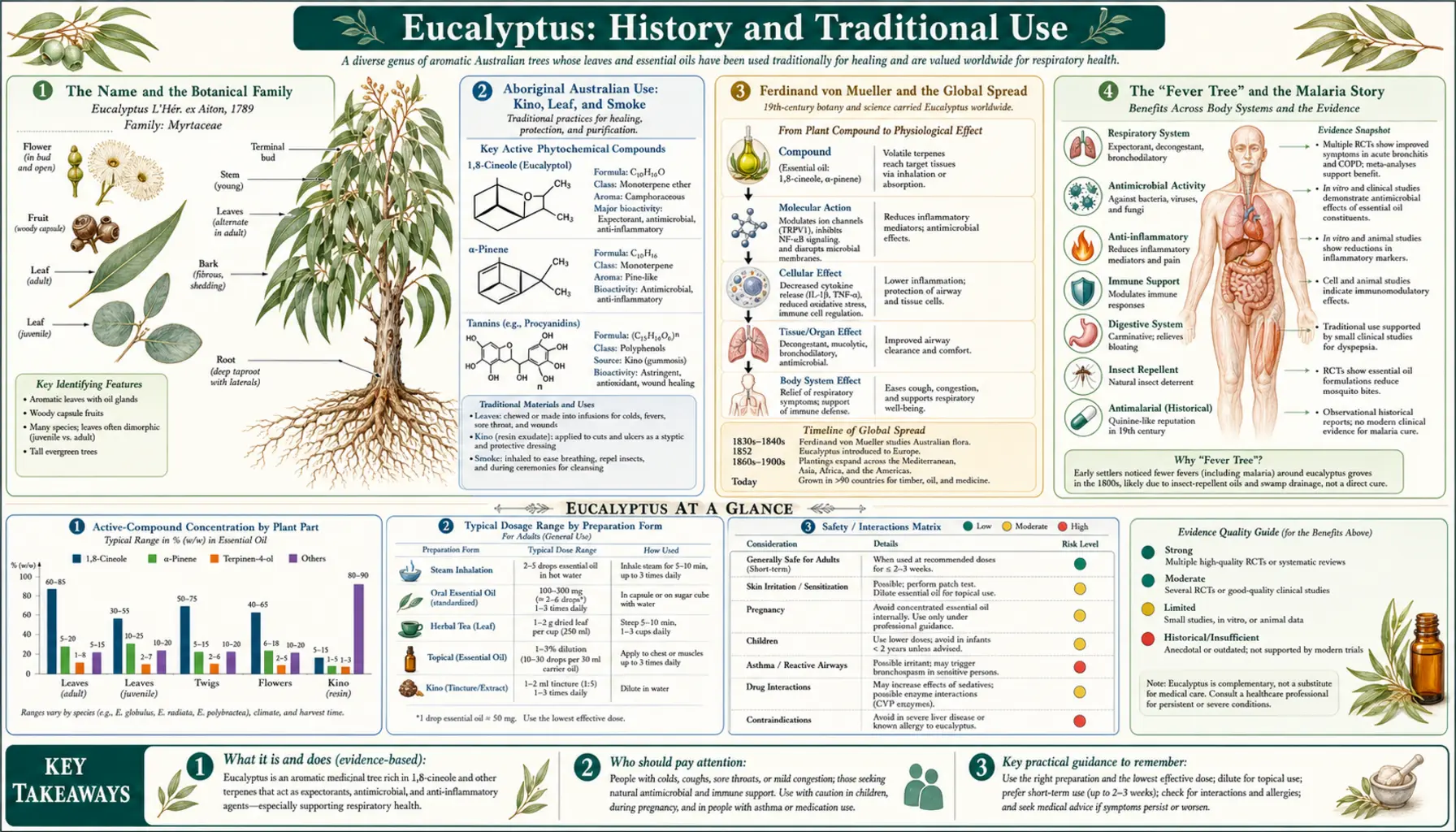
Few trees have travelled so far from home as the eucalyptus. For tens of thousands of years it was an Australian plant known only to Aboriginal peoples, who used its sticky red gum, its leaves, and its smoke as medicine. Then, in the space of a single century, it spread to nearly every warm corner of the earth — planted to "cure" malaria, distilled into the first uniquely Australian export product, and reduced in a Paris laboratory to a single fragrant molecule that still flavours your mouthwash and clears your blocked nose today. This article traces that documented journey honestly: where the historical record is firm we say so, and where a claim is really tradition, folklore, or a well-meant nineteenth-century mistake, we name it as such.
Table of Contents
- The Name and the Botanical Family
- Aboriginal Australian Use: Kino, Leaf, and Smoke
- Ferdinand von Mueller and the Global Spread
- The "Fever Tree" and the Malaria Story
- Joseph Bosisto and the First Eucalyptus-Oil Industry
- Cloez, Eucalyptol, and the Birth of the Chemistry
- Eucalyptus in Western Medicine and the Pharmacopoeias
- From Tradition to Modern Research
- Research Papers and References
- Connections
- Featured Videos
The Name and the Botanical Family
Eucalyptus is a large genus of evergreen trees and shrubs in the myrtle family (Myrtaceae), overwhelmingly native to Australia, with a handful of species reaching nearby islands. The genus is enormous — several hundred species — and several of its members are among the tallest flowering plants on earth. The plant most people mean by "eucalyptus" in a medicinal context, and the species at the centre of this site's Eucalyptus pages, is Eucalyptus globulus, commonly called the southern blue gum.
The name itself is young by the standards of a plant used for millennia. The genus Eucalyptus was formally established in 1789 by the French botanist Charles Louis L'Héritier de Brutelle, who published it in his work Sertum Anglicum. He based the genus on a specimen of stringybark — the species now called Eucalyptus obliqua — that had been collected on Bruny Island, off Tasmania, during one of Captain Cook's Pacific voyages and sent to the British Museum. E. obliqua remains the type species for the entire genus. L'Héritier coined the name from the Greek eu, "well," and kalyptos, "covered" — a reference to the little cap, or operculum, that covers the flower bud and is pushed off when the flower opens. (Sertum Anglicum was issued in parts, and a few sources date this fascicle to late 1788; the standard botanical authorities cite 1789.)
The blue gum acquired its own name a little later. Eucalyptus globulus was formally described in 1800 by the French naturalist Jacques Labillardière; the species epithet globulus is Latin for "a little ball," describing the small, rounded seed capsule. The tree is endemic to south-eastern Australia — chiefly Tasmania, Victoria, and parts of New South Wales — and it is the species that nineteenth-century enthusiasts would carry to Europe, Africa, Asia, and the Americas. Its high content of the aromatic compound that gives the leaves their sharp, clean scent made it, almost by accident, the eucalyptus the wider world came to know.
Aboriginal Australian Use: Kino, Leaf, and Smoke
Long before any botanist named it, eucalyptus was woven into the medicine of Aboriginal Australians, who had lived alongside these trees for tens of thousands of years. The ethnobotanical record — gathered from oral tradition, early colonial observation, and later anthropological work — describes several consistent uses, and it is fair to say that eucalyptus is one of the best-known plants in traditional Aboriginal healing. As always with such records, these describe documented cultural practice across many distinct nations, not a single uniform "recipe," and they are not modern medical recommendations.
The most distinctive traditional remedy is kino — the dark-red, astringent gum that oozes and dries on the trunks of many eucalypts (and the closely related Corymbia bloodwoods). Rich in tannins, this resin was applied to cuts, sores, and ulcers and used as a wash or gargle for sore throats; documented uses across different nations and tree species also include treating diarrhoea and other complaints. The high tannin content gives kino a genuinely astringent, drawing quality, which is the practical basis of its reputation as a wound dressing.
Eucalyptus leaves and bark were the other mainstay. Infusions and decoctions of the crushed leaves were taken or used as washes for fevers, colds, chills, sore throats, and chest and body pains, and crushed leaves were applied to wounds. The aromatic leaves were also burned, and the smoke inhaled or used to fumigate a sick person or a living space — a practice consistent with the airborne aromatic compounds the leaves release when heated. It is from this deep well of Aboriginal practice — eucalyptus as a fever remedy and antiseptic — that nineteenth-century Europeans first learned to take the plant seriously, a debt that the later medical and commercial story rarely acknowledged.
Ferdinand von Mueller and the Global Spread
The single person most responsible for turning eucalyptus from an Australian curiosity into a global plant was Ferdinand von Mueller (1825–1896), a German-born botanist who emigrated to Australia and was appointed Government Botanist of the colony of Victoria in 1853 — a post he would hold until his death more than four decades later. From 1857 to 1873 he also directed the Royal Botanic Gardens in Melbourne. Mueller was a tireless describer and promoter of the Australian flora, and he became eucalyptus's great evangelist.
Mueller made the qualities of the blue gum, E. globulus, known across the world and worked to introduce it abroad, succeeding most famously in the south of Europe. He exported eucalyptus seed to countries including India, Algeria, and California, and he actively argued that the fast-growing trees could improve unhealthy "fever districts." Through his correspondence and seed distribution, blue-gum plantations were established around the Mediterranean, in North and East Africa, in India, and in the Americas within a remarkably short span of years. By the closing decades of the nineteenth century the once-isolated Australian tree had become one of the most widely planted hardwoods on earth.
Mueller's enthusiasm had a scientific side as well as a promotional one: he encouraged others to investigate the medicinal and commercial potential of the oil (see the sections on Joseph Bosisto and on eucalyptol below), and in 1878 he repaid one chemist's work by naming a eucalyptus species, Eucalyptus cloeziana, after him. But the most famous claim Mueller and his contemporaries made for the tree — that it could fight malaria — deserves a careful, honest look.
The "Fever Tree" and the Malaria Story
In the nineteenth century eucalyptus earned the nickname the "fever tree," especially in Africa and in malaria-prone regions of southern Europe, California, and elsewhere. The reputation rested on a widely held belief that planting blue gums in or around marshy ground reduced outbreaks of malaria. This is one of those historical claims that is true in a narrow, accidental way and false in the way most people understood it at the time — and it is worth getting right.
At the time, malaria (the name literally means "bad air") was blamed on miasma: foul, disease-carrying vapours believed to rise from swamps and rotting matter. On that mistaken theory, the strongly aromatic eucalyptus was thought to purify or neutralise the dangerous air directly — and it was promoted, including in places like California in the 1870s and 1880s, on exactly that reasoning. We now know the miasma theory was wrong: malaria is caused by blood parasites transmitted by the bite of Anopheles mosquitoes, a discovery that overturned the old "bad air" idea in the late nineteenth century.
So why did planting eucalyptus sometimes seem to help? Where it had any real effect, the mechanism was mundane and physical, not medicinal: blue gums grow fast and drink enormous quantities of water, and large plantings could help dry out swampy land — draining the standing water where mosquitoes breed. Fewer mosquito breeding grounds can mean fewer mosquitoes and therefore less malaria. Even this effect was modest and often overstated, and it had nothing to do with the tree's aroma or with any antibacterial property of its oil. The honest summary is this: the "fever tree" story is a real and revealing piece of medical history, but eucalyptus never cured or prevented malaria as a medicine. Its genuine, well-documented medicinal niche — soothing coughs, congestion, and sore throats — lies elsewhere, and it is covered in the companion Eucalyptus Benefits articles.
Joseph Bosisto and the First Eucalyptus-Oil Industry
If Mueller spread the tree, it was a Yorkshire-born pharmacist named Joseph Bosisto (1824–1898) who turned its leaves into a product. Bosisto had trained as a chemist and druggist in England before emigrating to Australia, where he settled in Victoria and built up a successful pharmacy. Encouraged by Mueller to look into the commercial potential of eucalyptus, Bosisto began distilling the oil from local trees, and in 1852 he opened what is generally regarded as Australia's first commercial eucalyptus-oil distillery, at Dandenong Creek in Victoria, soon followed by others in the surrounding hill country.
The species Bosisto first distilled commercially was not the blue gum but a cineole-rich form of the narrow-leaved peppermint, Eucalyptus radiata — a useful reminder that "eucalyptus oil" has always been drawn from several species with differing chemistry. Bosisto was probably not the very first person ever to distil eucalyptus, but he is credited as the first to make it a genuine commercial enterprise, and eucalyptus oil holds an honoured place as one of the first distinctively Australian manufactured products to win a name for itself at home and abroad. The brand he founded, "Bosisto's," still survives today — an unusually direct living link back to the industry's very beginning.
From Bosisto's stills the oil entered the wider pharmacy trade. By the later nineteenth century steam-distilled eucalyptus oil was a familiar household and chemist's-shop item across the British Empire and beyond, valued as an inhalant for colds and chests, as a rub, and as an antiseptic — the practical, everyday face of a plant that the chemists were, at the very same moment, beginning to take apart molecule by molecule.
Cloez, Eucalyptol, and the Birth of the Chemistry
The scientific turning point in eucalyptus's story is one of the cleanest, best-documented milestones in the whole history of medicinal plants — the moment a vague "essential oil" was resolved into a named chemical compound. In 1870, the French chemist François Stanislas Cloez (1817–1883), working in Paris, identified the dominant constituent of Eucalyptus globulus oil and gave it the name eucalyptol — the substance chemists now more usually call 1,8-cineole. This is the molecule responsible for eucalyptus oil's characteristic sharp, cooling, camphor-like scent and for much of its medicinal activity, and it is the active ingredient measured and standardised in pharmaceutical eucalyptus preparations to this day.
Cloez was part of a broader nineteenth-century effort to sort out the chemistry of essential oils and classify them for medicinal, industrial, and perfumery use; his work on eucalyptus put a name and a structure to what had been folk knowledge and commercial empiricism. (The same compound had in fact been described decades earlier — in the early 1830s — in the related oil of cajuput, from the myrtle-family genus Melaleuca; Cloez's achievement was its clear identification and naming from eucalyptus itself.) His contribution was recognised by Ferdinand von Mueller, who in 1878 named the eucalyptus species Eucalyptus cloeziana in his honour — a quiet handshake between the botanist who spread the tree and the chemist who explained its oil.
Naming eucalyptol mattered far beyond chemistry. Once the active compound could be isolated, measured, and eventually purified, eucalyptus could move from the herbalist's shelf toward the standardised, dose-controlled world of modern pharmacy. The line runs directly from Cloez's 1870 flask to the purified-cineole capsules studied in twenty-first-century clinical trials. The detailed chemistry of these compounds — eucalyptol, alpha-pinene, limonene, and the rest — is covered on the main Eucalyptus page.
Eucalyptus in Western Medicine and the Pharmacopoeias
Armed with a name for its active principle and a ready commercial supply, eucalyptus oil settled into mainstream Western medicine in the late nineteenth and early twentieth centuries. This was the great age of antiseptic surgery — the era opened by Joseph Lister's carbolic-acid methods in the 1860s — and aromatic plant oils with germ-killing reputations were of intense practical interest. Eucalyptus oil was taken up as an antiseptic and inhalant, valued because it combined real antibacterial activity with relatively low tissue toxicity compared with the harsh phenol-based disinfectants of the day. It earned a place in the British Pharmacopoeia and in other national and colonial pharmacopoeias as a recognised medicinal substance.
The everyday medical roles of eucalyptus in this period are the ones still most familiar today: an inhalant for colds, blocked noses, and chesty coughs; a component of vapour chest-rubs and steam inhalations; an ingredient in throat lozenges; and a topical antiseptic and rubefacient. Its sharp, clean aroma and decongestant feel made it a natural fit for cold-and-cough products, and that association has never faded — eucalyptol remains a listed active ingredient in widely sold chest rubs and in antiseptic mouthwashes (it is one of the essential-oil components of the original Listerine formula, alongside thymol, menthol, and methyl salicylate).
It is worth being clear-eyed about what this long pharmacy tradition does and does not establish. It shows that eucalyptus oil was genuinely useful and genuinely valued — as a soothing inhalant and a mild antiseptic — not that it was ever a cure for serious infection. Then as now, the sensible role of eucalyptus is supportive comfort for ordinary respiratory complaints, and a complement to proper medical care rather than a replacement for it. And one hard safety lesson from this history endures: eucalyptus essential oil is toxic if swallowed, and serious and even fatal poisonings, particularly in children, have been recorded — it is for inhalation and (well-diluted) external use, never for drinking. The practical details of forms, dosage, and safety are set out on the main Eucalyptus page.
From Tradition to Modern Research
What is striking about eucalyptus is how neatly the old uses line up with what modern research has actually been able to test. For most of its history the plant was used for two broad things: to ease the lungs, nose, and throat, and to clean and protect wounds. Those are precisely the two areas where twentieth- and twenty-first-century science has concentrated — and where the strongest evidence sits with the single compound Cloez named in 1870.
The best modern evidence is for purified 1,8-cineole (eucalyptol) taken as a standardised oral capsule for respiratory conditions. Placebo-controlled randomised trials have studied cineole in acute rhinosinusitis, in bronchial asthma as an anti-inflammatory add-on, and in chronic obstructive pulmonary disease, where one trial reported fewer exacerbations. This is the direct scientific descendant of the traditional "clears the chest" reputation — the same idea, now measured against placebo with proper trial design. Separately, laboratory and review work continues on eucalyptus oil's antibacterial activity, including a systematic review of its effect against Staphylococcus aureus (MRSA) — the modern echo of the Aboriginal kino wound-wash and the Listerian antiseptic.
The honest bottom line of this whole history is encouraging but bounded. Eucalyptus is a genuinely useful medicinal plant with one of the better-documented active compounds in herbal medicine, and tradition pointed accurately at where its real value lies. But its reputation also collected some myths along the way — the "fever tree" malaria story chief among them — and its essential oil carries a real toxicity risk if misused. Tradition raised good questions; research has answered some of them well. The practical, evidence-based uses are taken up in detail in the Respiratory Health, Antimicrobial and Wound, Pain and Joint Relief, and Antifungal and Insect Repellent articles.
Research Papers and References
The list below combines key peer-reviewed sources with curated PubMed topic-search links into the historical, ethnobotanical, and clinical literature on eucalyptus. Author names, titles, and journals are given as plain text; only stable identifiers (DOI, PMID, or PubMed Central / PubMed links) are hyperlinked, and each opens in a new tab. Historical primary texts and the botanical naming records of L'Héritier (1789) and Labillardière (1800) are named in the article as historical sources rather than as modern citations.
- Eucalyptus Trees and Malaria (historical note). The Indian Medical Gazette. 1884;19(11):341. — PMID: 28999172 · PMC5166849
- Sadlon AE, Lamson DW. Immune-modifying and antimicrobial effects of Eucalyptus oil and simple inhalation devices. Alternative Medicine Review. 2010;15(1):33-47. — PMID: 20359267
- Juergens UR, Dethlefsen U, Steinkamp G, Gillissen A, Repges R, Vetter H. Anti-inflammatory activity of 1,8-cineol (eucalyptol) in bronchial asthma: a double-blind placebo-controlled trial. Respiratory Medicine. 2003;97(3):250-256. — PMID: 12645832
- Kehrl W, Sonnemann U, Dethlefsen U. Therapy for acute nonpurulent rhinosinusitis with cineole: results of a double-blind, randomized, placebo-controlled trial. The Laryngoscope. 2004;114(4):738-742. — PMID: 15064633
- Worth H, Schacher C, Dethlefsen U. Concomitant therapy with cineole (eucalyptole) reduces exacerbations in COPD: a placebo-controlled double-blind trial. Respiratory Research. 2009;10(1):69. — PMID: 19624838
- El-Shiekh RA, Atwa AM, Elgindy AM, Mustafa AM, Senna MM, et al. Therapeutic applications of eucalyptus essential oils. Inflammopharmacology. 2025;33(1):163-182. (Epub 2024 Nov 5.) — doi:10.1007/s10787-024-01588-8
- Elangovan S, Mudgil P. Antibacterial properties of Eucalyptus globulus essential oil against MRSA: a systematic review. Antibiotics. 2023;12(3):474. — doi:10.3390/antibiotics12030474
- Eucalyptus history, naming, and global spread — PubMed: Eucalyptus history, traditional medicine and ethnobotany
- Aboriginal Australian medicinal plant use and eucalypt kino — PubMed: Australian Aboriginal medicinal plants and Eucalyptus kino
- 1,8-cineole (eucalyptol) pharmacology and respiratory clinical trials — PubMed: 1,8-cineole respiratory clinical trials
External Authoritative Resources
- NCCIH — Herbs at a Glance
- MedlinePlus — Herbs and Supplements
- PubMed — All research on Eucalyptus globulus