Epimedium (Horny Goat Weed)
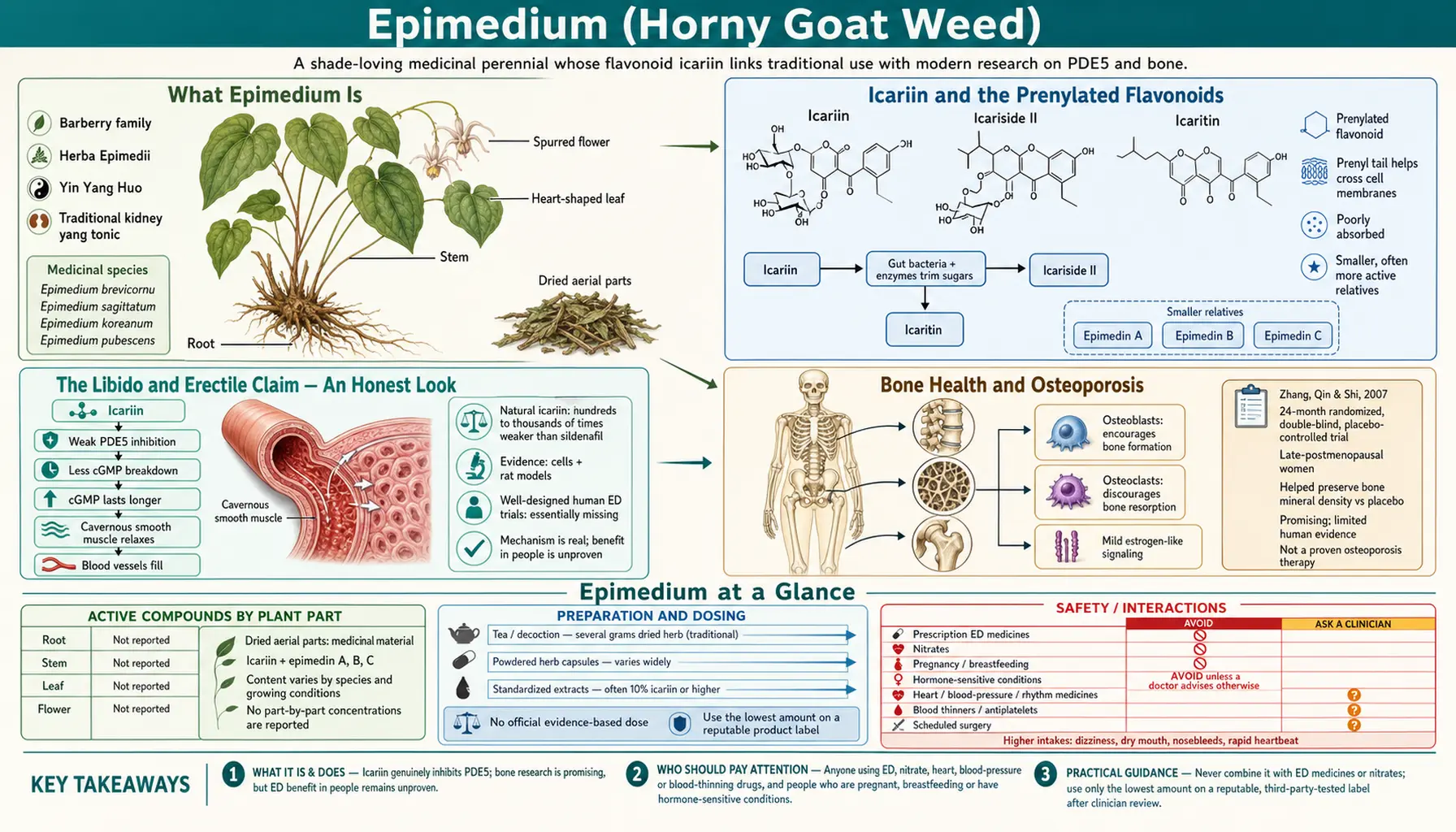
Epimedium is a group of shade-loving perennial plants better known in the West by a memorable folk name: horny goat weed. In traditional Chinese medicine it is called Yin Yang Huo and is one of the classic "kidney yang" tonics, used for centuries for fatigue, aging, and waning sexual vigor. Modern interest centers on a single flavonoid inside the plant — icariin — which, in the laboratory, gently blocks the very same enzyme (PDE5) that erectile-dysfunction drugs like sildenafil (Viagra) target. That real, measurable mechanism is why the herb earned its "natural Viagra" reputation.
This page tries to be honest about where the evidence is strong and where it is thin. The short version: the lab mechanism is genuine and interesting, the bone-health research is promising, but good human trials in erectile dysfunction are essentially missing — so the popular claim rests on cell and animal studies, not proven results in people. Just as important, because icariin acts a little like a mild version of an ED drug, this is one of those "natural" supplements where the safety and drug-interaction cautions matter, especially the rule against combining it with prescription ED medicines, nitrates, or heart and blood-pressure drugs. We will walk through all of it in plain language.
Table of Contents
- What Epimedium Is
- Icariin and the Prenylated Flavonoids
- The Libido and Erectile Claim — An Honest Look
- Bone Health and Osteoporosis
- Traditional Uses in Chinese Medicine
- Forms, Extracts, and Dosing
- Safety, Interactions, and Cautions
- Product Quality and Adulteration
- The Honest Bottom Line
- Research Papers
- Connections
- Featured Videos
What Epimedium Is
Epimedium is a genus of low, woodland perennials in the barberry family, with delicate, spurred flowers and heart-shaped leaves. Gardeners in the West grow several species — often as ground cover in shady spots — under the names barrenwort and bishop's hat. There are dozens of species; the ones most used medicinally include Epimedium brevicornu, Epimedium sagittatum, Epimedium koreanum, and Epimedium pubescens. Because the different species contain different amounts of the active flavonoids, the specific species and how a product is standardized both matter a great deal.
The colorful English name comes from an old bit of herbal folklore. A goatherd is said to have noticed that his flock became unusually frisky and eager to mate after grazing on the plant — hence "horny goat weed." Whether the story is literally true or simply a good tale, it captures how the herb has been understood for a very long time: as something that stirs sexual energy and vitality.
In traditional Chinese medicine the dried aerial parts of the plant, known as Herba Epimedii or Yin Yang Huo, are one of the major "kidney yang" tonics. In the older framework, the "kidney" governs vitality, reproduction, aging, and the health of bones and joints, and "yang deficiency" describes a pattern of coldness, tiredness, low libido, and weakness. Epimedium is a first-choice herb for that pattern. It is worth remembering that this traditional language is a system of pattern-recognition, not modern physiology — but it does point, interestingly, at the two areas where modern science has found the most: sexual function and bone.
Icariin and the Prenylated Flavonoids
Nearly all of the scientific attention on Epimedium comes down to one family of compounds. The star is icariin, a prenylated flavonoid — a plant pigment-type molecule with an extra fatty "prenyl" tail attached that helps it slip across cell membranes. Icariin is the marker compound that quality extracts are standardized to, much the way milk thistle products are standardized to silymarin.
Icariin does not travel alone. When you swallow it, gut bacteria and your own enzymes trim its attached sugars and convert it into smaller, often more active relatives — especially icariside II and icaritin. The plant also contains related flavonoids called epimedin A, B, and C. Researchers increasingly think several of these breakdown products, not just icariin itself, do much of the biological work in the body. This also explains a practical wrinkle: icariin on its own is poorly absorbed, so what actually reaches your bloodstream depends heavily on digestion and on how a product is formulated.
In test tubes and animal studies these flavonoids show a long list of effects — antioxidant activity, anti-inflammatory signaling, hints of bone-building and nerve-protective actions, and the PDE5-related activity discussed below. That breadth is genuinely interesting to scientists. It is also a caution: a molecule that touches many pathways in a dish has not been shown to safely do any one useful thing in a person until it is tested in people.
The Libido and Erectile Claim — An Honest Look
This is the reputation that sells the herb, so it deserves the most careful treatment.
The real mechanism
An erection depends on a signaling molecule called cyclic GMP (cGMP), which relaxes the smooth muscle of penile blood vessels so they can fill with blood. An enzyme named phosphodiesterase-5 (PDE5) breaks cGMP down and ends the erection. Sildenafil (Viagra), tadalafil (Cialis), and similar drugs work by blocking PDE5, so cGMP lasts longer. The striking finding is that icariin blocks the very same enzyme. Laboratory studies have measured icariin — and, more potently, chemically modified icariin derivatives — inhibiting human PDE5 and raising cGMP in cavernous smooth-muscle cells. This is a genuine, reproducible mechanism, and it is the honest scientific basis for the "natural Viagra" nickname.
Why the claim is far weaker than it sounds
Three things pull the reality back down to earth:
- Potency. In head-to-head lab comparisons, natural icariin is a much weaker PDE5 inhibitor than sildenafil — often on the order of hundreds to thousands of times weaker. The dramatic numbers you sometimes see come from synthetic icariin derivatives made in the lab, not from what is in a bottle of herb.
- Absorption. As noted, plain icariin is poorly absorbed, so the concentration that actually bathes the relevant tissue in a living person is far lower than the concentration used to inhibit the enzyme in a dish.
- Human trials are essentially missing. The impressive erection-related results come from cell studies and from rat models of nerve injury and diabetes. Well-designed, placebo-controlled clinical trials of Epimedium or icariin for erectile dysfunction in men are, at the time of writing, essentially lacking. There is animal and mechanistic promise, but not proof that it works in people.
So the fair summary is: the herb has a real, drug-like mechanism, but that mechanism has not been shown to translate into reliable results for actual erectile dysfunction. It is a plausible lead that has never been properly finished — not an established treatment. Anyone reaching for it as an alternative to a prescription should know they are betting on lab data, and should read the safety section below closely, because that same drug-like mechanism is exactly what makes combining it with real ED drugs dangerous.
Bone Health and Osteoporosis
The second major research area — and arguably the one with the better human evidence — is bone. This fits the traditional idea that Epimedium strengthens bones and joints.
In cell and animal studies, icariin and the broader Epimedium flavonoids tend to tip the balance toward building bone: they encourage bone-forming cells (osteoblasts) and discourage bone-dissolving cells (osteoclasts), and they show mild estrogen-like signaling that is relevant because falling estrogen after menopause is a main driver of bone loss. Reviews of the preclinical work describe fairly consistent pro-bone effects across many models.
Human data exist but are limited. The most cited trial is a two-year, randomized, double-blind, placebo-controlled study in late-postmenopausal women, in which an Epimedium-derived flavonoid preparation helped preserve bone mineral density compared with placebo. Additional trials, mostly from China, point in a similar direction. The honest caveats: the human studies are relatively few, several are of modest size or lower methodological quality, and many test proprietary flavonoid blends rather than a plain herb capsule — so results do not automatically transfer to whatever product is on a store shelf. The picture is promising, especially for postmenopausal bone density, but not yet strong enough to call Epimedium a proven osteoporosis therapy or a replacement for established treatments.
Traditional Uses in Chinese Medicine
Beyond libido and bone, Yin Yang Huo has a wider traditional role. Classical texts and modern TCM practice use it, usually in combination formulas rather than alone, for:
- Fatigue and low vitality attributed to "kidney yang deficiency" — a pattern of tiredness, cold limbs, and low drive.
- Sexual and reproductive complaints, including low libido, erectile difficulty, and some cases of infertility, in both men and women.
- Joint and bone problems, especially aching lower back and knees, and weakness associated with aging — the same domain where modern bone research has focused.
- General "warming" and tonifying in older adults, often blended with herbs such as Chinese foxglove, cornus, and others.
These uses are the origin of today's research questions, and it is genuinely notable that tradition and modern science converge on the same two themes — sexual function and bone. But traditional use is a source of hypotheses, not evidence of effectiveness, and traditional formulas are carefully combined and dose-adjusted by a trained practitioner in a way a single mass-market capsule is not.
Forms, Extracts, and Dosing
Epimedium is sold as dried herb for teas and decoctions, as powdered herb in capsules, and — most commonly in the supplement aisle — as standardized extracts labeled by their icariin content, often "standardized to 10% icariin" or higher. Because the raw plant's flavonoid content varies so much by species and growing conditions, a standardized extract is the only way to have any idea how much active compound you are taking. It is also frequently combined with maca, tribulus, L-arginine, or other "male vitality" ingredients in blended products, which makes it harder to know what is actually doing anything.
There is no official, evidence-based dose, because the human trials that would establish one have not been done for most uses. Traditional decoctions use several grams of dried herb; commercial extract capsules vary widely. Rather than quote a number that would imply a confidence the evidence does not support, the responsible guidance is: if you choose to try it, use the lowest amount on a reputable product's label, do not stack it with other stimulant or "vasodilator" supplements, and treat higher doses as riskier, not more effective — the cardiovascular cautions below become more relevant as the dose climbs. Anyone with a health condition or on medication should clear it with a doctor or pharmacist first.
Safety, Interactions, and Cautions
This is the most important section on the page. Epimedium is often marketed as gentle and "natural," but its drug-like mechanism and its hormonal activity create real cautions.
Do not combine it with ED drugs or nitrates
Because icariin acts — however weakly — on the same PDE5 pathway as sildenafil and tadalafil, stacking Epimedium on top of a prescription ED drug could add to the effect on blood vessels and blood pressure. Far more dangerous is combining any PDE5-type activity with nitrate medications (nitroglycerin and similar drugs for chest pain/angina): that combination can cause a severe, potentially life-threatening drop in blood pressure. Do not take Epimedium with prescription ED medicines or with nitrates.
Caution with heart, blood-pressure, and blood-thinning medications
Epimedium can affect blood vessels and, at high doses, has been linked to a racing or irregular heartbeat (see below). If you take blood-pressure medication, heart-rhythm drugs, or blood thinners/antiplatelet drugs, the herb could interact in unpredictable ways. Talk to your doctor or pharmacist before using it.
Rapid heartbeat and arrhythmia at high doses
There is a published case report of a man who developed a fast, irregular heartbeat and a manic-like mood change while taking horny goat weed. Case reports do not prove the herb caused the event, but combined with its cardiovascular mechanism they are a reasonable reason to be cautious — particularly at high doses and particularly if you have any heart condition.
Hormonal (estrogen-like) activity
Some of the same flavonoids that may help bone show mild estrogen-like activity. That raises a theoretical concern for anyone with a hormone-sensitive condition — certain breast, uterine, or ovarian cancers, endometriosis, or uterine fibroids. Until there is better safety data, people with those conditions should avoid Epimedium unless a doctor advises otherwise.
Pregnancy, breastfeeding, and other cautions
Avoid Epimedium in pregnancy and while breastfeeding — safety has not been established and the hormonal activity is a concern. It is also sensible to stop it well before any scheduled surgery given the blood-pressure and bleeding uncertainties. Reported side effects at higher intakes include dizziness, dry mouth, nosebleeds, and rapid heartbeat.
Product Quality and Adulteration
There is one more safety issue that is specific to this corner of the supplement market and important enough to stand on its own. "Natural" sexual-enhancement products — the category horny goat weed is sold into — have a documented history of being secretly spiked with real prescription drugs, most often sildenafil (Viagra) or its close chemical analogues, sometimes in uncontrolled amounts. Regulators including the U.S. FDA have issued numerous warnings about these "tainted sexual enhancement products," and analytical chemists have published methods specifically to detect hidden PDE5 inhibitors in supplements because the problem is so common.
This turns a low-risk herb into a potentially high-risk unknown. A consumer thinking they are taking a mild botanical could unknowingly ingest a full pharmaceutical dose of an ED drug — which is exactly the scenario that becomes dangerous for someone also taking nitrates or heart medication, or with heart disease. Practical protection: buy only from established brands that publish third-party testing, be deeply skeptical of any product promising drug-like or immediate results, and treat cheap "male enhancement" blends bought online or in gas stations as genuinely risky.
The Honest Bottom Line
Epimedium is a genuinely interesting herb. Unlike many folk remedies, it has a real, reproducible laboratory mechanism — its flavonoid icariin blocks the same PDE5 enzyme that Viagra targets — and that is the honest root of its "natural Viagra" fame. Its bone-health research is the more encouraging story, with at least one solid postmenopausal trial suggesting it may help preserve bone density.
But the enthusiasm has to be tempered by three facts: icariin is far weaker than the actual drug, it is poorly absorbed, and rigorous human trials for erectile dysfunction are essentially missing — so the sexual-performance claim rests on lab and animal data, not proof in people. Layer on top of that the meaningful cardiovascular-interaction cautions and the very real problem of products being spiked with hidden pharmaceuticals, and the picture becomes one to approach with respect rather than casual enthusiasm.
The sensible takeaway: this is not a proven fix for erectile dysfunction, and it is not risk-free. If you are considering it — and especially before combining it with any erectile-dysfunction drug, nitrate, or heart or blood-pressure medication — talk to a doctor or pharmacist first. If erectile dysfunction is the concern, remember that it is often an early warning sign of treatable heart or blood-vessel disease, which is a much better reason to see a physician than to self-treat with a supplement of uncertain contents.
Research Papers
- Dell'Agli M, Galli GV, Dal Cero E, et al. Potent inhibition of human phosphodiesterase-5 by icariin derivatives. Journal of Natural Products. 2008;71(9):1513–1517. doi:10.1021/np800049y — the key study showing icariin (and, more strongly, modified derivatives) inhibits the human PDE5 enzyme, the same target as sildenafil.
- Ning H, Xin ZC, Lin G, et al. Effects of icariin on phosphodiesterase-5 activity in vitro and cyclic guanosine monophosphate level in cavernous smooth muscle cells. Urology. 2006;68(6):1350–1354. doi:10.1016/j.urology.2006.09.031 — demonstrated that icariin inhibits PDE5 and raises cGMP in penile smooth-muscle cells, the mechanistic basis of the erectile claim.
- Shindel AW, Xin ZC, Lin G, et al. Erectogenic and neurotrophic effects of icariin, a purified extract of horny goat weed (Epimedium spp.) in vitro and in vivo. The Journal of Sexual Medicine. 2010;7(4 Pt 1):1518–1528. doi:10.1111/j.1743-6109.2009.01699.x — a leading laboratory/animal study; positive in cells and rats but notably not a human erectile-dysfunction trial.
- Ma H, He X, Yang Y, et al. The genus Epimedium: an ethnopharmacological and phytochemical review. Journal of Ethnopharmacology. 2011;134(3):519–541. doi:10.1016/j.jep.2011.01.001 — broad review of the plant's traditional uses, species, and chemistry, including icariin and the epimedins.
- Li C, Li Q, Mei Q, Lu T. Pharmacological effects and pharmacokinetic properties of icariin, the major bioactive component in Herba Epimedii. Life Sciences. 2015;126:57–68. doi:10.1016/j.lfs.2015.01.006 — reviews icariin's many reported effects and, importantly, its poor absorption and conversion to active metabolites.
- Zhang G, Qin L, Shi Y. Epimedium-derived phytoestrogen flavonoids exert beneficial effect on preventing bone loss in late postmenopausal women: a 24-month randomized, double-blind and placebo-controlled trial. Journal of Bone and Mineral Research. 2007;22(7):1072–1079. doi:10.1359/jbmr.070405 — the most-cited human trial: an Epimedium flavonoid preparation helped preserve bone density versus placebo.
- Indran IR, Liang RLZ, Min TE, Yong EL. Preclinical studies and clinical evaluation of compounds from the genus Epimedium for osteoporosis and bone health. Pharmacology & Therapeutics. 2016;162:188–205. doi:10.1016/j.pharmthera.2016.01.015 — weighs the promising but still limited bone evidence for Epimedium flavonoids.
- Wang Z, Wang D, Yang D, et al. The effect of icariin on bone metabolism and its potential clinical application. Osteoporosis International. 2018;29(3):535–544. doi:10.1007/s00198-017-4255-1 — reviews how icariin favors bone formation over resorption and where clinical use might fit.
- Chen M, Wu J, Luo Q, et al. The anticancer properties of Herba Epimedii and its main bioactive components icariin and icariside II. Nutrients. 2016;8(9):563. doi:10.3390/nu8090563 — surveys the (largely laboratory-stage) research on icariin and its metabolite icariside II.
- Patel DN, Li L, Kee CL, et al. Screening of synthetic PDE-5 inhibitors and their analogues as adulterants: analytical techniques and challenges. Journal of Pharmaceutical and Biomedical Analysis. 2014;87:176–190. doi:10.1016/j.jpba.2013.04.037 — documents how often "natural" sexual-enhancement supplements are secretly spiked with real PDE5 drugs like sildenafil.
- Partin JF, Pushkin YR. Tachyarrhythmia and hypomania with horny goat weed. Psychosomatics. 2004;45(6):536–537. doi:10.1176/appi.psy.45.6.536 — a case report of rapid, irregular heartbeat and a mood change linked to horny goat weed use, underscoring the cardiovascular caution.
- Human clinical evidence in erectile dysfunction (topic search): PubMed: Epimedium / icariin erectile dysfunction clinical trial — browse the current literature and note how sparse well-designed human ED trials remain.
Connections
- All Herbs
- Maca
- Ginseng
- Ashwagandha
- Fenugreek
- Ginkgo Biloba
- Reproductive Medicine
- Menopause
- Osteoporosis