Traditional Use in Chinese Medicine
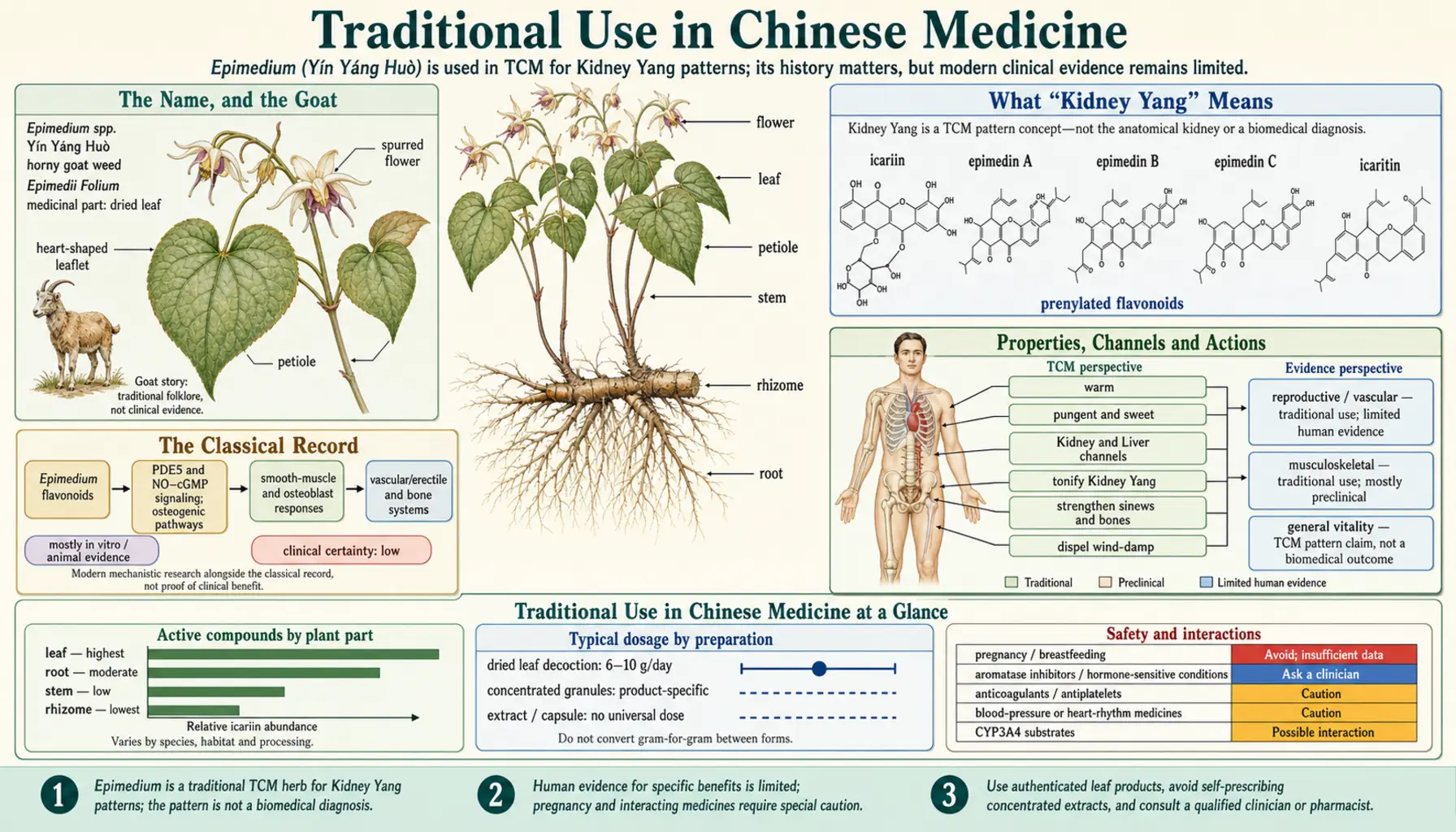
Before Epimedium was an enzyme assay it was a herb with a job, inside a system of medicine that had been describing that job for something close to two thousand years. Understanding that system does not tell you whether the herb works — traditional use is history, not evidence — but it tells you a great deal about how the herb was actually used, and that turns out to be sharply different from how a Western capsule is used.
Three differences matter most, and they run through everything below. Traditional practice never gives this herb alone; it gives it inside a formula. It never gives it to everybody; it gives it to people matching a specific pattern. And it does not give the raw leaf; it gives leaf that has been processed in a way that measurably changes the chemistry.
Table of Contents
- The Name, and the Goat
- What “Kidney Yang” Means
- The Classical Record
- Properties, Channels and Actions
- The Formulas It Lives Inside
- Processing: The Step Western Products Skip
- Which Species, and Why It Matters
- Where Tradition and Research Converge
- Traditional Dosing Versus a Western Capsule
- What Traditional Use Does and Does Not Prove
- Key Research Papers
- Connections
The Name, and the Goat
The Chinese name is 淫羊藿, yín yáng huò, and it is worth taking the characters apart because the translation is not a euphemism. 淫 yín means licentious or excessive. 羊 yáng is goat or sheep. 藿 huò refers to the leaves of a bean-like plant. Literally: licentious goat leaf. The English “horny goat weed” is not a marketing invention. It is an unusually faithful translation of a name the plant has carried for centuries.
The story behind it, as it is usually told, comes from classical commentary rather than from the earliest text. The version repeated in Chinese herbal literature and credited to the physician-alchemist Tao Hongjing (roughly 456–536 CE), and later carried into Li Shizhen’s Bencao Gangmu of 1596, describes goats in the north of Sichuan that mated many dozens of times in a day, an appetite attributed to their grazing on this leaf.
This is folklore. It is a story about how a plant got its name, recorded a thousand years after the plant entered the pharmacopoeia, in a genre where etymological anecdotes were routinely supplied after the fact. It is charming, it is genuinely old, and it is not data. No one has observed the phenomenon under controlled conditions, and modern livestock science has nothing to say about it. Having told it once, we can set it down: the Chinese medical tradition did not use this herb because of a goat, and neither should anyone else.
What “Kidney Yang” Means
Epimedium sits in the category of herbs that tonify yang (补阳药), and specifically kidney yang. Getting this concept right prevents most of the confusion Western readers have with the herb.
The “kidney” in Chinese medicine (肾 shèn) is not the anatomical organ. It is a functional system that traditional theory holds responsible for growth and development, reproduction and fertility, the ageing process, the health of bones and teeth, hearing, the lower back and knees, and the body’s deepest reserve of warmth and vitality. Within that system, yin is the cooling, moistening, substantial aspect, and yang is the warming, activating, functional aspect.
A person described as having kidney yang deficiency presents a recognisable picture: feeling cold, especially in the lower back, hips and legs; fatigue that rest does not fix; low libido, erectile difficulty or infertility; frequent pale urination or nocturia; aching or weak lower back and knees; loose stools in the early morning; a pale, swollen tongue and a deep, slow pulse.
Notice the two features that matter for reading the modern research. First, this is a syndrome, not a symptom — a constellation, and Epimedium was indicated for the constellation. Second, the constellation packages together exactly the two domains where modern research on this herb has concentrated: sexual function and bone. That is a real and interesting convergence, and it is discussed properly below.
The corollary is equally important. The tradition also identifies patterns where this herb is contraindicated — particularly yin deficiency with heat, a picture of night sweats, hot flushes, a dry red tongue and irritability. Giving a warming yang tonic to someone in that state was understood to make them worse. A supplement bottle that says “for men’s vitality” has thrown away the half of the traditional knowledge that told you who not to give it to.
The Classical Record
Yin yang huo appears in the Shennong Bencao Jing (神农本草经), the foundational Chinese materia medica compiled around the first to second century CE and attributed to the mythical Divine Farmer. That places its documented medical use at roughly two thousand years — a genuinely long record by any standard, and one of the reasons the herb continues to attract research funding in China.
Over the following centuries it accumulated synonyms that still appear on Chinese labels and in trial reports:
- 仙灵脾 xiān líng pí — “immortal spirit spleen,” the most common alternative name, and the reason the modern patent medicine Xianling Gubao carries that prefix.
- 刚前 gāng qián — an older name recorded in early texts.
- Herba Epimedii / Epimedii Folium — the pharmacopoeial Latin, and the terms you will see in Chinese-language research translated into English.
The ethnopharmacological literature has been reviewed thoroughly. The 2011 review in the Journal of Ethnopharmacology remains the standard English-language reference for the genus’s traditional uses, species and chemistry, and a 2024 systematic review does the same job specifically for Epimedium koreanum, including its toxicology.
Properties, Channels and Actions
Chinese materia medica describes each herb in a fixed vocabulary. For yin yang huo the standard description is:
| Category | Traditional description | What it signals in practice |
|---|---|---|
| Taste (味) | Acrid (辛), sweet (甘) | Acrid moves and disperses; sweet tonifies and harmonises |
| Nature (性) | Warm (温) | Adds warmth — hence unsuitable for heat patterns |
| Channels entered (归经) | Liver (肝), Kidney (肾) | Directs the action toward sinews (liver) and bones, reproduction and ageing (kidney) |
| Function 1 | 补肾阳 — tonify kidney yang | The core indication: coldness, fatigue, low libido, impotence, infertility |
| Function 2 | 强筋骨 — strengthen sinews and bones | Weak or aching lower back and knees; the bone research follows this line |
| Function 3 | 祛风湿 — dispel wind-damp | Joint pain, numbness and stiffness — the traditional rheumatological use |
| Typical dose | Roughly 3–15 g of dried leaf daily, decocted | Chinese pharmacopoeial guidance sits in the middle of that range |
The third function is the one Western marketing ignores completely. Epimedium has always been at least as much a joint and bone herb as a sexual one, and it appears in traditional formulas for bi syndrome — painful obstruction of the joints — alongside its use as a yang tonic.
The Formulas It Lives Inside
Chinese herbal medicine is a combinatorial art. Single herbs are rare; formulas are the unit of treatment, built so that some ingredients drive the effect, some direct it to a location, some moderate its harshness, and some counteract a side effect of the others. Epimedium is almost never given alone.
Er Xian Tang (二仙汤), “Two Immortals Decoction”
The most instructive example, and a modern one — it was devised in Shanghai in the 1950s, initially for menopausal hypertension and menopausal syndrome, and it is now among the most studied Chinese formulas in the menopause literature. Its six herbs are:
- Xian Mao (Curculigo orchioides) — warming yang tonic
- Xian Ling Pi / Yin Yang Huo (Epimedium) — warming yang tonic
- Ba Ji Tian (Morinda officinalis) — warming yang tonic
- Dang Gui (Angelica sinensis) — blood tonic
- Huang Bai (Phellodendron) — bitter, cold, clears heat
- Zhi Mu (Anemarrhena asphodeloides) — bitter, cold, clears heat and nourishes yin
The design is the point. Three warming yang tonics are deliberately balanced by two cold, yin-nourishing herbs. The formula is built for the menopausal picture in which a woman is simultaneously depleted and overheating — and the two cold herbs exist specifically to stop the three warm ones from making the hot flushes worse. Taking Epimedium alone, out of that architecture, discards the correction and keeps the problem.
Other traditional and modern contexts
- Zan Yu Dan (赞育丹), from Zhang Jingyue’s Jingyue Quanshu of 1624 — a large yang-tonifying formula for male impotence and infertility, in which Epimedium is one contributor among many.
- Xianling Gubao (仙灵骨葆) — a modern Chinese patent medicine built around Epimedium and marketed for osteoporosis and bone health, combining it with herbs including Dipsacus, Salvia miltiorrhiza, Anemarrhena, Psoralea and Rehmannia. It appears regularly in Chinese clinical studies, which is precisely why those studies cannot tell you what Epimedium does on its own.
- Yang-tonifying wines. A traditional preparation was to steep the leaf in rice wine — a genuinely different extraction, since alcohol pulls out flavonoids that water alone does not.
The methodological consequence is unavoidable and should shape how you read any Chinese trial of “Epimedium”: if the intervention was a multi-herb formula, the result belongs to the formula. Attributing it to Epimedium is an inference, not a finding.
Processing: The Step Western Products Skip
Chinese pharmacy treats paozhi (炮制), the processing of crude herbs, as part of the drug’s identity rather than as preparation. For Epimedium the classical method is 羊脂炙 (yáng zhī zhì) — stir-frying the leaf with rendered sheep or mutton fat until the fat is absorbed.
Traditional theory says this enhances the kidney-yang-tonifying action. Modern chemistry offers a mechanism that is at least suggestive: heating in the presence of fat is reported to hydrolyse some of icariin’s attached sugars, shifting the mixture toward icariside II and icaritin — the smaller, less-glycosylated, better-absorbed derivatives that human pharmacokinetic work identifies as the compounds actually reaching the bloodstream.
If that is right, it is a striking case of a pre-modern technique arriving at a real pharmacokinetic solution by trial and error. Researchers have taken it seriously enough that recent structural work on PDE5 inhibitors from this genus was done specifically on the prepared leaf of Epimedium sagittatum rather than the raw material.
Two cautions before this becomes a marketing claim. The chemical shift is documented in the phytochemical literature but has not been shown to change a clinical outcome in a person — no trial has compared processed against unprocessed leaf for any endpoint. And essentially no Western supplement uses processed leaf. Almost every capsule on an English-language shelf is raw-leaf extract standardised to icariin, which is to say standardised to the compound that does not survive digestion. Whatever the traditional preparation was doing, the Western product is not doing it.
Which Species, and Why It Matters
China’s pharmacopoeia recognises several Epimedium species as legitimate sources of the official drug, principally E. brevicornu, E. sagittatum, E. koreanum and E. pubescens. Others are used regionally.
This is treated as a substitution allowance, but the species differ meaningfully in their flavonoid profiles — different absolute amounts of icariin and different ratios of the epimedins. The research base does not respect the distinction either: the 2007 bone trial used material from E. brevicornu, the structural PDE5 work used E. sagittatum, and the 2024 toxicology review is specific to E. koreanum. Findings are routinely spoken of as though they applied to the genus.
For a reader, the practical translation is simple. A label that says only “horny goat weed” has told you the genus at best. A label that names Epimedium brevicornu or E. sagittatum and states an icariin percentage has told you something you can check against a study.
Where Tradition and Research Converge
Honest scoring, one row per traditional claim.
| Traditional indication | Modern status |
|---|---|
| Weak sinews and bones, aching lower back and knees | Partially supported. One 24-month randomised trial showed preserved bone mineral density in postmenopausal women — though the tested preparation also contained soy isoflavones |
| Impotence and low libido | Mechanism found, benefit unproven. Icariin inhibits PDE5 in vitro; no adequate human trial exists, and icariin is undetectable in blood after oral dosing |
| Infertility | Untested in humans. Some animal work on sperm and hormonal parameters; nothing clinical |
| Coldness, fatigue, low vitality | Untested. No controlled human trial has measured fatigue or energy with Epimedium alone |
| Wind-damp joint pain | Confounded. Studied only inside multi-herb formulas, where its own contribution cannot be isolated |
What is genuinely notable is that the tradition put bone and sexual function in the same category, under one organ system, centuries before anyone knew what a flavonoid was — and those are the two domains modern research went looking in. That is a point in favour of traditional observation as a source of hypotheses. It is not a point in favour of any specific product working.
Traditional Dosing Versus a Western Capsule
| Traditional decoction | Typical Western capsule | |
|---|---|---|
| Material | Dried leaf, often fat-fried | Raw-leaf extract, standardised to icariin |
| Amount | Roughly 3–15 g of leaf daily | 250–1,000 mg of extract, strength usually unstated |
| Preparation | Boiled 20–40 minutes in water, often with the other formula herbs together | Swallowed dry |
| Combination | Always in a formula of 4–12 herbs, several of which exist to moderate it | Alone, or blended with maca, tribulus and L-arginine for marketing rather than theory |
| Selection | Prescribed to a diagnosed pattern; withheld from heat patterns | Sold to anyone who reaches the shelf |
| Duration | Reassessed and adjusted, typically over weeks | Taken indefinitely |
These are not the same intervention. When someone says “this herb has been used safely for two thousand years,” the two thousand years belong to the left column. The right column is a few decades old and has never been evaluated on its own terms.
What Traditional Use Does and Does Not Prove
Two thousand years of use is a real thing, and it deserves neither dismissal nor over-reading.
What it does establish. That the plant was worth the trouble of harvesting, processing and trading over a very long period — economies do not sustain useless commodities for two millennia. That gross, acute toxicity at traditional doses is unlikely; something that poisoned people reliably would have been dropped. And that there is a defined body of practical knowledge about who it suited, what it combined with and how it was prepared.
What it does not establish. That it works for any specific condition. Pre-modern medicine had no way to detect a modest effect, no control group, no blinding, and no method for separating a treatment’s action from the natural history of an illness or from expectation. Traditions everywhere sustained treatments we now know were inert or harmful, for centuries, with complete conviction. Longevity of use selects for plausibility, availability and cultural fit at least as strongly as for efficacy.
And what it specifically cannot cover. Traditional use says nothing about long-term daily consumption of a concentrated extract by a person also taking antihypertensives and an anticoagulant, which is the actual modern exposure. It says nothing about drug interactions, because there were no drugs. It says nothing about the liver-injury reports that have accumulated in the modern Chinese pharmacovigilance literature, which are a product of scale, standardisation and monitoring that no earlier era possessed. And it certainly says nothing about a capsule spiked with sildenafil.
If you want to use this herb the way the tradition used it, the coherent route is to see a properly trained practitioner of Chinese medicine, be assessed for a pattern, and receive it inside a formula built for you — while telling your regular doctor what you are taking. Buying a bottle labelled “horny goat weed” is not traditional Chinese medicine. It is a Western supplement wearing a Chinese name.
Key Research Papers
Each identifier below was verified live against NCBI E-utilities — first author, title, journal and year all had to match. Claims about classical texts and traditional theory are historical statements drawn from the standard ethnopharmacological reviews below, not clinical findings.
Ethnopharmacology and the traditional record
- Ma H, He X, Yang Y, et al. The genus Epimedium: an ethnopharmacological and phytochemical review. Journal of Ethnopharmacology. 2011;134(3):519–541. The standard English-language reference for traditional uses, species and constituents.
- Qian HQ, et al. A systematic review of traditional uses, phytochemistry, pharmacology and toxicity of Epimedium koreanum Nakai. Journal of Ethnopharmacology. 2024;318(Pt B):116957. Species-specific, and unusually explicit about toxicity.
- Li C, Li Q, Mei Q, Lu T. Pharmacological effects and pharmacokinetic properties of icariin, the major bioactive component in Herba Epimedii. Life Sciences. 2015;126:57–68.
Processing, chemistry and preparation
- Fang Y, et al. Mechanistic study of PDE5A inhibitors from the prepared folium of Epimedium sagittatum Maxim. Journal of Structural Biology. 2026;218(1):108279. Notably performed on the processed leaf, the traditional form of the drug.
- Ding Z, Chen X, Tang D, et al. Comparisons of the bioavailability of icariin, icariside II, and epimedin C in rats after oral administration of total flavonoids of Epimedium brevicornu Maxim. and its three formulations. Journal of Pharmaceutical and Biomedical Analysis. 2025;255:116631. Formulation changes what reaches the blood.
- Yong EL, Cheong WF, Huang Z, Thu WPP, Cazenave-Gassiot A, Seng KY, Logan S. Randomized, double-blind, placebo-controlled trial to examine the safety, pharmacokinetics and effects of Epimedium prenylflavonoids, on bone specific alkaline phosphatase and the osteoclast adaptor protein TRAF6 in post-menopausal women. Phytomedicine. 2021;91:153680. The human data showing icariin does not survive to the bloodstream — the pharmacokinetic reason processing may matter.
Where the traditional indications were tested
- Zhang G, Qin L, Shi Y. Epimedium-derived phytoestrogen flavonoids exert beneficial effect on preventing bone loss in late postmenopausal women: a 24-month randomized, double-blind and placebo-controlled trial. Journal of Bone and Mineral Research. 2007;22(7):1072–1079. The bone-and-sinew indication, put to the test.
- Indran IR, Liang RLZ, Min TE, Yong EL. Preclinical studies and clinical evaluation of compounds from the genus Epimedium for osteoporosis and bone health. Pharmacology & Therapeutics. 2016;162:188–205.
- Dell’Agli M, Galli GV, Dal Cero E, Belluti F, Matera R, Zironi E, Pagliuca G, Bosisio E. Potent inhibition of human phosphodiesterase-5 by icariin derivatives. Journal of Natural Products. 2008;71(9):1513–1517. The impotence indication, screened against a modern target — and the only one of four traditional aphrodisiacs tested that showed any activity.
- Meng C, Jiang R. Molecular mechanisms of icariin in the treatment of erectile dysfunction. Sexual Medicine Reviews. 2026;14(3):qeag051.
Safety in the modern era
- Wang J, Cao Y, Sun M, et al. Integrating metabolomics and bioinformatics to reveal the mechanism of Epimedium-induced liver injury. Biomedical Chromatography. 2024;38(9):e5948.
- Partin JF, Pushkin YR. Tachyarrhythmia and hypomania with horny goat weed. Psychosomatics. 2004;45(6):536–537.
Live PubMed Searches
- Herba Epimedii in traditional Chinese medicine
- Er Xian Tang (Two Immortals Decoction)
- Xianling Gubao
- Kidney yang deficiency syndrome
- Paozhi — herbal processing
- Epimedium species and chemical profiles
- Epimedins A, B and C
- Chinese patent medicines for osteoporosis
Connections
- All Herbs
- Epimedium Benefits — hub
- Epimedium (Horny Goat Weed)
- Bone Density and Menopause
- Sexual Function and the Icariin PDE5 Question
- Ginseng — another classical tonic
- Astragalus
- Tongkat Ali
- Maca