⚠ Evidence warning: Clinical trials or other evidence do not support the claim that Lion's Mane helps perimenopausal and postpartum mood and adds benefit on top of SSRI antidepressants or standard depression care. This page keeps it as a report of what people, websites or other media say.
Lion's Mane for Mood and Depression
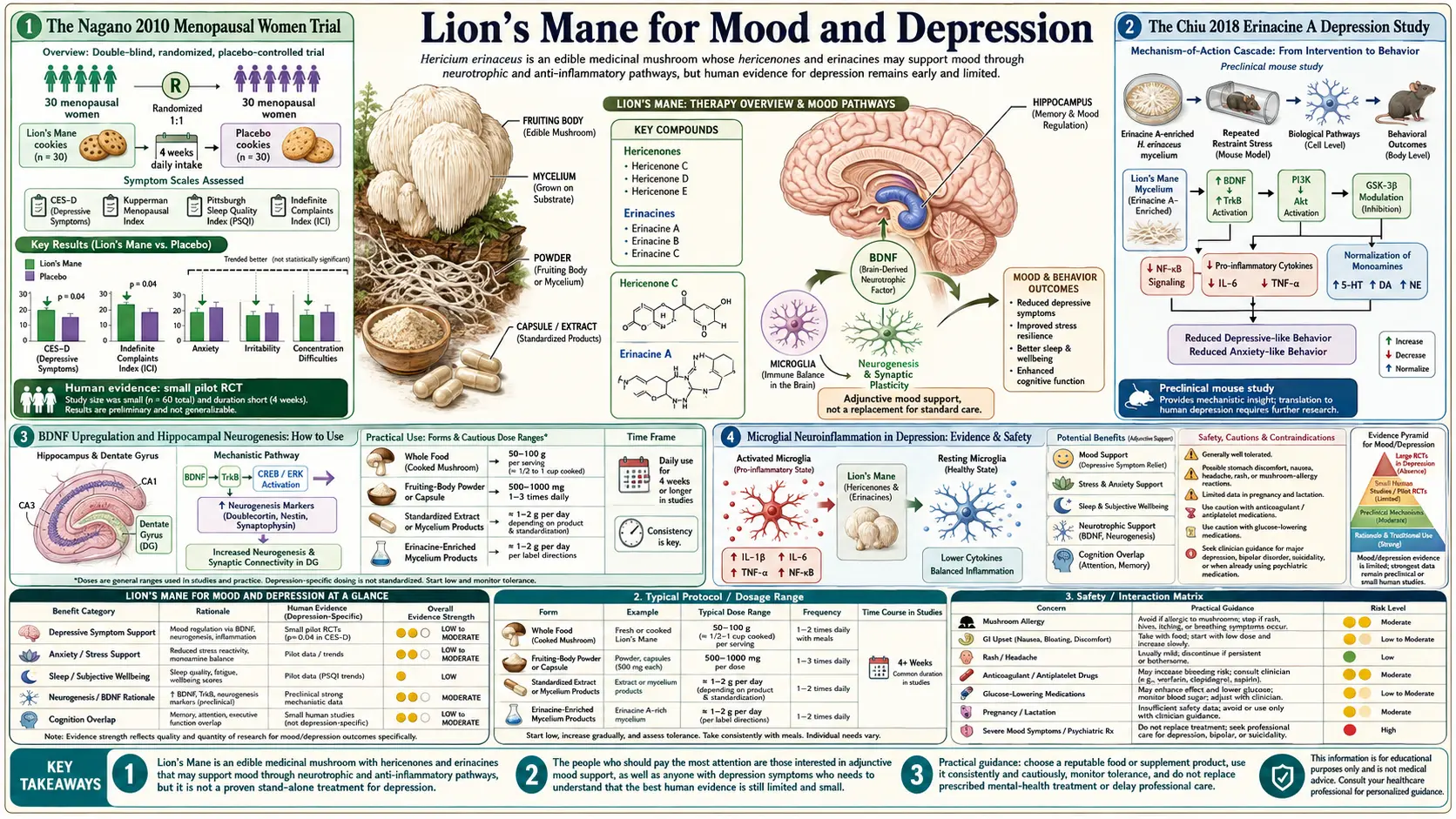
Lion's Mane has emerged in the last fifteen years as one of the most interesting natural candidates for depression and anxiety, distinct from herbal antidepressants like St. John's Wort or saffron because its mechanism converges on the same hippocampal neurotrophin and neuroinflammation pathways that contemporary depression research increasingly implicates in major depressive disorder. The pivotal human evidence is the Nagano 2010 trial in 30 Japanese women aged 41.3 years on average with non-specific complaints, in which Center for Epidemiologic Studies Depression scale and Indefinite Complaints Index scores fell within the Lion's Mane group after 4 weeks of Lion's Mane cookies, although the change in depression score did not differ significantly from placebo, followed by the Chiu 2018 erinacine-A-enriched mycelium depression study in mice and a small but growing list of follow-up pilots. The proposed mechanism is brain-derived neurotrophic factor (BDNF) upregulation, hippocampal neurogenesis, and reduction of microglial neuroinflammation — the same three molecular changes that ketamine, selective serotonin reuptake inhibitors (SSRIs), and exercise all produce. No trial has tested Lion's Mane as a replacement for prescribed antidepressants in moderate-to-severe major depression, or as an add-on to them.
Table of Contents
- The Nagano 2010 Trial in Women With Non-Specific Complaints
- The Chiu 2018 Erinacine A Depression Study
- Brain-Derived Neurotrophic Factor Upregulation and Hippocampal Neurogenesis
- Microglial Neuroinflammation in Depression
- The Vigna 2019 Overweight/Obesity Mood Trial
- Comparison to Selective Serotonin Reuptake Inhibitors
- Indefinite Complaints and the Midlife Mood Context
- Anxiety, Stress, and Sleep
- Newer Trials in Healthy Young Adults
- Postpartum and Perimenopausal Applications
- Dose, Form, and Expected Timeline
- Cautions and the Limits of the Evidence
- Key Research Papers
- Connections
- Featured Videos
The Nagano 2010 Trial in Women With Non-Specific Complaints
The foundational human mood trial of Lion's Mane is Nagano M et al. (2010), "Reduction of depression and anxiety by 4 weeks Hericium erinaceus intake," published in Biomedical Research. The design was a randomized, double-blind, placebo-controlled trial in 30 Japanese women aged 41.3 ± 5.6 years with a variety of non-specific ("indefinite") complaints and no specified diseases. They were not selected as menopausal, and 26 were analysed (12 on Lion's Mane, 14 on placebo). Key features:
- Intervention: Cookies containing 0.5 g of Lion's Mane fruit-body powder each — four cookies per day (2 g/day total Lion's Mane), consumed daily for 4 weeks
- Control: Identical-appearance placebo cookies without Lion's Mane
- Primary outcomes: Center for Epidemiologic Studies Depression Scale (CES-D), Indefinite Complaints Index (a validated Japanese instrument measuring non-specific symptoms including irritability, sleep, concentration, and somatic complaints); the trial also used the Kupperman Menopausal Index and the Pittsburgh Sleep Quality Index (PSQI)
Depression (CES-D) and Indefinite Complaints Index scores fell within the Lion's Mane group after 4 weeks (P = 0.033 and P = 0.004), but the change in depression score did not differ significantly from placebo. Two items of the complaints index, palpitation and loss of drive ("incentive"), improved more than on placebo (P = 0.032 and P = 0.047); irritability, anxiety and concentration showed only non-significant trends. Sleep quality (PSQI) did not differ between the two groups.
The trial was small (30 participants enrolled, 26 analysed) and short (4 weeks of supplementation), the cookie-delivery format makes precise dosing harder to verify, and most of its results were changes within the Lion's Mane group rather than differences from placebo. It remains the most cited human mood trial of Lion's Mane.
The 4-week duration is notable because it is shorter than the 8-12 week onset for cognitive effects in the Mori 2009 mild cognitive impairment (MCI) trial. This may reflect that mood effects manifest faster than cognitive effects (which require accumulated neurotrophic support of vulnerable neurons), or it may reflect the specific population (women in their early 40s with relatively mild complaints rather than established major depressive disorder) responding faster than older adults with structural cognitive impairment.
The Chiu 2018 Erinacine A Depression Study
Chiu CH et al. (2018), "Erinacine A-enriched Hericium erinaceus mycelium produces antidepressant-like effects through modulating BDNF/PI3K/Akt/GSK-3-beta signaling in mice," published in the International Journal of Molecular Sciences, established the mechanistic case for Lion's Mane as a depression intervention with molecular precision.
The Chiu group gave mice 100, 200 or 400 mg/kg a day of an erinacine-A-enriched Hericium erinaceus mycelium extract by mouth for four weeks; after the first two weeks, all mice except the control group were stressed by 14 days of repeated restraint. Depression-like behavior was assessed using two validated rodent depression assays:
- Forced swim test (FST) — mice are placed in a beaker of water and the time spent immobile (vs actively swimming) is measured. Antidepressants reduce immobility time; restraint stress lengthened immobility, and Lion's Mane reversed that increase.
- Tail suspension test (TST) — mice are suspended by the tail and immobility time is measured. Antidepressants reduce immobility; Lion's Mane reversed the stress-induced increase in immobility.
The extract also reversed the stress-induced fall in the brain messengers serotonin, dopamine and norepinephrine, and the stress-induced rise in the inflammatory signals interleukin-6 and tumor necrosis factor-alpha, especially at 200 or 400 mg/kg a day, and it blocked NF-kappaB inflammatory signalling.
The molecular analysis was the most important contribution. The Chiu group found that erinacine-A-enriched mycelium produced the following changes in mouse hippocampal tissue:
- Increased brain-derived neurotrophic factor protein expression in the hippocampus
- Increased tropomyosin receptor kinase B (TrkB, the brain-derived neurotrophic factor receptor)
- Increased phospho-Akt (downstream survival signaling)
- Restored phospho-GSK-3-beta after its stress-induced fall (the phosphorylated form is the inactive form of the enzyme, consistent with reduced apoptotic signaling; GSK-3-beta is a target of lithium and several mood stabilizers)
This mechanistic profile — brain-derived neurotrophic factor/TrkB/Akt upregulation — closely resembles the molecular signature of effective conventional antidepressants. Ketamine (the fastest-acting antidepressant in clinical use) produces a similar profile via a different upstream pathway (N-methyl-D-aspartate-receptor blockade releasing glutamate burst). Selective serotonin reuptake inhibitors produce a similar profile via gradual postsynaptic adaptation after sustained serotonin transporter inhibition. Exercise produces a similar profile via systemic effects on neurotrophin signaling. All converge on hippocampal brain-derived neurotrophic factor and neurogenesis as the common final mechanism.
That Lion's Mane — a dietary mushroom — reaches the same molecular endpoint through hericenone and erinacine signaling on astrocyte/neuron nerve growth factor (NGF)/BDNF synthesis is the most biologically interesting feature of this whole research program.
Brain-Derived Neurotrophic Factor Upregulation and Hippocampal Neurogenesis
Brain-Derived Neurotrophic Factor (BDNF) is the most studied neurotrophin in depression research. The "neurotrophic hypothesis of depression," developed by Eric Nestler and Ronald Duman in the late 1990s and 2000s, holds that chronic stress and major depression are associated with reduced hippocampal brain-derived neurotrophic factor and reduced hippocampal volume on magnetic resonance imaging (MRI), and that effective antidepressant treatment (selective serotonin reuptake inhibitors, ketamine, electroconvulsive therapy (ECT), exercise, behavioral activation) restores brain-derived neurotrophic factor and hippocampal neurogenesis over weeks of treatment.
The key supporting observations:
- Major depression is associated with reduced hippocampal volume on magnetic resonance imaging (Sheline et al. 1996 and subsequent replications). The reduction correlates with chronicity of depression.
- Suicide victims who were not taking psychotropic drugs show reduced brain-derived neurotrophic factor protein in postmortem hippocampal and prefrontal tissue (Karege et al. 2005, 30 suicide victims and 24 controls, and replications).
- Chronic stress in animal models reduces hippocampal brain-derived neurotrophic factor, reduces dendritic complexity, and reduces adult hippocampal neurogenesis — all reversible by antidepressant treatment.
- Genetic or pharmacological blockade of adult hippocampal neurogenesis blocks the behavioral effects of selective serotonin reuptake inhibitors in mouse depression models (Santarelli et al. 2003 in Science).
- Ketamine, the fastest-acting clinically used antidepressant, produces rapid brain-derived neurotrophic factor synthesis in the hippocampus and prefrontal cortex via N-methyl-D-aspartate-receptor-mediated glutamate burst.
Within this framework, Lion's Mane fits naturally as an intervention that would be expected to produce antidepressant effects via the canonical brain-derived neurotrophic factor/neurogenesis route. The hericenones and erinacines act on astrocytes and neurons to induce NGF and brain-derived neurotrophic factor transcription; sustained over weeks, this would be expected to drive hippocampal neurogenesis and synaptic plasticity, and to show behaviorally as improved mood, reduced anhedonia, and improved stress resilience.
The clinical question is the magnitude of the effect relative to other interventions. Exercise produces robust brain-derived neurotrophic factor elevation and is the best-validated lifestyle antidepressant. Selective serotonin reuptake inhibitors produce reliable but moderate antidepressant effects in major depression. Lion's Mane is a smaller magnitude than either based on current trial data. No trial has tested it together with antidepressants, or as a standalone alternative to evidence-based depression care.
Microglial Neuroinflammation in Depression
The second major contemporary depression framework, complementary to and partly overlapping with the brain-derived neurotrophic factor hypothesis, is the neuroinflammation hypothesis: that chronic low-grade activation of brain microglia (the resident immune cells of the brain) drives a subset of major depression, particularly the treatment-resistant subset.
Key observations supporting this:
- Patients with major depression show elevated peripheral inflammatory markers (C-reactive protein, interleukin-6 (IL-6), tumor necrosis factor-alpha) compared to non-depressed controls.
- Inflammatory medical conditions (rheumatoid arthritis, inflammatory bowel disease, post-viral states) carry significantly elevated depression risk.
- Interferon-alpha treatment (used for hepatitis C and some cancers) reliably induces depression in approximately 30% of treated patients, by a presumed neuroinflammatory mechanism.
- Positron emission tomography (PET) imaging of microglial activation (using translocator protein (TSPO) ligand tracers) shows elevated microglial activation in the cingulate cortex of depressed patients.
- Some antidepressant effects of conventional drugs may involve reduction of microglial activation and neuroinflammation in addition to monoamine effects.
Lion's Mane reduces microglial activation in animal models of neurodegeneration and aging. The Tsai-Teng 2016 study in APPswe/PS1dE9 mice (a mouse model of Alzheimer's disease) found fewer plaque-activated microglia and astrocytes in the cerebral cortex and hippocampus, a higher ratio of NGF to its precursor (proNGF) and more hippocampal neurogenesis, alongside improved daily-living skills. The Chiu 2018 erinacine-A depression study did not directly measure microglial activation, but it did measure inflammatory signals: the extract reversed the stress-induced rise in interleukin-6 and tumor necrosis factor-alpha and blocked NF-kappaB signalling, alongside Akt activation and GSK-3-beta inhibition.
This dual mechanism — brain-derived neurotrophic factor upregulation plus reduction of neuroinflammation — is the most plausible biological explanation for why Lion's Mane appears to produce mood benefit in both women with non-specific complaints (Nagano 2010) and animal depression models (Chiu 2018), with mechanisms that converge on the same hippocampal pathways implicated in major depression.
The Vigna 2019 Overweight/Obesity Mood Trial
Vigna L et al. (2019), "Hericium erinaceus improves mood and sleep disorders in patients affected by overweight or obesity," published in Evidence-Based Complementary and Alternative Medicine, extended the human evidence to a second population.
The Vigna group enrolled 77 overweight or obese Italian adults who had a mood or sleep disorder or binge eating on self-assessment questionnaires. Everyone followed a low-calorie diet and was randomly placed in a diet-only control group (37 people) or a diet plus Lion's Mane group (40 people) for 8 weeks; there was no placebo. People taking antidepressant or anti-anxiety drugs were excluded. The Lion's Mane group took 1,200 mg of mycelium plus 300 mg of fruiting-body extract a day (80% mycelium). Outcomes were Zung's depression and anxiety self-assessment scales, the Symptom Checklist-90 (SCL-90, given to the Lion's Mane group only), the Binge Eating Scale, and blood levels of brain-derived neurotrophic factor and its precursor (pro-BDNF).
Results showed:
- Depression symptoms on the SCL-90 fell 34.9% after 8 weeks in the Lion's Mane group, and the improvement was still present after an 8-week wash-out (36%)
- Anxiety symptoms on the SCL-90 fell 49.6% after 8 weeks (41.9% after the wash-out)
- Sleep problems on the SCL-90 sleep subscale fell 34.4% after 8 weeks
- No extra effect on binge eating beyond the diet: binge-eating scores fell 31.5% in the diet-only group and 32.7% in the Lion's Mane group at 8 weeks
- Blood pro-BDNF rose, with no significant change in brain-derived neurotrophic factor itself
- A safety questionnaire was completed by all participants; the paper does not report adverse-event results
The overweight/obesity context is interesting because obesity is associated with chronic low-grade systemic inflammation and elevated risk of depression. Lion's Mane's combined neurotrophic and anti-inflammatory action may be particularly well-suited to this population. The trial provides cross-cultural confirmation (Italian, not Japanese) of the Nagano 2010 mood findings and extends the evidence to a different demographic. Its main limit is that there was no placebo: everyone was also dieting.
Comparison to Selective Serotonin Reuptake Inhibitors
An honest comparison of Lion's Mane to prescription antidepressants:
- Effect size — selective serotonin reuptake inhibitors produce moderate effect sizes (Cohen's d approximately 0.3 vs placebo in major depression). Lion's Mane has been studied in smaller, milder populations and the directly comparable effect size estimate is uncertain, but is probably smaller in absolute terms.
- Onset speed — selective serotonin reuptake inhibitors typically show measurable mood effect at 2-4 weeks. Lion's Mane appears similar (Nagano 2010 measured effects at 4 weeks). Ketamine is faster than both (hours to days).
- Side effect profile — selective serotonin reuptake inhibitors commonly cause sexual dysfunction, weight gain, gastrointestinal (GI) side effects, and emotional blunting; discontinuation syndrome is common. Lion's Mane trials report few side effects; a 2025 systematic review notes that, although commonly unreported, potential side effects include stomach discomfort, headache and allergic reactions.
- Mechanism — selective serotonin reuptake inhibitors inhibit the serotonin transporter, gradually producing postsynaptic adaptation. Lion's Mane induces neurotrophin synthesis directly and reduces neuroinflammation. The mechanisms converge downstream at hippocampal brain-derived neurotrophic factor and neurogenesis.
- Severity indication — selective serotonin reuptake inhibitors are first-line for moderate-to-severe major depression. Lion's Mane has been studied only in milder populations (non-specific complaints in women in their early 40s, depressive symptoms in overweight adults) and has not been tested as monotherapy for severe major depression.
- Combination — no trial has tested Lion's Mane together with selective serotonin reuptake inhibitors; the Italian trial (Vigna 2019) excluded people taking antidepressant or anti-anxiety drugs.
The honest summary: Lion's Mane has been studied in small trials of mild mood complaints (women in their early 40s with non-specific complaints in the Nagano 2010 trial, overweight adults on a diet in the Vigna 2019 trial). It has not been tested as a replacement for prescribed antidepressants in moderate-to-severe major depressive disorder, where the evidence base for selective serotonin reuptake inhibitors, serotonin-norepinephrine reuptake inhibitors (SNRIs), and atypical antidepressants is far larger and the urgency of effective treatment is higher.
Indefinite Complaints and the Midlife Mood Context
The menopausal mood context is often linked to Lion's Mane, although the Nagano 2010 women (aged 41.3 years on average) were not selected as menopausal. Perimenopause and early menopause are associated with a substantial increase in depressive and anxious symptoms in women, beyond what the underlying age-trend would predict. Roughly 20-30% of women experience clinically significant mood symptoms during the menopausal transition, and women with a prior history of depression or premenstrual dysphoria are at particularly high risk.
The mood symptoms are often labeled "indefinite complaints" in Japanese clinical tradition — a constellation of irritability, sleep disturbance, concentration difficulty, palpitation, hot flashes, fatigue, and low mood that does not always meet formal major depression criteria but substantially impairs quality of life. Conventional Western medicine often addresses these symptoms with selective serotonin reuptake inhibitors, hormone replacement therapy (when appropriate), cognitive behavioral therapy, and sleep hygiene optimization.
In the Nagano 2010 trial, CES-D depression scores and the Indefinite Complaints Index fell within the Lion's Mane group, but the change in depression score did not differ significantly from placebo. The pairing of the two is read as fitting the multi-mechanism (neurotrophin + anti-inflammatory) hypothesis. The trials described on this page did not select women for the menopausal transition.
Anxiety, Stress, and Sleep
Vigna 2019 measured anxiety (Zung's anxiety scale and the SCL-90) and reported improvement; Nagano 2010 used no anxiety scale, and the "anxious" item of its complaints index showed only a non-significant trend (P = 0.067). The Vigna 2019 trial also reported a 34.4% fall in sleep problems on the SCL-90 sleep subscale after 8 weeks in the Lion's Mane group, suggesting a sleep-quality benefit; in Nagano 2010, sleep quality (PSQI) did not differ from placebo.
The mechanism for anxiety and stress effects likely overlaps with the depression mechanism: hippocampal neurogenesis, brain-derived neurotrophic factor support, and reduced neuroinflammation all support stress resilience generally. The hypothalamic-pituitary-adrenal (HPA) axis, the body's main stress-response system, is sensitive to hippocampal feedback, and a more robust hippocampus supports more effective stress-response termination — in plain language, the brain recovers faster from acute stress when the hippocampus is healthy.
This effect overlaps mechanistically with the well-known adaptogenic herbs — Ashwagandha, Rhodiola, and the broader adaptogen category — which also support stress resilience through hypothalamic-pituitary-adrenal axis modulation. Lion's Mane research focuses on the neurotrophic/structural side (brain-derived neurotrophic factor, hippocampal neurogenesis); Ashwagandha research focuses on the hypothalamic-pituitary-adrenal axis dampening side (cortisol regulation, gamma-aminobutyric acid-ergic effects).
Newer Trials in Healthy Young Adults
Two newer randomized, double-blind, placebo-controlled trials tested Lion's Mane in young people rather than in midlife women or dieting adults.
- Docherty 2023 (pilot study). 41 healthy adults aged 18-45 took 1.8 g of Lion's Mane a day for 28 days. A single dose made people quicker on the Stroop task 60 minutes later (p = 0.005); after 28 days there was only "a trend towards reduced subjective stress" (p = 0.051). The authors also reported "null and limited negative findings" and wrote that, given the small sample, the findings should be interpreted with caution.
- Smith and Docherty 2026. 84 young women aged 18-26 who were experiencing stress or anxiety took 1.8 g a day of Lion's Mane, 1.8 g a day of a Lion's Mane and reishi blend, or placebo for 28 days. Only the blend lowered the main anxiety score, the Generalized Anxiety Disorder-7 (GAD-7), and only relative to Lion's Mane alone (p = 0.018 overall). "Significant improvements across all psychological measures were observed regardless of treatment allocation", meaning the placebo group improved too.
Postpartum and Perimenopausal Applications
Two life stages where Lion's Mane is put forward for mood, beyond the trial evidence above:
- Perimenopause (typically late 30s to mid 50s) — the transition into menopause is associated with mood instability, sleep disruption, and the indefinite-complaints cluster discussed above. The Nagano 2010 women (aged 41.3 years on average) fall within this age range, although they were not selected as perimenopausal and the change in their depression scores did not differ from placebo. Lion's Mane is put forward as a possible addition to perimenopausal care alongside other measures (sleep optimization, exercise, possibly hormone therapy depending on individual risk-benefit assessment).
- Postpartum (after childbirth) — postpartum depression affects 10-20% of new mothers and is associated with substantial maternal and infant morbidity. Lion's Mane has not been formally studied in postpartum depression and pregnancy/lactation safety data are limited. Conventional postpartum depression care includes psychotherapy, selective serotonin reuptake inhibitors when appropriate, social support and sleep protection. Lion's Mane is put forward as a possible complementary option for postpartum women who are not breastfeeding, on the grounds that the brain-derived neurotrophic factor/neurogenesis mechanism is plausibly relevant to postpartum mood physiology; no trial has tested this.
In both contexts, Lion's Mane has been studied only as a slow-onset supplement, not as an acute crisis intervention. Significant suicidal thoughts, severe functional impairment and psychotic features are psychiatric emergencies that hospitals treat as urgent.
Dose, Form, and Expected Timeline
Doses and forms used in the mood trials:
- Dose — the Nagano 2010 trial used 2 g/day of fruit-body powder; the Vigna 2019 trial used 1,200 mg of mycelium plus 300 mg of fruiting-body extract a day, a mostly-mycelium (80%) supplement; the Docherty 2023 and Smith 2026 trials used 1.8 g/day.
- Preparation — dual extract (fruit body + mycelium-without-grain) is theoretically optimal because both compound families likely contribute (hericenones for the peripheral and indirect central effects, erinacines for the direct central blood-brain-barrier-crossing effects). Nagano 2010 used fruit body, while the Vigna 2019 product was 80% mycelium. Undefined mycelium-on-grain products can have low actual mushroom content.
- Timing — the Nagano 2010 women ate their 4 cookies at any time of day. The exact timing does not appear critical, in contrast to some supplements that depend on circadian timing.
- Duration — the mood trials ran 4-8 weeks of daily use. The Nagano 2010 changes were measured at 4 weeks; longer use (the Vigna 2019 trial ran 8 weeks) may produce a larger effect.
- Maintenance — the mood trials described here ran 4 to 8 weeks, so long-term use has not been tested; in Vigna 2019 the improvements in depression, anxiety and sleep were still present 8 weeks after the supplement stopped.
Measures commonly paired with it in depression care: regular aerobic exercise (the single best-validated lifestyle antidepressant), adequate sleep (7-9 hours), social engagement, sunlight exposure, and treatment of any reversible contributors (thyroid disease, anemia, B12 deficiency, sleep apnea). Lion's Mane is one piece of a multi-component approach, not a standalone fix.
Cautions and the Limits of the Evidence
- Severe major depression and suicidal thoughts are psychiatric emergencies. Lion's Mane has not been tested as the only treatment for severe depression. Active suicidal thoughts are a psychiatric emergency that emergency departments treat as urgent; the U.S. crisis line is 988.
- Postpartum depression with significant impairment is treated by obstetrics and gynecology (OB/GYN) specialists, primary care clinicians and psychiatrists; no trial has tested Lion's Mane in postpartum depression.
- Bipolar disorder — the antidepressant-like profile of Lion's Mane raises a theoretical concern about precipitating mania or hypomania in patients with bipolar disorder, as can occur with conventional antidepressants when used without a concurrent mood stabilizer.
- Allergy — mushroom allergy is a contraindication.
- Pregnancy and lactation — no specific safety data exist. Whole-food culinary consumption is presumed safe; concentrated supplements are untested in pregnancy and breastfeeding (the Vigna 2019 trial excluded pregnant women).
- Anticoagulants and antiplatelets — mild antiplatelet activity has been seen in vitro only; human data on use alongside warfarin, clopidogrel, apixaban, rivaroxaban, or daily aspirin are lacking.
- Quality of preparation — as with the cognitive applications, mycelium-on-grain products with low actual mushroom content are unlikely to produce the mood effects observed in trials using fruit body or defined mycelium preparations.
- Not a substitute for psychotherapy. Cognitive behavioral therapy, interpersonal therapy, and other evidence-based psychotherapies remain first-line or co-first-line for depression alongside medication when indicated. Supplementation does not replace therapy when therapy is what the situation calls for.
Key Research Papers
- Nagano M et al. (2010). Reduction of depression and anxiety by 4 weeks Hericium erinaceus intake. Biomedical Research. — PubMed PMID: 20834180
- Chiu CH et al. (2018). Erinacine A-enriched Hericium erinaceus mycelium produces antidepressant-like effects through modulating BDNF/PI3K/Akt/GSK-3-beta signaling in mice. International Journal of Molecular Sciences. — PubMed PMID: 29364170
- Vigna L et al. (2019). Hericium erinaceus improves mood and sleep disorders in patients affected by overweight or obesity: could circulating pro-BDNF and BDNF be potential biomarkers? Evidence-Based Complementary and Alternative Medicine. — PubMed PMID: 31118969
- Santarelli L et al. (2003). Requirement of hippocampal neurogenesis for the behavioral effects of antidepressants. Science. — PubMed PMID: 12907793
- Duman RS, Monteggia LM (2006). A neurotrophic model for stress-related mood disorders. Biological Psychiatry. — PubMed PMID: 16631126
- Sheline YI et al. (1996). Hippocampal atrophy in recurrent major depression. PNAS. — PubMed PMID: 8632988
- Karege F, Vaudan G, Schwald M, Perroud N, La Harpe R (2005). Neurotrophin levels in postmortem brains of suicide victims and the effects of antemortem diagnosis and psychotropic drugs. Brain Research. Molecular Brain Research. — PubMed PMID: 15893584
- Miller AH, Raison CL (2016). The role of inflammation in depression: from evolutionary imperative to modern treatment target. Nature Reviews Immunology. — PubMed PMID: 26711676
- Setiawan E et al. (2015). Role of translocator protein density, a marker of neuroinflammation, in the brain during major depressive episodes. JAMA Psychiatry. — PubMed PMID: 25629589
- Mori K et al. (2008). Nerve growth factor-inducing activity of Hericium erinaceus. Biological & Pharmaceutical Bulletin. — PubMed PMID: 18758067
- Berman RM et al. (2000). Antidepressant effects of ketamine in depressed patients. Biological Psychiatry. — PubMed PMID: 10686270
- Tsai-Teng T, Chin-Chu C, Li-Ya L, Wan-Ping C, Chung-Kuang L, Chien-Chang S, Chi-Ying HF, Chien-Chih C, Shiao YJ (2016). Erinacine A-enriched Hericium erinaceus mycelium ameliorates Alzheimer's disease-related pathologies in APPswe/PS1dE9 transgenic mice. Journal of Biomedical Science. — PubMed PMID: 27350344
- Menon A, Jalal A, Arshad Z, Nawaz FA, Kashyap R (2025). Benefits, side effects, and uses of Hericium erinaceus as a supplement: a systematic review. Frontiers in Nutrition. — PubMed PMID: 40959699
- Docherty S, Doughty FL, Smith EF (2023). The Acute and Chronic Effects of Lion's Mane Mushroom Supplementation on Cognitive Function, Stress and Mood in Young Adults: A Double-Blind, Parallel Groups, Pilot Study. Nutrients. — PubMed PMID: 38004235
- Smith EF, Docherty S (2026). The effects of four-week supplementation of Lion's mane and a Lion's mane and Reishi blend on prioritised mood and wellbeing measures in young women. Frontiers in Nutrition. — PubMed PMID: 42978868