⚠ Evidence warning: Clinical trials or other evidence do not support the claim that Lion's Mane heals the gut lining, rebalances gut bacteria, helps inflammatory bowel disease, functional dyspepsia and H. pylori gastritis in people, and acts on gut nerves to improve mood and thinking; the evidence is animal and cell studies plus one retrospective study of a multi-ingredient product in ulcerative colitis. This page keeps it as a report of what people, websites or other media say.
Lion's Mane for Gut Health
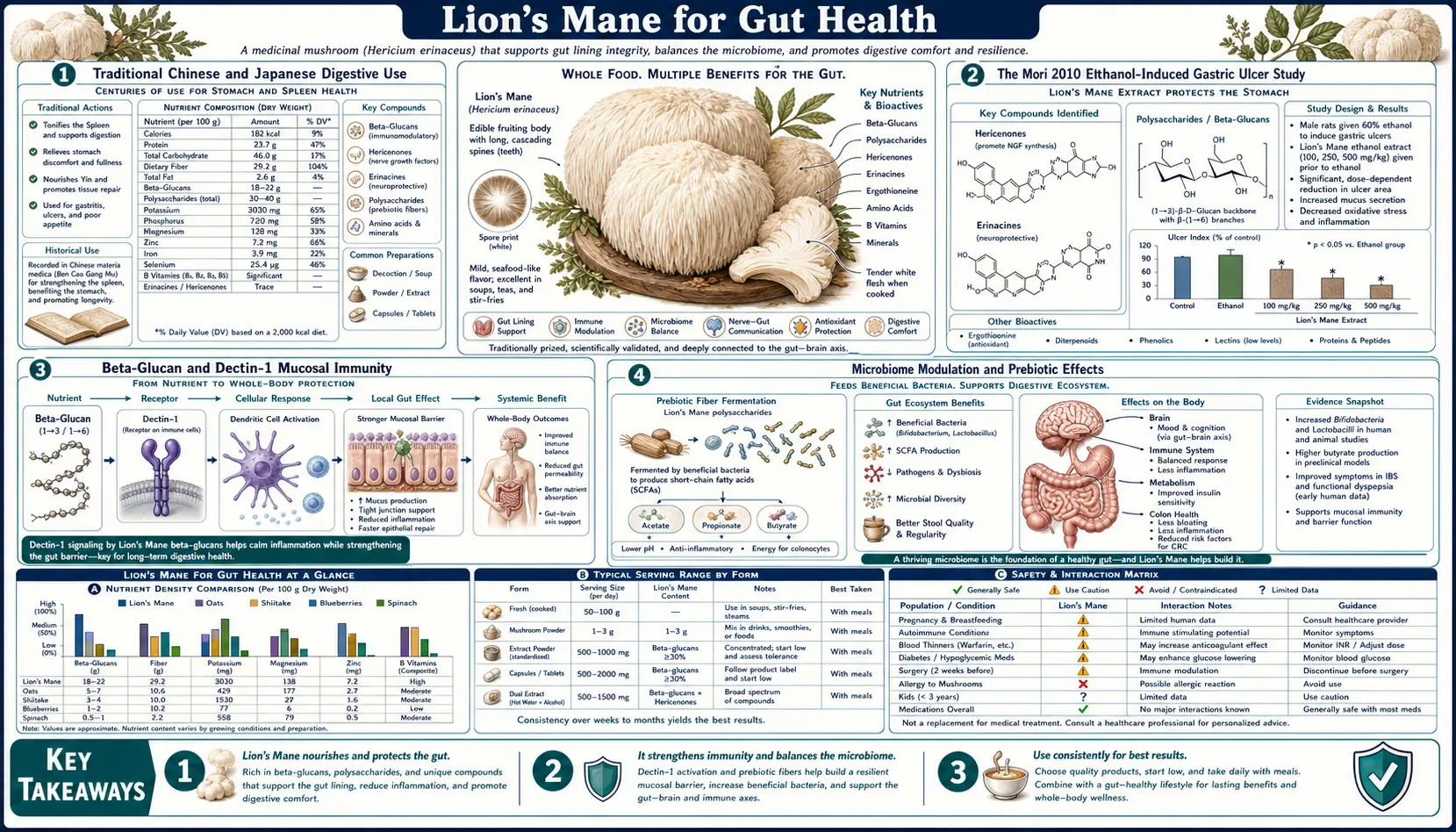
Long before the modern NGF research made Lion's Mane famous as a brain mushroom, Chinese and Japanese traditional medicine used Hericium erinaceus as a digestive remedy for chronic gastritis, peptic ulcer disease, and what we now call functional dyspepsia. A 2013 rat study by Wong and colleagues, using ulcers caused by ethanol, found a significant reduction in ulcer area with a water (aqueous) extract of Lion's Mane given beforehand. The beta-glucan polysaccharides in the fungal cell wall signal through the Dectin-1 receptor on intestinal macrophages and dendritic cells, modulating mucosal immunity in a manner consistent with the historical "stomach tonic" reputation. The mushroom also acts as a prebiotic, supporting beneficial gut bacteria and producing the short-chain fatty acids that maintain colonic epithelial integrity. In inflammatory bowel disease the colitis findings come from animal studies, and the human data are one 2024 retrospective study of a multi-ingredient product based on Lion's Mane in ulcerative colitis. The most interesting aspect is the gut-brain axis bridge: the same hericenones that act peripherally on enteric neurons connect Lion's Mane's digestive effects to its cognitive and mood effects, since vagal afferent signaling from gut to brain is a major and increasingly appreciated regulator of central neuroinflammation and mood.
Table of Contents
- Traditional Chinese and Japanese Digestive Use
- The Wong 2013 Ethanol-Induced Gastric Ulcer Study
- Beta-Glucan and Dectin-1 Mucosal Immunity
- Microbiome Modulation and Prebiotic Effects
- Gut Barrier Integrity and Tight Junctions
- Pilot Data in Inflammatory Bowel Disease
- Helicobacter pylori and Gastritis
- Functional Dyspepsia and Gastroesophageal Reflux Disease
- The Gut-Brain Axis Bridge to Cognitive and Mood Effects
- Preparation Choice for Gut Applications
- Dose and Pairing with Other Gut Interventions
- Cautions
- Key Research Papers
- Connections
- Featured Videos
Traditional Chinese and Japanese Digestive Use
Classical Chinese herbal texts (Compendium of Materia Medica, Bencao Gangmu, 16th century, and earlier works) describe hou tou gu (Lion's Mane, literally "monkey head mushroom") with three main indications:
- Brain tonic for memory and clarity (the cognitive use covered on the Cognitive Function page)
- Digestive remedy for chronic stomach complaints — recommended for what classical Chinese medicine described as "stomach yin deficiency" with symptoms of chronic indigestion, dull epigastric pain, reduced appetite, and what would now be recognized as functional dyspepsia, chronic gastritis, and possibly peptic ulcer disease
- Tonic for "five organ" health and longevity
In Japanese traditional medicine (kampo and the broader Buddhist-monastic medical tradition), Lion's Mane (yamabushitake) was used similarly for digestive complaints alongside its cognitive applications. The traditional preparation was typically a long-simmered soup or a hot-water extract drunk as a tea, which extracts the polysaccharides and beta-glucans (the most therapeutically relevant gut-active fraction) while degrading the more delicate aromatic hericenones somewhat. This preparation method matches the modern hot-water-extracted polysaccharide preparations sold for gut indications.
The traditional use predated by centuries the modern Helicobacter pylori discovery (Warren and Marshall 1982), the modern understanding of mucosal immunity, the development of proton pump inhibitors, and the recognition of the gut microbiome's role in health. The empirical observation that Lion's Mane helped chronic stomach complaints was based on practitioner experience and outcome over many generations of use, and the modern molecular mechanism (beta-glucan immune modulation, gastric mucosal protection, prebiotic microbiome effect) has provided several plausible biological explanations for why the traditional use produced the results that drove its longevity.
The Wong 2013 Ethanol-Induced Gastric Ulcer Study
A modern experimental study of Lion's Mane stomach protection is Wong JY and colleagues (2013), "Gastroprotective Effects of Lion's Mane Mushroom Hericium erinaceus Extract against Ethanol-Induced Ulcer in Rats." The ethanol-induced gastric ulcer rat model is a standard preclinical assay for gastric mucosal protective agents — ethanol directly damages gastric epithelium and produces reproducible ulcers that can be quantified by area measurement.
The Wong group pretreated Sprague Dawley rats with an aqueous extract of Lion's Mane before the ethanol challenge, then measured ulcer area, stomach-wall mucus, the damage seen by eye and under the microscope, antioxidant enzyme levels and malondialdehyde (MDA, a marker of fat damage by oxidation). Results showed:
- A significant reduction in ulcer area compared with the ulcer control group
- Protection against injury to the stomach lining, with the antioxidant enzymes kept from being depleted
- Lower MDA levels in stomach tissue than in the ulcer control group
- Upregulation of HSP70 protein and downregulation of BAX protein in the stomach tissue of pretreated rats
- No signs of toxicity in rats at a high dose of 5 g/kg in a separate acute toxicity test
The mechanism appears to involve preservation of the gastric mucus barrier (mediated by mucin glycoproteins secreted by gastric foveolar cells), reduction of acute inflammatory response, and possibly direct stimulation of mucosal repair. A later rat study of Lion's Mane polysaccharide (Wang XY 2018) found that pre-treatment reduced ethanol-induced stomach-lining lesions and ulcers caused by tying off the stomach outlet (pylorus ligation), lowered tumor necrosis factor-alpha and interleukin-1-beta in serum, and increased the defensive factors nitric oxide, prostaglandin E2 and epidermal growth factor in stomach tissue. Prostaglandin E2 is the principal cytoprotective signal for the gastric mucosa (the same mechanism that nonsteroidal anti-inflammatory drugs (NSAIDs) disrupt and that proton pump inhibitors indirectly support).
These results come from rats. People with stress-related gastritis, NSAID-induced gastric irritation, or chronic Helicobacter pylori-associated gastritis are the groups this research points to, but randomized controlled trials in humans for these specific indications have not yet been conducted at adequate scale.
Beta-Glucan and Dectin-1 Mucosal Immunity
The fungal cell wall is rich in beta-(1,3)/(1,6)-glucans — long branched polysaccharides that are structurally distinct from the (1,4)-glucans of plant starch and from the (1,3)-glucans of bacterial origin. Beta-(1,3)/(1,6)-glucans are recognized by the Dectin-1 receptor (CLEC7A), a C-type lectin pattern recognition receptor expressed on the surface of macrophages, dendritic cells, monocytes, and neutrophils, with particularly dense expression on intestinal macrophages and dendritic cells in the gut lamina propria.
Dectin-1 binding by fungal beta-glucan produces several downstream effects:
- Phagocytosis activation in macrophages (clearance of fungal pathogens, immune surveillance)
- Cytokine production (tumor necrosis factor-alpha, interleukin-6, IL-23) under appropriate context
- Dendritic cell maturation and antigen presentation to T cells
- Modulation of T helper 17 (Th17) vs regulatory T cell (Treg) differentiation in mucosal lymphoid tissue
- Cross-talk with TLR2 (Toll-like receptor 2) to fine-tune immune response
- Trained immunity — epigenetic reprogramming of innate immune cells to respond more robustly to subsequent unrelated immune challenges
The net effect of beta-glucan consumption in the gut is generally immunomodulatory rather than purely immunostimulatory or immunosuppressive. The same compound that primes macrophages to fight fungal infection also contributes to Th17/Treg balance that maintains tolerance to commensal bacteria and food antigens. This dual nature is why beta-glucan-containing mushrooms (Lion's Mane, Reishi, Turkey Tail, Maitake, Shiitake) feature prominently in traditional medical systems for both immune support during illness and ongoing immune balance during health.
Beta-glucan content is the most useful single quality marker for fungal supplement potency. Genuine fruit-body extracts typically test at 25-40% beta-glucan by weight. Mycelium-on-grain products often test below 10% because the residual grain dilutes the fungal content and grain (1,3)-glucans are different from fungal (1,3)/(1,6)-glucans. Beta-glucan testing is reported on third-party-tested supplement product labels and is a useful comparison metric across brands.
Microbiome Modulation and Prebiotic Effects
Beyond the direct immune effects, Lion's Mane polysaccharides act as a prebiotic — a substrate that selectively feeds beneficial gut bacteria. The non-digestible polysaccharides resist human digestive enzymes in the small intestine and reach the colon intact, where they are fermented by colonic bacteria to produce short-chain fatty acids (acetate, propionate, butyrate).
Animal studies of Lion's Mane supplementation consistently show:
- Increased abundance of beneficial Bifidobacterium and Lactobacillus species
- Increased abundance of butyrate-producing Faecalibacterium prausnitzii and Roseburia species
- Decreased abundance of pro-inflammatory Proteobacteria
- Increased fecal short-chain fatty acid concentrations
- Increased colonic mucin production
- Reduced markers of intestinal inflammation
Butyrate is the most therapeutically interesting short-chain fatty acid. It is the principal energy source for colonocytes (colonic epithelial cells), supports tight junction integrity, has anti-inflammatory effects through histone deacetylase (HDAC) inhibition, and supports Treg differentiation in the colonic lamina propria. Reduced butyrate production is a feature of dysbiosis in inflammatory bowel disease, irritable bowel syndrome, and several metabolic conditions.
Lion's Mane as a prebiotic fits within the broader picture of dietary fiber and resistant starch supporting microbiome health. It is not a replacement for diverse plant fiber (the most robust evidence for microbiome diversity comes from diversity of plant intake), but it is a useful adjunct, particularly for individuals who have used antibiotics, have inflammatory bowel disease, or have other risk factors for dysbiosis. See the Probiotics page for the complementary approach of direct beneficial-bacteria supplementation.
Gut Barrier Integrity and Tight Junctions
The gut barrier is a remarkable structure: a single layer of columnar epithelial cells separates the entire microbial mass of the colon (approximately 38 trillion bacteria) from the sterile interior of the body. The integrity of this single-cell-layer barrier depends on tight junction proteins (claudins, occludin, ZO-1) that seal the spaces between adjacent epithelial cells, on the protective mucin layer (Muc2 in the colon, Muc5AC in the small intestine), and on antimicrobial peptide production by Paneth cells in the small intestinal crypts.
Loss of gut barrier integrity ("intestinal permeability" or, less precisely, "leaky gut") allows translocation of bacterial products (lipopolysaccharide (LPS) from gram-negative bacteria, peptidoglycan from gram-positive bacteria) and food antigens from the gut lumen into the lamina propria and ultimately into systemic circulation. This is thought to contribute to chronic low-grade systemic inflammation, autoimmune disease susceptibility, food sensitivity, and possibly mood and cognitive symptoms via the gut-brain axis.
Lion's Mane supports gut barrier integrity through several mechanisms operating simultaneously:
- Direct epithelial protective effect — the stomach-ulcer protection seen in rats (Wong 2013) is proposed to extend to small and large intestinal epithelium under stress
- Microbiome modulation — promoting butyrate-producing bacteria, which support tight junction integrity and colonocyte energy supply
- Beta-glucan/Dectin-1 signaling — modulating mucosal immune balance to favor tolerance over inflammation
- Mucin support — the prebiotic effect supports goblet cell function and mucin production
- Reduction of pathogenic bacterial overgrowth — the gut microbiome modulation reduces abundance of pathobionts that disrupt barrier function
For patients with diagnosed conditions involving gut barrier dysfunction (inflammatory bowel disease, celiac disease, possibly some cases of irritable bowel syndrome and food sensitivity), Lion's Mane is used as one part of a broader gut-healing approach; the only human study found for this page in this area is the ulcerative colitis study described below. See the Gut Healing page for the broader framework.
Pilot Data in Inflammatory Bowel Disease
Lion's Mane has been studied in inflammatory bowel disease (Crohn's disease and ulcerative colitis) mainly in animals, with one human study:
- A 2024 multicentre retrospective study (HERICIUM-UC) looked back at people with mild-to-moderate ulcerative colitis treated with 5-aminosalicylic acid (5-ASA) medicine alone or with an added multi-ingredient supplement based on Lion's Mane. At six months, clinical remission was 50.9% with the supplement and 36.1% without, a significant difference; clinical response rates (70.4% against 60.2%) did not differ significantly. Faecal calprotectin levels fell significantly in both groups, more so with the supplement, and no adverse events were reported. Because the study looked back at records instead of randomly assigning treatments, and the product had several ingredients, it cannot show what Lion's Mane alone does (Tursi 2024).
- Animal models of DSS (dextran sulfate sodium) colitis have shown attenuation of colitis severity with Lion's Mane pretreatment or treatment, with reduction in inflammatory cytokines, preservation of colonic architecture, and improved microbiome composition; a polysaccharide from cultured mycelium relieved ulcerative colitis in rats, with less oxidative damage and better mitochondrial function (Wang D 2019)
- The mechanism likely involves the same beta-glucan/Dectin-1 immunomodulation, microbiome modulation, and gut barrier support discussed above
The available evidence is preliminary and does not support Lion's Mane as primary therapy for inflammatory bowel disease. Standard care — 5-ASA agents, immunomodulators, biologics — remains evidence-based first-line therapy, with surgical options for refractory disease. In the one human study, the Lion's Mane-based product was taken alongside 5-ASA medicine, not in place of it; it has not been studied as a replacement for evidence-based inflammatory bowel disease (IBD) therapy.
The people in that study had mild-to-moderate disease. No study has tested Lion's Mane in severe pancolitis or in place of biologic therapy; stopping a biologic in severe disease carries the risk of a disease flare on inadequate therapy.
Helicobacter pylori and Gastritis
Helicobacter pylori is a gram-negative spiral bacterium that colonizes the gastric mucosa and is the underlying cause of most peptic ulcer disease and a major risk factor for gastric cancer. The Barry Marshall and Robin Warren discovery of H. pylori (1982, Nobel Prize 2005) transformed peptic ulcer management from antacid suppression to antibiotic eradication.
Lion's Mane has shown modest in vitro and animal-model activity against H. pylori: ethanol extracts of the fruiting body inhibited the growth of laboratory strains and clinical isolates in the laboratory (Shang 2013), and in mice an ethanolic extract left a stomach H. pylori load about 1 log lower than in untreated controls (Wang G 2019). The gastric protective effects discussed above may be partly relevant in the context of H. pylori-associated gastritis. However, the evidence does not establish Lion's Mane as an H. pylori eradication therapy. The 2024 American College of Gastroenterology (ACG) guideline states that for people not treated before, 14-day bismuth quadruple therapy is the preferred regimen when antibiotic susceptibility is unknown, with rifabutin triple therapy or potassium-competitive acid blocker dual therapy for 14 days as a suitable alternative in patients without penicillin allergy; for people treated before, it states that salvage regimens containing clarithromycin or levofloxacin should only be used if antibiotic susceptibility is confirmed (Chey 2024).
Lion's Mane may have a role as adjunct during and after H. pylori eradication: supporting gastric mucosal healing during the inflammatory recovery period, supporting microbiome restoration after antibiotic disruption, and providing ongoing low-level immune support. This adjunct role is a proposal drawn from the animal and laboratory findings above.
For chronic atrophic gastritis, a long-lasting inflammation of the stomach lining, a 2025 commentary in the World Journal of Gastroenterology states that initial clinical data suggest Lion's Mane may bring clinical and histological (tissue) improvement in patients, along with a marked antimicrobial activity against H. pylori; the authors add that further evidence is needed before proposing it as a complementary approach (Pellegrino 2025).
For chronic gastritis not associated with H. pylori (autoimmune atrophic gastritis, nonsteroidal anti-inflammatory drug-induced gastritis, bile reflux gastritis), the same adjunct role is proposed alongside addressing the underlying cause where possible.
Functional Dyspepsia and Gastroesophageal Reflux Disease
Functional dyspepsia — chronic upper abdominal discomfort, early satiety, post-prandial fullness, or epigastric burning without identifiable structural cause — affects 10-20% of adults and is one of the most common reasons for gastrointestinal (GI) clinic visits. Conventional management is limited: proton pump inhibitors help some patients, prokinetic agents help others, low-dose tricyclic antidepressants help a subset, and many patients do not get full relief from any single intervention.
Lion's Mane fits the traditional Chinese medicine indication for "stomach yin deficiency" almost exactly — the same constellation of chronic indigestion, dull epigastric pain, reduced appetite, and post-prandial fullness that defines modern functional dyspepsia. The traditional preparation (long-simmered Lion's Mane soup) was given specifically for this presentation, and patient anecdotal reports of benefit are common.
Mechanistically, Lion's Mane may benefit functional dyspepsia through:
- Improved gastric mucosal integrity (the mechanism seen in the Wong 2013 rat study)
- Microbiome modulation reducing post-prandial bloating
- Vagal afferent signaling reducing visceral hypersensitivity (a known contributor to functional dyspepsia)
- Reduction of low-grade gastric inflammation
- Possible anxiolytic effects reducing the brain-gut axis dysregulation that contributes to functional gastrointestinal disorders
For gastroesophageal reflux disease (GERD), Lion's Mane is less directly relevant because the primary problem in gastroesophageal reflux disease is failure of the lower esophageal sphincter rather than gastric mucosal pathology. Lion's Mane may have indirect benefit through gastric emptying support and reduced gastric inflammation, but it is not a substitute for the conventional gastroesophageal reflux disease interventions (weight loss, head-of-bed elevation, dietary trigger identification, proton pump inhibitor therapy when indicated).
The Gut-Brain Axis Bridge to Cognitive and Mood Effects
The most interesting feature of Lion's Mane's gut effects is that they do not stop at the gut. The gut-brain axis — the bidirectional communication network linking gut microbiome, gut epithelium, enteric nervous system, vagus nerve, and central nervous system — is increasingly recognized as a major regulator of mood, cognition, and even neurodegeneration.
Key gut-to-brain communication channels:
- Vagal afferent nerves — the vagus nerve carries information from gut to brainstem (nucleus tractus solitarius), where it influences hypothalamic, limbic, and cortical activity. Hericenones acting on enteric neurons can signal centrally via this route even without crossing the blood-brain barrier (BBB) themselves.
- Microbiome-produced neurotransmitters — gut bacteria produce serotonin (90% of the body's serotonin is made by enterochromaffin cells in the gut, influenced by microbiome), gamma-aminobutyric acid (GABA), and dopamine. Microbiome modulation by Lion's Mane prebiotic effects influences these production rates.
- Short-chain fatty acids — butyrate, propionate, and acetate produced by colonic bacterial fermentation reach the brain, support microglial health, and reduce neuroinflammation.
- Inflammatory cytokine modulation — gut barrier integrity prevents systemic lipopolysaccharide translocation and the chronic low-grade systemic inflammation that drives neuroinflammation. Lion's Mane gut effects reduce this systemic inflammatory tone.
- Tryptophan metabolism — gut microbiome regulates the kynurenine pathway of tryptophan metabolism, which influences serotonin availability and neuroactive metabolite production.
This is the molecular bridge that links Lion's Mane's gut effects to its cognitive and mood effects. The hericenones acting peripherally on enteric neurons and the polysaccharides modulating the microbiome both feed back to the brain through these gut-brain axis channels, contributing to the central effects on cognition (Mori 2009) and mood (Nagano 2010) even when the direct central penetration of hericenones is limited. Erinacine A from mycelium adds the direct central effect on top of these indirect gut-brain pathways. See the Gut-Brain Axis page for the broader framework.
Preparation Choice for Gut Applications
For gut indications specifically, the preparation considerations differ slightly from cognitive applications:
- Polysaccharide content matters more than hericenone content — the beta-glucans and other polysaccharides drive the gut barrier, microbiome, and immune-modulatory effects. Hot-water extraction of the fruit body draws out these polysaccharides. The hericenones (which are more relevant for central effects) are less critical for gut applications.
- Hot-water extraction is more relevant than ethanol extraction — polysaccharides are water-soluble; hot water extracts them efficiently. Hericenones and erinacines are more lipid-soluble and require ethanol extraction. A pure hot-water-extracted fruit body powder carries mainly the polysaccharide fraction.
- Whole fruit body in food form — the traditional preparation of long-simmered Lion's Mane soup delivers the polysaccharides in a form that the gastrointestinal tract has evolved to handle. Fresh culinary Lion's Mane (a 200-300 g fresh portion, sauteed or in soup) is the food form of this traditional use.
- Dual extract carries both fractions — a dual extract contains both the polysaccharides linked to the gut effects and the hericenones/erinacines linked to the central effects, the combination of interest for someone with both irritable bowel syndrome (IBS) and depression.
Dose and Pairing with Other Gut Interventions
Amounts and pairings described for gut use:
- Dose — 1-3 g/day of fruit-body powder or extract is the amount described, similar to the amounts used in the cognitive and mood trials. Higher amounts (up to 5 g/day) are described as well tolerated for active gastritis or inflammatory bowel disease; the studies on this page give no tested dose for these conditions.
- Timing — taken with meals, particularly when the aim is gastric mucosal protection. For prebiotic microbiome effect, timing relative to meals matters less since the substrate must reach the colon.
- Duration — for gastric mucosal protection, benefit is described within 2-4 weeks. For microbiome modulation and inflammatory bowel disease symptom improvement, 8-12 weeks is the period described before judging effect; in the HERICIUM-UC study, remission was measured at three and six months.
- Pairing with probiotics — Lion's Mane is a prebiotic, and pairing it with a probiotic (Bifidobacterium, Lactobacillus, or Saccharomyces boulardii) is described as complementary. The Lion's Mane substrate feeds beneficial bacteria; the probiotic supplements the bacterial population directly.
- Pairing with dietary fiber diversity — Lion's Mane is not a replacement for diverse dietary fiber from vegetables, fruits, legumes, and whole grains. In the American Gut Project (McDonald and colleagues, 2018), people who reported eating more than 30 different plants a week had greater gut-microbe diversity than people eating fewer than 10. Lion's Mane is an addition, not a substitute.
- Pairing with bone broth and glutamine — for active gut-healing protocols, Lion's Mane can be combined with bone broth (collagen amino acids for epithelial repair), L-glutamine (the principal energy source for enterocytes), zinc carnosine, and slippery elm. See the Gut Healing page for the comprehensive approach.
Cautions
- Mushroom allergy — allergic reactions in people with mushroom allergy have been reported with culinary mushroom exposure as well as supplementation. Reports on Lion's Mane itself include occupational allergic contact dermatitis (Maes 1999) and a 63-year-old man admitted for severe acute respiratory failure (acute respiratory distress syndrome) after taking a Lion's Mane extract; his lymphocyte stimulation test reacted strongly to the extract, and he recovered with steroid pulse therapy under mechanical ventilation (Nakatsugawa 2003).
- Acute severe inflammatory bowel disease flare — an acute severe ulcerative colitis or Crohn's disease flare is treated by hospitals as urgent, with high-dose steroids, biologics, and possibly hospitalization; Lion's Mane has not been studied in this setting.
- Active gastrointestinal bleeding — the mild antiplatelet effect of Lion's Mane is theoretically unfavorable in active gastrointestinal bleeding, which hospitals treat as urgent.
- Anticoagulant interaction — as on other Lion's Mane pages, the mild antiplatelet activity raises a theoretical concern for people taking warfarin, clopidogrel, apixaban, rivaroxaban, or daily aspirin.
- Diabetes medication — Lion's Mane may modestly lower blood glucose, so an additive effect is possible in people taking insulin or sulfonylureas.
- Pregnancy and lactation — whole-food culinary consumption is presumed safe; there is no specific safety data on concentrated supplements in pregnancy or breastfeeding.
- Small intestinal bacterial overgrowth (SIBO) and FODMAP sensitivity — Lion's Mane polysaccharides are fermentable substrates and may worsen symptoms in some patients with small intestinal bacterial overgrowth (SIBO) or significant FODMAP sensitivity.
- Quality concerns — as on other Lion's Mane pages, products differ in whether they are third-party tested, whether they come from fruit body, mycelium or both, and how much grain an undefined mycelium-on-grain product contains.
- Not a substitute for evaluation of new gastrointestinal symptoms — new-onset persistent abdominal pain, unexplained weight loss, blood in stool, persistent change in bowel habits, or other red-flag symptoms are warning signs that doctors investigate for serious disease.
Key Research Papers
- Wong JY et al. (2013). Gastroprotective Effects of Lion's Mane Mushroom Hericium erinaceus (Bull.:Fr.) Pers. (Aphyllophoromycetideae) Extract against Ethanol-Induced Ulcer in Rats. Evidence-Based Complementary and Alternative Medicine. — PubMed PMID: 24302966
- Wang XY et al. (2018). Gastroprotective activity of polysaccharide from Hericium erinaceus against ethanol-induced gastric mucosal lesion and pylorus ligation-induced gastric ulcer, and its antioxidant activities. Carbohydrate Polymers. — PubMed PMID: 29455967
- Wang D et al. (2019). A polysaccharide from cultured mycelium of Hericium erinaceus relieves ulcerative colitis by counteracting oxidative stress and improving mitochondrial function. International Journal of Biological Macromolecules. — PubMed PMID: 30543884
- Tursi A et al. (2024). Enhancing Oral 5-ASA Effectiveness in Mild-to-Moderate Ulcerative Colitis through an H. erinaceus-Based Nutraceutical Add-on Multi-Compound: The "HERICIUM-UC" Two-Arm Multicentre Retrospective Study. Pharmaceutics. — PubMed PMID: 39339171
- Diling C et al. (2017). Immunomodulatory Activities of a Fungal Protein Extracted from Hericium erinaceus through Regulating the Gut Microbiota. Frontiers in Immunology. — PubMed PMID: 28713364
- Brown GD, Gordon S (2001). Immune recognition. A new receptor for beta-glucans. Nature. — PubMed PMID: 11544516
- Shang X et al. (2013). In vitro anti-Helicobacter pylori effects of medicinal mushroom extracts, with special emphasis on the Lion's Mane mushroom, Hericium erinaceus (higher Basidiomycetes). International Journal of Medicinal Mushrooms. — PubMed PMID: 23557368
- Wang G et al. (2019). In Vitro and In Vivo Inhibition of Helicobacter pylori by Ethanolic Extracts of Lion's Mane Medicinal Mushroom, Hericium erinaceus (Agaricomycetes). International Journal of Medicinal Mushrooms. — PubMed PMID: 30806251
- Chey WD et al. (2024). ACG Clinical Guideline: Treatment of Helicobacter pylori Infection. The American Journal of Gastroenterology. — PubMed PMID: 39626064
- Pellegrino R, Gravina AG (2025). Potential of traditional Chinese medicine in gastrointestinal disorders: Hericium erinaceus in chronic atrophic gastritis. World Journal of Gastroenterology. — PubMed PMID: 40495939
- Diling C et al. (2017). Extracts from Hericium erinaceus relieve inflammatory bowel disease by regulating immunity and gut microbiota. Oncotarget. — PubMed PMID: 29156761
- Khan MA et al. (2013). Hericium erinaceus: an edible mushroom with medicinal values. Journal of Complementary & Integrative Medicine. — PubMed PMID: 23735479
- Friedman M (2015). Chemistry, nutrition, and health-promoting properties of Hericium erinaceus. Journal of Agricultural and Food Chemistry. — PubMed PMID: 26244378
- Cryan JF, Dinan TG (2012). Mind-altering microorganisms: the impact of the gut microbiota on brain and behaviour. Nature Reviews Neuroscience. — PubMed PMID: 22968153
- Marshall BJ, Warren JR (1984). Unidentified curved bacilli in the stomach of patients with gastritis and peptic ulceration. The Lancet. — PubMed PMID: 6145023
- Sonnenburg ED, Sonnenburg JL (2014). Starving our microbial self: the deleterious consequences of a diet deficient in microbiota-accessible carbohydrates. Cell Metabolism. — PubMed PMID: 25156449
- McDonald D et al. (2018). American Gut: an Open Platform for Citizen Science Microbiome Research. mSystems. — PubMed PMID: 29795809
- Wong KH et al. (2007). Activity of Aqueous Extracts of Lion's Mane Mushroom Hericium erinaceus (Bull.: Fr.) Pers. (Aphyllophoromycetideae) on the Neural Cell Line NG108-15. International Journal of Medicinal Mushrooms. — doi:10.1615/intjmedmushr.v9.i1.70
- Nakatsugawa M et al. (2003). Hericium erinaceum (yamabushitake) extract-induced acute respiratory distress syndrome monitored by serum surfactant proteins. Internal Medicine. — PubMed PMID: 14714963
- Maes MF, van Baar HM, van Ginkel CJ (1999). Occupational allergic contact dermatitis from the mushroom White Pom Pom (Hericium erinaceum). Contact Dermatitis. — PubMed PMID: 10344494
PubMed Topic Searches
Connections
- Lion's Mane Overview
- Lion's Mane Benefits Hub
- Lion's Mane for NGF
- Lion's Mane for Cognitive Function
- Lion's Mane for Mood & Depression
- Gut-Brain Axis
- Gut Healing
- Probiotics
- Bone Broth
- Reishi Mushroom
- Turkey Tail Mushroom
- Chaga Mushroom
- Crohn's Disease
- Ulcerative Colitis
- Irritable Bowel Syndrome
- Small Intestinal Bacterial Overgrowth
- History