Cordyceps for Exercise Performance and Endurance
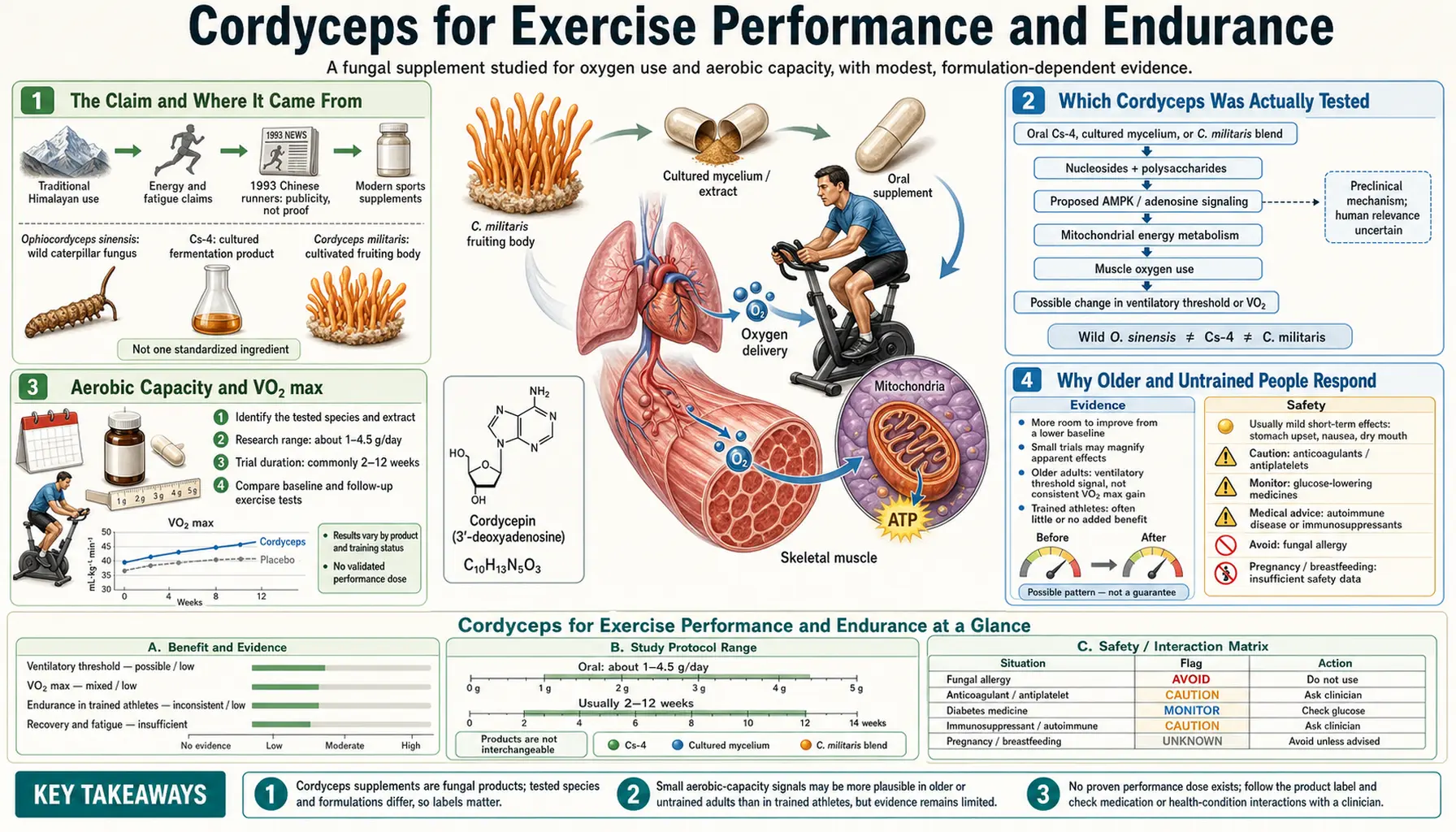
The single most famous claim about Cordyceps is that it boosts stamina and aerobic capacity — a reputation supercharged in 1993 when Chinese runners set world records and their coach credited a Cordyceps tonic. Three decades of controlled trials have produced a more sober picture: where a benefit appears it is modest, it has mostly been seen after weeks of daily use rather than after a single dose, and it depends heavily on which Cordyceps was tested. One small trial in older adults found a benefit, two trials in trained cyclists found none, and a 2025 pooled analysis of trials in athletes reported small improvements. This page walks through exactly what the trials measured, and in whom.
Table of Contents
- The Claim and Where It Came From
- Which Cordyceps Was Actually Tested
- Aerobic Capacity and VO2max
- Older and Untrained People: What Has Been Studied
- High-Intensity Tolerance and Chronic Dosing
- The Negative Trials in Trained Athletes
- Proposed Mechanisms
- Practical Use and Realistic Expectations
- Cautions
- Key Research Papers
- Connections
- Featured Videos
The Claim and Where It Came From
Cordyceps entered Western sports culture almost overnight in 1993, when a group of Chinese distance runners shattered several world records at the National Games. Their coach attributed the performances partly to a tonic containing Cordyceps (alongside turtle blood and other ingredients). The records were later shadowed by doping suspicions, and no Cordyceps supplement was ever shown to be responsible — but the association stuck, and Cordyceps has been marketed as an endurance aid ever since.
Underneath the folklore is a plausible physiological question: can a fungus improve the body's ability to take in, transport, and use oxygen during exercise? Traditional Chinese Medicine had used Cordyceps as a "kidney and lung" tonic for centuries, indications that map loosely onto stamina and breathing. The modern task has been to test that reputation with the tools of exercise physiology — VO2max, ventilatory threshold, time-to-exhaustion, and lactate — rather than anecdote.
Which Cordyceps Was Actually Tested
Before reading any Cordyceps exercise study, the first question is always: which Cordyceps? The three forms behave differently and are not interchangeable.
- Fermented Ophiocordyceps sinensis mycelium — a standardized fermentation product. Three of the human exercise trials on this page (Chen 2010, Parcell 2004 and Earnest 2004) used this fermented mycelium.
- Cordyceps militaris (cultivated fruiting body) — the bright-orange club fungus grown on grain. It typically contains far more cordycepin than wild O. sinensis, and is the form used in several newer trials.
- Wild O. sinensis (caterpillar fungus) — the scarce, extremely expensive Himalayan specimen. Almost no rigorous exercise trials use authentic wild material, partly because of cost and partly because of rampant adulteration.
This matters because a positive trial of the fermented mycelium does not automatically validate a C. militaris capsule, and neither validates a wild-harvest product of unknown potency. Many commercial "Cordyceps for athletes" blends also combine the fungus with Rhodiola, cordyceps-unrelated stimulants, or beetroot — so a benefit seen with a blend cannot be pinned on Cordyceps alone.
Aerobic Capacity and VO2max
VO2max — the maximum rate at which the body can consume oxygen during intense exercise — is the headline number in endurance science. The Cordyceps VO2max literature is genuinely mixed:
- In a double-blind, placebo-controlled trial in 20 healthy adults aged 50 to 75, Chen and colleagues (2010) gave a fermented O. sinensis mycelium extract (333 mg three times a day) or placebo for 12 weeks. On the extract, the metabolic threshold — the exercise intensity above which lactate accumulates — rose by 10.5% (from 0.83 to 0.93 L/min) and the ventilatory threshold by 8.5% (from 1.25 to 1.36 L/min); neither changed significantly on placebo, and there were no changes in VO2max in either group. This suggests a small improvement in aerobic efficiency.
- Some short crossover studies in younger, fitter subjects found no measurable change in VO2max at all.
- Reviews consistently note that when an effect appears, it tends to be a shift in the submaximal efficiency of oxygen use rather than a large jump in the ceiling of VO2max.
The individual trials on this page do not show Cordyceps reliably raising VO2max in already-fit people, although the 2025 pooled analysis of athletes described below reported a small rise in peak oxygen uptake. Where it seems to help, the effect is on how comfortably a person works below their maximum — a meaningful but undramatic difference that a recreational exerciser might feel as "less winded" without it changing a stopwatch by much.
Older and Untrained People: What Has Been Studied
Cordyceps is often described as most useful for older adults and deconditioned or untrained people, on the reasoning that people who start with lower aerobic fitness have more "headroom" to improve, so any intervention that nudges oxygen efficiency, reduces oxidative stress, or improves recovery would show up more clearly against a lower baseline. The research base does not settle this. A 2025 review found that “most studies involved active, young participants”, and that the potential of Cordyceps in older and sedentary people “requires further investigation due to the limited number of studies available”. The same review found that use for 2 to 16 weeks improved time to exhaustion in a dose-dependent way, while effects on aerobic fitness were inconsistent (Dewi and Khemtong, 2025).
The Chen 2010 trial is the one trial on this page in older people: it studied 20 healthy adults aged 50 to 75 and found higher metabolic and ventilatory thresholds after 12 weeks. It was a small pilot trial. The site's Exercise page covers building aerobic fitness.
High-Intensity Tolerance and Chronic Dosing
One of the better-controlled modern studies is Hirsch and colleagues (2017), who tested a C. militaris-containing mushroom blend on tolerance to high-intensity exercise. The design has two important lessons baked in:
- Three weeks did more than one. Twenty-eight young adults (average age 22.7) took 4 g a day of the blend or a placebo for 1 week, and 10 of them continued for 2 more weeks. After 1 week there was no significant difference from placebo on any measure, although by one statistical method time to exhaustion rose by 28.1 seconds. After 3 weeks, VO2max rose by 4.8 ml/kg/min on the blend (against 0.9 on placebo) and time to exhaustion by 69.8 seconds. This fits the traditional use pattern — Cordyceps was taken as a sustained tonic, not a pre-workout shot.
- It was a blend. The supplement contained multiple mushrooms, so the study supports the product more than it isolates Cordyceps as the single active agent.
Across these trials, the clearer gains appeared after several weeks of daily use rather than after a short course. The compound's proposed mechanisms (antioxidant enzyme upregulation, adaptive signaling) are the kind that would accrue over time, not acutely.
A single dose has also been tested. In a 2026 crossover trial, 12 recreationally active young men took 1 g of a standardized Cordyceps militaris extract or a placebo 30 minutes before a cycling test to exhaustion. The extract did not change peak oxygen uptake during exercise (p = 0.490), but resting oxygen uptake was higher (0.37 against 0.24 L/min) and reaction times after exercise were faster (Farzan and Koushkie Jahromi, 2026).
The Negative Trials in Trained Athletes
Honesty requires giving the negative results equal weight, because they are among the best-designed studies in the field:
- Parcell et al. (2004) ran a five-week, double-blind, placebo-controlled trial of a fermented Cordyceps sinensis mycelium extract (3 g a day) in 22 endurance-trained male cyclists. The supplement did not improve aerobic capacity or endurance performance: peak oxygen uptake went from 59.1 to 57.1 ml/kg/min on Cordyceps and from 59.9 to 60.1 ml/kg/min on placebo, and the time trial took 62.1 minutes on Cordyceps against 61.4 minutes on placebo, with no difference between groups. The title of the paper says so outright.
- Earnest et al. (2004) tested a commercial herbal formula in 17 competitive amateur cyclists for 2 weeks and likewise found no ergogenic benefit on performance measures. Three capsules, the daily maintenance dose, held 1000 mg of fermented Cordyceps sinensis mycelium and 300 mg of Rhodiola rosea root extract as the main ingredients, plus calcium pyruvate, phosphates, ribose, adenosine and chromium, so the trial was not a test of Cordyceps alone.
In these two trials of trained cyclists, Cordyceps did nothing measurable. The results fit the idea of a ceiling effect — the more trained a person already is, the less Cordyceps has to offer — but pooled data in athletes point the other way. A 2025 systematic review and meta-analysis of 14 randomised trials in 528 athletes (8 trials with 288 athletes pooled) found that Cordyceps sinensis improved endurance performance (p = 0.05), ventilatory threshold (p = 0.03) and peak oxygen uptake (p = 0.04), with low heterogeneity between trials (Shu and colleagues, 2025). The evidence in competitive athletes is therefore mixed: two negative cyclist trials sit beside a positive pooled analysis.
Proposed Mechanisms
Several mechanisms are offered to explain how Cordyceps could aid endurance. All are supported mainly by cell and animal work, so they remain plausible hypotheses rather than proven pathways in exercising humans:
- Improved oxygen utilization — animal studies suggest Cordyceps may increase the efficiency of oxygen use and raise tissue adenosine triphosphate-to-inorganic-phosphate ratios, which would delay the point at which working muscle runs short of energy.
- Antioxidant defense — extracts consistently raise endogenous antioxidant enzymes (superoxide dismutase, glutathione peroxidase) and lower markers of exercise-induced oxidative stress in rodents, which could aid recovery.
- Vasodilation — some data point to nitric-oxide-mediated relaxation of blood vessels, which would improve blood flow to working muscle.
- Anti-fatigue signaling — rodent "forced swim" and treadmill studies show longer time-to-exhaustion and lower lactate and blood-urea-nitrogen after Cordyceps, a classic anti-fatigue signature. In the 2017 study cited below, mice given a cereal extrudate containing C. militaris (5 to 20 g/kg body weight) for 30 days swam longer before exhaustion than control mice and had lower creatine kinase and blood urea nitrogen, with lower blood lactate at the highest dose — a mouse result, not a human one (see the companion Energy & adenosine triphosphate (ATP) page).
Practical Use and Realistic Expectations
- Form: the exercise trials on this page used a fermented O. sinensis mycelium extract (three trials), a mushroom blend containing C. militaris (one trial) or a standardized C. militaris extract (the 2026 single-dose trial). A label that says only "Cordyceps" does not show which of these forms it contains, and wild O. sinensis is, as noted above, scarce and often adulterated.
- Dose: the human trials used 333 mg three times a day (Chen 2010), 3 g a day (Parcell 2004), 4 g a day of a mushroom blend (Hirsch 2017), 1000 mg of Cordyceps in each daily maintenance dose of a multi-ingredient formula (Earnest 2004) and a single 1 g dose (Farzan and Koushkie Jahromi, 2026). There is no single official dose.
- Timing: in the trials, benefits appeared after weeks of daily use; a single 1 g dose before exercise did not change peak oxygen uptake in the 2026 trial.
- Who has been studied: mostly active young people, according to the 2025 review. One small trial in older adults found a benefit, two trials in trained cyclists did not, and a 2025 pooled analysis in athletes found small improvements; evidence in older and sedentary people is limited.
- What the trials measured: peak oxygen uptake, metabolic and ventilatory thresholds, time to exhaustion and time-trial performance, over periods of 1 to 12 weeks.
Cautions
- Not a substitute for training. No supplement replaces progressive aerobic conditioning; Cordyceps at best adds a small margin on top of consistent training.
- Blood sugar and blood thinners. Cordyceps may have mild glucose-lowering and anti-platelet effects in preclinical work, which raises a concern about added effects in people taking diabetes medicines or blood thinners (anticoagulants).
- Autoimmune disease and immunosuppressants. Because Cordyceps can stimulate immune activity, it could work against immunosuppressant drugs; this is a concern raised for people with autoimmune conditions or on those drugs (see the Immune & Inflammation page).
- Product quality. Wild O. sinensis is heavily adulterated and sometimes contaminated with heavy metals.
- Anti-doping. Some "energy" formulas that include Cordyceps also contain other ingredients, including stimulants, that are banned in tested sport.
Key Research Papers
- Chen S, Li Z, Krochmal R, et al. (2010). Effect of Cs-4 (Cordyceps sinensis) on exercise performance in healthy older subjects: a double-blind, placebo-controlled trial. J Altern Complement Med — PubMed PMID: 20804368
- Hirsch KR, Smith-Ryan AE, Roelofs EJ, et al. (2017). Cordyceps militaris improves tolerance to high-intensity exercise after acute and chronic supplementation. J Diet Suppl — PubMed PMID: 27408987
- Parcell AC, Smith JM, Schulthies SS, et al. (2004). Cordyceps sinensis (CordyMax Cs-4) supplementation does not improve endurance exercise performance. Int J Sport Nutr Exerc Metab — PubMed PMID: 15118196
- Earnest CP, Morss GM, Wyatt F, et al. (2004). Effects of a commercial herbal-based formula on exercise performance in cyclists. Med Sci Sports Exerc — PubMed PMID: 15076794
- Zhong L, Zhao L, Yang F, et al. (2017). Evaluation of anti-fatigue property of the extruded product of cereal grains mixed with Cordyceps militaris on mice. J Int Soc Sports Nutr (animal study in mice) — PubMed PMID: 28588427
- Radhi M, et al. (2021). A systematic review of the biological effects of cordycepin. Molecules — PubMed PMID: 34641429
- Tuli HS, Sandhu SS, Sharma AK (2014). Pharmacological and therapeutic potential of Cordyceps with special reference to cordycepin. 3 Biotech — PubMed PMID: 28324458
- Zhu JS, Halpern GM, Jones K (1998). The scientific rediscovery of an ancient Chinese herbal medicine: Cordyceps sinensis, Part I. J Altern Complement Med — PubMed PMID: 9764768
- Dewi L, Khemtong C (2025). Ergogenic Aid by Cordyceps: Does It Work?? Curr Nutr Rep — PubMed PMID: 40768109
- Shu MY, Zhang XC, Zuo L, et al. (2025). Effects of fungal supplementation on endurance, immune function, and hematological profiles in adult athletes: a systematic review and meta-analysis. Front Nutr — PubMed PMID: 41280379
- Farzan H, Koushkie Jahromi M (2026). Acute Cordyceps militaris supplementation and elevated resting oxygen uptake with faster reaction times: A randomized crossover trial. PLoS One — PubMed PMID: 42455764