Elecampane
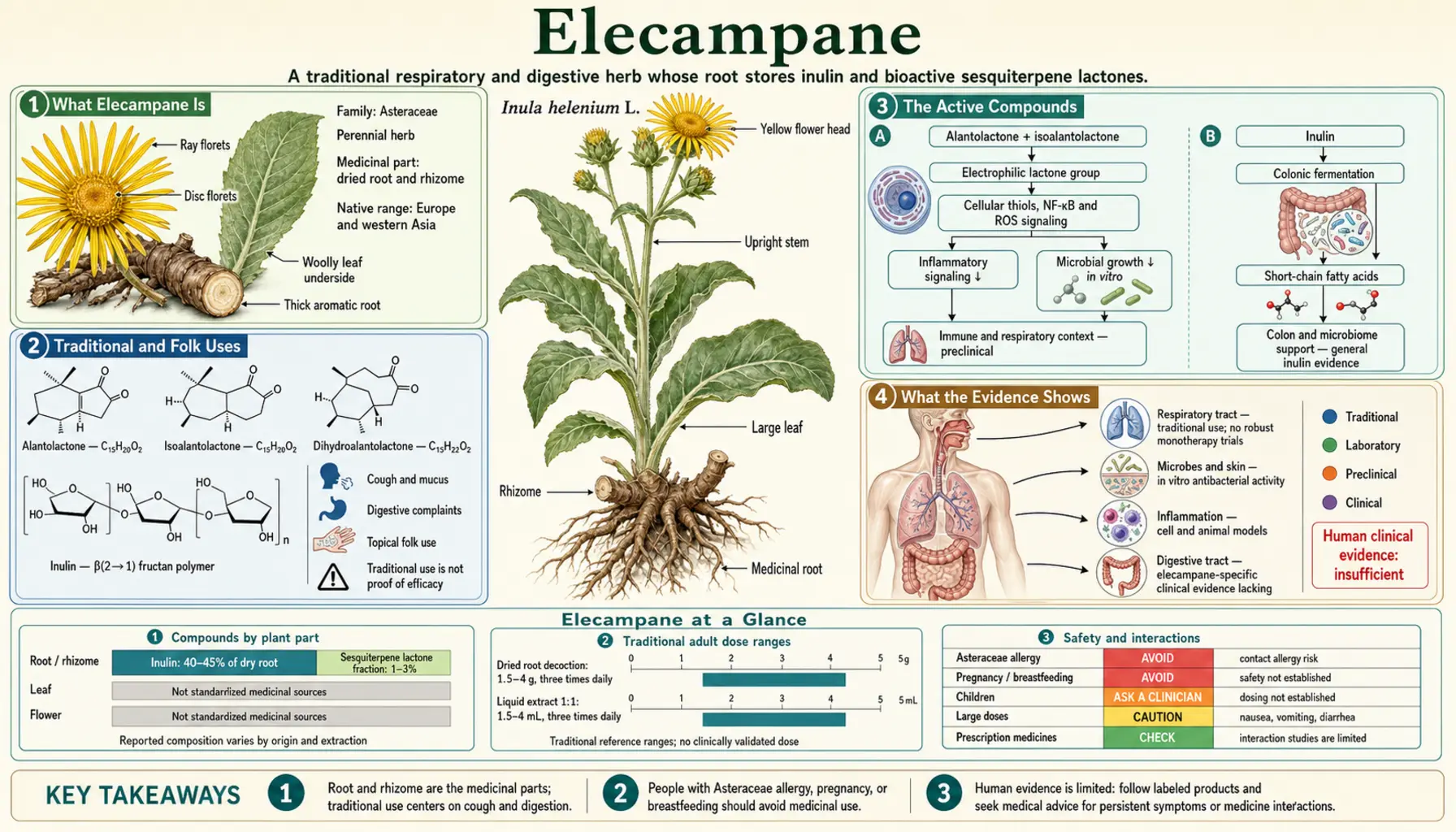
Elecampane (Inula helenium) is a tall, cheerful, yellow-flowered perennial in the daisy family whose large, aromatic root has been one of Europe's most trusted lung and chest herbs for well over two thousand years. Herbalists reached for it when a cough was wet and rattly, when the chest felt clogged, or when someone was slow to recover from a winter bronchitis. It was also a digestive bitter and a folk "worm" remedy. This page walks through what the plant is, how it was traditionally used, the compounds that make it interesting to modern chemists — a huge amount of the prebiotic fiber inulin plus two sesquiterpene lactones called alantolactone and isoalantolactone — and, honestly, what the science does and does not yet show. The traditional respiratory use is deep and consistent, and the laboratory data are genuinely interesting, but rigorous human trials are still thin. Elecampane also carries a real, well-documented caution: it is a notable skin allergen. We will be straight with you about all of it.
Table of Contents
- What Elecampane Is
- Traditional and Folk Uses
- The Active Compounds
- What the Evidence Shows
- Inulin, Prebiotics, and the Gut
- Forms and How It Is Used
- Safety and Cautions
- The Honest Bottom Line
- Research Papers
- Connections
- Featured Videos
What Elecampane Is
Elecampane is a big, striking plant. Left to grow, it reaches five to eight feet, sending up stout stems topped with bright yellow, shaggy, daisy-like flower heads and broad, downy leaves that can be a foot or more long. It belongs to the Asteraceae — the sunflower and daisy family — and is native to Europe and temperate Asia, though it long ago escaped gardens and naturalized across parts of North America. In the garden it reads as an old-fashioned, almost architectural plant; in the apothecary, only one part matters.
That part is the root: a thick, branching, aromatic rootstock usually dug in the autumn of the plant's second or third year, then sliced and dried. Fresh, it smells faintly of ripe bananas or violets; dried, it turns warming, bitter, and camphor-like, with a slightly sweet, sticky quality from all the starch-like fiber it holds. That aroma and warmth are exactly what traditional herbalists were after.
The plant carries a wonderful bundle of folk names that tell you how it was used. "Elf dock," "elfwort," and "elecampane" itself (from the medieval Latin enula campana, roughly "Inula of the fields") speak to its long presence in European life. "Horse-heal" and "scabwort" point to its heavy use in old veterinary medicine, where the root was given to horses for coughs and to livestock for skin conditions like sheep scab. And the botanical name Inula helenium ties the plant, in legend, to Helen of Troy — one story says the herb sprang up where her tears fell, another that she held a handful of it when Paris carried her away. Whether or not the myth is true, the name has stuck for centuries.
Traditional and Folk Uses
Elecampane is, first and foremost, the classic respiratory herb of the Western tradition. The Greek physician Dioscorides and the Roman naturalist Pliny both described the root, and Roman households kept it as enula campana. Through the medieval monastery gardens, into the herbals of the Renaissance, and right down to the nineteenth-century Eclectic physicians of North America, its reputation was remarkably steady: it was the herb for a wet, productive, lingering cough.
Herbalists classed it as a warming expectorant — a remedy meant to loosen thick, stubborn mucus and help the body move it up and out of the chest. It was reached for in bronchitis, in the long tail of a cold that had "gone to the chest," in chest congestion, and traditionally even in whooping cough and the coughs of tuberculosis (in an era with few other options). The idea of "warming" mattered: elecampane was chosen for damp, cold, boggy congestion rather than a dry, hot, tickly cough, for which soothing herbs like marshmallow were preferred.
Beyond the lungs, the bitter, aromatic root had two other traditional jobs. As a digestive bitter, a little before meals was said to wake up a sluggish appetite, settle the stomach, and ease gas and bloating — the usual work of an aromatic bitter. And as a traditional antiparasitic or "worm" remedy (a vermifuge), it was given to expel intestinal worms, a use that shows up repeatedly in old European and folk pharmacies. The candied or preserved root was also eaten as a sweetmeat and a general "lung tonic" through the winter.
The Active Compounds
Two very different kinds of chemistry live side by side in the elecampane root, and understanding them explains both the benefits and the cautions.
Inulin — the fiber that was named for this plant
Elecampane root is extraordinarily rich in inulin, a soft, starch-like storage fiber (a fructan) that can make up a very large share of the dried root — often quoted at roughly 40 percent or more. This is not a coincidence of naming: inulin was first isolated from elecampane, by the German chemist Valentin Rose in 1804, and the fiber was named inulin directly after the plant's genus, Inula. Inulin is not "active" in a drug-like way; instead it is a prebiotic — food for beneficial gut bacteria — and it gives the root its sticky, faintly sweet character. More on that below.
Alantolactone and isoalantolactone
The pharmacologically busy compounds are a pair of sesquiterpene lactones: alantolactone and its close cousin isoalantolactone. Concentrated in the root's essential oil and once known collectively as "alant camphor" or "helenin," these two molecules carry most of what the lab studies find interesting — the antimicrobial, antifungal, anti-inflammatory, and cough-related activity, and, in cell studies, the anticancer activity. Chemists have measured and extracted them from the root using a range of methods, confirming that the sesquiterpene lactones are genuinely there in meaningful amounts.
Here is the honest catch: the very same sesquiterpene lactones that do the interesting biology are also the part that causes allergy. Alantolactone is a recognized, potent skin sensitizer. So the compound class is a double-edged sword — a theme we return to in the safety section.
What the Evidence Shows
Let us separate what is well established from what is promising-but-preliminary, because with elecampane the gap is real.
Antimicrobial and antifungal action — solid lab evidence
This is where the modern data are strongest. The essential oil of elecampane root inhibits a range of microbes in the test tube, including Gram-positive and Gram-negative bacteria and Candida yeasts, with the sesquiterpene lactones doing much of the work. Isolated isoalantolactone shows antimicrobial activity of its own. This lines up neatly with the plant's traditional use for infected, mucky chest conditions — a warming herb that also happens to discourage microbes. It is important to be precise, though: these are laboratory findings against microbes in a dish, not clinical trials showing elecampane cures a specific human infection.
Anti-inflammatory and respiratory effects
A well-designed cell study found that Inula helenium extracts calmed inflammation in human immune cells and in cultured human respiratory (airway) tissue, reducing the release of inflammatory mediators. This is one of the more directly relevant modern findings, because it offers a plausible mechanism for the old observation that elecampane helps an irritated, inflamed, congested chest.
Cough and expectorant action
The expectorant and cough-easing reputation remains largely traditional and mechanistic. The aromatic essential oil and the sesquiterpene lactones are thought to help thin and mobilize mucus and to soothe the cough reflex, which is consistent with centuries of use — but there are no large, high-quality randomized human trials confirming that elecampane relieves cough better than placebo. So when you read that it is a proven cough remedy, treat that as traditional use supported by mechanism, not by clinical proof.
Anticancer — interesting, but only in cells so far
Alantolactone has become a popular molecule in laboratory cancer research. In cell and molecular studies it can trigger apoptosis (programmed cell death) in cancer cell lines and interferes with signaling pathways such as STAT3 that tumors rely on. This is genuinely interesting pharmacology and is why several reviews now catalog alantolactone's anticancer mechanisms. But it must be said plainly: this work is in cells and, at most, animal models — not in people. Nothing here means that drinking elecampane tea treats cancer, and it should never replace real oncology care.
What happens to it in the body
Absorption studies using intestinal cell models show that alantolactone and isoalantolactone can be taken up across the gut lining, which helps explain how the compounds could have effects beyond the digestive tract. This is early pharmacokinetic groundwork, useful for researchers, rather than a clinical result.
Inulin, Prebiotics, and the Gut
The other half of elecampane's story is the fiber. Because the root is so loaded with inulin, it doubles as a gentle prebiotic: inulin passes undigested into the large intestine, where friendly bacteria — especially Bifidobacteria — ferment it. That fermentation feeds a healthier microbial balance and produces short-chain fatty acids that nourish the gut lining. Inulin from many plant sources (chicory, Jerusalem artichoke, elecampane) is now a well-studied dietary prebiotic, and it is a reasonable part of why traditional herbalists felt elecampane was "strengthening" and good for digestion and appetite.
Two honest caveats. First, the same fermentation that helps the microbiome can cause gas, bloating, or loose stools in people who are sensitive to fructans or who have conditions like SIBO or IBS — inulin is a FODMAP. Second, a cup of elecampane tea is not a concentrated inulin supplement; the prebiotic effect from ordinary herbal doses is modest. It is a nice bonus of the herb, not its headline act.
Forms and How It Is Used
Elecampane is a root, so preparations are built to pull compounds out of a tough, fibrous material:
- Decoction (root tea). Because it is a hard root, it is traditionally simmered gently rather than just steeped — a small amount of dried root brought to a low simmer for ten to fifteen minutes, then strained. The result is warming, bitter, and aromatic. This is the classic chest-and-digestion preparation.
- Tincture. An alcohol extract concentrates both the sesquiterpene lactones and the bitters into an easily dosed liquid; a small number of drops in water is typical.
- Syrup and lozenges. The bitterness pairs naturally with honey, so cough syrups and throat lozenges made with elecampane are a long tradition, often combined with other lung herbs.
- Candied or preserved root. Historically the root was boiled in sugar and eaten through winter as a sweetmeat and lung tonic — the origin of some old "elecampane candy."
Elecampane is often blended with companion respiratory herbs — thyme, mullein, marshmallow, licorice — each covering a slightly different job (antimicrobial, expectorant, soothing, harmonizing). Traditional doses are modest, and because the root is warming and can irritate in excess, more is emphatically not better.
Safety and Cautions
Elecampane is a storied herb, but it is not a gentle "anything goes" tea. Its cautions are real and worth respecting.
Allergy and contact dermatitis — the headline caution
The sesquiterpene lactones that make elecampane interesting, above all alantolactone, are strong skin sensitizers. Elecampane is a well-recognized cause of allergic contact dermatitis: handling the plant or its preparations can trigger an itchy, red, sometimes blistering rash in sensitized people, and alantolactone is so reliably allergenic that it has been used as a marker allergen in patch-test screening for daisy-family allergy. Historically, workers who processed the root developed dermatitis from it.
Because it is in the Asteraceae, elecampane also carries a daisy-family cross-allergy risk. People who react to ragweed, chrysanthemum, chamomile, feverfew, marigold, arnica, or other Compositae plants may react to elecampane too, and studies of Compositae dermatitis document how common this cross-sensitivity is. If you have a known daisy/ragweed allergy, be cautious or avoid it.
Dose-related stomach upset
In ordinary amounts elecampane is generally well tolerated by mouth, but higher doses can irritate the gut, causing nausea, vomiting, diarrhea, and cramping. This is a classic case where exceeding traditional amounts backfires. Start low, and stop if it disagrees with you.
Pregnancy
Avoid elecampane in pregnancy. It has a traditional reputation as a uterine and menstrual stimulant, and there is not enough safety data to consider it safe for a developing pregnancy. It is also best avoided while breastfeeding, again for lack of safety information.
Medication interactions
Use caution and talk to a knowledgeable clinician or pharmacist if you take:
- Sedatives or sleep medications — elecampane has a mild traditional sedative/antispasmodic quality, which could add to drowsiness.
- Diabetes / blood-sugar medications — the herb (and its inulin) may influence blood sugar, so watch for additive effects if you are already treating high blood sugar.
- Blood-pressure medications — use caution, since combined effects are possible and not well characterized.
As always, this page is educational and not a substitute for personalized medical advice. A cough that lasts more than a couple of weeks, brings blood, comes with high fever or breathlessness, or hits someone with asthma, COPD, or a weakened immune system deserves a real medical evaluation — not just a pot of root tea.
The Honest Bottom Line
Elecampane is one of the great traditional lung and digestive herbs of the Western world, with a lineage that runs from Dioscorides to the Victorian apothecary. The modern picture is encouraging but incomplete: there is good laboratory evidence that its sesquiterpene lactones are antimicrobial, antifungal, and anti-inflammatory (including in respiratory tissue), and intriguing anticancer activity in cell studies — but robust human clinical trials are still missing, so the cherished cough-and-chest use rests on tradition plus mechanism rather than proof. For many people it is a reasonable, time-honored choice for a wet, congested cough, especially blended with companion respiratory herbs. The one caveat you should not skip is allergy: alantolactone is a real contact allergen, and anyone with daisy-family sensitivity, a pregnancy, or a serious respiratory illness should be cautious or steer clear. Used thoughtfully and in modest amounts, it is a warming, characterful herb with a genuinely deep history.
Research Papers
- Seca AML, Grigore A, Pinto DCGA, Silva AMS. The genus Inula and their metabolites: from ethnopharmacological to medicinal uses. Journal of Ethnopharmacology. 2014;154(2):286-310. doi:10.1016/j.jep.2014.04.010 — broad review of Inula phytochemistry (inulin, alantolactone, isoalantolactone) and traditional and medicinal uses.
- Gierlikowska B, Gierlikowski W, Bekier K, Skalicka-Woźniak K, Czerwińska ME, Kiss AK. Inula helenium and Grindelia squarrosa as a source of compounds with anti-inflammatory activity in human neutrophils and cultured human respiratory epithelium. Journal of Ethnopharmacology. 2020;249:112311. doi:10.1016/j.jep.2019.112311 — elecampane extracts reduced inflammatory mediators in human immune cells and airway tissue.
- Deriu A, Zanetti S, Sechi LA, Marongiu B, Piras A, et al. Antimicrobial activity of Inula helenium L. essential oil against Gram-positive and Gram-negative bacteria and Candida spp. International Journal of Antimicrobial Agents. 2008;31(6):588-590. doi:10.1016/j.ijantimicag.2008.02.006 — root essential oil inhibited a range of bacteria and Candida in vitro.
- Bourrel C, Vilarem G, Perineau F. Chemical analysis, bacteriostatic and fungistatic properties of the essential oil of elecampane (Inula helenium L.) Journal of Essential Oil Research. 1993;5(4):411-417. doi:10.1080/10412905.1993.9698251 — characterized the root oil and documented its antibacterial and antifungal action.
- Chun J, Li RJ, Cheng MS, Kim YS. Alantolactone selectively suppresses STAT3 activation and exhibits potent anticancer activity in MDA-MB-231 cells. Cancer Letters. 2015;357(1):393-403. doi:10.1016/j.canlet.2014.11.049 — mechanism of alantolactone's anticancer activity in a breast-cancer cell line (laboratory study).
- Rasul A, Khan M, Ali M, Li J, Li X. Targeting apoptosis pathways in cancer with alantolactone and isoalantolactone. The Scientific World Journal. 2013;2013:248532. doi:10.1155/2013/248532 — review of how the two sesquiterpene lactones trigger programmed cell death in cancer cells.
- Babaei G, Gholizadeh-Ghaleh Aziz S, Rajabi Bazl M, Khadem Ansari MH. A comprehensive review of anticancer mechanisms of action of alantolactone. Biomedicine & Pharmacotherapy. 2021;136:111231. doi:10.1016/j.biopha.2021.111231 — catalogs alantolactone's laboratory anticancer pathways (cell and animal data, not human trials).
- Xu R, Peng Y, Wang M, Li X. Intestinal absorption of isoalantolactone and alantolactone, two sesquiterpene lactones from Radix Inulae, using Caco-2 cells. European Journal of Drug Metabolism and Pharmacokinetics. 2019;44(2):295-303. doi:10.1007/s13318-018-0510-x — showed both compounds can be absorbed across an intestinal-cell model.
- Liu CH, Mishra AK, He B, Tan RX. Antimicrobial activities of isoalantolactone, a major sesquiterpene lactone of Inula racemosa. Chinese Science Bulletin. 2001;46(6):498-501. doi:10.1007/BF03187267 — isoalantolactone (also present in elecampane) showed antimicrobial activity; studied in a related Inula species.
- Trendafilova A, Chanev C, Todorova M. Ultrasound-assisted extraction of alantolactone and isoalantolactone from Inula helenium roots. Pharmacognosy Magazine. 2010;6(23):234. doi:10.4103/0973-1296.66942 — confirmed and quantified the sesquiterpene lactones in the elecampane root.
- Paulsen E. Contact sensitization from Compositae-containing herbal remedies and cosmetics. Contact Dermatitis. 2002;47(4):189-198. doi:10.1034/j.1600-0536.2002.470401.x — documents allergic contact dermatitis from daisy-family (Compositae) herbal products, the family that includes elecampane.
- Paulsen E, Andersen KE, Hausen BM. Compositae dermatitis in a Danish dermatology department in one year. Contact Dermatitis. 1993;29(1):6-10. doi:10.1111/j.1600-0536.1993.tb04528.x — epidemiology of Compositae (daisy-family) allergic contact dermatitis and cross-reactivity.
Connections
- All Herbs
- Mullein
- Marshmallow Root
- Thyme
- Licorice
- Eucalyptus
- Peppermint
- Oregano
- Pulmonology
- Bronchitis
- COPD
- SIBO
- Conditions on this site that reference this page: Bacteria · SIBO Root Causes · Allergic Rhinitis (Hay Fever) · Allergies · Pain & Allergy · Ascaris · Giardia · Hookworm