Blessed Thistle Safety: Allergy, Pregnancy and Dose
There is an uncomfortable pattern across this whole Benefits section: the things we can state most confidently about blessed thistle are safety facts, not benefit facts. The appetite indication rests on tradition and expert judgement. The liver reputation is borrowed from another plant. The milk-supply claim has no controlled trials. But the emetic effect at higher doses is well-documented, the daisy-family allergy risk follows from chemistry that is characterised in detail, and the pregnancy contraindication is standard across every reference source that lists the herb.
That asymmetry is worth naming out loud, because it inverts how the plant is usually presented. It does not make blessed thistle dangerous — a small bitter tea is a low-risk thing to drink. It does mean that on the strength of the available evidence, the cautions on this page are on firmer ground than the reasons for taking it.
Table of Contents
- The Cautions at a Glance
- Why Cnicin's Chemistry Predicts the Risks
- Asteraceae Allergy and Cross-Reactivity
- Sesquiterpene Lactone Contact Sensitisation
- The Emetic Effect: Benefit and Hazard as One Property
- Ulcer, Gastritis and Reflux
- Pregnancy: Why This Is a Contraindication
- Breastfeeding, Infants and Children
- Interactions, and What "No Known Interactions" Means
- Product Identity Is a Safety Issue
- Dose: What We Will and Will Not Say
- When to Stop and When to Seek Help
- What We Do Not Know
- Key Research Papers
- Connections
- Featured Videos
The Cautions at a Glance
- Reference sources list pregnancy as a contraindication. Traditional emmenagogue and abortifacient use, no safety data. This is the firmest contraindication on the page.
- Daisy-family allergy can carry over to blessed thistle in people who react to ragweed, chrysanthemum, feverfew, chamomile, yarrow, arnica, marigold, echinacea, artichoke, lettuce or sunflower.
- The dose matters. Large amounts cause nausea and vomiting; the plant was historically used as a deliberate emetic.
- Active peptic ulcer disease, erosive gastritis and significant reflux are the settings where a gastric irritant raises concern.
- Handling the fresh or dried herb can cause contact dermatitis, independently of drinking it.
- Interactions are unstudied — no enzyme, transporter or interaction studies exist, and alcoholic tinctures add ethanol, which matters with metronidazole, disulfiram, sedatives and liver disease.
- A Latin binomial on the label — Cnicus benedictus or Centaurea benedicta — is the minimum identity check; in a 2022 analysis, only 13 of 21 supplements claiming to contain blessed thistle (62%) were confirmed to contain it.
- New, unexplained appetite loss or weight loss is a red-flag symptom that doctors investigate; a bitter tea does not address it.
Why Cnicin's Chemistry Predicts the Risks
Almost everything on this page follows from one structural feature, which makes the safety profile unusually predictable for a traditional herb.
Cnicin is a germacranolide sesquiterpene lactone carrying an alpha-methylene-gamma-lactone group. That group is an electrophilic Michael acceptor: it reacts readily with nucleophiles, and the most abundant biological nucleophiles are the thiol groups of cysteine residues in proteins and of glutathione. Cnicin therefore forms covalent adducts with proteins fairly indiscriminately.
Follow that single fact through and you get the whole picture:
- Intense bitterness. Bitter taste receptors respond well to reactive terpenoids — a chemical alarm system detecting exactly this class of plant defence compound.
- Broad in-vitro activity. Antibacterial and cytotoxic effects reported together in the 2011 Natural Product Communications study of cnicin and onopordopicrin (cnicin isolated from a related knapweed, Centaurea diffusa, not from blessed thistle), including high cytotoxicity against human-derived immune cells (macrophages); antiparasitic activity against Schistosoma mansoni in Parasitology Research in 2021, where cnicin from blessed thistle killed adult worms in the dish and worked in infected mice when injected into the abdomen, but taken by mouth, alone or in a beta-cyclodextrin complex, gave no significant worm reductions — only a hydroxypropyl-beta-cyclodextrin complex worked by mouth. The authors point to cnicin's poor water solubility as the limit. Non-selective protein modification kills a lot of things in a dish, which is why such results are weak evidence of therapeutic value and good evidence of reactivity.
- Contact allergy. Covalent modification of skin proteins creates new antigens. That is the definition of a chemical sensitiser.
- Mucosal irritation and emesis. A reactive irritant in contact with gastric mucosa produces irritation; enough of it triggers vomiting.
This is a case where the benefit and the hazard are one property described twice. The bitterness that makes blessed thistle a bitter tonic and the reactivity that makes it a sensitiser and a gastric irritant are not separable features that could be engineered apart. They are the same electrophilic lactone. A "non-bitter, non-irritant blessed thistle" would not be blessed thistle doing its job.
Blessed thistle is not unusual in this. The same reasoning governs the safety pages for elecampane (alantolactone), feverfew (parthenolide), chrysanthemum and yarrow. They are all Asteraceae, they all carry sesquiterpene lactones, and they all share this class hazard.
Asteraceae Allergy and Cross-Reactivity
Blessed thistle is a member of the Asteraceae (Compositae), the daisy family — one of the largest plant families and one of the most clinically important for allergy. Sensitisation to one member frequently means reactivity to others, because the shared sesquiterpene lactones are the sensitising chemistry.
Plants in the family that matter for cross-reactivity:
- Ragweed (Ambrosia) — the big one in North America. Ragweed hay fever is common and its sufferers are the largest group with a reason for caution here.
- Mugwort (Artemisia vulgaris) — the corresponding major pollen sensitiser in much of Europe and Asia.
- Chrysanthemum — classically implicated in occupational contact dermatitis among florists and growers.
- Feverfew — parthenolide is a well-characterised sensitiser, and oral use has its own mucosal side effects.
- Chamomile — occasional but genuine reactions, including reported anaphylaxis, most often in people already sensitised to other Asteraceae.
- Yarrow, arnica, calendula, echinacea, tansy, dandelion, elecampane.
- Food members: lettuce, chicory, endive, artichoke, sunflower seed, safflower, tarragon, Jerusalem artichoke. Somebody with significant Compositae sensitivity may already know they react to some of these.
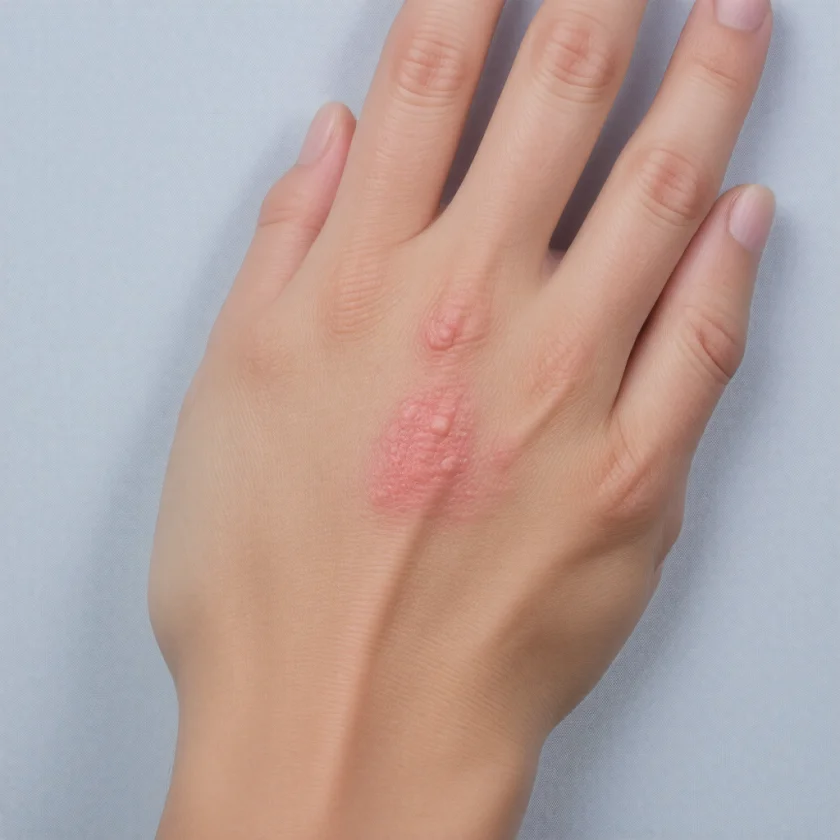
What a reaction looks like, roughly in order of frequency: itching or tingling in the mouth, lips and throat after drinking the tea; rash, hives or eczema-like dermatitis; nasal symptoms, sneezing and eye irritation; and rarely wheeze, throat swelling or systemic anaphylaxis. Any airway involvement, throat tightness or facial swelling is a medical emergency — that is not the moment to look up whether it was the herb.
Who the cross-reactivity concerns most: people with documented ragweed or mugwort pollen allergy, or who have reacted to chamomile tea, feverfew, arnica cream or chrysanthemum. For them, the potential upside of blessed thistle is a modestly better appetite and the potential downside is a systemic allergic reaction. See also Allergies and Allergic Rhinitis.
Sesquiterpene Lactone Contact Sensitisation
This risk is separate from drinking the tea, and it is the best-characterised hazard in the whole Compositae story.
Compositae dermatitis is a recognised clinical entity, documented in surveys of patch-tested patients since at least the early 1990s, and it disproportionately affects gardeners, florists, farm workers and herbalists — people whose hands and forearms contact plant material repeatedly. Presentation is typically an eczematous eruption on exposed skin, often worse seasonally, sometimes with an airborne pattern affecting the face and eyelids from plant dust rather than direct contact.
Diagnostically, the sesquiterpene lactone mix is a standard patch-test allergen used as a screening tool for Compositae sensitivity, developed in the late 1980s precisely because this compound class is the common sensitiser across an otherwise diverse family. That a whole compound class earned its own patch-test reagent tells you how routine the problem is.
Two consequences follow for blessed thistle specifically:
- Handling loose dried herb can sensitise or provoke, independently of ingestion. This matters for people who make their own teas from bulk material or grow the plant, particularly with existing hand eczema; gloves are the usual barrier.
- Sensitisation is generally durable. Contact allergy, once established, tends to persist and to broaden across the family rather than fade. A minor rash from a herb you did not need is a poor trade if it later complicates gardening or eating lettuce.
Two things we will not do here. We will not tell you the concentration of cnicin needed to sensitise skin — that has not been established for this compound. And we will not tell you how commonly blessed thistle specifically causes dermatitis, because the published Compositae literature is dominated by the plants people handle in bulk, and blessed thistle is not among the frequently reported culprits. Its risk is inferred from compound class, and we would rather say that than manufacture a frequency.
The Emetic Effect: Benefit and Hazard as One Property
Blessed thistle in quantity makes people vomit. This is not a rare idiosyncratic reaction; it is a dose-dependent pharmacological effect that older herbals exploited deliberately, in the era when induced emesis was considered therapeutic.
It is the clearest example on this page of benefit and hazard being one mechanism. The plant is useful as a bitter because cnicin is an intensely bitter, reactive irritant. Push that same property harder and you get gastric irritation, nausea and emesis. There is no version of blessed thistle that is strongly bitter and cannot make you sick, and the practical consequence is unusual for a herb: the gap between the useful dose and the unpleasant dose is narrow, and it is bridged by nothing more than enthusiasm. A reader who reasons "if a little helps, more will help more" is reasoning towards vomiting.
This also explains why the traditional protocol is so specific about small amounts before meals, and why the sensible forms — tea and tasted tincture — are somewhat self-limiting: they taste bad enough that most people stop. Capsules remove that brake. A tasteless capsule is easy to take several of, which is the worst combination available for this plant: no cephalic-phase bitter stimulus, so arguably less of the intended effect, and no sensory feedback discouraging escalation.
Nausea or vomiting is a signal that the dose is too high, not a sign of the remedy working.
Ulcer, Gastritis and Reflux
Bitters are irritants by design, and an already-inflamed mucosa is where irritation does harm. Situations where the research raises a concern:
- Active peptic ulcer disease — gastric or duodenal ulcer. A concentrated bitter can aggravate symptoms, and the traditional stimulation of acid secretion is the opposite of what ulcer treatment aims for.
- Gastritis, particularly erosive gastritis, and any nonsteroidal anti-inflammatory drug (NSAID)-associated gastropathy.
- Significant gastro-oesophageal reflux disease. Increased acid secretion and any relaxing effect on the lower oesophageal sphincter both point the wrong way. Alcoholic tinctures compound this, since ethanol itself relaxes the sphincter.
- Unexplained upper abdominal pain that has not been assessed. The traditional indication is functional dyspepsia — symptoms without structural disease. Establishing that requires assessment. Treating undiagnosed epigastric pain with a bitter risks masking something that needs a diagnosis; alarm features such as weight loss, vomiting, difficulty swallowing, anaemia or black stools need investigation rather than herbs.
Worth noting that these are mechanistic cautions rather than documented harms. There is no case series of blessed thistle exacerbating ulcers — because nobody collects that data. Under the principle that absent surveillance is not reassurance, the mechanistic caution stands on its own.
Pregnancy: Why This Is a Contraindication
Reference sources list pregnancy as a contraindication for blessed thistle, and the same concern applies to people trying to conceive. This is the position of every reference source we are aware of that lists the herb, and it rests on three converging arguments.
1. Traditional emmenagogue and abortifacient use. Blessed thistle appears in historical herbals as an emmenagogue — an agent to bring on delayed menstruation — and in the abortifacient lists that shadow that category. Those two uses are frequently the same tradition described in more or less deniable language. Whether the herb ever worked for that purpose is unknown and largely unknowable. But traditional use as an emmenagogue is a specific claim of uterine activity, and it is not a claim to dismiss in someone who wants to stay pregnant. Where a tradition asserts an effect on the uterus, the correct response is to take the assertion seriously as a hazard even while doubting it as an efficacy claim — the asymmetry of consequences settles it.
2. No safety data. There are no pregnancy exposure studies, no reproductive toxicology on cnicin that we can point to, no registry data. Ordinarily "no reported harm" reads as reassuring; in pregnancy it reads as an unexamined risk. Nobody is systematically collecting outcomes among pregnant women drinking blessed thistle tea, so the absence of reports reflects absent surveillance rather than demonstrated safety.
3. No offsetting benefit. This is decisive. The plausible benefit is appetite stimulation and digestive comfort. Nausea and appetite disturbance in pregnancy have their own well-trodden management, including ginger, vitamin B6 and prescribed antiemetics with actual pregnancy safety data. There is nothing blessed thistle offers that cannot be obtained from an option with a better-characterised profile. When the benefit is marginal and the hazard is uncharacterised, the calculation is not close.
A specific warning about lactation blends, because the two situations are easy to run together: some products marketed for nursing contain blessed thistle, and some people begin taking them late in pregnancy to "get ahead" of milk supply. The pregnancy contraindication applies to those blends too. The lactation context and the pregnancy context give opposite answers for this herb, and a product being labelled for breastfeeding is not a statement about its use before delivery. The ingredient list shows whether a blend contains it.
Breastfeeding, Infants and Children
During breastfeeding, blessed thistle at tea strength is generally treated as low concern by reference sources on drugs and lactation, while those same sources note the shortage of data. Points specific to this setting:
- Transfer into milk has not been measured. No published study establishes whether cnicin or its metabolites appear in breast milk, at what concentration, or what the infant is exposed to.
- Vomiting is counterproductive here in a direct way. Dehydration from an emetic dose will do more harm to milk supply than the herb could plausibly do good — see the breastfeeding page for the full treatment of the supply claim.
- Multi-herb lactation teas multiply the unknowns. Five ingredients is five safety profiles, and some common additions carry their own cautions. Fewer ingredients is better.
- No basis for use in infants or young children. There is no dosing basis and no paediatric safety data, including for colic or feeding problems in babies, and an emetic bitter is a poor thing to guess with.
- Rash or unusual fussiness in the infant, or a rash in the mother, while the mother takes the herb is a sign the herb may be the cause.
Interactions, and What "No Known Interactions" Means
You will read that blessed thistle has no known drug interactions. That phrase is systematically misleading and deserves translation: "no known interactions" here means no interaction study has been performed. It describes the state of the literature, not the state of the herb. It is absent data, not a clearance.
Specifically unstudied:
- Effects on cytochrome P450 enzymes or drug transporters — the pathways through which most clinically important herb-drug interactions occur.
- Interaction with acid suppressants (proton pump inhibitors, H2 blockers), whose purpose a bitter's traditional mechanism arguably opposes.
- Interaction with prokinetics, antiemetics, domperidone or metoclopramide.
- Interaction with anticoagulants, antiplatelets or antidiabetic drugs.
- Any interaction arising from the other ingredients in a blend, which is where the real risk in a multi-herb product usually sits.
Two practical implications. Alcoholic tinctures contribute ethanol, which is relevant with metronidazole, disulfiram, sedatives and in liver disease — a property of the vehicle rather than the plant, and one people forget. And because no cytochrome P450 or transporter study exists, the interaction risk with any prescription medicine is unknown rather than absent.
Product Identity Is a Safety Issue
Everything above assumes the packet contains blessed thistle. That assumption is doing more work than it should.
Dried, cut aerial herb is difficult to identify visually once it has been through processing, and bulk botanical material passes through multiple hands. Analytical methods for fingerprinting cnicin, flavonoids and phenolics in blessed thistle and in commercial supplements exist — published in the Journal of Pharmaceutical and Biomedical Analysis in 2022. That study tested 21 dietary supplements claiming to contain blessed thistle: only 13 (62%) showed all the marker compounds and were confirmed to contain Cnicus benedictus; the rest could not be confirmed as the labelled plant.
The tempting reading of an adulteration caveat is reassurance: "substitution is uncommon, so my product is probably fine." That inverts the logic. If you cannot verify which plant is in the packet, the uncertainty counts against the product, not in its favour. Unverified botanical material is not innocent until proven adulterated — it is unidentified, and an unidentified plant has an unknown safety profile rather than blessed thistle's.
What a label can show:
- A Latin binomial on the label — Cnicus benedictus or Centaurea benedicta. Without it, the label does not identify the plant.
- The plant part named — aerial parts, herb, leaf or flowering tops. "Blessed thistle seed" indicates a manufacturer confusing this plant with milk thistle, which uses the seed. See Blessed Thistle Is Not Milk Thistle.
- A batch or lot number, so a problem is traceable.
- Claims consistent with the plant. Liver and detox language on a blessed thistle label indicates a company that does not know what it is selling, and a silymarin percentage on the label is a category error.
- "Holy thistle" with no binomial — that name has been applied to both plants and identifies neither.
Dose: What We Will and Will Not Say
We will not print milligram figures, cnicin percentages or a maximum daily dose for blessed thistle, and it is worth saying explicitly that we are refusing rather than omitting. Here is why.
- Cnicin content varies with provenance, harvest timing, drying and storage, and no figure characterises the material generally — the 2022 analysis found cnicin ranging from 0.9 to 10.3 mg/g across the samples it tested.
- Extraction varies. Water temperature, steeping time, particle size, and the ethanol strength of a tincture all change how much bitter principle ends up in the cup.
- Product strengths differ by an unknown factor between manufacturers.
- No human dose-finding study exists. Traditional dose ranges — including those in the Commission E monograph — are inherited practice, not derived from trials.
- The emetic threshold has not been characterised. We know large doses cause vomiting; we do not know where the line is, and it plainly varies between people.
Any confident number we published would be a guess that other pages would then copy until it looked established. What can be said honestly:
- Each product's label carries its own dose, because strengths differ between manufacturers.
- Traditional use is a small amount shortly before a meal — a small cup of tea or a few drops of tincture in water.
- Traditionally, bitter enough to taste is the aim; more brings the emetic effect closer.
- There is no long-term safety data, so indefinite use has no evidence behind it.
- Combining several bitter products stacks the same class of irritant.
When to Stop and When to Seek Help
Signs the herb is disagreeing: nausea or vomiting; new rash, hives or itching; mouth, lip or throat tingling; worsening heartburn or epigastric pain; or any new symptom you cannot otherwise explain.
Signs hospitals treat as urgent: throat tightness, difficulty breathing or wheeze; swelling of the lips, tongue or face; widespread hives with faintness or dizziness; persistent vomiting with signs of dehydration; vomiting blood or passing black tarry stools; or severe abdominal pain. Emergency teams treat airway or circulatory symptoms after any herbal product as anaphylaxis until proven otherwise.
Symptoms doctors investigate rather than treat with herbs: unexplained weight loss or appetite loss, which is a red-flag symptom; difficulty swallowing; persistent vomiting; anaemia; a palpable abdominal mass; or dyspeptic symptoms that are new after the age of about fifty-five. A bitter tea's traditional place is known functional dyspepsia, not an undiagnosed symptom.
What We Do Not Know
- No formal toxicology. We can point to no published acute or chronic toxicity study, no established no-observed-adverse-effect level, and no reproductive toxicology for blessed thistle or purified cnicin. We will not quote a lethal dose, because we would be inventing it.
- No human pharmacokinetics. Absorption, distribution, metabolism and elimination of cnicin in humans are unestablished.
- The emetic dose threshold is uncharacterised, and interindividual variation is unmeasured.
- Sensitisation frequency is unknown. The compound class is a well-documented sensitiser; blessed thistle's individual contribution to Compositae dermatitis has not been quantified.
- Interactions are unstudied — no CYP or transporter data, no clinical interaction reports of any kind.
- Long-term use safety is unknown. No cohort has been followed on this herb.
- Milk transfer is unmeasured, so infant exposure during breastfeeding is unquantified.
- Adverse events are not systematically collected for this plant, so the sparse case literature reflects absent surveillance rather than demonstrated safety. For a herb taken by pregnant-capable and lactating populations, that asymmetry favours caution even with no documented harm.
Key Research Papers
Papers with a verified record link to PubMed by PMID; the rest are PubMed topic and title searches. Where metadata is uncertain the finding is described and a search given rather than a reference asserted.
- Blessed thistle, the modern review. "Cnicus benedictus: Folk Medicinal Uses, Biological Activities, and In Silico Screening of Main Phytochemical Constituents," Planta Medica, 2024 — the best single source on the plant, including its traditional uses and the state of its safety literature. PubMed search
- Cnicin's reactive, non-selective activity. Bach SM, Fortuna MA, Attarian R, et al. "Antibacterial and cytotoxic activities of the sesquiterpene lactones cnicin and onopordopicrin," Natural Product Communications, 2011 — cnicin isolated from Centaurea diffusa, a related knapweed; cytotoxicity reported alongside antibacterial activity is the signature of indiscriminate protein modification. PubMed PMID: 21425665
- Cnicin in a parasite model. Queiroz LS, Ferreira EA, Mengarda AC, et al. "In vitro and in vivo evaluation of cnicin from blessed thistle (Centaurea benedicta) and its inclusion complexes with cyclodextrins against Schistosoma mansoni," Parasitology Research, 2021 — further evidence of broad reactivity, and a reminder that the free compound needed formulating to behave. PubMed PMID: 33164156
- Compositae dermatitis as a clinical entity. Survey and case literature on Compositae contact dermatitis in gardeners, florists and farm workers, including its airborne facial pattern. PubMed search
- The sesquiterpene lactone mix patch test. Work establishing the sesquiterpene lactone mix as a screening allergen for Compositae sensitivity — the clearest evidence that this compound class is a routine sensitiser. PubMed search
- Why an alpha-methylene-gamma-lactone sensitises. Literature on the structure-activity relationship between the alpha-methylene-gamma-lactone group, thiol reactivity and allergenic potential. PubMed search
- Asteraceae pollen-food and pollen-herb cross-reactivity. Work on ragweed and mugwort sensitisation and cross-reactivity with related plants and foods, which is the basis of the caution for ragweed hay fever sufferers. PubMed search
- Chamomile hypersensitivity. Reported allergic reactions to chamomile including anaphylaxis, largely in patients sensitised to other Asteraceae — the closest well-documented analogue for what a serious blessed thistle reaction would look like. PubMed search
- Feverfew's oral and mucosal effects. Parthenolide-related mouth ulceration and mucosal irritation with oral feverfew — a documented instance of the class hazard appearing from ingestion rather than skin contact. PubMed search
- Product identity and authentication. Avula B, Katragunta K, Wang YH, Ali Z, Khan IA. "Simultaneous determination and characterization of flavonoids, sesquiterpene lactone, and other phenolics from Centaurea benedicta and dietary supplements using UHPLC-PDA-MS and LC-DAD-QToF," Journal of Pharmaceutical and Biomedical Analysis, 2022 — 13 of 21 supplements confirmed as the labelled plant; the analytical basis for treating label identity as verifiable rather than assumed. PubMed PMID: 35533533
- Herbal product adulteration generally. The DNA-barcoding and chemical-authentication literature on substitution in commercial botanicals, which is why an unverified packet is a safety question. PubMed search
- Herbal medicine adverse effects, overview. "Adverse effects of herbal medicines: an overview of systematic reviews," Clinical Medicine, 2013 — general framing for allergy, interactions and quality problems across herbal products. PubMed search
- Herbs in pregnancy. Reviews of herbal product use during pregnancy and the general absence of safety data, which is the evidential situation behind the contraindication here. PubMed search
- Blessed thistle in pregnancy and lactation, searched directly. The search returns monographs and general reviews rather than exposure studies — the absence is itself the result. PubMed search
Connections
- All Herbs
- Blessed Thistle — the main topic page
- Blessed Thistle Benefits Hub — all four deep dives
- Blessed Thistle as a Bitter — where the same chemistry is the benefit
- Blessed Thistle and Breastfeeding — the lactation claim in full
- Blessed Thistle Is Not Milk Thistle — product identity and the species confusion
- Elecampane: Sesquiterpene Lactones and Allergy — the same class hazard, alantolactone
- Chrysanthemum: Allergy and Safety — the classic Compositae contact allergen
- Feverfew: Side Effects — parthenolide and mucosal irritation
- Yarrow: Allergy and Safety — another Asteraceae bitter with a pregnancy caution
- Chamomile — the daisy-family herb with documented hypersensitivity reports
- Allergies — recognising and managing allergic reactions
- Allergic Rhinitis — ragweed and mugwort sensitisation
- Peptic Ulcer Disease — where a bitter is contraindicated
- Gastritis — irritated mucosa and bitter herbs
- Gastro-oesophageal Reflux Disease — acid, sphincter tone and tinctures