Chrysanthemum: Allergy Risk, Preparation and Safety
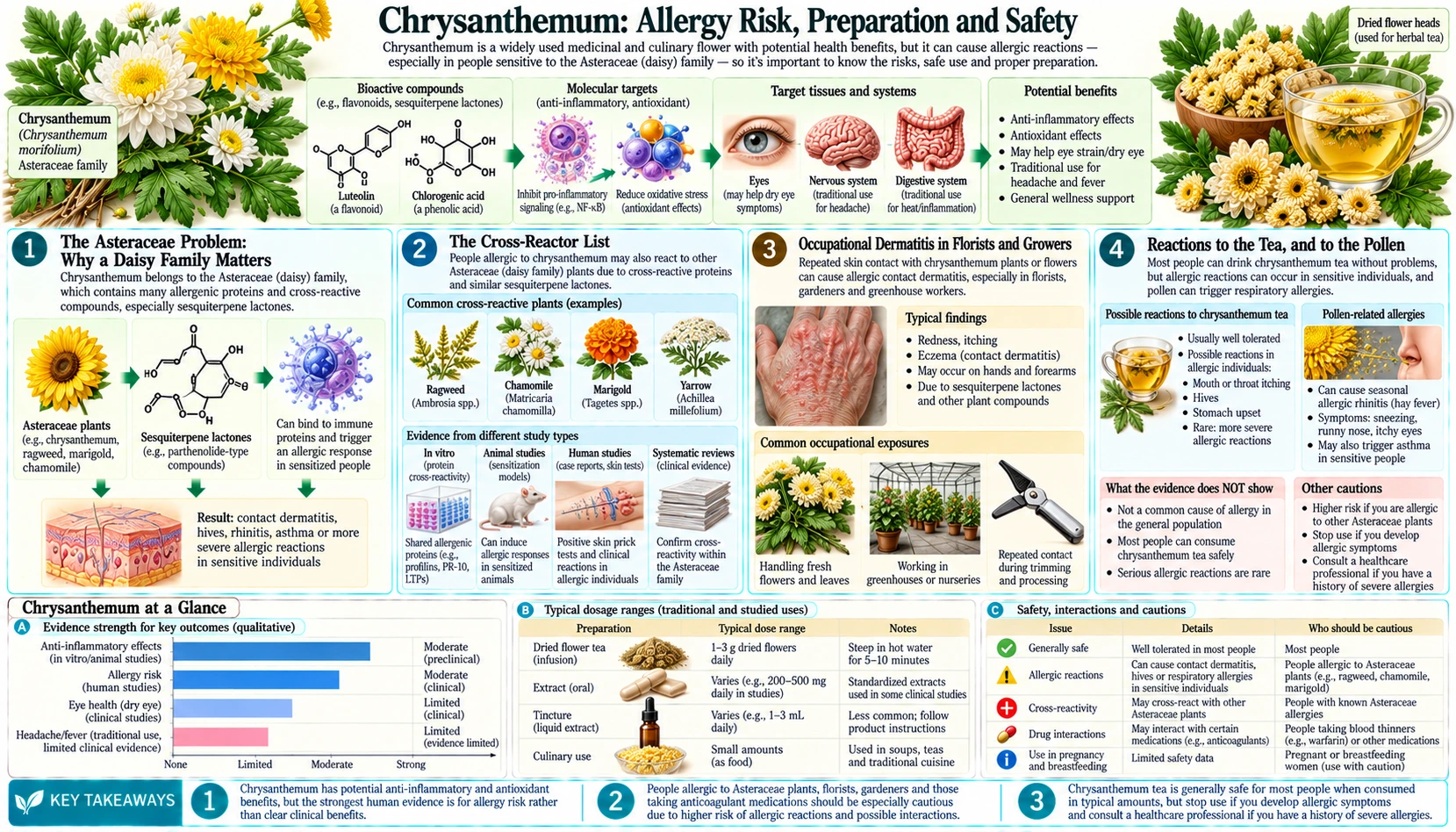
This is the most practically important page on chrysanthemum, and the reason is a single fact: chrysanthemum is a daisy. It belongs to the Asteraceae (formerly Compositae) — the family that also contains ragweed, mugwort, chamomile, feverfew, marigold, calendula, arnica, tansy, yarrow, echinacea, dandelion, sunflower, lettuce and artichoke. Members of that family share a class of compounds called sesquiterpene lactones, which are among the best-characterised contact allergens in all of dermatology. If you react to one Compositae plant, you have a meaningfully raised chance of reacting to others — because your immune system is recognising a shared chemical motif, not a species.
Everything else about chrysanthemum — the eye claim, the cooling claim, the antioxidant claim — is traditional use plus in-vitro constituent work. The allergy is the item with genuine, replicated human evidence, and it is a risk rather than a benefit. Contact dermatitis in florists and chrysanthemum growers has been documented since the 1970s, the allergens were chemically identified, and "sesquiterpene lactone mix" sits on standard dermatology patch-test panels precisely because sensitisation to it is common enough to screen for routinely.
This page also covers the two other things a careful buyer needs: the species confusion (including the "chrysanthemum" that natural insecticide is made from), and practical quality — sulphite fumigation, sugar-blended product, pesticide residue in cheap floral tea, and how to brew what you actually bought.
Table of Contents
- The Asteraceae Problem: Why a Daisy Family Matters
- The Cross-Reactor List
- Occupational Dermatitis in Florists and Growers
- Reactions to the Tea, and to the Pollen
- The Oral-Tolerance Hypothesis, and Why It Is Not Reassurance
- What Is Reported for People With an Asteraceae Allergy
- Recognising a Serious Reaction
- The Chrysanthemum That Is an Insecticide
- Buying the Right Species and Grade
- Sulphur Fumigation and Sulphite Residues
- Pesticide Residue in Cheap Floral Tea
- Sugar-Blended and Ready-to-Drink Product
- Brewing, Dose and Storage
- Other Cautions: Digestion, Pregnancy, Children, Medication
- Key Research Papers
- Connections
- Featured Videos
The Asteraceae Problem: Why a Daisy Family Matters
Evidence tier: well established in humans. This is the best-evidenced statement on any chrysanthemum page.
The Asteraceae is one of the largest plant families on earth, and a great many of its members produce sesquiterpene lactones — fifteen-carbon terpenoids carrying a lactone ring, very commonly an α-methylene-γ-butyrolactone. That structural motif is the problem. The exocyclic methylene group next to the lactone carbonyl is chemically reactive: it undergoes Michael addition with nucleophiles, including the thiol groups of cysteine residues in skin proteins. When that happens, the modified protein is presented to the immune system as something new, and a T-cell-mediated delayed hypersensitivity can be established. That is allergic contact dermatitis, and it is a type IV reaction — the same mechanism as nickel or poison ivy, not the immediate immunoglobulin E (IgE) mechanism of a peanut allergy.
Three consequences follow, and they explain almost everything about how this allergy behaves:
- Cross-reactivity is chemical, not taxonomic. The immune system is not recognising "chrysanthemum". It is recognising a reactive lactone motif that dozens of unrelated Compositae species happen to share. That is why people sensitised through one plant react to others they have never handled.
- Delayed hypersensitivity means delayed symptoms. A contact reaction typically appears 24–72 hours after exposure, not immediately. This is why people fail to connect their hand rash with the flowers they arranged two days earlier, and why the diagnosis is so often missed.
- Patch testing is the diagnostic tool. "Sesquiterpene lactone mix" is a standard reagent on baseline patch-test series internationally, and Compositae mix is available as a supplementary allergen. Its presence on those panels is a straightforward statement by the dermatology profession that this sensitisation is common enough to screen everyone for. A 2023 review gives the size of the problem: the mix (equal parts of alantolactone, costunolide and dehydrocostus lactone) was developed in the 1980s as a screening agent, and since it joined the baseline series about 1% of people patch-tested in Europe react to it, 0.8% in North America, and between 0% and 10.7% in other countries. In a random sample of 3,119 adults from the general population of five European countries who were patch tested with the standard panels plus the mix, nickel was the most common contact allergy (14.5%), and the sesquiterpene lactone mix was not among the allergens that reached 1%.
Chrysanthemum's own allergens were identified in the 1970s. Bleumink, Mitchell, Geissman and colleagues published “Contact hypersensitivity to sesquiterpene lactones in chrysanthemum dermatitis” in Contact Dermatitis in 1976, and Hausen and Schulz published “Chrysanthemum allergy III: identification of the allergens” in Archives of Dermatological Research the same year. The Hausen and Schulz work was done in guinea pigs sensitised with an extract of florists' chrysanthemum (Chrysanthemum indicum), and it identified arteglasin-A, the chrysanthemum sesquiterpene lactone most often named in that literature, as one of the allergens. The human evidence is the Bleumink patch-test study: in six people with contact allergy to florists' chrysanthemum, 15 of 25 sesquiterpene lactones gave positive reactions, alantolactone in every case. This is fifty-year-old, chemically characterised allergy science, with the allergen found in sensitised animals and the reactions confirmed by patch tests in people — not a speculative caution.
The Cross-Reactor List
For people to whom any of the following applies, chrysanthemum is a plausible cross-reactor, and the rest of this page describes what is known about drinking or handling it.
Airborne pollen allergy in this family:
- Ragweed (Ambrosia species) — the classic late-summer hay fever allergen in North America, and the most commonly relevant one. Ragweed-sensitive people are the single largest group at risk of a cross-reaction to chrysanthemum.
- Mugwort (Artemisia vulgaris) — the corresponding major late-summer weed pollen in Europe and much of Asia, and the hub of the well-known mugwort–celery–spice and mugwort–peach cross-reactivity clusters.
- Sunflower, feverfew and other Compositae pollens in occupationally exposed people.
Herbal and cosmetic Asteraceae you may already know you react to:
- Chamomile (Matricaria chamomilla, Chamaemelum nobile) — the other great Asteraceae flower tea. Chamomile is the Compositae plant most often reported in serious allergic reactions to a herbal drink, and it shares apigenin with chrysanthemum as well as the allergen class.
- Feverfew (Tanacetum parthenium) — a well-documented sensitiser; parthenolide, its named active compound, is a sesquiterpene lactone. If feverfew has ever given you mouth ulcers or a rash, that is a direct warning about chrysanthemum.
- Calendula / marigold (Calendula officinalis), and the ornamental marigolds (Tagetes).
- Arnica (Arnica montana) — a strong sensitiser, common in topical preparations.
- Echinacea — reactions including urticaria and, rarely, anaphylaxis are documented, with Asteraceae-sensitive people at higher risk.
- Yarrow (Achillea millefolium) and tansy (Tanacetum vulgare).
- Dandelion (Taraxacum officinale), wormwood (Artemisia absinthium), burdock, elecampane, boneset, blessed thistle, milk thistle.
- Laurel oil, and the sesquiterpene-lactone-containing non-Compositae that occasionally cross-react.
Foods in the family — usually lower risk but worth noting in someone with a strong Compositae picture: lettuce (which is a documented occupational Compositae allergen in growers), chicory and endive, artichoke, Jerusalem artichoke, sunflower seeds, chrysanthemum greens (tong hao / shungiku, actually Glebionis coronaria), and tarragon.
One important qualification, so this list is not read as alarmism. Cross-reactivity is a raised probability, not a certainty. Plenty of ragweed hay-fever sufferers drink chamomile and chrysanthemum tea with no trouble at all, and Asteraceae pollen allergy (an immunoglobulin E, respiratory phenomenon) and Compositae contact dermatitis (a T-cell, skin phenomenon) are different mechanisms that do not automatically travel together. Cross-reactivity means caution and a small first exposure, not avoidance by rule. The exception is anyone who has had a severe reaction to any Compositae plant — for that group, a further reaction can also be severe.
Occupational Dermatitis in Florists and Growers
The strongest human evidence about chrysanthemum sits in the occupational-dermatology literature, and it is worth understanding because it tells you where the real exposure risk is: handling the flowers, not drinking them.
Chrysanthemum dermatitis is a recognised occupational condition in florists, flower packers, nursery workers and chrysanthemum growers. The first florist reports came from Bleumink, Mitchell and Nater, “Contact dermatitis to chrysanthemums”, in Archives of Dermatology in 1973. Its typical picture:
- Hand and fingertip dermatitis — dryness, fissuring, itchy vesicles, thickening, most marked on the fingertips and finger webs, and often initially blamed on wet work or detergents.
- Airborne facial dermatitis — eyelid swelling, facial and neck involvement in areas not directly touched, from plant fragments, dust and pollen in the air. Eyelid dermatitis in someone who works with plants is a classic clue to this possibility, because it looks like something else entirely.
- A photoaggravated pattern in some people, with sun-exposed sites worse — which historically caused Compositae dermatitis to be misdiagnosed as photosensitivity or as chronic actinic dermatitis.
- A seasonal or work-week rhythm — better on holiday, worse in the flower's season. This history is often the diagnostic clue.
Why handling is higher-risk than drinking: repeated direct skin contact with intact plant material, over long shifts, with mechanical abrasion and often wet hands, delivers far more allergen to the skin than an aqueous infusion delivers anywhere. And the sesquiterpene lactones are concentrated in the plant's surface structures, so handling contacts them directly.
For people who handle chrysanthemums at work and have persistent hand or facial dermatitis, the test that identifies this allergy is patch testing including sesquiterpene lactone mix and Compositae mix. The result matters practically as well as medically — an established occupational sensitisation has consequences for job duties, protective equipment and, in many jurisdictions, for compensation. Nitrile gloves reduce but do not eliminate exposure; the airborne route bypasses them entirely.
Reactions to the Tea, and to the Pollen
Reactions to chrysanthemum tea are less common than contact reactions to the plant, but they are reported, and readers deserve a clear description of what they look like.
Reported presentations after drinking or preparing the tea:
- Oral and perioral itching or tingling — lips, tongue, palate, throat. The commonest and mildest signal, and usually the first sign of a reaction.
- Urticaria (hives) and angio-oedema — swelling of the lips, eyelids, tongue or face. See Urticaria and Hives and Flushing.
- Rhinitis, sneezing, watery itchy eyes or wheeze — often provoked by the aroma and dust during preparation as much as by the drink. See Allergic Rhinitis.
- Systemic contact dermatitis — an eczematous flare, sometimes widespread, in someone already contact-sensitised who then ingests the allergen. This is a recognised phenomenon in Compositae-sensitive people who drink Compositae teas, and it can appear days later, which makes it hard to attribute.
- Anaphylaxis — rare, but documented for Asteraceae herbal preparations. Chamomile is the family member with the most reported cases; echinacea also features. There is no reason to assume chrysanthemum is exempt, and people with prior severe Compositae reactions are the group at highest risk.
The pollen route is easy to overlook. Loose dried flower heads in a jar release pollen and plant dust when handled, tipped or scooped. Someone with ragweed or mugwort pollen allergy can get respiratory or eye symptoms simply from opening the bag and portioning the flowers, with the drink itself playing no part. If your symptoms come on while making the tea rather than after drinking it, that is the mechanism. Tea bags, which contain the material, reduce this specific exposure.
There is a small irony worth stating because it undercuts a piece of common internet advice: in a pollen-sensitive person, handling chrysanthemum flowers near the eyes is a plausible way to make allergic conjunctivitis worse, not better. See the eye health page on the risks of using tea or flowers as an eye compress.
The Oral-Tolerance Hypothesis, and Why It Is Not Reassurance
There is one published observation that cuts the other way, and reporting it is part of being honest about the evidence — as is being clear about what it does not license.
Mak RK, White IR, White JM and colleagues published a letter in Contact Dermatitis in 2007 titled “Lower incidence of sesquiterpene lactone sensitivity in a population in Asia versus a population in Europe: an effect of chrysanthemum tea?”. They noted that sesquiterpene lactone sensitivity appeared less common in a patch-tested population in Asia than in a comparable European population, and floated the possibility that lifelong dietary exposure to chrysanthemum tea might induce oral tolerance to the allergen class.
What that is: a plausible, interesting hypothesis, presented by its own authors as speculation in a letter rather than as a finding in a study. Oral tolerance is a real immunological phenomenon, and early oral exposure inducing tolerance is now well established in a different allergy context — the peanut-introduction trials changed practice on exactly that principle. So the idea is not fanciful.
What it is not:
- It does not show that people with a known Compositae allergy can safely start drinking chrysanthemum tea. Swallowing an allergen a person reacts to, unsupervised, in order to induce tolerance, provokes reactions. Oral immunotherapy in allergy practice is done under specialist supervision with defined protocols and rescue medication available, precisely because it provokes reactions.
- It is not evidence that the tea is protective. Population-level patch-test differences have many possible explanations: genetics, different environmental plant exposure, different occupational profiles, different referral patterns into the patch-test clinic, different baseline series. The authors knew this.
- It does usefully complicate the simple story. "Daisy family, therefore dangerous" is too crude. Hundreds of millions of people drink this tea daily without incident, and that fact belongs in the picture alongside the dermatitis literature.
The balanced conclusion: chrysanthemum tea is well tolerated by the great majority of people, and carries a real, mechanistically understood, human-documented allergy risk in a minority who can be substantially identified in advance by their existing Asteraceae history. Both halves of that sentence are true.
What Is Reported for People With an Asteraceae Allergy
What is known is graded by how severe a person's earlier reactions were, rather than a blanket rule.
People who have had a severe reaction to any Compositae plant — anaphylaxis, significant angio-oedema, a reaction needing adrenaline or emergency care:
- Chrysanthemum in any form carries a risk of another severe reaction for this group, and there is no home test that rules it out.
- The concentrated extracts carry the most risk — dose concentration is where risk concentrates.
- Chrysanthemum appears in "eight treasures" blends, floral blends and cooling-tea mixes, sometimes as a minor listed ingredient, so a blended tea's label shows whether it is there.
People with hay fever to ragweed or mugwort, or a mild rash or itch history with chamomile, feverfew, marigold or arnica, describe a cautious approach:
- A very small amount first — a few sips of a weak brew, at a time of day when the person is not alone and not about to drive or sleep.
- A long wait. Immunoglobulin E-type symptoms come within minutes to two hours. Contact-type and systemic contact dermatitis can take 24–72 hours. A clear first cup does not fully exonerate the tea until three days have passed.
- Stopping at the first sign of lip or tongue tingling, throat itch, itching palms or scalp, flushing, hives, wheeze, or a new rash.
- Less pollen exposure while preparing it: tea bags, or portioning the flowers away from the face rather than leaning over the jar.
- Tea is not extract. Tolerating the tea says nothing about a concentrated capsule.
- Other drinks exist for every use. Chrysanthemum's benefits are traditional-use-only, and other drinks carry no Compositae risk: for a soothing caffeine-free evening drink, rooibos, ginger, peppermint or lemon balm; for sore throat, marshmallow root with honey; for blood pressure, hibiscus, which is not an Asteraceae and actually has trials.
A rash thought to be chrysanthemum-related: the test that confirms Compositae sensitisation is patch testing including sesquiterpene lactone mix and Compositae mix. Knowing about the sensitisation is genuinely useful information — it points to a whole family of herbal teas and to topical arnica and calendula preparations as likely triggers of the same reaction, and, if it is occupational, it changes what work is safe.
Recognising a Serious Reaction
These signs after any herbal preparation are ones hospitals treat as an emergency:
- Difficulty breathing, wheeze, or a tight throat; a hoarse voice or stridor.
- Swelling of the lips, tongue, throat or face.
- Difficulty swallowing, or a feeling that the throat is closing.
- Widespread hives with faintness, collapse, or a sense of impending doom.
- Persistent vomiting with hives, particularly in a child.
- Dizziness or loss of consciousness.
Anaphylaxis guidance for people prescribed an adrenaline auto-injector is to use it first and then call for help, without waiting to see whether things settle. Antihistamines do not treat anaphylaxis.
Milder reactions — localised hives, itching, a rash without airway or circulatory involvement — can usually be managed by stopping the exposure and, if needed, an oral antihistamine, but they mark the person as sensitised to the plant. A mild reaction does not guarantee that the next one will be mild.
The Chrysanthemum That Is an Insecticide
This section exists because readers find it, and it alarms them, and they deserve a straight answer rather than reassurance.
Natural pyrethrin insecticide is made from the dried flower heads of Tanacetum cinerariifolium — Dalmatian pyrethrum. That plant was formerly classified in the genus Chrysanthemum as Chrysanthemum cinerariifolium, and it is still sold in garden catalogues and seed lists under names like "pyrethrum daisy" or "Dalmatian chrysanthemum". A related species, Tanacetum coccineum (Persian or painted daisy), is another pyrethrin source. Their flowers contain pyrethrins I and II, potent insect sodium-channel neurotoxins, and they are the chemical template for the entire synthetic pyrethroid class — permethrin, deltamethrin, cypermethrin, bifenthrin.
What this does and does not mean:
- They are different plants. A shared historical genus name is not shared chemistry. Chrysanthemum morifolium is not a pyrethrin source, and your tea is not diluted insecticide.
- Pyrethrum is not a tea plant. Pyrethrins are far less toxic to mammals than to insects, but they are not food.
- The realistic risk is misidentification, not adulteration. You are very unlikely to be sold pyrethrum in a Chinese grocery or a herb shop. You are entirely likely to encounter it in a garden centre, a seed catalogue or an ornamental border labelled "chrysanthemum" — which is why flowers someone grew, was given, or bought from a florist are not the same thing as food-grade tea.
- Ornamental chrysanthemums are a separate issue. Even genuine ornamental C. morifolium from a garden centre or a florist is grown as a non-food crop and may have been treated with pesticides that are not permitted on food. Florist flowers are not food.
- Pyrethroid allergy and asthma are a separate matter, and pyrethrum extract itself is a recognised occupational sensitiser — a further risk from that plant specifically for Compositae-sensitive people.
Stated once and simply: dried chrysanthemum flower heads sold as food, from a food shop, grocery or herb supplier, are the tea plant. Flowers of unknown origin or species may not be.
Buying the Right Species and Grade
Species and grade determine both what you taste and, to a lesser extent, what the herb traditionally does.
Chrysanthemum morifolium (菊花 ju hua) — the tea flower. Sweet, mild, faintly honeyed. The named grades:
- Hangbaiju (杭白菊) — "Hangzhou white chrysanthemum", grown mainly around Tongxiang in northern Zhejiang. Steamed then dried, pale ivory, opens into a large soft flower. Mild, sweet, low bitterness. The default drinking grade and the commonest export grade.
- Taiju (胎菊) — unopened or barely opened Hangbaiju buds. Sweeter, less bitter, more expensive, and they do not unfurl attractively in a glass.
- Gongju (贡菊) — "tribute chrysanthemum" from Shexian in the Huangshan region of southern Anhui, often sold as Huangshan Gongju. Small, tight, very white, baked rather than steamed. Cleaner and more aromatic, and the grade traditionally associated with the eye indication.
- Boju (亳菊) — from Bozhou in northern Anhui, sun-dried, loose shaggy flowers. Historically the herbalist's grade for decoctions.
- Chuju (滁菊) — from Chuzhou, Anhui. Compact ball-shaped white flowers, traditionally regarded as the finest medicinal grade.
- Also traded: Huaiju (怀菊) from Henan, and Jinsihuangju (金丝皇菊), a large golden single-flower type from Jiangxi sold one blossom to a cup.
Chrysanthemum indicum (野菊花 ye ju hua) — wild chrysanthemum. Small, deep yellow, aggressively bitter. A separate pharmacopoeial drug traditionally used for boils, abscesses, infected skin and severe hot sore throat — at lower amounts and for shorter courses. Not a daily beverage. If your "chrysanthemum tea" is startlingly bitter and the flowers are small and deep yellow, this is what you bought. It is not defective; it is a different herb.
Two more that get confused, without safety consequence. "Kunlun snow chrysanthemum" from Xinjiang, which brews deep red, is Coreopsis tinctoria — same family, different genus. And chrysanthemum greens (tong hao, Japanese shungiku), the hot-pot vegetable, are Glebionis coronaria, formerly Chrysanthemum coronarium — leaves eaten as food, not the tea flower.
What good material looks like: whole intact flower heads rather than crumbs and dust; natural creamy or pale-gold colour rather than uniform bleached white; a clean sweet floral smell with no acrid or sulfurous note; no visible mould, and no damp or clumping.
Sulphur Fumigation and Sulphite Residues
Sulphur fumigation is a real, documented quality problem in the dried-herb trade, not a rumour. Burning sulphur in a sealed room with drying plant material bleaches it, deters insects and mould, and speeds drying. It has been used on many Chinese herbal materials, chrysanthemum flowers included, and it leaves sulphite residues in the finished product. It can also alter the herb's own constituents — published work on sulphur-fumigated herbal materials has found chemical changes beyond simple residue.
How to spot it:
- Unnaturally bright, uniform white flowers. Naturally dried Hangbaiju and Gongju are creamy or pale gold, and vary a little between flowers.
- A sharp, acrid, matchstick or sulfurous smell when you open the bag. This is the giveaway. Good flowers smell sweet and floral.
- An oddly sour or chemical taste in the brewed cup.
Who needs to care:
- People with sulphite-sensitive asthma. Sulphite-induced bronchoconstriction in a subset of asthmatics is well documented — it is why sulphites are a mandatory label declaration on food in many jurisdictions. For this group, bleached-white, acrid-smelling flowers are the ones most likely to carry sulphite residue; some suppliers state that their material is unfumigated.
- Anyone with a known sulphite sensitivity — headache, flushing, urticaria or wheeze after sulphited wine, dried fruit or preserved vegetables.
- Everyone else, to a lesser degree, simply on quality grounds: fumigated material is worse material.
See Sulfites for the wider picture, and Sulfite Metabolism for how the body handles them.
Pesticide Residue in Cheap Floral Tea
This is a legitimate consideration and worth stating without either alarmism or dismissal.
Why flowers are a higher-risk matrix than most foods:
- They are not washed the way vegetables are. Delicate flower heads destined for drying cannot be scrubbed.
- They are dried whole, which concentrates residue per unit dry weight as water leaves.
- The whole material is infused, giving water-soluble residues a direct route into the cup — though fat-soluble residues transfer poorly into an aqueous infusion, which cuts the other way.
- Ornamental chrysanthemum production is intensive and uses products not approved for food crops, and the boundary between ornamental and tea supply chains is not always as firm as one would like.
- Herbal and floral teas have historically had weaker residue oversight than major food commodities, and residue surveys of dried herbal and floral teas have found detectable multi-residue contamination often enough for the question to be reasonable.
What lowers the exposure, in order of usefulness:
- Suppliers who publish residue testing. Some tea and Chinese-herb suppliers do, and it is a fair question to ask a shop.
- Named-origin graded material rather than unlabelled bulk. The protected geographical-indication grades exist partly because origin reputation disciplines quality.
- Certified-organic material, which does not guarantee zero residue but does change the production regime.
- A quick rinse of the flowers with hot water, discarded, then brew — the traditional "wash the tea" step. It removes surface dust and a little of the surface residue. It is a small measure, not a solution, and it costs you some of the first infusion's flavour.
- Keeping florist and garden-centre flowers out of the teapot. This makes the biggest difference on the list. Ornamentals are a non-food crop.
- Proportion. Two or three cups of tea a day from decent material is not the largest pesticide exposure in most people's diet. See Pesticides.
Sugar-Blended and Ready-to-Drink Product
The most consumed form of chrysanthemum tea in the world is not loose flowers — it is sweetened, canned or bottled, ready to drink, and it is standard convenience-store stock across East and Southeast Asia.
- Sugar content is frequently at soft-drink levels, commonly in the region of 20–30 g per serving and sometimes more. Two or three a day in hot weather is a substantial and easily unnoticed sugar intake, and it comes with the whole body of evidence linking sugar-sweetened beverages to weight gain, type 2 diabetes and cardiovascular disease.
- Loose flowers are also sold pre-blended with rock sugar or as "chrysanthemum tea" mixes where sugar or dextrose is the first ingredient by weight. The ingredient list shows this; the picture on the packet does not.
- Blends can hide the chrysanthemum — it appears in "eight treasures tea" (ba bao cha), floral blends, and Cantonese cooling-tea mixes. That matters for anyone avoiding it for allergy reasons.
- Licorice is a common blending partner and is not a free ingredient: glycyrrhizin at sustained intake causes potassium loss, sodium retention and raised blood pressure. If you drink a licorice-chrysanthemum blend daily, that is the ingredient with real pharmacological consequence in the cup.
- Monk fruit (luo han guo) blends are the traditional non-sugar sweetening route in Malaysian and Singaporean iced kek huai.
Home-brewed flowers, sweetened by hand or not at all, are cheaper than the bottled product and leave out its single largest health variable, the added sugar.
Brewing, Dose and Storage
Dose. There is no evidence-based therapeutic dose, because there is no established therapeutic effect to dose for. What exists is traditional and pharmacopoeial practice:
- Decoction, pharmacopoeial/traditional: around 5–10 g of dried flowers per day, the range given for Chrysanthemi Flos in Chinese pharmacopoeial practice.
- As a casual tea: five to ten flower heads per cup, roughly 1–3 g. Two or three cups a day sits comfortably inside traditional use.
- Ye ju hua (C. indicum): lower amounts, shorter courses. A stronger and more bitter herb.
- Extracts: no established dose, no human data. Unstandardised extracts concentrate the allergy risk without concentrating any demonstrated benefit.
Method.
- Water just off the boil — around 90 °C, not a rolling boil. Boiling water scalds the flowers and pushes bitterness forward.
- Three to five minutes. Longer extracts more phenolic and considerably more bitterness, with no known benefit.
- Two or three infusions from good whole flowers. Later infusions are milder and often sweeter.
- Optional first rinse — a short hot-water rinse discarded before brewing, which removes surface dust.
- Cover while steeping if you want to keep the aromatics in the cup rather than in the room.
- Honey rather than sugar is the traditional addition for a sore throat — honey is the part with symptomatic evidence. Honey is not given to infants under one year.
- If it turns bitter, you either over-steeped or bought ye ju hua.
Storage. Airtight, dark, cool, dry. Light, heat and humidity degrade both the flavones and the volatile oil, which is why old flowers taste flat — they are chemically flatter. A refrigerated container that admits condensation lets damp in. Musty or visibly mouldy flowers are a known hazard: mould on dried plant material can mean mycotoxins.
Other Cautions: Digestion, Pregnancy, Children, Medication
Digestion and the "cold" effect. Traditional practice classifies chrysanthemum as slightly cold and warns that cold herbs burden digestion when overused. That prediction lines up with something readers report commonly: loose stools, diarrhoea, stomach discomfort or a chilled feeling with heavy chrysanthemum intake. It is not dangerous and eases when intake drops. People with habitually loose stools, poor appetite or cold intolerance are the group traditional practice would moderate it for.
Pregnancy and breastfeeding. Chrysanthemum tea is drunk during pregnancy across East Asia and is not traditionally regarded as an abortifacient. But there is no modern human safety data at all, and traditional practice cautions against cold herbs in pregnancy and the postpartum period. The gap is widest for concentrated extracts and daily high intake, which have never been studied in pregnancy; occasional tea is the form with the long record of traditional use.
Children. Weak chrysanthemum tea is given to children throughout East Asia and is generally regarded as benign. Two caveats: concentrated extracts have not been studied in children, and a child with any Asteraceae allergy history carries the same cross-reaction risk as an adult. Honey is not given to infants under one year.
Medication. No clinically significant interaction has been documented in humans, mostly because nobody has looked. Theoretical considerations: additive effects with antihypertensives and with antidiabetic medication if the animal findings translate (they may not); platelet inhibition by flavones in laboratory (in-vitro) work, and whether that matters at tea-level intake in people on blood thinners (anticoagulants) who drink it heavily is unknown. Concentrated extracts are where all of these become less theoretical. No study supports changing a prescribed dose because of a herbal tea.
Sulphite-sensitive asthma, allergy and pyrethrum — covered above, and they are the three that actually matter.
Key Research Papers
Named papers link to their PubMed record (PMID); the other entries are PubMed topic searches. Named papers have their title, journal and year stated in the text.
- Bleumink E, Mitchell JC, Geismann TA, Towers GH, “Contact hypersensitivity to sesquiterpene lactones in chrysanthemum dermatitis”, Contact Dermatitis (1976) 2(2):81-88 — the foundational identification of the responsible allergen class in this plant, by patch tests in six people. PubMed PMID: 1017184.
- Bleumink E, Mitchell JC, Nater JP, “Contact dermatitis to chrysanthemums”, Archives of Dermatology (1973) 108(2):220-222 — early reports in florists. PubMed PMID: 4724125.
- Hausen BM and Schulz KH, “Chrysanthemum allergy III: identification of the allergens”, Archives of Dermatological Research (1976) — the chemical identification work in sensitised guinea pigs, including arteglasin-A. PubMed PMID: 1275550.
- Mak RK, White IR, White JM and colleagues, “Lower incidence of sesquiterpene lactone sensitivity in a population in Asia versus a population in Europe: an effect of chrysanthemum tea?”, Contact Dermatitis (2007) — the oral-tolerance hypothesis, framed by its own authors as speculation. PubMed PMID: 17680864.
- Compositae dermatitis and sesquiterpene lactone mix patch testing — the wider clinical literature, including prevalence in patch-tested populations and the case for keeping the allergen on baseline series. PubMed topic search.
- Paulsen E, “The sesquiterpene lactone mix: a review of past, present and future aspects”, Contact Dermatitis (2023) 89(6):434-441 — reaction rates to the mix in Europe, North America and elsewhere. PubMed PMID: 37820718.
- Diepgen TL, Ofenloch RF, Bruze M, Bertuccio P, Cazzaniga S, Coenraads PJ, Elsner P, Goncalo M, Svensson Å, Naldi L, “Prevalence of contact allergy in the general population in different European regions”, British Journal of Dermatology (2016) 174(2):319-329 — patch tests in 3,119 randomly sampled adults. PubMed PMID: 26370659.
- Occupational contact dermatitis in florists and flower growers — hand and airborne facial dermatitis, chrysanthemum among the leading culprits alongside Alstroemeria and tulip. PubMed topic search.
- Airborne allergic contact dermatitis from Compositae plants — the eyelid and facial pattern that is so often misdiagnosed as photosensitivity. PubMed topic search.
- Systemic contact dermatitis to ingested Compositae — the mechanism by which a contact-sensitised person can flare after drinking a daisy-family tea. PubMed topic search.
- Anaphylaxis and urticaria to Asteraceae herbal preparations — chamomile and echinacea case reports, which define the upper end of the risk for the family. PubMed topic search.
- Ragweed and mugwort pollen cross-reactivity in the Asteraceae — the IgE side of the family's allergenicity, and how it relates to plant-food syndromes. PubMed topic search.
- Chrysanthemum pollen sensitisation and respiratory allergy — the exposure route that catches people while they are portioning the flowers rather than drinking them. PubMed topic search.
- Pyrethrum and pyrethrins — Tanacetum cinerariifolium, toxicology and occupational sensitisation. The other "chrysanthemum", and why it is not a tea plant. PubMed topic search.
- Sulphur fumigation of Chinese herbal materials — residues, constituent changes and detection. PubMed topic search.
- Sulphite sensitivity and asthma — the human evidence behind the caution for bleached, acrid-smelling dried flowers. PubMed topic search.
- Pesticide residues in herbal, floral and dried-flower teas — survey data and transfer into the infusion. PubMed topic search.
- Liu Y and colleagues, “Chrysanthemum morifolium as a traditional herb: a review of historical development, classification, phytochemistry, pharmacology and application”, Journal of Ethnopharmacology (2024) — the comprehensive species review, including the cultivar and processing detail behind the buying advice. PubMed PMID: 38621465.
- Licorice, glycyrrhizin, hypertension and hypokalaemia — because licorice is a frequent chrysanthemum blending partner and is the pharmacologically consequential ingredient in that blend. PubMed topic search.
Connections
- All Herbs
- Chrysanthemum — Benefits Deep Dive — the hub, with the evidence summary for all four claims.
- Chrysanthemum (Chrysanthemum morifolium) — cultivars, grades, compounds, dosage and cautions.
- Chrysanthemum Tea for Eye Health and Screen Strain — including why not to use tea or flowers on your eyes.
- Chrysanthemum for Cooling, Fever and Sore Throat — the traditional "cold herb" classification and its own predicted downsides.
- Contact Dermatitis — the reaction florists and growers actually develop, and how it is diagnosed.
- Contact Dermatitis (Dermatology) — the dermatological view, including patch testing.
- Allergies — mechanisms, testing and management.
- Allergic Rhinitis — the ragweed and mugwort hay fever that flags who is at risk here.
- Urticaria — hives, including the herbal-trigger presentation.
- Hives and Flushing — recognising the symptom and what to do about it.
- Feverfew — Side Effects — the same allergen class in a herb with real trial data; parthenolide is a sesquiterpene lactone.
- Chamomile — Benefits — the other great Asteraceae flower tea, and the family's most-reported serious reactor.
- Mugwort — a key cross-reactor and a major pollen allergen.
- Calendula — marigold, another Compositae topical sensitiser.
- Echinacea — documented urticaria and rare anaphylaxis in Asteraceae-sensitive people.
- Yarrow — another sesquiterpene-lactone-bearing family member.
- Luteolin — Allergy and Mast Cells — the flavone's own relationship with allergic signalling, a separate question from allergy to the plant.
- Quercetin — Allergy and Histamine — the same distinction, worth understanding before reading any "anti-allergy herb" claim.
- Sulfites — relevant to sulphur-fumigated dried flowers.
- Pesticides — residue context for cheap floral tea and for never brewing florist flowers.
Safety and disclaimer. This article is educational and is not medical advice. Chrysanthemum is an Asteraceae (Compositae) plant and cross-reacts with ragweed, mugwort, chamomile, feverfew, marigold, calendula, arnica, echinacea, tansy and yarrow sensitivity; allergic contact dermatitis and, rarely, systemic and anaphylactic reactions are documented for plants in this family. For people who have had a severe reaction to any Compositae plant, chrysanthemum in any form carries a risk of another severe reaction. Difficulty breathing, throat tightness, swelling of the lips, tongue or throat, widespread hives with faintness, or collapse are emergency signs that hospitals treat as urgent; anaphylaxis guidance is that a prescribed adrenaline auto-injector is used first. Flowers of unknown species, florist or garden-centre flowers, and pyrethrum (Tanacetum cinerariifolium or T. coccineum) are not food. Bleached-white, acrid-smelling dried flowers are the ones most likely to carry sulphite residue, which matters for sulphite-sensitive asthma. Chrysanthemum's benefits are traditional-use-only. Concentrated chrysanthemum extracts have no human safety data alongside prescribed medicines, in pregnancy or in breastfeeding.