Devil's Claw
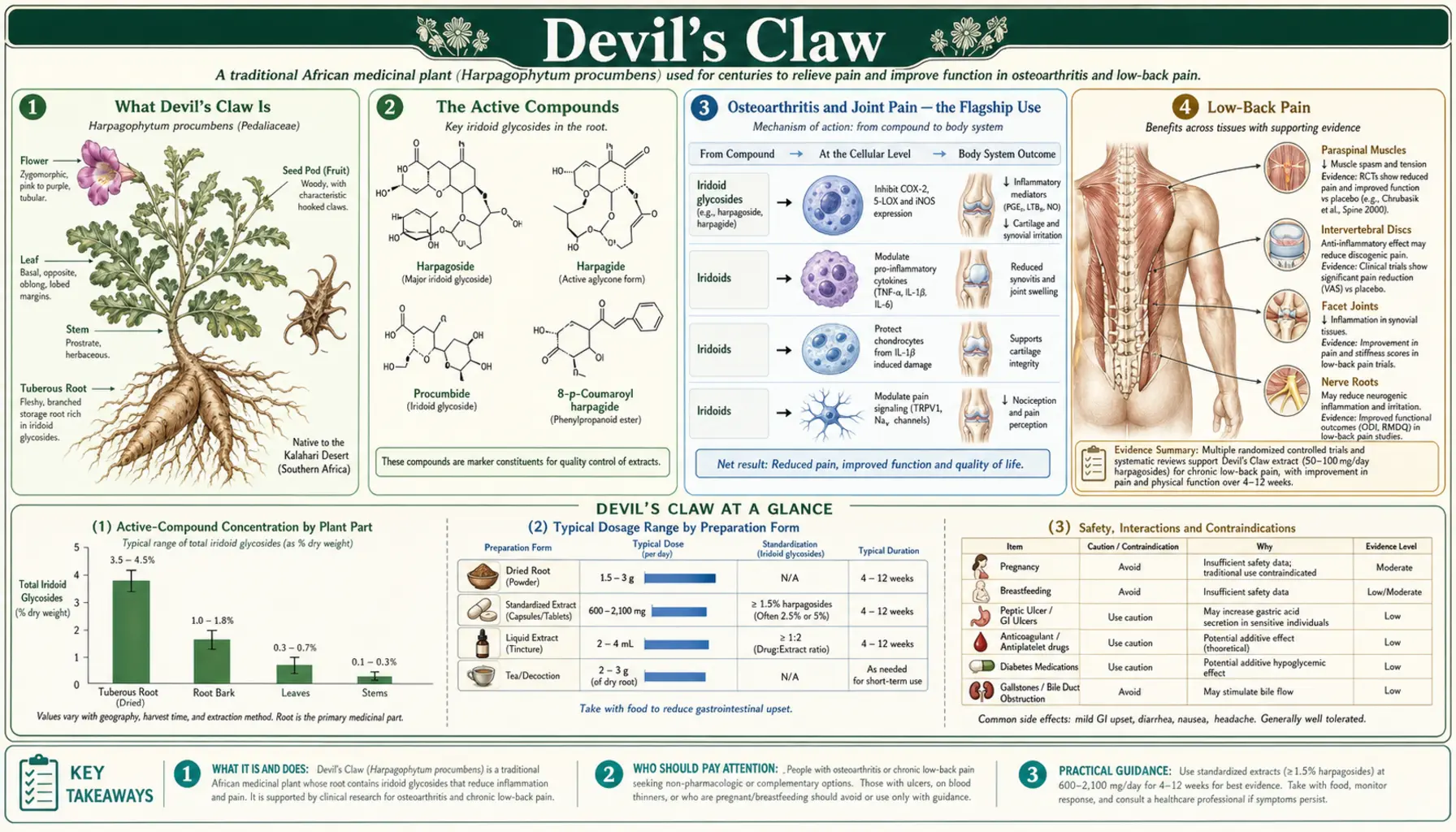
Devil's claw (Harpagophytum procumbens) is a low, trailing plant from the sandy savannas of southern Africa — the Kalahari of Namibia, Botswana, and South Africa. It earns its dramatic name not from anything sinister but from its fruit: a woody seed pod covered in curved, grappling hooks that can catch in the hooves and fur of passing animals. The part people actually use as medicine is hidden underground — the plant's swollen secondary roots, or storage tubers, which are dug up, sliced, and dried. For generations the San (Khoisan) peoples of the region used these bitter roots for pain, fevers, and digestive complaints, and in the twentieth century the herb traveled to Europe, where it became a popular remedy for arthritis and back pain. This page walks through what devil's claw is, the compounds it contains, what the research does and doesn't show for joint and back pain, how it is dosed, and — importantly — who should be cautious with it. The evidence here is genuinely mixed but not empty: for osteoarthritis and low-back pain, devil's claw is one of the better-studied herbal options, though the trials vary in quality and the effects are modest rather than miraculous.
Table of Contents
- What Devil's Claw Is
- The Active Compounds
- Osteoarthritis and Joint Pain — the Flagship Use
- Low-Back Pain
- How It Might Work — the Anti-Inflammatory Question
- Traditional Digestive and Appetite Use
- Forms and Dosing
- Safety and Side Effects
- Who Should Take Care — Cautions and Interactions
- The Honest Bottom Line
- Research Papers
- Connections
- Featured Videos
What Devil's Claw Is
Devil's claw is a perennial that hugs the ground, sending out trailing stems from a central crown with pretty, trumpet-shaped pink-to-purple flowers. It thrives in the deep red Kalahari sands of Namibia, Botswana, and South Africa, where rainfall is scarce and the plant survives by storing water and starch in fleshy underground tubers.
The name comes from the fruit. As the pod dries it splits into arms lined with stiff, backward-curving hooks — the "claws." These barbs snag onto the legs and hooves of grazing animals, who then unwittingly carry the seeds across the landscape and, in their struggles to shake the pod loose, help scatter them. It is a clever bit of botanical hitchhiking, and it gave the plant its ominous common name in several languages.
Medicinally, though, the fruit is not the useful part. Healers use the secondary roots — the tuberous side-roots that branch off the main taproot. These are harvested, chopped into slices while still fresh, and dried in the sun. Dried devil's claw root is intensely bitter, and that bitterness is a clue to its traditional roles.
Among the San (Khoisan) peoples of southern Africa, devil's claw root has a long history as a broad folk remedy: a decoction (a simmered water extract) taken for fevers, for pain in the joints and muscles, for digestive upset and poor appetite, and applied externally to sores and skin problems. When the plant reached Europe in the early 1900s it was gradually adopted for rheumatic complaints, and by the later twentieth century standardized devil's claw extracts had become a mainstream over-the-counter joint remedy in Germany, France, and beyond.
One consequence of that popularity is worth knowing: devil's claw is wild-harvested, not farmed at scale, and heavy demand has raised real concerns about over-collection and sustainability in its home range. Buyers who care about this can look for products that mention sustainable or certified sourcing.
The Active Compounds
Devil's claw root is a chemical mixture, but attention has centered on a family of bitter compounds called iridoid glycosides. The best known and most measured of these is harpagoside, which has become the standard marker used to gauge a product's strength. Related iridoids include harpagide and procumbide.
The root also contains phenylethanoid glycosides such as verbascoside (also called acteoside) and isoacteoside, along with flavonoids, phenolic acids, sugars, and other plant constituents. Some researchers suspect these accompanying compounds contribute to the herb's effects too, meaning harpagoside may be a convenient yardstick rather than the whole story.
Because harpagoside is the compound most closely tied to the studied effects, quality extracts are standardized to contain a defined percentage of it. When you read that a product is "standardized to X mg harpagoside," that number is your best point of comparison between brands — far more meaningful than the raw milligrams of root powder, which can vary widely in potency. Most of the clinical trials that showed benefit used standardized extracts, not plain ground root, which is one reason results with unstandardized products can be unpredictable.
Osteoarthritis and Joint Pain — the Flagship Use
If devil's claw has one headline use, it is osteoarthritis — the common "wear-and-tear" arthritis that stiffens and aches in the knees, hips, hands, and spine as cartilage thins with age. This is where the plant is most studied and most often recommended.
The evidence is best described as moderate and encouraging, but not airtight. Several clinical trials have found that standardized devil's claw extracts reduce osteoarthritis pain and improve function compared with placebo, and a few have compared it head-to-head with conventional drugs. In one notable four-month trial, devil's claw was compared against diacerein, a prescription osteoarthritis drug used in Europe; the herb performed comparably for pain and function in hip and knee osteoarthritis, and patients on devil's claw needed fewer rescue analgesics and reported fewer side effects. Open-label studies of aqueous (water-based) devil's claw extract have likewise reported meaningful drops in pain and improved mobility over 8–12 weeks.
Reviews that pool this research reach a cautiously positive verdict: there is reasonable evidence that devil's claw helps osteoarthritis pain, but the trials differ in the extracts used, the doses, the length of treatment, and their methodological rigor. Some were open-label (no blinding), some were short, and some were funded by product makers. So the honest summary is that devil's claw looks like a legitimate option for osteoarthritis discomfort — potentially a way to reduce reliance on anti-inflammatory painkillers — while acknowledging that the best-quality, largest trials that would settle the matter have not all been done.
It is also worth being clear about what devil's claw is not claimed to do: there is no good evidence that it repairs cartilage, reverses arthritis, or changes the long-term course of the disease. Its role is symptom relief — easing pain and stiffness — not a cure.
Low-Back Pain
The second well-studied use is chronic low-back pain, and here the evidence is arguably a touch stronger and better organized. Devil's claw is one of a small handful of herbal remedies that respected systematic reviews have taken seriously for back pain.
A Cochrane review of herbal medicine for low-back pain concluded that devil's claw extracts standardized to 50–100 mg of harpagoside per day reduced pain more than placebo over the short term, with the higher (100 mg) dose showing the clearer benefit. Randomized trials of specific standardized preparations found that more people taking devil's claw became pain-free, or needed less additional pain medication, than those on placebo. An updated Cochrane review kept devil's claw among the herbal options with supportive but moderate-quality evidence for short-term relief of acute flares of low-back pain.
The practical takeaways are: the benefit is tied to a genuinely standardized harpagoside dose (the plain-root products used in some studies did less well), the studies were mostly short (a few weeks), and the effect is real but modest — a reduction in pain, not its abolition. For someone with nagging chronic or recurrent low-back pain who wants to try a plant-based option, devil's claw is one of the more defensible choices, ideally using a product whose harpagoside content is stated on the label.
How It Might Work — the Anti-Inflammatory Question
Why would a bitter African root ease sore joints? The leading idea is that devil's claw has anti-inflammatory activity, and there is laboratory support for that — but the picture is honestly incomplete.
In cell and test-tube studies, devil's claw extracts and harpagoside can dampen key drivers of inflammation. They have been shown to reduce the production of inflammatory messengers such as TNF-α and to lower expression of COX-2, an enzyme that manufactures prostaglandins — the same enzyme targeted by common anti-inflammatory drugs like ibuprofen. Some research points to effects on the master inflammatory switch NF-κB and related signaling. If those mechanisms operate meaningfully in people, they would plausibly explain relief of the inflammatory component of joint and back pain.
The important caveats: much of this work is in isolated cells or animals, not humans, and the concentrations used in a laboratory dish are not always achievable in the bloodstream after swallowing a pill. Harpagoside is also partly broken down in the stomach and gut, which complicates the story of how the active compound reaches inflamed tissue. So while "devil's claw is anti-inflammatory" is a reasonable working explanation supported by real data, it is not fully established that this is how — or how much — it helps in everyday use. It is better thought of as a promising, partly-proven mechanism than a settled fact.
Traditional Digestive and Appetite Use
Long before it was a joint remedy, devil's claw was valued as a bitter tonic. Its root is genuinely and powerfully bitter, and in traditional herbalism bitters are used to stimulate appetite and support digestion.
The reasoning is old but not unreasonable: tasting a strong bitter is thought to prime the digestive system, encouraging the flow of saliva, stomach acid, and digestive juices, which can rouse a sluggish appetite and ease the sense of fullness or indigestion after meals. European herbal traditions and some regulatory herb monographs have recognized devil's claw for exactly this — loss of appetite and mild digestive complaints — alongside its joint uses.
This is the traditional, lower-evidence side of the herb; the appetite-and-digestion role rests far more on long use and plausible physiology than on modern clinical trials. It also carries a direct warning, discussed below: the very same acid-stimulating, bile-stirring bitterness that can help digestion is exactly why devil's claw is a poor choice for people with ulcers, gastritis, or gallstones.
Forms and Dosing
Devil's claw is sold as capsules and tablets of dried root or concentrated extract, as liquid tinctures, and as loose root for teas and decoctions. The single most useful thing to look for on any label is the harpagoside content, because that is what the studies standardized to.
- By harpagoside (the studied approach): clinical trials for joint and back pain generally delivered roughly 50 to 100 mg of harpagoside per day, often split across the day. For back pain in particular, the higher end (about 100 mg harpagoside daily) is where benefit was clearest.
- By extract weight: depending on how concentrated a product is, that harpagoside target usually corresponds to something on the order of 600 to 2,400 mg of standardized extract per day — but the number on the box is meaningless without knowing the harpagoside percentage, so always check that figure.
- Powdered whole root: traditional and monograph doses of dried root are considerably higher (often several grams a day) because plain root is far less concentrated than a standardized extract.
A few practical notes: benefits in the trials typically built up over weeks, not hours — a fair trial is usually 4 to 12 weeks, not a single dose. Taking it with food can blunt the stomach upset some people get, though it may also slightly reduce absorption. And because potency varies so much between brands, it is wise to follow the specific product's label and, ideally, choose one that states its harpagoside content.
Safety and Side Effects
Used for the short-to-medium term at typical doses, devil's claw is generally well tolerated. In the clinical trials, side effects were usually mild and not much more common than with placebo, and studies specifically looking at rheumatic patients reported good tolerability — with a meaningful share of users able to reduce or stop their conventional painkillers.
By far the most common complaint is digestive upset — mild diarrhea, loose stools, nausea, or stomach discomfort. This fits the herb's bitter, acid- and bile-stimulating nature. For most people it is manageable and settles, especially if the dose is taken with food, but it is the reason a minority stop using it.
Less commonly reported effects include headache, dizziness, ringing in the ears, or allergic skin reactions. Serious harms are rare in the published trials, but it is important to be honest about the flip side of that reassurance: most studies were short, so the safety of taking devil's claw continuously for many months or years is not well established, and long-term data are thin.
Who Should Take Care — Cautions and Interactions
Devil's claw is gentle for many people but genuinely wrong for some. The cautions below are not boilerplate — they follow directly from how the herb behaves in the body.
- Peptic ulcers and gastritis: because devil's claw can increase stomach acid, it is a poor choice for anyone with active stomach or duodenal ulcers, or with gastritis or reflux, where extra acid can worsen the problem. Traditional and modern sources both flag this.
- Gallstones and bile-duct problems: the herb stimulates the flow of bile. That can be part of its digestive action, but for someone with gallstones it may provoke a gallbladder attack, so devil's claw should be avoided or used only with medical guidance if you have gallstones or bile-duct disease.
- Blood thinners: there is a theoretical interaction with anticoagulant and antiplatelet medicines, most importantly warfarin. Case-level and pharmacological concerns suggest devil's claw could affect bleeding risk or interfere with how such drugs are handled, so it is best avoided — or used only with a doctor's oversight and monitoring — if you take warfarin or similar medication.
- Blood sugar and blood pressure: devil's claw may lower blood sugar and can affect blood pressure and heart rhythm. If you take medication for diabetes, hypertension, or a heart condition, treat this as a possible interaction, watch for additive effects, and check with your prescriber.
- Stomach-acid and heart medicines: for the same reasons above, the herb could theoretically counteract acid-reducing drugs or interact with cardiac medications; loop in your pharmacist if you take these.
- Pregnancy and breastfeeding: devil's claw has traditionally been associated with effects on the uterus and is not recommended during pregnancy. With too little safety data for nursing, it is also best avoided while breastfeeding.
- Before surgery: given the possible effects on bleeding, blood sugar, and blood pressure, it is sensible to stop devil's claw a week or two before any planned surgery, and to tell your surgical team you have been using it.
None of this makes devil's claw a dangerous herb for the average healthy adult using it short-term for a sore knee or an aching back. But if you have ulcers, gallstones, diabetes, heart or blood-pressure conditions, or take a blood thinner — or you are pregnant — this is a herb to discuss with a clinician first rather than start on your own.
The Honest Bottom Line
Devil's claw is one of the more credible herbal remedies for musculoskeletal pain. For osteoarthritis and low-back pain, real clinical trials and respected systematic reviews — including Cochrane work on back pain — support a modest, meaningful reduction in pain and improved function, especially when you use a standardized extract delivering roughly 50–100 mg of harpagoside a day. It is not a cure, it does not rebuild joints, and the study quality is uneven, but it is a reasonable, evidence-supported thing to try — and for some people a way to lean less heavily on anti-inflammatory painkillers.
Balance that against the practical cautions: expect it to take a few weeks to judge; expect mild digestive upset as the most likely nuisance; and steer clear — or get medical advice first — if you have ulcers or gastritis, gallstones, diabetes, heart or blood-pressure conditions, take warfarin or another blood thinner, or are pregnant. Choose a product that states its harpagoside content, ideally from a sustainable source, and treat devil's claw as a sensible complement to — not a replacement for — the rest of your care. As always, keep your doctor or pharmacist in the loop, particularly if you take other medicines.
Research Papers
- Gagnier JJ, van Tulder MW, Berman B, Bombardier C. Herbal medicine for low back pain: a Cochrane review. Spine. 2007;32(1):82–92. doi:10.1097/01.brs.0000249525.70011.fe — found devil's claw standardized to 50–100 mg harpagoside reduced low-back pain more than placebo.
- Gagnier JJ, Oltean H, van Tulder MW, Berman BM, Bombardier C, Robbins CB. Herbal medicine for low back pain: a Cochrane review. Spine. 2016;41(2):116–133. doi:10.1097/BRS.0000000000001310 — updated review keeping devil's claw among herbs with moderate-quality evidence for short-term back-pain relief.
- Gagnier JJ, Chrubasik S, Manheimer E. Harpagophytum procumbens for osteoarthritis and low back pain: a systematic review. BMC Complementary and Alternative Medicine. 2004;4:13. doi:10.1186/1472-6882-4-13 — pooled trials showing support for both conditions while flagging variable study quality.
- Chrubasik S, et al. Effectiveness of Harpagophytum extract WS 1531 in the treatment of exacerbation of low back pain: a randomized, placebo-controlled, double-blind study. European Journal of Anaesthesiology. 1999;16(2):118–129. doi:10.1046/j.1365-2346.1999.00435.x — more patients became pain-free on the higher harpagoside dose than on placebo.
- Chrubasik S, Thanner J, Künzel O, Conradt C, Black A, Pollak S. Comparison of outcome measures during treatment with the proprietary Harpagophytum extract doloteffin in patients with pain in the lower back, knee or hip. Phytomedicine. 2002;9(3):181–194. doi:10.1078/0944-7113-00140 — standardized extract improved pain and function across back, knee, and hip.
- Chantre P, Cappelaere A, Leblan D, Guedon D, Vandermander J, Fournie B. Efficacy and tolerance of Harpagophytum procumbens versus diacerhein in treatment of osteoarthritis. Phytomedicine. 2000;7(3):177–183. doi:10.1016/S0944-7113(00)80001-X — devil's claw comparable to the reference drug diacerein for hip/knee OA, with fewer side effects.
- Wegener T, Lüpke NP. Treatment of patients with arthrosis of hip or knee with an aqueous extract of devil's claw (Harpagophytum procumbens DC.) Phytotherapy Research. 2003;17(10):1165–1172. doi:10.1002/ptr.1322 — open study reporting reduced pain and improved mobility over 12 weeks.
- Warnock M, McBean D, Suter A, Tan J, Whittaker P. Effectiveness and safety of devil's claw tablets in patients with general rheumatic disorders. Phytotherapy Research. 2007;21(12):1228–1233. doi:10.1002/ptr.2288 — 8-week study in which many participants reduced or stopped conventional pain medication.
- Brien S, Lewith GT, McGregor G. Devil's claw (Harpagophytum procumbens) as a treatment for osteoarthritis: a review of efficacy and safety. The Journal of Alternative and Complementary Medicine. 2006;12(10):981–993. doi:10.1089/acm.2006.12.981 — review judging the herb promising for OA but calling for larger, higher-quality trials.
- Fiebich BL, Muñoz E, Rose T, Weiss G, McGregor GP. Molecular targets of the antiinflammatory Harpagophytum procumbens (devil's claw): inhibition of TNFα and COX-2 gene expression by preventing activation of AP-1. Phytotherapy Research. 2012;26(6):806–811. doi:10.1002/ptr.3636 — laboratory evidence that the extract suppresses TNF-α and COX-2 expression.
- Grant L, McBean DE, Fyfe L, Warnock AM. A review of the biological and potential therapeutic actions of Harpagophytum procumbens. Phytotherapy Research. 2007;21(3):199–209. doi:10.1002/ptr.2029 — overview of proposed anti-inflammatory and analgesic mechanisms.
- Mncwangi N, Chen W, Vermaak I, Viljoen AM, Gericke N. Devil's claw — a review of the ethnobotany, phytochemistry and biological activity of Harpagophytum procumbens. Journal of Ethnopharmacology. 2012;143(3):755–771. doi:10.1016/j.jep.2012.08.013 — comprehensive review of southern African traditional use, chemistry, and pharmacology.
Connections
- All Herbs
- Boswellia
- Willow Bark
- Turmeric
- Ginger
- Cat's Claw
- Osteoarthritis
- Low-Back Pain
- Rheumatology
- Orthopedics
- Back Pain (Symptom Overview) — causes, red flags, and the full range of treatment options.