Savory — Benefits Deep Dive
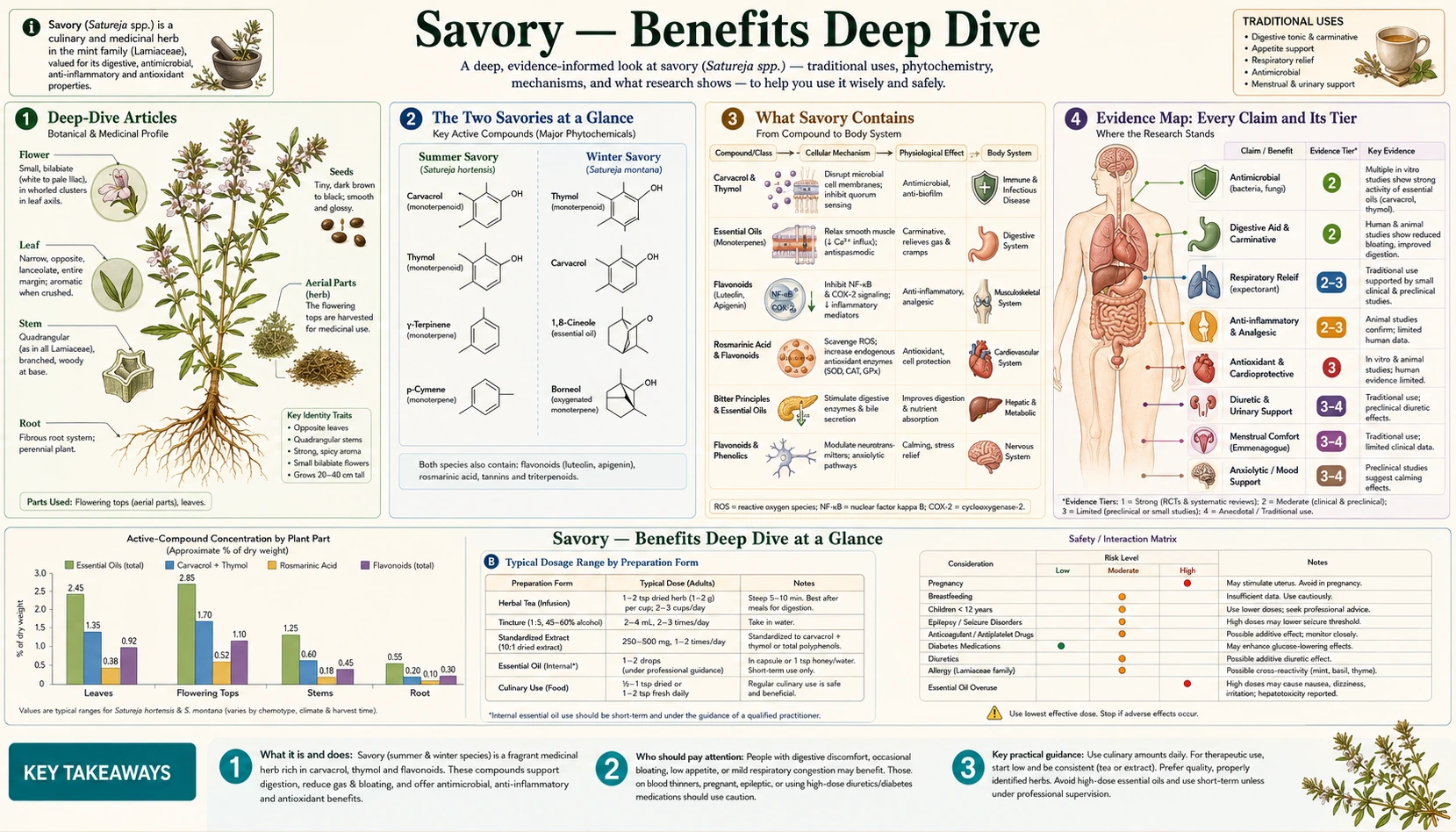
Savory is one of the most useful herbs in a European kitchen and one of the least studied in a clinic, and those two facts are the whole subject of these four pages. It has been cooked with beans and lentils for two thousand years, it is a backbone of herbes de Provence, and its essential oil contains one of the most potent naturally occurring antimicrobials known to food science. It also has, as of this writing, only one small controlled human trial: a two-week test of a gel containing 1% summer savory oil, applied inside the mouth by 80 denture wearers with a yeast infection of the palate. Both halves of that are true at once, and holding them together is more informative than picking one.
Two distinctions run through everything below and are worth fixing in mind before you read further. First, there are two savories: summer savory, Satureja hortensis, the milder annual that goes in the bean pot; and winter savory, Satureja montana, the sharper perennial that is higher in carvacrol and the subject of most of the laboratory research. Most writing about savory names neither, which quietly hides the fact that the two oils are chemically different. Second, the oil is not the herb: distilling savory concentrates it fifty- to two-hundred-fold by weight, so a pinch of dried leaf and a capsule of standardised oil differ in carvacrol content by roughly two orders of magnitude. Almost every confused claim about savory — safe or dangerous, useless or miraculous — comes from crossing one of those two lines without noticing.
These pages label the evidence tier for every claim: randomized clinical trial, preliminary (animal or in-vitro), or traditional use only. For savory, that last label appears most often, and it is not a criticism — it is an accurate description of a herb whose real value is on the plate and whose pharmacology is still at the hypothesis stage.
Deep-Dive Articles
Savory for Digestion and Gas
The bean-herb tradition — German Bohnenkraut, Bulgarian chubritsa, French sarriette — and whether it holds up. Where bean gas actually comes from, why a seasoning cannot remove the oligosaccharides that cause it, and why it might still make the aftermath more comfortable. The classic carminative claim, with the mechanism it plausibly has and the trials it does not.
Read the deep dive →Savory: Antimicrobial and Antioxidant Research
The strongest science savory has, and the most misdescribed. How carvacrol destroys a bacterial membrane, why the literature is really a carvacrol literature shared with oregano and thyme, and the arithmetic showing that an in-vitro inhibitory concentration would take roughly two bottles of essential oil to reach in a human body. Plus why "high antioxidant activity" in a cuvette is not a health outcome.
Read the deep dive →Savory for Coughs and Other Traditional Uses
The second tier of the traditional record: cough and sore-throat teas, wound washes, gargles, worms, and the aphrodisiac folklore that rests on a satyr-shaped pun. What thyme has that savory does not — an official monograph and real bronchitis trials — and why borrowing a cousin's evidence is the commonest error in herbal writing.
Read the deep dive →Summer vs Winter, Carvacrol and Safety
The two species side by side, why chemotype and harvest make two jars of savory chemically different, and the full dose arithmetic: a culinary serving (one teaspoon of dried leaf shared across four plates) delivers roughly 0.5–3 mg of carvacrol, one drop of essential oil delivers 12–30 mg. Dilution numbers for topical use, Lamiaceae cross-sensitivity, pregnancy, children, cats, and the interaction claims that are guessed rather than known.
Read the deep dive →Table of Contents
The Two Savories at a Glance
Summer savory — Satureja hortensis
A soft annual, resown each spring, dying at the first frost. Milder, sweeter and rounder in flavour, with tender leaves that can be added late in cooking. This is the herb sold dried in jars, the German Bohnenkraut or "bean herb," and the species the digestive tradition mainly attaches to. It has also been tested in vitro, and it is the species behind the animal antispasmodic and anti-inflammatory work.
Winter savory — Satureja montana
A hardy perennial subshrub, woody at the base, semi-evergreen, cropping for years. Sharper, more resinous and considerably more pungent — use less, and add it early so it can soften. Generally the higher-carvacrol species, and the one that dominates the antimicrobial literature.
And a third group that clutters the search results
Several other Satureja species — especially the Iranian endemic S. khuzistanica, along with S. bachtiarica, S. thymbra and S. spicigera — are heavily researched, sometimes carry extraordinarily carvacrol-dominant oils, and are not the herb in your spice jar. A striking savory statistic with no binomial attached may well have come from one of them.
What Savory Contains
Two fractions matter, and they are extracted by different methods, which is why preparation changes what you actually get.
- The volatile essential oil — carvacrol (usually dominant), thymol (its isomer), and their weaker precursors p-cymene and γ-terpinene, with linalool, borneol and other minor terpenes. This is the fraction responsible for pungency and for all the antimicrobial activity. It is poorly water-soluble and volatile, so a water infusion extracts relatively little of it.
- Water-soluble polyphenols — chiefly rosmarinic acid, the caffeic-acid ester common across the mint family. This is what a savory tea mainly delivers.
The proportions are not fixed. Species, chemotype, altitude, drought, harvest timing, drying and distillation method all shift them, which is why this section uses ranges and why the pages below insist on naming the species behind every claim.
Evidence Map: Every Claim and Its Tier
The single most useful summary on this hub, and a frame for any list of savory "benefits" found elsewhere.
Randomized controlled trials in humans
One small trial, for a yeast infection under dentures. Eighty denture wearers with denture stomatitis (redness of the palate under the denture, with the yeast Candida albicans confirmed by a swab) applied either a gel containing 1% summer savory (Satureja hortensis) essential oil or a placebo gel twice a day for two weeks. In the savory-gel group the redness of the palate fell significantly (P<0.0001) and the Candida colony counts fell significantly (P=0.001) (Sabzghabaee and colleagues, 2012). It is a single, short, topical trial of the oil in a gel, not evidence for swallowing the oil.
There is no randomized human trial for digestion, cough or any other use, for either kitchen savory.
Strong in-vitro evidence with an established mechanism
- Antibacterial and antifungal activity of savory essential oil on culture plates — repeatable, independently confirmed, dose-dependent, and explained at the level of the bacterial membrane. Applies to the concentrated oil in direct contact with microbes.
- Radical-scavenging (antioxidant) activity of both the oil phenols and the leaf polyphenols in chemical assays and in food-oxidation models.
- Food-preservation effects — slower spoilage and rancidity when savory oil or extract is added to foods, though usually at doses that also make the food taste of savory.
Preliminary animal evidence
- Antispasmodic and anti-diarrhoeal effects of summer savory oil in isolated tissue and animal models — the closest thing to mechanistic support for the carminative tradition.
- Anti-inflammatory and pain-reducing effects of summer savory extracts and oil in rodents, at doses well above culinary exposure.
- Metabolic effects on blood glucose and lipids, mostly in non-culinary Satureja species. One summer savory product is the exception: in Georgia, capsules holding 0.33 g of dried water extract of summer savory leaf are registered by the national health ministry for type 2 diabetes. Its developers report that the extract significantly lowered blood sugar in animals with chemically induced (alloxan) diabetes and state that clinical trials confirmed its effect, but their published abstract gives no trial numbers (Kemertelidze and colleagues, 2012).
Traditional use only
- Carminative and digestive use — the strongest tradition, with the most plausible mechanism, and no human trial.
- Cough, sore throat and chest complaints.
- Wound washes, gargles and mouth rinses.
- Intestinal worms and menstrual complaints (the latter being the origin of the pregnancy caution).
Folklore, and labelled as such
- Aphrodisiac use. It rests on a folk etymology linking Satureja to the satyrs of Greek myth, plus a seventeenth-century claim that the two savories had opposite effects on desire. There is no evidence, and the animal "reproductive" studies sometimes cited concern a different species entirely.
Not supported at all
- Savory oil taken internally as a treatment for any infection.
- Savory as a substitute for a prescribed antibiotic, antifungal or antiparasitic.
- Savory as a treatment for bacterial overgrowth, blood sugar, cholesterol or weight.
- Any claim that reads "shown to kill" a named pathogen and implies a clinical effect. In-vitro inhibitory concentrations do not imply clinical antimicrobial activity.
Three Rules for Reading Any Savory Claim
- Find the binomial. If a claim does not say Satureja hortensis or Satureja montana, it may be about neither — the genus contains heavily studied species that are not culinary herbs, and even the two kitchen savories differ in oil composition.
- Find the preparation. Leaf, tea, whole essential oil, or isolated carvacrol? These are four different substances. The most common sleight of hand is a finding about isolated carvacrol reported as a property of the herb.
- Find the dose, then compare it to food. A teaspoon of dried savory carries roughly 2–12 mg of carvacrol; a single drop of essential oil carries roughly 12–30 mg; a 100 mg standardised capsule carries about 50 mg. Animal studies and in-vitro work routinely operate one to four orders of magnitude above the culinary range. The arithmetic is set out in full on the species and safety page.
Those three questions will resolve almost every overstated savory claim you encounter, and they are worth applying to any herb, not just this one.
What Savory Is Actually Good For
Confidently:
- Flavour. Peppery, warm, thyme-adjacent; superb with beans, lentils, split peas and fava beans, with roast lamb, pork, sausages and game, and in herbes de Provence anywhere that blend belongs.
- A pleasant aromatic tea, delivering rosmarinic acid and other polyphenols, traditionally taken after a heavy meal.
- Growing. Summer savory from seed each spring; winter savory as a low-maintenance perennial in a dry, sunny spot or a pot. Homegrown is the freshest and cheapest form of the real thing.
- Standing in for pepper when you want warmth without the bite, which is much of why the Romans planted it so widely.
Reasonably, with expectations set low:
- Cooking savory with legumes on the traditional theory that it eases the aftermath — harmless, cheap, plausible, unproven. Note that soaking dried beans and discarding the water has a far better claim to reducing gas, since it removes the oligosaccharides that cause it.
- A warm honeyed savory tea for a sore throat — comforting, with the honey probably doing most of the work.
Uses no study supports:
- Treating infections by swallowing savory or its oil, or on wounds. (The one human trial tested a 1% oil gel on the palate for a denture yeast infection, described in the evidence map above.)
- Replacing any prescribed medication.
- Swallowing the essential oil, at any dose or dilution — no internal dose has been established and no trial has tested it.
Key Research Papers
Grouped by theme. Named papers link to their PubMed records; the other entries are PubMed topic searches, which show the surrounding literature instead of one selected paper. Where a specific study is named, the finding is described in prose on the relevant deep-dive page.
1. Genus overviews and phytochemistry
- A pharmacological and phytochemical overview on Satureja — Tepe and Cilkiz, Pharmaceutical Biology, 2016. The standard reference for the genus: species, oil chemistry, reported pharmacology, and the clinical gap. PubMed PMID: 25955956
- An update on pharmacology of Satureja species — Momtaz and Abdollahi, International Journal of Pharmacology, 2010. Survey across antioxidant, antimicrobial, metabolic and reproductive endpoints. PubMed search
- Essential-oil composition of Satureja hortensis and Satureja montana: carvacrol, thymol, p-cymene and γ-terpinene proportions. PubMed search
- Chemotype, altitude and harvest-time variability in savory oils — why two jars are not the same. PubMed search
2. Carvacrol and thymol: mechanism and the molecule literature
- The phenolic hydroxyl group of carvacrol is essential for action against the food-borne pathogen Bacillus cereus — Ultee and colleagues, Applied and Environmental Microbiology, 2002. Mechanism established by capping the responsible chemical group. PubMed PMID: 11916669
- A study of the minimum inhibitory concentration and mode of action of oregano essential oil, thymol and carvacrol — Lambert and colleagues, Journal of Applied Microbiology, 2001. The two phenols account for most of a phenolic oil's activity. PubMed PMID: 11556910
- Biological and pharmacological activities of carvacrol and carvacrol bearing essential oils — Başer, Current Pharmaceutical Design, 2008. PubMed PMID: 19075694
- Carvacrol and human health: a comprehensive review — Sharifi-Rad and colleagues, Phytotherapy Research, 2018. What is known about the molecule, as distinct from the herb. PubMed PMID: 29744941
3. Antimicrobial, antifungal and antioxidant testing
- In vitro antibacterial, antifungal, and antioxidant activities of the essential oil and methanol extracts of Satureja hortensis L. — Güllüce and colleagues, Journal of Agricultural and Food Chemistry, 2003. The principal in-vitro study of the culinary summer savory. PubMed PMID: 12822930
- Antioxidant and antimicrobial activity of Satureja montana L. extracts — Serrano and colleagues, Journal of the Science of Food and Agriculture, 2011. Winter savory, with food application in view. PubMed PMID: 21445865
- Essential oils: their antibacterial properties and potential applications in foods — Burt, International Journal of Food Microbiology, 2004. Why fat and protein in a food matrix blunt in-vitro potency. PubMed search
- Rosmarinic acid — Petersen and Simmonds, Phytochemistry, 2003. The water-soluble polyphenol a savory infusion actually delivers. PubMed PMID: 12482446
4. Digestive, antispasmodic and anti-inflammatory work
- Antispasmodic and anti-diarrhoeal effect of Satureja hortensis L. essential oil — Hajhashemi and colleagues, Journal of Ethnopharmacology, 2000. The animal and isolated-tissue evidence closest to the carminative tradition. PubMed PMID: 10904162
- Antinociceptive and anti-inflammatory effects of Satureja hortensis L. extracts and essential oil — Hajhashemi and colleagues, Journal of Ethnopharmacology, 2002. Rodent pain and inflammation models. PubMed PMID: 12241981
- Peppermint oil in irritable bowel syndrome — the randomized-trial benchmark that herbal digestive claims are commonly measured against. PubMed PMID: 35942669
- α-Galactosidase supplementation and legume flatulence — the intervention that targets the actual source of bean gas. PubMed search
5. Safety, toxicology and pharmacokinetics
- The bioactivity and toxicological actions of carvacrol — Suntres and colleagues, Critical Reviews in Food Science and Nutrition, 2015. Benefit and irritant toxicity in one place, with dose dependence. PubMed PMID: 24915411
- Carvacrol and thymol pharmacokinetics — absorption, glucuronidation, sulfation and urinary excretion, and why plasma concentrations never approach in-vitro inhibitory levels. PubMed search
- Allergic and occupational contact dermatitis from Lamiaceae herbs and their essential oils — the basis of the cross-sensitivity warning. PubMed search
- Essential-oil ingestion: mucosal injury and paediatric exposures in the clinical case literature. PubMed search
6. Human trial and clinical use
- Clinical evaluation of the essential oil of "Satureja Hortensis" for the treatment of denture stomatitis — Sabzghabaee and colleagues, Dental Research Journal (Isfahan), 2012;9(2):198–202. The one randomized, placebo-controlled human trial of a kitchen savory: 80 patients, 1% oil gel or placebo twice daily for two weeks. PubMed PMID: 22623938
- Kemertelidze and colleagues, Georgian Medical News, 2012;(203):47–52 (article in Russian). Chemistry of summer savory leaf, an animal study in alloxan diabetes, and the registration in Georgia of a dried water extract of the leaf for type 2 diabetes. PubMed PMID: 22466541
External Resources
- PubMed — the National Library of Medicine's biomedical literature database, and the source of every citation search on these pages.
- U.S. National Center for Complementary and Integrative Health (NCCIH) — the U.S. National Institutes of Health (NIH) National Center for Complementary and Integrative Health, with plain-language, appropriately cautious herb summaries.
- European Medicines Agency — publisher of the herbal monographs that exist for several of savory's better-documented relatives, including thyme.
- U.S. Department of Agriculture (USDA) FoodData Central — composition data for herbs, spices and legumes.
- US Food and Drug Administration — the regulatory framework distinguishing a spice from a dietary supplement.
- Poison Control — what to do about an essential-oil ingestion or exposure.
- NHS — clear guidance on when digestive or respiratory symptoms need medical assessment.
Safety Summary
The safety picture is simple once the herb and the oil are kept apart.
- Savory leaf as a seasoning — about as safe as culinary herbs get, with a long uneventful record and ordinary spice regulatory status.
- Savory tea — a mild food-level preparation, delivering mainly water-soluble polyphenols.
- Savory essential oil — a potent mucous-membrane and skin irritant. No internal dose has been established; undiluted oil irritates the mucous membranes of the eyes, inner nose, mouth and genitals, and the aromatherapy trade dilutes hot phenolic oils to 0.5% or less for skin. The one human trial used a 1% oil gel on the palate twice a day for two weeks; its authors report a spicy smell as the only minor complaint and no other reportable side effects. The irritancy is the same membrane-disrupting action that makes it antimicrobial, applied to your own cells.
- Lamiaceae cross-sensitivity — cross-reactions within the mint family (Lamiaceae) are reported, so people who react to oregano, thyme, marjoram, sage or mint may also react to savory.
- Pregnancy and breastfeeding — the caution attaches to concentrated preparations and the oil, not to seasoning food.
- Children and pets — concentrated phenolic oils are a genuine poisoning risk for small children and are disproportionately toxic to cats, which clear phenols poorly.
These pages are general health information and not medical advice. Nothing here diagnoses, treats, cures or prevents any disease. Savory's claimed benefits are documented as traditional use, and for the antimicrobial and antioxidant claims as in-vitro and animal findings — not as clinically demonstrated effects (the single exception is the small two-week trial of a 1% oil gel for denture stomatitis), and in-vitro potency never implies a clinical result. The safety facts behind concentrated savory products are the ones listed above: the essential oil irritates skin and mucous membranes and has no established internal dose; concentrated phenolic oils are a poisoning risk for small children and toxic to cats; the pregnancy caution attaches to concentrated preparations and the oil; and the interaction claims made for savory alongside prescription medicines are guessed rather than known.
Connections
- All Herbs
- Savory — the main hub page: botany, compounds, culinary use, and the honest bottom line.
- Savory for Digestion and Gas — the bean-herb tradition examined.
- Savory: Antimicrobial and Antioxidant Research — the laboratory data and why a minimum inhibitory concentration (MIC) is not a dose.
- Savory for Coughs and Other Traditional Uses — the rest of the traditional record, including the satyr story.
- Summer vs Winter, Carvacrol and Safety — species, chemistry, dose arithmetic and safety.
- Oregano Benefits — the closest chemical relative, sharing the carvacrol profile.
- Thyme Benefits — the thymol cousin, with an official monograph and real cough trials.
- Marjoram Benefits — the mild relative often blended with savory.
- Rosemary Benefits — rosmarinic acid's namesake and a fellow herbes de Provence herb.
- Sage Benefits — the traditional gargle herb of the same family.
- Fennel Benefits — the other classic carminative, with somewhat more human data.
- Peppermint Benefits — the one culinary-herb oil with real randomized trials for gut symptoms.
- Antibacterial Herbs — the site's overview of herbs with in-vitro antibacterial activity.
- Antioxidants — why assay antioxidant capacity is not a health outcome.
- Functional Dyspepsia — the modern diagnosis nearest the old "weak digestion."
- Irritable Bowel Syndrome — where bloating and cramping are properly investigated.
- Beans — the food the whole tradition is built around.
- Lentils — savory's other traditional partner in the pot.