Perilla for Digestion and Antimicrobial Use
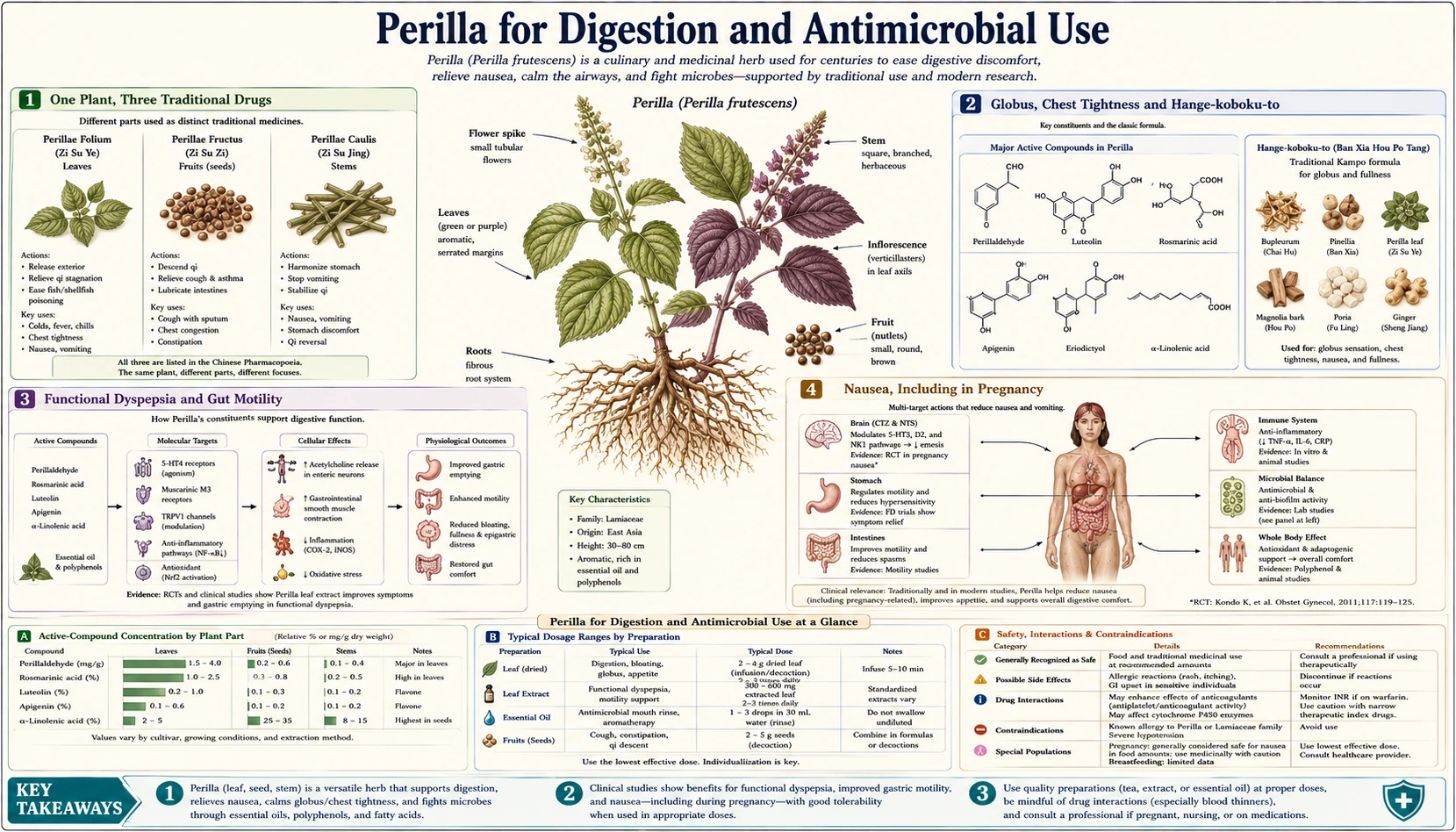
This is the traditional half of perilla's reputation, and it needs a different kind of honesty from the allergy and seed-oil pages. There, the evidence was thin but at least pointed at a specific measurable claim. Here, the claims are old, culturally deep, and almost entirely untested in controlled trials — while the laboratory evidence that is plentiful (antimicrobial activity in a petri dish) turns out to say much less about your gut than it appears to.
Two things are worth reading this page for. The first is what Chinese and Japanese medicine actually claim for perilla, which is narrower and more interesting than “good for digestion” three separate drugs from one plant, each for a different problem. The second is the antimicrobial question, where a real and well-documented laboratory effect gets routinely over-extended into claims about food poisoning and gut infections that the data cannot support. The shiso leaf under your sashimi is a flavour element, not a food-safety measure.
Table of Contents
- One Plant, Three Traditional Drugs
- Globus, Chest Tightness and Hange-koboku-to
- Functional Dyspepsia and Gut Motility
- Nausea, Including in Pregnancy
- The Seed: Cough, Phlegm and Constipation
- Antimicrobial Activity: What the Lab Shows
- The Petri Dish to Patient Gap
- The Sashimi Question, Answered Properly
- Where the Antimicrobial Effect Is Genuinely Useful
- Perilla Seed, Fibre and the Gut Microbiome
- Forms, Preparations and Practical Use
- Cautions
- Evidence Verdict
- Key Research Papers
- Connections
- Featured Videos
One Plant, Three Traditional Drugs
Evidence tier: traditional use only.
Chinese medicine has used perilla for well over a thousand years and, unusually, treats three parts of the plant as three distinct medicines with different indications. Getting this right matters, because Western supplement labels blur them together.
- Zi su ye (紫蘇葉) — the leaf. Classified as acrid and warm. Used for the earliest stage of a wind-cold common cold — chills, blocked nose, no sweating — and, distinctly, for seafood and crab poisoning. That second indication is the traditional reasoning behind serving perilla with raw fish.
- Zi su geng (紫蘇梗) — the stem. Used to move stagnant qi in the chest and epigastrium and to settle nausea in pregnancy. The stem is considered gentler and less dispersing than the leaf.
- Zi su zi (紫蘇子) — the seed, formally Perillae Fructus. Used quite differently again: to “descend qi,” loosen phlegm, quiet a wheezy cough and moisten the intestines in constipation. It appears in the classical formula San Zi Yang Qin Tang.
Japanese Kampo inherited these uses. Perilla leaf (so-yo) is a named component of hange-koboku-to and of koso-san, a gentle cold formula. In Vietnam, tía tô is the household cold remedy — leaves torn into hot rice congee with ginger and spring onion, eaten to raise a sweat at the first sign of chills. In Korea, perilla is food first, but ground perilla seed is folk-credited with easing coughs.
A necessary caveat before any of this is read as evidence: this is a record of what people did, not a demonstration that it works. It is a good guide to where a researcher might look. It is not a result.
Globus, Chest Tightness and Hange-koboku-to
Evidence tier: traditional use, plus small uncontrolled and multi-herb studies.
The most specific traditional indication involving perilla is the one Chinese medicine calls mei he qi (梅核氣), or plum-pit qi — the sensation of a lump in the throat with nothing physically there, which Western medicine calls globus sensation or globus pharyngeus. It is a real and often distressing symptom, frequently associated with reflux, anxiety or upper-oesophageal muscle tension; the treatments studied for it, including acid suppression, nerve-calming medicines and speech therapy, help some people and not others (see Globus Sensation).
Hange-koboku-to (Chinese ban xia hou po tang) is the classical formula for it, and perilla leaf is one of its five ingredients — alongside pinellia, magnolia bark, poria and ginger. It has been studied in Japan for globus, for functional dyspepsia and for swallowing problems in older patients.
The methodological problem is severe and unavoidable:
- These are studies of a five-herb formula. Nothing in a positive result can be attributed to perilla leaf. Perilla is not even the dominant ingredient by weight or by traditional emphasis — pinellia and magnolia bark are.
- Many are uncontrolled or open-label, in a symptom with a large placebo response and a fluctuating natural course.
- Sample sizes are usually small and single-centre.
The best-controlled study so far comes from Taiwan. In a 2025 single-blinded randomized trial, 92 people with globus completed 4 weeks of standard drugs (fexofenadine, famotidine and acetylcysteine) plus either ban xia hou po tang or a placebo. Both groups improved on symptom questionnaires, including the Glasgow Edinburgh Throat Scale. The formula group had a lower Reflux Finding Score — a doctor's score of how the throat looks through a scope — at week 2 (8.03 against 10.12) and week 4 (7.43 against 9.17), and no liver or kidney side effects were found. Perilla's share of the effect cannot be separated from the other four herbs.
The same formula was tested against pneumonia from food or saliva going down the wrong way (aspiration pneumonia). In a 2007 observer-blinded randomized trial in two Japanese long-term care hospitals, 95 older patients with dementia took hange-koboku-to (47 people) or a placebo (48 people) for 12 months. Pneumonia developed in 4 people on the formula, 1 of whom died of it, against 14 on placebo, 6 of whom died of it; the formula group also kept feeding themselves better. Again, five herbs were given together.
So the honest statement is: a traditional formula containing perilla is used and studied for globus in Japan and Taiwan, with encouraging but mostly methodologically weak results; there is no evidence at all that perilla leaf alone helps globus, and taking a perilla capsule for a lump-in-the-throat sensation is not supported by anything.
One more point is a safety fact rather than an efficacy point: a persistent lump-in-the-throat sensation, and especially any actual difficulty swallowing, weight loss, or a sensation that food is sticking, can be a sign of oesophageal disease (disease of the food pipe). These are warning signs that doctors investigate, and no herb has been shown to address them.
Functional Dyspepsia and Gut Motility
Evidence tier: preliminary (animal and in-vitro) plus multi-herb formula studies.
The traditional framing — perilla “moves stagnant qi” in the epigastrium — maps loosely onto what modern gastroenterology calls functional dyspepsia: upper abdominal fullness, early satiety, bloating and discomfort without a structural cause, often involving impaired gastric accommodation or delayed emptying.
What is actually known:
- Perillaldehyde and perilla extracts affect smooth muscle contraction in isolated tissue preparations. This is standard behaviour for aromatic mint-family compounds — peppermint oil's antispasmodic action is the best-characterised example, and it works through calcium-channel blockade in intestinal smooth muscle. Perilla has been much less studied than peppermint.
- Animal studies report effects on gastric emptying and intestinal transit for perilla preparations, in both directions depending on the model and the dose.
- Kampo formulas containing perilla have been studied in functional dyspepsia, with the same multi-herb attribution problem described above. In one Japanese study, the stomach emptied more slowly in people with functional dyspepsia than in healthy volunteers; after 2 weeks of hange-koboku-to it emptied faster in both groups, and the patients' dyspepsia symptoms improved. The abstract reports no placebo group, and the formula has five herbs.
- There is no randomized controlled trial of perilla leaf or perilla extract for dyspepsia, bloating, irritable bowel syndrome (IBS) or any other functional gut disorder. None.
The mint-family herb with actual trial evidence for functional gut symptoms is peppermint — enteric-coated peppermint oil has been tested repeatedly in irritable bowel syndrome. Perilla is a pleasant food that may or may not help; peppermint oil has been measured. Saying so is more useful than promoting the herb this page is about.
Nausea, Including in Pregnancy
Evidence tier: traditional use only.
Perilla stem (zi su geng) has a specific traditional reputation for pregnancy nausea, and perilla leaf appears in formulas used for morning sickness. This is one of the few places where a herb's traditional indication is for pregnancy rather than contraindicated in it.
Two honest points:
- There are no controlled trials of perilla for nausea of any cause — not pregnancy, not motion sickness, not post-operative. The herb with real trial evidence for nausea is ginger, which has been tested in pregnancy sickness in multiple randomized trials.
- Traditional use in pregnancy does not license a concentrated extract in pregnancy. Perilla leaf in food amounts is eaten daily across East Asia, including by pregnant women, and that long record is genuinely reassuring for food. Concentrated extracts and essential oil have no pregnancy safety data whatever. The gap between a leaf in your congee and a standardized capsule is not rhetorical — it is a difference of one or two orders of magnitude in dose.
The Seed: Cough, Phlegm and Constipation
Evidence tier: traditional use, with a modern review of the seed drug.
Perillae Fructus — the seed drug zi su zi — has its own literature, summarised in a comprehensive review published in the Journal of Ethnopharmacology in 2023 covering the botany, ethnopharmacology, phytochemistry, pharmacology, toxicity and quality control of the seed. It is the best single entry point to this material. The review counts 193 compounds identified in the seed so far — mainly fatty acids, flavonoids, phenolic acids, plant sterols (phytosterols), triterpenoids and volatile oils. It reports that support for the seed's traditional uses comes from laboratory and animal experiments, and that how its active ingredients work is still unclear.
Traditional uses are respiratory and intestinal: quieting a productive cough, loosening phlegm, and relieving constipation by “moistening” the intestine — which, given that the seed is 30 to 40 per cent oil and carries fibre, has a plainly mechanical rationale that requires no traditional theory at all. A tablespoon of ground oily seed is a mild bulk-and-lubricant laxative for the same reason ground flaxseed is.
What is not established: any effect on cough or phlegm in a controlled human trial. The antitussive claims rest on animal work and tradition.
The seed's substantial nutritional value — overwhelmingly its alpha-linolenic acid content — is covered separately in Perilla Seed Oil: Plant Omega-3 and What alpha-linolenic acid (ALA) Does.
Antimicrobial Activity: What the Lab Shows
Evidence tier: in-vitro. Extensive and real at that tier.
Perilla's antimicrobial activity in the laboratory is not in doubt, and it is worth describing properly because the mechanism is interesting.
The active agent is mainly the essential oil, and within it perillaldehyde, the compound that gives shiso its smell. Aromatic aldehydes and terpenes of this kind work by partitioning into bacterial and fungal cell membranes, disrupting membrane integrity and proton gradients. It is a blunt, physical mode of action — which is why resistance to it is uncommon, and also why it is non-selective and requires relatively high concentrations.
Reported in-vitro activity spans:
- Gram-positive bacteria including Staphylococcus aureus and Bacillus cereus, generally more susceptible than Gram-negatives.
- Gram-negative bacteria including Escherichia coli — usually at higher concentrations, because the outer membrane is a barrier.
- Fungi and yeasts, where perillaldehyde has attracted the most interest, including activity against Candida species and against food-spoilage and plant-pathogenic moulds.
- Helicobacter pylori, which many culinary plant extracts inhibit in culture. See also H. pylori.
Rosmarinic acid and the leaf's flavones contribute more modestly. Perilla leaf extracts also inhibit some bacterial biofilm formation in culture.
The Petri Dish to Patient Gap
This is the section that matters, and it is the one usually missing.
An in-vitro antimicrobial result tells you that a compound kills an organism when the compound is placed in direct contact with it, at a known concentration, in a nutrient broth, for hours. Almost nothing about that situation resembles your gastrointestinal tract. Four gaps, each of which is enough on its own to break the inference:
- Concentration. Minimum inhibitory concentrations for plant essential oils are typically in the hundreds to thousands of micrograms per millilitre. Reaching that concentration in the lumen of a human gut, let alone in blood or tissue, from any edible dose is generally impossible. This is the fatal objection to most “natural antibiotic” claims.
- Absorption and metabolism. Perillaldehyde is absorbed, metabolised and cleared. It does not sit in your stomach at broth concentrations.
- The matrix. Food, mucus, bile and protein bind and sequester lipophilic compounds. Activity measured in clean broth routinely collapses in a real food or biological matrix — often by an order of magnitude or more.
- Selectivity. A membrane-disrupting compound does not distinguish pathogens from your own commensal bacteria, or from your own cells. At concentrations that would sterilise anything, it is a toxin.
There is no clinical trial showing that perilla leaf, perilla extract or perilla oil treats or prevents any human infection. Not gastroenteritis, not food poisoning, not H. pylori, not thrush, not anything. Bacterial infections that need treatment are treated with antibiotics. A broader discussion of this whole category of claim is on Antibacterial Herbs.
The Sashimi Question, Answered Properly
The traditional claim is charming and it is partly grounded, which is exactly why it deserves a careful answer rather than a dismissal or an endorsement.
What is true: perillaldehyde does inhibit bacterial and fungal growth in a dish. The Chinese materia medica does list zi su ye for seafood and crab poisoning. Serving an aromatic antimicrobial leaf with raw fish is not a random custom, and the practice long predates refrigeration.
What is not true: that the green leaf under your sashimi is protecting you. Consider the arithmetic. One leaf weighs a gram or two. Its essential oil is a fraction of a per cent of that, so we are discussing single-digit milligrams of perillaldehyde. That leaf is in loose contact with the underside of a slice of fish for a few minutes, at refrigerator temperature, with no mixing. The concentration achieved anywhere in the fish is negligible, and the contact time is nothing.
Therefore: the leaf is a garnish and a flavour element, and a good one. Raw-fish safety comes from sourcing, cold-chain handling, freezing regimes for parasite control, and the skill of the person cutting it. Shiso is not a food-safety measure, and its presence does nothing to make fish of doubtful provenance safer. The same applies to perilla wrapped around grilled meat and to kkaennip used as a ssam wrapper: delicious, not protective.
Where the Antimicrobial Effect Is Genuinely Useful
It would be unfair to leave the antimicrobial story as purely negative, because there is a domain where it works and is actively used: food technology, at concentrations and contact times that a human gut can never replicate.
- Salt-pickling with red shiso. Salted akajiso packed with sour ume plums to make umeboshi is a preservation system in which the perilla contributes colour, aroma and some antimicrobial and antioxidant activity — but the actual preservation is done by salt and acid. Perilla is an adjunct.
- Antioxidant protection of fats. Perilla leaf extracts retard lipid oxidation in food systems. Given how oxidisable perilla seed oil is, that is a nice symmetry.
- Active packaging and edible films. Perilla essential oil is studied as an antimicrobial agent in food films and coatings. Here the concentration is controlled, contact is continuous, and there is no absorption problem — the conditions in-vitro data were actually predictive of.
- Agricultural and post-harvest antifungal use. Perillaldehyde has been examined for controlling storage moulds.
The lesson is a general one worth carrying to every herb: an in-vitro antimicrobial result is often real and useful — just not as a medicine.
Perilla Seed, Fibre and the Gut Microbiome
Evidence tier: preliminary (animal studies).
Animal studies of perilla seed and perilla seed oil report shifts in gut microbial composition — usually described as increases in groups the authors consider beneficial and reductions in others. This is now a routine finding for almost every plant food and fatty acid tested, and its interpretation is genuinely unsettled: a change in a rodent's microbiome after a dietary intervention is expected, and mapping it onto a human health outcome is speculation.
What can be said without over-reaching is duller and more reliable. Ground perilla seed is a whole food supplying fat, protein, insoluble fibre and minerals. Whole ground oily seeds are good for bowel regularity and provide fermentable substrate. That is a real if modest benefit, and it requires no microbiome study to justify — the same is true of ground flaxseed, chia seeds and walnuts.
Relevant caution repeated from the seed-oil page: ground perilla seed oxidises very fast, and cold storage slows that.
Forms, Preparations and Practical Use
- Fresh leaf as food — the best-supported use of this plant, because it is food and needs no justification. Vietnamese tía tô on the raw-herb plate, Japanese shiso with cold noodles or as tempura, Korean kkaennip as a wrapper or soy-pickled. Note that Korean perilla leaf and Japanese shiso are not compositionally interchangeable and taste noticeably different.
- Perilla leaf in hot congee — the Vietnamese household cold preparation (cháo tía tô) with ginger and spring onion. Traditional, comforting, unproven, harmless.
- Dried leaf infusion — extracts the water-soluble rosmarinic acid; loses most aroma. Unstandardized.
- Ground perilla seed (deulkkae garu) — a Korean staple, stirred into stews and vegetable side dishes. Kept refrigerated, because it oxidises fast.
- Traditional Chinese medicine (TCM) decoction — zi su ye traditionally prescribed at roughly 5 to 10 g/day and zi su zi at roughly 3 to 10 g/day, always within a formula and traditionally by a trained practitioner. These are traditional prescribing ranges, not doses validated against any diagnosis.
- Chinese and Kampo formulas — hange-koboku-to, koso-san, San Zi Yang Qin Tang. Prescribed as whole formulas; perilla is a minor component.
- Perilla essential oil — not food-grade. This is the antimicrobial fraction, and it is also where the chemotype and toxicity questions live: essential oils are not standardised for chemotype, and perilla-ketone chemotypes are toxic. See Perilla: Perilla Ketone, Species and Safety.
Cautions
- Perilla essential oil is not food. The single most important caution on this page. Aromatherapy oils are not standardized for chemotype, are not food-grade, perilla-ketone chemotypes are toxic, and the “natural antimicrobial” framing is exactly what tempts people to swallow them.
- Wild perilla in North America is not the same as shiso. Naturalized “beefsteak plant” and “purple mint” populations may be perilla-ketone chemotypes, and they cannot reliably be told apart by look or smell.
- Perilla has not been shown to treat any infection. Food poisoning with fever, blood in the stool, severe dehydration or symptoms lasting more than a couple of days are signs that hospitals treat as serious.
- Persistent upper-gut symptoms can have serious causes. Difficulty swallowing, food sticking, unintended weight loss, vomiting blood, black stools, or new dyspepsia over the age of about 55 are warning signs that doctors investigate; vomiting blood and black stools are signs of bleeding that hospitals treat as urgent. See Gastroenterology.
- Pregnancy: the leaf as food has a long record of everyday use; concentrated extracts and essential oil have no safety data.
- Perilla can itself be an allergen, and perillaldehyde is a contact sensitiser that has caused hand dermatitis in people handling large quantities of leaf.
- Herb–drug interactions with traditional Chinese medicine and Kampo formulas are poorly characterised. A multi-herb formula is a multi-drug exposure.
Evidence Verdict
- “Perilla leaf is a traditional remedy for early colds and for chest and stomach stagnation” — true as a statement about tradition. Well documented in Chinese and Japanese practice.
- “Perilla helps globus or functional dyspepsia” — unproven. Only multi-herb formula studies, mostly uncontrolled; nothing on perilla alone.
- “Perilla settles nausea” — traditional only. Ginger is the herb with actual trials.
- “Perilla seed relieves constipation” — plausible on mechanical grounds (oil plus fibre), untested.
- “Perilla is antimicrobial” — true in vitro, extensively.
- “Perilla treats or prevents infections in people” — not supported. No clinical trials; the concentration gap makes it implausible at edible doses.
- “Shiso protects you from bad sashimi” — false. A few milligrams of aroma compound in brief contact does nothing.
- “Perilla is useful as a food preservative and antioxidant” — supported in food-technology settings.
Key Research Papers
Single papers link to their PubMed record; the other links are PubMed topic searches, so they stay current.
- Liu S, Jin X, Shang Y, et al. A comprehensive review of the botany, ethnopharmacology, phytochemistry, pharmacology, toxicity and quality control of Perillae Fructus. Journal of Ethnopharmacology, 2023. The best entry point to the seed drug zi su zi. PubMed PMID: 36481246
- Ahmed HM. Ethnomedicinal, phytochemical and pharmacological investigations of Perilla frutescens (L.) Britt. Molecules, 2018;24(1):102. Broad review covering traditional indications and reported pharmacology. PubMed PMID: 30597896
- Studies of perilla essential oil and perillaldehyde antibacterial activity, including minimum inhibitory concentrations against Gram-positive and Gram-negative organisms. All in vitro. Find on PubMed
- Antifungal work on perillaldehyde, including activity against Candida species and food-spoilage moulds, and proposed membrane mechanisms. In vitro. Find on PubMed
- Plant-extract inhibition of Helicobacter pylori in culture — the literature that gets over-extended into treatment claims. Find on PubMed
- Clinical research on hange-koboku-to (ban xia hou po tang) for globus sensation, functional dyspepsia and swallowing — note the multi-herb attribution problem throughout. Find on PubMed
- Yeh HF, Chu YS, Hwang SJ, Chen FP, Lu YT. Effects of Ban-Xia-Hou-Pu-Tang and Western medicine on patients with globus sensation: A randomized controlled trial. J Chin Med Assoc. 2025;88(12):941-948. PubMed PMID: 40241419 — formula plus standard drugs against placebo plus standard drugs, 4 weeks, 92 completers.
- Iwasaki K, Kato S, Monma Y, Niu K, Ohrui T, Okitsu R, Higuchi S, Ozaki S, Kaneko N, Seki T, Nakayama K, Furukawa K, Fujii M, Arai H. A pilot study of banxia houpu tang, a traditional Chinese medicine, for reducing pneumonia risk in older adults with dementia. J Am Geriatr Soc. 2007;55(12):2035-40. PubMed PMID: 17944889 — 12-month observer-blinded randomized trial, 95 patients.
- Oikawa T, Ito G, Koyama H, Hanawa T. Prokinetic effect of a Kampo medicine, Hange-koboku-to (Banxia-houpo-tang), on patients with functional dyspepsia. Phytomedicine. 2005;12(10):730-4. PubMed PMID: 16323291 — stomach emptying before and after 2 weeks of the formula; no placebo group reported.
- Animal and isolated-tissue studies of perilla and perillaldehyde effects on gastrointestinal motility and smooth muscle. Preliminary. Find on PubMed
- Enteric-coated peppermint oil randomized trials in irritable bowel syndrome — the mint-family comparator with real evidence. Find on PubMed
- Ginger randomized trials for nausea and vomiting of pregnancy — the herb with randomized-trial evidence for nausea. Find on PubMed
- Perilla essential oil in active food packaging, edible films and post-harvest antifungal application — where in-vitro activity does translate. Find on PubMed
- Animal studies of perilla seed and perilla oil effects on gut microbiota composition. Preliminary; interpretation unsettled. Find on PubMed
- Reviews of the general problem of extrapolating in-vitro antimicrobial results from plant essential oils to clinical use. Find on PubMed
External Resources
- PubMed — the primary biomedical literature.
- National Center for Complementary and Integrative Health — NIH herb and supplement summaries.
- American Gastroenterological Association — professional guidance on digestive conditions.
- World Health Organization — foodborne illness and food safety guidance.
Connections
- All Herbs
- Perilla (Perilla frutescens) — the main topic page.
- Perilla Benefits Hub — all four deep dives.
- Perilla Ketone, Species and Safety — why essential oil is not for internal use.
- Perilla Seed Oil and Alpha-Linolenic Acid — the seed's nutritional story.
- Peppermint — the mint-family herb with real gut-symptom trials.
- Ginger — the herb with randomized trials for nausea.
- Fennel — traditional carminative, similar evidence tier.
- Chamomile — the other classical digestive infusion.
- Antibacterial Herbs — the in-vitro-to-clinical gap discussed across the whole category.
- Functional Dyspepsia — the condition the traditional claims map onto.
- Irritable Bowel Syndrome — where peppermint oil has been tested.
- Gastroesophageal Reflux Disease — often underlies a globus sensation.
- Gastritis — upper-gut inflammation and its real causes.
- H. pylori — the infection plant extracts inhibit in a dish and not in a person.
- Helicobacter pylori — the organism itself.
- Staphylococcus aureus — the Gram-positive most often tested against plant oils.
- Escherichia coli — the Gram-negative comparator.
- Houttuynia cordata (Fish Mint) — perilla's partner on the Vietnamese herb plate.
- Vietnamese Balm — another Lamiaceae herb on the same plate.
- Vietnamese Coriander — the third essential Vietnamese fresh herb.
- Gastroenterology — the full digestive-disease index.
Safety and disclaimer. This page is health information, not medical advice. There is no clinical evidence that perilla in any form treats or prevents a human infection. Perilla essential oil is not food-grade, and perilla-ketone chemotypes are toxic. Perilla is not a food-safety measure with raw fish or meat. Persistent difficulty swallowing, food sticking, unintended weight loss, vomiting blood or black stools are warning signs that hospitals investigate promptly. Concentrated perilla extracts have no safety data in pregnancy or childhood; the fresh leaf as food has a long safe record.