Perilla: Perilla Ketone, Species and Safety
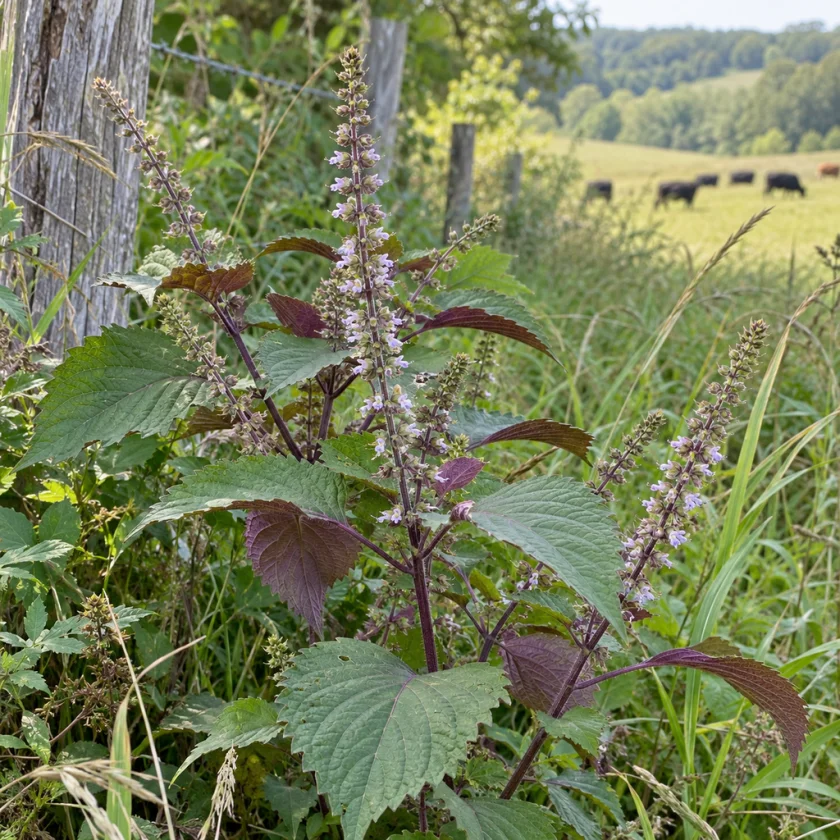
Somewhere in the eastern United States this summer, a farmer will find cattle dead or gasping in a shady fencerow, and the cause will be a plant that looks exactly like the herb in a Japanese restaurant. It is the same species. Perilla frutescens kills livestock in American pastures every year through a compound called perilla ketone, a documented lung toxin — and the identical species, in a different chemotype, is one of the most widely eaten fresh herbs on earth with a safe record going back over a thousand years.
Both of those statements are true, and holding them together at once is the whole point of this page. The bridge between them is chemotype: Perilla frutescens is a species in which nearly identical-looking plants produce completely different dominant volatile compounds, controlled by a handful of genes. The culinary types make perillaldehyde and are harmless. Some wild types make perilla ketone and are not.
What this page is not. It is not a reason to be afraid of a shiso leaf. Human relevance for perilla ketone has never been established, and culinary perilla has an extraordinarily long safe record. What it does show is that the source matters: wild “purple mint” in North America is the population most likely to carry the toxic chemotype, and concentrated volatile preparations such as perilla essential oil are exactly where an unknown chemotype stops being an academic question.
Table of Contents
- One Species, Several Chemotypes
- The Chemotypes, Named
- var. crispa, var. frutescens, and Why They Are Not Interchangeable
- What Perilla Ketone Is and How It Damages Lungs
- Panting Disease: The Veterinary Record
- Human Relevance: An Open Question, Stated Honestly
- Why Essential Oil Is the Risk Concentrate
- Why Seed Oil Does Not Carry Perilla Ketone
- Wild Perilla in North America and the Foraging Risk
- Two Naming Traps: Sesame Leaf and Ornamentals
- The Other Cautions That Actually Apply
- Pregnancy, Breastfeeding and Children
- The Anticoagulant Question
- Sources and Labels: The Facts in Brief
- Evidence Verdict
- Key Research Papers
- Connections
- Featured Videos
One Species, Several Chemotypes
A chemotype is a population within a species that consistently produces a different profile of secondary metabolites while remaining, botanically, the same species. Thyme is the textbook example in the kitchen — thymol, carvacrol, linalool and geraniol chemotypes of Thymus vulgaris smell and behave differently. Perilla frutescens is one of the most sharply chemotyped species in the mint family.
What makes perilla unusual, and dangerous to reason about casually, is that its chemotypes are discrete rather than graded. The essential-oil composition is controlled by a small number of genetic loci, so a plant tends to be dominated by one compound rather than carrying a blend. Two perilla plants growing a metre apart can be chemically almost unrelated in their volatile fraction while looking like siblings.
The practical consequences are worth spelling out, because each one is a place people go wrong:
- You cannot identify a chemotype by sight. Leaf shape, crinkle and colour track the horticultural variety, not the chemotype, and both vary within each.
- You cannot reliably identify it by smell either. A trained nose may notice that a wild plant smells wrong — less bright, more musty or solvent-like — but this is not a safety test, and people who have never smelled true shiso have no baseline for comparison.
- Cultivation is the actual safeguard. Culinary perilla has been selected for flavour for centuries, and flavour means perillaldehyde. That selection is why the food crop is safe, and it is not a property of the species — it is a property of the seed stock.
- The chemotype is the safety-relevant variable, and it is invisible on a label. No supplement bottle states its chemotype. That is why the plant part and the preparation method carry the whole burden of the safety judgement.
The Chemotypes, Named
| Chemotype | Dominant compound | Where it is found | Status |
|---|---|---|---|
| PA | Perillaldehyde | The culinary type — Japanese shiso, Vietnamese tía tô, Korean kkaennip | Long safe food record |
| PK | Perilla ketone | Wild and weedy populations, notably naturalized North American ones | Documented livestock lung toxin |
| EK / IK | Egomaketone, isoegomaketone | Wild populations and some oilseed lines | Related furanoketones; less studied |
| PP | Phenylpropanoids (myristicin, elemicin) | Scattered wild populations | Not a food chemotype |
| C / PL | Citral, piperitenone | Minor, mostly wild | Not a food chemotype |
Perillaldehyde is worth a note of its own, because it is the reason the culinary chemotype exists. It is typically 50 to 60 per cent or more of the leaf essential oil in culinary perilla, and it is the smell of shiso — a bright, complex aroma with notes of cumin, cinnamon and citrus. Its oxime derivative, perillartine, is roughly two thousand times sweeter than sucrose and has been used as a sweetener in Japan. Perillaldehyde has its own minor caution — it is a contact sensitiser — but no lung toxicity.
var. crispa, var. frutescens, and Why They Are Not Interchangeable
Overlaid on the chemotype question is a horticultural one. Two botanical varieties of the species are cultivated for two different crops:
- Perilla frutescens var. crispa — the leaf crop. Japanese shiso, both green (aojiso) and red (akajiso), and Vietnamese tía tô. Strongly crinkled, saw-toothed leaves, intensely aromatic, perillaldehyde-dominant. Grown to be eaten raw.
- Perilla frutescens var. frutescens — the oilseed crop. Korean deulkkae, grown for seed that is pressed into oil or ground into deulkkae garu. Also the source of Korean kkaennip leaf — much larger, flatter, rounder and softer than shiso, milder in flavour, built to be a wrapper.
Korean perilla leaf and Japanese shiso are not compositionally interchangeable. They differ in essential-oil content and in the balance of their volatile compounds, in leaf texture and thickness, and in how much rosmarinic acid they carry — and they taste noticeably different: shiso is bright and cumin-cinnamon-citrus, kkaennip is greener and rounder, tía tô is more anise-like and assertive than either. Recipes are not portable between them, and neither is research. Studies done on Japanese shiso are not studies of Korean perilla leaf, and vice versa.
This is also why the phrase “perilla extract” on a label conveys less information than it appears to. It leaves open which variety, which plant part, and which extraction — the water-soluble rosmarinic-acid fraction, the pressed seed oil, and the distilled essential oil are three unrelated products from one species.
What Perilla Ketone Is and How It Damages Lungs
Evidence tier: established in animals — chemistry characterised, mechanism supported in vivo.
Perilla ketone is a substituted furan: chemically, 3-furyl isoamyl ketone. It is a small, volatile, lipophilic molecule, and by itself it is fairly inert. That is the crux of the story.
Furans of this kind are what toxicologists call bioactivated toxins — harmless until an enzyme opens the furan ring, at which point a highly reactive intermediate is produced that attacks whatever is nearby. The relevant enzymes are cytochrome P450 monooxygenases, and the lung is the crucial site because the club cells (formerly Clara cells) lining the small airways are unusually rich in them.
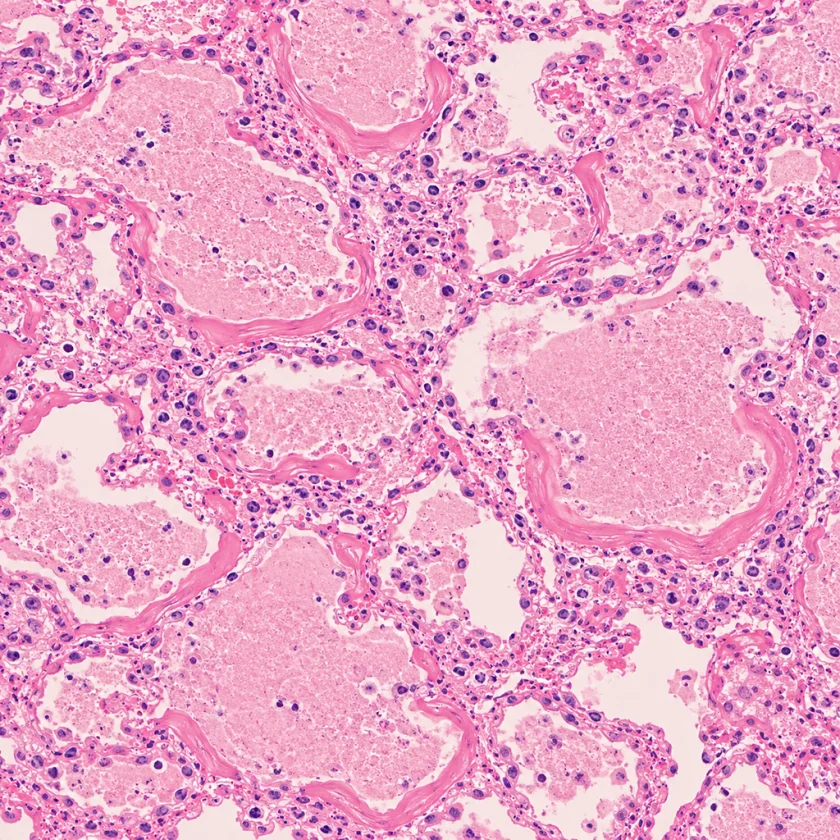
So the sequence runs: perilla ketone is inhaled or absorbed from the gut, reaches the lung, and the club cells — doing their normal job of metabolising foreign compounds — convert it into a reactive species that destroys them and injures the surrounding capillary endothelium. Fluid floods into the airspaces. The lung poisons itself in the act of processing the compound.
The result in a cow is acute pulmonary oedema and interstitial emphysema: fluid in the alveoli, air forced into the tissue between them, and an animal that cannot get oxygen across a waterlogged membrane. It is one of the recognised causes of acute bovine pulmonary emphysema, and the syndrome is called perilla mint toxicosis.
The chemistry was pinned down in 1977, when Wilson, Garst, Linnabary and colleagues published Perilla ketone: a potent lung toxin from the mint plant, Perilla frutescens Britton in Science, isolating the compound and identifying it as the responsible agent. Follow-up work by Garst and colleagues in the Journal of Animal Science in 1985 examined which species are susceptible and produced in-vivo support for the requirement of the lung monooxygenase system — the mechanistic keystone. Field reports through the 1980s, including Kerr, Johnson and Burrows in Veterinary and Human Toxicology in 1986, documented cattle intoxication in Tennessee and neighbouring states.
Note that bioactivation-by-the-target-organ is not exotic. It is the same general principle behind paracetamol's liver toxicity in overdose and behind several pyrrolizidine-alkaloid liver injuries. Perilla ketone is unusual only in that the organ doing the activating is the lung.
Panting Disease: The Veterinary Record
Evidence tier: established. Recurring field disease with a characterised toxin.
American farmers call it panting disease, and the pattern is consistent and seasonal enough that veterinarians recognise it on history alone:
- The plant grows where cattle shelter. Perilla has naturalized across much of the eastern and midwestern United States as a weed of fencerows, woodland edges, barn lots and shady pasture margins — exactly where animals stand out of the sun.
- Late summer is the danger window. Pasture is short and dry, the plants are flowering and setting seed, and toxin concentration is thought to be highest at that stage. Hungry animals browse what is left standing.
- Onset is fast. Animals are found dead, or in severe respiratory distress — open-mouth breathing, extended neck, obvious distress, frothing — within a day or two of exposure.
- Handling makes it worse. Moving or stressing an affected animal can kill it, because any increase in oxygen demand is unsurvivable with a waterlogged lung. Veterinary advice is to leave affected cattle undisturbed.
- There is no antidote. Treatment is supportive; removal from the source and rest. Mortality is high.
- Dried plant in hay remains toxic. Perilla in cut hay is a documented route, so the problem is not confined to grazing.
Cattle are the classic victims and the best documented. Perilla mint toxicosis has also been reported in horses and in other grazing livestock, and susceptibility varies between species — which was one of the specific questions the 1985 species-susceptibility work addressed. Toxicity in animals is not limited to the respiratory syndrome either: perilla exposure has been associated with other effects in livestock, but the lung injury is what kills them.
This is a genuine, recurring agricultural hazard, not a laboratory curiosity. Agricultural extension services in the affected states publish identification and control guidance for livestock keepers in the naturalized range, centred on recognising the plant and controlling it in fencerows and barn lots before late summer.
Human Relevance: An Open Question, Stated Honestly
Here is where most writing on perilla goes wrong in one of two directions — either omitting the toxin entirely, or treating it as a reason to fear a garnish. Neither is right. The accurate position has three parts, and all three need stating together.
1. Human relevance has not been established. There is no body of case reports of human perilla ketone lung injury comparable to the veterinary record. Human beings do not graze a hedgerow for a day, and the exposures are not comparable in dose, duration or route. Nobody has demonstrated a human syndrome.
2. Culinary perilla has an excellent safety record, and it is a very large one. This is the strongest reassurance available and it deserves emphasis. Perilla leaf is eaten daily, in quantity, by many millions of people across Japan, Korea, Vietnam and China, and has been for over a thousand years. Korean diners routinely eat 10 to 30 grams of kkaennip a day. If the food crop caused lung injury, it would have been noticed a very long time ago. A shiso leaf on a plate is not a hazard.
3. The compound is real, the enzymology is not species-exclusive, and concentrated preparations are an open question. Human lungs also contain club cells rich in cytochrome P450. There is no biological principle that makes human lung tissue immune to a bioactivated furan; what protects us is exposure, not immunity. So the honest formulation is: perilla ketone is a demonstrated mammalian lung toxin whose human dose–response is unknown, because it has never been studied and nobody would design that study. For a food crop of a known chemotype that is a non-issue. For a concentrated volatile preparation of unknown chemotype, sold for internal use, it is an unquantified risk taken for no benefit.
That is the entire practical content of the toxicology: it changes nothing about eating perilla, and it is the central concern for swallowed perilla essential oil.
Why Essential Oil Is the Risk Concentrate
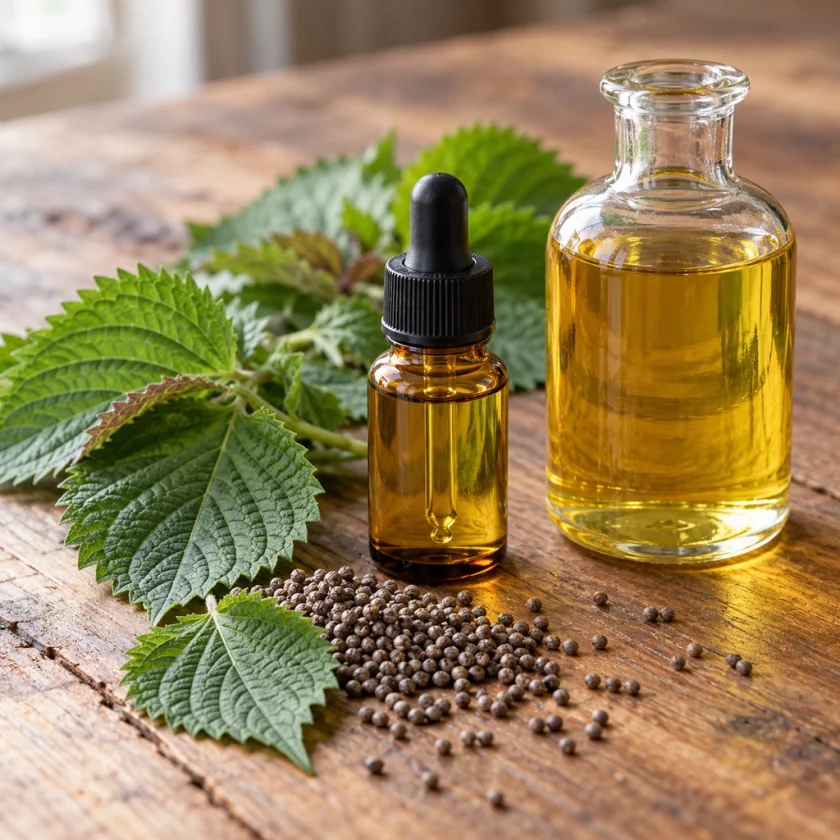
Perilla essential oil is the steam-distilled volatile fraction of the plant. That single sentence contains the whole problem, because the volatile fraction is precisely and exclusively where the chemotype difference lives. Whatever the dominant volatile compound of that plant was, distillation concentrates it several hundred-fold and puts it in a dropper bottle.
Compounding factors:
- Chemotype is never declared. No aromatherapy supplier states whether their perilla oil is a PA or a PK chemotype. Most would not know.
- Source material is often not the food crop. Essential-oil feedstock is grown or collected for oil yield, not for culinary flavour, and wild-collected material is entirely possible.
- Aromatherapy oils are not food-regulated. They are not manufactured, tested or labelled as food, whatever the retailer implies.
- The dose step is enormous. A few drops of essential oil can exceed the volatile-compound content of an entire meal's worth of leaf.
- The internal-use culture around essential oils is the actual hazard. Advice to add drops to water, take them in capsules, or gargle them is common online; for this plant specifically, it means swallowing a concentrate of an undeclared chemotype.
No safety data exist for swallowing perilla essential oil, its chemotype is never declared, and distillation concentrates the volatile fraction in which perilla ketone occurs. Nothing perilla has been shown to do requires the essential oil: the allergy evidence is for a water-soluble leaf extract, and the culinary use is the fresh leaf.
Why Seed Oil Does Not Carry Perilla Ketone
The difference between the two oils is a matter of chemistry, and it is worth being precise about.
Perilla seed oil is a fixed oil — triglycerides, mechanically pressed from seed, in the same class as olive or walnut oil. Perilla essential oil is a volatile oil — steam-distilled aroma compounds. They share a name and nothing else. Fixed oils do not carry the volatile fraction: the pressing process does not concentrate it, and perilla ketone is not a meaningful component of cold-pressed culinary seed oil regardless of the plant's chemotype.
So the chemotype question does not apply to a bottle of Korean deulgireum or to a cold-pressed perilla oil supplement. Those have entirely different concerns — oxidation and rancidity, which are genuinely important and are covered on Perilla Seed Oil: Plant Omega-3 and What alpha-linolenic acid (ALA) Does.
Wild Perilla in North America and the Foraging Risk
This is the point on this page most directly tied to preventing harm, and it concerns exactly the sort of person who reads a page like this: someone who has learned to recognise a useful plant and is pleased to find it growing free.
Perilla naturalized across the eastern and midwestern United States a long time ago and is now a common weed under the names beefsteak plant and purple mint. It self-seeds enthusiastically. It is genuinely abundant, it is unmistakably perilla, and it is free.
The naturalized American population is exactly the group most likely to contain perilla-ketone chemotypes — because it has not been under culinary selection for centuries; it has been under natural selection, where a potent furanoketone is a perfectly good defence against browsing animals. That is presumably why the toxic chemotype is common in the wild and absent from the food crop.
You cannot tell by looking. You cannot reliably tell by smelling. A cattle-killing plant and a sashimi garnish are the same species with the same leaves. The food crop sold in Asian groceries, and plants grown from named culinary seed, come from culinary-selected stock. The saving from foraging is a couple of dollars.
The same reasoning applies, with less force, to wild-collected herbal material in general: perilla leaf sold loose in bulk from an unnamed source is a less certain product than a labelled Korean or Japanese food item with high turnover.
Two Naming Traps: Sesame Leaf and Ornamentals
The “sesame leaf” trap. Korean kkaennip is routinely translated as “sesame leaf” on restaurant menus and grocery packaging in the West. It is not sesame. Sesame is Sesamum indicum, an unrelated plant in the Pedaliaceae whose leaves are not eaten. The confusion comes from Korean usage: chamkkae (“true kkae”) is sesame, deulkkae (“wild kkae”) is perilla, and kkaennip is literally “kkae leaf.”
This matters in two directions. If you have a sesame allergy, a packet of Korean “sesame leaves” is perilla and poses no sesame risk — though a prepared side dish may genuinely contain sesame seeds or sesame oil, which its full ingredient list shows. If you are buying “perilla oil” expecting the flavour of toasted sesame oil, you will get something quite different.
The ornamental trap. Deep-purple perilla is sold in Western garden centres as a bedding plant, sometimes labelled “beefsteak plant” and often mistaken for coleus, which it superficially resembles. Ornamental nursery stock is grown as a decorative: its chemotype is unselected, and it may carry pesticides and growth regulators not permitted on food crops. Ornamental perilla is not grown as food. Seed sold explicitly as culinary shiso, tía tô or kkaennip comes from culinary stock.
The Other Cautions That Actually Apply
With perilla ketone put in proportion, these are the cautions most likely to affect an ordinary reader:
- Perillaldehyde is a contact sensitiser. It belongs to the family of fragrance aldehydes that cause allergic contact dermatitis, and hand dermatitis has been described in people who handle large quantities of fresh leaf — kitchen workers rather than diners. Gloves block the skin contact behind it. See Contact Dermatitis.
- Perilla itself can be an allergen. Allergic reactions to perilla leaf and seed have been reported, mostly from countries where it is eaten daily and in quantity. It is not a common allergen in the West, but it is not a non-allergen either, and occupational sensitisation among perilla growers has been described. See Food Allergy.
- Rancid seed oil is a real and common problem. Perilla oil oxidises faster than almost any other culinary oil, and oxidised oil smells of paint or old fish.
- Ground perilla seed goes off just as fast.
- Drug interactions are poorly studied. No clinically important interaction has been established for perilla leaf. That reflects absence of study as much as absence of risk. The alpha-linolenic acid in perilla seed has a weaker antiplatelet effect than the eicosapentaenoic acid and docosahexaenoic acid in fish oil (see The Anticoagulant Question).
- Multi-herb TCM and Kampo formulas are multi-drug exposures. Perilla is usually a minor component; the formula as a whole is what interacts.
Pregnancy, Breastfeeding and Children
The line here is between food and concentrate, and it is a clean one.
Perilla leaf as food is traditional across East Asia during pregnancy, including within Chinese formulas used specifically for pregnancy nausea. Millions of pregnant women have eaten it. That record is genuinely reassuring for culinary amounts. Perilla seed oil as a culinary fat is likewise a food, and its alpha-linolenic acid is a normal dietary component.
Concentrated perilla extracts have no safety data in pregnancy or breastfeeding. This applies to rosmarinic-acid-standardized leaf extract capsules, to any concentrated leaf or seed extract, and absolutely to essential oil. No harm has been shown; nothing has been studied, and the dose is one or two orders of magnitude above food. The same applies to children: perilla as food has the long dietary record, and perilla extracts have no safety data in children.
One nutritional footnote that belongs here: pregnancy and infancy are precisely when preformed docosahexaenoic acid (DHA) matters most, and perilla oil does not supply it.
The Anticoagulant Question
This caution circulates widely and deserves to be scaled correctly rather than repeated or dismissed.
Omega-3 fatty acids have mild antiplatelet effects, and the standard clinical advice is to mention any high-dose omega-3 supplement to a surgeon before an operation, or to a clinician managing warfarin, apixaban, rivaroxaban or clopidogrel. Perilla seed oil is a high-ALA product, so the caution is raised for it.
The honest qualifiers:
- Alpha-linolenic acid has a considerably weaker antiplatelet effect than the eicosapentaenoic acid (EPA) and docosahexaenoic acid (DHA) in fish oil. Most of the bleeding literature concerns marine omega-3, and extrapolating it directly to alpha-linolenic acid overstates the concern.
- Clinically significant bleeding attributable to culinary perilla oil has not been demonstrated.
- Dose matters. The surgical and anticoagulant caution concerns supplement-sized doses far more than a teaspoon on a salad.
A separate and often-cited item belongs beside it: an older body of observational research suggested a weak association between high alpha-linolenic acid intake and prostate cancer risk. Later and larger analyses have been inconsistent and the association is not considered established. It is most relevant to people taking high-dose alpha-linolenic acid supplements long term with a strong family history. It does not concern perilla as a food.
Sources and Labels: The Facts in Brief
- The food crop. Fresh kkaennip, shiso or tía tô from an Asian grocery is culinary-selected stock, and high turnover is itself a quality control.
- Named culinary seed. Seed sold as shiso, tía tô or kkaennip comes from culinary stock; ornamental nursery stock does not. Perilla self-seeds readily across a garden, and a pot contains it.
- Wild North American perilla is the population most likely to carry the perilla-ketone chemotype.
- Ornamental perilla from a garden centre is unselected for chemotype and may carry pesticides not permitted on food crops.
- Perilla essential oil has no safety data for internal use and an undeclared chemotype.
- Leaf-extract supplement labels differ in what they state; the informative ones give the plant part (leaf), the standardization (milligrams of rosmarinic acid, not milligrams of extract), and where the material came from.
- The products are different: fresh leaf is food; leaf extract is the allergy preparation; seed oil is a pressed fat; essential oil is a distilled volatile concentrate.
Evidence Verdict
- “Perilla frutescens has distinct chemotypes” — established botanical and phytochemical fact.
- “Perilla ketone is a potent lung toxin” — established in animals, with characterised chemistry and in-vivo mechanistic support.
- “Perilla causes fatal respiratory disease in cattle” — established, a recurring seasonal field disease with a documented veterinary literature.
- “Perilla ketone harms humans” — not established. No human case series; exposure routes are not comparable. Biologically not impossible, and unstudied.
- “Culinary perilla leaf is safe” — supported by an enormous and long dietary record, with contact dermatitis and occasional allergy as the real, minor caveats.
- “Perilla essential oil is safe to swallow” — no evidence, and a specific reason for concern.
- “Perilla seed oil carries the toxin” — false. Different fraction entirely; its real issue is oxidation.
- “Perilla thins the blood” — theoretical and weak for alpha-linolenic acid; the caution concerns supplement doses, not food.
Key Research Papers
Links are PubMed topic searches rather than fixed records, so they stay current.
- Wilson BJ, Garst JE, Linnabary RD, et al. Perilla ketone: a potent lung toxin from the mint plant, Perilla frutescens Britton. Science, 1977. The original isolation and identification of the toxic constituent. Find on PubMed
- Garst JE, Wilson WC, Kristensen NC, et al. Species susceptibility to the pulmonary toxicity of 3-furyl isoamyl ketone (perilla ketone): in vivo support for involvement of the lung monooxygenase system. Journal of Animal Science, 1985. The mechanistic keystone. Find on PubMed
- Kerr LA, Johnson BJ, Burrows GE. Intoxication of cattle by Perilla frutescens (purple mint). Veterinary and Human Toxicology, 1986. Field documentation of cattle deaths. Find on PubMed
- The wider veterinary literature on acute bovine pulmonary emphysema and perilla mint toxicosis, including cases in horses and other livestock and the role of perilla in cut hay. Find on PubMed
- Chemotype genetics and essential-oil composition studies in Perilla frutescens — the work establishing that oil type is controlled by a small number of loci and segregates discretely. Find on PubMed
- Studies on club-cell (Clara-cell) cytochrome P450 bioactivation of furans and other pulmonary toxins — the general mechanism perilla ketone belongs to. Find on PubMed
- Work on egomaketone and isoegomaketone, the related furanoketones of other perilla chemotypes. Find on PubMed
- Perillaldehyde toxicology and its role as a fragrance contact sensitiser, including reports of occupational hand dermatitis in perilla handlers. Find on PubMed
- Case reports and series of perilla allergy, including occupational sensitisation among growers, mostly from Japan and Korea. Find on PubMed
- Liu S, Jin X, Shang Y, et al. A comprehensive review of the botany, ethnopharmacology, phytochemistry, pharmacology, toxicity and quality control of Perillae Fructus. Journal of Ethnopharmacology, 2023 — includes the toxicity and quality-control literature for the seed drug. Find on PubMed
- Ahmed HM. Ethnomedicinal, phytochemical and pharmacological investigations of Perilla frutescens (L.) Britt. Molecules, 2018. General review including the constituent profile. Find on PubMed
- ALA intake and prostate cancer risk — the inconsistent observational literature behind that caution. Find on PubMed
External Resources
- PubMed — the primary biomedical and veterinary literature.
- Merck Veterinary Manual — the standard reference for livestock plant toxicoses.
- USDA PLANTS Database — distribution and status of naturalized species in the United States.
- National Center for Complementary and Integrative Health — NIH herb and supplement safety summaries.
- Poison Control — United States poison-centre help.
Connections
- All Herbs
- Perilla (Perilla frutescens) — the main topic page, including names and identification.
- Perilla Benefits Hub — all four deep dives.
- Perilla Seed Oil and Alpha-Linolenic Acid — the fixed oil, and why the chemotype question does not apply to it.
- Perilla for Allergy and Rhinitis — the leaf extract, and why its chemotype matters.
- Perilla for Digestion and Antimicrobial Use — the antimicrobial claims that tempt people toward the essential oil.
- Contact Dermatitis — the perillaldehyde sensitisation risk for cooks.
- Food Allergy — perilla as an allergen in its own right.
- Allergies — how sensitisation works.
- Pulmonology — the organ system perilla ketone injures.
- Asthma — a reminder that lung disease is not a supplement problem.
- Toxins — the broader index of plant and environmental toxins.
- Peppermint — a fellow Lamiaceae, for comparison of mint-family chemistry.
- Rosemary — another chemotype-variable aromatic mint relative.
- Thyme — the classic culinary example of a chemotyped species.
- Lemon Balm — a rosmarinic-acid-rich alternative with no equivalent toxin story.
- Flaxseed — the alternative plant alpha-linolenic acid source.
Safety and disclaimer. This page is health information, not medical or veterinary advice. Perilla ketone is a documented lung toxin in livestock; its human dose–response is unknown and has never been studied. Culinary perilla has an exceptionally long safe dietary record. The risks the evidence points to are wild North American perilla gathered for food, ornamental nursery perilla, and perilla essential oil taken internally. Concentrated perilla extracts have no safety data in pregnancy, breastfeeding or childhood. Veterinarians and agricultural extension services in the naturalized range provide plant identification for livestock keepers. Suspected poisoning in a person is an emergency that poison centres and emergency services handle.