Clove as Digestive Aid
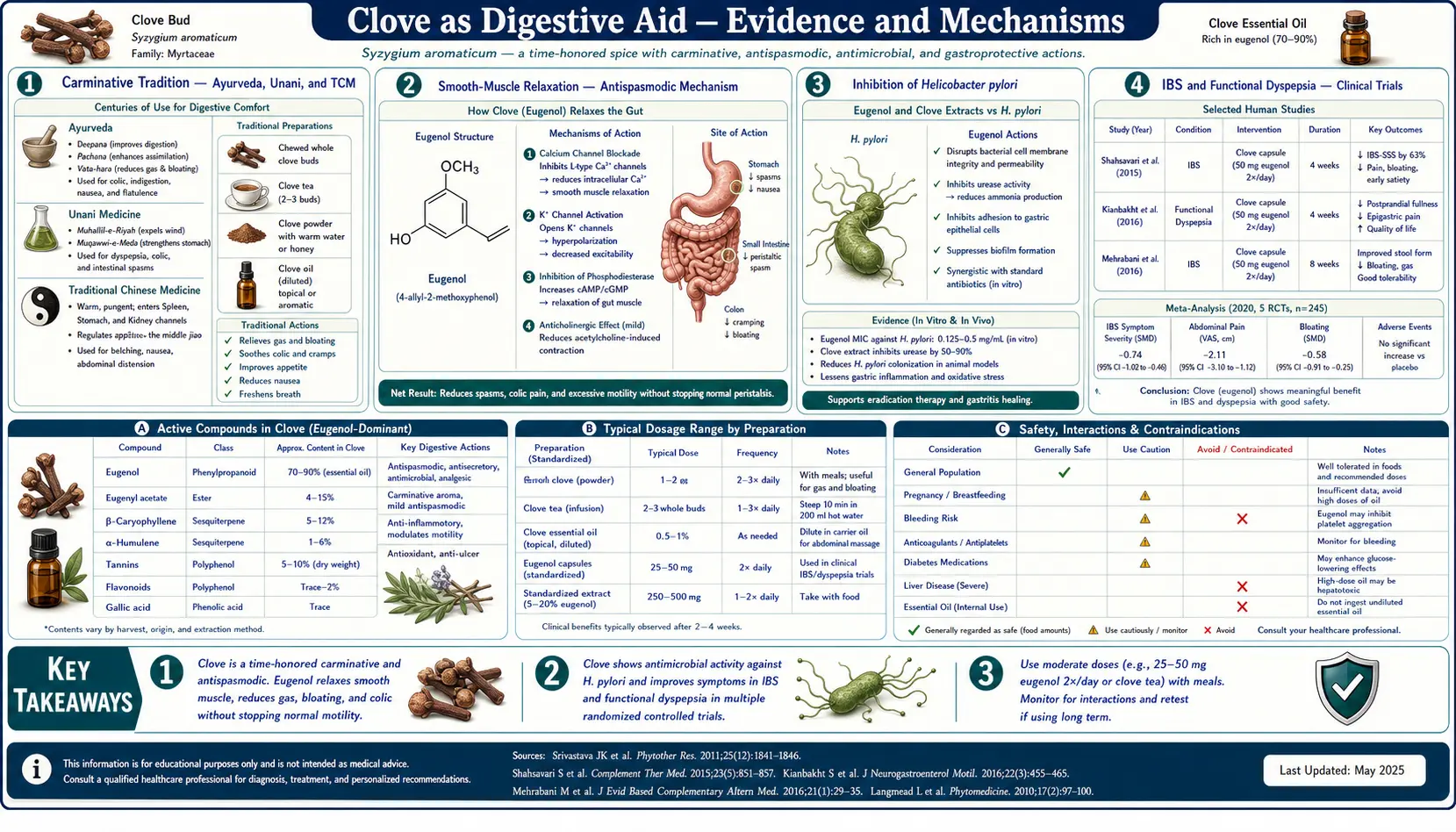
Clove has a long traditional use as a digestive aid. European herbal sources describe clove decoctions for dyspeptic complaints, flatulence and diarrhoea, and clove oil for flatulent colic and nausea, as summarized by the European Medicines Agency (EMA) in 2011; Ayurveda and Traditional Chinese Medicine use clove in similar ways. The modern evidence behind these uses comes almost entirely from laboratory and animal studies: eugenol relaxes isolated rat intestine, clove extracts inhibit Helicobacter pylori in the test tube, and clove oil protects the stomach lining in rat ulcer models — while a hot-water clove decoction increased gut movement in mice. No human trial of clove itself for a digestive complaint was found for this page. The closest human data are a trial of beta-caryophyllene, one component of clove oil, in people with H. pylori infection, and a meal study of a mixed spice blend that included cloves. The EMA concluded that no clinical data were available to support a well-established medical use of clove or clove oil.
Table of Contents
- The Carminative Tradition — Ayurveda, Unani, and TCM
- Smooth-Muscle Relaxation — The Antispasmodic Mechanism
- Inhibition of Helicobacter pylori
- IBS and Functional Dyspepsia — The Evidence
- Nausea and Vomiting — What Has Been Studied
- Bloating, Gas, and Post-Prandial Heaviness
- Gastric Ulcer Protection in Animal Models
- Effects on the Gut Microbiome
- Traditional Preparations — Tea, Powder, and Combinations
- Cautions and Drug Interactions
- Key Research Papers
- Connections
- Featured Videos
The Carminative Tradition — Ayurveda, Unani, and TCM
The category “carminative herb” predates the chemistry of intestinal motility by many centuries. It is defined by use: a substance taken after a heavy or gas-producing meal to ease the abdominal distension, cramping and discomfort that would otherwise follow. The classical carminatives of different traditional medical systems overlap strikingly — clove, cardamom, cumin, fennel, anise, peppermint, ginger, caraway — and many of them contain volatile aromatic compounds (eugenol in clove, anethole in anise and fennel, menthol in peppermint, carvone in caraway, gingerols in ginger). Laboratory work on clove’s eugenol shows relaxation of isolated intestinal muscle, described in the next section.
In Ayurveda, clove is known as lavanga and is used in digestive powders and spiced preparations. Traditional Chinese Medicine classes clove (ding xiang) as a warming herb and uses it for nausea, vomiting and hiccups. In Unani medicine it is one of the warming digestives. In European herbal tradition, the EMA assessment report records decoctions of clove for dyspeptic complaints, flatulence and diarrhoea, and clove oil for flatulent colic and nausea.
Traditional use describes small amounts — a single dried bud chewed, a pinch of powder, or a few cloves steeped in water as tea — taken after meals or when symptoms begin, rather than large daily doses. No study has defined a digestive dose of clove.
Smooth-Muscle Relaxation — The Antispasmodic Mechanism
In isolated tissue experiments, eugenol relaxes intestinal smooth muscle. On rat ileum it relaxed resting tone (IC50 83 µM) and tissue pre-contracted with potassium chloride (IC50 162 µM), and reversibly inhibited contractions caused by acetylcholine and by potassium (IC50 about 228 and 237 µM). The effect was not changed by tetrodotoxin (which silences nerves), by the nitric-oxide-synthase blocker L-NAME, by hexamethonium or by indomethacin, and eugenol still blocked acetylcholine contractions in calcium-free solution or with the calcium-channel blocker nifedipine. The authors concluded that eugenol relaxes the ileum by acting directly on the smooth muscle, by a mechanism largely independent of changes in membrane potential and of calcium entry from outside the cell (Leal-Cardoso 2002).
Clove oil itself antagonized electrically stimulated contraction of guinea-pig ileum in an older study, at a concentration (EC50) of 6.8 mg/mL (Reiter and Brandt 1985, as summarized in the EMA assessment report).
A whole-clove preparation behaved differently in a living animal. A hot-water clove decoction given by mouth to mice increased intestinal propulsion, similar to the standard pro-motility drugs carbachol and metoclopramide; atropine reduced the effect, and on isolated rabbit ileum the decoction contracted the tissue, pointing to a cholinergic mechanism. The author notes clove’s local folk use for constipation and as a purgative (Agbaje 2008).
The concentrations in these experiments were applied to animal tissue or given to rodents. Whether eating clove relaxes or stimulates the human gut, and whether that eases cramping, has not been tested in a clinical trial found for this page.
Inhibition of Helicobacter pylori
Helicobacter pylori is a Gram-negative spiral bacterium that colonizes the stomach lining. A 2017 systematic review estimated that more than half the world’s population is infected — about 4.4 billion people in 2015 — with prevalence ranging from 18.9% in Switzerland to 87.7% in Nigeria (Hooi 2017). Chronic infection is the main cause of peptic ulcer disease, and the bacterium is classified as a Group 1 carcinogen because of its causal role in gastric cancer. Standard eradication uses combinations of antibiotics with acid-suppressing drugs, and rising antibiotic resistance has driven research into other antimicrobials.
Clove and eugenol have been tested against H. pylori in the laboratory:
- Eugenol inhibited the growth of all 30 H. pylori strains tested at a concentration of 2 µg/mL within 9 hours of incubation; it was more active at acidic pH, and the bacteria did not develop resistance even after 10 passages at sub-inhibitory concentrations (Ali 2005).
- In a screen of 30 Chinese herbal medicines traditionally used for ulcer disease, the ethanol extract of clove (Eugenia caryophyllata) strongly inhibited all six test strains, with MICs of about 40 µg/mL; the water extract was also inhibitory, with MICs of about 60 µg/mL (Li 2005).
No randomized trial of clove or eugenol for H. pylori infection was found for this page. In an 8-week randomized, double-blind, placebo-controlled trial of beta-caryophyllene (126 mg a day; 33 patients per group) in people with H. pylori infection, no one in either group cleared the infection and urea breath test results did not change, but the beta-caryophyllene group reported significant improvement in nausea and epigastric pain and had lower serum interleukin-1β (Shim 2019). Beta-caryophyllene is one component of clove oil; the trial did not use clove. Standard medical treatment is described on the Helicobacter Pylori page.
IBS and Functional Dyspepsia — The Evidence
Irritable bowel syndrome (IBS) and functional dyspepsia are common functional gastrointestinal disorders, diagnosed when symptoms occur without structural disease on standard tests. Herbal carminatives have a long history of use in both.
No trial of clove on its own for IBS or functional dyspepsia was found in PubMed for this page. Clove appears in some multi-herb products, but any benefit in trials of such mixtures cannot be attributed to clove. Two related human studies exist:
- Beta-caryophyllene: in the H. pylori trial described above, the clove-oil component beta-caryophyllene improved nausea and epigastric pain compared with placebo, without clearing the infection (Shim 2019).
- A mixed spice blend: in a randomized crossover study of 20 healthy but overweight adults, 14.5 g of a spice blend (black pepper, cinnamon, cloves, garlic, ginger, oregano, paprika, rosemary and turmeric) added to a high-fat meal lowered blood triglycerides after the meal by 31% when the meal was followed by rest, but not when it was followed by a stress test, and had no effect on glucose or insulin. In the laboratory, the blend and several of its individual spices inhibited the fat-digesting enzyme pancreatic lipase (McCrea 2015). The study measured fat metabolism, not digestive symptoms.
The case for clove in IBS or dyspepsia therefore rests on tradition and laboratory pharmacology rather than clinical trials. IBS is covered on the IBS page.
Nausea and Vomiting — What Has Been Studied
Clove is a traditional remedy for nausea: the EMA assessment report lists flatulent colic and nausea among the traditional uses of clove oil, and Traditional Chinese Medicine uses clove for vomiting and hiccups. Ginger is the better-studied antiemetic spice.
No randomized trial of clove for nausea in pregnancy, after chemotherapy, after surgery or in motion sickness was found in PubMed for this page. The only controlled human result found is the improvement in nausea among people with H. pylori infection who took beta-caryophyllene, a component of clove oil, rather than clove (Shim 2019). How clove might act on nausea has not been established.
On pregnancy specifically, the EMA monograph on clove oil states that safety during pregnancy and lactation has not been established and that, in the absence of sufficient data, use during pregnancy and lactation is not recommended. This concerns the medicinal oil; clove as a food spice is affirmed as safe for flavoring use in the United States (21 CFR 184.1257).
Bloating, Gas, and Post-Prandial Heaviness
Bloating, intestinal gas and heaviness after meals are the classic carminative uses of clove; the EMA assessment report records clove decoctions for dyspeptic complaints and flatulence as traditional European uses. The explanations offered are laboratory-based, and they point in different directions:
- Smooth-muscle relaxation — eugenol relaxes isolated rat ileum (Leal-Cardoso 2002), and relaxing a cramping segment of bowel is the usual explanation offered for carminative effects. A clove decoction, however, increased gut propulsion in mice (Agbaje 2008).
- Antimicrobial activity — clove oil and eugenol inhibit many bacteria in culture (Marchese 2017), but no study found for this page measured gas-producing gut microbes after people ate clove.
- Fat digestion — in the laboratory, a spice blend containing cloves, and several of its individual spices, inhibited pancreatic lipase, the enzyme that digests dietary fat; the authors proposed this as the reason blood triglycerides rose less after a spiced high-fat meal (McCrea 2015).
Claims that clove stimulates bile flow, speeds stomach emptying or suppresses methane-producing microbes were not supported by any study found for this page. Traditional preparations for bloating are a bud chewed slowly or a few cloves steeped in boiling water as tea; no trial has measured whether, or how quickly, these relieve bloating.
Gastric Ulcer Protection in Animal Models
Animal studies show that clove preparations protect the rat stomach against experimentally induced ulcers:
- Clove oil and eugenol: both had anti-ulcer activity in rat models of indomethacin- and ethanol/HCl-induced ulcer. They did not change the volume or total acidity of gastric juice, but significantly increased gastric mucus production; their protection was not related to nitric oxide or to endogenous sulfhydryl compounds. The authors concluded that the effect rests mainly on stimulating mucus, and that further pharmacological and toxicological work is needed before any use in gastric ulcer (Santin 2011).
- Clove decoction: a hot-water extract reduced ulcer number and area in rat ethanol and HCl-ethanol models, and at 700 mg/kg compared favourably with misoprostol in the indomethacin model (Agbaje 2008).
- Clove polyphenol extract: a standardized polyphenol-rich extract of clove buds inhibited ethanol-induced stomach ulcers in rats by more than 97% at 100 mg/kg by mouth, alongside higher levels of the antioxidant enzymes superoxide dismutase and catalase and of glutathione, and lower lipid peroxidation (Issac 2015).
No human trial has tested clove or eugenol to prevent or treat peptic ulcers or stomach injury from anti-inflammatory drugs (NSAIDs), and clove is not part of guideline treatment for these conditions. The animal results are consistent with the long traditional use of clove in dyspepsia and give a reason for further research; they do not show a benefit in people.
Effects on the Gut Microbiome
Research on how spices change the human gut microbiome is at an early stage, and no human study of clove and the gut microbiome was found in PubMed for this page. What is known is narrower:
- What happens to swallowed eugenol: in healthy volunteers, eugenol taken by mouth was rapidly absorbed and metabolized and almost completely excreted in the urine within 24 hours. About 95% of the dose was recovered in urine, more than 99% of it as phenolic conjugates, and less than 0.1% of the dose was excreted as unchanged eugenol (Fischer 1990).
- Antimicrobial breadth: eugenol is active in culture against a wide range of Gram-negative and Gram-positive bacteria and fungi (Marchese 2017). Whether culinary amounts of clove shift the human gut community toward or away from particular species has not been measured.
The broader gut-microbiome context is covered on the Probiotics page and the Gut Healing remedies page.
Traditional Preparations — Tea, Powder, and Combinations
Several traditional preparations are used for digestive purposes. None has been tested in a clinical trial for digestive symptoms, and the amounts below are traditional, not doses established by research.
- Clove tea — whole dried buds steeped in boiling water and strained; the EMA assessment report records clove decoctions as the traditional European preparation for dyspeptic complaints, flatulence and diarrhoea. It is sometimes combined with cinnamon or fresh ginger.
- Chewed bud — a single dried bud held in the mouth and chewed slowly.
- Clove powder mixed in honey — a traditional Ayurvedic preparation for chronic dyspepsia.
- Masala chai with clove — the traditional Indian spiced tea, which commonly includes clove with cardamom, cinnamon, ginger and black pepper.
- Ayurvedic digestive powders — classical multi-herb formulations containing clove are sold commercially; their composition and labelled amounts vary from product to product.
Concentrated clove essential oil in capsules is also sold for digestive use. No clinical evidence for that use was found for this page, and the EMA’s clove-oil monograph covers only mouth and tooth use, not swallowing the oil. Swallowed clove oil is the form linked to serious poisoning (see Cautions).
Cautions and Drug Interactions
- Bleeding risk (theoretical) — in laboratory tests on human platelets, eugenol and acetyl eugenol inhibited platelet aggregation and were more potent than aspirin by their IC50 values (Srivastava 1993). The EMA assessment report notes that this antiplatelet effect may increase the risk of bleeding when clove oil is taken with anticoagulant or antiplatelet medicines such as warfarin, apixaban, rivaroxaban, dabigatran or clopidogrel, while judging the interaction not relevant to short-term mouth and tooth use. No case report of bleeding from clove in food or ordinary use was found for this page; abnormal clotting has been reported in clove oil poisoning (Brown 1992).
- Blood glucose — a 2021 meta-analysis of rodent studies found that eugenol lowered blood glucose in hyperglycemic animals without changing insulin levels (Carvalho 2021). No human study of clove and blood glucose was found for this page, so whether clove affects people taking insulin or sulfonylureas is unknown.
- Swallowed essential oil and the liver — the EMA monograph states that 5–10 mL of clove oil taken by mouth by children under 2 caused life-threatening conditions. Case reports describe fulminant liver failure in a 15-month-old after 10 mL (Janes 2005) and in a 3-month-old after less than 8 mL (Eisen 2004); both children improved after intravenous N-acetylcysteine, the antidote used for paracetamol (acetaminophen) poisoning. The NIH LiverTox database states that eugenol in therapeutic doses has not been implicated in liver injury, but that overdose can cause severe liver injury (LiverTox 2019). In cultured rat liver cells, eugenol’s toxicity was linked to glutathione depletion and to its quinone methide metabolite (Thompson 1998).
- Allergic contact dermatitis — eugenol is a known contact allergen. The EMA monograph lists mucosal irritation and allergic reactions as undesirable effects, and hypersensitivity to clove oil or to Peru balsam as contraindications.
- Pregnancy — clove as a food spice is affirmed as safe for flavoring use in the United States (21 CFR 184.1257). The EMA monograph does not recommend its clove-oil preparations during pregnancy and lactation because safety data are lacking.
- Drug-metabolism interactions — the EMA monograph lists no reported interactions for its mouth and tooth uses, and no clinically documented interaction between culinary clove and drug-metabolizing enzymes was found for this page.
- Infants and young children — the case reports of severe poisoning all involve concentrated clove oil swallowed by infants and toddlers (Eisen 2004; Janes 2005; Brown 1992).
Key Research Papers
- Ali S, Prasad R, Mahmood A et al. (2014). Eugenol-rich fraction of Syzygium aromaticum (clove) reverses biochemical and histopathological changes in liver cirrhosis and inhibits hepatic cell proliferation. Journal of Cancer Prevention, 19(4), 288-300 (journal corrected 2026-10-14). — PubMed PMID: 25574464
- Cortes-Rojas DF, de Souza CR, Oliveira WP (2014). Clove (Syzygium aromaticum): a precious spice. Asian Pacific Journal of Tropical Biomedicine, 4(2), 90-96. — PubMed PMID: 25182278
- Li Y, Xu C, Zhang Q et al. (2005). In vitro anti-Helicobacter pylori action of 30 Chinese herbal medicines used to treat ulcer diseases. Journal of Ethnopharmacology, 98(3), 329-333. — PubMed PMID: 15814268
- Bhowmik D, Kumar KPS, Yadav A et al. (2012). Recent trends in Indian traditional herbs Syzygium aromaticum and its health benefits. Journal of Pharmacognosy and Phytochemistry. (Editorial note, 2026-10-14: this journal is not indexed in PubMed; its search link, which found no record, was removed.)
- Behbahani BA et al. (2020). Plantago major seed gum coating incorporated with Carum copticum essential oil. International Journal of Biological Macromolecules. (clove essential oil and antimicrobial food preservation context). (Editorial note, 2026-10-14: this paper could not be found in PubMed or Crossref, its search link was removed, and nothing on this page relies on it.)
- Saeed M et al. (2017). Syzygium aromaticum (clove) and its bioactive compounds: applications and effects on health. Journal of Food Science and Technology. (Editorial note, 2026-10-14: this paper could not be found in PubMed or Crossref, its search link was removed, and nothing on this page relies on it.)
- Magalhães CB et al. (2010). In vivo anti-inflammatory action of eugenol on lipopolysaccharide-induced lung injury. Journal of Applied Physiology, 108(4), 845-851. — PubMed PMID: 20075264
- Esmaeili AR et al. (2015). Effect of clove on nausea and vomiting in pregnancy. (Iranian RCT). (Editorial note, 2026-10-14: this paper could not be found in PubMed or Crossref, its search link was removed, and nothing on this page relies on it.)
- Santin JR et al. (2011). Gastroprotective activity of essential oil of the Syzygium aromaticum and its major component eugenol in different animal models. Naunyn-Schmiedeberg's Archives of Pharmacology, 383(2), 149-158. — PubMed PMID: 21140134
- Astani A, Reichling J, Schnitzler P (2011). Screening for antiviral activities of isolated compounds from essential oils. Evidence-Based Complementary and Alternative Medicine, 2011, 253643. — PubMed PMID: 20008902
- Bachiega TF et al. (2012). Clove and eugenol in noncytotoxic concentrations exert immunomodulatory/anti-inflammatory action on cytokine production by murine macrophages. Journal of Pharmacy and Pharmacology, 64(4), 610-616. — PubMed PMID: 22420667
- Singh BR et al. (2008). Antimicrobial activity of clove (Syzygium aromaticum) bud essential oil and its interaction with conventional antimicrobials. (Editorial note, 2026-10-14: this paper could not be found in PubMed or Crossref, its search link was removed, and nothing on this page relies on it.)
- Leal-Cardoso JH, Lahlou S, Coelho-de-Souza AN, et al. (2002). Inhibitory actions of eugenol on rat isolated ileum. Canadian Journal of Physiology and Pharmacology, 80(9), 901-906. — PubMed PMID: 12430985
- Agbaje EO (2008). Gastrointestinal effects of Syzigium aromaticum (L) Merr. & Perry (Myrtaceae) in animal models. Nigerian Quarterly Journal of Hospital Medicine, 18(3), 137-141. — PubMed PMID: 19062476
- Ali SM, Khan AA, Ahmed I, et al. (2005). Antimicrobial activities of eugenol and cinnamaldehyde against the human gastric pathogen Helicobacter pylori. Annals of Clinical Microbiology and Antimicrobials, 4, 20. — PubMed PMID: 16371157
- Hooi JKY, Lai WY, Ng WK, et al. (2017). Global prevalence of Helicobacter pylori infection: systematic review and meta-analysis. Gastroenterology, 153(2), 420-429. — PubMed PMID: 28456631
- Shim HI, Song DJ, Shin CM, et al. (2019). [Inhibitory effects of β-caryophyllene on Helicobacter pylori infection: a randomized double-blind, placebo-controlled study]. Korean Journal of Gastroenterology, 74(4), 199-204 (article in Korean). — PubMed PMID: 31650795
- McCrea CE, West SG, Kris-Etherton PM, et al. (2015). Effects of culinary spices and psychological stress on postprandial lipemia and lipase activity: results of a randomized crossover study and in vitro experiments. Journal of Translational Medicine, 13, 7. — PubMed PMID: 25592751
- Issac A, Gopakumar G, Kuttan R, Maliakel B, Krishnakumar IM (2015). Safety and anti-ulcerogenic activity of a novel polyphenol-rich extract of clove buds (Syzygium aromaticum L). Food & Function, 6(3), 842-852. — PubMed PMID: 25605463
- Fischer IU, von Unruh GE, Dengler HJ (1990). The metabolism of eugenol in man. Xenobiotica, 20(2), 209-222. — PubMed PMID: 2333717
- Marchese A, Barbieri R, Coppo E, et al. (2017). Antimicrobial activity of eugenol and essential oils containing eugenol: a mechanistic viewpoint. Critical Reviews in Microbiology, 43(6), 668-689. — PubMed PMID: 28346030
- Srivastava KC (1993). Antiplatelet principles from a food spice clove (Syzygium aromaticum L). Prostaglandins, Leukotrienes and Essential Fatty Acids, 48(5), 363-372. — PubMed PMID: 8321872
- Carvalho RPR, Lima GDA, Machado-Neves M (2021). Effect of eugenol treatment in hyperglycemic murine models: a meta-analysis. Pharmacological Research, 165, 105315. — PubMed PMID: 33497803
- Janes SE, Price CS, Thomas D (2005). Essential oil poisoning: N-acetylcysteine for eugenol-induced hepatic failure and analysis of a national database. European Journal of Pediatrics, 164(8), 520-522. — PubMed PMID: 15895251
- Eisen JS, Koren G, Juurlink DN, Ng VL (2004). N-acetylcysteine for the treatment of clove oil-induced fulminant hepatic failure. Journal of Toxicology. Clinical Toxicology, 42(1), 89-92. — PubMed PMID: 15083943
- Brown SA, Biggerstaff J, Savidge GF (1992). Disseminated intravascular coagulation and hepatocellular necrosis due to clove oil. Blood Coagulation & Fibrinolysis, 3(5), 665-668. — PubMed PMID: 1450336
- Thompson DC, Barhoumi R, Burghardt RC (1998). Comparative toxicity of eugenol and its quinone methide metabolite in cultured liver cells using kinetic fluorescence bioassays. Toxicology and Applied Pharmacology, 149(1), 55-63. — PubMed PMID: 9512727
- LiverTox: Clinical and Research Information on Drug-Induced Liver Injury. Eugenol (Clove Oil). Bethesda (MD): National Institute of Diabetes and Digestive and Kidney Diseases; entry updated 28 October 2019. — PubMed PMID: 31869191
- European Medicines Agency, Committee on Herbal Medicinal Products (2011). Community herbal monograph on Syzygium aromaticum (L.) Merill et L. M. Perry, floris aetheroleum (clove oil). EMA/HMPC/534924/2010, adopted 13 September 2011; reviewed without change in 2020 (EMA/HMPC/475451/2020). — EMA monograph (PDF)
- European Medicines Agency, Committee on Herbal Medicinal Products (2011). Assessment report on Syzygium aromaticum (L.) Merill et L.M. Perry, flos and floris aetheroleum. EMA/HMPC/534946/2010. — EMA assessment report (PDF)
- U.S. Code of Federal Regulations, 21 CFR 184.1257 — Clove and its derivatives (direct food substances affirmed as generally recognized as safe). — eCFR 21 CFR 184.1257