Clove — Benefits Deep Dive
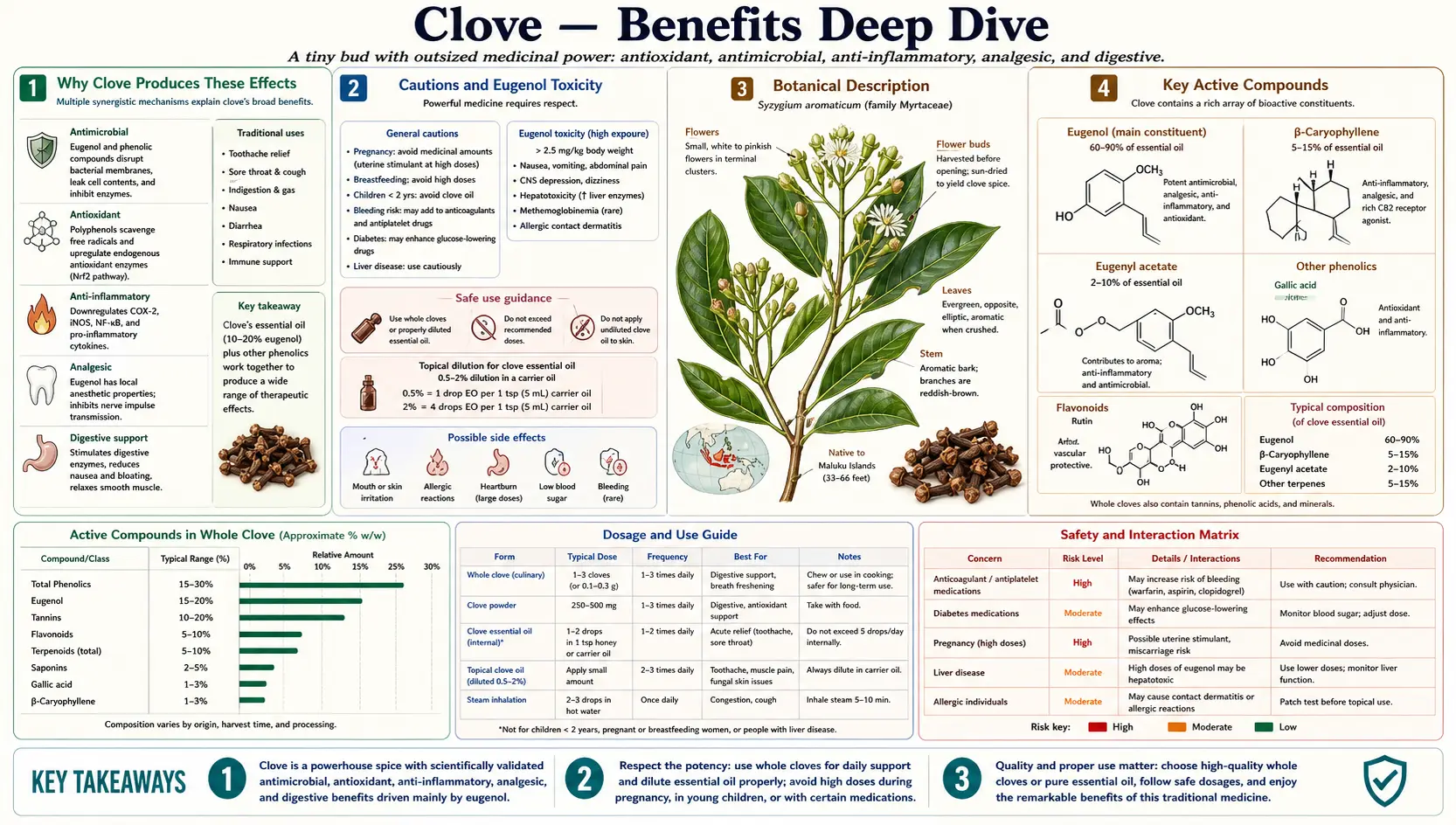
Clove (Syzygium aromaticum) is the dried, unopened flower bud of an evergreen tree native to the Maluku Islands of Indonesia. Its essential oil is 80–90% eugenol — a phenolic compound so concentrated that whole clove buds are the most antioxidant-dense edible spice on Earth (USDA ORAC 314,446 µmol Trolox-equivalent per 100 g, dwarfing every other spice tested). A staple of Indian, Chinese, and Indonesian cuisine for at least two millennia, clove also served as the ancient world's most-trusted dental remedy — chewed for toothache long before zinc oxide eugenol (ZOE) became the standard temporary restorative material in modern dentistry. Four deep-dive pages below cover the major therapeutic domains: topical dental anesthesia, digestive support, antioxidant capacity, and the broad-spectrum antimicrobial activity of eugenol against bacteria, fungi, parasites, and viruses.
Deep-Dive Articles
Dental Pain & Oral Health
Eugenol's topical anesthetic mechanism (transient receptor potential channel modulation), the classical dental remedy traceable to Han Dynasty China, the Alqareer 2006 randomized trial showing clove gel non-inferior to 20% benzocaine for needle-stick analgesia, zinc oxide eugenol (ZOE) as the standard temporary dental restoration material, gingivitis and periodontitis trials, and modern eugenol mouthwash formulations.
Read the deep dive →Digestive Aid
Clove as carminative and antispasmodic in traditional Ayurvedic and Chinese pharmacopeias, eugenol's smooth-muscle relaxant effect on intestinal tissue, in-vitro inhibition of Helicobacter pylori at clinically achievable concentrations, small IBS and functional dyspepsia trials, and use against nausea, bloating, and post-prandial heaviness.
Read the deep dive →Antioxidant Capacity
Clove's USDA-measured ORAC of 314,446 µmol TE/100 g — the highest of any spice, food, or beverage tested. Eugenol as the dominant phenolic species, hydrogen-donating mechanism, comparison to cinnamon, oregano, turmeric, and the polyphenol-rich berries, and what "antioxidant capacity in a test tube" does (and does not) predict about clinical benefit.
Read the deep dive →Antimicrobial Spectrum
Eugenol's broad-spectrum activity against Gram-positive and Gram-negative bacteria, Candida albicans and other yeasts, parasites including Giardia lamblia, and enveloped viruses including HSV-1 and HSV-2. Traditional Indonesian and Indian use as a food preservative, the membrane-disrupting mechanism, and the rationale for combining clove with other plant antimicrobials.
Read the deep dive →Table of Contents
Why Clove Produces These Effects
Almost every documented therapeutic effect of clove can be traced to a single molecule: eugenol (4-allyl-2-methoxyphenol), a phenylpropene phenolic compound that comprises 80–90% of clove essential oil and approximately 15–20% of the dried bud by weight. No other commonly consumed plant material concentrates eugenol to anywhere near these levels — for comparison, allspice (the second-richest dietary source) is approximately 4% eugenol, and basil and bay are below 1%. The therapeutic spectrum of clove is, to a first approximation, the therapeutic spectrum of eugenol.
Eugenol acts simultaneously through four distinct mechanisms, which together account for the unusually broad range of clinical effects:
- Topical anesthesia (TRP channel modulation) — eugenol desensitizes the TRPV1 (capsaicin) and TRPA1 (wasabi) receptor channels on peripheral nociceptive nerve endings, producing a local numbing effect comparable to mild lidocaine within minutes of application. This is the mechanism behind the millennia-old use of clove for toothache and behind zinc oxide eugenol (ZOE) as a modern dental restorative material.
- Membrane-disrupting antimicrobial activity — the lipophilic phenolic structure of eugenol partitions into microbial cell membranes, increasing permeability and dissipating proton-motive force. This is the mechanism behind eugenol's broad-spectrum activity against bacteria, fungi, parasites, and enveloped viruses, and the reason traditional cuisines in equatorial Indonesia and India use heavy clove dosing as a food preservative.
- Hydrogen-donating antioxidant capacity — the phenolic hydroxyl group on eugenol donates a hydrogen atom to quench reactive oxygen species, terminating lipid peroxidation chains. This is why clove tops the USDA ORAC table at 314,446 µmol TE/100 g — more than three times the ORAC of cinnamon or oregano, more than ten times that of dark chocolate.
- COX-2 and 5-LOX inhibition (mild anti-inflammatory) — eugenol weakly inhibits both cyclooxygenase-2 and 5-lipoxygenase, reducing prostaglandin and leukotriene synthesis. The effect is much milder than NSAID drugs but contributes to the gingival anti-inflammatory effect observed in periodontal disease trials and to the general antispasmodic profile relevant to digestive support.
A secondary set of constituents — beta-caryophyllene (a CB2 cannabinoid receptor agonist), eugenyl acetate, and small amounts of methyl salicylate — contribute to the anti-inflammatory and antispasmodic profile but are not the principal active agents.
Key Research Papers
- Alqareer A, Alyahya A, Andersson L (2006). The effect of clove and benzocaine versus placebo as topical anesthetics. Journal of Dentistry — PubMed PMID: 16530911
- USDA Database for the Oxygen Radical Absorbance Capacity (ORAC) of Selected Foods, Release 2 (2010) PubMed: USDA ORAC of spices
- Pramod K, Ansari SH, Ali J (2010). Eugenol: a natural compound with versatile pharmacological actions. Natural Product Communications. PubMed PMID: 21299140
- Cortes-Rojas DF, de Souza CR, Oliveira WP (2014). Clove (Syzygium aromaticum): a precious spice. Asian Pacific Journal of Tropical Biomedicine. PubMed PMID: 25182278
- Hashemipour MA et al. (2013). Anti-inflammatory and anti-microbial effects of clove (Syzygium aromaticum) oil and its constituents on periodontal pathogens. Journal of Periodontology. PubMed
Cautions and Eugenol Toxicity
- Essential oil hepatotoxicity — high doses of concentrated clove essential oil are hepatotoxic. Reports of acute liver failure in pediatric patients exist after as little as 5–10 mL of essential oil ingested in a single dose. The mechanism is cytochrome P450-mediated bioactivation of eugenol to quinone methide, which depletes hepatic glutathione and produces centrilobular necrosis — the same pathway responsible for acetaminophen hepatotoxicity. Concentrated clove essential oil should never be taken internally without medical supervision; whole clove buds used as a culinary spice present no such risk.
- Mucosal irritation — undiluted clove essential oil applied to oral or skin tissue is a chemical irritant and can produce burns. Dental applications use eugenol diluted to 1–5% in a carrier such as olive oil or zinc oxide cement.
- Anticoagulant interaction — eugenol inhibits platelet aggregation. Patients on warfarin, dabigatran, apixaban, rivaroxaban, or clopidogrel should avoid concentrated clove preparations.
- Pregnancy — culinary use is safe; concentrated essential oil is not recommended in pregnancy due to insufficient safety data.
- Allergic contact dermatitis — eugenol is a recognized contact allergen and is one of the components of "fragrance mix I" used in dermatology patch testing.
- Pediatric application — topical eugenol gel for teething pain is sold but not FDA-recommended; benzocaine teething gels have been associated with methemoglobinemia in infants and the FDA discourages all topical anesthetic teething products in children under 2 years.
External Authoritative Resources
- LiverTox — Eugenol (Clove Oil) — clinical reference for eugenol overdose and its hepatotoxic mechanism
- NCI Drug Dictionary — Eugenol
- MedlinePlus — Clove
- ScienceDirect Topics — Eugenol (aggregated review chapters on eugenol chemistry and pharmacology)
- PubMed — All research on Syzygium aromaticum / eugenol
Connections
- All Herbs
- Clove (Main Page)
- Clove for Dental Pain & Oral Health
- Clove as Digestive Aid
- Clove Antioxidant Capacity
- Clove Antimicrobial Spectrum
- Antibacterial Herbs
- Cinnamon
- Oregano
- Thyme
- Myrrh
- Tea Tree
- Rosemary
- Staphylococcus Aureus
- Escherichia Coli
- Helicobacter Pylori
- IBS
- Oxidative Stress
- Inflammatory Markers
- History