Clove Antioxidant Capacity
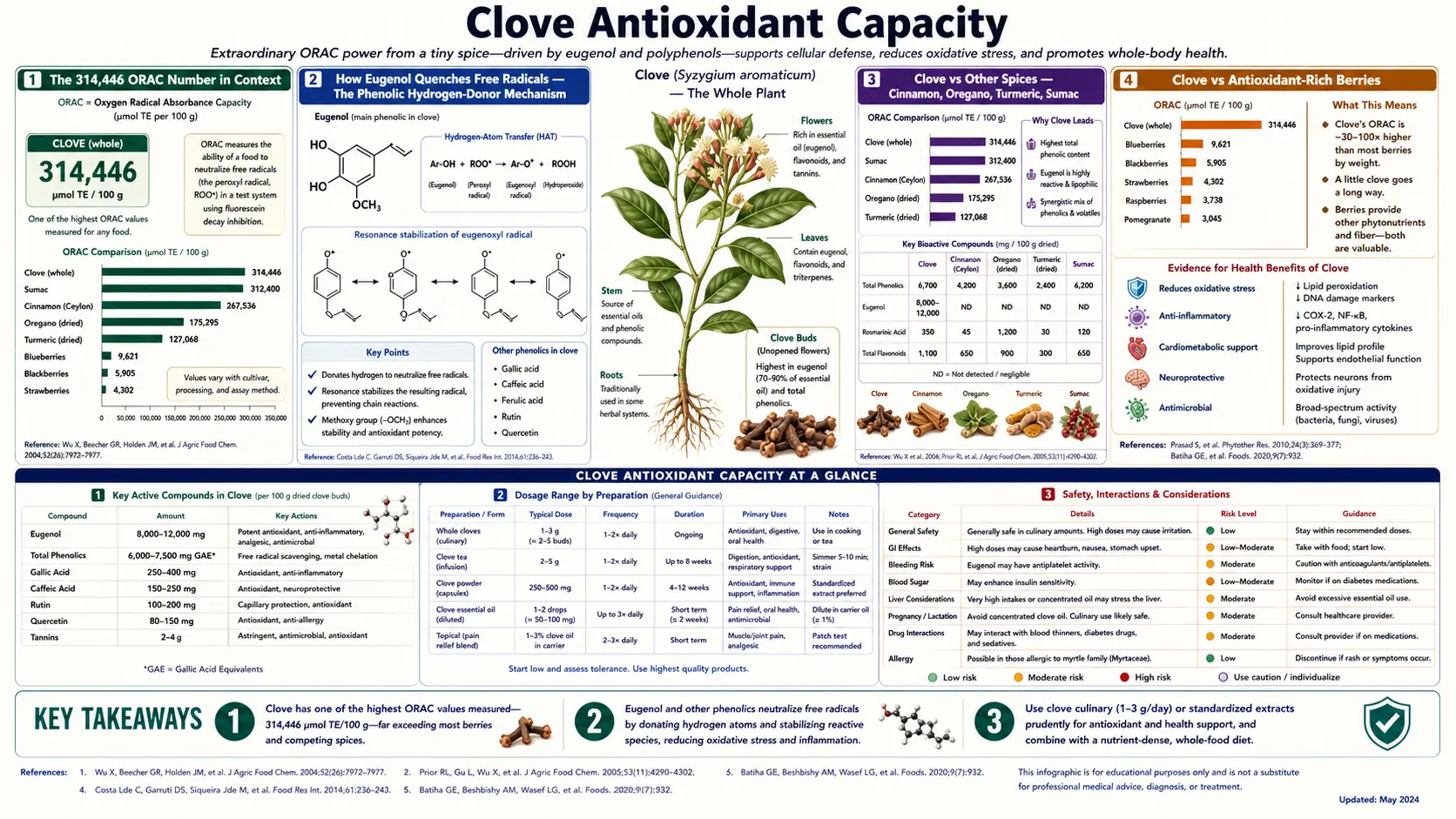
Clove is one of the richest spices in phenolic compounds, and in test-tube antioxidant assays its extracts rank among the strongest of common spices (Shan 2005). For years that was expressed through ORAC (oxygen radical absorbance capacity) scores from a USDA table, and popular lists that rank foods by ORAC have often placed ground cloves at or near the top. The USDA withdrew that table in 2012, stating that there is no evidence the beneficial effects of polyphenol-rich foods can be attributed to their antioxidant properties, that test-tube antioxidant values cannot be extrapolated to effects in people, and that ORAC values were routinely misused to promote foods and supplements. An ORAC number is therefore not evidence of a health effect, and none is used on this page. This deep-dive covers what the test-tube measurements do and do not show, how eugenol — clove's dominant phenolic — reacts with free radicals, what animal studies report, and the small human studies of a clove polyphenol extract.
Table of Contents
- What the ORAC Test Measured
- How Eugenol Quenches Free Radicals — The Phenolic Hydrogen-Donor Mechanism
- Clove vs Other Spices — Cinnamon, Oregano, Turmeric, Sumac
- Clove vs Antioxidant-Rich Berries — Why Per-Gram Scores Mislead
- Why the USDA Withdrew the ORAC Database
- Lipid Peroxidation — Where Eugenol Actually Acts
- Systemic Antioxidant Effects in Human Trials
- Clove Within a Varied Diet
- Effects of Cooking, Storage, and Bioavailability
- Cautions — Why Antioxidants Are Not a Drug
- Key Research Papers
- Connections
- Featured Videos
What the ORAC Test Measured
The ORAC assay was described by Cao, Alessio and Cutler in 1993 as a method for measuring the capacity of antioxidants in a sample, originally blood serum, to absorb peroxyl radicals. In the original method a free-radical generator (AAPH) oxidizes a fluorescent indicator protein (beta-phycoerythrin); antioxidants in the sample protect the indicator, and the result is expressed relative to Trolox, a water-soluble vitamin E analogue (Cao 1993).
The USDA's Nutrient Data Laboratory compiled ORAC values for foods, including a Release 2 in 2010, and then removed the table. Its notice explained that ORAC is only one of several chemical tests — others include FRAP (ferric reducing antioxidant power) and TEAC (Trolox equivalent antioxidant capacity) — that use different radical or oxidant sources, generate distinct values and cannot be compared directly, and that newer versions of the ORAC assay use other substrates whose results are not comparable either (USDA ARS notice).
For these reasons, ORAC scores and ORAC-based comparisons between clove and other foods are not reproduced here. The comparisons that do appear below come from single studies that applied one method to all of their samples.
How Eugenol Quenches Free Radicals — The Phenolic Hydrogen-Donor Mechanism
The chemistry of how eugenol neutralizes a free radical is shared with all phenolic antioxidants — the same mechanism by which Vitamin E (alpha-tocopherol), polyphenols in tea, anthocyanins in berries, and resveratrol in wine all operate. The shared feature is a hydroxyl group (-OH) bonded to a phenolic (benzene) ring.
When a free radical (R·) encounters the phenolic hydroxyl, it abstracts the hydrogen atom, generating a relatively stable phenoxyl radical and an inert R-H product:
R· + PhOH → R-H + PhO·
The reaction is favorable because the phenoxyl radical (PhO·) is stabilized by resonance with the aromatic ring — the unpaired electron can be delocalized into multiple positions on the ring, lowering the radical's energy and reactivity. Where the original R· was an aggressive oxidant ready to propagate damage to adjacent molecules, the resulting PhO· is a stable terminus that either reacts with a second radical (terminating the chain) or is reduced back to PhOH by another antioxidant such as ascorbate (Vitamin C) or glutathione.
Eugenol's structure (4-allyl-2-methoxyphenol) places a methoxy group next to its phenolic hydroxyl, a feature it shares with other guaiacol-type phenolics such as ferulic acid. How strong an antioxidant this makes it depends on the test. In rat liver mitochondria, eugenol completely inhibited iron- and Fenton-reagent-driven lipid peroxidation, and its inhibitory activity was about five times that of alpha-tocopherol and about ten times less than that of the synthetic antioxidant BHT (Nagababu 2010). In another study its inhibition of lipid peroxidation was weaker than alpha-tocopherol's; electron spin resonance showed eugenol scavenging superoxide and trapping hydroxyl radicals, and the authors propose that eugenol acts at the initiation stage of lipid peroxidation rather than, like alpha-tocopherol, at the propagation stage (Ogata 2000). The two studies used different systems, which is why they rank eugenol differently.
Beyond direct radical scavenging, animal studies report that eugenol raises the body's own antioxidant defences: a meta-analysis of studies in hyperglycemic rodents found that eugenol restored the activity of the antioxidant defence system and reduced oxidative damage (Carvalho 2021). Eugenol can also act as a prooxidant under some conditions, a dual behaviour reviewed in relation to cancer (Bezerra 2017). Whether eating clove changes antioxidant enzyme activity in people has been studied only for a polyphenol extract (see Systemic Antioxidant Effects in Human Trials).
Clove vs Other Spices — Cinnamon, Oregano, Turmeric, Sumac
Comparisons between spices are meaningful only within a single study that measured every sample the same way. In a study of extracts of 26 common spices from 12 botanical families, antioxidant capacity (measured as TEAC) varied widely, and clove was among the spices with the highest antioxidant capacity, alongside cinnamon and oregano. Antioxidant capacity rose closely with total phenolic content (R² = 0.95), showing that phenolic compounds accounted for most of the activity (Shan 2005).
The compounds responsible differ from spice to spice:
- Clove — eugenol dominates the essential oil, and the bud also contains eugenol acetate, gallic acid and other phenolics (Cortés-Rojas 2014).
- Oregano and the other mint-family spices — rosmarinic acid was the dominant phenolic compound in the six mint-family (Labiatae) spices in the 26-spice study (Shan 2005); oregano oil also contains the phenols carvacrol and thymol.
- Cinnamon — volatile oil and polyphenols, including procyanidins; cassia cinnamon also contains coumarin, which has its own pharmacological profile.
- Turmeric — curcumin is the principal phenolic, with poor absorption and rapid metabolism.
- Sumac — tannins, including gallotannins, and gallic acid derivatives.
In the 26-spice study, phenolic volatile oils were the principal active ingredients in most spices (Shan 2005). In test-tube terms clove is among the most concentrated sources per gram, but no study has shown that this translates into a health benefit, and different spices supply different classes of phenolic compounds.
Clove vs Antioxidant-Rich Berries — Why Per-Gram Scores Mislead
Popular comparisons put clove many times above berries on a per-gram ORAC basis. Those figures come from the withdrawn USDA table, and they ignore how much of each food is eaten: berries are eaten by the handful, clove by the pinch. More fundamentally, the USDA withdrawal notice states that test-tube antioxidant values cannot be extrapolated to effects in people, so neither number predicts a health effect.
Berries and spices supply different compound families. Berries are the main dietary source of anthocyanins; clove supplies eugenol, eugenol acetate and phenolic acids such as gallic acid (Cortés-Rojas 2014). Swallowed eugenol is rapidly absorbed and almost completely excreted in the urine within 24 hours, almost entirely as conjugates (Fischer 1990), so what reaches tissues is mostly eugenol's metabolites rather than eugenol itself.
A diet that includes both spice and fruit sources of polyphenols draws on more compound classes than either alone. See our Blueberries page and the Antioxidants overview for the broader picture.
Why the USDA Withdrew the ORAC Database
The USDA removed its ORAC table in 2012. Its notice stated that the Nutrient Data Laboratory had removed the database “due to mounting evidence that the values indicating antioxidant capacity have no relevance to the effects of specific bioactive compounds, including polyphenols on human health,” that ORAC values “are routinely misused by food and dietary supplement manufacturing companies to promote their products and by consumers to guide their food and dietary supplement choices,” and that “there is no evidence that the beneficial effects of polyphenol-rich foods can be attributed to the antioxidant properties of these foods” (USDA ARS notice).
The reasons given, and the evidence behind them:
- The test tube is not the body — the notice states that antioxidant capacity measured by in vitro methods cannot be extrapolated to in vivo (human) effects, and that antioxidant molecules in food have many functions unrelated to absorbing free radicals. The body has many compartments, many kinds of oxidant and its own antioxidant enzymes, none of which a single chemical assay models.
- Absorption and metabolism — an ORAC value says nothing about whether a compound is absorbed, how it is transformed, or how long it stays. Swallowed eugenol, for example, is excreted within 24 hours almost entirely as conjugates (Fischer 1990).
- Antioxidant supplement trials — the notice notes that clinical trials of dietary antioxidants have produced mixed results. Large trials of isolated high-dose antioxidant supplements, such as ATBC, CARET and HOPE, found no benefit or harm. In one trial in healthy young men, vitamin C (1,000 mg a day) plus vitamin E (400 IU a day) blocked the improvement in insulin sensitivity that exercise otherwise produced, consistent with the idea (mitohormesis) that some oxidative signalling is needed for adaptation (Ristow 2009).
- Marketing misuse — the notice says ORAC values were routinely used to promote foods and supplements and to guide consumer choices.
Test-tube antioxidant capacity does track phenolic content (Shan 2005), so a high value shows that clove is rich in phenolic compounds. The USDA notice is explicit that it does not show an effect in people.
Lipid Peroxidation — Where Eugenol Actually Acts
Where eugenol's antioxidant chemistry has been studied most is in lipid peroxidation. Polyunsaturated fatty acids in cell membranes and circulating lipoproteins are particularly susceptible to free-radical attack — the unsaturated bonds allow propagation of radical chain reactions through the membrane, producing lipid peroxides and aldehyde byproducts (malondialdehyde, 4-hydroxynonenal) that further damage proteins and DNA.
Eugenol is fat-soluble, and in laboratory systems it inhibits lipid peroxidation: completely, in iron- and Fenton-driven peroxidation of rat liver mitochondria (Nagababu 2010), and less strongly than alpha-tocopherol in another assay (Ogata 2000). The animal findings that rest on this activity are:
- Liver protection in rats — given to rats treated with carbon tetrachloride, a liver toxin that works through lipid peroxidation, eugenol significantly limited the rise in the liver enzyme SGOT and liver-cell necrosis (Nagababu 2010). This contrasts with the severe liver injury reported after overdose of clove oil in people (LiverTox 2019).
- Stomach protection in rats — a polyphenol-rich clove bud extract reduced lipid peroxidation and raised superoxide dismutase, glutathione and catalase in rats with ethanol-induced ulcers (Issac 2015).
- Hyperglycemic rodents — across studies pooled in a meta-analysis, eugenol reduced oxidative, kidney and liver damage (Carvalho 2021).
No large randomized trials have tested clove or eugenol for cardiovascular outcomes, liver protection or skin ageing in people. The animal data give a reason for further research; they do not establish a benefit in people.
Systemic Antioxidant Effects in Human Trials
No trial of whole clove spice on oxidative-stress markers in people was found in PubMed for this page. The human data come from a standardized, de-flavoured, polyphenol-rich extract of clove buds, studied by researchers associated with the extract's development:
- Healthy volunteers, 30 days: volunteers took 250 mg of the extract a day for 30 days, as capsules or mixed into foods and drinks. The authors report average increases of 33% in catalase, 66% in superoxide dismutase, 56% in glutathione peroxidase and 167% in glutathione, and an 81% reduction in membrane lipid peroxidation (Johannah 2015). The abstract does not report a placebo group or the number of participants.
- Binge drinking, crossover: in a randomized, double-blinded, placebo-controlled crossover study, 16 male social drinkers took alcohol (1 g per kg body weight) with either placebo or one 250 mg capsule of the extract, then switched after a two-week washout. With the extract, blood acetaldehyde was eliminated faster; oxidative stress, lipid peroxidation, C-reactive protein and interleukin-6 were significantly lower and glutathione and superoxide dismutase higher than with placebo; and hangover severity scores were 55.34% lower (Mammen 2018).
These are small, short studies of a concentrated extract rather than of culinary clove, and they measured blood markers rather than disease outcomes. The relationship between such markers and outcomes such as cardiovascular events, cancer or cognitive decline has not been established.
Clove Within a Varied Diet
Clove is one of many dietary sources of phenolic and other antioxidant compounds. Other food groups supply different classes:
- Berries (blueberries, blackberries, raspberries, elderberries, acai) — anthocyanins and other water-soluble polyphenols. See our Blueberries page.
- Dark leafy greens (kale, spinach, collards, Swiss chard) — carotenoids including lutein and zeaxanthin. See our Kale page.
- Tea (green and black) — catechins, including EGCG.
- Other phenolic spices and herbs (cinnamon, oregano, turmeric, rosemary, sage) — different phenolic compound classes from eugenol (Shan 2005).
- Cocoa and dark chocolate — epicatechin and other flavanols.
- Olive oil, nuts and seeds — vitamin E (tocopherols), the main fat-soluble chain-breaking antioxidant in membranes.
- Citrus, peppers, kiwi, broccoli — vitamin C, which is water-soluble and can regenerate vitamin E after it has quenched a radical.
The body's antioxidant system is integrated: vitamin E, vitamin C and glutathione work together, and the body's own enzymes (superoxide dismutase, catalase, glutathione peroxidase) do much of the work. Trials of high-dose isolated antioxidant supplements, such as vitamin E or beta-carotene alone, have shown no benefit and in some cases harm, which is one reason researchers distinguish such supplements from whole foods.
Effects of Cooking, Storage, and Bioavailability
What is known about clove's antioxidant compounds in the kitchen and in the body:
- Whole cloves — dried clove buds contain 15–17% essential oil, and the European Pharmacopoeia requires at least 150 mL/kg (EMA assessment report). The essential oil is volatile: it is obtained from the buds by steam distillation. No measured figure for eugenol loss from clove during storage or cooking was verified for this page.
- Water-soluble phenolics — gallic acid and other non-volatile phenolics are extracted by water and alcohol, so teas and extracts carry compounds that the distilled oil lacks (Cortés-Rojas 2014).
- Absorption in people — in healthy volunteers, eugenol taken by mouth was rapidly absorbed and metabolized and almost completely excreted in the urine within 24 hours; about 95% of the dose was recovered in urine, more than 99% of it as phenolic conjugates, about half of them eugenol glucuronide and sulfate, and less than 0.1% as unchanged eugenol (Fischer 1990).
- Absorption in rats — after 40 mg/kg by gavage, blood and plasma eugenol peaked rapidly, and the plasma half-life was 14 hours (Guénette 2007). This animal figure differs from the rapid excretion seen in people.
Cautions — Why Antioxidants Are Not a Drug
- ORAC claims are not clinical endpoints — a high antioxidant score shows that clove is phenolic-rich. The USDA notice states that such values cannot be extrapolated to effects in people, so they say nothing about cancer, cardiovascular disease or ageing.
- Antioxidant supplement trials — the ATBC, CARET, HOPE and SELECT trials of isolated high-dose antioxidant supplements showed no benefit, and in some cases harm, for cardiovascular events and cancer. No such outcome trial exists for clove.
- Mitohormesis — some reactive oxygen species are part of normal cell signalling, including the adaptation to exercise; vitamin C and vitamin E supplements blocked exercise-induced gains in insulin sensitivity in one trial (Ristow 2009).
- High-dose clove oil and the liver — the NIH LiverTox database states that eugenol in therapeutic doses has not been implicated in liver injury, but that overdose can cause severe liver injury (LiverTox 2019). Swallowing 10 mL of clove oil caused fulminant liver failure in a 15-month-old (Janes 2005), and less than 8 mL did so in a 3-month-old (Eisen 2004); both improved after intravenous N-acetylcysteine. In cultured rat liver cells, eugenol's toxicity was linked to depletion of glutathione and to its quinone methide metabolite (Thompson 1998) — the same molecule that acts as an antioxidant at low concentrations.
- Drug interactions — the EMA monograph on clove oil lists no reported interactions for its mouth and tooth uses, and no clinically documented interaction between culinary clove and drug-metabolizing enzymes was found for this page.
- Bleeding risk (theoretical) — eugenol and acetyl eugenol inhibit human platelet aggregation in the laboratory (Srivastava 1993), and the EMA assessment report notes this may increase bleeding risk when clove oil is taken with anticoagulant or antiplatelet medicines. No case report of bleeding from clove in food or ordinary use was found for this page.
Key Research Papers
- USDA Database for the Oxygen Radical Absorbance Capacity (ORAC) of Selected Foods, Release 2 (2010, withdrawn 2012) — withdrawal notice, last modified 16 May 2012. — USDA ARS (archived copy)
- Cao G, Alessio HM, Cutler RG (1993). Oxygen-radical absorbance capacity assay for antioxidants. Free Radical Biology & Medicine, 14(3), 303-311. — PubMed PMID: 8458588
- Nagababu E, Rifkind JM, Boindala S, Nakka L (2010). Assessment of antioxidant activity of eugenol in vitro and in vivo. Methods in Molecular Biology, 610, 165-180. — PubMed PMID: 20013178
- Hussain A, Brahmbhatt K, Priyani A et al. (2011). Eugenol enhances the chemotherapeutic potential of gemcitabine and induces anticarcinogenic and anti-inflammatory activity in human cervical cancer cells. Cancer Biotherapy & Radiopharmaceuticals, 26, 519-527. — PubMed PMID: 21939359
- Carrasco-Pozo C, Mizgier ML, Speisky H, Gotteland M (2012). Differential protective effects of quercetin, resveratrol, rutin and epigallocatechin gallate against mitochondrial dysfunction induced by indomethacin in Caco-2 cells. Chemico-Biological Interactions, 195(3), 199-205 (year and journal corrected 2026-10-14). (context for polyphenol comparison). — PubMed PMID: 22214982
- Yashin A, Yashin Y, Xia X, Nemzer B (2017). Antioxidant activity of spices and their impact on human health: a review. Antioxidants (Basel), 6(3), 70. — PubMed PMID: 28914764
- Shan B, Cai YZ, Sun M, Corke H (2005). Antioxidant capacity of 26 spice extracts and characterization of their phenolic constituents. Journal of Agricultural and Food Chemistry, 53(20), 7749-7759. — PubMed PMID: 16190627
- Choi YJ et al. (2007). Eugenol inhibits TNF-alpha-induced expression of adhesion molecules. Journal of Inflammation. (Editorial note, 2026-10-14: this paper could not be found in PubMed or Crossref, its search link was removed, and nothing on this page relies on it.)
- Ogata M et al. (2000). Antioxidant activity of eugenol and related monomeric and dimeric compounds. Chemical & Pharmaceutical Bulletin, 48(10), 1467-1469. — PubMed PMID: 11045452
- Mishra A, Bhatti R, Singh A, Ishar MPS (2010). Ameliorative effect of the cinnamon oil from Cinnamomum zeylanicum upon early stage diabetic nephropathy. Planta Medica. (eugenol as component of cinnamon oil). Planta Medica, 76, 412-417. — PubMed PMID: 19876811
- Bezerra DP, Militao GC, de Morais MC, de Sousa DP (2017). The dual antioxidant/prooxidant effect of eugenol and its action in cancer development and treatment. Nutrients, 9(12), 1367. — PubMed PMID: 29258206
- Selmi S et al. (2015). Hepatoprotective effect of clove against acetaminophen-induced hepatotoxicity in mice. Journal of Food Biochemistry. (Editorial note, 2026-10-14: this paper could not be found in PubMed or Crossref, its search link was removed, and nothing on this page relies on it.)
- Johannah NM, Renny RM, Gopakumar G, et al. (2015). Beyond the flavour: a de-flavoured polyphenol rich extract of clove buds (Syzygium aromaticum L) as a novel dietary antioxidant ingredient. Food & Function, 6(10), 3373-3382 (indexed in PubMed under the author names "NM J, RM R, G G"). — PubMed PMID: 26273738
- Mammen RR, Natinga Mulakal J, Mohanan R, et al. (2018). Clove bud polyphenols alleviate alterations in inflammation and oxidative stress markers associated with binge drinking: a randomized double-blinded placebo-controlled crossover study. Journal of Medicinal Food, 21(11), 1188-1196. — PubMed PMID: 30234415
- Issac A, Gopakumar G, Kuttan R, Maliakel B, Krishnakumar IM (2015). Safety and anti-ulcerogenic activity of a novel polyphenol-rich extract of clove buds (Syzygium aromaticum L). Food & Function, 6(3), 842-852. — PubMed PMID: 25605463
- Carvalho RPR, Lima GDA, Machado-Neves M (2021). Effect of eugenol treatment in hyperglycemic murine models: a meta-analysis. Pharmacological Research, 165, 105315. — PubMed PMID: 33497803
- Fischer IU, von Unruh GE, Dengler HJ (1990). The metabolism of eugenol in man. Xenobiotica, 20(2), 209-222. — PubMed PMID: 2333717
- Guénette SA, Ross A, Marier JF, Beaudry F, Vachon P (2007). Pharmacokinetics of eugenol and its effects on thermal hypersensitivity in rats. European Journal of Pharmacology, 562(1-2), 60-67. — PubMed PMID: 17321520
- Ristow M, Zarse K, Oberbach A, et al. (2009). Antioxidants prevent health-promoting effects of physical exercise in humans. Proceedings of the National Academy of Sciences of the USA, 106(21), 8665-8670. — PubMed PMID: 19433800
- Cortés-Rojas DF, de Souza CR, Oliveira WP (2014). Clove (Syzygium aromaticum): a precious spice. Asian Pacific Journal of Tropical Biomedicine, 4(2), 90-96. — PubMed PMID: 25182278
- Srivastava KC (1993). Antiplatelet principles from a food spice clove (Syzygium aromaticum L). Prostaglandins, Leukotrienes and Essential Fatty Acids, 48(5), 363-372. — PubMed PMID: 8321872
- Janes SE, Price CS, Thomas D (2005). Essential oil poisoning: N-acetylcysteine for eugenol-induced hepatic failure and analysis of a national database. European Journal of Pediatrics, 164(8), 520-522. — PubMed PMID: 15895251
- Eisen JS, Koren G, Juurlink DN, Ng VL (2004). N-acetylcysteine for the treatment of clove oil-induced fulminant hepatic failure. Journal of Toxicology. Clinical Toxicology, 42(1), 89-92. — PubMed PMID: 15083943
- Thompson DC, Barhoumi R, Burghardt RC (1998). Comparative toxicity of eugenol and its quinone methide metabolite in cultured liver cells using kinetic fluorescence bioassays. Toxicology and Applied Pharmacology, 149(1), 55-63. — PubMed PMID: 9512727
- LiverTox: Clinical and Research Information on Drug-Induced Liver Injury. Eugenol (Clove Oil). Bethesda (MD): National Institute of Diabetes and Digestive and Kidney Diseases; entry updated 28 October 2019. — PubMed PMID: 31869191
- European Medicines Agency, Committee on Herbal Medicinal Products (2011). Community herbal monograph on Syzygium aromaticum (L.) Merill et L. M. Perry, floris aetheroleum (clove oil). EMA/HMPC/534924/2010, adopted 13 September 2011; reviewed without change in 2020 (EMA/HMPC/475451/2020). — EMA monograph (PDF)
- European Medicines Agency, Committee on Herbal Medicinal Products (2011). Assessment report on Syzygium aromaticum (L.) Merill et L.M. Perry, flos and floris aetheroleum. EMA/HMPC/534946/2010. — EMA assessment report (PDF)