Ringworm Bush: Antibacterial Activity and Skin Infections
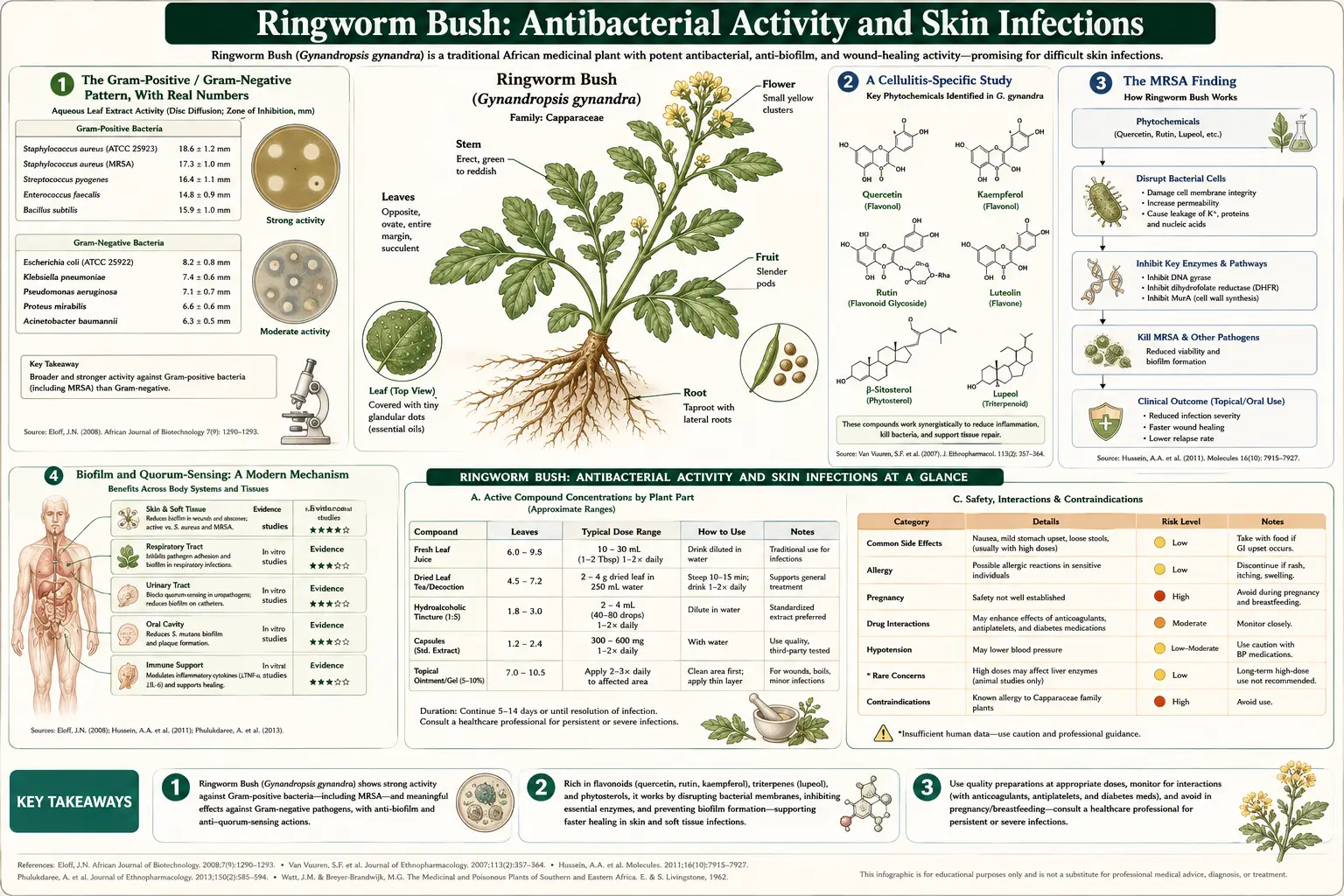
This page was originally going to be titled "wound healing," matching the traditional use for insect bites and minor skin eruptions described on the main article. The literature does not support that framing: a direct search for wound-healing evidence specific to this plant turns up only a handful of records. A search for antibacterial activity broadly — which subsumes the traditional wound and insect-bite use, but is not limited to it — turns up nearly ten times as many, including real minimum-inhibitory-concentration numbers, a methicillin-resistant Staphylococcus aureus finding, and modern anti-biofilm and anti-quorum-sensing work. This page follows the evidence rather than the traditional framing, and says so plainly, per this site's own doctrine that a brief should be checked against the literature rather than assumed correct.
Table of Contents
- The Gram-Positive / Gram-Negative Pattern, With Real Numbers
- A Cellulitis-Specific Study
- The MRSA Finding
- Biofilm and Quorum-Sensing: A Modern Mechanism
- Human Skin-Cell Data: Closer to Wound Healing Than Anything Else Available
- Traditional Wound and Insect-Bite Use, Restated Honestly
- A Genuinely Novel Compound
- A Note on Antiparasitic Screening
- What Is Not Known
- Key Research Papers
- Connections
The Gram-Positive / Gram-Negative Pattern, With Real Numbers
Across the studies reviewed for this page, leaf, stem and root extracts inhibit Gram-positive organisms — chiefly Staphylococcus aureus and Bacillus subtilis — more readily and at lower concentrations than Gram-negative organisms such as Escherichia coli and Pseudomonas aeruginosa. This is a completely standard pattern for plant phenolics generally: Gram-negative bacteria carry an additional outer membrane that Gram-positive organisms lack, and that extra barrier excludes many plant-derived compounds that would otherwise cross a Gram-positive cell wall (Ibrahim & Osman, 1995; Somchit et al., 2003; Khan, 2001).
The antifungal page already reports the Crockett group's comparative numbers against E. coli: extract MIC 1.6 mg/mL against chloramphenicol's 2 µg/mL, roughly an 800-fold gap. That comparison, deliberately chosen against a Gram-negative organism, illustrates the weaker end of this plant's antibacterial spectrum. The Gram-positive numbers below, against Staphylococcus aureus specifically, tell a more favourable story.
A Cellulitis-Specific Study
A 2023 Malaysian study went looking for activity against the organism responsible for one of the more serious common skin infections. Staphylococcus aureus is the leading cause of cellulitis, and antibiotic resistance in that organism is an acknowledged clinical problem — the study's own stated motivation. Researchers extracted leaves, stems and roots of Cassia alata using four solvents of increasing polarity and tested each systematically (agar-well diffusion, broth microdilution, grid culture, growth-curve analysis) against S. aureus. The ethyl acetate root extract performed best: a 15.30 mm zone of inhibition, and a minimum inhibitory concentration of 0.313 µg/µL (313 µg/mL) with a minimum bactericidal concentration of 0.625 µg/µL (625 µg/mL) — concentrations low enough to be pharmacologically interesting for a crude extract, and notably from the root, a plant part that gets almost no attention in the rest of this plant's literature, which concentrates overwhelmingly on the leaf. GC-MS analysis identified 88 phytochemicals in the crude extracts, 32 of which had prior individual characterisation for antimicrobial, antioxidant or anti-inflammatory activity (Toh et al., 2023). See Cellulitis and Staphylococcus aureus for the clinical picture this study was aimed at.
The MRSA Finding
The most clinically pointed single finding in this plant's antibacterial literature concerns methicillin-resistant Staphylococcus aureus — MRSA, one of the more consequential antibiotic-resistant organisms in modern medicine. A Malaysian phytochemistry group fractionated leaf extract by increasing polarity and tested each fraction against MRSA by agar-well diffusion, then purified the active butanol and chloroform fractions down to four individual compounds: kaempferol, two kaempferol glycosides, and aloe-emodin — the same anthraquinone discussed on the laxative and chemistry page as the compound responsible for this plant's colonic effect when swallowed.
Kaempferol and aloe-emodin were the two most active compounds, with near-identical MIC50 values against MRSA of 13.0 ± 1.5 µg/mL and 12.0 ± 1.5 µg/mL respectively. The two kaempferol glycosides were substantially weaker (83 and 560 µg/mL), and the researchers identified a specific structural requirement: a free hydroxyl group at the C-3 position of the flavonol structure was necessary for MRSA inhibition — explaining why attaching a sugar there (as in the glycosides) sharply reduces potency (Hazni et al., 2008, Planta Medica). This is a purified-compound finding, not a crude-extract or clinical result, and no trial has tested a ringworm bush preparation against an actual MRSA skin infection in a person — but it is a specific, structurally explained, and mechanistically coherent piece of laboratory pharmacology, considerably more precise than most of what this plant's literature offers.
Biofilm and Quorum-Sensing: A Modern Mechanism
Two lines of research place this plant's antibacterial chemistry within a currently active area of antibiotic-resistance research: attacking bacterial coordination rather than bacterial viability.
A purified, concentrated leaf-extract fraction inhibited growth of Pseudomonas aeruginosa, Staphylococcus epidermidis, S. aureus and Bacillus subtilis, and specifically inhibited biofilm formation by S. epidermidis and P. aeruginosa — the sticky, antibiotic-tolerant bacterial communities responsible for much of the difficulty in treating chronic wound and device-associated infections. Bioassay-guided fractionation identified six active compounds: kaempferol, three kaempferol/quercetin glycosides, rhein, and danthron (Saito et al., 2012).
Separately, an Indian group tested a flavonoid-rich leaf fraction against bacterial quorum sensing — the chemical signalling system bacteria use to coordinate virulence-factor production and biofilm formation once their population reaches a threshold density, rather than attacking the bacteria directly. The fraction produced 50 per cent inhibition of violacein pigment production (a standard quorum-sensing reporter output) in Chromobacterium violaceum at 0.05 mg/mL, and separately inhibited quorum-sensing-controlled virulence factors and biofilm formation in Pseudomonas aeruginosa PAO1. The active fraction's major identified flavonoids were quercetin, quercitrin and kaempferol (Rekha et al., 2017). Anti-quorum-sensing activity does not kill bacteria outright and has not been tested in an animal or human infection model for this plant, but it is a genuinely modern mechanistic angle, not a repeat of the same growth-inhibition assay run again. See Pseudomonas Aeruginosa for background on this organism's clinical significance.
A separately isolated triterpenoid, a secofriedelane never previously reported from this species, showed antibacterial activity against both Gram-positive and Gram-negative strains in the same 2024 study, with molecular docking against bacterial DNA gyrase scoring close to the reference drug ciprofloxacin — another computational prediction, reported here with the same caveat given to the antifungal docking result on the companion page: plausible, not a demonstrated functional inhibition (Chimi et al., 2024).
Human Skin-Cell Data: Closer to Wound Healing Than Anything Else Available
A 2025 study is the closest thing to actual wound-healing evidence this plant has, and it is still a considerable distance from a clinical wound trial — the distinction matters and is stated precisely here rather than blurred. Researchers optimised a leaf extraction (75% methanol/water), quantified its four dominant polyphenols by HPLC (rhein > aloe-emodin > astragalin > kaempferol, in that order of abundance), and confirmed strong activity against S. aureus (MIC 0.625 mg/mL, MBC 1.25 mg/mL) — a major driver of atopic-dermatitis skin flares. They then tested the extract directly on cultured human epidermal keratinocytes: no meaningful cytotoxicity up to 200 µg/mL (IC50 > 100 µg/mL), and in a standard scratch-wound assay, a 50 µg/mL concentration produced the best cell-migration rate — 5.89 ± 0.80 µm/hour over 96 hours — of the concentrations tested (Lee et al., 2025, Plants).
What this is and is not. This is real evidence that the extract is non-toxic to human skin cells at antimicrobial concentrations and that it can accelerate migration of those cells across a lab-created gap in a dish — a genuine step up from the "no wound-healing evidence at all" position the main article takes, and worth updating in light of it. It is not a clinical wound-healing trial, has not been tested on an actual wound in a person or an animal, and a cell-culture migration assay is a long-established proxy that does not always predict in-vivo healing rates once inflammation, infection risk, and the mechanical environment of a real wound are involved. Read together with the antimicrobial and antioxidant data on this and the companion antioxidant page, it is the most complete single piece of laboratory support for any topical use of this plant beyond dermatophyte infection.
Traditional Wound and Insect-Bite Use, Restated Honestly
Traditional practice across the plant's range extends beyond ringworm to minor wounds, insect bites, eczema and scabies-related itch. Two of these deserve a direct clinical caution repeated from the main article, because it matters more here than anywhere else on this page: scabies is a mite infestation, not a bacterial or fungal condition, and requires permethrin or ivermectin to actually eradicate the mites — a leaf application may calm the itch without touching the underlying infestation, and untreated scabies continues to spread through a household. An open wound is also, mechanically, the wrong place to apply a non-sterile plant paste regardless of any antibacterial activity the plant may carry in a laboratory assay — introducing plant material, soil organisms or contaminating bacteria into broken skin is its own infection risk that a laboratory MIC value says nothing about. Use on intact skin only. See Scabies, Eczema and Impetigo, a genuinely bacterial skin infection this plant's Gram-positive activity is at least mechanistically relevant to.
A Genuinely Novel Compound
Not every finding in this plant's literature is a repeat of the same anthraquinone-and-flavonoid story. Cassiaindoline, a previously undescribed dimeric indole alkaloid, was isolated from the leaves and characterised by full spectroscopic analysis in 2009 — genuinely new chemistry, not a compound already known from other plants. It showed measurable analgesic activity in mice (a 49.4 per cent reduction in acetic-acid-induced writhing at 125 mg/kg) and anti-inflammatory activity (57.1 per cent at 75 mg/kg) (Villaseñor & Sanchez, 2009). It is mentioned here rather than as a full topic of its own because, twenty years on, nothing further appears to have been published on it — a single-study finding rather than a developed line of research. The fuller analgesic and anti-inflammatory literature, including a second, independently active kaempferol glycoside, is covered on the antioxidant and other research page.
A Note on Antiparasitic Screening
A 2025 review paper title frames this plant as a "helminth and bacteria fighter," reflecting a smaller and separate literature on anthelmintic (worm-killing) screening alongside the antibacterial work covered above. This page treats that claim the same way the main article treats the plant's traditional use against intestinal parasites: real preclinical screening exists, it has not been translated into any controlled human data, and a person with a confirmed parasitic infection should be treated with a proven antiparasitic drug rather than a leaf decoction of unknown potency (Elshershaby, 2025).
What Is Not Known
- No clinical trial has tested any ringworm bush preparation against a real bacterial skin infection — cellulitis, impetigo, MRSA colonisation or otherwise — in a person.
- No animal wound-healing model has been run; the keratinocyte scratch assay above is the nearest available evidence, and it is a dish, not a wound.
- No dosage form for antibacterial use has been standardised or tested for stability, shelf life or delivery.
- The quorum-sensing and biofilm findings are in-vitro reporter-strain and laboratory-biofilm results; whether they translate to a meaningful clinical effect against an established biofilm infection is untested.
- The DNA-gyrase docking result for the secofriedelane compound is computational, exactly like the lanosterol-demethylase docking on the antifungal page, and carries the same caveat.
Key Research Papers
- Toh SC, Lihan S, Bunya SR, Leong SS. "In vitro antimicrobial efficacy of Cassia alata (Linn.) leaves, stem, and root extracts against cellulitis causative agent Staphylococcus aureus." BMC Complementary Medicine and Therapies, 2023.
- Hazni H, Ahmad N, Hitotsuyanagi Y, Takeya K, Choo CY. "Phytochemical constituents from Cassia alata with inhibition against methicillin-resistant Staphylococcus aureus (MRSA)." Planta Medica, 2008.
- Saito ST, Trentin DS, Macedo AJ, et al. "Bioguided Fractionation Shows Cassia alata Extract to Inhibit Staphylococcus epidermidis and Pseudomonas aeruginosa Growth and Biofilm Formation." Evidence-Based Complementary and Alternative Medicine, 2012.
- Rekha PD, Vasavi HS, Vipin C, Saptami K, Arun AB. "A medicinal herb Cassia alata attenuates quorum sensing in Chromobacterium violaceum and Pseudomonas aeruginosa." Letters in Applied Microbiology, 2017.
- Crockett CO, Guede-Guina F, Pugh D, et al. "Cassia alata and the preclinical search for therapeutic agents for the treatment of opportunistic infections in AIDS patients." Cellular and Molecular Biology, 1992.
- Khan MR, et al. "Antimicrobial activity of Cassia alata." Fitoterapia, 2001.
- Ibrahim D, Osman H. "Antimicrobial activity of Cassia alata from Malaysia." Journal of Ethnopharmacology, 1995.
- Somchit MN, et al. "In vitro antimicrobial activity of ethanol and water extracts of Cassia alata." Journal of Ethnopharmacology, 2003.
- Chimi SF, Ewonkem MB, Tiakouang EN, et al. "In vitro and in silico studies of antibacterial activities of secofriedelane derivatives from Senna alata." Natural Product Research, 2024.
- Lee SK, Keng JW, Yon JA, et al. "Phytochemical Analysis and Biological Activities of Flavonoids and Anthraquinones from Cassia alata (Linnaeus) Roxburgh and Their Implications for Atopic Dermatitis Management." Plants, 2025 — the human keratinocyte data.
- Ajose FO. "Some Nigerian plants of dermatologic importance." International Journal of Dermatology, 2007.
- Elshershaby RE. "Cassia alata: Helminth and Bacteria Fighter." Combinatorial Chemistry & High Throughput Screening, 2025.
Connections
- All Herbs
- Ringworm Bush (Senna alata) — the main article.
- Ringworm Bush Benefits Deep Dive — the hub for this set.
- Antifungal Activity and Ringworm Treatment — the plant's more famous, but less deeply evidenced, use.
- Laxative Effect and Anthraquinone Chemistry — where aloe-emodin's other, internal effect is covered in full.
- Cellulitis — the infection the Toh 2023 study specifically targeted.
- Staphylococcus Aureus — the organism behind most of the findings on this page.
- Pseudomonas Aeruginosa — the biofilm and quorum-sensing target organism.
- Impetigo — a genuinely bacterial skin infection.
- Scabies — a mite infestation this plant's leaf paste does not treat, despite traditional use for the itch.
- Eczema — relevant to the atopic-dermatitis angle of the Lee 2025 study.
- Neem — the other major topical antimicrobial plant of the region, with a broader traditional skin repertoire.
- Tea Tree — the topical antimicrobial with the deepest human-trial base for comparison.
- Dermatology — the full skin-disease library.