Carum / Ajwain: History and Traditional Use
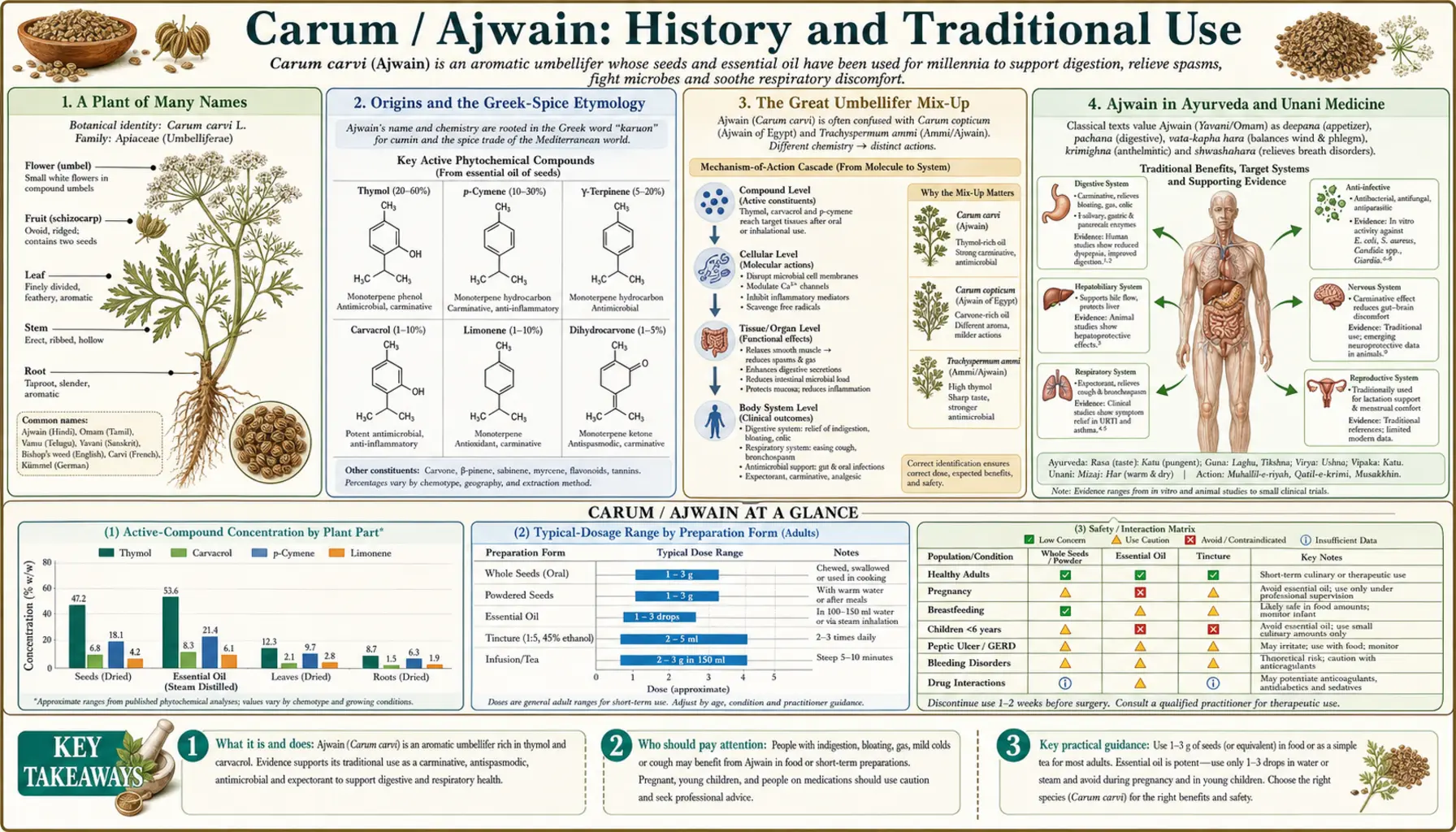
Ajwain (Trachyspermum ammi) is one of the great kitchen-and-medicine seeds of the Indian subcontinent — tiny, sharply thyme-scented fruits that have flavoured flatbreads and settled upset stomachs for centuries. Its history is shorter and more honest than the marketing around it suggests: the most solidly documented thread is the name itself, which traces through Sanskrit back to a word meaning “Greek,” hinting that the plant reached India along ancient trade routes. This page separates what is firmly recorded — the plant's identity, its name's origin, its place in Ayurveda and Unani medicine, and the genuine 18th-to-19th-century chemistry of its main compound, thymol — from what is living tradition and what is folklore. Throughout, traditional uses are described as history and culture, not as medical advice.
Table of Contents
- A Plant of Many Names
- Origins and the Greek-Spice Etymology
- The Great Umbellifer Mix-Up
- Ajwain in Ayurveda and Unani Medicine
- The Kitchen and the Household
- Thymol: From Thyme Crystals to a Named Compound
- From Tradition to Modern Research
- Research Papers and References
- Connections
- Featured Videos
A Plant of Many Names
The little seed sold in South Asian kitchens as ajwain (also spelled ajowan, ajwan, or carom) is botanically Trachyspermum ammi (L.) Sprague, a member of the carrot and parsley family, the Apiaceae (Umbelliferae). Like many old and widely traded plants, it has accumulated a long tail of botanical synonyms: Carum copticum, Trachyspermum copticum, Ammi copticum, and Sison ammi all appear in the older literature for the same plant. That tangle of names is itself a clue to the plant's history — it has been re-classified and re-described by botanists more than once, and a great deal of published research uses the synonym Carum copticum rather than the currently accepted Trachyspermum ammi.
In English the plant is often called bishop's weed or carom, and the “Carum” in this site's page title reflects that older generic name. (Readers should note that “bishop's weed” is an unusually slippery common name in English — it has also been applied to Ammi majus and to the unrelated garden weed goutweed, so the English name alone is not a reliable identifier.) What is consistent across all of these names is the plant's defining sensory feature: the seeds smell and taste strongly of thyme, because they are rich in the same aromatic compound, thymol, discussed below.
The fruits themselves are tiny, ridged, grey-green to brown ovals — what cooks call “seeds” are technically the dried split fruits (schizocarps) typical of the carrot family. Their small size and resemblance to several other umbellifer seeds is the source of a long history of confusion, both in the kitchen and in old herbals, which is taken up further below.
Origins and the Greek-Spice Etymology
Botanists place the plant's likely origin in the eastern Mediterranean, possibly Egypt, with the greatest diversity of the plant found in that region. From there it became, over a long span of time, above all a crop of the Indian subcontinent and Persia (Iran); today the main cultivation areas are India — especially the dry states of Rajasthan and Gujarat — together with Iran, Afghanistan, and parts of North Africa. It is a spice of enormous importance in Indian cooking and traditional medicine, yet it remains relatively minor in global spice trade, which is part of why its early written history is thinner than that of, say, pepper or cinnamon.
The single most telling piece of documented history is hidden inside the word ajwain itself. The Hindi name traces back to the Sanskrit yavanaka or yavani, which derives from the adjective yavana, meaning “Greek” (more precisely, “Ionian”). The same ancient root for “Greek” survives in Arabic al-Yunan, Tajik Yunon, and Armenian usage, all descending from the name of a Greek people, the Ionians. In other words, classical Indian culture seems to have remembered this seed as “the Greek spice” — a linguistic fossil widely read as evidence that the plant, or its use, reached India from or by way of the eastern-Mediterranean and Greek-influenced world along the old overland and maritime trade routes.
It is worth being careful here. The yavana etymology is well attested and genuinely informative, but it tells us about a name and a perceived origin, not a precise date of introduction. Popular articles sometimes go further and assert that ajwain appears by name in ancient Egyptian papyri or in the works of Greek physicians such as Dioscorides; those specific claims are difficult to confirm, because ancient texts describe umbellifer seeds in terms that are genuinely hard to match to a single modern species, and standard reference sources do not document such named appearances. This page therefore treats the Greek-spice etymology as the solid thread and leaves the rest as plausible but unverified tradition.
The Great Umbellifer Mix-Up
Few spices are as routinely confused with their relatives as ajwain, and the confusion is not a modern carelessness — it runs through the historical literature and matters for anyone reading old recipes or herbals. The carrot family produces dozens of small, ridged, aromatic seeds that look alike to the eye, and several of them carry overlapping names in Indian languages. Ajwain has been misidentified in the literature with celery, lovage, and nigella (black seed), among others, and the closely related Indian spice Trachyspermum roxburghianum — known in Bengali cooking as radhuni — shares very similar or even identical names with ajwain in some regions.
The confusion reaches into the classical Sanskrit texts as well. In Ayurvedic literature ajwain is the plant called yavani (and also yamani or bhutika), whereas the name ajamoda properly refers to a different umbellifer — a celery-type plant — even though the two are repeatedly muddled in popular sources and even in some product labelling. (This site's own main page notes a Sanskrit name of “Ajwain”; the strictly classical Sanskrit term for this plant is yavani, and ajamoda is best understood as a related but distinct herb.) On top of this, in much of India celery and parsley are not sharply distinguished by name at all.
None of this is a footnote — it is central to the herb's history. It means that historical references to “ajwain” or its synonyms must be read with caution, that some claims attributed to ajwain may actually belong to celery, lovage, or radhuni, and that the cleanest way to identify the true plant across centuries is by its unmistakable thyme-like aroma and its high thymol content rather than by name alone.
Ajwain in Ayurveda and Unani Medicine
Where the record becomes firm again is in the traditional medical systems of South Asia and the Persianate world, in which ajwain has a long and well-recognized place. In Ayurveda, the indigenous medical tradition of India, ajwain (as yavani) is used above all for complaints of the digestive tract and for fever. It is classed in Ayurvedic terms as warming and as a stimulant to the “digestive fire,” and traditional texts list it for poor appetite, flatulence, colic, and sluggish digestion — the same carminative role that runs through the herb's entire folk reputation. These are described here as the categories of a traditional system, not as proven clinical effects.
Ajwain is equally at home in Unani medicine — the Greco-Arabic (Greco-Islamic) tradition that descended from classical Greek humoral theory and flourished across Persia, the Arab world, and Mughal India — where it is known by names such as nankhah (from Persian) and is similarly valued as a warming digestive and antiseptic remedy. The recurrence of ajwain in both the Sanskritic and the Greco-Arabic systems is a nice echo of the plant's “Greek spice” etymology: a seed remembered in India as coming from the Greek world also took a settled place in the medical tradition that itself grew out of Greek medicine.
Across these traditions the consistent themes are digestive comfort (gas, bloating, colic, weak appetite), a warming and drying character, and use as a general antiseptic and breath-freshener. Modern reviews of the plant summarize this inherited reputation — describing the fruit as a traditional stimulant, antispasmodic, and carminative used for flatulence, indigestion, diarrhoea, abdominal pain, and bronchial complaints — while making clear that these are descriptions of traditional use, and that rigorous clinical proof for most indications is still limited.
The Kitchen and the Household
Ajwain's history cannot be separated from the kitchen, because in South Asia the line between food and medicine has always been faint, and ajwain sits squarely on it. The seeds are a workhorse of Indian, Pakistani, and Afghan cooking: they are tempered in hot oil or ghee, scattered over flatbreads and savoury biscuits, folded into the dough of parathas and the Gujarati flour snacks built around them, and added to lentil dishes, pickles, and fried snacks — very often, and tellingly, to the very foods reputed to be heavy or hard to digest. The folk logic is plain: the same seed that flavours a rich fried bread is also the household remedy for the indigestion that bread might cause.
The most widespread domestic use is the simplest. A long-standing folk remedy for an upset or gassy stomach is to chew a small spoonful of the seeds and wash them down with warm water, a practice recorded in spice literature and still common in South Asian homes today. Ajwain water — seeds steeped or simmered in water — is a familiar home preparation for bloating and colic, and in many families a mild ajwain infusion is a traditional comfort given to mothers after childbirth and, with great caution, for infant colic. These are cultural practices with deep roots, described here as tradition; they are not endorsements, and concentrated ajwain or its essential oil should never be given casually to infants.
Beyond the stomach, the seeds' strong, clean, thyme-like aroma earned them a place as a fumigant, preservative, and antiseptic in the household — used to keep stored grain and clothing free of insects and to freshen the breath and mouth. This dual identity, as both a beloved seasoning and a ready home medicine, is exactly what one expects of a plant grown abundantly and cheaply across a whole subcontinent, and it is the living tradition into which the modern science of the seed's chemistry eventually arrived.
Thymol: From Thyme Crystals to a Named Compound
The one part of ajwain's story that belongs to the precise, dated history of science is its dominant aromatic compound, thymol — the substance that gives both thyme and ajwain their sharp, medicinal scent and that makes up a large fraction of ajwain's essential oil. It is important to tell this history accurately: thymol was first obtained not from ajwain but from common thyme. The German chemist and apothecary Caspar Neumann distilled essential oils from various herbs and, in 1719, isolated a crystalline substance from thyme oil, which he called Camphora Thymi — the “camphor of thyme.” More than a century later, in 1853, the French chemist Alexandre Lallemand gave the compound its modern name, thymol, and determined its empirical formula.
Where ajwain enters this thread is as a great natural source of that same compound. Because ajwain seed oil is unusually rich in thymol — often the major constituent of the volatile oil — the plant became, alongside thyme, a leading commercial raw material for extracting thymol once the compound's value was recognized. In the era before modern synthetic antiseptics, thymol obtained from sources such as ajwain was used in Western medicine in preparations for cough and throat irritation, as a topical and oral antiseptic, and as an anthelmintic (a treatment for intestinal worms). The herb's ancient folk reputation as a warming, antiseptic, digestive remedy and the laboratory chemistry of thymol thus turn out to be describing, from two very different directions, the same molecule.
It is worth noting how cleanly this maps onto tradition. Long before anyone could name thymol or draw its structure, cooks and healers across the eastern Mediterranean, Persia, and India had selected and prized exactly the seeds that carried the most of it — recognizing by smell and effect the plant chemistry that nineteenth-century laboratories would later isolate and name. That convergence is the most satisfying single point in the whole history of ajwain.
From Tradition to Modern Research
The modern scientific literature on ajwain is, fittingly, organized around the very uses its traditional reputation emphasized. Contemporary reviews of Trachyspermum ammi (often catalogued under the synonym Carum copticum) gather laboratory and preclinical work reporting antimicrobial, antifungal, antioxidant, antispasmodic, carminative, and bronchodilatory activities, and attribute much of this activity to thymol and the related compound carvacrol, together with the other constituents of the seed's volatile oil. In other words, the digestive-comfort, antiseptic, and chest-and-cough categories that the Ayurvedic, Unani, and household traditions converged on are precisely the areas where researchers have since looked for — and reported — measurable effects.
Honesty about the state of that evidence matters on a public-health page. Much of the published research is laboratory or animal work rather than large, well-controlled human trials, and authoritative health bodies caution that there is not yet good evidence that ajwain is an effective treatment for any specific disease. What the science has done well is to provide a chemical explanation for why this seed earned its long reputation — a high thymol content with genuine antimicrobial and smooth-muscle-relaxing properties in the laboratory — while leaving the question of proven clinical benefit, and safe effective dosing, as open work. Tradition raised the questions; modern research is still testing the answers.
The detailed chemistry and the specific benefit areas — digestive support, antimicrobial action, respiratory use, and pain and inflammation — are taken up in the companion articles linked from the Ajwain Benefits hub and on the main Carum / Ajwain page. The thread that runs from a Sanskrit word for “the Greek spice,” through the spice boxes and home remedies of South Asia, to a nineteenth-century chemist naming thymol and a modern laboratory measuring it, is what makes the history of this humble seed worth knowing.
Research Papers and References
The list below combines the key peer-reviewed reviews of Trachyspermum ammi (Carum copticum) with curated PubMed topic-search links into the phytochemical and traditional-use literature. Historical and etymological points in the article (the yavana/“Greek spice” derivation, the botanical synonymy, and the umbellifer-naming confusion) are drawn from standard botanical and spice-history reference sources and from the reviews below; the thymol discovery dates (Neumann 1719; Lallemand 1853) are the standard history-of-chemistry record. Each DOI or PMID link opens in a new tab.
- Bairwa R, Sodha RS, Rajawat BS. Trachyspermum ammi. Pharmacognosy Reviews. 2012;6(11):56-60. — doi:10.4103/0973-7847.95871 ( — Search PubMed)
- Boskabady MH, Alitaneh S, Alavinezhad A. Carum copticum L.: a herbal medicine with various pharmacological effects. BioMed Research International. 2014;2014:569087. — doi:10.1155/2014/569087 (PMID: 25089273)
- Trachyspermum ammi ethnobotany and traditional use PubMed: Trachyspermum ammi ethnobotany traditional use
- Ajwain / Carum copticum in Ayurveda and Unani medicine PubMed: ajwain in Ayurveda and Unani medicine
- Thymol and carvacrol — pharmacology and history PubMed: thymol and carvacrol pharmacology
- Trachyspermum ammi antimicrobial and antifungal activity PubMed: Trachyspermum ammi antimicrobial antifungal
- Trachyspermum ammi antispasmodic and bronchodilatory effects PubMed: Carum copticum antispasmodic bronchodilator
External Authoritative Resources
- NCCIH — Herbs at a Glance
- MedlinePlus — Herbs and Supplements
- PubMed — All research on Trachyspermum ammi