Soursop Leaf (Annona muricata)
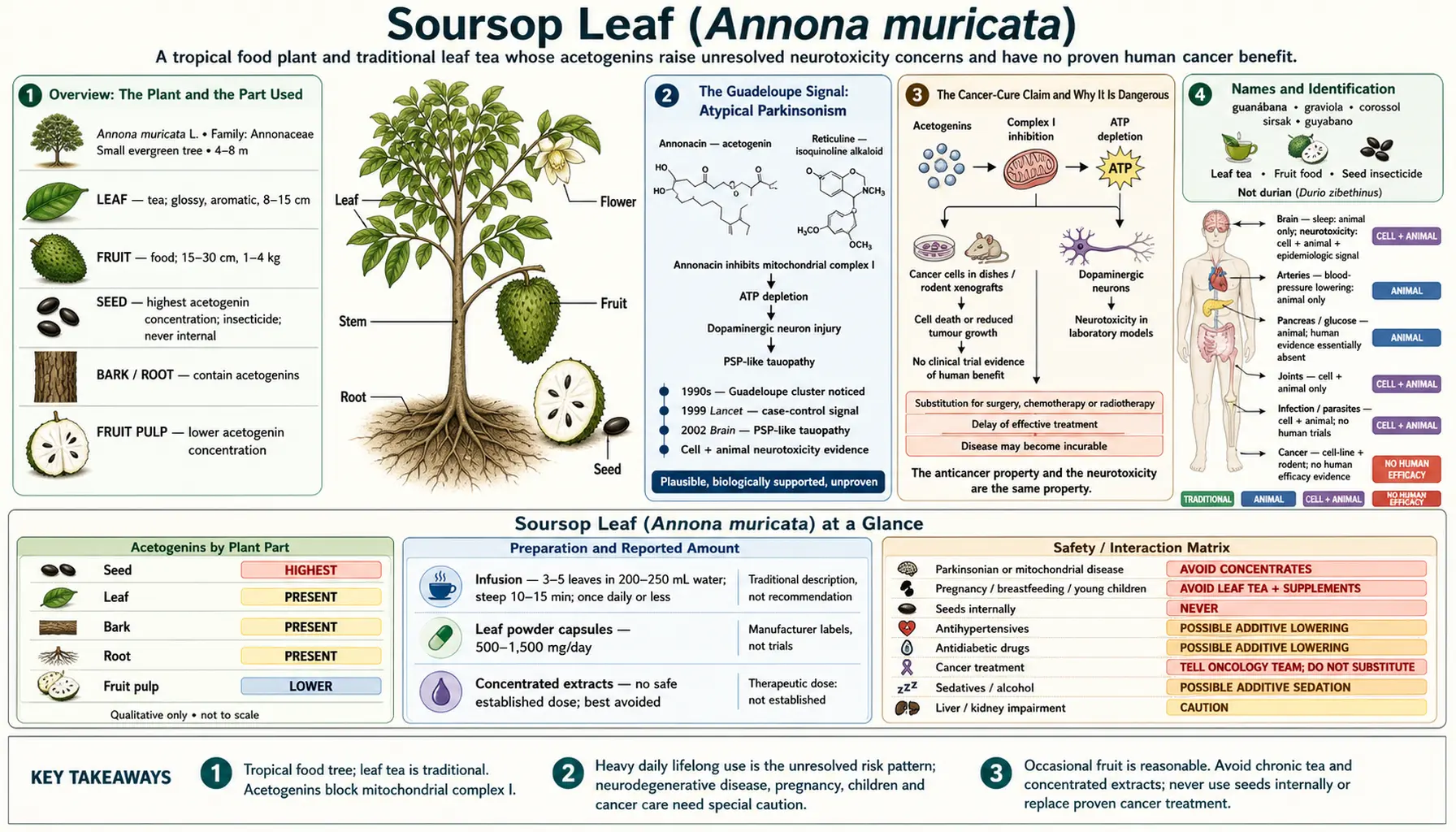
Soursop — Annona muricata, also called guanábana, graviola, corossol, sirsak or guyabano — is a small tropical tree whose spiny green fruit is eaten across the Caribbean, Latin America, West Africa and Southeast Asia, and whose leaves are brewed as a tea. The fruit is a food and the leaf tea is a traditional remedy. The research on the plant raises two questions that this page sets out in detail: one neurological and one about cancer claims.
The neurological question. The plant contains annonacin and a family of related compounds called acetogenins, which block complex I of the mitochondrial respiratory chain. Neurologists on Guadeloupe documented an unusually high proportion of atypical parkinsonism, much of it resembling progressive supranuclear palsy, and in case-control and cross-sectional studies found that patients reported more consumption of Annona fruit and herbal tea than comparison groups. The human studies are associations, not proof of causation — but annonacin is neurotoxic to dopaminergic neurons in cell and animal studies, and a 2020 risk assessment concluded that the available data do not allow a safe intake level to be set. The full evidence is reviewed in Soursop Safety: Annonacin and Neurotoxicity Research.
The cancer question. Graviola is widely marketed as a natural cancer remedy. No clinical trial has shown that soursop leaf or fruit treats or prevents cancer in people. The anticancer evidence comes from cell-culture and animal studies; the one small randomised trial found in patients measured laboratory markers, not tumour outcomes. In 2008 the US Federal Trade Commission took action against a seller of a soursop extract advertised to prevent and treat melanoma.
Table of Contents
- Overview: The Plant and the Part Used
- The Guadeloupe Signal: Atypical Parkinsonism
- The Cancer-Cure Claim and What the Evidence Shows
- Names and Identification
- Traditional Use
- Active Compounds
- Sleep and Sedation
- Antiparasitic and Antimicrobial Activity
- Blood Sugar and Blood Pressure
- Anti-inflammatory and Analgesic Claims
- Culinary Use
- Forms and Preparations
- Dose: What Has and Has Not Been Established
- Cautions: Who the Research Raises Concerns For
- Key Research Papers
- Conditions It Is Used For
- Connections
- Featured Videos
Overview: The Plant and the Part Used
Annona muricata is an evergreen tree in the custard-apple family Annonaceae. It is native to the Caribbean and Central America and is now widely distributed through tropical and subtropical regions, including India, Malaysia and Nigeria. A 2015 review describes it as an erect tree reaching 5–8 metres, with an open, roundish canopy and large, glossy, dark green leaves.
The fruit is large, heart-shaped and green, with a diameter of about 15–20 cm according to the same review, and soft, curved spines on the skin. It encloses a white fibrous pulp with hard black seeds. The flavour is often described as strawberry-and-pineapple with a creamy texture and a sharp acid edge. It is eaten fresh and made into juices, nectars, syrups, candies, ice creams and shakes.
The leaves are the part this page is mainly about. They are strongly aromatic when crushed and are boiled or steeped into a tea or decoction. In Indonesia this is daun sirsak; in the Philippines, guyabano leaf tea; in the Caribbean, corossol or soursop tea. In a 2018 survey of patients treated for lung cancer on Réunion, an infusion of boiled leaves was the most common way graviola was taken.
Acetogenins have been isolated from every part of the plant that has been studied — leaves, bark, roots, seeds and fruit. The fruit is not a negligible source: a 2005 measurement study estimated about 15 mg of annonacin in an average fruit and 36 mg in a can of commercial nectar, against about 140 micrograms in a cup of leaf infusion or decoction. In tropical Africa the plant is used as an insecticide and a fish poison, according to the 2015 review.
The Guadeloupe Signal: Atypical Parkinsonism
The record is complicated, and the research supports neither a proven cause nor a myth. Told in order:
What was observed
Through the 1990s, neurologists on the French Caribbean island of Guadeloupe saw an unusually high proportion of parkinsonian patients who did not have ordinary Parkinson's disease. In the 1999 series of 87 consecutive patients, 22 had Parkinson's disease, 31 had progressive supranuclear palsy (PSP) and 30 had atypical parkinsonism. The atypical patients had symmetrical rigidity and slowness; the PSP patients had vertical down-gaze palsy, severe gait and balance problems and a frontal-lobe syndrome. In the 2002 series of 220 patients, early falls, frontal-lobe dysfunction and pseudobulbar palsy were common, and three-quarters of the patients did not respond to levodopa, the drug that reliably helps Parkinson's disease. Tremor was not absent: in the 2007 study it occurred in more than half of the PSP-like patients. A 2005 account of 265 patients put atypical parkinsonism at 75% of cases and Parkinson's disease at 25%, the reverse of the proportions seen in Europe.
The case-control and cross-sectional studies
In 1999, Caparros-Lefebvre and Elbaz published a case-control study in The Lancet. Patients with PSP or atypical parkinsonism reported significantly more regular consumption of Annonaceae fruit and herbal tea (the study named Annona muricata and Annona squamosa) than patients with Parkinson's disease (odds ratios 23.6 for fruit and 28.2 for herbal tea) and than hospital controls with benign symptoms (20.7 and 6.48). A 2002 paper in Brain reported the brains of three PSP-like patients who came to autopsy, all showing tau accumulation predominating in the midbrain, and concluded that Guadeloupean parkinsonism may be a tauopathy identical or closely related to PSP. A 2007 Brain cross-sectional study of 160 patients by Lannuzel and colleagues found soursop consumption significantly greater in both atypical groups than in controls and in patients with Parkinson's disease. In a 2022 study of 180 Caribbean patients with degenerative parkinsonism, including Parkinson's disease, even low cumulative fruit or juice consumption (above 0.2 fruit-years) or any herbal-tea consumption was associated with more severe disease and cognitive deficits (odds ratios 3.76 and 2.91).
The laboratory evidence
- Annonacin inhibits mitochondrial complex I. Complex I is the entry point of the electron transport chain; inhibiting it lowers the neuron's ATP supply. MPTP, whose metabolite MPP+ inhibits complex I, caused marked parkinsonism in people who injected it (Langston 1983), and the pesticide rotenone is another complex I inhibitor.
- Annonacin kills dopaminergic neurons in culture. Lannuzel and colleagues reported in Neuroscience in 2003 that annonacin killed half of rat midbrain dopaminergic neurons within 24 hours at about 0.018 micromolar — far more potent than MPP+ (1.9 micromolar) and about as potent as rotenone (0.034 micromolar) — and that extra glucose or mannose restored ATP and prevented cell death. A 2002 study by the same group found an alkaloid extract of soursop root bark, and its alkaloids coreximine and reticuline, also toxic to dopaminergic neurons. Cell culture.
- Annonacin causes brain lesions in rats. Champy and colleagues reported in the Journal of Neurochemistry in 2004 that rats given annonacin intravenously by minipump for 28 days lost nigral dopaminergic neurons and striatal neurons, a lesion pattern resembling that in the patients. Animal.
- Annonacin produces a tau change. Escobar-Khondiker and colleagues reported in 2007 that annonacin redistributed tau from the axons to the cell body in cultured neurons, and Höllerhage and colleagues reported in Experimental Neurology in 2009 that 24 lipophilic complex I inhibitors all did so, in proportion to how strongly they inhibited complex I. In a 2016 mouse study, 12 months of drinking commercial soursop juice increased phosphorylated tau in the brain. Cell culture and animal.
- The amounts in food. Champy and colleagues reported in Movement Disorders in 2005 about 15 mg of annonacin in an average fruit, 36 mg in a can of nectar and 140 micrograms in a cup of infusion or decoction, and estimated that an adult who consumes one fruit or one can of nectar a day would ingest, over a year, the amount of annonacin that induced brain lesions in rats given purified annonacin intravenously. This estimate links the epidemiology and the toxicology, and it is also the step most open to challenge, since it extrapolates across species and from an intravenous to an oral route.
What is genuinely uncertain
The research supports describing the hypothesis as plausible, biologically supported, and unproven:
- The human studies are case-control and cross-sectional studies, almost all from the French Caribbean and French Guiana, with retrospective dietary recall — a method vulnerable to recall bias, particularly once a local hypothesis is publicly known.
- In New Caledonia, two 2004 letters in Movement Disorders reported atypical parkinsonism in connection with Annonaceae consumption and compared it with Guadeloupe. The parkinsonism–dementia complex of Guam has been compared with the Guadeloupe syndrome and has been attributed at various times to cycad consumption and to other factors. A genetic contribution in Guadeloupe cannot be excluded: the three autopsied patients in the 2002 study were all homozygous for the H1 tau haplotype, though none carried a tau gene mutation.
- The rat lesion study infused purified annonacin into the bloodstream. Eating fruit or drinking an infusion involves gut absorption and a mixture of compounds; in a rat pharmacokinetic study, only about 3.2% of an oral dose of annonacin reached the circulation. Human pharmacokinetic data were not found.
- Annona fruit is widely eaten across Latin America, West Africa and Southeast Asia, yet a 2023 review of endemic parkinsonism listed only one Caribbean cluster (Guadeloupe and Martinique) among the ten endemic forms known worldwide. The same review concluded that both genetic and environmental factors contribute to these diseases.
- No prospective human study has tested the hypothesis.
What the research says about exposure patterns
The research concern is about regular consumption over long periods, not a single cup or an occasional fruit producing a movement disorder. The patients in the Caribbean studies reported regular long-term consumption of fruit, juice and herbal tea, and the 2005 estimate was framed as a year of daily intake. The findings that bear on exposure:
- Per serving, the fruit and nectar are the high-exposure end. The 2005 figures were about 15 mg of annonacin per fruit and 36 mg per can of nectar, against 140 micrograms per cup of infusion.
- The association is not confined to the leaf. The 1999, 2007 and 2022 studies all examined fruit (or juice) as well as herbal tea, and in 2022 even low cumulative fruit or juice intake was associated with more severe disease.
- Capsules deliver the whole leaf. Seven commercial leaf products tested in 2023 contained 1.05–3.09 mg of annonacin per gram.
- No safe intake level has been set. A 2020 risk assessment carried out at Germany's Federal Institute for Risk Assessment within an EFSA-supported fellowship programme found indications of neurotoxic potential in certain preparations and too few studies, particularly of long-term use, to establish a safe intake level. The 2022 Caribbean authors proposed more restrictive public-health recommendations on Annonaceae products.
The Cancer-Cure Claim and What the Evidence Shows
Graviola is marketed online as "10,000 times stronger than chemotherapy", as a cure kept from the public, and as a treatment for many kinds of tumour. According to the 2020 risk assessment, A. muricata supplements are marketed particularly for cancer and parasitic infections.
No clinical trial has shown that Annona muricata treats or prevents cancer in people. The literature consists of:
- Cell-line work. Isolated acetogenins and leaf extracts are toxic to cultured cancer cells, and the 2015 review lists many acetogenins tested against lung, breast, colon, pancreatic and prostate cancer cell lines. A result in a dish is a screening finding, not evidence of a treatment.
- Animal work. Some rodent studies report reduced tumour growth with leaf extracts or leaf essential oil; for example, a 2022 rat study of the leaf essential oil in a chemically induced breast cancer model reported reduced tumour volume. Animal results do not establish an effect in people.
- One small human trial with laboratory endpoints. In a 2017 randomised, double-blind, placebo-controlled trial, 28 patients with colorectal cancer who had already had their tumour removed took a leaf extract or placebo for 8 weeks; serum from the extract group showed higher cytotoxicity against colorectal cancer cell lines in the laboratory. The trial did not measure tumour recurrence or survival, and its authors called for further research.
- Reviews summarising the above. Moghadamtousi and colleagues' 2015 review in the International Journal of Molecular Sciences catalogues the isolated acetogenins and their biological activities from laboratory and animal studies.
The "10,000 times" figure matches a 1996 laboratory report: one acetogenin isolated from soursop seeds, cis-annonacin, was selectively cytotoxic to a colon adenocarcinoma cell line (HT-29), in which it showed 10,000 times the potency of the chemotherapy drug adriamycin (Rieser 1996). It is a ratio between two compounds in a cell assay and says nothing about what happens in a person, where absorption, distribution, metabolism, excretion and toxicity determine the effect.
Use alongside cancer treatment. A 2018 survey on Réunion of 100 patients receiving chemotherapy or immunotherapy for lung cancer found that 67 had consumed graviola, 53.7% of them as an anticancer agent, and 25 took it regularly; the authors wrote that the consequences of this intake, including drug interactions and side effects, are unknown. No clinical interaction studies of soursop with cancer treatment were found. The mechanism raises two concerns: acetogenins are mitochondrial complex I inhibitors, and several cancer drugs also act on or depend on mitochondrial function; and chemotherapy-induced peripheral neuropathy is already a common, dose-limiting problem, to which a neurotoxin would add. The evidence is examined in Soursop and Cancer: The Claim Examined.
Regulatory action. In September 2008 the US Federal Trade Commission announced eleven law-enforcement actions against sellers of products marketed as cancer cures; one concerned a soursop (guanabana) extract advertised to prevent and treat melanoma. The settlements barred the sellers from claiming that their products prevent, treat or cure any type of cancer unless the claim is supported by competent and reliable scientific evidence.
Names and Identification
Binomial: Annona muricata L. Family: Annonaceae. Parts used: leaf (tea), fruit (food), seed (traditional insecticide; not eaten).
Regional names:
- Spanish: guanábana
- Portuguese (Brazil): graviola
- French / Creole: corossol
- Indonesian / Malay: sirsak, durian belanda ("Dutch durian")
- Tagalog: guyabano
- Thai: thurian thet (ทุเรียนเทศ)
- Vietnamese: mãng câu xiêm
- Hindi: lakshman phal
- Swahili: mstafeli
Related species. Several Annona species look and taste similar and are sold in the same markets. Acetogenins have been found in more than one of them:
- Annona squamosa — sugar apple, sweetsop, custard apple, sitaphal, srikaya. Round, knobbly, sweeter. A 2017 study measured 13.5–36.4 mg of the acetogenin squamocin per fruit, and the 1999 Guadeloupe study examined this species alongside soursop.
- Annona reticulata — bullock's heart, custard apple.
- Annona cherimola — cherimoya. Acetogenins were detected in a commercial cherimoya-based alcoholic drink (2014).
- Annona montana — mountain soursop.
"Custard apple" is ambiguous and is applied in different countries to A. reticulata, A. squamosa and occasionally A. cherimola. A label reading "custard apple" or simply "Annona" does not identify the species.
Not to be confused with: durian (Durio zibethinus), despite the Malay name "Dutch durian" — a completely unrelated plant.
Traditional Use
A 2015 review of the plant's ethnomedicinal uses reports that all parts of the tree, like those of related Annona species, are used in traditional medicine, especially for cancer and parasitic infections:
- Leaves. Used for cystitis, diabetes, headaches and insomnia; the leaf decoction is taken for rheumatic and neuralgic complaints, and cooked leaves are applied to abscesses. Anti-inflammatory, hypoglycaemic, sedative, hypotensive and antispasmodic effects are attributed to the leaves, bark and roots.
- Fruit. Used for arthritic pain, neuralgia, diarrhoea, dysentery, fever, malaria, parasites, rheumatism, skin rashes and worms, and eaten to increase breast milk after childbirth.
- West Africa. In tropical Africa the plant is used as an astringent, insecticide and fish poison and for coughs, pain and skin diseases; in Cameroon the leaves are used for diabetes (Florence 2014); in Nigeria and South America the leaves are used against tumours.
- India. The fruit and flower are used for catarrh, and the root bark and leaves are believed to have anti-inflammatory and anthelmintic activity.
- Seeds. Crushed seeds are believed to act against external and internal worms and parasites. Custard-apple (A. squamosa) seeds are a folk head-lice treatment; a 2006 laboratory analysis attributed that anti-lice activity to oleic acid and an oleate triglyceride in the seed oil rather than to acetogenins.
Traditional use shows that the plant is bioactive and that people have found it worth using. It does not show that any of these uses works, or that daily long-term use is safe.
Active Compounds
Annonaceous acetogenins — the defining and most consequential class. A 2015 review counted more than 100 isolated from the leaves, bark, seeds, roots and fruit of Annona muricata and described them as the plant's major constituents. Chemically they are long-chain fatty-acid derivatives with tetrahydrofuran rings and a terminal lactone. Annonacin is the major acetogenin of A. muricata; others listed in the review include annomuricins, muricatocins, annomutacin, murisolin and muricatacin, and related acetogenins include squamocin and bullatacin.
Their pharmacology is unusually well characterised for a plant compound: they are potent inhibitors of mitochondrial complex I (NADH:ubiquinone oxidoreductase). Complex I inhibition depletes cellular ATP, and in laboratory work this is the mechanism behind both the toxicity to cultured cancer cells and the toxicity to dopaminergic neurons described above. Dopaminergic neurons of the substantia nigra are considered especially vulnerable to energy failure: they have long, highly branched, largely unmyelinated axons that are energetically expensive to run.
Acetogenins are lipophilic — they dissolve in fat far better than in water. In the 2004 rat study, annonacin given into the bloodstream was detected inside brain tissue. How much builds up in human tissue is not known.
Isoquinoline alkaloids — including reticuline and coreximine (leaves, roots, stems and bark), anonaine (leaves and fruit) and asimilobine (fruit). Coreximine and reticuline were toxic to dopaminergic neurons in culture (Lannuzel 2002), and anonaine, asimilobine and nornuciferine from the fruit acted as serotonin 5-HT1A receptor agonists in cell assays (Hasrat 1997). The 1999 Guadeloupe authors originally suspected these benzyltetrahydroisoquinoline alkaloids; later work focused on acetogenins.
Phenolics and flavonoids — a 2018 analysis of a hydroalcoholic leaf extract identified quercetin, isoquercitrin, quercitrin, rutin and kaempferol, and gallic, chlorogenic, ellagic and caffeic acids. These compounds are also present in a great many other plants.
Essential oil — in a 2022 analysis of the leaf essential oil, 40 compounds were identified; the most abundant were Z-caryophyllene (40.22%), α-selinene, β-pinene and β-elemene.
Fruit minerals. The 2015 review lists potassium, calcium, sodium, copper, iron and magnesium among the minerals in the fruit.
Sleep and Sedation
The claim: soursop leaf tea for sleep and anxiety — the 2015 review lists insomnia among the leaf's traditional uses and attributes sedative effects to the leaves, bark and roots.
Animal and laboratory evidence: in a 2018 mouse study, a hydroalcoholic leaf extract given by injection had sedative effects, and at the highest dose anxiolytic and anticonvulsant effects; these effects were partly reversed by flumazenil, which the authors took as a sign of action on the GABA system. Fruit alkaloids acted on serotonin 5-HT1A receptors in cell assays (Hasrat 1997).
Human evidence: no randomised controlled trials of soursop leaf for insomnia or anxiety were found. The sleep use is also the one that produces daily, long-term consumption, the exposure pattern the neurological research concerns. Evidence: animal and laboratory only. The use is covered in Soursop Leaf for Sleep and Digestive Comfort.
Antiparasitic and Antimicrobial Activity
The claim: leaf, fruit and seed preparations for malaria, worms and other parasites, and for skin infections.
Mechanism: acetogenins inhibit mitochondrial respiration, which is the proposed basis of the plant's insecticidal use. Complex I inhibition is not specific to parasites; the same action underlies the toxicity to cultured neurons described above.
Evidence: laboratory studies summarised in the 2015 review report activity of leaf extracts against Leishmania species, Trypanosoma cruzi and Plasmodium falciparum, and of seed and leaf extracts against worm larvae and eggs. An aqueous extract of soursop fruit pods inhibited Staphylococcus aureus and Vibrio cholerae in a 2010 laboratory test, while the ethanol extract did not. Evidence: cell-culture and laboratory. No human trials for malaria or for systemic parasitic infection were found.
Blood Sugar and Blood Pressure
The claim: soursop leaf tea for type 2 diabetes and high blood pressure — the 2015 review lists diabetes among the leaf's traditional uses, and a Cameroonian study notes the leaves are used there for diabetes.
Blood sugar. In streptozotocin-diabetic rats, an oral aqueous leaf extract lowered blood glucose and was associated with stronger beta-cell staining in the pancreas (Florence 2014), and an injected methanolic leaf extract was associated with more and larger beta cells in the pancreatic islets (Adeyemi 2010). The 2014 extract had no glucose-lowering effect in normal rats. Evidence: animal. No human trial of soursop for blood sugar was found. Animal data suggest possible additive glucose lowering with diabetes medicines; no human interaction data exist.
Blood pressure. In anaesthetised normotensive rats, an intravenous aqueous leaf extract lowered blood pressure in a dose-dependent way without affecting heart rate, and relaxed isolated aortic rings through a mechanism involving calcium antagonism (Nwokocha 2012). Evidence: animal. One human trial was found: in a 2020 Indonesian randomised trial of 143 adults with prehypertension and high-normal uric acid, the group given 2 × 100 g of soursop fruit juice a day for 3 months had lower systolic blood pressure than an untreated control group, which received no placebo. No trial of the leaf for blood pressure was found. Animal data suggest possible additive blood-pressure lowering with antihypertensive medicines. The evidence is reviewed in Soursop Leaf for Blood Sugar and Blood Pressure.
Anti-inflammatory and Analgesic Claims
The claim: leaf preparations for arthritis, rheumatism, pain and inflammation — uses listed in the 2015 review.
Evidence: in a 2010 study in rodents, an oral ethanol leaf extract reduced abdominal writhing after acetic acid, paw licking, and carrageenan paw oedema (by 29.50% and 37.33% at the higher dose, 3 to 4 hours after carrageenan), and reduced exudate volume and leukocyte migration. Evidence: animal only. No human trials were found.
Culinary Use
The fruit is a popular food. Ripe soursop is scooped from the skin, the black seeds removed, and the pulp eaten fresh or blended.
- Juice and batidos. Champola de guanábana in Cuba and Puerto Rico — pulp blended with milk and ice. Jus corossol across the French Caribbean.
- Ice cream and sorbet, widely made from the pulp in Latin America and Southeast Asia.
- Es sirsak in Indonesia — pulp with ice.
- Candies, syrups, nectar and canned pulp are sold worldwide.
The seeds are not eaten. They are hard, black and easily separated. Seed extracts are the source of acetogenin-based insecticides, and a 2016 case series described six patients who developed toxic keratoconjunctivitis within 6–12 hours of custard-apple (A. squamosa) seed material getting into the eye.
The fruit is also part of the neurological question: the Caribbean studies associated fruit and juice consumption, as well as herbal tea, with atypical parkinsonism and with more severe disease, and the 2005 study measured more annonacin per fruit or can of nectar than per cup of leaf infusion. The leaves are not a culinary ingredient; they are used as an infusion or decoction.
Forms and Preparations
- Leaf infusion or decoction. The traditional form, steeped or simmered. The 2005 study measured about 140 micrograms of annonacin in a cup of either.
- Dried leaf tea, loose or bagged. Widely sold; acetogenin content is rarely stated on the label.
- Leaf powder capsules. These deliver the whole leaf rather than what passes into water. Seven commercial leaf products tested in 2023 contained 1.05–3.09 mg of annonacin per gram, varied in which acetogenins were present, and one contained less than half the content stated on its label.
- Standardised graviola extracts. Sometimes sold with an acetogenin percentage on the label. No safety data were found for products standardised to acetogenins, the constituents the toxicology concerns.
- Tinctures and liquid extracts. Ethanol dissolves lipophilic compounds well, and acetogenins have been identified in an alcoholic drink made from cherimoya fruit (2014). The acetogenin content of soursop tinctures was not found in the literature checked for this page.
- Fruit pulp, juice, nectar, frozen and canned pulp — food products. Per serving, the 2005 study found more annonacin in a fruit (about 15 mg) or a can of nectar (36 mg) than in a cup of leaf infusion.
- Seed preparations. Traditional topical insecticide and lice treatment; the seeds are not eaten.
Labels. A label reading "graviola 1000 mg" does not say whether it contains leaf, bark, seed or a mixture, or which Annona species supplied it, and the acetogenin content is rarely stated. In the 2023 analysis, labelled dosage recommendations varied between products; label directions come from sellers, not from safety studies.
Dose: What Has and Has Not Been Established
There is no established therapeutic dose of soursop leaf, because there are no adequate human efficacy trials to derive one from. There is also no established safe intake level: the 2020 risk assessment concluded that the paucity of adequate studies, particularly of long-term use, does not allow one to be set. No figure on this page is a recommended amount.
What has been reported:
- Measured amounts per serving (2005): about 15 mg of annonacin in a fruit, 36 mg in a can of nectar, 140 micrograms in a cup of infusion or decoction.
- Leaf products (2023): 1.05–3.09 mg of annonacin per gram, with labelled dosage recommendations that varied between products.
- Duration: the human associations involve regular, long-term consumption; the 2022 study measured exposure in cumulative fruit-years and found the association even at low cumulative fruit or juice intake and with any herbal-tea use.
- Absorption: in rats, about 3.2% of an oral dose of annonacin reached the bloodstream; human data were not found.
- Trial doses: the 2020 blood-pressure trial used 2 × 100 g of fruit juice a day for 3 months; the 2017 colorectal cancer trial gave a leaf extract daily for 8 weeks.
Cautions: Who the Research Raises Concerns For
Neurotoxicity is the main safety finding. Annonacin and related acetogenins inhibit mitochondrial complex I, are neurotoxic to dopaminergic neurons in cell and animal studies, and are the basis of an epidemiological association between regular Annona consumption and atypical parkinsonism in the French Caribbean. The association is not proven to be causal, and it has not been ruled out. A 2020 systematic review of the leaf extract listed neurotoxic effects among its findings but concluded overall that the extract had a favourable safety and tolerability profile, noting that doses used in toxic animal studies may not translate directly to humans.
The research raises a particular concern for:
- People with Parkinson's disease, progressive supranuclear palsy, multiple system atrophy or another parkinsonian syndrome. This is the one group with direct human data: in the 2022 Caribbean study, Annonaceae consumption was associated with more severe disease, including in Parkinson's disease.
- People with a family history of parkinsonism or another neurodegenerative disorder. Researchers describe these diseases as arising from both genetic and environmental factors, and complex I inhibitors are among the environmental factors studied.
- People with a mitochondrial disease. Their respiratory chain is already impaired, and acetogenins inhibit complex I.
- Pregnancy and breastfeeding. There is no human safety data.
- Infants and young children. There is no safety data, and the developing nervous system has not been studied for this exposure.
- Seeds. Seed material is the source of acetogenin insecticides, and eye contact with custard-apple seed material has caused toxic keratoconjunctivitis.
Drug and condition interactions. No clinical interaction studies of soursop were found. The points below are what the mechanism and the animal data raise:
- Levodopa and other dopaminergic drugs. A theoretical conflict: a dopaminergic neurotoxin acting on the neurons the drugs are meant to support. No interaction study exists.
- Antihypertensives. Animal data suggest possible additive blood-pressure lowering.
- Antidiabetic drugs (metformin, sulfonylureas, insulin). Animal data suggest possible additive glucose lowering. Metformin's own action involves inhibition of mitochondrial complex I (Owen 2000); combining it with a more potent complex I inhibitor has not been studied.
- Chemotherapy and radiotherapy. Chemotherapy-induced peripheral neuropathy is already a common, dose-limiting problem, and a neurotoxin adds to the same concern; several cancer drugs also act on or depend on mitochondrial function.
- Liver and kidney impairment. Human clearance of acetogenins has not been characterised; in rats, the elimination half-life of oral annonacin was about 4.8 hours.
- Sedatives, benzodiazepines and alcohol. Possible additive sedation, given the sedative effects reported in mice.
Movement-disorder effects would not be expected to appear acutely; the research concern is cumulative, and neuronal loss in the nigrostriatal system typically produces symptoms only after a large share of neurons has been lost. No clinical trial has shown that soursop treats or prevents cancer. Decisions about supplements and herbal products belong with a clinician who knows the person's history.
Key Research Papers
- Caparros-Lefebvre D, Elbaz A. Possible relation of atypical parkinsonism in the French West Indies with consumption of tropical plants: a case-control study. Caribbean Parkinsonism Study Group. The Lancet. 1999;354(9175):281–286 — PubMed PMID: 10440304 — The original epidemiological signal.
- Caparros-Lefebvre D, Sergeant N, Lees A, et al. Guadeloupean parkinsonism: a cluster of progressive supranuclear palsy-like tauopathy. Brain. 2002;125(Pt 4):801–811. — PubMed PMID: 11912113
- Lannuzel A, Michel PP, Höglinger GU, et al. The mitochondrial complex I inhibitor annonacin is toxic to mesencephalic dopaminergic neurons by impairment of energy metabolism. Neuroscience. 2003;121(2):287–296 — PubMed PMID: 14521988 — Cell culture.
- Champy P, Höglinger GU, Féger J, et al. Annonacin, a lipophilic inhibitor of mitochondrial complex I, induces nigral and striatal neurodegeneration in rats. Journal of Neurochemistry. 2004;88(1):63–69 — PubMed PMID: 14675150 — Animal.
- Champy P, Melot A, Guérineau Eng V, et al. Quantification of acetogenins in Annona muricata linked to atypical parkinsonism in Guadeloupe. Movement Disorders. 2005;20(12):1629–1633 — PubMed PMID: 16078200 — The dose-estimate paper.
- Lannuzel A, Höglinger GU, Verhaeghe S, et al. Atypical parkinsonism in Guadeloupe: a common risk factor for two closely related phenotypes? Brain. 2007;130(Pt 3):816–827. — PubMed PMID: 17303592
- Höllerhage M, Matusch A, Champy P, et al. Natural lipophilic inhibitors of mitochondrial complex I are candidate toxins for sporadic neurodegenerative tau pathologies. Experimental Neurology. 2009;220(1):133–142. — PubMed PMID: 19682988 — Cell culture.
- Moghadamtousi SZ, Fadaeinasab M, Nikzad S, et al. Annona muricata (Annonaceae): a review of its traditional uses, isolated acetogenins and biological activities. International Journal of Molecular Sciences. 2015;16(7):15625–15658 — PubMed PMID: 26184167 — The standard phytochemical review; it reports laboratory and animal activities.
- Moreau D, Huchot E, Gazaille V, et al. Self-medication with Annona muricata L. (corossol) as an anti-cancer agent in Réunion. Revue des Maladies Respiratoires. 2018;35(9):948–955 — PubMed PMID: 30195454 — Article in French. A survey of 100 patients receiving chemotherapy or immunotherapy for lung cancer.
- Lannuzel A, Michel PP, Caparros-Lefebvre D, et al. Toxicity of Annonaceae for dopaminergic neurons: potential role in atypical parkinsonism in Guadeloupe. Movement Disorders. 2002;17(1):84–90 — PubMed PMID: 11835443 — Alkaloids from soursop root bark. Cell culture.
- Escobar-Khondiker M, Höllerhage M, Muriel MP, et al. Annonacin, a natural mitochondrial complex I inhibitor, causes tau pathology in cultured neurons. Journal of Neuroscience. 2007;27(29):7827–7837 — PubMed PMID: 17634376 — Cell culture.
- Lannuzel A, Ruberg M, Michel PP. Atypical parkinsonism in the Caribbean island of Guadeloupe: etiological role of the mitochondrial complex I inhibitor annonacin. Movement Disorders. 2008;23(15):2122–2128 — PubMed PMID: 18816693 — Review.
- Caparros-Lefebvre D, Steele J. Atypical parkinsonism on Guadeloupe, comparison with the parkinsonism-dementia complex of Guam, and environmental toxic hypotheses. Environmental Toxicology and Pharmacology. 2005;19(3):407–413 — PubMed PMID: 21783505 — 265 patients; comparison with Guam.
- Angibaud G, Gaultier C, Rascol O. Atypical parkinsonism and Annonaceae consumption in New Caledonia. Movement Disorders. 2004;19(5):603–604 — PubMed PMID: 15133832 — Letter; no abstract indexed.
- Caparros-Lefebvre D. Atypical parkinsonism in New Caledonia: comparison with Guadeloupe and association with Annonaceae consumption. Movement Disorders. 2004;19(5):604 — PubMed PMID: 15133833 — Letter; no abstract indexed.
- Cleret de Langavant L, Roze E, Petit A, et al. Annonaceae consumption worsens disease severity and cognitive deficits in degenerative parkinsonism. Movement Disorders. 2022;37(12):2355–2366 — PubMed PMID: 36210778 — Observational; 180 patients.
- Menšíková K, Steele JC, Rosales R, et al. Endemic parkinsonism: clusters, biology and clinical features. Nature Reviews Neurology. 2023;19(10):599–616 — PubMed PMID: 37684518 — Review.
- Langston JW, Ballard P, Tetrud JW, Irwin I. Chronic Parkinsonism in humans due to a product of meperidine-analog synthesis. Science. 1983;219(4587):979–980 — PubMed PMID: 6823561 — The MPTP precedent.
- Rottscholl R, Haegele M, Jainsch B, et al. Chronic consumption of Annona muricata juice triggers and aggravates cerebral tau phosphorylation in wild-type and MAPT transgenic mice. Journal of Neurochemistry. 2016;139(4):624–639 — PubMed PMID: 27569447 — Animal.
- Bonneau N, Schmitz-Afonso I, Brunelle A, et al. Method development for quantification of the environmental neurotoxin annonacin in rat plasma by UPLC-MS/MS and application to a pharmacokinetic study. Journal of Chromatography B. 2015;1004:46–52 — PubMed PMID: 26444335 — Oral bioavailability in rats.
- Bonneau N, Baloul L, Bajin Ba Ndob I, et al. The fruit of Annona squamosa L. as a source of environmental neurotoxins: from quantification of squamocin to annotation of Annonaceous acetogenins by LC-MS/MS analysis. Food Chemistry. 2017;226:32–40 — PubMed PMID: 28254016
- Le Ven J, Schmitz-Afonso I, Lewin G, et al. Identification of the environmental neurotoxins annonaceous acetogenins in an Annona cherimolia Mill. alcoholic beverage using HPLC-ESI-LTQ-Orbitrap. Journal of Agricultural and Food Chemistry. 2014;62(34):8696–8704 — PubMed PMID: 25088119
- Jocelin Chan WJ, Harnett JE, Meroni A, et al. An evaluation of the quality of Annona muricata leaf products. Journal of Pharmacy and Pharmacology. 2023;75(10):1357–1365 — PubMed PMID: 37440207 — Seven commercial leaf products.
- Chan WJ, McLachlan AJ, Hanrahan JR, Harnett JE. The safety and tolerability of Annona muricata leaf extract: a systematic review. Journal of Pharmacy and Pharmacology. 2020;72(1):1–16 — PubMed PMID: 31659754 — Systematic review.
- Raclariu-Manolica AC, Bakhiya N, Hirsch-Ernst KI. Risk assessment regarding the use of Annona muricata in food supplements. EFSA Journal. 2020;18(Suppl 1):e181112 — PubMed PMID: 33294051 — German Federal Institute for Risk Assessment, EU-FORA programme.
- Rieser MJ, Gu ZM, Fang XP, et al. Five novel mono-tetrahydrofuran ring acetogenins from the seeds of Annona muricata. Journal of Natural Products. 1996;59(2):100–108 — PubMed PMID: 8991944 — Source of the "10,000 times adriamycin" cell-line figure. Cell culture.
- Indrawati L, Ascobat P, Bela B, et al. The effect of an Annona muricata leaf extract on nutritional status and cytotoxicity in colorectal cancer: a randomized controlled trial. Asia Pacific Journal of Clinical Nutrition. 2017;26(4):606–612 — PubMed PMID: 28582808 — 28 completers; laboratory endpoints.
- Rojas-Armas JP, Arroyo-Acevedo JL, Palomino-Pacheco M, et al. Phytochemical constituents and ameliorative effect of the essential oil from Annona muricata L. leaves in a murine model of breast cancer. Molecules. 2022;27(6):1818 — PubMed PMID: 35335182 — Animal.
- Souza DO, Dos Santos Sales V, de Souza Rodrigues CK, et al. Phytochemical analysis and central effects of Annona muricata Linnaeus: possible involvement of the GABAergic and monoaminergic systems. Iranian Journal of Pharmaceutical Research. 2018;17(4):1306–1317 — PubMed PMID: 30568689 — Animal.
- Hasrat JA, De Bruyne T, De Backer JP, et al. Isoquinoline derivatives isolated from the fruit of Annona muricata as 5-HTergic 5-HT1A receptor agonists in rats: unexploited antidepressive (lead) products. Journal of Pharmacy and Pharmacology. 1997;49(11):1145–1149 — PubMed PMID: 9401954 — Receptor and cell assays.
- Florence NT, Benoit MZ, Jonas K, et al. Antidiabetic and antioxidant effects of Annona muricata (Annonaceae), aqueous extract on streptozotocin-induced diabetic rats. Journal of Ethnopharmacology. 2014;151(2):784–790 — PubMed PMID: 24076471 — Animal.
- Adeyemi DO, Komolafe OA, Adewole OS, et al. Histomorphological and morphometric studies of the pancreatic islet cells of diabetic rats treated with extracts of Annona muricata. Folia Morphologica. 2010;69(2):92–100 — PubMed PMID: 20512759 — Animal.
- Nwokocha CR, Owu DU, Gordon A, et al. Possible mechanisms of action of the hypotensive effect of Annona muricata (soursop) in normotensive Sprague-Dawley rats. Pharmaceutical Biology. 2012;50(11):1436–1441 — PubMed PMID: 22950673 — Animal.
- Alatas H, Sja'bani M, Mustofa M, et al. The effects of soursop supplementation on blood pressure, serum uric acid, and kidney function in a prehypertensive population in accordance with the 2017 ACC/AHA guideline. Journal of Human Hypertension. 2020;34(3):223–232 — PubMed PMID: 31462727 — Randomised; fruit juice versus untreated control; 143 participants.
- de Sousa OV, Vieira GD, de Jesus R G de Pinho J, et al. Antinociceptive and anti-inflammatory activities of the ethanol extract of Annona muricata L. leaves in animal models. International Journal of Molecular Sciences. 2010;11(5):2067–2078 — PubMed PMID: 20559502 — Animal.
- Viera GH, Mourão JA, Angelo AM, et al. Antibacterial effect (in vitro) of Moringa oleifera and Annona muricata against Gram positive and Gram negative bacteria. Revista do Instituto de Medicina Tropical de São Paulo. 2010;52(3):129–132 — PubMed PMID: 20602021 — Laboratory.
- Intaranongpai J, Chavasiri W, Gritsanapan W. Anti-head lice effect of Annona squamosa seeds. Southeast Asian Journal of Tropical Medicine and Public Health. 2006;37(3):532–535 — PubMed PMID: 17120975
- Nagaraja H, Kugar T, Shivanna Y, et al. Ocular toxicity by seeds of Annona squamosa (custard apple). Indian Journal of Ophthalmology. 2016;64(8):611–613 — PubMed PMID: 27688289 — Case series.
- Owen MR, Doran E, Halestrap AP. Evidence that metformin exerts its anti-diabetic effects through inhibition of complex 1 of the mitochondrial respiratory chain. Biochemical Journal. 2000;348(Pt 3):607–614 — PubMed PMID: 10839993
- US Federal Trade Commission. FTC sweep stops peddlers of bogus cancer cures. Press release, 18 September 2008 — ftc.gov
PubMed Topic Searches
- PubMed: Annonacin neurotoxicity
- PubMed: Annonaceae and atypical parkinsonism
- PubMed: Guadeloupean parkinsonism and tauopathy
- PubMed: Annona muricata acetogenins
- PubMed: Annona muricata and cancer research
- PubMed: Graviola and soursop toxicity
- PubMed: Mitochondrial complex I inhibitors and dopaminergic neurons
- PubMed: Annona muricata and blood glucose
- PubMed: Annona muricata antiparasitic activity
- PubMed: Delayed conventional cancer treatment and survival
Conditions Soursop Leaf Is Used For
Each condition below links to its page. The coloured half of every capsule shows how much human evidence supports this herb for that specific use — traditional use is history, not proof, and is marked as such.
Connections
- All Herbs
- Progressive Supranuclear Palsy — the syndrome the Guadeloupe cluster resembles
- Parkinson's Disease
- Multiple System Atrophy
- Neurology
- Cancer
- Oncology
- Toxins
- Conditions on this site that reference this page: Breast Cancer · Psychiatry