Black Pepper for Digestion & Gut Health
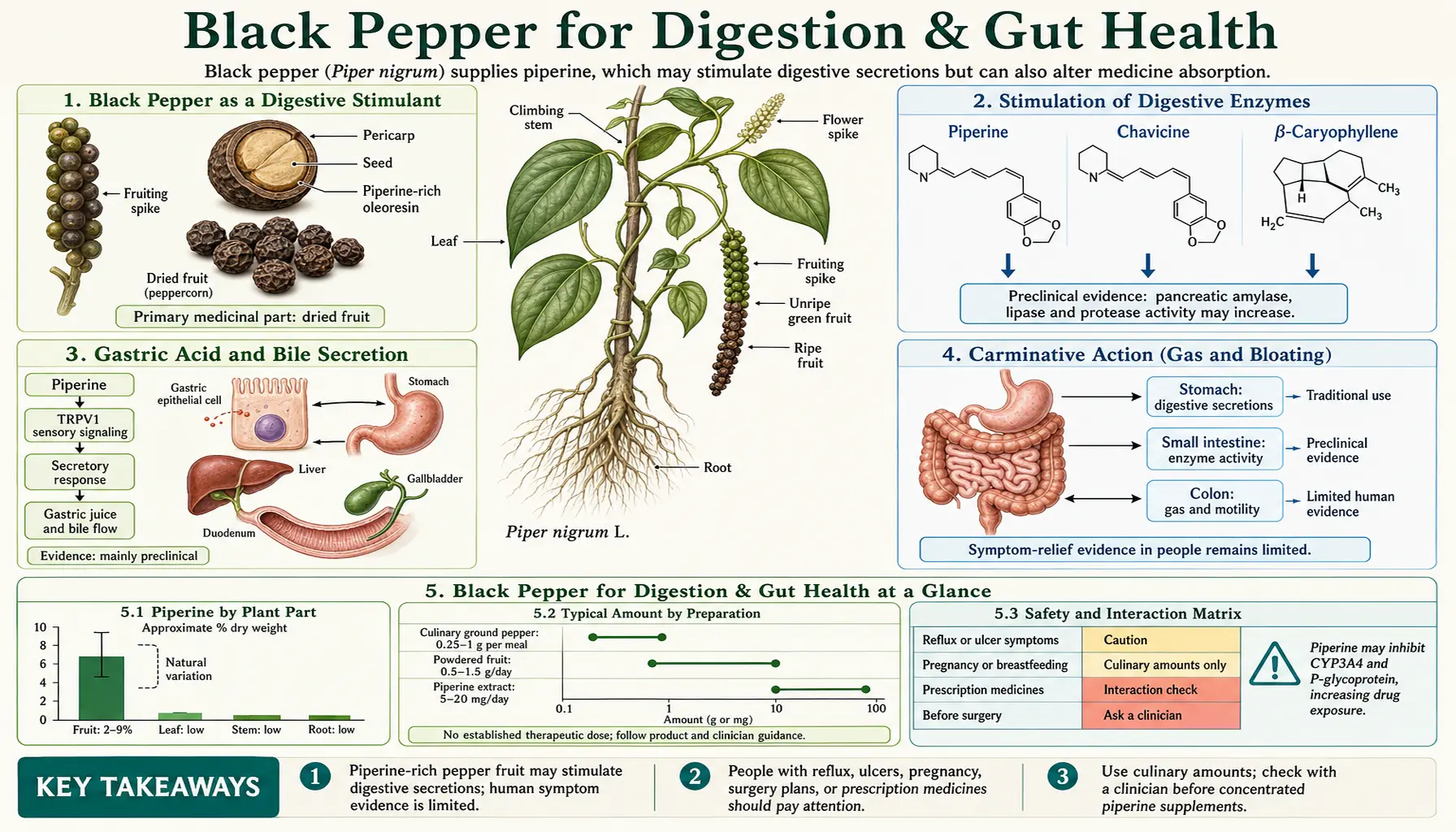
Long before anyone measured curcumin levels in a laboratory, black pepper was valued as a digestive aid. Traditional Ayurvedic and Greco-Roman medicine used it to "kindle the digestive fire," ease heaviness after meals, and settle gas. Modern research — carried out largely in rats by the Indian food-science group of Platel and Srinivasan — gives that tradition partial support: piperine can stimulate the secretion of salivary and pancreatic digestive enzymes, gastric acid, and bile, all of which help break food down. But the picture is more interesting than the folk claim suggests. Piperine actually slows gut transit in animal studies rather than speeding it, and the strongest evidence is in animals, not people. This page lays out what black pepper genuinely does in the digestive tract, what remains traditional belief, and who should be a little cautious.
Table of Contents
- Black Pepper as a Digestive Stimulant
- Stimulation of Digestive Enzymes
- Gastric Acid and Bile Secretion
- Carminative Action (Gas and Bloating)
- Gut Motility and Transit — A Surprise
- The Nutrient-Absorption Connection
- Traditional Uses vs Modern Evidence
- Who Might Benefit — and Cautions
- Key Research Papers
- External Resources
- Connections
- Featured Videos
Black Pepper as a Digestive Stimulant
The concept of a "digestive stimulant" — a food that prompts the body to release more of its own digestive secretions — sits at the center of how many culinary spices were traditionally understood. Black pepper is one of the archetypes. The idea is that the pungent bite of piperine on the tongue and in the gut triggers a reflex increase in saliva, stomach acid, bile, and pancreatic enzymes, priming the digestive tract to handle a meal more thoroughly.
Krishnapura Srinivasan, whose group at India's Central Food Technological Research Institute has done much of the primary work, summarized this in a comprehensive 2007 review in Critical Reviews in Food Science and Nutrition. The review documents piperine's ability to stimulate digestive enzyme activity and other physiological effects, while being careful to note that much of the evidence comes from controlled animal experiments rather than human trials. That balance — a real, measurable effect in the laboratory, with human confirmation still limited — runs through this entire topic.
Platel and Srinivasan directly asked whether the traditional claim holds up in a 2004 Indian Journal of Medical Research article pointedly titled "Digestive stimulant action of spices: a myth or reality?" Their answer, based on their rat studies, was that the digestive-stimulant effect is real and measurable for several spices including pepper — not merely folklore — though they were appropriately restrained about extrapolating the magnitude to humans.
Stimulation of Digestive Enzymes
The most concrete digestive finding is that dietary piperine increases the activity of the enzymes that chemically dismantle food. In a 2000 study in Nahrung, Platel and Srinivasan fed albino rats diets containing spices and their active principles and measured pancreatic enzyme output. Piperine (and several other spice compounds) raised the activity of pancreatic lipase, amylase, trypsin, and chymotrypsin — the enzymes responsible for digesting fats, starches, and proteins respectively.
An earlier 1996 study in the International Journal of Food Science and Nutrition looked at the enzymes of the small-intestinal mucosa (the lining itself, not just the pancreas) and again found that dietary spices or their active principles influenced these digestive enzymes. A follow-up 2002 Nahrung paper extended the finding to realistic Indian spice mixes, showing the digestive-stimulant action persisted when pepper was combined with other spices as it would be in cooking.
Taken together, this body of work makes a reasonably firm claim: in rats, dietary piperine measurably increases digestive-enzyme activity across the pancreas and gut lining. The mechanism appears to be a stimulatory signal from the pungent compound to the secretory tissues. What is not established with the same confidence is how large this effect is in a human eating ordinary amounts of pepper, or whether it translates into a noticeable improvement in digestion for a healthy person.
Gastric Acid and Bile Secretion
Two further secretions matter for digestion: stomach acid, which begins protein breakdown and activates enzymes, and bile, which emulsifies fat so it can be absorbed.
On gastric acid, Ononiwu and colleagues (2002), writing in the African Journal of Medicine and Medical Sciences, studied the effect of piperine on gastric acid secretion in albino rats and documented a measurable influence on acid output. This fits the traditional picture of pepper as an appetite-and-digestion stimulant that gets the stomach working. It also, however, hints at why pepper can aggravate some people — more on that below.
On bile, Srinivasan's broader research program has reported that several dietary spices, piperine among them, stimulate bile secretion and raise bile-acid output in rats. Enhanced bile flow would, in principle, improve the digestion and absorption of dietary fat and fat-soluble nutrients, dovetailing with piperine's better-known role in nutrient absorption covered on the Absorption & Bioavailability page.
As with the enzyme work, these are animal findings. They give a plausible physiological basis for the traditional use of pepper as a digestive tonic, but they should not be overstated into a promise of clinical benefit in humans.
Carminative Action (Gas and Bloating)
A carminative is a substance traditionally used to relieve intestinal gas and the bloating and cramping that come with it. Black pepper appears on virtually every historical list of carminative spices, alongside relatives like ginger, cardamom, cumin, and fennel.
The proposed mechanisms are indirect and overlapping: by stimulating digestive enzymes and bile, pepper may improve the breakdown of foods that would otherwise ferment and produce gas; and by influencing the smooth muscle of the gut, it may help move trapped gas along. It is worth being candid that the carminative reputation of pepper rests far more on centuries of traditional use and plausibility than on modern controlled human trials specifically measuring gas or bloating relief. It is a reasonable traditional use, not a proven therapy.
For gas and bloating, pepper is best thought of as one member of a family of culinary carminative spices used together in cooking — the peppered, spiced dish as a whole, rather than pepper in isolation. Its close culinary partner ginger has somewhat stronger evidence for settling the stomach.
Gut Motility and Transit — A Surprise
Here the research complicates the folk story in an instructive way. The popular image of pepper is of something that "gets things moving." But when Bajad and colleagues (2001) actually measured it in Planta Medica, they found that piperine inhibited gastric emptying and slowed gastrointestinal transit in rats and mice — the opposite of a laxative or pro-motility effect.
This is not a contradiction so much as a clue. A slower transit means food and any co-ingested compounds spend more time in contact with the absorptive surface of the gut. That extra dwell time is one of the ways piperine increases the absorption of nutrients and drugs — the digestive and bioavailability effects are two faces of the same underlying action on the gut. So the accurate statement is that pepper does not speed the gut up; it appears to slow it down modestly while ramping up secretions and absorption.
The practical implication is small for most people but real for a few: someone with a condition of already-slow gut motility (such as gastroparesis) should not assume pepper will help move things along, and might reasonably be cautious.
The Nutrient-Absorption Connection
Digestion and absorption are two ends of the same process, and piperine touches both. Beyond stimulating the enzymes and bile that break food down, piperine changes the gut lining itself. Johri and colleagues (1992) reported that piperine alters the permeability of rat intestinal epithelial cells, and Khajuria and colleagues (2002) described piperine-induced changes in the membrane dynamics of the intestinal surface — effectively making the absorptive barrier more receptive.
These membrane effects, combined with the slowed transit described above, are why the same spice that stimulates digestion also enhances how much of a meal's nutrients (and any co-taken supplements) actually get absorbed. For the full mechanism — including the enzyme and transporter inhibition that drives the famous curcumin result — see the Absorption & Bioavailability deep dive. It is a genuinely elegant bit of physiology: pepper does not just help you digest a meal, it helps you extract more from it.
Traditional Uses vs Modern Evidence
It helps to line up the traditional claims against what the research actually supports:
- "Stimulates digestion / kindles digestive fire" — supported in animal studies (increased enzyme, acid, and bile secretion). Human-scale magnitude uncertain, but the underlying effect is real.
- "Relieves gas and bloating" (carminative) — long traditional use and plausible mechanism; direct modern human trials are lacking. Reasonable but unproven.
- "Improves appetite" — consistent with the secretion-stimulating findings; some supporting animal data. Modest.
- "Speeds up the gut / acts as a laxative" — not supported; piperine slowed transit in animals.
- "Helps you absorb nutrients from food" — well-supported mechanistically and for specific compounds like curcumin.
The honest summary is that black pepper's digestive reputation is partly earned and partly inherited. The secretion-stimulating and absorption-enhancing effects have real laboratory backing; the gas-relief and "gets things moving" claims are traditional and, in the case of motility, actually contradicted by the data. None of this is a reason to avoid a well-seasoned meal — it is a reason not to buy a pepper-based "digestive supplement" expecting a dramatic clinical effect.
Who Might Benefit — and Cautions
For most people, black pepper's digestive contribution is simply part of eating flavorful, spice-rich food — a pleasant, low-risk part of a normal diet. A few specifics are worth noting:
- May help: people who enjoy and tolerate spiced food and want the modest enzyme-and-absorption benefits that come bundled with it, especially when pepper is paired with turmeric or other poorly-absorbed nutrients.
- Be cautious — acid reflux and heartburn (GERD): because piperine can increase gastric acid secretion, pepper is a common trigger for reflux symptoms in susceptible people. See GERD.
- Be cautious — gastritis and peptic ulcer: an already-irritated or ulcerated stomach lining may be aggravated by pungent spices. See Gastritis.
- Be cautious — functional dyspepsia: some people with sensitive, easily-upset stomachs find spicy food worsens their symptoms rather than helping. See Functional Dyspepsia.
- Supplement caution: concentrated piperine capsules are a different matter from culinary pepper and carry the drug-interaction concerns detailed on the Sources & Safety page.
Key Research Papers
- Srinivasan K (2007). Black pepper and its pungent principle-piperine: a review of diverse physiological effects. Critical Reviews in Food Science and Nutrition. — PubMed 17987447
- Platel K, Srinivasan K (2004). Digestive stimulant action of spices: a myth or reality? Indian Journal of Medical Research. — PubMed 15218978
- Platel K, Srinivasan K (2000). Influence of dietary spices and their active principles on pancreatic digestive enzymes in albino rats. Nahrung. — PubMed 10702999
- Platel K, Srinivasan K (1996). Influence of dietary spices or their active principles on digestive enzymes of small intestinal mucosa in rats. International Journal of Food Sciences and Nutrition. — PubMed 8616674
- Platel K, Srinivasan K (2002). Digestive stimulant action of three Indian spice mixes in experimental rats. Nahrung. — PubMed 12577586
- Bajad S, et al. (2001). Piperine inhibits gastric emptying and gastrointestinal transit in rats and mice. Planta Medica. — PubMed 11301872
- Ononiwu IM, et al. (2002). Effects of piperine on gastric acid secretion in albino rats. African Journal of Medicine and Medical Sciences. — PubMed 15027765
- Khajuria A, et al. (2002). Piperine modulates permeability characteristics of intestine by inducing alterations in membrane dynamics. Phytomedicine. — PubMed 12046863
- Johri RK, et al. (1992). Piperine-mediated changes in the permeability of rat intestinal epithelial cells. Biochemical Pharmacology. — PubMed 1348936
- Suresh D, Srinivasan K (2010). Tissue distribution & elimination of capsaicin, piperine & curcumin following oral intake in rats. Indian Journal of Medical Research. — PubMed 20516541
- Meghwal M, Goswami TK (2013). Piper nigrum and piperine: an update. Phytotherapy Research. — PubMed 23625885
PubMed Topic Searches
- PubMed: Piperine and digestive enzymes
- PubMed: Black pepper, gastric acid and bile
- PubMed: Piperine gastrointestinal transit
- PubMed: Spices as digestive stimulants
- PubMed: Piper nigrum gastroprotective
External Resources
- PubChem — Piperine — NIH chemical record
- Examine.com — Piperine — independent evidence review
- PubMed — Piperine and digestion literature
Connections
- All Herbs
- Black Pepper (Main Page)
- Black Pepper Benefits Hub
- Absorption & Bioavailability
- Antioxidant & Metabolic
- Sources & Safety
- Ginger
- Gut Healing
- Functional Dyspepsia
- GERD (Acid Reflux)
- Gastritis
- SIBO