Wormwood Safety: Thujone, Absinthe and Dose Limits
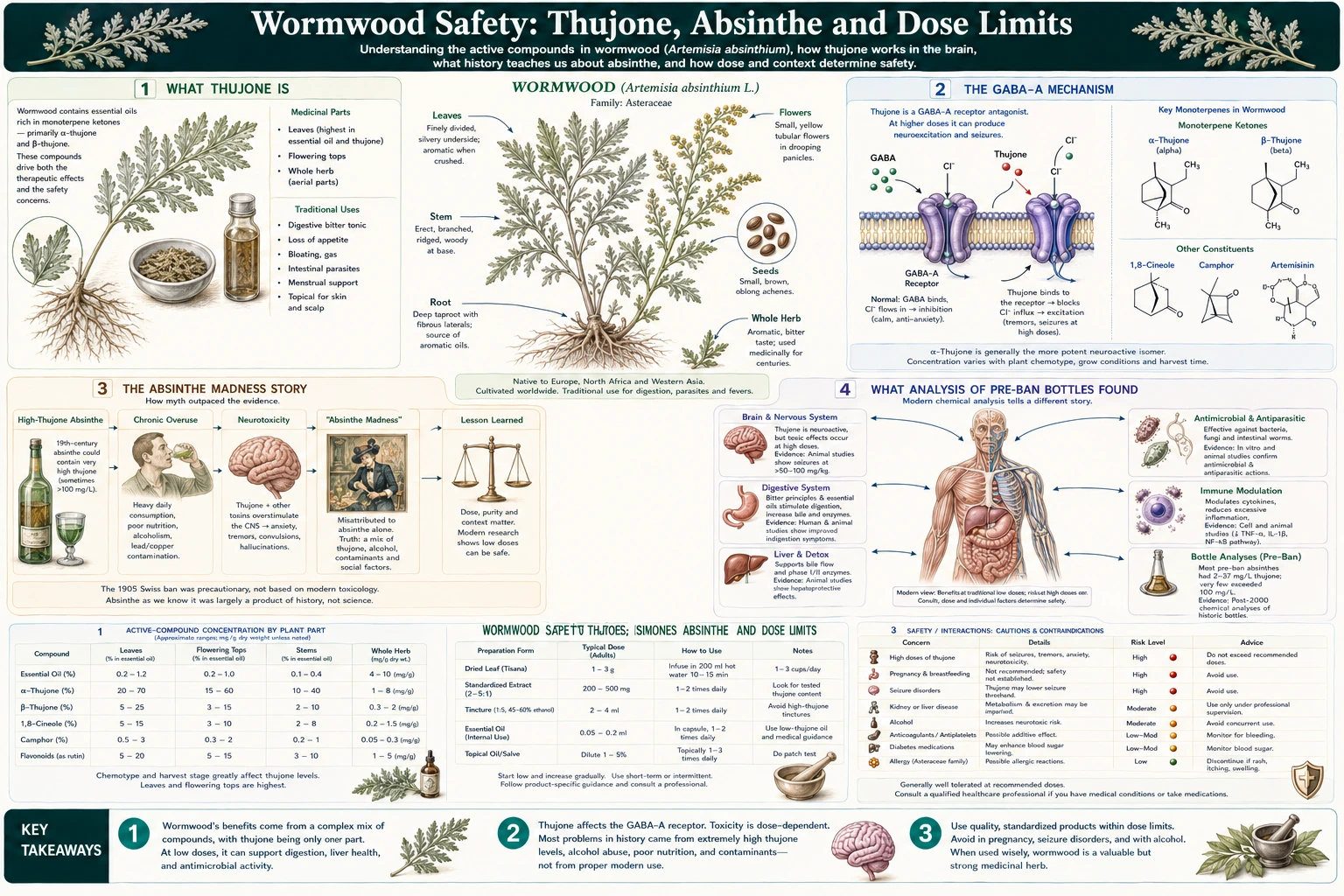
Almost everything written about thujone falls into one of two errors. The older error is the absinthe legend: that a green liqueur flavoured with wormwood drove nineteenth-century Europe mad, caused hallucinations, and made men murder their families. The newer error is the debunking overshoot: that thujone was exonerated, the whole thing was moral panic, and wormwood is therefore harmless.
Neither is right, and the interesting part is that both halves of the truth are solid. Thujone is a genuine neurotoxin — a gamma-aminobutyric acid-A receptor antagonist and a convulsant in quantity, with a real body count in the form of essential-oil poisonings. And the absinthe hysteria was not caused by it — the historical harm was overwhelmingly a spirit at about 45 to 72 per cent alcohol by volume, depending on grade, drunk in quantity, sometimes adulterated with genuinely poisonous colourants, and chemical analysis of surviving pre-ban bottles found thujone at levels far below what the legend required.
This page gives both halves, then the safety facts that follow from them: the legal limits, the conditions in which the risk is clearest, and the essential-oil poisonings, the one danger with no exception in the record.
Table of Contents
- What Thujone Is
- The Gamma-Aminobutyric Acid-A Mechanism
- The Absinthe Madness Story
- What Analysis of Pre-Ban Bottles Found
- The Real Culprit: Alcohol and Adulterants
- The Honest Two-Sided Version
- The Essential Oil: The Poisoning Record
- EU and US Thujone Limits
- Contraindications
- Drug Interactions
- Warning Signs and Emergencies
- How Traditional Use Keeps Exposure Low
- Key Research Papers
- Connections
- Featured Videos
What Thujone Is
Thujone is a monoterpene ketone, and it comes in two stereoisomeric forms usually written as alpha-thujone and beta-thujone (equivalently cis- and trans-thujone). It is volatile and aromatic, which means it concentrates in the essential oil when a plant is steam-distilled, and it is present at far lower concentration in a water or alcohol extract of the whole herb.
It is not unique to wormwood. Thujone is named after Thuja occidentalis, northern white cedar, and occurs in common sage, tansy, mugwort and other plants. Ordinary culinary sage contains thujone, which is a useful calibration: the compound is not so dangerous that its presence makes a plant untouchable. What matters, as always, is concentration and quantity.
The single most important practical fact about wormwood chemistry is the split between fractions:
- Bitter fraction — absinthin and related sesquiterpene lactones. Non-volatile, water- and alcohol-soluble, responsible for the bitterness and for the intended digestive effect.
- Volatile fraction — the essential oil, containing thujone. Responsible for the aroma and for the toxicity.
Distillation separates them and concentrates the dangerous one. That is why a few drops of dilute bitters and a spoonful of wormwood essential oil are not versions of the same thing at different strengths — they are different substances in practical terms. Thujone content also varies enormously between plant sources, chemotypes and harvests; Juteau and colleagues documented that variation between Croatian and French material in Planta Medica, 2003, which is why no home preparation can be assumed to match any published dose.
The Gamma-Aminobutyric Acid-A Mechanism
The mechanism was established in a landmark paper: Höld and colleagues, "Alpha-thujone (the active component of absinthe): gamma-aminobutyric acid type A receptor modulation and metabolic detoxification," PNAS, 2000. Evidence tier: preliminary (receptor and rodent work) — but definitive as mechanism, and the reason every dose limit exists.
Gamma-aminobutyric acid (GABA) is the brain's principal inhibitory neurotransmitter, and the gamma-aminobutyric acid-A receptor is its main fast target — the brake pedal. Drugs that enhance gamma-aminobutyric acid-A signalling are sedatives: benzodiazepines, barbiturates, alcohol itself. Alpha-thujone does the opposite. It acts as an antagonist at the gamma-aminobutyric acid-A receptor, blocking inhibition. Remove the brakes and neurons fire too readily; enough of that and you get tremor, then myoclonus, then generalized convulsions. This places thujone in the same broad functional class as classic convulsant poisons such as picrotoxin.
Two findings from the same work are equally important and usually left out:
- Alpha-thujone is the more potent isomer, and the convulsant effect in rodents appears at doses in the tens of milligrams per kilogram — large in comparison with what any drink delivers, small in comparison with what a spoonful of concentrated oil delivers.
- Thujone is rapidly detoxified. Cytochrome P450 enzymes hydroxylate it quickly to much less active metabolites. This is why low exposures do very little: the compound is cleared before it accumulates. It is also why rate matters — a single large bolus can outrun the clearance that handles a trickle without difficulty.
That pharmacology explains the whole shape of the story. A glass of vermouth is a trickle. A tablespoon of essential oil is a bolus.
The Absinthe Madness Story
Absinthe appeared as a medicinal tonic in the late eighteenth century, became a mass drink in nineteenth-century France, and by the 1860s was being consumed on an industrial scale — the heure verte, the green hour, was a daily social ritual. It was cheap, extremely strong, and diluted with iced water at the table.
By mid-century a supposed distinct disease had been named: absinthism. It was described as different from and worse than ordinary alcoholism — hallucinations, convulsions, sudden violence, moral degeneration, madness. The French psychiatrist Valentin Magnan supplied the apparently decisive experiment: he exposed animals to wormwood oil and saw them convulse, whereas animals given alcohol became merely intoxicated. The conclusion drawn was that absinthe contained a specific poison beyond alcohol.
Two things were wrong with that inference, and they are the same two things wrong with a great deal of toxicology reporting today. First, he tested concentrated wormwood oil, not the drink — an exposure route and dose unrelated to drinking absinthe. Second, the alcohol comparison was not equivalent: absinthe was far stronger than wine, so absinthe drinkers were consuming far more ethanol.
The panic had powerful allies. The French wine industry, ruined by phylloxera and then recovering into a market absinthe had taken, was not a neutral party. Temperance movements had an obvious interest. And the 1905 case of Jean Lanfray — a Swiss labourer who killed his wife and children and whose crime was blamed on absinthe, though the day's drinking had included wine, brandy, cognac and crème de menthe alongside two glasses of absinthe — became the emblematic scandal that drove the Swiss ban. Bans followed across much of Europe and in the United States in the early twentieth century.
What Analysis of Pre-Ban Bottles Found
The myth became testable when researchers obtained and analysed sealed bottles of genuine pre-ban absinthe. Lachenmeier and colleagues published "Chemical composition of vintage preban absinthe with special reference to thujone, fenchone, pinocamphone, methanol, copper, and antimony concentrations" in the Journal of Agricultural and Food Chemistry in 2008. Evidence tier: direct chemical measurement of historical product.
The findings were unambiguous and deflating for the legend. Thujone in historical absinthe was present at levels on the order of tens of milligrams per litre — not the extreme concentrations the "absinthism" theory needed, and broadly comparable to what modern regulated absinthe is permitted to contain. Nor did the analysis find the other suspected culprits in dangerous quantities: methanol, copper and antimony — the latter two associated with adulterants used to fake absinthe's colour and its cloudy louche — were not present at concentrations that would explain a mass neurological syndrome in the bottles tested.
The companion papers drew the conclusion out. Lachenmeier and colleagues asked directly, in "Thujone — cause of absinthism?" (Forensic Science International, 2006), and answered largely no. Padosch, Lachenmeier and Kröner then made the argument in full in "Absinthism: a fictitious 19th century syndrome with present impact" (Substance Abuse Treatment, Prevention, and Policy, 2006): absinthism as a disease entity distinct from alcoholism does not hold up, and the symptoms attributed to it are those of chronic heavy alcohol use.
There is also a controlled human experiment worth knowing about: Dettling and colleagues, "Absinthe: attention performance and mood under the influence of thujone," Journal of Studies on Alcohol, 2004, gave 25 healthy volunteers three drinks with the same amount of alcohol but different amounts of thujone, and measured attention and mood. Randomized clinical trial (small, acute). Only the high-thujone drink impaired attention — alcohol alone, or alcohol with a low thujone concentration, did not — and high thujone temporarily counteracted alcohol's anxiety-relieving effect. Nothing resembling hallucination or madness was described.
The Real Culprit: Alcohol and Adulterants
Period recipe books, as Padosch and colleagues summarise them, put absinthe at about 45 to 72 per cent alcohol by volume depending on grade — about 45–50 per cent for absinthe ordinaire, 50–68 for demi-fine and 68–72 for absinthe Suisse — stronger than whisky and several times the strength of wine. It was drunk daily, often in multiple servings, in a culture that had normalized it as an aperitif. Whatever else was in the bottle, that is a formula for severe chronic alcohol harm.
Everything attributed to "absinthism" is documented in chronic heavy alcohol use: seizures — particularly withdrawal seizures, which are common, dangerous and were surely being counted as thujone effects; hallucinations, including alcoholic hallucinosis and delirium tremens; cognitive decline; peripheral neuropathy from thiamine deficiency; liver disease; and violence. See Alcohol Use Disorder and Alcoholic Hepatitis.
The adulterant story is a genuine secondary factor rather than a myth. Cheap absinthe was widely faked. Copper salts and aniline dyes were used to produce the green colour, antimony trichloride to force the louche. Those are real poisons and there is no doubt they harmed people who drank counterfeit product — the 2008 analysis specifically looked for them. The point is narrower than the legend: the harm came from what was added to bad absinthe, not from the wormwood in good absinthe.
Modern absinthe is legal again in the European Union and the United States, produced under thujone limits, and is not associated with any distinct syndrome. It is simply a very strong spirit, with a very strong spirit's risks.
The Honest Two-Sided Version
Put the two findings side by side, because keeping both is the whole point:
- Thujone is genuinely neurotoxic in quantity. The gamma-aminobutyric acid-A antagonism is established, the convulsant effect is real, and people have been hospitalized and seriously injured by ingesting concentrated wormwood preparations. This is not a hypothetical risk drawn from a mouse study — there are human case reports.
- The absinthe epidemic was not thujone poisoning. The concentrations in the drink were too low, the syndrome was indistinguishable from alcoholism, the experiments that founded the theory used the concentrated oil rather than the beverage, and commercial and political interests amplified the panic.
The failure mode of most writing on this topic is to pick one of these and discard the other. An article that only tells you thujone causes madness will frighten you away from a glass of vermouth. An article that only tells you the absinthe scare was a hoax may leave you comfortable buying wormwood essential oil, which is how people end up in hospital. Both halves are true.
The Essential Oil: The Poisoning Record
This is the one point on this page with no exception in the record: swallowed wormwood essential oil has caused seizures and acute kidney failure, as the case report below describes.
The reference case is Weisbord, Soule and Kimmel, "Poison on line — acute renal failure caused by oil of wormwood purchased through the Internet," New England Journal of Medicine, 1997. Evidence tier: human, non-randomized (case report). A young man swallowed wormwood essential oil bought online in the belief that it was absinthe. He became agitated and had a seizure, and went on to develop acute kidney injury with muscle breakdown — rhabdomyolysis, the predictable consequence of sustained convulsive muscle activity. The title carries the wider lesson: the oil is freely purchasable and nothing about the transaction warns the buyer.
Older work on related oils points the same way. Millet and colleagues, in a clinical and experimental study published in Clinical Toxicology in 1981, described eight human poisonings from commercial essences of sage, hyssop, thuja and cedar, with tonic-clonic convulsions as the major symptom; their rat experiments tied the oils' toxicity to the ketones they contain — thujone in thuja, cedar and Dalmatian sage oils, camphor in sage oil, and pinocamphone in hyssop oil.
Three corollaries:
- "Absinthe essence," "absinthe extract" and "wormwood oil" are not absinthe. They are concentrates. Absinthe is a diluted, regulated beverage.
- Essential oil in a drink or a capsule is still the concentrate. No home dilution method is known to make it safe, because the thujone concentration of any given bottle of oil is unknown to the person holding it.
- Aromatic use is a different question from ingestion, but wormwood oil is still not a beginner's oil: a child who reaches the bottle faces the same swallowing danger, and aromatherapy practice does not apply it undiluted to skin.
EU and US Thujone Limits
Both jurisdictions permit wormwood in drinks and cap thujone. The figures below are the headline limits; food law is amended over time, and the current text of each instrument is the legal reference.
- European Union. Thujone is a restricted substance under Regulation (EC) No 1334/2008 on flavourings. Annex III of the regulation, as adopted, bars thujone from being added to food as such and sets three maximum levels for it: 35 mg/kg for alcoholic beverages produced from Artemisia species — the absinthe and bitters category — 10 mg/kg for other alcoholic beverages, and 0.5 mg/kg for non-alcoholic beverages produced from Artemisia species. The European Food Safety Authority has separately assessed thujone exposure from flavourings.
- United States. Under 21 CFR 172.510, wormwood (Artemisia species) may be used as a natural flavouring in food, alcoholic beverages included, provided the finished food is "thujone-free", which in practice means below the detection threshold of the official method — conventionally cited as 10 mg/L (10 ppm). Compliance is administered by the Alcohol and Tobacco Tax and Trade Bureau, which is why American absinthe returned to legal sale in 2007 without any change to the underlying thujone rule.
Two things follow that readers routinely get wrong.
First, these limits govern wormwood used to flavour food and drink — the EU figures cover beverages, the US rule any finished food — not herbal supplements. A dietary supplement or dried herb sold as a botanical is not regulated to a thujone specification in the way a spirit is. A capsule can therefore lawfully deliver more thujone than a glass of legal absinthe. The regulated product is the safer one, which is the opposite of most people's intuition.
Second, modern absinthe is not "watered down" relative to the historical drink. The 2008 analysis of pre-ban bottles found thujone in the same general range that current law allows. The banned drink and the legal drink are chemically similar; what has changed is the story told about them.
Contraindications
These are not generic supplement disclaimers. Wormwood has a narrower window than nearly anything else in the herbal cabinet.
Where the risk is clearest
- Pregnancy. Wormwood's documented traditional use as an emmenagogue (to bring on menstruation) and abortifacient is the core of the concern, not a footnote to it: the tradition claims exactly the effect that ends a pregnancy. Add thujone's central-nervous-system activity and the absence of any human safety data, and no safe use in pregnancy is known. The same concern applies while trying to conceive.
- Breastfeeding. Thujone and bitter constituents can pass into milk; no safety data exist; infants clear compounds less efficiently than adults.
- Epilepsy or any seizure disorder. Thujone antagonizes gamma-aminobutyric acid-A and lowers the seizure threshold — taking a convulsant when you already have a lowered threshold is the mechanism of harm stated plainly. See Epilepsy. This extends to a history of febrile seizures, head injury with post-traumatic seizures, and anyone at risk of alcohol-withdrawal seizures.
- The essential oil, internally, by anyone. See above.
- Children. No established paediatric dose and no margin for error.
Strong cautions
- Kidney disease. Documented acute kidney injury from wormwood oil; existing impairment removes what reserve you have.
- Liver disease. Thujone clearance depends on hepatic cytochrome P450 activity, so impaired liver function plausibly means higher and longer exposure — and most tinctures are alcohol-based. Yellowing of the skin or eyes (jaundice), dark urine, pale stools or pain under the right ribs are signs of liver injury that hospitals treat as urgent; liver function tests are the blood tests that measure it.
- Asteraceae (daisy-family) allergy. Cross-reactivity with ragweed, chamomile, marigold, chrysanthemum and feverfew. Artemisia pollen is itself a significant aeroallergen.
- Reflux, gastritis or peptic ulcer. Stimulating acid secretion is the wrong direction.
- Gallstones or bile-duct obstruction. Bitters promote gallbladder contraction.
- Recovery from alcohol dependence. Alcohol-based tinctures, plus the amaro and absinthe association, are a relapse concern regardless of thujone.
- Prolonged or high-dose use by anyone. Wormwood is traditionally a short-course herb: weeks, not months. Even the Crohn's trials described on the Crohn's page ran for weeks and cannot speak to long-term safety at grams per day.
Drug Interactions
Formal interaction studies for wormwood are scarce, so most of what follows is inferred from the mechanism. The list below is a set of mechanism-based concerns rather than a settled table.
- Anticonvulsants (phenytoin, carbamazepine, valproate, levetiracetam and others). A gamma-aminobutyric acid-A antagonist works against drugs whose job is to raise the seizure threshold. Pharmacological antagonism is the concern; loss of seizure control is the consequence.
- Anything else that lowers seizure threshold — bupropion, tramadol, some antipsychotics and antidepressants, fluoroquinolone antibiotics, theophylline. Risks stack.
- Sedatives and alcohol. Opposing actions at the same receptor, unpredictable net effect, and tinctures deliver ethanol themselves.
- Drugs sharing cytochrome P450 pathways. Thujone is cleared by P450 enzymes, so competition in either direction is plausible — relevant to anyone on medication with a narrow therapeutic index.
- Immunomodulators and hepatotoxic drugs. Particularly relevant in inflammatory bowel disease, where thiopurines or methotrexate already require liver monitoring; an added herb makes an abnormal result harder to attribute.
- Acid-suppressing drugs. Not dangerous, but working against each other if you are taking one to reduce acid and a bitter to increase it.
- An undisclosed herb slows diagnosis. When a seizure, a rash or abnormal liver enzymes appear and the treating clinician does not know wormwood is being taken, the cause takes longer to find.
Warning Signs and Emergencies
Symptoms of excessive wormwood or thujone exposure, roughly in order of escalation:
- Nausea, vomiting, abdominal pain, diarrhoea.
- Dizziness, headache, restlessness, agitation, insomnia.
- Tremor, muscle twitching, jerking movements.
- Seizure — the characteristic serious event.
- Confusion or loss of consciousness.
- Dark or reduced urine output, and severe muscle pain, which together suggest rhabdomyolysis with kidney injury.
Emergency facts. Twitching, agitation and unusual restlessness are the earliest neurological signs that thujone exposure has gone too far. A suspected significant ingestion, especially of essential oil, is a poisoning emergency that emergency services and poison control centres handle straight away, before any seizure develops; making the person vomit is not part of standard poisoning first aid. The bottle or packaging tells clinicians the concentration and the plant species, which they cannot otherwise guess. A seizure is an emergency in itself, and a person who has had one needs medical assessment afterwards, however well they seem.
How Traditional Use Keeps Exposure Low
Traditional bitters practice, read against the safety record above, comes down to these points:
- The Latin name. Artemisia absinthium is the bitter; Artemisia annua is a different plant used for different purposes. See Artemisia annua.
- Known composition. A commercial compound bitters or tincture whose maker states its composition differs from home-harvested material, whose chemotype and thujone content are unknown.
- Drops, before meals. Traditional bitters are taken in drops before meals; the bitter taste is the mechanism. A larger amount adds thujone, not benefit.
- Short courses. Traditional use runs from days to a couple of weeks, not as a daily supplement.
- The essential oil is the poisoning risk. Diluted, in a capsule or as "just a drop," it is still the concentrate.
- The highest-risk groups above — pregnancy, breastfeeding, children, and any personal or family seizure history — are where the danger is clearest.
- Seizure medicines. Thujone works against anticonvulsants, and its effect adds to that of any other drug that lowers the seizure threshold (see Drug Interactions above).
- The first neurological symptom — twitching, agitation, restlessness — is the warning sign that exposure has gone too far.
- Gentler bitters exist. Artichoke, dandelion and blessed thistle deliver the bitter reflex without a convulsant attached.
Key Research Papers
Linked as PubMed searches by design; titles, journals and years given for verification.
- Höld and colleagues, "Alpha-thujone (the active component of absinthe): gamma-aminobutyric acid type A receptor modulation and metabolic detoxification," PNAS, 2000 — the mechanism paper: GABA-A antagonism plus rapid P450 detoxification. Preliminary (receptor and rodent), definitive on mechanism. — PubMed PMID: 10725394
- Lachenmeier and colleagues, "Chemical composition of vintage preban absinthe with special reference to thujone, fenchone, pinocamphone, methanol, copper, and antimony concentrations," Journal of Agricultural and Food Chemistry, 2008 — direct measurement of surviving historical bottles. — PubMed PMID: 18419128
- Lachenmeier and colleagues, "Thujone — cause of absinthism?," Forensic Science International, 2006 — asks the question directly and answers it largely in the negative. — Search PubMed
- Padosch, Lachenmeier and Kröner, "Absinthism: a fictitious 19th century syndrome with present impact," Substance Abuse Treatment, Prevention, and Policy, 2006 — the full historical and toxicological reappraisal. — PubMed PMID: 16722551
- Dettling and colleagues, "Absinthe: attention performance and mood under the influence of thujone," Journal of Studies on Alcohol, 2004 — controlled human exposure in 25 volunteers; attention was impaired only with high thujone, which also temporarily counteracted alcohol's anxiety-relieving effect. Randomized clinical trial (small, acute). — PubMed PMID: 15536765
- Lachenmeier, Walch, Padosch and Kröner, review of absinthe, Critical Reviews in Food Science and Nutrition, 2006 — the history, chemistry and regulation together. — Search PubMed
- Weisbord, Soule and Kimmel, "Poison on line — acute renal failure caused by oil of wormwood purchased through the Internet," New England Journal of Medicine, 1997 — human, non-randomized (case report); seizure and acute kidney injury after ingesting the oil. — PubMed PMID: 9297113
- Millet, Jouglard, Steinmetz, Tognetti, Joanny and Arditti, "Toxicity of some essential plant oils. Clinical and experimental study," Clinical Toxicology, 1981 — eight human poisonings from commercial sage, hyssop, thuja and cedar essences, with convulsions the major symptom; rat work tied the toxicity to the oils' ketones, thujone among them. — PubMed PMID: 7333081
- Lachenmeier, "Wormwood (Artemisia absinthium L.) — a curious plant with both neurotoxic and neuroprotective properties?," Journal of Ethnopharmacology, 2010 — the two-sided reading, by the researcher who did most of the debunking. — PubMed PMID: 20542104
- Juteau and colleagues, "Composition and antimicrobial activity of the essential oil of Artemisia absinthium from Croatia and France," Planta Medica, 2003 — documents how far thujone content varies by origin, which is why no home dose can be assumed safe. — PubMed PMID: 12624823
- PubMed topic search: thujone safety assessment and dietary exposure from flavourings — the regulatory-toxicology literature behind the EU limits. — Search PubMed
- PubMed topic search: Artemisia absinthium seizure and herbal toxicity case reports — the clinical record of real-world harm, which is small but not empty. — Search PubMed
- Szopa and colleagues, "Artemisia absinthium L. — importance in the history of medicine, the latest advances in phytochemistry…," Plants, 2020 — chemistry, including how the bitter and volatile fractions differ. Review. — PubMed PMID: 32825178
Connections
- All Herbs
- Wormwood — the main overview page.
- Wormwood Benefits Hub — all four deep dives.
- Wormwood for Digestion — the low-dose use these limits permit.
- Wormwood for Crohn's Disease — where a much higher dose was studied, briefly.
- Wormwood for Parasites — why "cleanse" dosing is the risky pattern.
- Artemisia annua (Sweet Wormwood) — the other plant, low in thujone.
- Mugwort — another thujone-bearing Artemisia, same pregnancy caution.
- Sage — culinary herb whose oil is thujone-rich; useful calibration.
- Chamomile — daisy-family relative; shares the allergy caution.
- Artichoke — a bitter with no convulsant attached.
- Dandelion — gentle everyday bitter.
- Blessed Thistle — classic bitter tonic alternative.
- Epilepsy — the absolute contraindication explained.
- Neurology — nervous-system conditions overview.
- Alcohol Use Disorder — what "absinthism" actually was.
- Alcoholic Hepatitis — the organ damage the legend misattributed.
- Liver Function Tests — monitoring during herbal use.
- Toxins — how the site handles dose-dependent poisons generally.
Educational information only, not medical advice, and not a dosing guide. Wormwood contains thujone, a convulsant, and the margin between a traditional bitters dose and a harmful dose is narrower than for almost any other common herb. Swallowed wormwood essential oil has caused seizures and kidney failure. The risk is clearest in pregnancy, while trying to conceive, while breastfeeding, in children, and with epilepsy or any seizure disorder; the research raises further concerns with kidney or liver disease, daisy-family allergy, and any medication that lowers the seizure threshold. Twitching, agitation, confusion or a seizure after taking wormwood are emergency signs; a suspected essential-oil ingestion is a poisoning emergency for emergency services or poison control, and the container tells them what was taken.