⚠ Evidence warning: Clinical trials or other evidence do not support the claim that a lower 1,8-cineole content gives better skin tolerability without losing antimicrobial effect. This page keeps it as a report of what people, websites or other media say.
Tea Tree — Benefits Deep Dive
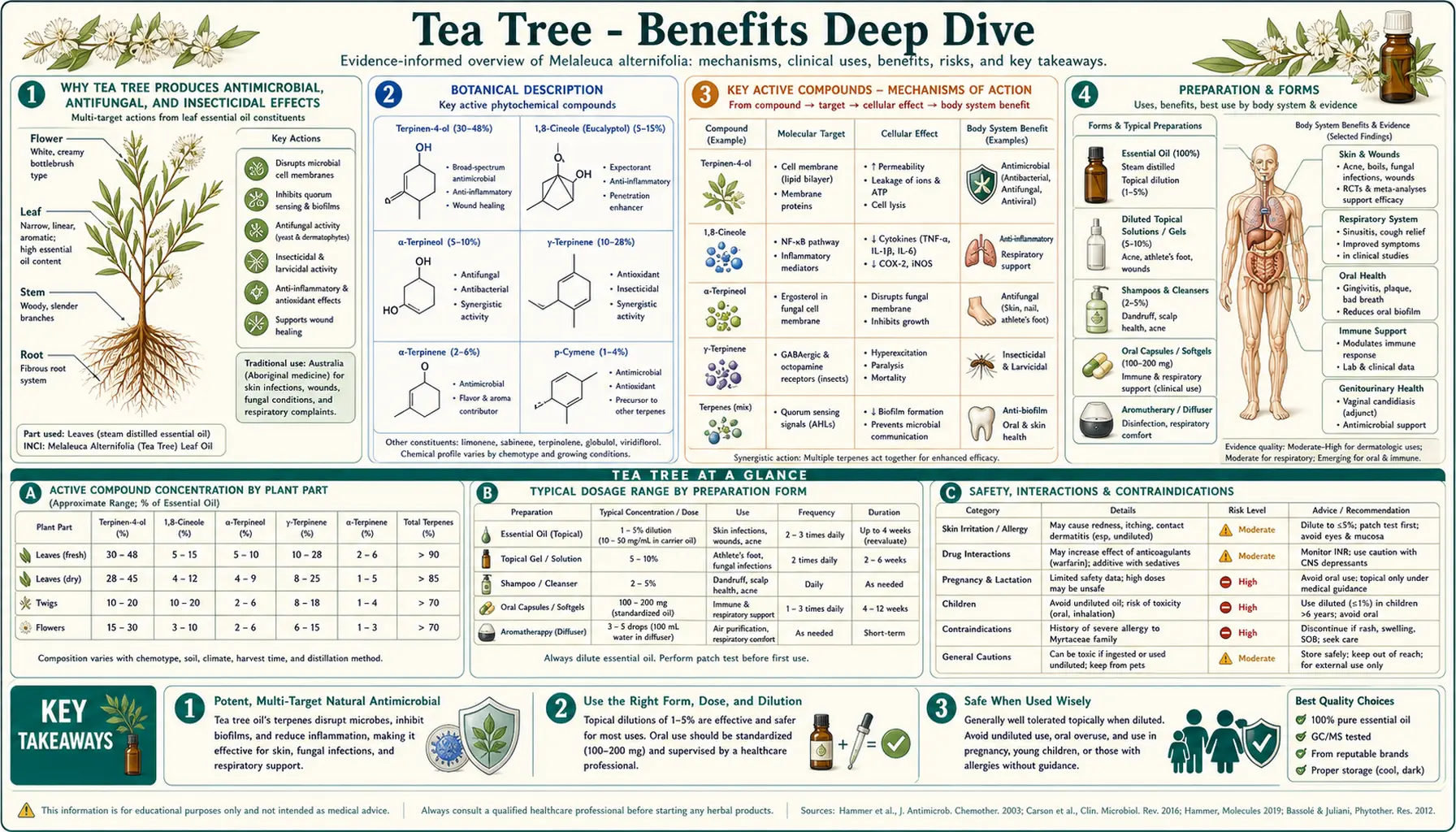
Tea tree oil is the steam-distilled essential oil of Melaleuca alternifolia, a small paperbark tree native to the swampy northeast coast of New South Wales, Australia. Despite the common name, the plant has no botanical or chemical relationship to the tea plant (Camellia sinensis) — the name comes from 18th-century British sailors who brewed a tea-like infusion from the leaves. The Aboriginal Bundjalung people of northern New South Wales used crushed leaves topically for wounds, skin infections, and insect bites for thousands of years before European contact. The oil's principal antimicrobial compound is terpinen-4-ol (35–48% of the oil under the international standard ISO 4730:2017), supported by alpha-terpineol, 1,8-cineole, and other monoterpenes. Modern commercial production is centered in northern New South Wales, with global annual output of approximately 600 tonnes. Four benefit pages below cover the conditions where tea tree oil has the largest body of peer-reviewed clinical evidence — antimicrobial activity against methicillin-resistant Staphylococcus aureus (MRSA) and hospital-acquired pathogens, acne, fungal infections including onychomycosis and tinea pedis, and head lice / scabies infestation.
Deep-Dive Articles
Antimicrobial & Methicillin-Resistant Staphylococcus Aureus
The Carson, Hammer & Riley 2006 Clinical Microbiology Reviews landmark review documenting in vitro activity against >60 bacterial and fungal species, the Dryden 2004 methicillin-resistant Staphylococcus aureus decolonization trial (110 hospital patients used a 5-day tea tree regimen of 10% tea tree cream in the nose and a 5% tea tree body wash; 114 used a standard regimen of 2% mupirocin nasal ointment, chlorhexidine soap and silver sulfadiazine cream; 41% versus 49% were cleared, not a significant difference; mupirocin cleared the nose better, 78% versus 47%, while tea tree cleared skin sites and skin lesions better), the terpinen-4-ol membrane-disruption mechanism, hospital infection control protocols, the standardized 5% topical concentration, and why bacteria rarely develop resistance.
Read the deep dive →Acne
The pivotal Bassett, Pannowitz & Barnetson 1990 Medical Journal of Australia single-blind randomized trial of 5% tea tree gel vs 5% benzoyl peroxide lotion in 124 patients with mild to moderate acne — both treatments reduced inflamed and non-inflamed lesions (open and closed comedones); tea tree acted more slowly, and patients using it had fewer side effects. Mechanism via Cutibacterium acnes membrane disruption plus anti-inflammatory cytokine modulation, commercial 5% tea tree gels, and how it compares to retinoids.
Read the deep dive →Antifungal & Nail Fungus
The Buck, Nidorf & Addino 1994 Journal of Family Practice onychomycosis trial of 100% tea tree oil vs 1% clotrimazole solution, athlete's foot (tinea pedis) trials, the slow-but-effective profile of topical antifungals for nail infection, why 6–12 months of daily application is realistic, and how tea tree compares to oral terbinafine.
Read the deep dive →Head Lice & Scabies
The Barker & Altman 2010 randomized, assessor-blind trial in 123 people with live head lice (louse-free one day after the last treatment: 41 of 42, 97.6%, with a tea tree and lavender oil product; 40 of 41, 97.6%, with a “suffocation” product; 10 of 40, 25.0%, with a pyrethrins and piperonyl butoxide product), the separate 2011 ex vivo study of the same products on lice eggs, the scabies pilot data using 5% tea tree, terpene insecticidal mechanism against arthropod nervous systems, and the relevance for permethrin-resistant infestations now common worldwide.
Read the deep dive →Table of Contents
- Deep-Dive Articles
- Why Tea Tree Produces Antimicrobial, Antifungal, and Insecticidal Effects
- Research Papers: Antimicrobial & Methicillin-Resistant Staphylococcus Aureus
- Research Papers: Acne
- Research Papers: Antifungal & Nail Fungus
- Research Papers: Head Lice & Scabies
- Research Papers: Cross-Cutting (Chemistry, Safety, Toxicity)
- External Authoritative Resources
- Connections
- Featured Videos
Why Tea Tree Produces Antimicrobial, Antifungal, and Insecticidal Effects
Tea tree oil is a complex mixture of approximately 100 distinct monoterpenes, sesquiterpenes, and their associated alcohols. The international standard ISO 4730 specifies the principal components and minimum/maximum percentages for an oil that can legally be labeled "tea tree oil" — an attempt to prevent the dilution and adulteration that plagued the early commercial industry. The three components that account for most of the biological activity are:
- Terpinen-4-ol (35–48%) — the principal antimicrobial constituent and the most-studied component. Terpinen-4-ol is a small lipophilic alcohol that intercalates into bacterial and fungal cell membranes, increasing membrane fluidity and disrupting the proton-motive force that drives adenosine triphosphate (ATP) synthesis. It also inhibits respiration and depolarizes the membrane potential. Because the mechanism is purely biophysical — membrane disruption rather than enzyme inhibition — resistance is rare and difficult to evolve. Strains of methicillin-resistant Staphylococcus aureus, vancomycin-resistant Enterococcus (VRE), and multi-drug-resistant Pseudomonas aeruginosa remain susceptible. See the antimicrobial deep-dive for the full Carson 2006 review and methicillin-resistant Staphylococcus aureus decolonization data.
- Alpha-terpineol (2–5%) — structurally similar to terpinen-4-ol with comparable antimicrobial activity but slightly lower potency on a weight basis. Contributes to the oil's overall activity profile and to the characteristic camphor-like aroma.
- 1,8-cineole (eucalyptol, traces to 10%) — the same compound that is the principal constituent of eucalyptus oil. Has its own antimicrobial activity. For many years it was believed to be the main skin irritant in tea tree oil, which is why producers tried to keep its level low; the Carson, Hammer & Riley 2006 review reports that more recent data do not show 1,8-cineole to be an irritant, and that allergic reactions come mainly from oxidation products in aged or badly stored oil (see below). The current ISO 4730:2017 standard allows from traces up to 10%. The lower the 1,8-cineole content (down to about 3% in premium oils), the better the topical tolerability without sacrificing antimicrobial effect.
This three-compound mechanism explains why tea tree has activity against such a broad target spectrum — gram-positive bacteria (including methicillin-resistant Staphylococcus aureus), gram-negative bacteria, yeasts (Candida albicans), filamentous fungi (Trichophyton species causing nail and skin infection), enveloped viruses (HSV-1, influenza), and arthropods (Pediculus humanus capitis head lice, Sarcoptes scabiei scabies mites). Cell membranes are the universal target, and almost every infectious agent has a membrane that monoterpenes can disrupt.
The therapeutic complications are also chemistry-driven. Oxidized tea tree oil — oil that has been exposed to air, light, or heat for prolonged periods — develops elevated concentrations of ascaridole, 1,2,4-trihydroxymenthane, and peroxides that are substantially more sensitizing than the parent oil. In plain words: allergic skin reactions to tea tree oil come mainly from these breakdown products in old or badly stored oil, not from 1,8-cineole. In a 1999 guinea-pig study (Hausen and colleagues), fresh oil was a very weak sensitizer and oxidized oil was 3 times stronger; oil kept in open or closed bottles oxidized in light within a few days to several months, and its peroxides rose from under 50 to over 500 parts per million in 4 days. Light, air and warmth drive this change, which is why amber glass and cool, dark storage are described, and practitioners describe using oil within about 12 months of opening. The other safety finding — covered in detail on each sub-article — is that tea tree oil taken by mouth has caused poisoning. A 4-year-old boy who swallowed a small amount became unsteady within 30 minutes, then unresponsive, and needed a breathing tube (Morris 2003); a 23-month-old who swallowed less than 10 mL of undiluted oil became confused and unable to walk (Jacobs & Hornfeldt 1994). Reported effects of swallowing it include central nervous system depression, ataxia (loss of coordination), coma, and in severe cases respiratory failure. No therapeutic use involves swallowing tea tree oil; the trials applied it to skin, scalp and nails, or used it as a mouth rinse that is spat out.
Research Papers: Antimicrobial & Methicillin-Resistant Staphylococcus Aureus
- Carson CF, Hammer KA, Riley TV (2006). Melaleuca alternifolia (Tea Tree) oil: a review of antimicrobial and other medicinal properties. Clin Microbiol Rev 19(1):50-62 — the landmark review — PubMed PMID: 16418522
- Carson CF, Mee BJ, Riley TV (2002). Mechanism of action of Melaleuca alternifolia (tea tree) oil on Staphylococcus aureus: membrane disruption — PubMed: Membrane mechanism
- Dryden MS, Dailly S, Crouch M (2004). A randomized, controlled trial of tea tree topical preparations versus a standard topical regimen for the clearance of MRSA colonization. J Hosp Infect 56(4):283-6 — PubMed PMID: 15066738
- Caelli M et al. (2000). Tea tree oil as an alternative topical decolonization agent for MRSA — PubMed: Caelli MRSA
- Edmondson M, Newall N, Carville K, Smith J, Riley TV, Carson CF (2011). Uncontrolled, open-label, pilot study of tea tree (Melaleuca alternifolia) oil solution in the decolonisation of methicillin-resistant Staphylococcus aureus positive wounds and its influence on wound healing. Int Wound J 8(4):375-84 — PubMed PMID: 21564552
- May J et al. (2000). Time-kill studies of tea tree oils on clinical isolates — PubMed: Time-kill kinetics
- Hammer KA, Carson CF, Riley TV (2002). In vitro activity of Melaleuca alternifolia oil against dermatophytes and other filamentous fungi — PubMed: Dermatophyte activity
- Brady A et al. (2006). Tea tree oil inhibits viability and growth of methicillin-resistant Staphylococcus aureus biofilms — PubMed: MRSA biofilms
- Loughlin R et al. (2008). Comparison of the cidal activity of tea tree oil and terpinen-4-ol against clinical bacterial skin isolates — PubMed: Loughlin terpinen-4-ol
- Messager S et al. (2005). Effectiveness of hand-cleansing formulations containing tea tree oil — PubMed: Hand-cleansing
- LaPlante KL (2007). In vitro activity of lysostaphin, mupirocin, and tea tree oil against clinical MRSA isolates — PubMed: vs mupirocin in vitro
- Hammer KA et al. (2008). Frequencies of resistance to tea tree oil and antibiotic resistance — PubMed: Resistance frequencies
Research Papers: Acne
- Bassett IB, Pannowitz DL, Barnetson RS (1990). A comparative study of tea-tree oil versus benzoylperoxide in the treatment of acne. Med J Aust 153(8):455-8 — the landmark randomized trial — PubMed PMID: 2145499
- Enshaieh S et al. (2007). The efficacy of 5% topical tea tree oil gel in mild to moderate acne vulgaris: a randomized, double-blind, placebo-controlled study — PubMed: Enshaieh placebo-controlled
- Malhi HK et al. (2017). Tea tree oil gel for mild to moderate acne — an open-label uncontrolled efficacy trial — PubMed: Malhi gel trial
- Raman A et al. (1995). Antimicrobial effects of tea-tree oil and its major components on Propionibacterium acnes — PubMed: P. acnes activity
- Hammer KA (2015). Treatment of acne with tea tree oil (melaleuca) products: a review of efficacy, tolerability and potential modes of action — PubMed: Hammer 2015 review
- Najafi-Taher R et al. (2018). A topical gel of tea tree oil nanoemulsion containing adapalene versus adapalene marketed gel in patients with acne vulgaris — PubMed: Tea tree + adapalene nanoemulsion
Research Papers: Antifungal & Nail Fungus
- Buck DS, Nidorf DM, Addino JG (1994). Comparison of two topical preparations for the treatment of onychomycosis: Melaleuca alternifolia (tea tree) oil and clotrimazole — the foundational nail fungus trial — PubMed: Buck 1994
- Tong MM, Altman PM, Barnetson RS (1992). Tea tree oil in the treatment of tinea pedis — PubMed: Tong tinea pedis
- Satchell AC et al. (2002). Treatment of interdigital tinea pedis with 25% and 50% tea tree oil solution: a randomized, placebo-controlled, blinded study — PubMed: Satchell tinea pedis
- Jandourek A, Vaishampayan JK, Vazquez JA (1998). Efficacy of melaleuca oral solution for the treatment of fluconazole refractory oral candidiasis in AIDS patients. AIDS 12(9):1033-7 — PubMed PMID: 9662200
- Vazquez JA, Zawawi AA (2002). Efficacy of alcohol-based and alcohol-free melaleuca oral solution for the treatment of fluconazole-refractory oropharyngeal candidiasis in patients with AIDS. HIV Clin Trials 3(5):379-85 — PubMed PMID: 12407487
- Hammer KA, Carson CF, Riley TV (2003). Antifungal activity of the components of Melaleuca alternifolia (tea tree) oil — PubMed: Component antifungal activity
- Mertas A et al. (2015). The influence of tea tree oil on fluconazole activity against fluconazole-resistant Candida albicans — PubMed: Fluconazole synergy
- Nenoff P et al. (1996). Antifungal activity of the essential oil of Melaleuca alternifolia against pathogenic fungi in vitro — PubMed: Nenoff in vitro
- Concha JM, Moore LS, Holloway WJ (1998). 1998 William J. Stickel Bronze Award. Antifungal activity of Melaleuca alternifolia (tea-tree) oil against various pathogenic organisms (laboratory study of 58 clinical isolates). J Am Podiatr Med Assoc 88(10):489-92 — PubMed PMID: 9791953
Research Papers: Head Lice & Scabies
- Barker SC, Altman PM (2010). A randomised, assessor blind, parallel group comparative efficacy trial of three products for the treatment of head lice in children — melaleuca oil and lavender oil, pyrethrins and piperonyl butoxide, and a "suffocation" product. BMC Dermatol 10:6 — PubMed PMID: 20727129
- Barker SC, Altman PM (2011). An ex vivo, assessor blind, randomised, parallel group, comparative efficacy trial of the ovicidal activity of three head lice treatments — PubMed: Barker ovicidal ex vivo
- Walton SF, McKinnon M, Pizzutto S, et al. (2004). Acaricidal activity of Melaleuca alternifolia (tea tree) oil: in vitro sensitivity of Sarcoptes scabiei var hominis to terpinen-4-ol — PubMed: Walton scabies in vitro
- Mills C, Cleary BJ, Gilmer JF, Walsh JJ (2004). Inhibition of acetylcholinesterase by tea tree oil — insecticidal mechanism — PubMed: AChE mechanism
- Williamson EM, Priestley CM, Burgess IF (2007). An investigation and comparison of the bioactivity of selected essential oils on human lice and house dust mites. Fitoterapia 78(7-8):521-5 — PubMed PMID: 17662541
- Thomas J et al. (2016). Head lice: a review of clinical features, treatment, and emerging pediculicide resistance — PubMed: Pediculicide resistance review
- Pasay C, Mounsey K, Stevenson G, Davis R, Arlian L, Morgan M, Vyszenski-Moher D, Andrews K, McCarthy J (2010). Acaricidal activity of eugenol based compounds against scabies mites (permethrin-sensitive and permethrin-resistant mites; tea tree oil not among the oils tested). PLoS One 5(8):e12079 — PubMed PMID: 20711455
- Greive KA, Barnes TM (2018). The efficacy of Australian essential oils for the treatment of head lice — PubMed: Australian essential oils review
Research Papers: Cross-Cutting (Chemistry, Safety, Toxicity)
- ISO 4730:2017 international standard for Melaleuca alternifolia (tea tree) oil chemical composition — PubMed: ISO 4730 chemistry
- Hammer KA, Carson CF, Riley TV, Nielsen JB (2006). A review of the toxicity of Melaleuca alternifolia (tea tree) oil. Food Chem Toxicol 44(5):616-25 — PubMed PMID: 16243420
- Henley DV, Lipson N, Korach KS, Bloch CA (2007). Prepubertal gynecomastia linked to lavender and tea tree oils — NEJM case series — PubMed: Henley NEJM 2007
- Carson CF, Tisserand R, Larkman T (2014). Lack of evidence that essential oils affect puberty (letter commenting on the Henley 2007 case series). Reprod Toxicol 44:50-1 — PubMed PMID: 24556344
- Morris MC, Donoghue A, Markowitz JA, Osterhoudt KC (2003). Ingestion of tea tree oil (Melaleuca oil) by a 4-year-old boy. Pediatr Emerg Care 19(3):169-71 — PubMed PMID: 12813303
- Jacobs MR, Hornfeldt CS (1994). Melaleuca oil poisoning. J Toxicol Clin Toxicol 32(4):461-4 — PubMed PMID: 8057407
- Hausen BM, Reichling J, Harkenthal M (1999). Degradation products of monoterpenes are the sensitizing agents in tea tree oil. Am J Contact Dermat 10(2):68-77 — PubMed PMID: 10357714
- Larson D, Jacob SE (2012). Tea tree oil — allergic contact dermatitis review — PubMed: Contact dermatitis
- Christoffers WA et al. (2014). Patch testing with tea tree oil — oxidized vs unoxidized — PubMed: Oxidation patch test
- Carson CF, Riley TV (1995). Antimicrobial activity of the major components of the essential oil of Melaleuca alternifolia — PubMed: Component activity
External Authoritative Resources
- U.S. National Center for Complementary and Integrative Health (NCCIH) (U.S. National Institutes of Health, NIH) — Tea Tree Oil Fact Sheet — the US National Center for Complementary and Integrative Health overview
- LactMed (U.S. National Institutes of Health) — Tea Tree Oil — the Drugs and Lactation Database entry on tea tree oil and breastfeeding
- ISO 4730:2017 — Essential Oil of Melaleuca, terpinen-4-ol type (tea tree oil) — the international compositional standard
- Australian Tea Tree Industry Association — producer and research consortium
- PubMed — All research on Melaleuca alternifolia / tea tree oil (~2,500+ papers)
Connections
- All Herbs
- Tea Tree (Main Page)
- Tea Tree for Antimicrobial & Methicillin-Resistant Staphylococcus Aureus
- Tea Tree for Acne
- Tea Tree for Antifungal & Nail Fungus
- Tea Tree for Head Lice & Scabies
- Antibacterial Herbs
- Eucalyptus (1,8-cineole)
- Oregano
- Thyme
- Lavender
- Manuka Honey
- Neem
- Olive Leaf
- Acne
- Fungal Infections
- Eczema
- Staphylococcus aureus (Methicillin-Resistant Staphylococcus Aureus)
- Pseudomonas aeruginosa
- Cellulitis
- Silver Nanoparticles
- History