⚠ Evidence warning: Clinical trials or other evidence do not support the claims that undiluted tea tree oil is a credible nail-fungus treatment over 6 to 12 months, and that it treats jock itch and ringworm. This page keeps it as a report of what people, websites or other media say.
Tea Tree Oil for Antifungal Use & Nail Fungus
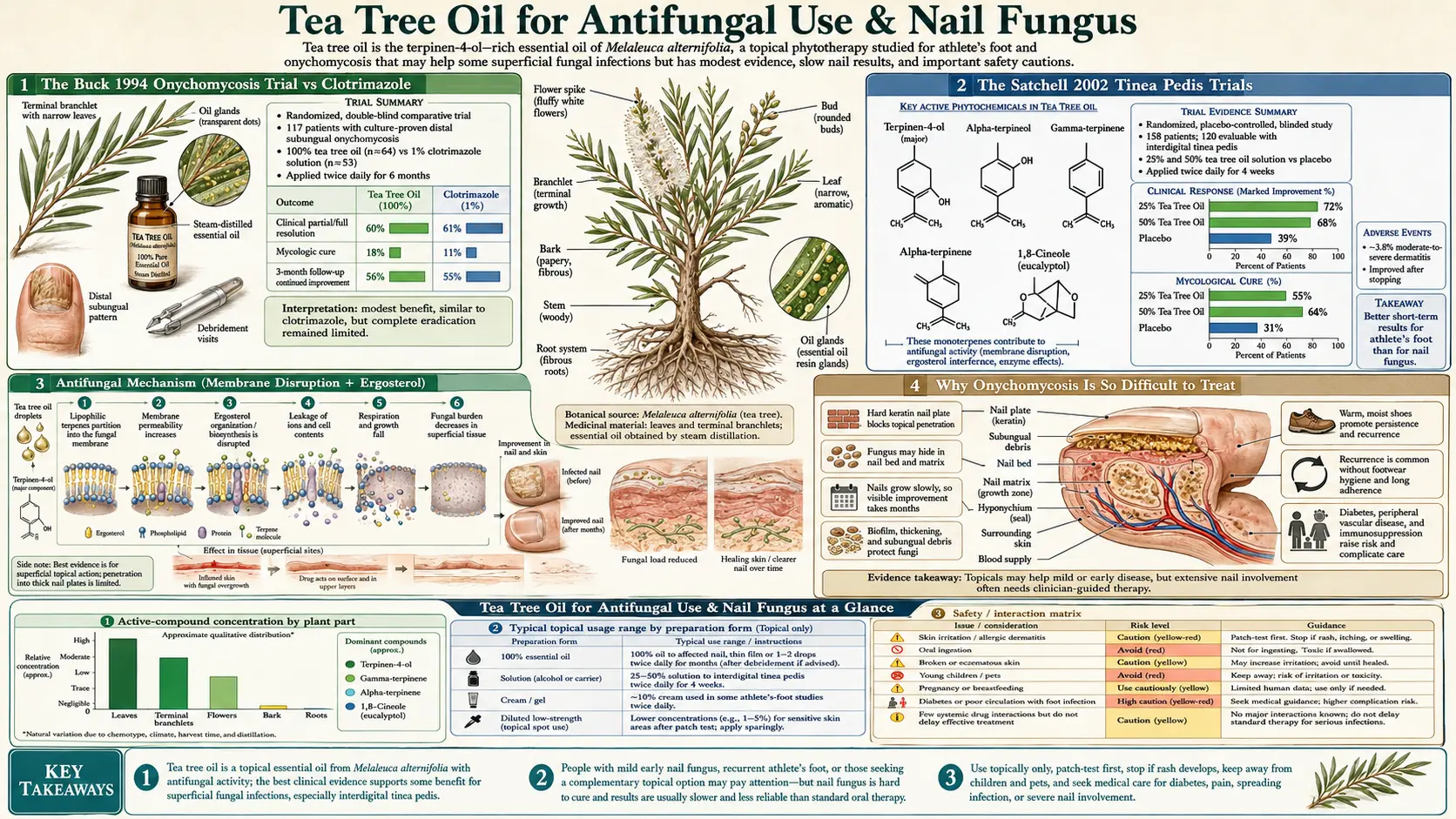
Nail fungus (onychomycosis) is one of the most frustrating dermatologic conditions to treat. The infecting organisms — Trichophyton rubrum, Trichophyton mentagrophytes, and several non-dermatophyte molds — live inside the nail plate, a hard keratin structure that conventional antifungal creams penetrate poorly. Oral terbinafine has far higher cure rates in trials; its drug label gives one 250 mg tablet daily for 12 weeks for toenails and warns of liver injury (hepatotoxicity). Topical alternatives have historically been disappointing. The Buck, Nidorf & Addino 1994 Journal of Family Practice trial offered hope by comparing 100% tea tree oil applied twice daily for six months against 1% clotrimazole solution: culture cure was 18% with tea tree and 11% with clotrimazole, and partial or full resolution was 60% and 61%. This was modest absolute efficacy, and the authors reported the two groups as comparable; the trial had no placebo arm. A later trial (Satchell 2002) tested tea tree oil on tinea pedis (athlete's foot) at 25% and 50% concentrations. Users describe tea tree oil as a slow-but-effective topical antifungal, with 6–12 months of consistent daily application for nail fungus (the Buck trial ran 6 months) and 4–8 weeks for skin fungal infections (the Satchell trial ran 4 weeks).
Table of Contents
- The Buck 1994 Onychomycosis Trial vs Clotrimazole
- The Satchell 2002 Tinea Pedis Trial and the Mouth-Rinse Studies
- Antifungal Mechanism (Membrane Disruption + Ergosterol)
- Why Onychomycosis Is So Difficult to Treat
- The 100% Tea Tree Topical Application
- How Tea Tree Compares to Oral Terbinafine
- Athlete's Foot (Tinea Pedis) and Skin Fungal Infections
- Oral Candidiasis and Vaginal Candida
- Practical 6–12 Month Topical Regimen
- Cautions (Poisoning if Swallowed, Contact Dermatitis, Children)
- Key Research Papers
- Connections
- Featured Videos
The Buck 1994 Onychomycosis Trial vs Clotrimazole
The Buck, Nidorf & Addino 1994 paper in the Journal of Family Practice is the foundational clinical trial of tea tree oil for nail fungus. The investigators randomized 117 patients with culture-proven distal subungual onychomycosis to one of two topical regimens applied twice daily for six months:
- 100% tea tree oil, applied directly to the affected nail with a cotton swab twice daily
- 1% clotrimazole solution (a standard topical azole antifungal), applied to the affected nail twice daily
The duration of treatment (six months) reflects the slow growth rate of toenails and the time needed for a non-diseased nail to grow out from the matrix and replace the infected nail. Debridement (filing or trimming away the diseased nail) and clinical assessment were done at 0, 1, 3 and 6 months in both groups. The double-blind design used identically-appearing dropper bottles with each agent.
Results at six months:
- Culture cure — 18% in the tea tree group, 11% in the clotrimazole group. The authors reported the two groups as comparable
- Clinical assessment — 60% of tea tree patients and 61% of clotrimazole patients showed either partial or full resolution of nail discoloration, thickening, and brittleness
- Three months after treatment ended — 56% of the tea tree group and 55% of the clotrimazole group reported continued improvement or resolution
- Adverse effects — both groups well-tolerated. Three patients in the tea tree group reported transient mild redness of the surrounding cuticle, resolving on continuation
The conclusion: tea tree oil at 100% concentration was approximately equivalent to 1% clotrimazole solution for topical management of distal subungual onychomycosis. Both produced modest absolute cure rates — reflecting the inherent difficulty of penetrating the nail plate, not any specific failure of either agent. For the patient who cannot or will not take oral antifungal therapy, tea tree was a credible alternative to clotrimazole.
What the trial cannot show: it had no placebo arm, and debridement was part of both arms. A comparable result therefore cannot show that either preparation worked beyond the nail filing itself. The authors' own conclusion was that topical preparations “provide improvement in nail appearance and symptomatology” and that a topical preparation with debridement is an appropriate initial strategy.
The Buck trial used the maximum-concentration topical formulation (undiluted oil), which would not be tolerable on most other skin sites. The nail plate itself is keratinized and not innervated, so the high concentration produces no discomfort. The surrounding cuticle and periungual skin can develop transient irritation, addressed by careful application that minimizes spread beyond the nail surface.
The Satchell 2002 Tinea Pedis Trial and the Mouth-Rinse Studies
The Satchell 2002 trial extended the tea tree antifungal evidence to tinea pedis (athlete's foot). It randomized 158 patients with interdigital tinea pedis to one of three preparations applied twice daily for four weeks:
- Placebo
- 25% tea tree oil solution
- 50% tea tree oil solution
Results at four weeks:
- Clinical response (resolution of erythema, scaling, itching) — 39% placebo, 72% with 25% tea tree, 68% with 50% tea tree (both active arms significantly better than placebo)
- Mycologic cure — 31% placebo, 55% with 25% tea tree, 64% with 50% tea tree (50% arm significantly better than placebo; 25% arm intermediate)
- Adverse effects — four patients (3.8%) applying tea tree oil developed moderate to severe dermatitis that improved quickly on stopping the study medication
Oral candidiasis was tested by a different research group, not by Satchell. Vazquez and Zawawi (2002, HIV Clinical Trials) ran an open-label, single-center study of 27 patients with acquired immunodeficiency syndrome (AIDS) whose oral candidiasis had not responded to fluconazole. Patients used an alcohol-based or alcohol-free melaleuca (tea tree) oral solution four times daily for 2–4 weeks, with no placebo or comparator drug. At 4 weeks, 60% showed a clinical response (7 cured, 8 improved). An earlier open-label study from the same center (Jandourek 1998) gave 13 patients 15 mL four times daily to swish and expel: of the 12 who could be evaluated, 8 responded at 4 weeks (2 cured, 6 improved), and 7 had a mycological response. The solution is described elsewhere as 5% oil; neither study abstract states the strength.
Taken together, these separate studies describe clinical activity across several fungal infections, at strengths from 25–50% (skin) to 100% (nail), with the lower-strength mouth rinse used on oral mucosa. Of these, only the skin trial had a placebo arm.
Antifungal Mechanism (Membrane Disruption + Ergosterol)
Tea tree oil's antifungal mechanism extends the same membrane-disruption mechanism described in detail on the antimicrobial deep-dive, with one important addition specific to fungal cell biology.
Fungal cell membranes differ from bacterial membranes in one critical way: instead of cholesterol (the dominant sterol in animal cell membranes) or hopanoids (in many bacteria), fungal membranes contain ergosterol as their primary sterol. Ergosterol biosynthesis is the target of every major class of antifungal drug — the azoles (fluconazole, itraconazole, ketoconazole) inhibit lanosterol 14α-demethylase, the allylamines (terbinafine, naftifine) inhibit squalene epoxidase, and the polyenes (amphotericin B, nystatin) bind ergosterol directly to disrupt the membrane.
Tea tree oil's terpinen-4-ol has a slightly different mechanism. It intercalates into fungal membranes through the same biophysical disruption it uses against bacteria, but the higher ergosterol content of fungal membranes makes them somewhat more susceptible to monoterpene disruption than bacterial membranes are. In laboratory tests of the whole oil against 106 dermatophytes and 78 other filamentous fungi (Hammer 2002), minimum inhibitory concentration (MIC) values ranged from 0.004% to 0.25% and minimum fungicidal concentration (MFC) values from under 0.03% to 8.0%. Tested as separate components (Hammer 2003), the most active, terpinen-4-ol among them, had MIC and MFC values of 0.25% or less, and most of the others 0.5–2%. The organisms usually named in this laboratory work are major dermatophytes (Trichophyton mentagrophytes, T. rubrum, Microsporum canis, Epidermophyton floccosum) and yeasts (Candida albicans, C. glabrata, Cryptococcus neoformans), with values lower than the bacterial MICs.
An additional finding, from a laboratory study (Mertas 2015): tea tree oil enhanced the activity of fluconazole against 32 clinical strains of fluconazole-resistant Candida albicans, with the average fluconazole MIC falling from 244.0 to 38.46 µg/mL after exposure to a sublethal dose of the oil. This was shown in culture, not in patients. The proposed mechanism is that membrane disruption by tea tree increases the intracellular concentration of fluconazole, partially restoring susceptibility in strains that had developed efflux-pump-mediated fluconazole resistance. This is potentially useful for the difficult clinical problem of fluconazole-refractory Candida in immunocompromised patients, particularly oral candidiasis in advanced human immunodeficiency virus.
Why Onychomycosis Is So Difficult to Treat
Distal subungual onychomycosis — the most common pattern of nail fungus — involves invasion of the keratin nail plate by the dermatophyte Trichophyton rubrum. The fungus lives in and digests the nail plate, producing the characteristic yellow-brown discoloration, thickening, and crumbling that patients recognize. Several biological features make it exceptionally difficult to treat:
- The nail plate is keratin, not living tissue. Topical antifungals must diffuse through the nail plate to reach the fungus underneath, which most agents do very poorly. The nail plate is essentially a barrier
- The growth rate is slow. A toenail takes 12–18 months to grow completely from the matrix to the distal edge. Any therapy must persist long enough for new uninfected nail to replace the infected nail
- The fungus persists in the nail bed even after the nail plate clears. Recurrence after topical-only therapy is common
- The fungus produces a biofilm matrix within the nail that further reduces drug penetration
- Compliance is difficult over the 6–12+ months that any topical regimen requires. Many patients abandon therapy at the 2–3 month mark when no visible improvement is yet apparent
This is why oral therapy with terbinafine or itraconazole — which delivers the antifungal systemically and concentrates in the nail matrix — achieves substantially higher cure rates (60–80%) than any topical agent (15–30%). The trade-off is the cost (around $200–$400 for a 3-month terbinafine course), the requirement for baseline and interval liver function testing, and the small but real risk of hepatotoxicity, drug interactions, and other systemic adverse effects.
The terbinafine label contraindicates the tablets in chronic or active liver disease and after a past allergic reaction to oral terbinafine. Others leave it aside because of drug interactions, pregnancy, breastfeeding or polypharmacy concerns (the label's wording on pregnancy and breastfeeding is in the comparison table below). For these people topical therapy is what remains, and tea tree oil's modest absolute cure rates are usually weighed against that comparison, not against terbinafine.
Prescription nail solutions are part of that topical comparison. In two phase III trials of tavaborole 5% solution used once daily for 48 weeks, complete cure at week 52 was 6.5% and 9.1% against 0.5% and 1.5% on the inactive vehicle, and negative mycology (no fungus found on testing) was 31.1–35.9% against 7.2–12.2% (Elewski 2015).
The 100% Tea Tree Topical Application
Onychomycosis is the one tea tree application where undiluted 100% oil is the usual concentration, and the strength the Buck trial tested. The reasoning users and practitioners give:
- The nail plate is the principal diffusion barrier, and the diffusion gradient is proportional to the source concentration. Higher external concentration produces higher concentration at the fungus
- The nail plate itself is keratinized and not innervated, so it does not experience the high-concentration tea tree as irritating
- Application is to a defined small area (typically one or two affected toenails), so total dose remains modest
- Twice-daily application maintains continuous concentration gradient through the application period
The application technique people describe:
- The foot is washed and dried completely, with particular attention to drying between the toes
- A thickened nail is filed gently with a single-use emery board to reduce thickness and improve drug penetration. The board is discarded after use to avoid re-inoculating cleared nails
- 1–2 drops of undiluted tea tree oil go directly on the affected nail surface and the proximal nail fold
- A cotton swab pushes a small amount of oil under the distal edge of the nail where possible
- The oil air dries before a sock or shoe goes on
- This is repeated morning and bedtime for 6–12 months continuously
People describe no visible improvement for the first 2–3 months. Improvement appears at the proximal margin (the part of the nail closest to the cuticle, which is the newest nail emerging from the matrix). The treated nail does not become clear; it grows out clear, which takes many months.
How Tea Tree Compares to Oral Terbinafine
Oral terbinafine 250 mg daily for 12 weeks is the label dose and the current standard of care for moderate-to-severe toenail onychomycosis. Direct head-to-head comparison with tea tree oil has not been performed (and would not pass an ethics committee, given the substantial efficacy difference). Indirect comparison from separate trials:
| Parameter | Oral terbinafine | 100% tea tree oil topical |
|---|---|---|
| Mycologic cure rate | 70–76% | ~18% |
| Complete cure rate | 38–55% | ~10% |
| Duration of therapy | 12 weeks oral | 6–12 months topical |
| Cost (US) | $200–$400 generic | $15–$40 (oil) |
| Liver toxicity risk | Label: cases of liver failure, some leading to liver transplant or death; it gives no rate (the often-quoted 1:50,000–1:120,000 hepatic injury is not a label figure) | None at topical use |
| Drug interactions | Several (inhibits cytochrome P450 2D6, CYP2D6) | None |
| Pregnancy/lactation use | Not a label contraindication. Label: data “are insufficient to evaluate a drug-associated risk of major birth defects, miscarriage, or adverse maternal or fetal outcomes”; terbinafine “is present in human milk”, with no data on the breastfed child | Limited data |
The figures on the current terbinafine label come from its first toenail trial, assessed at week 48: mycological cure in 70% of subjects and mycological plus clinical cure (0% nail involvement) in 38%. The label asks for liver function tests before treatment and periodically during it, and lists chronic or active liver disease and a history of allergic reaction to oral terbinafine as its contraindications.
The clinical interpretation usually given:
- For a patient who tolerates oral therapy and has no contraindication, oral terbinafine has the higher cure rates in trials and is what most dermatologists prescribe
- For a patient with liver disease, who is taking multiple medications, who is pregnant or breastfeeding, or who has had a previous terbinafine reaction, topical tea tree is an alternative some people use, with the trial data pointing to partial improvement rather than complete cure
- For a patient with mild distal disease (only the distal third of the nail involved), users report that topical tea tree can be enough, and it avoids systemic exposure
- Combination strategies — oral terbinafine plus topical tea tree as adjunct — have not been formally studied; some regard them as biologically reasonable for severe disease
A separate trial tested a cream combining 2% butenafine (an antifungal drug) with 5% tea tree oil on toenails: 60 outpatients, 16 weeks, 80% cured on the cream against none on placebo, with mild inflammation in 4 patients on the cream (Syed 1999). Because the cream contains a drug, the result cannot be credited to tea tree oil alone.
Terbinafine resistance is a growing concern. Trichophyton indotineae, an emerging skin fungus often resistant to terbinafine, showed a 3-fold increase in laboratory identifications in a global network during 2022–2025 (Jabet 2026). A 2023 network analysis of 21 studies of oral antifungals found that 24 weeks of terbinafine 250 mg daily gave greater 1-year odds of mycological cure than 12 weeks (odds ratio 2.62, 95% credible interval 1.57–4.54), and that some triazole drugs could be more effective than terbinafine (Gupta 2023).
Athlete's Foot (Tinea Pedis) and Skin Fungal Infections
Tinea pedis (athlete's foot) is much easier to treat than nail fungus because the infecting dermatophyte lives in the stratum corneum of the skin, not inside the nail plate. Topical antifungals reach effective concentrations easily. Tea tree oil at 25% or 50% concentration was tested in the Satchell 2002 trial discussed above — clinical response rates of 68–72% and mycologic cure rates of 55–64% within four weeks of twice-daily application.
The earlier Tong 1992 trial used a much lower strength, a 10% tea tree oil cream, against 1% tolnaftate and placebo creams in 104 patients who completed it. Culture turned negative in 85% on tolnaftate, 30% on tea tree and 21% on placebo, with no statistically significant difference between tea tree and placebo. Symptoms improved about as well on the tea tree cream as on tolnaftate, and the authors concluded it “is no more effective than placebo in achieving a mycological cure”. The 25% and 50% strengths are the ones commonly described for skin fungal applications.
Other skin fungal infections where tea tree is used:
- Jock itch (tinea cruris) — the same dermatophytes that cause athlete's foot, infecting the groin and inner thigh. Reported use, no trial found: people describe 25% tea tree cream twice daily for 4 weeks and compare it to over-the-counter (OTC) clotrimazole
- Ringworm of the body (tinea corporis) — circular scaling patches on the trunk or limbs. Reported use, no trial found: people describe 25% tea tree cream as similarly effective
- Pityriasis versicolor — Malassezia furfur overgrowth producing hypo- or hyperpigmented patches. Tea tree shows in vitro activity but less clinical data than dermatophyte indications
- Diaper dermatitis with Candida — the concern with topical tea tree in infants is ingestion if the area is mouthed; nystatin and clotrimazole are the conventional treatments
For chronic or recurrent dermatophyte infection, broader management including foot hygiene, footwear rotation, and treatment of household contacts is described alongside any topical agent. See our Fungal Infections page for the broader management approach.
Oral Candidiasis and Vaginal Candida
The Vazquez 2002 and Jandourek 1998 open-label studies described above gave a melaleuca oral solution (swish and expel, not swallowed) to patients with AIDS and fluconazole-refractory oral Candida; at 4 weeks 60% responded in the first and 8 of 12 in the second. Neither had a placebo or comparator drug.
The caveats reported:
- Tea tree oil is poisonous when swallowed (see Cautions). The oral solution in these studies was swished and expelled
- The oral solution, described as 5% oil, is reported to irritate the oral mucosa and to be generally less well tolerated than nystatin oral suspension
- For uncomplicated oral candidiasis in immunocompetent adults, nystatin oral suspension or oral fluconazole are the standard therapies
- For fluconazole-refractory oral candidiasis in immunocompromised patients, tea tree is proposed as a possible adjunct, partly on the Mertas 2015 laboratory finding of enhanced fluconazole activity
Vaginal Candida has been less formally studied. Case series and small trials suggest activity but the data are not strong enough to displace standard fluconazole or topical azole therapy. Tea tree douching is sometimes promoted in alternative-medicine circles; the irritation potential is real, the evidence is weak, and standard treatments are highly effective.
Practical 6–12 Month Topical Regimen
The regimen people and practitioners describe for culture-confirmed mild-to-moderate distal subungual onychomycosis treated topically (the one comparative trial ran 6 months; no 12-month regimen has been tested):
- The oil — pharmaceutical-grade tea tree oil in a 10–30 mL amber dropper bottle, with ISO 4730 compliance on the label. Bulk-warehouse tea tree oil of uncertain provenance and storage history is the kind users steer away from
- Patch test — one drop on the inner forearm, then a 24-hour wait. Users go on if no significant reaction develops
- Trim and file — the affected nail is filed with a single-use disposable emery board to reduce thickness and improve drug penetration, and the board is discarded after use to avoid re-inoculation. The Buck trial debrided nails at 0, 1, 3 and 6 months
- Twice-daily application — 1–2 drops of undiluted tea tree oil on the nail surface, the proximal nail fold, and under the distal nail edge if accessible, air dried before socks or shoes go on
- Footwear hygiene — shoes rotated daily (each pair dries completely between uses), antifungal foot powder in shoes, and replacement of old socks and shoes that may harbor fungal spores
- 6–12 months minimum — longer for severe disease. Practitioners report that stopping at the first sign of improvement brings recurrence
- Checks at 3 and 6 months — progress shows at the proximal margin as new clear nail growing in from the cuticle. With no improvement at 6 months, oral terbinafine is the usual next option
- Contributing factors — tight footwear, chronic foot moisture, immunocompromise (diabetes, human immunodeficiency virus), and active tinea pedis elsewhere all promote recurrence
For tinea pedis (skin fungal infection): the Satchell trial used a 25% or 50% tea tree solution twice daily for 4 weeks. Users describe a solution or cream for 4–6 weeks, continued for 1–2 weeks after visible resolution, along with foot hygiene (drying thoroughly between toes after bathing, daily sock change, antifungal powder in shoes).
Cautions (Poisoning if Swallowed, Contact Dermatitis, Children)
- Tea tree oil is poisonous when swallowed — oral ingestion produces dose-dependent central nervous system (CNS) depression, ataxia, coma, and respiratory failure. In the Morris 2003 case report, a 4-year-old boy who swallowed a small quantity became unsteady within 30 minutes, then unresponsive, was intubated by paramedics, and improved over 10 hours. In the Jacobs 1994 case report, a 23-month-old boy became confused and unable to walk 30 minutes after swallowing less than 10 mL of 100% oil, and was symptom-free within 5 hours. Tea tree oil is a topical-only product, and both of these reported poisonings were in small children, which matters in any home keeping the oil for nail fungus
- Pre-pubertal boys — gynecomastia concern — Henley 2007 NEJM described three boys whose breast enlargement coincided with topical products containing lavender and tea tree oils and resolved after stopping them; the authors concluded the oils probably caused it. Causality is disputed: a 2014 letter by Carson, Tisserand and Larkman is titled “Lack of evidence that essential oils affect puberty”, and a 2023 review counted 8 boys and 4 girls reported since 2007, all regressing after stopping the oils, and concluded that it “cannot be concluded” the oils were the cause (Braunstein 2023). The question remains unresolved for prolonged use on pre-pubertal boys
- Allergic contact dermatitis — tea tree oil is one of the most common essential oil sensitizers. The principal sensitizing chemistry is oxidation products that accumulate in old or improperly stored oil, not the parent monoterpenes. Common practice is fresh oil, replaced within 12 months of opening, stored in amber glass in a cool dark place. Persistent redness, itching, or vesiculation at the application site are the signs of a reaction
- Strong concentrations — a 2023 systematic review of 46 randomized tea tree articles rated the quality of the research poor to modest. Side effects were reported in 60% of the studies and were minor, except where the oil was applied in concentrations of 25% or more (Kairey 2023). This matters for undiluted oil used for months
- Periungual irritation — the high-concentration tea tree used for nail fungus can produce transient redness and mild discomfort in the cuticle and surrounding skin. This is usually self-limited and improves with careful application that avoids excess spread beyond the nail surface. When it persists or worsens, some users dilute to 50% in a carrier oil
- Pediatric use — the concern in children under 6 years using it for nail fungus or tinea pedis is the inability to prevent oral exposure and the higher pediatric sensitivity. Clotrimazole and terbinafine cream are the standard topical antifungals
- Pregnancy and breastfeeding — limited data, including for chronic use over 6+ months. Some practitioners regard topical use at standard concentrations as acceptable. A 2006 toxicity review found that data from individual components suggest the oil has the potential to be developmentally toxic if swallowed at higher doses (Hammer 2006)
- Diabetes and onychomycosis — patients with diabetes are at high risk for secondary bacterial infection of fungal-affected toenails. Podiatry care commonly runs alongside any antifungal therapy. Topical-only therapy may be inadequate for moderate-severe disease in diabetic patients; oral terbinafine is often prescribed despite the additional monitoring
- Pet safety — tea tree oil is highly toxic to cats and dogs even at dilute concentrations, so use on or around pets is a poisoning risk
Key Research Papers
- Buck DS, Nidorf DM, Addino JG (1994). Comparison of two topical preparations for the treatment of onychomycosis: Melaleuca alternifolia (tea tree) oil and clotrimazole. Journal of Family Practice. — PubMed PMID: 8195735
- Tong MM, Altman PM, Barnetson RS (1992). Tea tree oil in the treatment of tinea pedis. Australasian Journal of Dermatology. — PubMed PMID: 1303075
- Satchell AC, Saurajen A, Bell C, Barnetson RS (2002). Treatment of interdigital tinea pedis with 25% and 50% tea tree oil solution: a randomized, placebo-controlled, blinded study. Australasian Journal of Dermatology. — PubMed PMID: 12121393
- Vazquez JA, Zawawi AA (2002). Efficacy of alcohol-based and alcohol-free melaleuca oral solution for the treatment of fluconazole-refractory oropharyngeal candidiasis in patients with AIDS. HIV Clinical Trials. — PubMed PMID: 12407487
- Jandourek A, Vaishampayan JK, Vazquez JA (1998). Efficacy of melaleuca oral solution for the treatment of fluconazole refractory oral candidiasis in AIDS patients. AIDS. — PubMed PMID: 9662200
- Hammer KA, Carson CF, Riley TV (2003). Antifungal activity of the components of Melaleuca alternifolia (tea tree) oil. Journal of Applied Microbiology. — PubMed PMID: 12969301
- Hammer KA, Carson CF, Riley TV (2002). In vitro activity of Melaleuca alternifolia (tea tree) oil against dermatophytes and other filamentous fungi. Journal of Antimicrobial Chemotherapy. — PubMed PMID: 12161399
- Mertas A, Garbusińska A, Szliszka E, Jureczko A, Kowalska M, Król W (2015). The influence of tea tree oil (Melaleuca alternifolia) on fluconazole activity against fluconazole-resistant Candida albicans strains. BioMed Research International. — PubMed PMID: 25722982
- Nenoff P, Haustein UF, Brandt W (1996). Antifungal activity of the essential oil of Melaleuca alternifolia (tea tree oil) against pathogenic fungi in vitro. Skin Pharmacology. — PubMed PMID: 9055360
- Concha JM, Moore LS, Holloway WJ (1998). Antifungal activity of Melaleuca alternifolia (tea-tree) oil against various pathogenic organisms. Journal of the American Podiatric Medical Association. — PubMed PMID: 9791953
- Hammer KA, Carson CF, Riley TV (2004). Antifungal effects of Melaleuca alternifolia (tea tree) oil and its components on Candida albicans, C. glabrata and Saccharomyces cerevisiae. Journal of Antimicrobial Chemotherapy. — PubMed PMID: 15140856
- Morris MC, Donoghue A, Markowitz JA, Osterhoudt KC (2003). Ingestion of tea tree oil (Melaleuca oil) by a 4-year-old boy. Pediatric Emergency Care. — PubMed PMID: 12813303
- Hammer KA, Carson CF, Riley TV, Nielsen JB (2006). A review of the toxicity of Melaleuca alternifolia (tea tree) oil. Food and Chemical Toxicology. — PubMed PMID: 16243420
- Jacobs MR, Hornfeldt CS (1994). Melaleuca oil poisoning. Journal of Toxicology: Clinical Toxicology. — PubMed PMID: 8057407
- Henley DV, Lipson N, Korach KS, Bloch CA (2007). Prepubertal gynecomastia linked to lavender and tea tree oils. New England Journal of Medicine. — PubMed PMID: 17267908
- Carson CF, Tisserand R, Larkman T (2014). Lack of evidence that essential oils affect puberty. Reproductive Toxicology. — PubMed PMID: 24556344
- Braunstein EW, Braunstein GD (2023). Are Prepubertal Gynaecomastia and Premature Thelarche Linked to Topical Lavender and Tea Tree Oil Use? touchREVIEWS in Endocrinology. — PubMed PMID: 38187077
- Kairey L, Agnew T, Bowles EJ, Barkla BJ, Wardle J, Lauche R (2023). Efficacy and safety of Melaleuca alternifolia (tea tree) oil for human health-A systematic review of randomized controlled trials. Frontiers in Pharmacology. — PubMed PMID: 37033604
- Syed TA, Qureshi ZA, Ali SM, Ahmad S, Ahmad SA (1999). Treatment of toenail onychomycosis with 2% butenafine and 5% Melaleuca alternifolia (tea tree) oil in cream. Tropical Medicine & International Health. — PubMed PMID: 10357864
- Elewski BE, Aly R, Baldwin SL, González Soto RF, Rich P, Weisfeld M, Wiltz H, Zane LT, Pollak R (2015). Efficacy and safety of tavaborole topical solution, 5%, a novel boron-based antifungal agent, for the treatment of toenail onychomycosis: Results from 2 randomized phase-III studies. Journal of the American Academy of Dermatology. — PubMed PMID: 25956661
- Jabet A, Normand AC, Amilon K, et al. (2026). Global Spread of Trichophyton indotineae Tracked by Mass Spectrometry Identification Network, 2022-2025. Emerging Infectious Diseases. — PubMed PMID: 42661283
- Gupta AK, Venkataraman M, Bamimore MA (2023). Relative impact of traditional vs. newer oral antifungals for dermatophyte toenail onychomycosis: a network meta-analysis study. British Journal of Dermatology. — PubMed PMID: 37253047
- Terbinafine tablets, US prescribing information (generic label, revised 10/2020). DailyMed, US National Library of Medicine. — DailyMed label