Watermelon
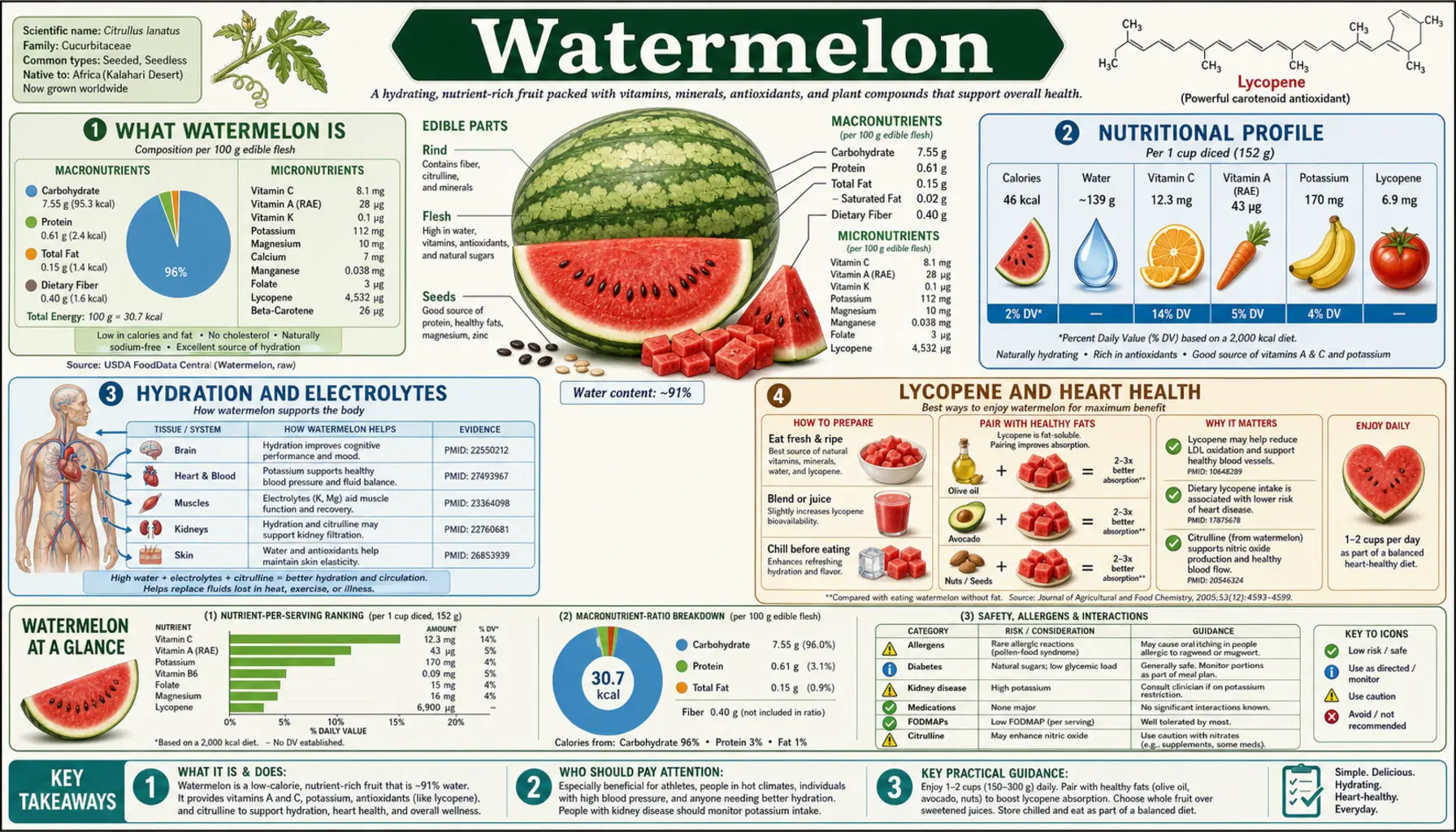
Few foods say "summer" quite like a cold slice of watermelon. It is sweet, dripping, cheap, and about as refreshing as eating gets. But watermelon (Citrullus lanatus) is more than a hot-weather treat. Behind that pink flesh sits a genuinely interesting little nutrition story: it is roughly 92% water, it carries more of the antioxidant lycopene, gram for gram, than a raw tomato, and it is one of the best natural sources of an amino acid called citrulline that your body turns into the building blocks of blood-vessel-relaxing nitric oxide.
This page walks through what watermelon actually contains, what the research does and does not show about its heart and blood-flow effects, how to make sense of its "high glycemic index," how to pick a ripe one at the store, and a few honest cautions. Throughout, we try to separate the solid findings from the hopeful marketing — because watermelon is lovely without any hype, and some of the boldest claims come from studies using concentrated citrulline supplements, not the fruit itself.
Table of Contents
- What Watermelon Is
- Nutritional Profile
- Hydration and Electrolytes
- Lycopene and Heart Health
- Citrulline, Arginine, and Blood Flow
- The Rind and the Seeds
- Watermelon and Blood Sugar
- How to Pick a Ripe Watermelon
- Safety and Simple Cautions
- Easy Ways to Enjoy It
- Research Papers
- Connections
- Featured Videos
What Watermelon Is
Watermelon is the fruit of Citrullus lanatus, a sprawling vine in the gourd family (Cucurbitaceae) — the same botanical neighborhood as cucumbers, squash, and pumpkins. It was domesticated in Africa thousands of years ago, and early versions were prized as much for their portable, storable water as for sweetness. Centuries of breeding turned a hard, bitter ancestor into the sugary, deep-red fruit we know.
The flesh is not always red. Depending on the variety you may find yellow, orange, or pale-pink flesh, and the color is a clue to what is inside: red and pink types are rich in lycopene, while yellow and orange types trade some of that lycopene for other pigments and can carry more beta-carotene.
You will also choose between seeded and seedless melons. Seedless watermelons are not genetically modified; they are conventional hybrids that end up with an extra set of chromosomes, which leaves them sterile and unable to form mature black seeds. The small, soft, white "seeds" you still see in a seedless melon are immature seed coats, and they are perfectly fine to eat.
Nutritional Profile
Watermelon's headline feature is how little it contains by weight and how much water fills the gap. A typical one-cup serving of diced red watermelon (about 150 grams) provides roughly 45–46 calories, around 11–12 grams of carbohydrate (mostly natural sugars, about 9 grams), under a gram of fiber, and almost no fat or protein. The rest — the great majority of the fruit — is water. That is why a large wedge feels filling and hydrating without being heavy.
Within those few calories, watermelon delivers a respectable spread of micronutrients and plant compounds. Per one-cup serving you get roughly:
- Vitamin C — about 12–13 mg, or roughly 14% of the daily target, supporting immune function and collagen.
- Vitamin A (as beta-carotene) — a modest amount, more generous in the orange- and yellow-fleshed varieties.
- Potassium — around 170 mg, a helpful contribution to the electrolyte you sweat out on a hot day.
- Lycopene — the red carotenoid antioxidant, typically 6–7 mg per cup, which places raw watermelon among the richest fresh sources.
- Citrulline — a non-protein amino acid concentrated in watermelon, discussed in its own section below.
- Water — roughly 92% of the fruit's weight, the reason it is so refreshing and so low in calories.
Two numbers deserve a second look. First, the lycopene: gram for gram, raw watermelon usually contains more lycopene than a raw tomato. (Cooked and concentrated tomato products like paste and sauce still win overall, because concentrating and heating the tomato packs and frees up far more lycopene.) Second, the citrulline — watermelon is one of the few common foods that supplies it in meaningful amounts, and that fact underpins most of the "watermelon is good for your blood vessels" research.
Hydration and Electrolytes
At about 92% water, watermelon is essentially a delicious way to drink. On a hot day, a couple of cups can add a useful splash of fluid, and unlike plain water it comes with a little potassium and natural sugar — the same broad combination (fluid plus electrolytes plus carbohydrate) that sports drinks are built around, only in a whole-food form with fiber and antioxidants attached.
It is worth keeping perspective. Watermelon is a nice contributor to hydration, not a replacement for water during heavy exertion or illness, and its potassium content, while welcome, is moderate rather than dramatic. Think of it as a pleasant, hydrating snack that happens to carry a few extras, rather than a rehydration therapy.
Lycopene and Heart Health
Lycopene is the pigment that makes red watermelon red. It belongs to the carotenoid family and behaves as an antioxidant, mopping up reactive molecules that can damage cells and oxidize LDL cholesterol — a step thought to matter in the earliest stages of artery disease. Because watermelon is such a rich fresh source, researchers have used it to study whether eating the fruit actually raises lycopene in the bloodstream.
It does. In a controlled feeding study, drinking watermelon juice measurably increased plasma concentrations of both lycopene and beta-carotene, confirming that the lycopene in watermelon is genuinely absorbable, not just present on paper. Watermelon's lycopene also appears reasonably bioavailable even without cooking, which is convenient given that you rarely cook watermelon.
The honest caveat is about outcomes. Higher dietary and blood lycopene track with somewhat lower cardiovascular risk in population studies, and lycopene has plausible antioxidant mechanisms, but that is association and biochemistry — not proof that eating watermelon prevents heart attacks. Treat the lycopene as a real, welcome bonus of a hydrating fruit rather than as medicine. For a deeper look at the evidence and the cooking-and-fat nuances of absorption, see the dedicated Lycopene page.
Citrulline, Arginine, and Blood Flow
This is watermelon's most intriguing story, and also the one most often oversold. Watermelon is one of the richest food sources of L-citrulline, a non-protein amino acid named after the melon itself (Citrullus). Once absorbed, your kidneys convert citrulline into the amino acid arginine, and arginine is the raw material your blood-vessel lining uses to make nitric oxide — a signaling molecule that tells arteries to relax and widen. Wider, more relaxed arteries mean easier blood flow and, in principle, lower blood pressure.
Interestingly, loading up on citrulline can raise blood arginine more effectively than swallowing arginine itself, because a large share of oral arginine is broken down in the gut and liver before it ever reaches the circulation. Human feeding studies confirm the first link in the chain: eating watermelon raises plasma arginine concentrations.
From there the picture gets genuinely promising but needs an asterisk. Several small trials — many led by the researcher Arturo Figueroa — found that watermelon extract or supplementation modestly lowered blood pressure and improved arterial stiffness measures in adults with prehypertension or hypertension, and other work has explored watermelon and citrulline for exercise recovery and reduced muscle soreness. That is a real and repeatable signal.
Here is the asterisk, stated plainly:
- Many of the most encouraging studies used concentrated watermelon extract or purified L-citrulline supplements (often 3–6 grams), not slices of fruit off a picnic table.
- A generous everyday portion of watermelon supplies on the order of a gram of citrulline — helpful, but well short of the doses used in the strongest trials, so you would have to eat a great deal of melon to match them.
- When researchers gave athletes plain watermelon juice, they saw improved nitric-oxide markers but no clear boost in endurance performance — a useful reminder that a lab marker moving is not the same as running faster.
So the fair summary is: the biology is sound, the fruit really does nudge the arginine–nitric-oxide system, and modest blood-pressure benefits are plausible — but the dramatic "watermelon is nature's Viagra / blood-pressure drug" claims lean on concentrated doses, not the wedge on your plate. Enjoy watermelon as a heart-friendly whole food, and if you are specifically after the citrulline dose used in studies, read the honest, supplement-focused breakdown on the Citrulline page.
The Rind and the Seeds
Two of the most nutritious parts of a watermelon are the parts most people throw away.
The rind
The pale layer between the red flesh and the green skin is fully edible and, perhaps surprisingly, tends to hold even more citrulline than the sweet flesh does. It is crisp, mild, and low in sugar. Around the world people pickle watermelon rind, stir-fry it like a vegetable, or blend it into juices and smoothies where its color disappears. If you want the most citrulline from your melon, do not discard the rind.
The seeds
Whole black watermelon seeds are edible, and roasted, salted watermelon seeds are a popular snack across parts of Africa, the Middle East, and Asia. Roasting or sprouting them makes them pleasant to eat and provides plant protein, magnesium, healthy fats, and zinc. And to retire an old childhood worry: swallowing a seed will not grow a watermelon in your stomach — it passes straight through. The soft white seeds in seedless melons are immature and can be eaten without a second thought.
Watermelon and Blood Sugar
You will sometimes see watermelon flagged as a "high-glycemic" food to avoid, and the label is half-right in a way that is genuinely misleading. Watermelon does have a high glycemic index (GI) — commonly cited around 72–76 — meaning the sugar it does contain is absorbed quickly.
But glycemic index only describes quality, not quantity. Because watermelon is mostly water, a normal serving delivers very little actual carbohydrate, so its glycemic load (GL) — the number that reflects a realistic portion — is low, usually around 4–5. A typical slice simply does not carry enough sugar to cause the blood-sugar spike its scary GI number implies.
Practically, this means most people, including many with well-managed diabetes, can enjoy sensible portions of watermelon as part of a balanced meal. As always, pairing it with a source of protein or fat, watching total portion size, and following your own glucose readings and clinician's guidance is the right approach if blood sugar is a concern.
How to Pick a Ripe Watermelon
A watermelon does not keep ripening once it is picked, so choosing well at the store matters. You cannot see inside, but the outside gives away more than you would think. Look for these signs:
- The field spot. This is the pale patch where the melon rested on the ground. A creamy, buttery-yellow spot signals ripeness; a white or greenish spot means it was picked too early.
- Heft. Pick it up. A ripe watermelon feels heavy for its size because it is full of water. Compare two melons of the same size and choose the heavier one.
- The sound. Give it a firm tap or knock. A ripe melon returns a deep, hollow thump; an underripe or overripe one sounds dull and flat.
- The skin and shape. Choose a firm, symmetrical melon with a dull (not shiny) rind and no soft spots, deep dents, cuts, or bruises. A shiny surface can mean it is underripe.
- Webbing and the tendril. Brown, web-like "sugar spots" on the skin hint at extra sweetness, and a dried, brown curly tendril near the stem is another sign the melon had time to mature on the vine.
None of these is perfect on its own, but a heavy melon with a creamy field spot and a hollow thump is a reliable combination.
Safety and Simple Cautions
Watermelon is one of the safest foods you can eat — a hydrating, low-calorie whole fruit with no meaningful toxicity. For nearly everyone, the only real risk is enjoying so much that you fill up on it. That said, a few people should keep a couple of points in mind:
- FODMAPs and sensitive guts. Watermelon is relatively high in fructose and in FODMAPs (fermentable sugars). Large amounts can cause gas, bloating, or loose stools in people with irritable bowel syndrome or fructose malabsorption. If that is you, smaller portions usually solve it.
- Advanced kidney disease. Watermelon's potassium is moderate, but people on strict potassium- or fluid-restricted diets (for example, on dialysis) should count it toward their daily limits and follow their care team's guidance, especially if eating large quantities.
- Blood-pressure medication. If you take concentrated citrulline or watermelon-extract supplements alongside blood-pressure or erectile-dysfunction medication, the blood-vessel-relaxing effects could add up; that is a supplement-and-drug conversation, not a concern about eating the fruit.
- Balance and portions. Because it is sweet and easy to eat, it is simple to overshoot on sugar if watermelon becomes the whole snack. Enjoy generous but reasonable portions.
For the overwhelming majority of people, none of this applies — watermelon is a wholesome, refreshing choice.
Easy Ways to Enjoy It
Watermelon needs almost nothing done to it, which is part of the charm. A few ideas that make the most of it:
- Cold and plain. Chilled wedges or cubes are hard to improve on. A pinch of salt or a squeeze of lime brightens the sweetness.
- Savory salad. Cubed watermelon with feta, mint, cucumber, and a drizzle of olive oil is a classic summer plate — the salt and acid play beautifully against the sugar.
- Frozen and blended. Freeze cubes for a naturally sweet addition to smoothies, or blend and freeze into simple popsicles for kids.
- Use the whole fruit. Blend the rind into a green-tinted juice for extra citrulline, or pickle and roast the seeds instead of composting them.
- Grilled. A brief sear on a hot grill concentrates the sugars and adds a smoky edge for salads or salsas.
Research Papers
- Manivannan A, Lee E, Han K, Lee H, Kim DS. Versatile Nutraceutical Potentials of Watermelon — A Modest Fruit Loaded with Pharmaceutically Valuable Phytochemicals. Molecules. 2020;25(22):5258. doi:10.3390/molecules25225258 — broad review of watermelon's lycopene, citrulline, and other bioactive compounds.
- Volino-Souza M, de Oliveira GV, Conte-Junior CA, Figueroa A, Alvares TS. Current Evidence of Watermelon (Citrullus lanatus) Ingestion on Vascular Health: A Food Science and Technology Perspective. Nutrients. 2022;14(14):2913. doi:10.3390/nu14142913 — weighs the vascular evidence and highlights the gap between fruit amounts and study doses.
- Perkins-Veazie P, Collins JK, Pair SD, Roberts W. Lycopene content differs among red-fleshed watermelon cultivars. Journal of the Science of Food and Agriculture. 2001;81(10):983-987. doi:10.1002/jsfa.880 — documents watermelon's high lycopene levels and how they vary by variety.
- Edwards AJ, Vinyard BT, Wiley ER, et al. Consumption of Watermelon Juice Increases Plasma Concentrations of Lycopene and β-Carotene in Humans. The Journal of Nutrition. 2003;133(4):1043-1050. doi:10.1093/jn/133.4.1043 — shows watermelon lycopene is genuinely absorbed into the bloodstream.
- Collins JK, Wu G, Perkins-Veazie P, et al. Watermelon consumption increases plasma arginine concentrations in adults. Nutrition. 2007;23(3):261-266. doi:10.1016/j.nut.2007.01.005 — confirms the citrulline-to-arginine conversion after eating watermelon.
- Figueroa A, Sanchez-Gonzalez MA, Perkins-Veazie PM, Arjmandi BH. Effects of Watermelon Supplementation on Aortic Blood Pressure and Wave Reflection in Individuals With Prehypertension: A Pilot Study. American Journal of Hypertension. 2011;24(1):40-44. doi:10.1038/ajh.2010.142 — early trial showing modest blood-pressure and arterial benefits from watermelon extract.
- Figueroa A, Sanchez-Gonzalez MA, Wong A, Arjmandi BH. Watermelon extract supplementation reduces ankle blood pressure and carotid augmentation index in obese adults with prehypertension or hypertension. American Journal of Hypertension. 2012;25(6):640-643. doi:10.1038/ajh.2012.20 — follow-up trial in obese adults, again using concentrated extract.
- Massa NML, Silva AS, Toscano LT, et al. Watermelon extract reduces blood pressure but does not change sympathovagal balance in prehypertensive and hypertensive subjects. Blood Pressure. 2016;25(4):244-248. doi:10.3109/08037051.2016.1150561 — independent confirmation of the blood-pressure signal.
- Figueroa A, Wong A, Jaime SJ, Gonzales JU. Influence of L-citrulline and watermelon supplementation on vascular function and exercise performance. Current Opinion in Clinical Nutrition & Metabolic Care. 2017;20(1):92-98. doi:10.1097/MCO.0000000000000340 — review distinguishing whole-food watermelon from supplemental citrulline doses.
- Bailey SJ, Blackwell JR, Williams E, et al. Two weeks of watermelon juice supplementation improves nitric oxide bioavailability but not endurance exercise performance in humans. Nitric Oxide. 2016;59:10-20. doi:10.1016/j.niox.2016.06.008 — an honest null result: markers improved, performance did not.
- Tarazona-Díaz MP, Alacid F, Carrasco M, et al. Watermelon Juice: Potential Functional Drink for Sore Muscle Relief in Athletes. Journal of Agricultural and Food Chemistry. 2013;61(31):7522-7528. doi:10.1021/jf400964r — watermelon juice and reduced post-exercise muscle soreness.
- Allerton TD, Proctor DN, Stephens JM, et al. L-Citrulline Supplementation: Impact on Cardiometabolic Health. Nutrients. 2018;10(7):921. doi:10.3390/nu10070921 — reviews the supplemental citrulline doses behind the blood-flow claims.
Connections
- All Food
- Lycopene
- Citrulline
- Arginine
- Tomatoes
- Beta-Carotene
- Vitamin C
- Vitamin A
- Potassium
- Cardiology