Kale: Nutrient Profile
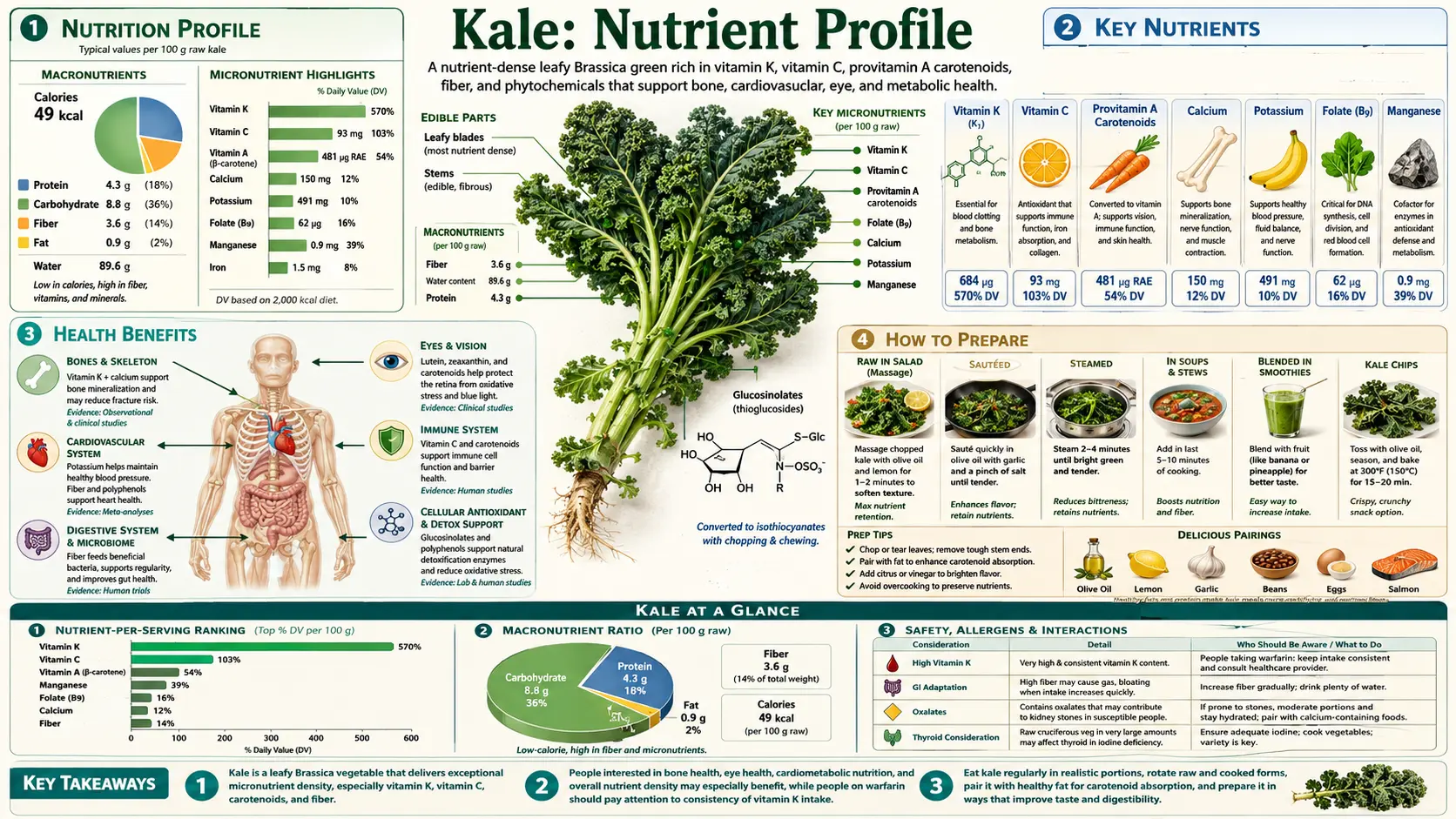
What is Kale richest in? Below are the vitamins, minerals and amino acids that 100 g of boiled kale (cooked, drained, without salt) delivers in the highest amounts, as listed in USDA FoodData Central. Each one links to that nutrient’s own page listing the best foods to get it from.
| Kale: Richest Nutrients (per 100 g, boiled) | ||||
|---|---|---|---|---|
| Rank | Nutrient | Per 100 g | %DV / 100g | Role in the body |
| Vitamins | ||||
| 1 | Vitamin K | 418.5 mcg | 🟢 349% | Blood clotting; bone role under study |
| 2 | Vitamin C | 17.8 mg | 🟡 20% | Antioxidant; builds collagen |
| 3 | Vitamin B9 (Folate) | 65 mcg DFE | 🟡 16% | DNA & red blood cells |
| 4 | Vitamin A | 146 mcg RAE | 🟡 16% | Low-light vision, skin & tissues |
| 5 | Vitamin B2 (Riboflavin) | 0.14 mg | 🟡 11% | Energy release; red blood cells |
| 6 | Vitamin E | 1.61 mg | 🟡 11% | Protects cells (antioxidant) |
| Minerals | ||||
| 1 | Manganese | 0.542 mg | 🟡 24% | Needed by many enzymes |
| 2 | Calcium | 150 mg | 🟡 12% | Bones, teeth, muscles & nerves |
| Amino Acids — ranked by amount (no Daily Value) | ||||
| 1 | Glutamic acid | 0.332 g | 🟢 | Nonessential |
| 2 | Aspartic acid | 0.263 g | 🟢 | Nonessential |
| 3 | Leucine | 0.205 g | 🟢 | Essential |
| 4 | Lysine | 0.176 g | 🟢 | Essential |
| 5 | Isoleucine | 0.176 g | 🟢 | Essential |
| 6 | Proline | 0.174 g | 🟢 | Conditionally essential |
| 7 | Histidine | 0.172 g | 🟢 | Essential |
| 8 | Arginine | 0.163 g | 🟡 | Conditionally essential |
| 9 | Valine | 0.160 g | 🟡 | Essential |
| 10 | Phenylalanine | 0.150 g | 🟡 | Essential |
| 11 | Alanine | 0.148 g | 🟡 | Nonessential |
| 12 | Glycine | 0.141 g | 🟡 | Conditionally essential |
| 13 | Threonine | 0.131 g | 🟡 | Essential |
| 14 | Serine | 0.124 g | 🟡 | Conditionally essential |
Source and method. The amounts above are the USDA FoodData Central SR Legacy record FDC 169238, “Kale, cooked, boiled, drained, without salt”. %DV = the amount per 100 g ÷ the adult Daily Value in 21 CFR 101.9 (vitamin K 120 mcg, vitamin C 90 mg, folate 400 mcg DFE, vitamin A 900 mcg RAE, riboflavin 1.3 mg, vitamin E 15 mg, manganese 2.3 mg, calcium 1,300 mg). Vitamins and minerals are listed when 100 g supplies at least 10% of the Daily Value; amino acids have no Daily Value. The raw-kale record, FDC 168421, “Kale, raw”, lists different amounts per 100 g — vitamin K 389.6 mcg, vitamin C 93.4 mg, vitamin A 241 mcg RAE, calcium 254 mg, manganese 0.92 mg, lutein + zeaxanthin 6,261 mcg (6.26 mg) — and these raw figures are the ones on the Kale main page. USDA gives one cup of raw kale as 21 g and one cup of boiled kale as 118 g.
Roles in the body are summarized from the MedlinePlus Medical Encyclopedia entries on vitamin K, vitamin C, folate, vitamin A, riboflavin, vitamin E, calcium and amino acids (which also gives the essential / nonessential / conditionally essential grouping; it lists arginine, glycine, proline and serine as both nonessential and conditionally essential), and for manganese from the Nordic Nutrition Recommendations 2023 scoping review (Kippler 2024, PMID: 38327991), which describes it as an essential trace element required for multiple enzymes.