Pork: Nutrient Profile
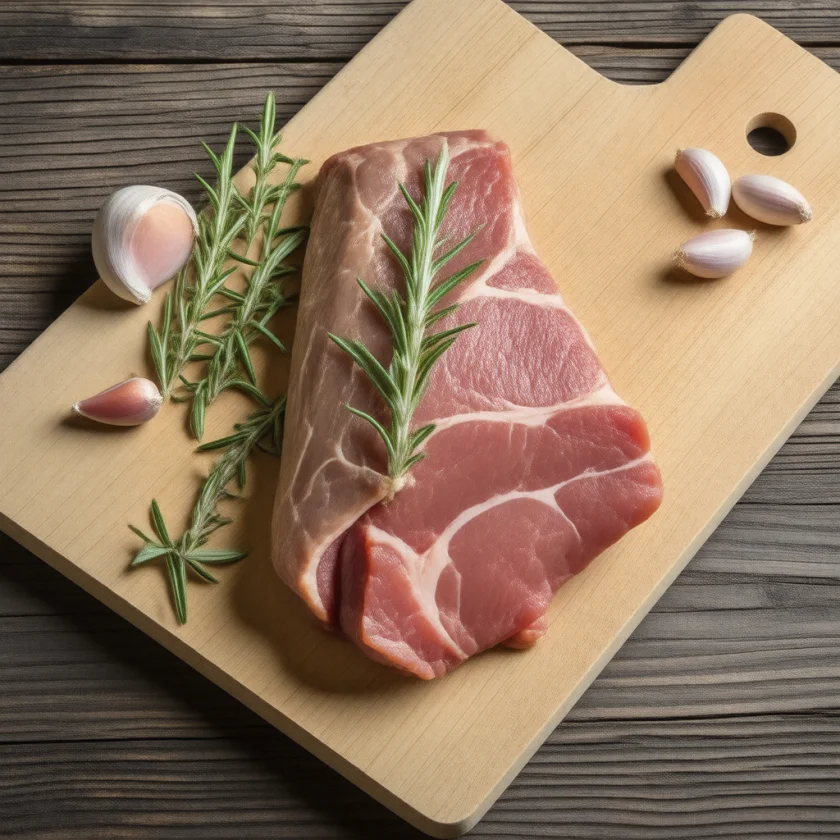
What is Pork richest in? Below are the vitamins, minerals and amino acids that 100 g of Pork delivers in the highest amounts. Each one links to that nutrient’s own page listing the best foods to get it from.
| Pork: Richest Nutrients (per 100 g) | ||||
|---|---|---|---|---|
| Rank | Nutrient | Per 100 g | %DV / 100g | Purpose |
| Vitamins | ||||
| 1 | Vitamin B1 (Thiamine) | 0.5 mg | 🟡 46% | Turns carbs into energy |
| 2 | Vitamin B3 (Niacin) | 7.1 mg | 🟡 44% | Energy, skin & nerves |
| 3 | Vitamin B6 | 0.7 mg | 🟡 41% | Brain & metabolism |
| 4 | Vitamin B12 | 0.6 mcg | 🟡 24% | Nerves & red blood cells |
| 5 | Vitamin B2 (Riboflavin) | 0.2 mg | 🟡 18% | Energy & cell health |
| 6 | Choline | 76 mg | 🟡 14% | Brain & liver |
| 7 | Vitamin B5 (Pantothenic Acid) | 0.7 mg | 🟡 13% | Energy metabolism |
| Minerals | ||||
| 1 | Selenium | 35 mcg | 🟢 63% | Antioxidant & thyroid |
| 2 | Zinc | 2.1 mg | 🟡 19% | Immunity & healing |
| 3 | Phosphorus | 223 mg | 🟡 18% | Bones & cellular energy |
| Amino Acids — ranked by amount (no Daily Value) | ||||
| 1 | Glutamic acid | 4.2 g | 🟢 | Brain signaling (glutamate) |
| 2 | Aspartic acid | 2.6 g | 🟢 | Cellular energy & detox |
| 3 | Lysine | 2.5 g | 🟢 | Collagen & immunity |
| 4 | Leucine | 2.2 g | 🟢 | Builds muscle (branched-chain amino acid, BCAA) |
| 5 | Arginine | 1.8 g | 🟡 | Blood flow (nitric oxide) |
| 6 | Alanine | 1.6 g | 🟡 | Energy (glucose cycle) |
| 7 | Valine | 1.4 g | 🟡 | Muscle & energy (branched-chain amino acid) |
| 8 | Isoleucine | 1.3 g | 🟡 | Muscle & energy (branched-chain amino acid) |
| 9 | Threonine | 1.2 g | 🟡 | Collagen & gut lining |
| 10 | Glycine | 1.2 g | 🟡 | Collagen, calm & sleep |
| 11 | Histidine | 1.1 g | 🟡 | Histamine & blood |
| 12 | Serine | 1.1 g | 🟡 | Cell membranes & brain |
| 13 | Phenylalanine | 1.1 g | 🟡 | Dopamine & focus |
| 14 | Proline | 1.1 g | 🟡 | Collagen & joints |
Values are per 100 g of the U.S. Department of Agriculture (USDA) FoodData Central record FDC 167842, “Pork, fresh, loin, top loin (roasts), boneless, separable lean and fat, cooked, roasted” (SR Legacy). %DV is the amount per 100 g divided by the adult Daily Value in 21 CFR 101.9.
Food Safety of Undercooked Pork
Trichinellosis is a parasitic disease caused by Trichinella roundworms; people catch it by eating raw or undercooked meat that carries the worm’s larvae. Its common signs are a raised count of eosinophils (a type of white blood cell), fever, swelling around the eyes and muscle pain.
In US surveillance from 2008 to 2012, 84 confirmed cases were analysed, a median of 15 cases a year (0.1 cases per million people a year). Pork products were linked to 22 cases (26%): 10 to commercial pork, 6 to wild boar, 1 to home-raised pigs and 5 unspecified. Meats other than pork were linked to 45 cases (54%), 41 of them to bear meat, and the source of 17 cases (20%) was unknown. Of the 51 patients whose way of cooking the meat was reported, 24 (47%) had eaten raw or undercooked meat. The report states that the risk from commercial pork in the US has fallen substantially since the 1940s, when data collection began (Wilson and colleagues, 2015).
Key Research Papers
- Wilson NO, Hall RL, Montgomery SP, Jones JL (2015). Trichinellosis surveillance — United States, 2008–2012. MMWR Surveillance Summaries; 64(1):1–8. — PubMed PMID: 25590865