Mango
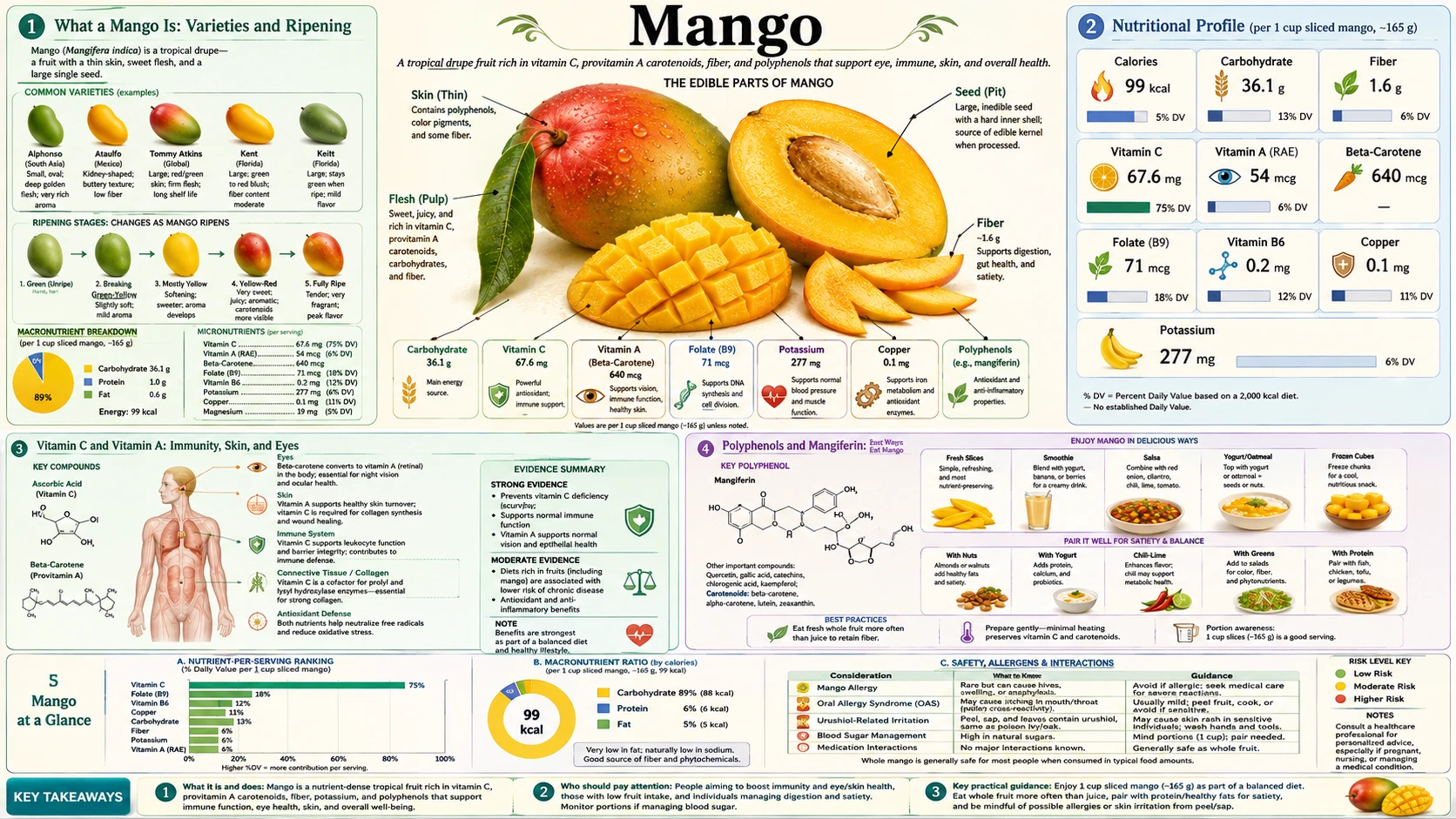
The mango (Mangifera indica) is often called the "king of fruits," and once you have eaten a perfectly ripe one, dripping down to the elbow, the title feels earned. It has been grown in India and Southeast Asia for more than four thousand years, woven into festivals, folklore, and everyday kitchens, and today it is one of the most widely eaten fruits on Earth. Beyond the sheer pleasure of it, a mango is a genuinely nourishing food: a single cup delivers roughly two-thirds of a day's vitamin C, a useful helping of vitamin A precursors, folate, fiber, copper, and vitamin E, plus a family of plant polyphenols led by a compound called mangiferin. This page walks through what mango is, what it actually contains, and which of its reputed health benefits are backed by solid human evidence versus which are still mostly promising laboratory findings. We will be honest throughout: mango is a sweet fruit with real natural sugar, and a few people who react to poison ivy can react to its skin and sap. But for the vast majority of us, it is a delicious, well-rounded whole food that earns a regular place on the plate.
Table of Contents
- What a Mango Is: Varieties and Ripening
- Nutritional Profile
- Vitamin C and Vitamin A: Immunity, Skin, and Eyes
- Polyphenols and Mangiferin
- Digestion, Fiber, and Enzymes
- Mango and Blood Sugar
- The Gut and the Microbiome
- How to Choose, Ripen, and Cut a Mango
- Safety, Urushiol, and Who Should Be Careful
- Research Papers
- Connections
- Featured Videos
What a Mango Is: Varieties and Ripening
A mango is the stone fruit of a large evergreen tree in the cashew family, the Anacardiaceae. That family membership matters later, when we talk about skin sensitivity, but it also explains the fruit's rich, resinous perfume. Inside the smooth skin is a soft, golden-orange flesh wrapped around a single flat pit. There are hundreds of named varieties, and they are not interchangeable — a mango is less one flavor than a whole spectrum of them, from piney and tart to honeyed and floral.
A few types you are most likely to meet at the market:
- Alphonso — the celebrated Indian variety, deeply aromatic, nearly fiberless, with a saffron-colored flesh. It has a short season (roughly spring into early summer) and a devoted following.
- Ataulfo (sold as Honey or Champagne mango) — small, kidney-shaped, buttery-smooth, and very sweet, with a thin pit. A great everyday choice.
- Tommy Atkins — the sturdy red-blushed mango that dominates supermarket shelves because it ships and stores well. It is firmer and more fibrous, and its color does not reliably tell you when it is ripe.
- Others you may find include Kent, Keitt, Haden, and Francis, each with its own texture and sweetness.
Ripening is part of the magic. A mango picked mature-but-firm continues to soften after harvest: enzymes break down starch into sugar and dissolve the pectin that keeps the flesh firm, so the fruit grows sweeter, juicier, and more fragrant over several days at room temperature. This is why a rock-hard mango is not a bad mango — it is simply an early one. It also means the nutrient content shifts with variety, growing region, and ripeness, so no two mangoes are nutritionally identical (Manthey and Perkins-Veazie, 2009).
Nutritional Profile
Mango is mostly water and carbohydrate, with very little fat or protein — which is exactly what you would expect from a sweet fruit. What sets it apart is the density of vitamins and plant compounds packed into those carbohydrates. The numbers below are approximate, for about one cup of diced fresh mango (roughly 165 grams); a whole medium fruit is close to a cup and a half.
Per cup of mango you get, in round numbers:
- About 100 calories, almost entirely from carbohydrate.
- Around 25 grams of carbohydrate, of which roughly 23 grams are naturally occurring sugars and about 2.6 grams are fiber.
- Vitamin C: about 60 mg — roughly two-thirds of an adult's daily target, and one of mango's standout features.
- Vitamin A: about 89 micrograms RAE (near 10% of the Daily Value), delivered as beta-carotene and beta-cryptoxanthin that your body converts as needed.
- Folate: about 70 micrograms (around 18% of the Daily Value), an unusually good amount for a fruit.
- Copper: about 0.2 mg (roughly 20% of the Daily Value), a mineral many people fall short on.
- Vitamin E: about 1.5 mg (around 10% of the Daily Value) — notable, because most fruits contain almost none.
- Vitamin B6 (about 11% of the Daily Value), plus smaller amounts of potassium, magnesium, niacin, and vitamin K.
On top of the vitamins, mango carries a broad set of polyphenols and carotenoids — mangiferin, gallotannins, quercetin, and the orange pigments that give the flesh its color (Masibo and He, 2008; Lauricella et al., 2017). These are not counted on a nutrition label, but they are a real part of why researchers keep studying the fruit. It is worth being plain about the sugar: nearly all of a mango's carbohydrate is sugar, so it is a sweet fruit. The difference from a candy bar is that mango's sugar arrives wrapped in fiber, water, vitamin C, and antioxidants, which changes how your body handles it — more on that below.
Vitamin C and Vitamin A: Immunity, Skin, and Eyes
Mango's headline nutrient is vitamin C. This is one of the reasons the fruit was historically prized by sailors and travelers: it is a rich, portable source. Vitamin C is a genuine essential nutrient, and its jobs are well established rather than speculative. It helps your immune cells work properly, it is required to build collagen (the protein scaffolding of skin, blood vessels, gums, and healing wounds), and it acts as a water-soluble antioxidant that helps recycle other antioxidants. A single serving of mango covering most of a day's vitamin C is a real, measurable contribution — not a marketing claim.
The vitamin A story is a little more nuanced, and pleasingly so. Mango does not contain preformed vitamin A; instead it supplies provitamin-A carotenoids such as beta-carotene and beta-cryptoxanthin, which your body converts into active vitamin A according to its needs. This built-in regulation is a safety feature: unlike high-dose retinol supplements, you cannot overdose on vitamin A by eating carotene-rich fruit, because the conversion slows down when your stores are full. Vitamin A supports normal vision (especially seeing in dim light), the health of the surfaces that line your eyes, airways, and gut, and normal immune function. How efficiently any individual converts beta-carotene varies from person to person, so mango is best thought of as a helpful contributor to vitamin A status rather than a guaranteed full dose.
Because the carotenoids are fat-soluble, you absorb them better alongside a little fat — a few nuts, a spoon of yogurt, or a drizzle of coconut in a smoothie all help. The carotenoids also double as antioxidant pigments, which links directly into the next section.
Polyphenols and Mangiferin
If vitamin C is mango's famous nutrient, mangiferin is its most interesting one. Mangiferin is a xanthone polyphenol found throughout the mango tree — concentrated in the peel, seed kernel, bark, and leaves, with smaller amounts in the flesh. It has become a favorite of laboratory researchers because, in test tubes and animal models, it behaves as a potent antioxidant and anti-inflammatory agent, and it has been probed for effects on blood sugar, blood fats, and even cancer-cell pathways (Imran et al., 2017; Saha et al., 2016; Gold-Smith et al., 2016).
Here honesty is important. Most of what we know about mangiferin comes from preclinical work — cells in a dish and studies in mice and rats — and often uses concentrated extracts at doses far higher than you would ever get from eating the fruit. That research is genuinely promising and worth following, but it is not the same as proof that eating mango treats or prevents any disease in people. A few human trials do exist: a double-blind randomized study found that a purified mangiferin supplement improved cholesterol and triglyceride levels in overweight adults with high blood lipids (Na et al., 2015). Notice the word "supplement" — that trial used isolated mangiferin, not slices of mango, so it tells us more about the compound than about the fruit on your cutting board.
Alongside mangiferin, mango's flesh contains gallotannins, quercetin, and other polyphenols, plus the carotenoid pigments (Masibo and He, 2008). Together these give mango a respectable antioxidant capacity among common fruits (Septembre-Malaterre et al., 2016). The sensible takeaway: enjoy mango as a tasty, antioxidant-rich whole food, and treat the more dramatic mangiferin headlines as early science rather than settled medicine.
Digestion, Fiber, and Enzymes
Mango is often described as a digestive fruit, and part of that reputation is well earned. The most reliable digestive benefit is simply its fiber — a mix of soluble and insoluble types, including pectin, that adds bulk and softness to stool and feeds the bacteria in your colon. That is not a small thing: a well-designed human study found that people with constipation who ate mango daily had more improvement in their symptoms than people who took an equivalent amount of fiber alone, hinting that mango's polyphenols and fiber work together rather than fiber doing all the lifting (Venancio et al., 2018).
What about the "mango is full of digestive enzymes" claim you sometimes hear? This is where a little skepticism helps. Mango does contain amylase enzymes, but their main role is inside the ripening fruit itself, where they break starch down into sugar — which is precisely why a mango grows sweeter as it softens. Whether the small amount of enzyme you swallow meaningfully aids your digestion is far less certain, and mango does not carry a powerful protein-digesting enzyme the way papaya carries papain. So it is fair to say mango is gentle and pleasant on the stomach and its fiber genuinely supports regularity, but the "enzyme" angle is more folklore than established fact. The honest headline is: eat mango for its fiber and its taste, not as a digestive medicine.
Mango and Blood Sugar
Because mango is sweet, a reasonable question is whether it spikes blood sugar, especially for people with diabetes or prediabetes. The reassuring news is that whole mango has a low-to-moderate glycemic index — typically reported around the low 50s — meaning it raises blood sugar more gently than its sweetness might suggest. The reason is the packaging: the fiber, water, and polyphenols in the whole fruit slow the release of its natural sugars, so they enter the bloodstream more gradually than the sugar in juice or soda would.
There is even a hint that mango may be actively helpful in the right context — and it is worth stating the study precisely, because the way this finding usually gets quoted is more impressive than the study itself. Twenty obese adults took 10 g a day of ground freeze-dried mango pulp for 12 weeks. Fasting blood glucose fell by 4.45 mg/dL in the men and 3.56 mg/dL in the women, with no change in body weight or body composition (Evans et al., Nutr Metab Insights. 2014;7:77–84; PMID 25210462). Note what that is: a single-arm pilot with no control group and no placebo, twenty people, and a glucose change of about four points. The same group later found no effect of the same supplement on inflammatory markers or lipids. So the honest reading is that mango did not make blood sugar worse and may nudge it slightly better — a reassuring result rather than a therapeutic one, and consistent with the broader picture that whole fruit behaves very differently from refined sugar.
Practical, honest guidance if you are watching your blood sugar:
- Mind the portion. A whole large mango is closer to a cup and a half of sugar-containing fruit; a half-mango or a cup of pieces is an easier serving to manage.
- Eat it whole, not as juice. Juicing strips the fiber and concentrates the sugar — the two things that make whole mango gentler.
- Pair it with protein or fat. Mango with a handful of nuts, plain yogurt, or cottage cheese blunts the rise further and keeps you full.
- Use your own meter. People respond differently; if you have diabetes, checking your glucose after mango tells you more than any general rule.
For most people without diabetes, none of this requires much thought — mango is a whole fruit and fits comfortably in a balanced diet.
The Gut and the Microbiome
Some of the freshest mango research looks past individual nutrients to the gut microbiome, the community of trillions of bacteria in your intestines. Mango's fiber and polyphenols are not fully absorbed in the small intestine; a good share travels onward to the colon, where resident bacteria ferment them. This is a two-way street: the fibers and polyphenols can nourish beneficial microbes, and the microbes in turn transform mango's polyphenols (particularly its gallotannins) into smaller compounds your body can actually absorb.
Early human studies are encouraging but small. In a pilot trial in people with inflammatory bowel disease, daily mango was associated with lower levels of several inflammatory signaling proteins in the blood and an increase in beneficial Lactobacillus bacteria (Kim et al., 2020). A separate study tracking adults over six weeks of mango consumption found that the fruit shifted the makeup of the gut bacteria and that body size influenced how much of mango's polyphenol metabolites reached the bloodstream (Barnes et al., 2019).
These are exactly the kind of findings that deserve enthusiasm tempered with caution: the studies are small, short, and preliminary, and no one should treat mango as a therapy for gut disease. But they point in a hopeful direction — that mango is a genuinely "microbiome-friendly" fruit — and they are a good example of nutrition science moving beyond the vitamin label to ask how a whole food behaves inside a living gut.
How to Choose, Ripen, and Cut a Mango
Picking a good mango is less about color than most people think. Depending on the variety, a ripe mango may be green, yellow, orange, or red, so trust your nose and your hands, not the hue.
- Smell the stem end. A ripe mango gives off a sweet, fruity fragrance right where it was attached to the tree. Little or no smell means it needs more time; a fermented, boozy smell means it is past its best.
- Give it a gentle squeeze. Like a ripe avocado or peach, it should yield slightly to soft pressure without being mushy or leaking.
- Ignore small speckles. Freckles and a bit of skin wrinkling near the stem often signal sweetness, not spoilage.
To ripen a firm mango, leave it on the counter at room temperature for a few days; putting it in a paper bag with a banana or apple speeds things up, because those fruits release ethylene gas that hastens ripening. Do not refrigerate an unripe mango — cold stalls ripening and can give the flesh a dull, chilled-off flavor. Once it is ripe and fragrant, the fridge will hold it for a few more days.
To cut it, stand the mango on end and slice down either side of the flat central pit to remove the two plump "cheeks." Score the flesh of each cheek in a crosshatch grid without cutting through the skin, then push the skin inward so the cubes pop up like a hedgehog and slice them free. Trim whatever clings to the pit as the cook's reward. Ripe mango is wonderful raw, but it also shines in smoothies, salsa with lime and chili, yogurt bowls, salads, and the classic Indian lassi. Green (unripe) mango is a different pleasure entirely — tart and crunchy, it stars in salads, pickles, and chutneys across South and Southeast Asia.
Safety, Urushiol, and Who Should Be Careful
For nearly everyone, mango is a very safe, well-tolerated food. There are only a couple of caveats worth knowing, and the first is genuinely interesting.
Remember that mango belongs to the cashew family, the Anacardiaceae — the same botanical family as poison ivy, poison oak, cashew, and pistachio. The peel and the sap of the mango contain urushiol and closely related resinous compounds, the very oils that cause the itchy, blistering rash of poison ivy. In people who have become sensitized to poison ivy or poison oak, contact with mango skin or sap — typically around the lips and mouth, or on the hands while peeling — can trigger an allergic contact dermatitis, sometimes days after exposure. Laboratory work has confirmed that mango's contact allergens genuinely cross-react with urushiol, so this is a real phenomenon and not a myth (Oka et al., 2004). The important reassurance is that the flesh is generally fine even for sensitive people, because the reactive oils are concentrated in the skin and sap. If you know you react to poison ivy, have someone else peel your mango, or peel it yourself with gloves and wash your hands afterward, and simply avoid letting the skin touch your face.
A distinct and much rarer issue is a true IgE-mediated food allergy to mango, which can cause hives, mouth itching, or in very unusual cases a more serious reaction; people allergic to certain pollens or to other Anacardiaceae fruits are slightly more likely to be affected. This is uncommon, but anyone with a known fruit or tree-nut allergy should introduce mango thoughtfully.
Beyond those, the honest list of concerns is short. Mango is a sugar-containing fruit, so people managing diabetes should watch portions as described above, and anyone counting calories should remember that dried mango and mango juice are far more concentrated than the fresh fruit. Eating a great deal of any high-fiber fruit at once can cause temporary gas or loose stools. But for the ordinary eater, a ripe mango is one of the safest, friendliest, and most delightful foods you can put on your plate.
Research Papers
- Lauricella M, Emanuele S, Calvaruso G, et al. Multifaceted Health Benefits of Mangifera indica L. (Mango): The Inestimable Value of Orchards Recently Planted in Sicilian Rural Areas. Nutrients. 2017;9(5):525. doi:10.3390/nu9050525 — a broad review of mango's nutrients, polyphenols, and reported health effects.
- Masibo M, He Q. Major Mango Polyphenols and Their Potential Significance to Human Health. Comprehensive Reviews in Food Science and Food Safety. 2008;7(4):309-319. doi:10.1111/j.1541-4337.2008.00047.x — catalogs mango's polyphenols, including mangiferin and the gallotannins.
- Imran M, Arshad MS, Butt MS, et al. Mangiferin: a natural miracle bioactive compound against lifestyle related disorders. Lipids in Health and Disease. 2017;16(1):84. doi:10.1186/s12944-017-0449-y — reviews mangiferin's antioxidant and metabolic activity, mostly from lab and animal work.
- Gold-Smith F, Fernandez A, Bishop K. Mangiferin and Cancer: Mechanisms of Action. Nutrients. 2016;8(7):396. doi:10.3390/nu8070396 — summarizes preclinical anticancer mechanisms; not evidence of effect in people.
- Saha S, Sadhukhan P, Sil PC. Mangiferin: A xanthonoid with multipotent anti-inflammatory potential. BioFactors. 2016;42(5):459-474. doi:10.1002/biof.1292 — reviews mangiferin's anti-inflammatory pathways in cell and animal models.
- Evans SF, Meister M, Mahmood M, et al. Mango Supplementation Improves Blood Glucose in Obese Individuals. Nutrition and Metabolic Insights. 2014;7:77-84. doi:10.4137/NMI.S17028 — a small human study; daily mango was linked to lower fasting glucose.
- Na L, Zhang Q, Jiang S, et al. Mangiferin supplementation improves serum lipid profiles in overweight patients with hyperlipidemia: a double-blind randomized controlled trial. Scientific Reports. 2015;5:10344. doi:10.1038/srep10344 — an RCT of concentrated mangiferin (not mango flesh) that improved blood lipids.
- Venancio VP, Kim H, Sirven MA, et al. Polyphenol-rich Mango (Mangifera indica L.) Ameliorate Functional Constipation Symptoms in Humans beyond Equivalent Amount of Fiber. Molecular Nutrition & Food Research. 2018;62(12):e1701034. doi:10.1002/mnfr.201701034 — mango eased constipation more than a matched dose of fiber alone.
- Kim H, Venancio VP, Fang C, et al. Mango (Mangifera indica L.) polyphenols reduce IL-8, GRO, and GM-CSF plasma levels and increase Lactobacillus species in a pilot study in patients with inflammatory bowel disease. Nutrition Research. 2020;75:85-94. doi:10.1016/j.nutres.2020.01.002 — a small pilot in which mango lowered inflammatory markers and favored beneficial bacteria.
- Barnes RC, Kim H, Fang C, et al. Body Mass Index as a Determinant of Systemic Exposure to Gallotannin Metabolites during 6-Week Consumption of Mango (Mangifera indica L.) and Modulation of Intestinal Microbiota in Lean and Obese Individuals. Molecular Nutrition & Food Research. 2019;63(2):e1800512. doi:10.1002/mnfr.201800512 — mango shifted the gut microbiota and its polyphenol-metabolite exposure varied with body size.
- Manthey JA, Perkins-Veazie P. Influences of Harvest Date and Location on the Levels of β-Carotene, Ascorbic Acid, Total Phenols, the in Vitro Antioxidant Capacity, and Phenolic Profiles of Five Commercial Varieties of Mango. Journal of Agricultural and Food Chemistry. 2009;57(22):10825-10830. doi:10.1021/jf902606h — shows how nutrient levels differ by mango variety, ripeness, and growing region.
- Oka K, Saito F, Yasuhara T, Sugimoto A. A study of cross-reactions between mango contact allergens and urushiol. Contact Dermatitis. 2004;51(5-6):292-296. doi:10.1111/j.0105-1873.2004.00451.x — confirms that mango's contact allergens cross-react with poison-ivy urushiol.
Connections
- All Food
- Papaya
- Avocado
- Vitamin C
- Vitamin A
- Vitamin E
- Folate (Vitamin B9)
- Beta-Carotene
- Antioxidants
- Copper
- Potassium