Dates
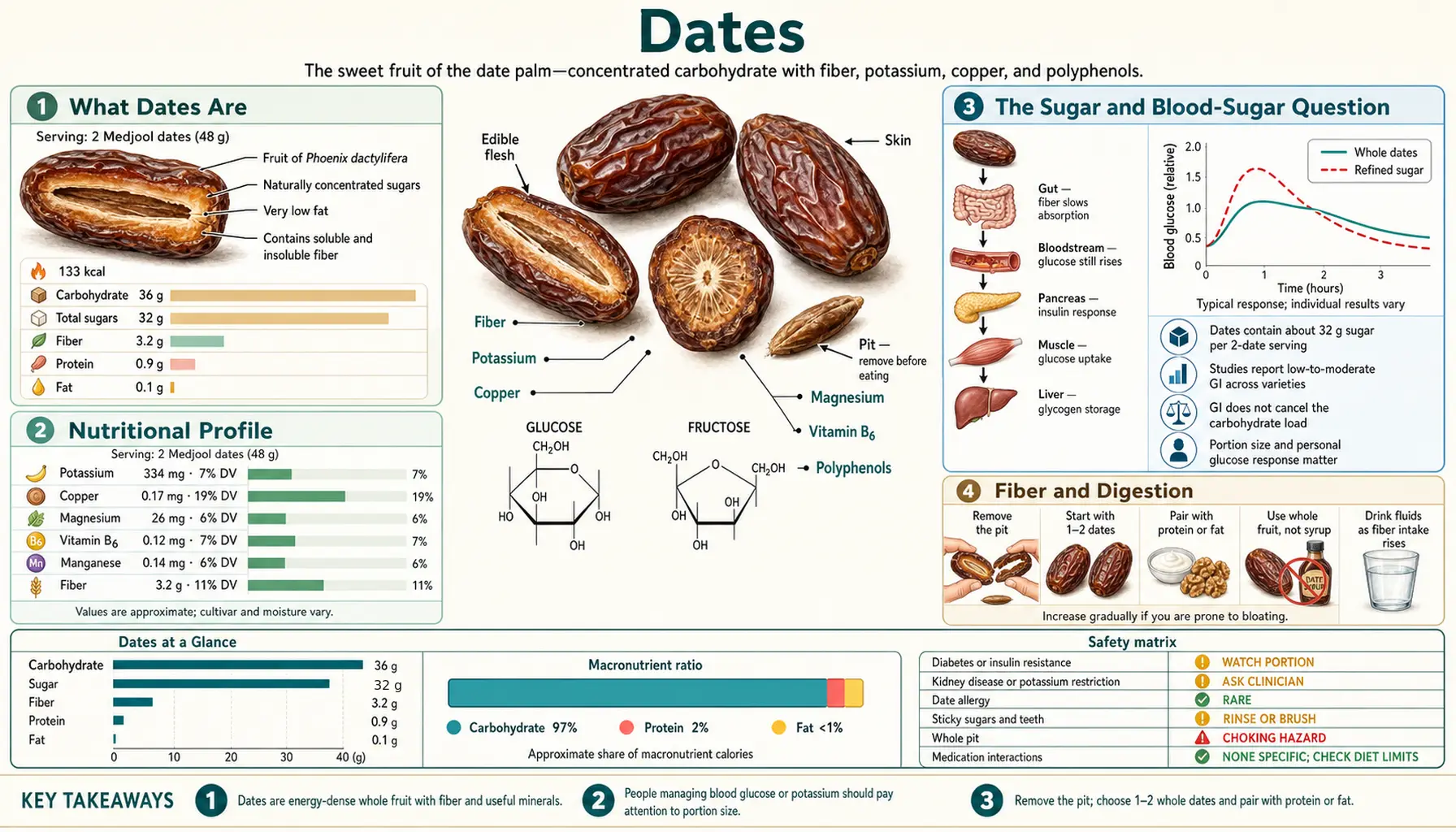
Dates are the sweet, chewy fruit of the date palm (Phoenix dactylifera), one of the oldest cultivated trees on Earth. People across the Middle East and North Africa have eaten them for thousands of years, and for good reason: a handful of dates is dense with energy, minerals, and fiber, and it tastes almost like caramel candy straight off the branch. That sweetness is also the honest catch — dates are very high in natural sugar, which understandably worries anyone watching their blood sugar. This page walks through what dates actually are, what is inside them, and the surprising research on how their sugar behaves in the body. It also covers the intriguing (but still small) studies on eating dates in late pregnancy, how to use them as a whole-food sweetener, and how to pick and store them. Throughout, the goal is plain and honest: dates are a nourishing food for most people in sensible amounts, not a miracle and not a villain.
Table of Contents
- What Dates Are
- Nutritional Profile
- The Sugar and Blood-Sugar Question
- Fiber and Digestion
- Antioxidants and Polyphenols
- Potassium, Magnesium, and the Heart
- Dates in Late Pregnancy and Labor
- Dates as a Natural Sweetener
- How to Select and Store Dates
- Safety and Cautions
- Research Papers
- Connections
- Featured Videos
What Dates Are
A date is a single-seeded fruit that grows in heavy hanging clusters on the date palm. Each fruit has thin skin, sweet flesh, and a hard central pit (the seed). As dates ripen on the tree they lose water and concentrate their sugars, which is why even a "fresh" date tastes intensely sweet and why so many dates reach us partly or fully dried.
Fresh, soft, and dried
Dates are usually sorted by how much moisture they hold:
- Soft dates — high moisture, tender and syrupy. Medjool is the famous example.
- Semi-dry dates — firmer and chewier, with less water. Deglet Noor is the classic.
- Dry (or "bread") dates — low moisture, firm, and long-keeping.
Most dates sold in Western supermarkets are naturally sun-dried or partly dried; they are not "dried fruit" in the sense of having added sugar or preservatives — the sweetness is simply the fruit's own concentrated sugar.
Medjool versus Deglet Noor
These are the two varieties most shoppers meet, and they are genuinely different fruits:
- Medjool — large, plump, soft, and deeply caramel-like. Often eaten out of hand or stuffed. Prized enough that it was historically called the "king of dates."
- Deglet Noor — smaller, firmer, drier, and a little less sweet, with an amber, translucent look. Common in baking and cooking, and often the date you find already pitted and chopped.
Beyond these two, hundreds of cultivars exist. Ajwa, Barhi, Khudri, Sukkari, and Zahidi are widely enjoyed across the Arabian Peninsula, and studies of many cultivars grown side by side show they vary noticeably in sugar, mineral, and antioxidant content.
An ancient food
The date palm was domesticated in the region of present-day Iraq and the Persian Gulf many thousands of years ago, and dates appear again and again in the history, art, and scripture of the Middle East and North Africa. In desert oases the tree was close to a complete life-support system: fruit for food, trunks and fronds for building and shade, and a reliable crop in harsh heat where little else would grow. Dates traveled with traders and pilgrims across North Africa and, much later, to the deserts of California and Arizona, where Medjool and Deglet Noor are now grown commercially. For countless generations of desert peoples, dates were not a treat but a staple.
Nutritional Profile
Dates are often called "nature's candy," and the label is fair — but it undersells them. Unlike table sugar, which delivers calories and nothing else, dates arrive packaged with fiber, a broad range of minerals, some B vitamins, and a generous dose of plant antioxidants. They are a calorie-dense whole food rather than empty sweetness.
What a serving gives you
Numbers shift a little by variety and moisture, but a typical medium Medjool date (about 24 grams) provides roughly:
- Calories: about 66–70.
- Sugar: around 16 grams — mostly glucose and fructose, the fruit's own natural sugars.
- Fiber: roughly 1.6 grams, a meaningful amount for such a small fruit.
- Protein: under 1 gram, with a little potassium, magnesium, and copper alongside.
Eat two or three dates and the minerals begin to add up.
The minerals and vitamins that stand out
- Potassium — dates are a genuinely rich source; a few of them rival a small banana. Potassium supports normal blood pressure and healthy nerve and muscle signaling.
- Magnesium — involved in hundreds of enzyme reactions, from energy production to muscle relaxation.
- Copper — needed to form red blood cells and connective tissue; dates are one of the better fruit sources.
- Manganese and a little iron — trace minerals present in useful amounts.
- B vitamins — modest amounts of B6, niacin, pantothenic acid, and folate.
- Polyphenol antioxidants — dates are among the more antioxidant-rich dried fruits, which is covered in its own section below.
So "nature's candy" is only half the story. Dates are sweet, yes, but they are also nutrient-dense in a way that refined sweeteners simply are not.
The Sugar and Blood-Sugar Question
This is the question almost everyone asks, so it deserves an honest, careful answer. Dates are high in sugar — there is no getting around that. By weight they are roughly two-thirds to three-quarters sugar. If sugar content were the whole story, dates would spike blood glucose dramatically.
The surprising part: a modest glycemic index
Here is where dates defy the expectation. Despite all that sugar, most common varieties have a low-to-moderate glycemic index — the glycemic index (GI) being a measure of how quickly a food raises blood glucose compared with pure glucose. In a well-known study, researchers tested five date varieties in both healthy people and people with type 2 diabetes and found glycemic indices in roughly the low-to-mid range (about 44 to 53 on a 0–100 scale), with no sharp spike even in the diabetic participants (Alkaabi 2011). Other small feeding studies in healthy volunteers likewise found dates did not throw blood sugar or blood fats out of balance (Rock 2009).
Why the fiber and fruit matrix matter
How can a food this sweet behave so gently? A few reasons work together:
- Fiber slows things down. The fiber in dates slows how fast sugar is released and absorbed, blunting the spike.
- The fruit matrix. The sugar is bound inside intact plant cells and flesh, not dissolved in water as it is in juice or soda. Your gut has to break that structure down, which takes time.
- Fructose. A large share of a date's sugar is fructose, which has a lower immediate impact on blood glucose than glucose alone.
- Polyphenols. Date polyphenols may modestly influence how carbohydrates are digested and absorbed.
This is a good example of why whole foods behave differently than their isolated parts. The same amount of sugar as a spoon of syrup, wrapped inside a fibrous fruit, simply does not hit the bloodstream the same way.
What this means in practice — and the honest caveat
For most people, a few dates are a reasonable way to satisfy a sweet craving with real nutrition attached, and dates can sensibly stand in for refined sugar in recipes. But portion still matters, especially for people with diabetes. A "low GI" does not mean "eat unlimited amounts." Dates are calorie- and carbohydrate-dense, so a large handful is a large sugar load no matter how gently each date behaves. If you live with diabetes or prediabetes, treat dates as a measured carbohydrate: enjoy a couple, ideally paired with protein or fat (a date stuffed with a nut or nut butter is a classic pairing that slows absorption further), watch your own glucose response, and work the portion into your overall plan with your care team. The takeaway is balanced, not permissive: dates are a smarter sweet than candy, but they are still sweet.
Fiber and Digestion
For a small, sweet fruit, dates carry a respectable amount of dietary fiber — roughly 6 to 7 grams per 100 grams, most of it insoluble. That fiber does quiet, useful work in the gut.
- Regularity. Insoluble fiber adds bulk and helps move things through the digestive tract, which is why dates have a long folk reputation as a gentle remedy for constipation.
- Feeding good bacteria. Some of the fiber and polyphenols in dates reach the colon intact, where beneficial microbes ferment them. Controlled human studies have found that eating dates daily can nudge the gut environment in a favorable direction — supporting beneficial bacterial activity and increasing helpful short-chain fatty acids — and laboratory work suggests date polyphenols may reduce the growth of colon cancer cells (Eid 2014; Eid 2015).
- Steadier energy and appetite. Fiber slows digestion, which helps you feel full and keeps energy from crashing after the initial sweetness.
As with any fiber-rich food, if your diet is currently low in fiber, add dates gradually and drink water — a sudden large amount can cause gas or bloating.
Antioxidants and Polyphenols
Dates are one of the more antioxidant-dense dried fruits. Their color and depth of flavor come partly from polyphenols — plant compounds that help neutralize the reactive molecules ("free radicals") involved in aging and chronic disease.
The main families found in dates include:
- Flavonoids — including flavonols and related pigments that give dates their rich brown tones.
- Phenolic acids — such as ferulic, caffeic, and p-coumaric acids.
- Carotenoids — more concentrated in some varieties than others.
- Tannins — which contribute the slight astringency of firmer, drier dates.
Interestingly, drier dates often test higher in antioxidant concentration than the softest fresh ones, simply because the compounds are more concentrated as water leaves the fruit. Reviews of the chemistry and pharmacology of dates catalog a broad antioxidant and anti-inflammatory profile in laboratory and animal studies (Baliga 2011; Vayalil 2012; Khalid 2017). It is worth being honest about the limits here: most of this evidence comes from test-tube and animal work, not large human trials, so the sensible reading is that dates are a genuinely antioxidant-rich whole food — not a proven treatment for any disease.
Potassium, Magnesium, and the Heart
Two of the minerals dates supply most generously — potassium and magnesium — are exactly the ones tied to healthy blood pressure and a steady heartbeat.
- Potassium helps balance the effects of sodium and relaxes blood-vessel walls, which supports normal blood pressure. Many people fall short of the recommended intake, and dates are an easy, portable way to add some.
- Magnesium supports normal heart rhythm, muscle relaxation, and healthy blood-vessel function. It is another mineral that a lot of modern diets under-deliver.
Because dates provide these minerals with no added sodium and no cholesterol, and because their fiber and polyphenols may modestly support healthy blood fats, they fit naturally into a heart-friendly, whole-food pattern of eating. The honest framing: a few dates are a mineral-rich snack that supports cardiovascular health as part of an overall good diet — not a substitute for the basics of blood-pressure care.
Dates in Late Pregnancy and Labor
One of the most talked-about ideas about dates is that eating them in the last weeks of pregnancy may make labor easier. This is a case where the tradition is old, the early research is genuinely interesting, and the honest verdict is "promising but not proven."
What the studies suggest
Several small clinical trials, mostly from the Middle East, have had women eat a set number of dates (often around six or seven a day) during the final four weeks before their due date. The results have leaned encouraging:
- In an early and widely cited study, women who ate dates in late pregnancy arrived at the hospital with more favorable cervical readiness and were less likely to need medical induction than women who ate none; the first stage of labor also tended to be shorter (Al-Kuran 2011).
- A later trial found date-eaters had a somewhat higher chance of spontaneous labor and, in some measures, a reduced need for intervention, though not every outcome reached statistical significance (Razali 2017).
The proposed explanation is that compounds in dates may gently support cervical ripening and uterine tone toward the end of pregnancy, alongside providing easy energy for the work of labor.
How to read this honestly
These are small studies, they vary in quality, and the women were not always well matched between groups. That is why obstetric guidelines do not (yet) recommend dates as a medical intervention. What can be said fairly is this: for a healthy pregnancy, eating a few dates a day in the final weeks appears safe and inexpensive, and the early evidence hints it may modestly favor a smoother labor — but it is not a guarantee and not a replacement for prenatal care. Anyone with gestational diabetes, or advised to limit sugar, should check the amount with their midwife or doctor first, since dates are sugar-dense.
Dates as a Natural Sweetener
Because dates are sweet, fibrous, and whole, they make an excellent stand-in for refined sugar in the kitchen — and unlike white sugar, they bring minerals, fiber, and antioxidants along. This is one of the most practical, everyday uses of dates.
Date paste
The simplest homemade sweetener. Pit soft dates (Medjools are ideal), soak them in warm water for about ten minutes to soften, then blend with a splash of the soaking water until smooth. The result is a thick caramel-colored paste you can spoon into oatmeal, smoothies, energy balls, baked goods, and sauces in place of sugar or honey. It keeps in the refrigerator for a week or two.
Date syrup
A pourable version — sometimes called date molasses or, in the Middle East, silan — made by simmering and straining dates down into a dark, rich syrup. It is a traditional sweetener across the region, delicious drizzled over yogurt, dipped with bread and tahini, or used to sweeten drinks. Because it is still concentrated sugar, use it the way you would honey or maple syrup: for flavor, in modest amounts.
A sensible substitution
Swapping date paste for refined sugar upgrades the nutrition of a recipe and adds a gentle caramel depth. But keep perspective — date sweeteners are still sugar. They are a better kind of sweet, not a free pass to sweeten everything more heavily.
How to Select and Store Dates
Choosing good dates
- Look for plump, glossy, wrinkled (not cracked) fruit. A little wrinkling is normal and desirable; deep cracks or a dried-out, hard texture mean they are past their best.
- A dusting of white on the surface is usually fine. It is often crystallized natural sugar rising to the skin, not mold. Fuzzy or off-smelling spots, however, mean discard.
- Check whether they are pitted. Many dates are sold with the pit still inside — useful to know before you bite in or blend them.
- Softness by variety. Medjools should feel soft and yielding; Deglet Noor will be firmer and drier by nature.
Storing them
- Room temperature is fine for a few weeks in an airtight container, kept cool and out of direct sun.
- Refrigerate to keep them fresh for several months; the cold firms them up, which some people prefer.
- Freeze for very long storage — dates freeze well for a year or more and thaw quickly.
- If refrigerated dates seem stiff, let them come to room temperature or warm them briefly to bring back their soft, sticky texture.
Safety and Cautions
For the vast majority of people, dates are a very safe whole food. The cautions are common-sense and few.
- Sugar and calories. This is the main one. Dates are energy- and sugar-dense, so it is easy to eat a lot of calories quickly. People managing diabetes, prediabetes, or weight should mind their portion — a couple of dates, not a whole box — and ideally pair them with protein or fat.
- The pit is a choking hazard. Many dates contain a hard pit. Remove it before giving dates to children, and cut dates into small pieces for toddlers, as whole sticky dates can be a choking risk for very young kids. Never bite down hard on an unpitted date — the stone can crack a tooth.
- Dental health. Being sticky and sweet, dates can cling to teeth. Rinsing or brushing after eating them is a good habit.
- Rare sensitivities. Allergy to dates is uncommon but possible. Some dried dates may be treated with sulfites or contain traces of contaminants from processing; buying good-quality, minimally processed dates avoids most of this.
- Digestive adjustment. Because dates are fiber-rich, a sudden large amount can cause gas or loose stools in some people. Add them gradually.
Set against these small points, dates are a nourishing, naturally sweet food with a very long track record. Enjoyed in sensible amounts, they are a genuinely good thing to have in the pantry.
Research Papers
- Alkaabi JM, Al-Dabbagh B, Ahmad S, et al. Glycemic indices of five varieties of dates in healthy and diabetic subjects. Nutrition Journal. 2011;10:59. doi:10.1186/1475-2891-10-59 — the landmark study showing common date varieties have a low-to-moderate glycemic index, even in people with type 2 diabetes.
- Al-Kuran O, Al-Mehaisen L, Bawadi H, et al. The effect of late pregnancy consumption of date fruit on labour and delivery. Journal of Obstetrics and Gynaecology. 2011;31(1):29–31. doi:10.3109/01443615.2010.522267 — women eating dates in the last weeks had more favorable cervical readiness and less need for induction.
- Razali N, Mohd Nahwari SH, Sulaiman S, et al. Date fruit consumption at term: effect on length of gestation, labour and delivery. Journal of Obstetrics and Gynaecology. 2017;37(5):595–600. doi:10.1080/01443615.2017.1283304 — a later trial finding date-eaters more likely to enter spontaneous labor, though not every outcome was significant.
- Al-Farsi MA, Lee CY. Nutritional and functional properties of dates: a review. Critical Reviews in Food Science and Nutrition. 2008;48(10):877–887. doi:10.1080/10408390701724264 — a broad review of the sugars, fiber, minerals, and antioxidants that make up date fruit.
- Baliga MS, Baliga BRV, Kandathil SM, et al. A review of the chemistry and pharmacology of the date fruits (Phoenix dactylifera L.) Food Research International. 2011;44(7):1812–1822. doi:10.1016/j.foodres.2010.07.004 — catalogs the antioxidant, anti-inflammatory, and other bioactivities reported for dates.
- Vayalil PK. Date fruits (Phoenix dactylifera Linn): an emerging medicinal food. Critical Reviews in Food Science and Nutrition. 2012;52(3):249–271. doi:10.1080/10408398.2010.499824 — reviews dates as a nutrient-dense food with documented antioxidant activity, noting most disease evidence is preclinical.
- Assirey EAR. Nutritional composition of fruit of 10 date palm (Phoenix dactylifera L.) cultivars grown in Saudi Arabia. Journal of Taibah University for Science. 2015;9(1):75–79. doi:10.1016/j.jtusci.2014.07.002 — shows how sugar and mineral content vary meaningfully across date varieties.
- Eid N, Enani S, Walton G, et al. The impact of date palm fruits and their component polyphenols on gut microbial ecology, bacterial metabolites and colon cancer cell proliferation. Journal of Nutritional Science. 2014;3:e46. doi:10.1017/jns.2014.16 — date polyphenols favorably shifted gut bacteria and reduced colon cancer cell growth in laboratory models.
- Eid N, Osmanova H, Natchez C, et al. Impact of palm date consumption on microbiota growth and large intestinal health: a randomised, controlled, cross-over, human intervention study. British Journal of Nutrition. 2015;114(8):1226–1236. doi:10.1017/S0007114515002780 — a controlled human trial showing daily dates supported beneficial gut activity.
- Mohamed RMA, Fageer ASM, Eltayeb MM, et al. Chemical composition, antioxidant capacity, and mineral extractability of Sudanese date palm (Phoenix dactylifera L.) fruits. Food Science & Nutrition. 2014;2(5):478–489. doi:10.1002/fsn3.123 — documents the antioxidant capacity and mineral content of several date cultivars.
- Khalid S, Khalid N, Khan RS, et al. A review on chemistry and pharmacology of Ajwa date fruit and pit. Trends in Food Science & Technology. 2017;63:60–69. doi:10.1016/j.tifs.2017.02.009 — focuses on the well-studied Ajwa variety and its reported bioactive compounds.
- Rock W, Rosenblat M, Borochov-Neori H, et al. Effects of date (Phoenix dactylifera L., Medjool or Hallawi variety) consumption by healthy subjects on serum glucose and lipid levels and on serum oxidative status: a pilot study. Journal of Agricultural and Food Chemistry. 2009;57(17):8010–8017. doi:10.1021/jf901559a — healthy volunteers eating dates daily saw no worsening of blood sugar or blood fats and some antioxidant benefit.
Connections
- All Food
- Figs
- Prunes
- Bananas
- Honey
- Potassium
- Magnesium
- Copper
- Antioxidants
- Type 2 Diabetes
- Endocrinology