Brussels Sprouts
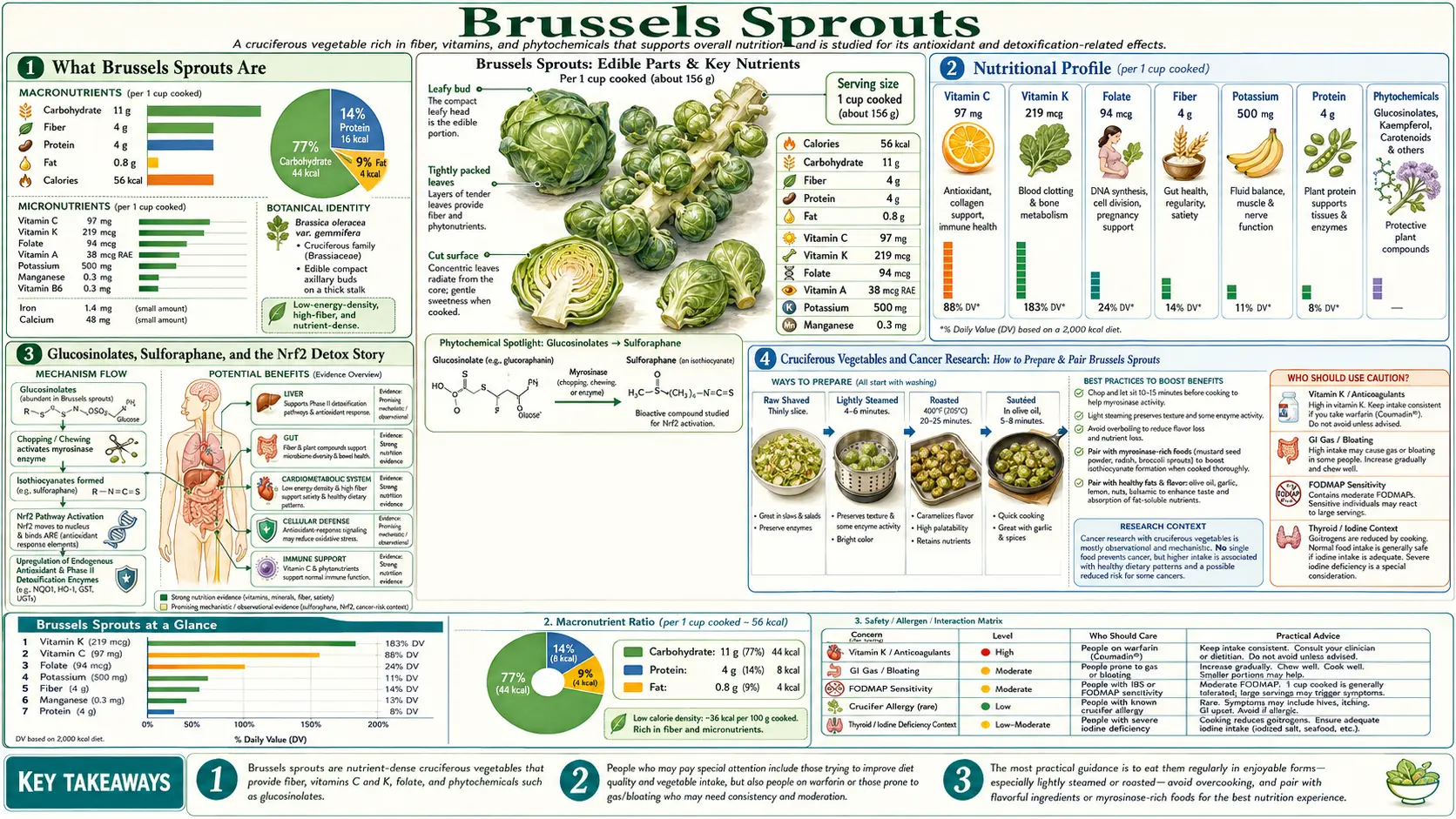
Brussels sprouts are the small, tightly wrapped green buds that grow in a spiral up a thick stalk — essentially miniature cabbages, and one of the most nutrient-dense vegetables you can put on a plate. They belong to the cruciferous (mustard) family, the same group as broccoli, kale, and cabbage, and they carry that family's most interesting trait: a set of sulfur compounds called glucosinolates that break down into biologically active substances when you chop or chew them. This page explains what Brussels sprouts are, walks through their nutrition in plain language, and looks honestly at the science — the strong signals for gut and heart health, the genuinely promising but still-unproven cancer research, and a couple of real cautions (the vitamin K interaction with the blood thinner warfarin, and the much-overstated thyroid question). We also cover the practical stuff that actually matters at the stove: why sprouts smell sulfurous when overcooked, and how to roast them so they turn sweet and nutty instead of bitter.
Table of Contents
- What Brussels Sprouts Are
- Nutritional Profile
- Glucosinolates, Sulforaphane, and the Nrf2 Detox Story
- Cruciferous Vegetables and Cancer Research
- Heart Health, Fiber, and Cholesterol
- Vitamin K and the Warfarin Interaction
- The Goitrogen and Thyroid Question
- Why They Taste Bitter — and How to Cook Them Well
- How to Select and Store
- Safety and Who Should Take Care
- Research Papers
- Connections
- Featured Videos
What Brussels Sprouts Are
Botanically, Brussels sprouts are a cultivated form of Brassica oleracea — the astonishingly versatile wild cabbage species that human breeders have, over centuries, coaxed into broccoli, cauliflower, kale, kohlrabi, collards, and ordinary head cabbage. Each of these is the same species; growers simply selected for a different exaggerated part of the plant. For Brussels sprouts the prized part is the axillary bud: the little cabbage-like sprout that forms where each leaf meets the main stem. A single plant produces dozens of these buds stacked in a tall column, which is why in farm stands and markets you sometimes see them still attached to the stalk.
The name is a genuine geographic clue — the vegetable was widely grown around Brussels, Belgium, and across the Low Countries from at least the 1500s and 1600s, and the modern name stuck. Today they are a cool-season crop, at their sweetest after the first light frosts of autumn, which is why they are a fixture of late-fall and winter cooking in much of Europe and North America. A little cold stress prompts the plant to convert some of its starches to sugars, measurably improving the flavor.
Like the rest of the cruciferous family, Brussels sprouts share a defining chemistry rather than a defining flavor: they store sulfur- and nitrogen-containing compounds called glucosinolates, and they keep, in a separate compartment of the plant cell, an enzyme called myrosinase. Nothing much happens until the tissue is damaged — by chopping, chewing, or chewing insects — at which point the enzyme meets the glucosinolate and produces the sharp, pungent breakdown products that give the whole family its bite. That single reaction is the thread running through most of this page.
Nutritional Profile
Brussels sprouts are low in calories and unusually rich in vitamins, fiber, and plant compounds for their size. A 100-gram serving of raw sprouts (a little under a cup) supplies roughly 43 calories, about 3.4 grams of protein, around 9 grams of carbohydrate, and close to 4 grams of dietary fiber, with almost no fat. Cooking concentrates them somewhat as they lose water, so a cooked cup delivers a bit more of everything by weight.
Their standout nutrients, per 100 grams raw (with approximate share of the FDA Daily Value):
- Vitamin C — about 85 mg, roughly 90–95% of a full day's requirement. Weight for weight, sprouts rival citrus. Vitamin C is water-soluble and heat-sensitive, so gentler, shorter cooking preserves more of it.
- Vitamin K1 (phylloquinone) — about 177 micrograms, roughly 145–150% of the Daily Value, and often more per cooked cup. This is one of the richest common food sources of vitamin K, which matters a great deal for anyone taking the blood thinner warfarin (see below).
- Folate (vitamin B9) — about 60 micrograms, roughly 15% of the Daily Value, important for cell division and especially in pregnancy.
- Dietary fiber — about 3.8 grams, roughly 14% of the Daily Value, a mix of soluble and insoluble fiber that feeds the gut microbiome and supports regularity.
- Potassium — about 390 mg, roughly 8% of the Daily Value, part of the mineral balance that helps regulate blood pressure.
- Provitamin A carotenoids — a modest amount of vitamin A activity plus the eye-protective carotenoids lutein and zeaxanthin, which concentrate in the retina.
- Manganese, vitamin B6, and small amounts of iron round out the mineral and B-vitamin content.
Beyond the vitamins on a nutrition label, Brussels sprouts carry a generous load of non-nutrient plant compounds worth naming separately:
- Glucosinolates — chiefly glucoraphanin (the precursor of sulforaphane) and glucobrassicin (the precursor of indole-3-carbinol). Brussels sprouts are among the higher-glucosinolate members of the cabbage family.
- Flavonoids and phenolic acids — antioxidant polyphenols such as kaempferol.
- Soluble fiber that binds bile acids in the gut, a mechanism connected to the modest cholesterol effect discussed later.
The short version: for very few calories, a serving of Brussels sprouts covers most of a day's vitamin C, overshoots vitamin K, and adds meaningful fiber, folate, potassium, and a distinctive package of protective plant chemistry.
Glucosinolates, Sulforaphane, and the Nrf2 Detox Story
The most-studied thing about Brussels sprouts is not a vitamin at all — it is what happens when their glucosinolates break down. When you cut or chew a sprout, the enzyme myrosinase converts the intact glucosinolate glucoraphanin into sulforaphane, an isothiocyanate, and converts glucobrassicin into indole-3-carbinol, which can further react in the stomach to form a compound called DIM. These breakdown products, not the parent glucosinolates, are the biologically interesting molecules.
Sulforaphane's headline mechanism is that it switches on a cellular defense system governed by a protein called Nrf2 (nuclear factor erythroid 2–related factor 2). In everyday terms, Nrf2 acts like a master control that turns up a cell's own protective and detoxifying machinery — the family of "phase II" enzymes that neutralize reactive molecules, help clear certain carcinogens, and replenish the cell's antioxidant defenses. Rather than acting as an antioxidant itself in the way vitamin C does, sulforaphane works one level up: it prompts the cell to make more of its own protective enzymes, an effect that lasts far longer than the compound itself remains in the body. Talalay and Fahey's foundational work described exactly this kind of indirect, long-lasting protection from cruciferous phytochemicals.
A practical wrinkle follows directly from the chemistry. Myrosinase is a protein, and heat destroys it. If sprouts are boiled hard from the start, much of the enzyme is inactivated before it can make sulforaphane, and some glucosinolates leach into the cooking water. The gut's own bacteria can perform some of the conversion, but far less efficiently. The takeaways for anyone eating sprouts specifically for these compounds are simple: chop them and let them rest a few minutes before cooking, favor steaming or quick roasting over prolonged boiling, and don't cook them to mush. None of this is essential for general nutrition — it is only relevant if the glucosinolate chemistry is your goal.
Cruciferous Vegetables and Cancer Research
This is the area where honesty matters most, because Brussels sprouts and their cruciferous relatives are frequently marketed as "anti-cancer" foods, and the truth is more nuanced — genuinely promising, but not proven at the level of a drug.
The mechanistic case is strong. In cell and animal studies, sulforaphane and indole-3-carbinol influence several processes relevant to cancer: they induce the phase II detox enzymes described above, help the body clear certain carcinogens before they can damage DNA, and can slow the growth of abnormal cells in the dish. Higdon and colleagues reviewed both the epidemiology and these mechanisms in detail. Two well-designed human trials from Qidong, China — a region with heavy dietary exposure to aflatoxin and airborne pollutants — showed that a broccoli-sprout beverage rich in glucoraphanin measurably increased the excretion of pollutant breakdown products in urine, direct human evidence that these foods can accelerate detoxification pathways.
The observational case is suggestive but mixed. Population studies that follow large groups over time often find that people who eat more cruciferous vegetables have somewhat lower rates of certain cancers, particularly colorectal, lung, and possibly breast cancer. Meta-analyses pooling these studies have reported modest inverse associations for colorectal and breast cancer. But these are correlations: people who eat a lot of vegetables also tend to smoke less, exercise more, and eat less processed food, and even careful statistics cannot fully separate the vegetable from the lifestyle. Some large studies find little or no association at all, and results vary by cancer type and by individual genetics — people carry different versions of the enzymes (the GST genes) that handle isothiocyanates, which may be one reason the vegetable seems to help some people more than others.
The randomized-trial case — the gold standard — is still thin. Feeding trials measuring actual cancer outcomes are enormously difficult to run, so most human trials measure biological markers rather than tumors. The ESCAPE trial, which fed men on prostate-cancer active surveillance a high-glucoraphanin broccoli soup for a year, found changes in gene-expression patterns in prostate tissue — encouraging biological movement, but not proof of prevented cancer. In short: the mechanisms are real and the population signals point the right way, but no one can honestly promise that eating Brussels sprouts prevents cancer. The reasonable, evidence-based conclusion is that a diet regularly including cruciferous vegetables is part of an overall eating pattern associated with better health, and that is reason enough to enjoy them.
Heart Health, Fiber, and Cholesterol
The cardiovascular story rests on firmer, if less glamorous, ground than the cancer story: fiber and overall dietary pattern. Brussels sprouts contribute soluble fiber, and soluble fiber has a well-established, modest cholesterol-lowering effect. It works mechanically in the gut: soluble fiber binds bile acids — which the body makes from cholesterol — and carries them out in the stool. To replace the lost bile acids, the liver pulls cholesterol out of the blood, nudging LDL ("bad") cholesterol down. Steamed Brussels sprouts appear to bind bile acids somewhat more effectively than the same sprouts eaten raw, one small practical argument for lightly cooking them.
Zooming out, the largest analyses of diet and heart disease consistently favor people who eat more vegetables. A major dose-response meta-analysis by Aune and colleagues found that higher fruit and vegetable intake was associated with lower risk of cardiovascular disease and all-cause mortality, with cruciferous and green leafy vegetables among the categories showing benefit. A prospective study in Chinese women specifically linked higher cruciferous-vegetable intake to lower total and cardiovascular mortality. These are still observational findings, but the consistency across large populations, combined with a plausible mechanism (fiber, potassium, folate, and a low calorie density that helps with weight), makes vegetables like Brussels sprouts a sensible part of a heart-protective diet. The potassium content also supports healthy blood pressure, working against the effect of dietary sodium.
Vitamin K and the Warfarin Interaction
This section is the single most practically important caution on the page, and it deserves plain, clear language because it involves a medication where the stakes are high.
Brussels sprouts are extraordinarily rich in vitamin K1 — a cooked cup can supply well over a day's worth. Vitamin K is essential for normal blood clotting. The common blood thinner warfarin (brand name Coumadin) works precisely by blocking vitamin K's clotting action; the drug and the vitamin are direct opponents. Because of that, a sudden change in how much vitamin K you eat can push warfarin out of its safe range: eating far more vitamin K than usual can make the drug less effective (raising clot risk), while suddenly eating far less can make it too strong (raising bleeding risk). Doctors track this balance with a blood test called the INR (derived from prothrombin time).
The crucial and often-misunderstood point is that people on warfarin do not need to avoid Brussels sprouts, kale, or other vitamin-K-rich greens. The goal is consistency, not avoidance. As Booth and Centurelli emphasized in their practical guidance for clinicians, keeping vitamin K intake steady from week to week lets the warfarin dose be tuned to that intake and stay stable. What causes trouble is the big swing — a person who normally eats no greens suddenly starting a daily kale-and-sprouts habit, or the reverse. If you take warfarin, the sensible plan is to eat a roughly steady amount of green vegetables, tell the clinician who manages your dose about your usual diet, and never make a dramatic change without letting them recheck your INR. Newer blood thinners (the DOACs, such as apixaban and rivaroxaban) do not interact with vitamin K, so this caution applies specifically to warfarin and similar vitamin-K-antagonist drugs.
The Goitrogen and Thyroid Question
Brussels sprouts, like other cruciferous vegetables, contain compounds sometimes labeled goitrogens — substances that can, in principle, interfere with the thyroid gland's ability to take up iodine and make thyroid hormone. This fact gets repeated online with far more alarm than the evidence justifies, so here is the honest, proportionate version.
The effect is real but small, and it depends heavily on dose and preparation. When glucosinolates break down they can yield thiocyanate and, from a specific glucosinolate called progoitrin, a compound named goitrin — both of which can modestly compete with iodine uptake. Felker and colleagues actually measured these compounds in people and in the vegetables and concluded that reaching a thyroid-affecting dose from ordinary cooked servings is unlikely for most people; you would need to eat very large amounts of raw cruciferous vegetables, day after day, to approach a meaningful effect. Two facts blunt the concern further: cooking substantially reduces goitrogenic compounds (heat inactivates myrosinase and drives off volatile products), and adequate iodine intake largely offsets the competition at the thyroid.
Who should actually pay attention? People with existing hypothyroidism or iodine deficiency, and those who consume very large quantities of raw cruciferous vegetables — for example, daily raw kale-and-sprout smoothies in large volumes — are the realistic edge cases, and even they are usually fine with cooked portions and sufficient iodine. For the general population eating normal cooked servings, Brussels sprouts pose no meaningful thyroid risk, and the well-documented benefits of the vegetable far outweigh this largely theoretical concern. Anyone with thyroid disease who is worried can simply favor cooked over raw and mention it to their clinician.
Why They Taste Bitter — and How to Cook Them Well
Brussels sprouts have a reputation, earned by a generation of overboiled, sulfurous, gray-green sprouts, that they simply do not deserve when cooked properly. Understanding the chemistry makes the fix obvious.
The bitterness and the notorious smell come from the very sulfur compounds discussed above. When sprouts are cooked too long — especially boiled — more glucosinolates break down and release volatile sulfur-containing molecules, the same class of compounds responsible for the smell of overcooked cabbage. The longer the heat, the more sulfur volatilizes and the more bitter and pungent the result. Interestingly, plant breeders have also reduced the bitterness of modern varieties: over recent decades, growers deliberately selected sprouts with lower levels of the most bitter glucosinolates, which is one reason today's Brussels sprouts taste noticeably milder and sweeter than those many adults remember from childhood.
The practical rules for good sprouts:
- Do not overcook them. This is the whole game. Aim for tender-crisp, not soft and drab. Long boiling is the classic mistake.
- Roast them. Halve the sprouts, toss with a little oil and salt, and roast in a hot oven (around 400–425°F) until the outsides are browned and crisp. High dry heat caramelizes their natural sugars through the Maillard reaction, turning them sweet and nutty. This is the method that converts skeptics.
- Steam or sauté briefly as a lighter alternative — a few minutes until just tender and still bright green. Steaming also preserves more vitamin C than boiling and retains more glucosinolates, which leach into boiling water.
- Cut them for even cooking. Halving or quartering large sprouts helps them cook through before the outside overcooks, and exposes more surface for browning.
- Season to balance. A little acid (lemon, balsamic vinegar), fat, or a touch of sweetness (a drizzle of honey or maple, or the natural sweetness of caramelization) offsets any lingering bitterness. Bacon, parmesan, toasted nuts, or garlic are classic partners.
Cooked correctly, Brussels sprouts are sweet, nutty, and lightly crisp — a completely different vegetable from the boiled version that gave them their bad name.
How to Select and Store
Choosing: Look for firm, tightly closed, bright-green sprouts that feel heavy and dense for their size. Smaller sprouts tend to be sweeter and more tender than very large ones. Avoid sprouts with yellowing or wilted outer leaves, black spots, or a strong sulfurous smell in the store, which signal age. If you can buy them still attached to the stalk, they keep noticeably longer and are usually fresher. A few loose or blemished outer leaves are normal and simply peel away.
Storing: Keep sprouts unwashed in the refrigerator, loose or in a perforated bag, in the crisper drawer. They hold well for about a week to ten days on the stalk, somewhat less loose. Wash them only right before cooking, since surface moisture speeds spoilage. Trim the stem end and pull off any loose or yellowed leaves just before use. Brussels sprouts also freeze well after a brief blanch (a minute or two in boiling water, then an ice bath), which preserves color and texture for several months. As with all cruciferous vegetables, the fresher they are cooked, the sweeter and less sulfurous they taste.
Safety and Who Should Take Care
For the overwhelming majority of people, Brussels sprouts are a safe, healthful, everyday vegetable. A few situations warrant a little awareness:
- Warfarin and other vitamin-K-antagonist blood thinners: the most important item, covered above. Keep vitamin K intake consistent rather than avoiding greens, and coordinate any big dietary change with the clinician managing your INR. This does not apply to the newer DOAC blood thinners.
- Gas and bloating: the fiber and certain hard-to-digest sugars (raffinose) in cruciferous vegetables can cause gas, especially when intake increases suddenly. Introducing them gradually, cooking them thoroughly (rather than eating large raw amounts), and chewing well all help the gut adjust.
- Thyroid conditions: as discussed, the goitrogen concern is minor for normal cooked servings. Those with hypothyroidism or low iodine who eat very large amounts of raw sprouts can simply favor cooked portions and ensure adequate iodine.
- IBS or sensitive digestion: cruciferous vegetables are relatively high in FODMAPs, which can trigger symptoms in some people with irritable bowel syndrome; smaller cooked portions are usually better tolerated.
- Allergy: true Brassica allergy is uncommon but exists; anyone with a known reaction should avoid the family.
None of these cautions changes the basic picture: eaten as part of a varied diet, and cooked so they taste good, Brussels sprouts are one of the more nutritious and well-supported vegetables on offer.
Research Papers
- Fahey JW, Zalcmann AT, Talalay P. The chemical diversity and distribution of glucosinolates and isothiocyanates among plants. Phytochemistry. 2001;56(1):5–51. doi:10.1016/S0031-9422(00)00316-2 — the foundational catalog of glucosinolates and their isothiocyanate breakdown products across cruciferous plants.
- Talalay P, Fahey JW. Phytochemicals from cruciferous plants protect against cancer by modulating carcinogen metabolism. Journal of Nutrition. 2001;131(11 Suppl):3027S–3033S. doi:10.1093/jn/131.11.3027S — describes how sulforaphane induces the body's own phase II detoxification enzymes.
- Higdon JV, Delage B, Williams DE, Dashwood RH. Cruciferous vegetables and human cancer risk: epidemiologic evidence and mechanistic basis. Pharmacological Research. 2007;55(3):224–236. doi:10.1016/j.phrs.2007.01.009 — a balanced review of both the population data and the biological mechanisms, including gene-related variation in response.
- Zhang X, Shu XO, Xiang YB, et al. Cruciferous vegetable consumption is associated with a reduced risk of total and cardiovascular disease mortality. The American Journal of Clinical Nutrition. 2011;94(1):240–246. doi:10.3945/ajcn.110.009340 — higher cruciferous intake linked to lower total and cardiovascular mortality in a large prospective cohort.
- Aune D, Giovannucci E, Boffetta P, et al. Fruit and vegetable intake and the risk of cardiovascular disease, total cancer and all-cause mortality — a systematic review and dose-response meta-analysis. International Journal of Epidemiology. 2017;46(3):1029–1056. doi:10.1093/ije/dyw319 — pooled global evidence that higher vegetable intake, including cruciferous, tracks with lower disease and mortality risk.
- Kensler TW, Ng D, Carmella SG, et al. Modulation of the metabolism of airborne pollutants by glucoraphanin-rich and sulforaphane-rich broccoli sprout beverages in Qidong, China. Carcinogenesis. 2012;33(1):101–107. doi:10.1093/carcin/bgr229 — human evidence that cruciferous-sprout compounds accelerate excretion of pollutant metabolites.
- Egner PA, Chen JG, Zarth AT, et al. Rapid and sustainable detoxication of airborne pollutants by broccoli sprout beverage: results of a randomized clinical trial in China. Cancer Prevention Research. 2014;7(8):813–823. doi:10.1158/1940-6207.CAPR-14-0103 — a randomized trial showing increased excretion of benzene and acrolein breakdown products.
- Traka MH, Melchini A, Coode-Bate J, et al. Transcriptional changes in prostate of men on active surveillance after a 12-month glucoraphanin-rich broccoli intervention (ESCAPE randomized controlled trial). The American Journal of Clinical Nutrition. 2019;109(4):1133–1144. doi:10.1093/ajcn/nqz012 — a year-long human trial showing gene-expression changes in prostate tissue, a biological marker rather than a cancer-prevention outcome.
- Liu X, Lv K. Cruciferous vegetables intake is inversely associated with risk of breast cancer: a meta-analysis. The Breast. 2013;22(3):309–313. doi:10.1016/j.breast.2012.07.013 — pooled observational data suggesting a modest inverse association with breast cancer.
- Wu QJ, Yang Y, Vogtmann E, et al. Cruciferous vegetables intake and the risk of colorectal cancer: a meta-analysis of observational studies. Annals of Oncology. 2013;24(4):1079–1087. doi:10.1093/annonc/mds601 — higher cruciferous intake associated with modestly lower colorectal cancer risk.
- Felker P, Bunch R, Leung AM. Concentrations of thiocyanate and goitrin in human plasma, their precursor concentrations in brassica vegetables, and associated potential risk for hypothyroidism. Nutrition Reviews. 2016;74(4):248–258. doi:10.1093/nutrit/nuv110 — measures the actual goitrogen doses and concludes ordinary cooked servings pose little thyroid risk.
- Booth SL, Centurelli MA. Vitamin K: a practical guide to the dietary management of patients on warfarin. Nutrition Reviews. 1999;57(9):288–296. doi:10.1111/j.1753-4887.1999.tb01815.x — the clinical basis for the "keep vitamin K intake consistent" advice rather than avoiding greens.
Connections
- All Food
- Broccoli
- Cabbage
- Kale
- Sulforaphane
- All Antioxidants
- Vitamin K
- Vitamin C
- Folate (Vitamin B9)
- Potassium
- Prothrombin Time (INR)
- All Lab Tests