Frozen vs Fresh Blueberries
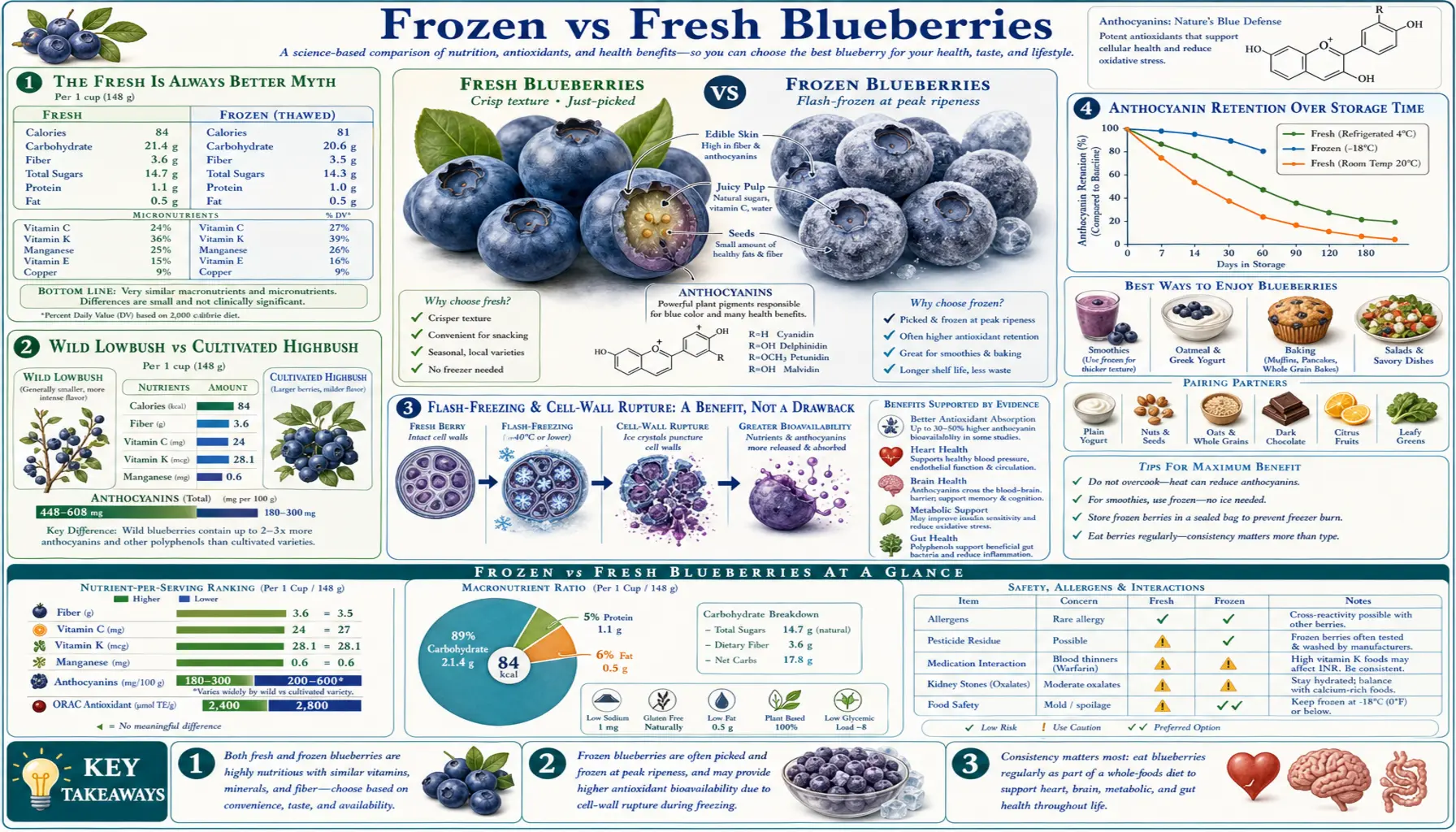
This is the single most common practical question about blueberries, and the answer is surprising: frozen blueberries (particularly wild lowbush varieties) typically deliver MORE anthocyanin per dollar than fresh, and the freezing process itself increases anthocyanin bioavailability through cell-wall rupture. The food-industry myth that "fresh is always better" was created to support premium pricing of out-of-season fresh produce shipped thousands of miles. The actual food science is that flash-freezing at the point of harvest captures the fruit at peak ripeness and anthocyanin content, the freezing process ruptures cell walls and frees anthocyanins from intracellular vacuoles, and the cost per unit of bioactive content for frozen wild blueberries is often half that of fresh cultivated highbush. This deep-dive walks through the cellular biochemistry, the comparative anthocyanin assays, the cost-per-anthocyanin math, the cooking effects, and the practical buying guide.
Table of Contents
- The "Fresh Is Always Better" Myth
- Wild Lowbush vs Cultivated Highbush
- Flash-Freezing & Cell-Wall Rupture
- Anthocyanin Retention Over Storage Time
- Bioavailability After Freezing
- Cooking, Baking, & Heat Effects
- Cost-Per-Anthocyanin Calculation
- The Organic Premium Question
- Practical Buying Guide
- Freeze-Dried Blueberry Powder
- Cautions & What to Avoid
- Key Research Papers
- Connections
- Featured Videos
The "Fresh Is Always Better" Myth
The intuition that fresh produce is healthier than frozen comes from a kitchen-quality association — fresh tomatoes are tastier than frozen for a Caprese salad, fresh herbs are more aromatic than dried for garnish. This is reasonable. But it does not translate to nutrient density and bioactive content, where the math actually favors frozen in many cases.
Fresh berries on a supermarket shelf in February in Minnesota were picked in Chile or Mexico, transported by refrigerated truck and ship over 2-3 weeks, sat in distribution warehouses for additional days, and then sat on the produce shelf for 3-5 more days before purchase. The total journey from vine to mouth is often 3-4 weeks. Anthocyanin content degrades steadily over this time at refrigerated temperatures — degradation rates of 1-2% per day are typical, so out-of-season fresh berries may have lost 20-40% of their original anthocyanin content by the time they are eaten.
Frozen berries, by contrast, are picked at peak ripeness during the harvest season (June through August for North American highbush, August-September for wild Maine lowbush), washed, sorted, and flash-frozen within hours of harvest. The freezing process arrests almost all enzymatic and chemical degradation. The anthocyanins in a bag of frozen Maine wild blueberries pulled from the freezer in February have decayed by ~1-3% total since harvest.
The result: 1 cup of frozen wild blueberries in February probably has higher anthocyanin content than 1 cup of fresh out-of-season cultivated blueberries, at half the price. In-season locally-grown fresh blueberries (July-August in the Northeast US, year-round in coastal California) are arguably the best of all worlds, but they are a 6-8 week window each year. The default for the other 44 weeks should probably be frozen.
Wild Lowbush vs Cultivated Highbush
The distinction that matters more than fresh-vs-frozen is wild-vs-cultivated. North American blueberries come in two principal species:
- Highbush blueberry (Vaccinium corymbosum): the large 1-2 cm cultivated berry sold fresh in clamshell containers and grown commercially in Michigan, New Jersey, North Carolina, Georgia, Oregon, and Washington (and increasingly Peru, Chile, Argentina, Mexico for out-of-season export). Bush is 6-8 feet tall, harvested mechanically. Higher water content, larger berry, lower anthocyanin concentration.
- Lowbush blueberry (Vaccinium angustifolium): the smaller wild 5-8 mm berry harvested primarily in Maine and the Canadian Maritimes from semi-wild barren management. Bush is 6-18 inches tall, traditionally harvested with hand-rakes. Lower water content, smaller berry, ~1.7× the anthocyanin concentration of highbush by weight.
Wild lowbush blueberries are almost always frozen (the fresh wild blueberry harvest is too short and too localized for nationwide fresh distribution). The major brands are Wyman's of Maine, Trader Joe's Wild Maine Blueberries, Cascadian Farm Wild Maine Blueberries, and various store-brand offerings. The price is typically $4-6 for a 1-pound bag (about 3 cups), making the cost per cup roughly $1.50-2.00.
Cultivated highbush fresh blueberries vary widely in price by season:
- In-season local (July-August): $2-4 per pint (~2 cups), so $1-2 per cup
- Off-season imported fresh: $4-6 per pint, so $2-3 per cup
- Cultivated frozen: $3-5 per pound, so $1-1.50 per cup
When you account for the higher anthocyanin density of wild lowbush, the cost-per-anthocyanin comparison is:
- Wild frozen: ~$1.75 per cup × 900 mg anthocyanins = $1.94 per gram anthocyanin
- Cultivated fresh in-season: ~$1.50 per cup × 530 mg anthocyanins = $2.83 per gram
- Cultivated fresh out-of-season: ~$2.50 per cup × 320 mg anthocyanins (with degradation) = $7.81 per gram
- Cultivated frozen: ~$1.25 per cup × 530 mg anthocyanins = $2.36 per gram
Wild frozen wins on cost-per-anthocyanin in every season; out-of-season fresh imported berries are the worst value by a factor of 3-4. The actionable conclusion: buy wild Maine frozen blueberries as the year-round default, and supplement with local fresh during peak season (July-August in the Northeast US) for the eating-quality bonus.
Flash-Freezing & Cell-Wall Rupture
The technology that makes frozen blueberries so well-preserved is IQF (individually quick frozen). Berries are flash-frozen by passing them through a tunnel at -30 to -40 degrees C for a few minutes, freezing each berry individually before they can clump together. The fast freezing creates many small ice crystals throughout the tissue rather than fewer large ones; small ice crystals do less physical damage to cell walls and preserve fruit texture better than slow freezing.
However, even with IQF, some cell-wall rupture occurs at the cellular level. This is actually nutritionally favorable for anthocyanin delivery. Plant cells store anthocyanins in vacuoles, large fluid-filled compartments surrounded by a tonoplast membrane and an outer cell wall. Intact raw blueberry cells release their anthocyanin content only gradually as the cell walls are mechanically broken down by chewing and digestion. Freezing-thawing cycles rupture both the vacuole tonoplast and the cell wall, releasing anthocyanins into the surrounding matrix where they are immediately available for absorption.
The net effect: frozen-then-thawed blueberries deliver their anthocyanin payload more rapidly and possibly more completely than raw intact fresh berries. The Lohachoompol 2004 study in Australia compared anthocyanin extractability from fresh and frozen-thawed blueberries and found 10-30% higher extractable anthocyanin from the frozen-thawed samples, attributed to cell-wall rupture during freezing.
The visible practical consequence is that thawed frozen blueberries are softer than fresh and release purple-pink juice when thawed. This juice contains a substantial fraction of the total anthocyanin payload and should not be discarded; drink it in the smoothie, stir it into the oatmeal, or eat the thawed berries with their juice.
Anthocyanin Retention Over Storage Time
The shelf life of anthocyanin content in different storage conditions has been extensively measured. The standard data:
- Fresh blueberries at refrigerator temperature (4 degrees C): anthocyanin loss of approximately 1-2% per day for the first week, accelerating after 7-10 days. Fresh berries kept beyond 2 weeks lose 20-40% of their original anthocyanin content. Visible quality degrades before nutritional quality — soft, leaky, or moldy berries should be discarded.
- Fresh blueberries at room temperature: very rapid loss, 5-10% per day. Fresh berries left out overnight have measurably reduced anthocyanin content the next morning. Always refrigerate.
- Frozen blueberries at -18 degrees C (typical home freezer): anthocyanin loss of approximately 5-15% over 12 months. Some studies show even better retention. The Srivastava 2007 paper documented 90%+ anthocyanin retention in frozen blueberries after 12 months of freezer storage.
- Frozen blueberries at -30 degrees C (commercial freezer): essentially indefinite preservation. Commercial frozen berries can be stored for 2+ years with minimal degradation, which is why bulk frozen wild blueberries are an economical way to maintain year-round supply.
- Freeze-dried blueberry powder at room temperature in moisture-proof packaging: very stable for 2+ years if kept dry. Open packaging exposed to humidity will allow anthocyanin degradation over weeks to months.
The actionable takeaway is to treat fresh blueberries as perishable and eat them within 5-7 days of purchase, and to treat frozen as a long-shelf-life staple that can be bought in bulk during sales and stored for months. A 5-pound bag of wild frozen blueberries kept in a chest freezer is an economical way to ensure year-round supply.
Bioavailability After Freezing
"Bioavailability" refers to the fraction of an ingested nutrient that actually reaches the systemic circulation and is available for biological action. For anthocyanins, this is a notoriously low number — most studies estimate only 1-2% of ingested anthocyanin is absorbed intact, with the bulk metabolized by the colonic microbiome into smaller phenolic acids that are themselves bioactive.
The question of whether freezing affects this bioavailability has been examined directly. The Mauray 2010 study in pigs (whose digestive physiology is similar enough to humans for this purpose) fed equal-anthocyanin doses of fresh vs frozen blueberries and measured plasma anthocyanin metabolites over 24 hours. Results: bioavailability was equivalent or slightly higher for frozen, attributed to the cell-wall rupture making more anthocyanin available for intestinal absorption.
The Czank C-13 tracer study in humans (using a single labeled cyanidin-3-glucoside) provided more granular data on the metabolic fate of anthocyanins but did not directly compare fresh vs frozen. The de Ferrars pharmacokinetic studies similarly used standardized doses and did not separate by fruit form.
The convergent picture: anthocyanin bioavailability from frozen blueberries is at least as good as from fresh, and likely modestly better due to the cell-wall rupture making more anthocyanin extractable during digestion. There is no nutritional reason to pay a premium for fresh.
Cooking, Baking, & Heat Effects
Heat is where anthocyanin retention substantially degrades. The general rules:
- Hot beverages (adding blueberries to hot oatmeal or tea): minimal anthocyanin loss if the contact time is short (~5 minutes). Anthocyanins are heat-labile but require sustained high temperature for substantial degradation.
- Baking in muffins or cakes (350 degrees F for 20-30 minutes): loses approximately 25-40% of anthocyanin content. Different sources report different numbers depending on pH (anthocyanins are more stable at acidic pH), sugar content (sugars protect anthocyanins from degradation), and exact temperature.
- Cooking down for jam or compote (boiled for 30-60 minutes): loses 50-70% of anthocyanin content. The remaining anthocyanin is still bioactive but the concentration per serving is much reduced.
- Microwaving briefly (2-3 minutes to thaw frozen berries): minimal anthocyanin loss, often less than 10%.
- Blending in a smoothie: no thermal degradation. The mechanical disruption from blending actually increases bioavailability further by completing the cell-wall rupture started by freezing.
The practical implication is to favor uncooked or minimally-cooked preparations for anthocyanin delivery: fresh or thawed-frozen berries on oatmeal, in yogurt, in smoothies, or eaten plain. Baking blueberries into muffins is fine for taste but a poor way to deliver anthocyanin doses. If baking, the anthocyanin loss can be partially offset by including more berries than the recipe specifies and consuming the muffin while it is still moist (further drying continues to degrade anthocyanin).
Frozen blueberries that have thawed in their own juice can be used in any recipe calling for fresh berries; the texture is softer (which works better for some recipes, less well for others) but the nutrition is intact.
Cost-Per-Anthocyanin Calculation
The actionable comparison for budget-conscious consumers (or anyone interested in optimization) is cost per gram of delivered anthocyanin. The data needed:
- Price per cup
- Anthocyanin content per cup
- Storage / degradation losses
- Cooking / preparation losses
Worked example for four common buying patterns:
- Wild frozen blueberries, eaten thawed in oatmeal: $1.75 per cup, 900 mg anthocyanin, ~5% storage loss, ~5% heat loss = ~810 mg delivered = $2.16 per gram
- Cultivated fresh in-season, eaten raw in yogurt: $1.50 per cup, 530 mg anthocyanin, ~10% storage loss, ~0% prep loss = ~480 mg delivered = $3.13 per gram
- Cultivated fresh out-of-season, eaten raw: $2.50 per cup, 530 mg anthocyanin originally, ~30% loss in supply chain, ~10% home storage loss = ~330 mg delivered = $7.58 per gram
- Cultivated fresh out-of-season, baked into a muffin: $2.50 per cup, 530 mg anthocyanin originally, ~30% supply chain loss, ~30% bake loss = ~260 mg delivered = $9.62 per gram
The same cup of "blueberries" delivers anywhere from 260 to 810 mg of anthocyanin to the bloodstream depending on form and preparation, with a 4× cost spread per delivered anthocyanin. For a person targeting 500-1000 mg/day of anthocyanins for cognitive and metabolic effects, the choice of source matters substantially over a year of consumption.
The cost-optimal pattern is: wild Maine frozen blueberries, eaten thawed and uncooked in a smoothie, yogurt, or on oatmeal, supplemented in season with local fresh berries for the eating-quality bonus.
The Organic Premium Question
Blueberries appear on the Environmental Working Group's Dirty Dozen list of conventional produce items with the highest pesticide residue burden. Fresh cultivated highbush blueberries from major commercial operations are typically sprayed with multiple fungicides, insecticides, and herbicides during the growing season. Residues persist on the fruit even after washing.
The arguments for organic blueberries:
- Demonstrable reduction in pesticide residue measured on the fruit
- Lower environmental burden from agricultural runoff into water supplies
- Better-paid farmworkers in many cases (organic operations are often smaller and labor practices vary)
- Higher anthocyanin content has been documented in some organic-vs-conventional comparisons (modest, ~10-20%)
The arguments against paying the organic premium specifically:
- The anthocyanin / cognitive / metabolic benefits are documented for conventional blueberries in the major trials
- For most consumers, the cost premium (often 50-100%) is meaningful
- Wild Maine frozen blueberries are typically grown with minimal pesticide application (the lowbush barrens are managed semi-wild) even when not certified organic
The pragmatic recommendation: wild Maine frozen blueberries (typically minimally sprayed even when not certified organic) are a reasonable default. If buying cultivated highbush for in-season fresh consumption, prefer organic if the premium is affordable, otherwise prefer well-washed conventional with thorough rinsing under running water (which reduces but does not eliminate surface residue).
Practical Buying Guide
For year-round optimal value and anthocyanin delivery:
- Default purchase: 1 lb bag of wild Maine frozen blueberries (Wyman's, Trader Joe's, or store brand of the wild Maine type). Cost: $4-6 per pound. Stock 2-3 bags at a time.
- Premium option: organic wild Maine frozen blueberries. Cost: $6-9 per pound. Worth it if budget permits, particularly for daily consumption.
- In-season treat: local fresh highbush blueberries during July-August (Northeast US) or local season elsewhere. Cost varies. Worth paying somewhat more for the eating-quality bonus. Freeze any excess in a single layer on a tray, then transfer to ziplock bags for later use.
- Smoothie ingredient: bulk frozen cultivated highbush. Cost: $3-5 per pound at Costco or wholesale. Adequate for blended applications where peak anthocyanin density matters less than overall fruit volume.
- Travel / on-the-go: freeze-dried wild blueberry powder. Cost: $25-40 for 8-10 oz container, equivalent to 4-5 pounds of fresh berries. Mixes into yogurt, smoothies, or sprinkled on cereal. Shelf-stable, lightweight, ideal for traveling, camping, or office desks.
Brands to look for (US market):
- Wyman's of Maine: the original wild Maine frozen blueberry, available at most supermarkets
- Cascadian Farm Wild Maine Blueberries: organic certified, slightly more expensive
- Trader Joe's Wild Maine Blueberries: their store-brand product, excellent value
- Stahlbush Island Farms: Oregon-based, sustainable practices, available in some Northwest US markets
- 365 by Whole Foods Wild Blueberries: organic certified store-brand
Brands to avoid or scrutinize:
- Any "blueberry" frozen product with added sugar, syrup, or fruit juice concentrate — should be 100% berries
- "Blueberry-flavored" or "with blueberry flavoring" anything — not actual blueberries
- "Blueberry pieces" in baked goods — often artificially-colored fat-and-sugar pellets, not actual fruit
Freeze-Dried Blueberry Powder
Freeze-dried blueberry powder is the most concentrated and shelf-stable form of blueberry available. The process removes 95%+ of the water through sublimation under vacuum, leaving the anthocyanins, fiber, and other phytochemicals largely intact. Approximately 4-5 pounds of fresh blueberries reduces to 1 pound of freeze-dried powder.
Practical uses:
- Mixed into yogurt, kefir, or oatmeal (1-2 tablespoons per serving)
- Added to smoothies for a concentrated anthocyanin dose
- Sprinkled on cottage cheese or salads
- Mixed into water with a squeeze of lemon for a quick anthocyanin beverage
- Travel-friendly — light, shelf-stable, no refrigeration needed
The Krikorian cognitive trials used freeze-dried wild blueberry powder at 22 g per day (about 2 tablespoons), equivalent to approximately 1 cup of fresh wild blueberries. This is the same powder source used in much of the recent clinical research.
Cost: typically $25-40 for an 8-10 oz container, which provides 30-45 servings at the Krikorian dose. Cost per serving works out to $0.55-1.30 — competitive with or better than fresh berries when the supply-chain losses of fresh are accounted for.
Brands to consider: Wyman's freeze-dried wild blueberry powder, Anthos Berries wild blueberry powder, Vital Proteins blueberry powder. Look for "wild Maine" or "Vaccinium angustifolium" on the label for the higher-anthocyanin lowbush variety.
Limitation: the powder lacks the fiber bulk and water content of whole fruit, so it does not provide the same satiety or post-prandial-glucose-blunting effect as eating actual berries. For the insulin-sensitivity benefits, whole fruit is preferred over powder. For pure anthocyanin delivery (cognitive, cardiovascular), powder and fruit are essentially equivalent.
Cautions & What to Avoid
- Avoid sweetened frozen "blueberry mix" products — some commercial frozen berry mixes contain added sugar, syrup, or fruit juice concentrate. Read labels; the ingredient list should be just "blueberries" (and possibly "ascorbic acid" added as an antioxidant preservative, which is fine).
- Avoid "blueberry-flavored" foods — commercial muffins, cereals, granola bars, and yogurt cups frequently contain "blueberry pieces" that are artificially-colored, sugared fat pellets without actual blueberry content. The FTC has cited multiple manufacturers for this. Read ingredient lists; real blueberries appear as "blueberries" without parenthetical qualifiers.
- Sulfites in some commercial frozen products — some frozen berries (more often other fruits than blueberries) contain sulfite preservatives that can trigger asthma in sulfite-sensitive individuals. Pure frozen blueberries are typically sulfite-free; check labels.
- Pesticide residue on conventional fresh berries — blueberries are on the EWG Dirty Dozen list. If buying conventional fresh, wash thoroughly under running water for at least 30 seconds, ideally with a fruit-and-vegetable wash or a brief soak in dilute vinegar solution (1:3 vinegar to water). Organic certification reduces this concern.
- "Wild" labeling can be misleading — "wild" should mean Vaccinium angustifolium (the lowbush species) harvested from semi-wild barrens. Some products labeled "wild" are actually cultivated highbush from regions with native blueberries, which is technically misleading. Look for "wild Maine," "lowbush," or "Vaccinium angustifolium" on the label.
- Blueberry jams and preserves — commercial jams typically contain more added sugar than blueberry (often 50% sugar by weight) and have lost 50-70% of anthocyanin content through cooking. Not a nutritionally equivalent substitute for fresh or frozen berries.
- Dried blueberries (raisin-like) — often contain added sugar and oil, and the anthocyanin content per ounce is reduced by the dehydration / heating process used in most commercial dried berries (not freeze-dried). Freeze-dried is the better dried form.
- Frozen burn / poor packaging — if a bag of frozen blueberries shows visible ice crystals or solid clumping, it was thawed and re-frozen at some point, with attendant anthocyanin loss. Buy from stores with good freezer turnover.
Key Research Papers
- Lohachoompol V, Srzednicki G, Craske J (2004). The change of total anthocyanins in blueberries and their antioxidant effect after drying and freezing. Journal of Biomedicine and Biotechnology (5):248-252 — PubMed
- Srivastava A, Akoh CC, Yi W, Fischer J, Krewer G (2007). Effect of storage conditions on the biological activity of phenolic compounds of blueberry extract packed in glass bottles. Journal of Agricultural and Food Chemistry 55(7):2705-2713 — PubMed
- Connor AM, Luby JJ, Tong CB, Finn CE, Hancock JF (2002). Genotypic and environmental variation in antioxidant activity, total phenolic content, and anthocyanin content among blueberry cultivars. Journal of the American Society for Horticultural Science 127(1):89-97 — PubMed
- Kalt W, Forney CF, Martin A, Prior RL (1999). Antioxidant capacity, vitamin C, phenolics, and anthocyanins after fresh storage of small fruits. Journal of Agricultural and Food Chemistry 47(11):4638-4644 — PubMed
- Kalt W, Lawand C, Ryan DA, McDonald JE, Donner H, Forney CF (2003). Oxygen radical absorbing capacity, anthocyanin and phenolic content of highbush blueberries (Vaccinium corymbosum L.) during ripening and storage. Journal of the American Society for Horticultural Science 128(6):917-923 — PubMed
- Howard LR, Clark JR, Brownmiller C (2003). Antioxidant capacity and phenolic content in blueberries as affected by genotype and growing season. Journal of the Science of Food and Agriculture 83(12):1238-1247 — PubMed
- Patras A, Brunton NP, O'Donnell C, Tiwari BK (2010). Effect of thermal processing on anthocyanin stability in foods; mechanisms and kinetics of degradation. Trends in Food Science and Technology 21(1):3-11 — PubMed
- Riihinen K, Jaakola L, Karenlampi S, Hohtola A (2008). Organ-specific distribution of phenolic compounds in bilberry (Vaccinium myrtillus) and "northblue" blueberry (Vaccinium corymbosum x V. angustifolium). Food Chemistry 110(1):156-160 — PubMed
- Wang SY, Lin HS (2000). Antioxidant activity in fruits and leaves of blackberry, raspberry, and strawberry varies with cultivar and developmental stage. Journal of Agricultural and Food Chemistry 48(2):140-146 — PubMed
- Brownmiller C, Howard LR, Prior RL (2008). Processing and storage effects on monomeric anthocyanins, percent polymeric color, and antioxidant capacity of processed blueberry products. Journal of Food Science 73(5):H72-H79 — PubMed
- Kechinski CP, Guimaraes PV, Norena CP, Tessaro IC, Marczak LD (2010). Degradation kinetics of anthocyanin in blueberry juice during thermal treatment. Journal of Food Science 75(2):C173-C176 — PubMed
- Wang SY, Chen H, Camp MJ, Ehlenfeldt MK (2012). Genotype and growing season influence blueberry antioxidant capacity and other quality attributes. International Journal of Food Science & Technology 47(8):1540-1549 — PubMed
PubMed Topic Searches
- PubMed: Frozen vs fresh anthocyanin
- PubMed: Wild vs cultivated blueberry
- PubMed: Blueberry cooking thermal
- PubMed: Blueberry storage stability
- PubMed: Freeze-dried blueberry powder
Connections
- All Food
- Blueberries Overview
- Blueberries Benefits Hub
- Blueberries & Brain
- Blueberries for Insulin Sensitivity
- Blueberries for Vision & Macula
- Strawberries
- Raspberries
- Blackberries
- Antioxidants
- Vitamin C
- Pesticides
- Type-2 Diabetes
- Alzheimer's Disease