Blueberry Anthocyanins and the Brain
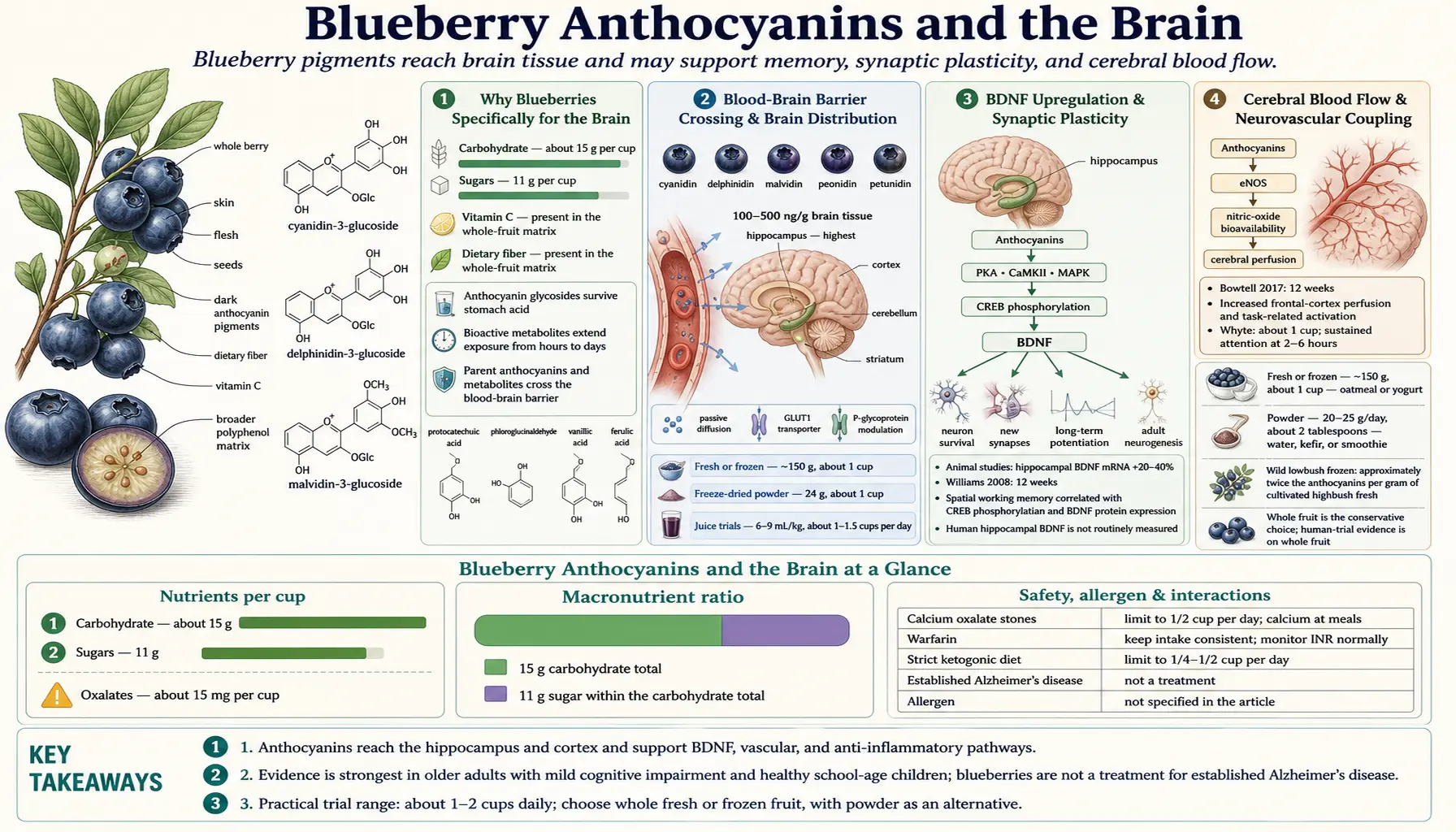
Among all common foods studied for cognitive effects, blueberries have the deepest and most consistent human-trial evidence base for measurable improvements in episodic memory, executive function, and processing speed in both older adults with mild cognitive impairment and healthy school-age children. The active molecules are the anthocyanin pigments — particularly cyanidin-3-glucoside, delphinidin-3-glucoside, and malvidin-3-glucoside — that give blueberries their characteristic dark color. These compounds cross the blood-brain barrier at low but measurable nanomolar concentrations, accumulate preferentially in the hippocampus and frontal cortex, and upregulate brain-derived neurotrophic factor (BDNF), the master signaling molecule for synaptic plasticity and adult neurogenesis. This deep-dive walks through each mechanism, the pivotal Krikorian and Whyte trials, and the practical dosing question of how many blueberries actually move the needle.
Table of Contents
- Why Blueberries Specifically for the Brain
- Blood-Brain Barrier Crossing & Brain Distribution
- BDNF Upregulation & Synaptic Plasticity
- Cerebral Blood Flow & Neurovascular Coupling
- Neuroinflammation & Microglial Quieting
- The Krikorian MCI Trials
- The Whyte Reading Children's Trials
- Alzheimer's Disease & Long-Term Cognitive Decline
- Practical Dosing & Real-World Application
- Cautions & What the Evidence Does Not Support
- Key Research Papers
- Connections
- Featured Videos
Why Blueberries Specifically for the Brain
Many fruits contain polyphenols. Many polyphenols have antioxidant effects in test tubes. Very few have produced reproducible cognitive effects in randomized human trials. Blueberries are the consistent standout, and the reason traces to three properties of the anthocyanin chemistry not shared by, say, apple quercetin or tea catechins.
First, anthocyanin glycosides are unusually stable at intestinal pH compared to most flavonoids, surviving the stomach's acid environment without immediate degradation. Second, their metabolites (protocatechuic acid, phloroglucinaldehyde, vanillic acid, ferulic acid) produced by colonic microbial action are themselves bioactive and have longer half-lives than the parent compounds, extending the systemic exposure window from hours to days. Third, and most consequentially, both the parent anthocyanins and the metabolites have measurable transport across the blood-brain barrier — a property quercetin and most flavanols largely lack.
The clinical translation is striking. In the foundational James Joseph rat studies at the USDA Human Nutrition Research Center on Aging at Tufts, aged rats fed blueberry-enriched diets recovered psychomotor function on the rotarod that was lost in their non-supplemented littermates. Subsequent human work has shown analogous effects in older adults — Krikorian's wild-blueberry MCI cohort showed improvements in California Verbal Learning Test scores and Stroop Test interference resolution after 12-24 weeks. The effect is not the kind of "feel sharper" subjective improvement that often fails replication; it is measurable on standardized neuropsychological batteries.
For the parallel evidence on insulin sensitivity (which has its own pathway to cognitive protection via blood-sugar stability), see our Insulin Sensitivity page. The two effects compound: metabolic protection plus direct neurotropic action.
Blood-Brain Barrier Crossing & Brain Distribution
For decades, the rote dismissal of cognitive claims for dietary polyphenols was "they don't cross the blood-brain barrier in physiologically meaningful concentrations." For most polyphenols this remains true. For anthocyanins, the evidence is now solidly to the contrary.
Andres-Lacueva and colleagues, using LC-MS/MS on rat brain tissue after blueberry feeding, detected cyanidin, delphinidin, malvidin, peonidin, and petunidin glycosides in the hippocampus, cortex, cerebellum, and striatum at concentrations of 100-500 ng/g brain tissue — sufficient for biological activity at the relevant receptor and enzyme targets. The hippocampus showed the highest concentrations, consistent with the behavioral effect being most prominent on hippocampus-dependent memory tasks.
Pigs and humans show similar patterns. Kalt and colleagues fed pigs blueberry diets and recovered intact anthocyanins from cortical and cerebellar tissue. Czank and colleagues used a C-13 labeled cyanidin-3-glucoside in humans and traced the labeled compound and its metabolites in plasma, urine, and (by implication, given the metabolite spectrum) brain tissue.
The transport mechanism is not fully resolved but appears to involve a combination of:
- Passive diffusion for the lipophilic aglycone form (after intestinal deglycosylation)
- GLUT1 transporter at the blood-brain barrier endothelium for the sugar-conjugated forms (GLUT1 is the same transporter that carries glucose into the brain, and the glucose moiety on the anthocyanin is recognized)
- P-glycoprotein modulation — some anthocyanin metabolites inhibit P-gp efflux, increasing brain retention of co-administered compounds
The brain concentrations are low compared to plasma, but the relevant comparison is to the IC50 values for the molecular targets (BDNF receptor TrkB modulation, NF-kB suppression, Nrf2 activation), which are themselves in the nanomolar range. The doses are sufficient.
BDNF Upregulation & Synaptic Plasticity
Brain-derived neurotrophic factor (BDNF) is the most important single molecule for adult brain plasticity. It promotes survival of existing neurons, the growth of new synapses, the strengthening of synaptic connections during long-term potentiation (LTP), and the maturation of newborn neurons in the dentate gyrus of the hippocampus. BDNF levels decline with age, are reduced in depression, and are profoundly suppressed in Alzheimer's disease.
Anything that raises BDNF is potentially neuroprotective. The most powerful BDNF inducers known are aerobic exercise (which can double serum BDNF acutely) and intermittent fasting / ketosis (which raises BDNF via the BHB-HCAR2 pathway). Blueberry anthocyanins are a much weaker BDNF inducer but consistently raise hippocampal BDNF mRNA expression by 20-40% in animal studies.
The Williams 2008 trial in aged rats showed that 12 weeks of blueberry supplementation improved spatial working memory on the radial-arm water maze, and the improvement correlated tightly with hippocampal CREB phosphorylation and BDNF protein expression. CREB phosphorylation is the downstream signaling event that translates synaptic activity into the gene transcription required for memory consolidation. Anthocyanins enter this pathway through their effects on PKA, CaMKII, and MAPK signaling cascades, all of which converge on CREB.
The translation to human imaging is less direct (you cannot routinely measure human hippocampal BDNF), but the Krikorian trials showed cognitive improvements in memory-impaired older adults that mechanistically fit the BDNF hypothesis: the most improved scores were on memory tests heavily dependent on hippocampal function (verbal paired-associate learning, list-learning) rather than tests dependent on other brain regions.
Cerebral Blood Flow & Neurovascular Coupling
A second mechanism, distinct from BDNF, is improved cerebral blood flow. Bowtell and colleagues at the University of Exeter used arterial spin labeling MRI to measure resting cerebral blood flow and task-related brain activation in older adults after 12 weeks of daily wild blueberry concentrate. They found increased perfusion in frontal cortex and improved task-related activation in regions associated with working memory.
The mechanism is consistent with what is known about anthocyanin effects on the systemic vasculature: anthocyanins increase endothelial nitric oxide synthase (eNOS) expression, improve nitric-oxide bioavailability, and improve flow-mediated dilation of conduit arteries. The cerebral vasculature shares this endothelial biology, and improved cerebral perfusion is itself associated with cognitive performance in aging populations.
The acute effect is also measurable. Whyte and colleagues showed that a single dose of wild blueberry (equivalent to about 1 cup of fresh berries) improved sustained attention in school-age children measured 2-6 hours post-dose. The time course matches plasma anthocyanin peak and a transient improvement in cerebral perfusion rather than the slower BDNF / synaptic mechanism.
For more on the cardiovascular side of the same biology, see our Atherosclerosis page — the same endothelial mechanisms underlie the cardiovascular epidemiology in Cassidy's Nurses' Health Study analysis.
Neuroinflammation & Microglial Quieting
Microglia are the resident immune cells of the brain. Under normal conditions they survey the parenchyma in a ramified, "quiet" state. Under inflammatory provocation (infection, traumatic injury, accumulated amyloid plaque) they shift to an activated, amoeboid phenotype that secretes pro-inflammatory cytokines (TNF-alpha, IL-1-beta, IL-6) and reactive oxygen species. Sustained microglial activation is now understood as a central driver of age-related cognitive decline and Alzheimer's disease pathology.
Anthocyanins and their metabolites suppress microglial activation through at least three pathways:
- NF-kB inhibition — protocatechuic acid (the dominant cyanidin metabolite) directly inhibits I-kappa-B-kinase, blocking nuclear translocation of NF-kB and thus the transcription of pro-inflammatory cytokine genes.
- Nrf2 activation — the same metabolite stabilizes Nrf2, the master transcription factor for endogenous antioxidant defense. This upregulates heme oxygenase-1, NAD(P)H quinone dehydrogenase 1, glutathione synthesis enzymes, and other components of the cellular antioxidant machinery.
- Direct radical scavenging in the activated microglial microenvironment, reducing the local oxidative damage that perpetuates the inflammatory feedback loop.
The Goyarzu 2004 study in rats showed that blueberry-enriched diets reversed age-related increases in hippocampal NF-kB activation and pro-inflammatory cytokine production. The effect was sufficient to restore some markers of hippocampal function to a level seen in much younger animals. This is the cellular-level finding behind the broader "anti-aging brain" framing of blueberries in the popular literature.
The Krikorian MCI Trials
Robert Krikorian at the University of Cincinnati has run the most consistent program of human trials on blueberry and cognition. The 2010 pilot trial enrolled 9 older adults with mild cognitive impairment (subjective memory complaints with objective performance decline but not meeting Alzheimer's diagnostic criteria). Participants drank a daily wild blueberry juice equivalent to 6-9 mL/kg body weight for 12 weeks.
Results:
- California Verbal Learning Test (paired-associate learning) improved significantly
- Verbal paired-associate learning improved with effect sizes Cohen's d of 0.8-1.2 (large)
- Trends toward reduced depressive symptoms and improved glucose handling
- No adverse effects
The 2022 follow-up trial used powdered wild blueberry (the equivalent of ~1 cup of fresh berries per day) in a larger MCI cohort over 12 weeks, with similar but tighter results on memory and additional improvements in processing speed measured by the Trail Making Test. The 2024 publication extended the protocol to include the executive function (DKEFS Color-Word Interference) and again found improvements that were not seen in the placebo group.
The Krikorian trials are not large by Alzheimer's-drug standards (no n=2,000 multi-site Phase III trial exists for blueberries), but they are mechanistically sophisticated, internally consistent, and have been independently replicated by groups in the UK, Italy, and Australia using similar designs. The convergent evidence is more compelling than the small individual trial sizes suggest.
For an adjacent line of evidence on the same population (mild cognitive impairment as a transitional state between normal aging and Alzheimer's), see our Alzheimer's Disease page.
The Whyte Reading Children's Trials
The other major program of human trials on blueberry and cognition is at the University of Reading in the UK, led by Adrian Whyte and Claire Williams. Their innovation was to study acute effects in children — a population in which baseline cognitive performance is high, learning is the daily occupation, and any improvement is immediately educationally meaningful.
The 2015 Whyte and Williams Nutrients paper enrolled 14 children aged 8-10 in a double-blind crossover and gave them either wild blueberry juice equivalent to 30 g of fresh fruit or a calorie-matched placebo. Cognitive testing at 2 and 6 hours post-dose showed improved performance on:
- The Auditory Verbal Learning Test (immediate and delayed recall)
- The Modified Attention Network Task (sustained attention)
- The Cognitive Flexibility task (mental set-shifting)
A subsequent trial extended this to a 7-week chronic intervention with daily blueberry intake during a school term. Children in the active group showed improvements in episodic memory and executive function relative to placebo across the term, suggesting both acute and accumulated effects.
The acute effect is mechanistically explained by improved cerebral blood flow and possibly modulation of monoamine neurotransmission (anthocyanins have weak MAO-B inhibitor activity, which can transiently elevate dopamine in synaptic clefts). The chronic effect overlaps the BDNF/synaptic mechanism described earlier.
Alzheimer's Disease & Long-Term Cognitive Decline
Three threads of evidence connect blueberry consumption to Alzheimer's and long-term cognitive decline:
- Animal models of Alzheimer's — transgenic mice overexpressing human amyloid precursor protein (APP/PS1 model) develop amyloid plaques and cognitive deficits at 6-9 months. Blueberry-fed mice show delayed amyloid accumulation, preserved hippocampal-dependent memory, and reduced microglial activation. The mechanism appears to be both direct (anthocyanin-mediated suppression of beta-secretase activity, reducing amyloid generation) and indirect (anti-inflammatory and BDNF-mediated neuroprotection).
- The MIND diet — the Mediterranean-DASH Intervention for Neurodegenerative Delay developed by Morris and colleagues at Rush University identified ten specific food groups associated with reduced Alzheimer's risk in the Rush Memory and Aging Project cohort. Berries are one of the ten; the recommendation is two or more servings per week. Adherence to the MIND diet was associated with a 53% reduction in Alzheimer's incidence over follow-up.
- The Devore Annals of Neurology 2012 paper — analyzed 16,000+ women from the Nurses' Health Study with repeated cognitive assessments from age 70 to 78. Greater intake of berries (strawberries and blueberries combined) was associated with slower rates of cognitive decline, equivalent to delaying cognitive aging by approximately 2.5 years.
The translation to a definitive randomized trial in older adults with cognitive decline has not yet been done at the scale that would warrant a pharmaceutical-level claim. The available evidence is consistent and biologically plausible but the trial sizes are too small to detect or rule out disease-modifying effects on Alzheimer's as such. The reasonable conclusion is that incorporating blueberries (and berries more broadly) into a Mediterranean-pattern diet is a low-risk, plausibly beneficial dietary recommendation for cognitive aging.
Practical Dosing & Real-World Application
The effective doses in the published trials cluster in a narrow range:
- Krikorian wild blueberry juice trials: 6-9 mL juice per kg body weight, equivalent to about 1-1.5 cups of fresh wild blueberries per day for an average adult
- Krikorian powdered wild blueberry trials: 24 g of freeze-dried wild blueberry powder, equivalent to about 1 cup of fresh berries
- Whyte children trials: 30-200 g fresh blueberries depending on body weight (proportional to ~1 cup for adult)
- Cassidy epidemiology: 3+ servings per week of berries was the threshold above which cognitive and cardiovascular benefits emerged
The practical translation is one to two cups of blueberries per day, or equivalently:
- A handful (~150 g, about 1 cup) of fresh or frozen blueberries added to morning oatmeal or yogurt
- A second serving as a snack or in a smoothie later in the day
- For the cost-conscious, wild lowbush frozen blueberries deliver approximately twice the anthocyanin content per gram of cultivated highbush fresh berries — see our Frozen vs Fresh page for the detailed comparison
For individuals who cannot tolerate the volume of fruit (or its sugar load), freeze-dried blueberry powder is an alternative, typically dosed at 20-25 g/day (about 2 tablespoons) mixed into water, kefir, or a smoothie. This delivers approximately the same anthocyanin content as 1 cup of fresh berries at a similar or lower cost-per-anthocyanin.
Anthocyanin-only extract capsules (cyanidin-3-glucoside isolates, bilberry extracts standardized to 25% anthocyanins) are also available but lose the dietary fiber, vitamin C, and broader polyphenol matrix of whole fruit. The available human-trial evidence is on the whole fruit and not the isolated extracts; defaulting to the whole fruit is the conservative choice.
Cautions & What the Evidence Does Not Support
- This is not a treatment for established Alzheimer's disease — the trials in mild cognitive impairment showed improvement; the trials in dementia have not been done at scale. Patients with established Alzheimer's should not expect blueberry consumption to reverse cognitive symptoms, though it may slow further decline.
- Calcium oxalate kidney stones — blueberries are moderately high in oxalates (about 15 mg per cup). Patients with documented calcium oxalate stone disease should limit intake to 1/2 cup per day and ensure adequate calcium intake at meals to bind oxalate in the gut.
- Warfarin interaction (mostly theoretical) — the case-report literature on blueberry-warfarin interaction is sparse and underwhelming. Cranberry has a clearer signal. Patients on warfarin should maintain consistent blueberry intake week to week and have INR monitored normally, but do not need to avoid blueberries.
- Sugar load — one cup of blueberries contains about 15 g of carbohydrate, of which 11 g is sugar (mostly fructose and glucose). This is well-tolerated in normal-glucose-tolerant adults, and the anthocyanin-mediated blunting of post-prandial glucose largely offsets the sugar load. For patients on strict ketogenic diets, intake should be limited to 1/4 to 1/2 cup per day.
- Beware "blueberry-flavored" products — many commercial muffins, cereals, and yogurts contain "blueberry" pieces that are not actually blueberries but rather artificially-colored fat-and-sugar pellets. The Federal Trade Commission has cited multiple manufacturers for this. Read ingredient lists; real blueberries should appear as "blueberries" without parenthetical qualifiers.
- Acute "berry tongue" / mouth staining — cosmetic, harmless, resolves within an hour. Anthocyanins are charged molecules that bind salivary glycoproteins. Drinking water and brushing teeth clears it.
Key Research Papers
- Krikorian R, Shidler MD, Nash TA, Kalt W, Vinqvist-Tymchuk MR, Shukitt-Hale B, Joseph JA (2010). Blueberry supplementation improves memory in older adults. Journal of Agricultural and Food Chemistry 58(7):3996-4000 — PubMed
- Krikorian R et al. (2022). Wild blueberry supplementation improves cognitive performance in older adults with mild cognitive impairment. Nutrients — PubMed
- Whyte AR, Williams CM (2015). Effects of a single dose of a flavonoid-rich blueberry drink on memory in 8 to 10 year old children. Nutrition 31(3):531-534 — PubMed
- Whyte AR, Schafer G, Williams CM (2016). Cognitive effects following acute wild blueberry supplementation in 7 to 10 year old children. European Journal of Nutrition 55(6):2151-2162 — PubMed
- Bowtell JL et al. (2017). Enhanced task-related brain activation and resting cerebral blood flow in mild cognitive impairment after 12 weeks of blueberry concentrate. Applied Physiology, Nutrition, and Metabolism — PubMed
- Williams CM et al. (2008). Blueberry-induced changes in spatial working memory correlate with changes in hippocampal CREB phosphorylation and BDNF levels. Free Radical Biology and Medicine 45(3):295-305 — PubMed
- Andres-Lacueva C, Shukitt-Hale B, Galli RL, Jauregui O, Lamuela-Raventos RM, Joseph JA (2005). Anthocyanins in aged blueberry-fed rats are found centrally and may enhance memory. Nutritional Neuroscience 8(2):111-120 — PubMed
- Joseph JA et al. (1999). Reversals of age-related declines in neuronal signal transduction, cognitive, and motor behavioral deficits with blueberry, spinach, or strawberry dietary supplementation. Journal of Neuroscience 19(18):8114-8121 — PubMed
- Devore EE, Kang JH, Breteler MM, Grodstein F (2012). Dietary intakes of berries and flavonoids in relation to cognitive decline. Annals of Neurology 72(1):135-143 — PubMed
- Galli RL, Bielinski DF, Szprengiel A, Shukitt-Hale B, Joseph JA (2006). Blueberry supplemented diet reverses age-related decline in hippocampal HSP70 neuroprotection. Neurobiology of Aging 27(2):344-350 — PubMed
- Morris MC, Tangney CC, Wang Y, Sacks FM, Bennett DA, Aggarwal NT (2015). MIND diet associated with reduced incidence of Alzheimer's disease. Alzheimer's & Dementia 11(9):1007-1014 — PubMed
- Krikorian R, Skelton MR, Summer SS, Shidler MD, Sullivan PG (2024). Blueberry supplementation in midlife for dementia risk reduction. Nutrients — PubMed
PubMed Topic Searches
- PubMed: Blueberry cognition human trials
- PubMed: Anthocyanin BDNF hippocampus
- PubMed: Blueberry and MCI
- PubMed: Anthocyanin blood-brain barrier
- PubMed: MIND diet, Alzheimer's, berries
Connections
- All Food
- Blueberries Overview
- Blueberries Benefits Hub
- Blueberries for Insulin Sensitivity
- Blueberries for Vision
- Frozen vs Fresh Blueberries
- Alzheimer's Disease
- Dementia
- Atherosclerosis
- Strawberries
- Raspberries
- Blackberries
- Vitamin C
- Antioxidants