Blueberries for Vision and Macular Health
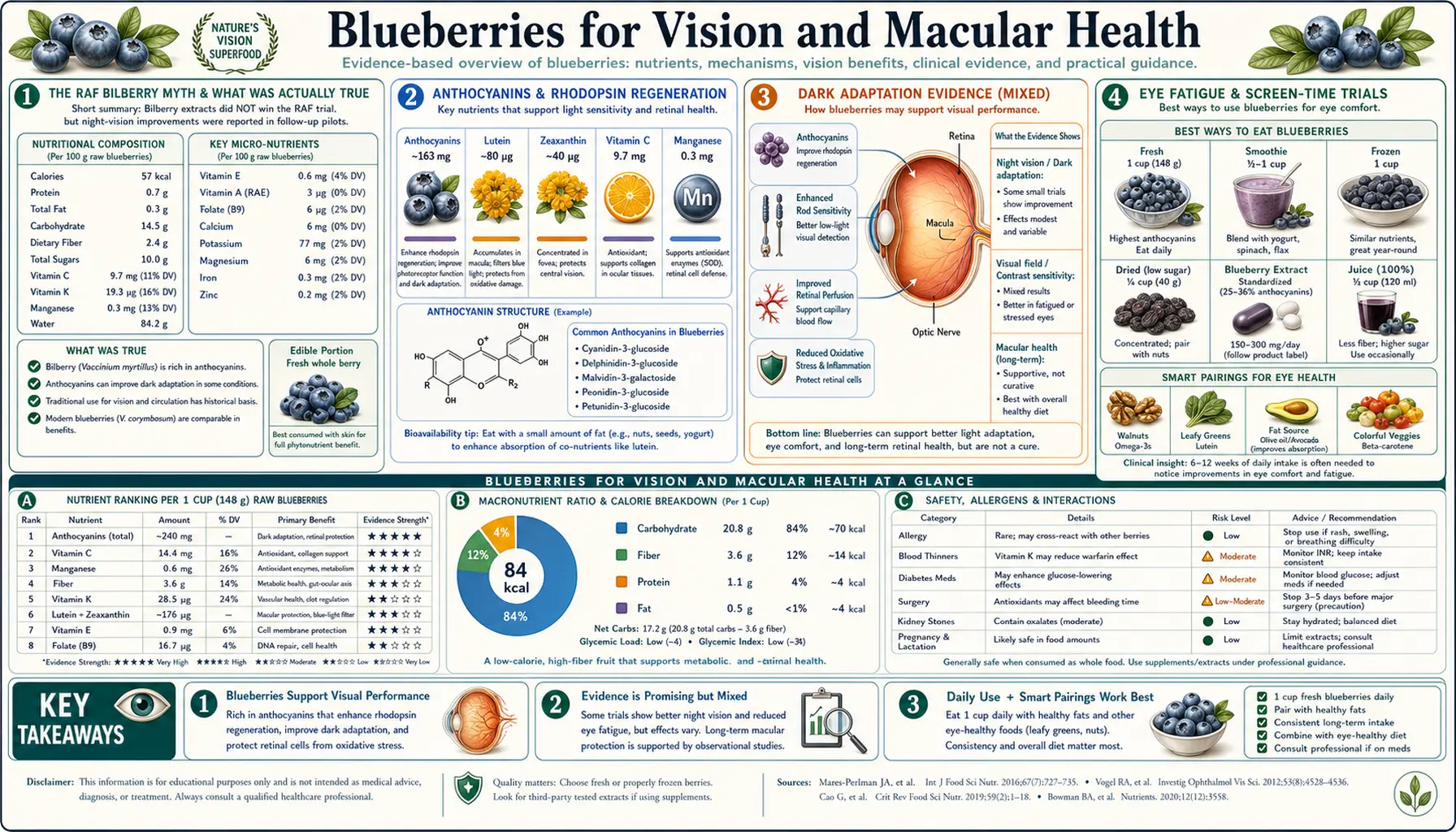
The folk story that Royal Air Force pilots in World War II ate bilberry jam to improve their night vision for raids over Germany has been retold for 80 years — and is largely apocryphal. The historical record suggests the story was probably wartime British misinformation designed to obscure radar technology development. But the underlying biological claim — that blueberry and bilberry anthocyanins improve dark adaptation and protect retinal function — has a defensible mechanistic basis (anthocyanin-mediated rhodopsin regeneration in retinal rod cells) and a mixed but suggestive clinical literature. The modern evidence supports a modest role for blueberries in eye-fatigue reduction from screen use, dark-adaptation in low-light conditions, and as one component of an AREDS2-style nutritional approach to age-related macular degeneration. The evidence does not support blueberries as a cure for cataracts, glaucoma, or established macular degeneration. This deep-dive separates the well-documented effects from the marketing exaggeration.
Table of Contents
- The RAF Bilberry Myth & What Was Actually True
- Anthocyanins & Rhodopsin Regeneration
- Dark Adaptation Evidence (Mixed)
- Eye Fatigue & Screen-Time Trials
- Dry Eye Syndrome
- Macular Degeneration & the AREDS2 Context
- Diabetic Retinopathy & Capillary Fragility
- Cataract & Glaucoma: Evidence Limits
- Practical Recommendations
- Cautions
- Key Research Papers
- Connections
- Featured Videos
The RAF Bilberry Myth & What Was Actually True
The story, in standard form: during the Battle of Britain in 1940, RAF night fighters were shooting down German bombers in the dark over Britain with uncanny accuracy. Asked how, the British attributed it to pilots eating bilberry jam, which sharpened their night vision via the anthocyanins. The Germans believed it (or at least did not crack the actual mechanism), and an industry of bilberry-for-vision claims was born.
The actual technology was airborne intercept radar (the AI Mk IV and successors), classified at the time. The bilberry story was probably wartime disinformation, intentionally circulated to obscure the radar program. There is no published wartime documentation of an RAF bilberry-supplementation protocol, no surviving records of bilberry quartermaster orders disproportionate to ordinary rations, and the post-war attempts to replicate the night-vision claim with controlled trials have been largely negative or weakly positive.
That said, the underlying claim is not biologically unreasonable. Bilberry (Vaccinium myrtillus, the European wild blueberry relative) and North American blueberries share the same anthocyanin chemistry, and the molecular mechanisms by which anthocyanins could plausibly affect dark adaptation have been reasonably worked out. The historical story is myth; the biology is not unreasonable.
The modern evidence base for blueberries and vision is best framed as: modest measurable effects on a few specific endpoints (eye fatigue, dark adaptation in some trials, dry eye, capillary integrity), part of a multi-component nutritional approach to age-related macular degeneration, no role in established cataracts or glaucoma, no replacement for routine ophthalmologic care.
Anthocyanins & Rhodopsin Regeneration
The retina's ability to detect dim light depends on rhodopsin, the visual pigment in rod photoreceptors. Rhodopsin consists of a protein (opsin) covalently bonded to a small organic molecule (11-cis-retinal, a derivative of Vitamin A). When a photon hits rhodopsin, the 11-cis-retinal isomerizes to all-trans-retinal, which initiates the signaling cascade that ultimately produces the visual signal sent to the brain. The all-trans-retinal then dissociates from opsin and must be transported to the retinal pigment epithelium (RPE), reduced to all-trans-retinol, isomerized back to 11-cis-retinol, oxidized to 11-cis-retinal, and shuttled back to the photoreceptor to regenerate rhodopsin. This is the "visual cycle."
The rate-limiting step in dark adaptation is the regeneration of rhodopsin after bleaching. In bright sunlight, most rhodopsin is bleached. When you walk into a dark room, your dark adaptation curve (the gradual recovery of dim-light sensitivity over 20-30 minutes) reflects the kinetics of rhodopsin regeneration.
Matsumoto and colleagues in Japan demonstrated in 2003 that cyanidin-3-glycosides accelerate the regeneration of rhodopsin in cell-free systems using purified opsin and 11-cis-retinal. The mechanism is not certain but may involve anthocyanin-mediated stabilization of the opsin-retinal binding pocket, accelerated transport of retinoids into the RPE, or modulation of the rhodopsin kinase that regulates rhodopsin turnover.
This is one of the few documented direct molecular interactions between a dietary polyphenol and a visual-pigment protein. The translation to clinical dark-adaptation improvement has been more elusive — some trials show measurable improvement in dark-adaptation thresholds with bilberry / anthocyanin supplementation, others do not, and methodological differences (acute vs chronic dosing, anthocyanin source, dark-adaptation testing protocol) make direct comparison difficult.
For the parallel biology of Vitamin A and the visual cycle, see our Vitamin A for Vision page.
Dark Adaptation Evidence (Mixed)
The clinical dark-adaptation literature for bilberry / blueberry anthocyanins is genuinely mixed. A 2004 systematic review by Canter and Ernst examined all available trials and concluded that the night-vision claim was not adequately supported by controlled evidence. Specifically:
- Nine of 12 placebo-controlled trials of bilberry on dark adaptation showed no significant effect
- The three positive trials had methodological limitations (small samples, unblinded, suspect endpoints)
- The Vingrys 1999 trial in young men found no improvement in dark adaptation thresholds after 21 days of high-dose bilberry vs placebo
Subsequent trials have been somewhat more positive in specific populations:
- Nakaishi 2000 showed improvement in dark adaptation in subjects with computer-vision-induced refractive alteration after blackcurrant anthocyanin intake
- Ozawa 2015 demonstrated reduced eye-fatigue symptoms in VDT (video display terminal) workers given bilberry extract for 8 weeks, including improved subjective night-vision and dark-adaptation reports
- The Yamashita 2017 rat model of retinal ischemia showed bilberry extract protected against the retinal damage
The most defensible synthesis is: blueberry / bilberry anthocyanins probably do not produce a dramatic dark-adaptation effect in young, healthy, well-rested individuals (the original RAF claim). They may produce modest measurable effects in individuals with screen-related visual stress, mild dark-adaptation deficits, or other forms of mild retinal compromise. The effect is small, not consistently reproducible, and would not be expected to translate to operational night-flying advantages in modern aviation.
Eye Fatigue & Screen-Time Trials
The most reproducible blueberry-and-vision effect in modern trials is on subjective eye fatigue from prolonged screen use. The Ozawa 2015 trial enrolled 96 Japanese office workers who used video display terminals more than 4 hours per day, randomized to bilberry extract (480 mg/day standardized to 36% anthocyanins) or placebo for 8 weeks. Outcomes assessed by both standardized eye-fatigue questionnaires and ophthalmologic exam:
- Subjective eye-fatigue symptoms (burning, blurring, soreness, headache) improved significantly in active group
- Critical flicker frequency (CFF) — an objective measure of visual fatigue — deteriorated less in active group over the workday
- Tear film stability assessed by tear breakup time was preserved better in active group
- No adverse effects
Similar findings have come from Japanese and Korean trials. The proposed mechanisms include reduced retinal oxidative stress from sustained near-vision and high-energy blue light exposure (anthocyanins absorb in the blue spectrum and can quench blue-light-induced retinal reactive oxygen species), improved choroidal blood flow under sustained accommodation strain, and reduced inflammation in the meibomian glands that produce the lipid layer of the tear film.
The translation for the average screen-bound office worker or remote employee: blueberry consumption (or bilberry extract supplementation) is one of the more evidence-supported food-based interventions for screen-related eye strain. It does not replace blinking, the 20-20-20 rule (every 20 minutes, look at something 20 feet away for 20 seconds), proper screen ergonomics, or treatment of underlying dry eye. It is a modest adjunct.
Dry Eye Syndrome
Dry eye syndrome (keratoconjunctivitis sicca) affects an estimated 16 million Americans and is increasing with screen-use trends and an aging population. The pathophysiology involves both aqueous-deficient dry eye (Sjogren's syndrome, age-related lacrimal gland atrophy) and evaporative dry eye (meibomian gland dysfunction, blepharitis, environmental factors).
The Riva 2017 trial in Italy enrolled 22 patients with dry eye and randomized them to standardized bilberry extract (160 mg/day twice daily for 4 weeks) or no treatment in an open-label design. Outcomes assessed by tear breakup time, Schirmer test, and OSDI (Ocular Surface Disease Index) questionnaire:
- Tear breakup time improved by ~40% in active group
- Schirmer test (basal tear production) improved modestly
- OSDI scores improved significantly
- No adverse effects
The mechanism is likely anti-inflammatory at the ocular surface (anthocyanins suppress the same NF-kB-mediated cytokine cascades that drive ocular surface inflammation in dry eye), plus probable effects on meibomian gland function through systemic anti-inflammatory action.
For dry eye patients, the evidence-tier ordering of interventions remains: artificial tear lubrication (most evidence), warm compresses and lid hygiene for meibomian disease (strong evidence), omega-3 fatty acid supplementation (mixed but generally positive evidence), and then anthocyanin / bilberry supplementation as an additional adjunct. Underlying autoimmune (Sjogren's) or environmental contributors should be addressed.
Macular Degeneration & the AREDS2 Context
Age-related macular degeneration (AMD) is the leading cause of irreversible vision loss in adults over 50 in the developed world. The two large NIH-funded trials (AREDS and AREDS2) established a specific nutrient supplementation formula that reduces progression of intermediate AMD to advanced AMD by about 25% over 5 years. The current AREDS2 formula contains Vitamin C (500 mg), Vitamin E (400 IU), zinc (80 mg), copper (2 mg), lutein (10 mg), and zeaxanthin (2 mg).
Blueberries are not part of the AREDS2 formula, but the underlying biology of macular protection is shared. The macula is densely pigmented with lutein and zeaxanthin (concentrated 1000-fold above plasma levels) which function as blue-light filters and antioxidants. Blueberries contain small amounts of lutein and zeaxanthin (about 80 micrograms per cup) but are more notable for providing anthocyanins that can complement the carotenoid macular pigment as antioxidants.
A small number of trials have looked specifically at blueberry / bilberry supplementation in AMD:
- The Bonadio 1999 trial of standardized bilberry extract in AMD patients showed improved visual fields and contrast sensitivity
- The Riva 2017 review of bilberry extract in ocular disease included AMD as a positive indication
- No large-scale RCTs have been done to add bilberry or blueberry to the AREDS2 protocol in a hard-endpoint trial
The defensible recommendation for patients with diagnosed intermediate AMD: follow the AREDS2 supplement protocol per ophthalmologist guidance, and incorporate blueberries (1 cup per day) as a complementary dietary intervention. The blueberries do not replace AREDS2 supplementation but provide additional antioxidant capacity and the documented small effects on macular pigment, capillary integrity, and inflammatory modulation that all theoretically support macular health.
For more on AMD, see our Macular Degeneration page.
Diabetic Retinopathy & Capillary Fragility
Diabetic retinopathy is the leading cause of blindness in working-age adults in the developed world, driven by hyperglycemia-induced damage to the retinal microvasculature. The cascade involves endothelial dysfunction, capillary basement membrane thickening, microaneurysm formation, and eventually retinal hemorrhage, exudate, and neovascularization.
Anthocyanins have a long history of use in European phytomedicine for "capillary fragility" indications, including diabetic retinopathy. The mechanistic basis is reasonably solid: anthocyanins inhibit elastase and hyaluronidase (enzymes that degrade vascular basement membrane), increase eNOS activity (improving endothelial function), reduce VEGF expression (the cytokine driving abnormal neovascularization in proliferative retinopathy), and provide direct antioxidant protection of capillary endothelium against hyperglycemia-induced damage.
The clinical evidence is mostly from small European trials of standardized bilberry extracts, showing improvements in retinal microaneurysm counts, retinal capillary permeability (by fluorescein angiography), and progression to proliferative disease. Modern large-scale trials have not been done. The current evidence-tier ordering for diabetic retinopathy prevention is: glycemic control (most evidence), blood pressure control (strong evidence), statin therapy (moderate evidence), and then anti-VEGF therapy for proliferative disease. Anthocyanin supplementation is supportive but not primary.
For diabetic patients on the type-2 diabetes pathway, the insulin-sensitivity effects of blueberries discussed on our Insulin Sensitivity page are arguably more important for retinopathy prevention than the direct retinal effects, because better glycemic control upstream prevents the microvascular damage downstream.
Cataract & Glaucoma: Evidence Limits
Two common eye diseases where blueberries have been marketed but the evidence is weak:
Cataracts are opacities of the crystalline lens, driven primarily by lifetime oxidative damage and age. AREDS data suggest that antioxidant nutrient adequacy modestly reduces cataract progression in deficient subjects, but supraphysiologic supplementation does not provide additional benefit in well-nourished adults. No high-quality randomized trial of blueberry supplementation for cataract prevention or progression exists. The reasonable conclusion is that adequate dietary antioxidant intake (which a blueberry-inclusive diet provides) is part of overall eye-healthy nutrition, but no specific blueberry-cataract claim is supported by clinical evidence.
Glaucoma is optic nerve damage usually associated with elevated intraocular pressure. The pathophysiology is neurodegenerative at the ganglion cell layer. Vascular contributors (impaired ocular blood flow) play a role, particularly in normal-tension glaucoma. Some small trials suggest bilberry / anthocyanin supplementation modestly improves ocular blood flow on Doppler ultrasound, but no trial has demonstrated reduction in glaucomatous visual field loss, IOP-lowering effect, or improvement in optic nerve survival from blueberry consumption. Glaucoma management remains IOP-lowering medications, laser, or surgery as appropriate, with adequate antioxidant nutrition as a non-specific adjunct.
The general principle: blueberries support eye health through documented antioxidant, vascular, and anti-inflammatory mechanisms, but they are not a treatment for established eye disease and should never replace appropriate ophthalmologic care for cataracts, glaucoma, advanced AMD, or diabetic retinopathy.
Practical Recommendations
For different vision-related contexts, the practical blueberry recommendations are:
- General eye-health maintenance: 1 cup of fresh or frozen blueberries per day, as part of an overall Mediterranean-pattern diet rich in colored vegetables and oily fish (the omega-3 contribution to dry eye and AMD prevention is at least as important as the blueberry contribution)
- Screen-related eye fatigue: 1 cup per day plus the standard ergonomic interventions (20-20-20 rule, screen distance > arm's length, ambient lighting, frequent blinking, prescription glasses for accommodation needs). Bilberry extract (160-320 mg/day standardized to 25-36% anthocyanins) is an alternative for those who cannot tolerate the volume of fruit.
- Established dry eye: artificial tears (preservative-free for frequent use), warm compresses for meibomian disease, omega-3 supplementation (2-3 g/day combined EPA + DHA), and 1 cup of blueberries daily. Treat underlying autoimmune disease per rheumatologist.
- Intermediate AMD: follow AREDS2 supplement protocol per ophthalmologist. Add 1 cup of blueberries daily as dietary adjunct. Also add 2 servings/week of cold-water oily fish.
- Diabetic retinopathy prevention: aggressive glycemic control (HbA1c target per endocrinologist), blood pressure control, statin therapy if indicated, regular dilated eye exams. Blueberries contribute through both insulin-sensitivity and direct retinal effects; 1-2 cups daily is reasonable.
- Pediatric eye-health: blueberries are an excellent dietary inclusion for children for general nutrition, and the Whyte trials suggest cognitive benefits. No specific pediatric vision claim is supported, but blueberries are a healthful inclusion.
Bilberry extract supplements are an option for individuals who cannot tolerate the volume or sugar load of whole fruit. Look for extracts standardized to 25% anthocyanins (the European pharmaceutical-grade standard), typically dosed at 160-320 mg/day. The whole-fruit evidence is stronger than the extract evidence, so whole fruit is the first choice.
Cautions
- Blueberries are not a treatment for established eye disease — cataracts, glaucoma, advanced AMD, diabetic retinopathy, retinal detachment, and acute vision changes all require ophthalmologic evaluation and appropriate treatment. Blueberries are supportive nutrition, not a substitute.
- Acute vision changes require urgent evaluation — sudden vision loss, floaters with flashes of light, central scotoma, or asymmetric vision deterioration are red-flag symptoms requiring same-day ophthalmologist evaluation. Do not delay care to "try blueberries first."
- Bilberry / blueberry supplement and warfarin interaction — case reports of mildly increased INR with very high-dose bilberry supplementation. Whole-fruit blueberry consumption is not a meaningful interaction. Patients on warfarin should maintain consistent intake week to week.
- The night-vision claim is largely myth — do not consume blueberries before driving at night under the impression that they will substantially improve your visibility. They will not. Good headlights, well-maintained windshield, proper prescription, and avoiding glare from oncoming headlights matter more.
- Lutein and zeaxanthin in blueberries are low — if specifically targeting macular pigment density, kale, spinach, egg yolks (especially pasture-raised), and dedicated lutein supplements provide much higher doses. Blueberries contribute supportively but are not a primary lutein source.
- Children should not be given high-dose adult bilberry extracts — the safety margin in pediatric populations is not well-established. Whole-fruit blueberries are fine for children at any age (developmentally appropriate for choking-risk in the youngest).
Key Research Papers
- Matsumoto H, Nakamura Y, Tachibanaki S, Kawamura S, Hirayama M (2003). Stimulatory effect of cyanidin 3-glycosides on the regeneration of rhodopsin. Journal of Agricultural and Food Chemistry 51(12):3560-3563 — PubMed
- Canter PH, Ernst E (2004). Anthocyanosides of Vaccinium myrtillus (bilberry) for night vision — a systematic review of placebo-controlled trials. Survey of Ophthalmology 49(1):38-50 — PubMed
- Vingrys AJ, Mahon CE, Stannard B (1999). The effect of a diet rich in blueberries on dark adaptation. (Negative trial) — PubMed
- Nakaishi H, Matsumoto H, Tominaga S, Hirayama M (2000). Effects of black currant anthocyanoside intake on dark adaptation and VDT work-induced transient refractive alteration in healthy humans. Alternative Medicine Review 5(6):553-562 — PubMed
- Ozawa Y et al. (2015). Bilberry extract supplementation for preventing eye fatigue in video display terminal workers. Journal of Nutrition, Health and Aging 19(5):548-554 — PubMed
- Riva A, Togni S, Franceschi F, Kawada S, Inaba Y, Eggenhoffner R, Giacomelli L (2017). The effect of a natural, standardized bilberry extract (Mirtoselect) on dry eye: a randomized, double blinded, placebo-controlled trial. European Review for Medical and Pharmacological Sciences 21(10):2518-2525 — PubMed
- Yamashita SI et al. (2017). Bilberry extract attenuates retinal ischemia-reperfusion injury in rats. Molecular Vision — PubMed
- Kalt W, Hanneken A, Milbury P, Tremblay F (2010). Recent research on polyphenolics in vision and eye health. Journal of Agricultural and Food Chemistry 58(7):4001-4007 — PubMed
- Matsumoto H, Nakamura Y, Iida H, Ito K, Ohguro H (2006). Comparative assessment of distribution of blackcurrant anthocyanins in rabbit and rat ocular tissues. Experimental Eye Research 83(2):348-356 — PubMed
- Lee J, Lee HK, Kim CY, Hong YJ, Choe CM, You TW, Seong GJ (2005). Purified high-dose anthocyanoside oligomer administration improves nocturnal vision and clinical symptoms in myopia subjects. British Journal of Nutrition 93(6):895-899 — PubMed
- Chu W, Cheung SCM, Lau RAW, Benzie IFF (2011). Bilberry (Vaccinium myrtillus L.) In: Herbal Medicine: Biomolecular and Clinical Aspects — PubMed
- Tremblay F, Waterhouse J, Nason J, Kalt W (2013). Prophylactic neuroprotection by blueberry-enriched diet in a rat model of light-induced retinopathy. Journal of Nutritional Biochemistry 24(4):647-655 — PubMed
PubMed Topic Searches
- PubMed: Bilberry night vision
- PubMed: Anthocyanin rhodopsin
- PubMed: Bilberry eye fatigue
- PubMed: Bilberry dry eye
- PubMed: Anthocyanin AMD
Connections
- All Food
- Blueberries Overview
- Blueberries Benefits Hub
- Blueberries & Brain
- Blueberries for Insulin Sensitivity
- Frozen vs Fresh Blueberries
- Vitamin A for Vision
- Vitamin A
- Macular Degeneration
- Diabetic Retinopathy
- Dry Eye Syndrome
- Kale (Lutein)
- Eggs (Lutein & Zeaxanthin)
- Omega-3 Fatty Acids