Beets: History and Origins
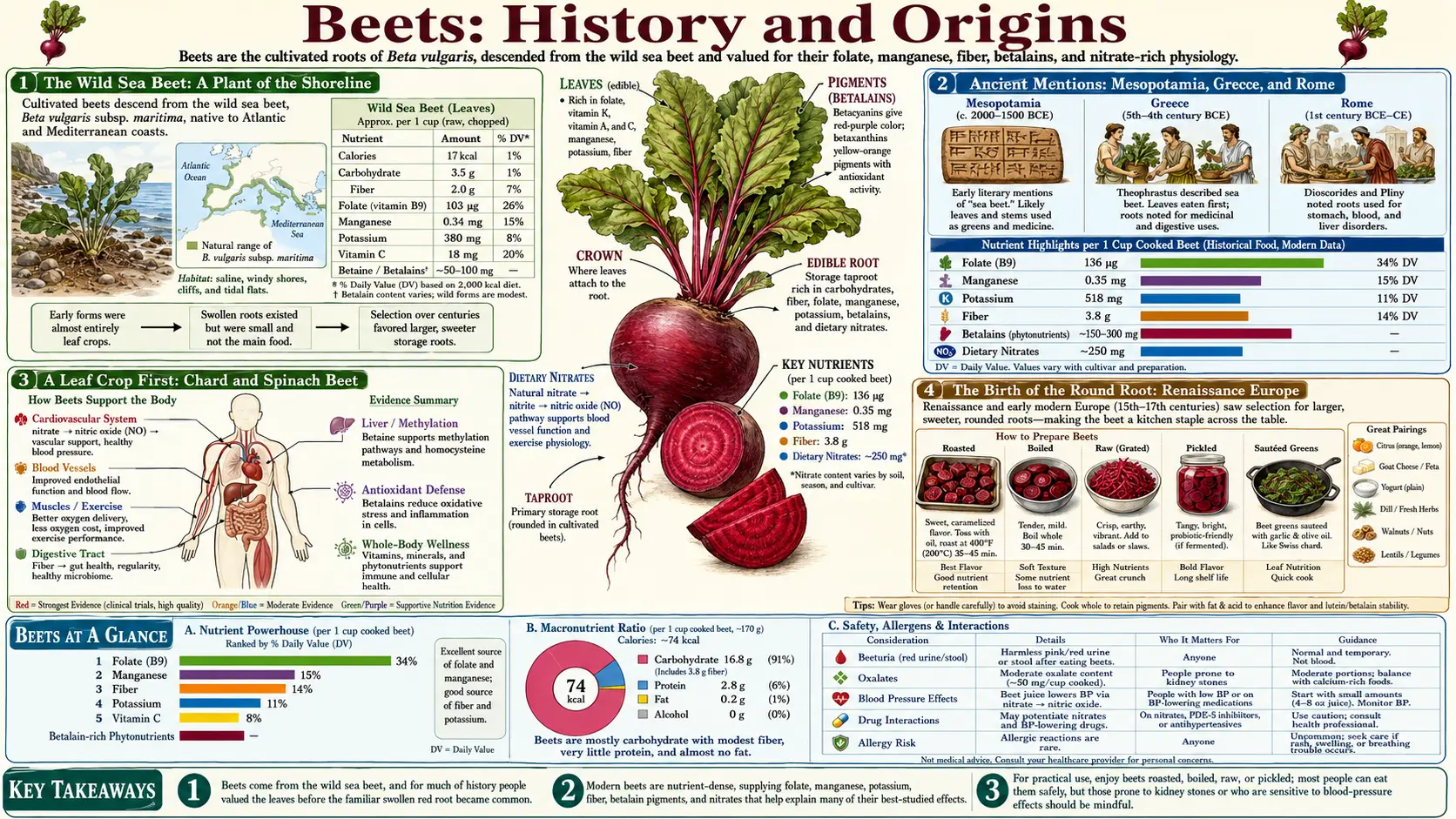
The beet most of us picture — a heavy, dark-crimson globe pulled from the soil — is a surprisingly recent thing. For most of its long history the beet was a leaf, not a root: a salt-tolerant seaside plant whose ancestors grew wild along the shores of the Mediterranean and the Atlantic, gathered first for their greens. The swollen, sweet, blood-red taproot we now treat as the whole point of the plant does not appear clearly in the written and pictorial record until the sixteenth century. This article traces what the historical evidence actually supports: the wild sea-beet ancestor and where it grew; the earliest mentions in ancient Mesopotamia, Greece, and Rome; how the round root finally took shape in Renaissance Europe; the eighteenth-century discovery that beets were full of ordinary sugar; and how a wartime blockade under Napoleon turned that laboratory curiosity into one of the world's great industrial crops. Beets were never invented by anyone — like every food, the plant is the product of nature and of generations of growers — so where a claim is firm we say so, and where it is folklore, a single ancient text, or still argued among scholars, we say that too.
Table of Contents
- The Wild Sea Beet: A Plant of the Shoreline
- Ancient Mentions: Mesopotamia, Greece, and Rome
- A Leaf Crop First: Chard and Spinach Beet
- The Birth of the Round Root: Renaissance Europe
- Sugar in the Beet: Marggraf, Achard, and Napoleon
- Spread and Culinary Traditions
- From Folk Tonic to Modern Research
- Research Papers and References
- Connections
- Featured Videos
The Wild Sea Beet: A Plant of the Shoreline
Every beet on earth — the dark salad beetroot, the pale sugar beet, the rainbow-stemmed chard, the cattle-feed mangel — descends from a single wild plant, the sea beet, known botanically as Beta vulgaris subspecies maritima. It is a tough, sprawling, salt-tolerant herb that grows wild along coastlines and in disturbed ground, and its natural range is wide: the shores of the Mediterranean, up the Atlantic coast of Europe as far as Scandinavia, and eastward through the Middle East into India, Iran, and the Caucasus. This is a plant built for hard places — sand, salt spray, and stony soil — and that hardiness is part of why people across so many regions came to know it.
Botanically the beet sits in the family Amaranthaceae (older books place it in the Chenopodiaceae, the goosefoot family), which makes it a relative not of the carrot or the turnip but of spinach, chard, and quinoa. One feature of the wild sea beet matters a great deal for the story that follows: its root contains extra rings of growth tissue, called supernumerary cambia. In most of its wild forms the root stays thin and woody, but that unusual internal anatomy gave later growers something to work with — the raw material from which, after many centuries of selection, a fat storage root could eventually be coaxed.
The honest summary is that the beet is native to a broad arid-and-coastal belt of the Old World, not to any single country, and that its earliest human use was as a wild gathered green. Where it was first deliberately cultivated is generally placed in the Mediterranean region, but the wild plant's sheer geographic spread means several ancient cultures could have come to know it independently.
Ancient Mentions: Mesopotamia, Greece, and Rome
The beet has a genuinely ancient paper trail, though it is a modest one. The earliest reasonably secure written mention is usually traced to Mesopotamia in roughly the eighth century BC; the botanists Daniel Zohary and Maria Hopf, in their standard reference on the domestication of Old World plants, note that the beet is "linguistically well identified" in records from this period. A frequently repeated claim that beets grew in the Hanging Gardens of Babylon around 800 BC should be treated with caution — the Hanging Gardens themselves may never have existed in the form later writers described — but the broader point stands: people in the ancient Near East knew the plant.
In the classical Mediterranean, beets appear in both medical and culinary writing, and here a crucial detail is easy to miss: the ancients were almost always talking about the leaves, not the round root we know today. The Greek physician Dioscorides, writing in the first century AD, described pale and dark forms of beet and recommended them for a range of ailments — the white kind to loosen the bowels, the dark kind to bind them, with further uses for earache and for scalp complaints. Roman writers likewise valued the plant mostly as a pot-herb and a gentle medicine, used as a mild laxative or in the treatment of fevers, rather than as a substantial vegetable in its own right.
Beets also turn up in the most famous of Roman cookery collections, the recipe book known as De re coquinaria that travels under the name of Apicius. The name points to Marcus Gavius Apicius, a Roman gourmet of the first century AD, but the surviving text is a later compilation assembled toward the end of the Roman era, so it is best read as a Roman culinary tradition bearing his name rather than the work of one author. Its beet recipes — the vegetable dressed with leeks, coriander, cumin, oil, and vinegar — again reflect a plant eaten chiefly for its leaves and stalks. The clear thread through all of this is that classical antiquity prized the beet as a leaf and a remedy, and that the heavy sweet root of the modern garden was not yet on the table.
A Leaf Crop First: Chard and Spinach Beet
Because the wild sea beet was gathered for its greens, the first crops people bred from it were leaf crops. Selecting the plants with the largest, most tender foliage and the broadest, fleshiest leaf-stalks gradually produced what we now call chard (also Swiss chard, leaf beet, or silverbeet) and the closely related spinach beet. These are not separate species but cultivated forms of the very same plant, Beta vulgaris — a beet bred for its top rather than its bottom. The leaf-beet group has a long pedigree, with its roots in selections made in the Mediterranean world well before the swollen-rooted forms existed.
This is why the beet's closest kitchen relatives are leafy: chard is, quite literally, a beet, and spinach belongs to the same plant family. For most of recorded history a "beet" in the garden or on the plate would have meant these greens and their thick midribs, simmered as a pot-herb. The familiar globe beetroot is a latecomer that branched off from this older leafy lineage once growers began, much later, to push the plant's selection in an entirely different direction — downward, into the root.
The Birth of the Round Root: Renaissance Europe
The most striking fact in the beet's history is how late the beetroot itself arrives. According to a detailed study of the plant's images and texts by the horticultural historians Irwin Goldman and Jules Janick, swollen-rooted table beets "do not appear to be documented until the early sixteenth century." Earlier forms had thin, often conical roots; the substantial, rounded, deep-red root we now take for granted is essentially a Renaissance European development, refined over the following centuries.
The evidence for this is pictorial as much as textual. Goldman and Janick point to early depictions of a swollen-rooted beet in the frescoes of the Villa Farnesina in Rome, painted around 1515–1517, and to later sixteenth-century herbals such as that of Jacques Dalechamps (1587), which show the rounder root becoming established. Over the following two hundred years the conical garden beet gradually gave way to the spherical type. The domestication of the storage root, in other words, happened after the plant had spread well beyond the Mediterranean — largely in Europe, and largely in the modern era rather than in antiquity.
It is worth saying plainly that this corrects a common impression. Beets are genuinely ancient as a cultivated plant, but the blood-red root — the thing a modern cook means by "a beet" — is only a few centuries old. From those rounded European garden beets came not only today's table beetroot but, as growers selected for other traits, the pale fodder beets and, eventually, the sugar beet that would change the plant's economic fortunes entirely.
Sugar in the Beet: Marggraf, Achard, and Napoleon
By the eighteenth century the European beet had been bred into fat-rooted garden and fodder forms, and people had long noticed that beets taste sweet. The decisive step came in 1747, when the Prussian chemist Andreas Sigismund Marggraf, working at the Berlin Academy of Sciences, showed that the sweetness was not merely beet-flavoured but was actual sucrose — the same sugar then obtained only from tropical sugar cane. Using alcohol to extract and crystallise it, he demonstrated that beet sugar and cane sugar were chemically the same substance, finding it in his beets at concentrations of only around 1.3 to 1.6 percent. This was the genuine discovery in the beet's story: a named chemist, a verifiable date, and a specific finding. Marggraf treated it, accurately enough for his time, as a laboratory result with no obvious commercial future.
Turning that finding into an industry fell to Marggraf's pupil, the chemist Franz Karl Achard. Beginning in the 1780s, Achard set about selectively breeding beets to raise their sugar content well above the levels Marggraf had measured, working in particular with a white Silesian fodder beet. In 1801–1802, with the backing of King Frederick William III of Prussia, he opened what is generally credited as the world's first beet-sugar factory at Cunern (Kunern) in Silesia — today Konary, in Poland. The technology was crude and barely profitable, and it might have languished there.
What rescued it was war. During the Napoleonic Wars, the British naval blockade and Napoleon's answering Continental System choked off cane sugar imports to continental Europe. Cut off from Caribbean sugar, France threw its weight behind the home-grown alternative: Napoleon promoted the crop directly, dedicating tens of thousands of hectares to sugar beet and supporting schools and factories to develop it. The result was explosive — the number of French beet-sugar works grew from a handful to several hundred within a few years around 1811–1813. When the blockade lifted and cheap cane sugar returned, beet sugar had nonetheless put down permanent roots in European agriculture. Today the sugar beet is one of the world's major sugar crops, and it descends directly from those Renaissance-era European root beets.
Spread and Culinary Traditions
As the rounded red root spread through Europe from the sixteenth century onward, it settled deeply into regional cooking — above all in the colder lands where it stored well through winter. The most famous dish is borscht, the beet soup of Ukraine and the wider region of Eastern Europe, served hot or cold and often finished with sour cream; in 2022 UNESCO inscribed the culture of Ukrainian borscht cooking on its list of intangible cultural heritage in need of urgent safeguarding. Pickled beets, beet relishes, and fermented preparations such as beet kvass became staples of Eastern and Central European tables, prized partly because pickling and fermentation kept the harvest edible long past autumn.
The beet travelled with Europeans to the Americas and beyond as a garden and field crop, and its uses multiplied: a sweet salad root, a source of betanin used as a natural red food colouring, a livestock feed in its mangel form, and an industrial sugar source in its sugar-beet form. Different cultures emphasised different parts — the root in much of Europe, but the leaves and stalks (as chard) all around the Mediterranean and in parts of Asia — so that a single species came to occupy several quite distinct culinary niches. By the modern era the beet had completed an unlikely journey: from a wild seaside green, to an ancient leaf crop, to a Renaissance garden root, to a global vegetable, dye, fodder, and sweetener all at once.
From Folk Tonic to Modern Research
Running quietly through all of this is the beet's reputation as a healthful food. The ancient medical uses recorded by Dioscorides and the Romans were modest and specific — a mild laxative, a remedy for minor complaints — and beet juice later acquired a folk reputation as a "blood tonic," encouraged no doubt by its deep red colour. These are best understood as history, not as medical advice: a long tradition of use tells us a plant was valued and worth investigating, not that any particular health claim has been proven.
What is striking is that modern science has, in part, circled back to the beet. Researchers have shown that the root is unusually rich in dietary nitrate, which the body converts into nitric oxide — a molecule that relaxes blood vessels. A widely cited 2008 study in the journal Hypertension, by Andrew Webb and colleagues, found that drinking beetroot juice lowered blood pressure in healthy volunteers, helping to launch a large body of contemporary research into beets and cardiovascular and exercise performance. That work, and the evidence behind it, is covered in detail on the companion Beets Benefits articles and on the main Beets page; this history is concerned only with how the beet came to be grown and eaten in the first place. The thread from a wild shoreline green, to a Renaissance garden root, to a juice studied in a modern laboratory is unbroken — and following it honestly is the point of knowing the history at all.
Research Papers and References
The list below combines peer-reviewed sources on the history, domestication, and botany of Beta vulgaris with reputable food-history references and curated PubMed topic-search links. Historical primary sources (the writings of Dioscorides and the Roman recipe collection bearing the name of Apicius) are named in the article as historical sources rather than as modern citations. Author names, titles, and journals are given as plain text; only the stable DOI, PMID, or archive link is hyperlinked, and each opens in a new tab.
- Goldman IL, Janick J. Evolution of root morphology in table beet: historical and iconographic. Frontiers in Plant Science. 2021;12:689926. — doi:10.3389/fpls.2021.689926 (also PMID: 34447400)
- Webb AJ, Patel N, Loukogeorgakis S, et al. Acute blood pressure lowering, vasoprotective, and antiplatelet properties of dietary nitrate via bioconversion to nitrite. Hypertension. 2008;51(3):784-790. — doi:10.1161/HYPERTENSIONAHA.107.103523 (also PMID: 18250365)
- Zohary D, Hopf M, Weiss E. Domestication of Plants in the Old World (4th ed.). Oxford University Press; 2012. — Standard reference identifying the eighth-century-BC Mesopotamian written record of the beet.
- Frese L, Desprez B, Ziegler D. Potential of genetic resources and breeding strategies for base-broadening in Beta. In: Broadening the Genetic Base of Crop Production. CABI; 2001. — On the wild Beta vulgaris ssp. maritima gene pool and crop relationships.
- Beta vulgaris (beet) — history, domestication, and origin — PubMed: Beta vulgaris domestication and history
- Sugar beet history and the development of beet sugar — PubMed: sugar beet history and sucrose
External Authoritative Resources
- Encyclopaedic overview — Beta vulgaris
- University of Oxford, Plants 400 — Beta (beet) profile
- The Sugar Association — the story of sugar beets