Beef: History and Origins
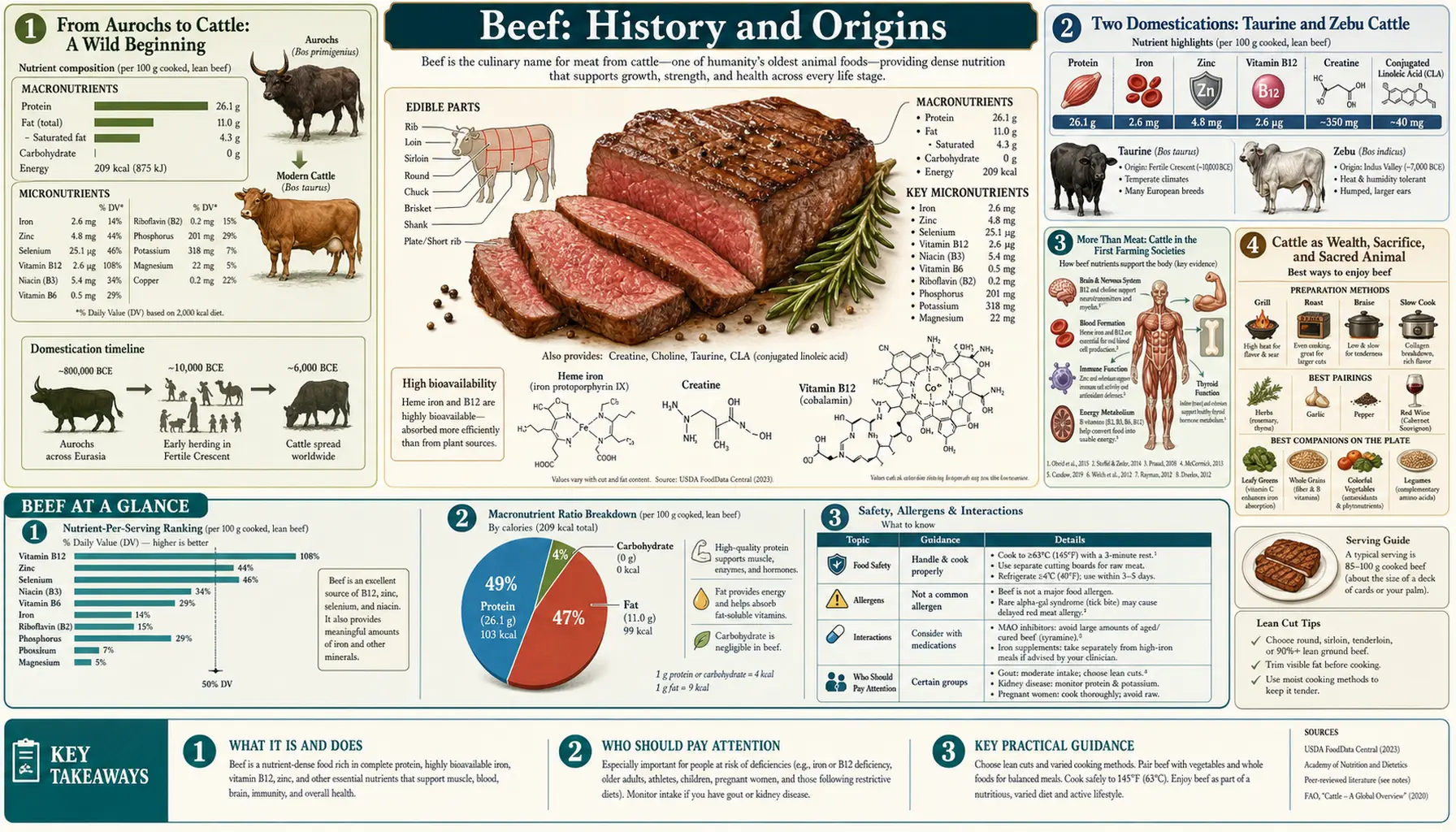
Beef has no inventor. It begins instead with a wild animal — the aurochs, a huge, long-horned wild ox that once roamed from Europe to Asia and North Africa — and with a small group of Neolithic herders in the Near East who, around 10,500 years ago, began keeping and breeding a handful of those wild cattle. Genetic work suggests that all of today's humpless "taurine" cattle trace back to a founding herd of only about eighty wild cows tamed in that region. From those beginnings beef became one of the most far-reaching foods in human history: a source of meat, milk, leather, and muscle-power; a measure of wealth so basic that the Latin word for money grew out of the word for cattle; a sacred animal in some cultures and a sacrificial one in others; and, after 1493, a New World industry that reshaped two continents. This article follows what the archaeological and genetic record actually supports, and is careful to flag the places where a claim is tradition, language, or still under study rather than settled fact.
Table of Contents
- From Aurochs to Cattle: A Wild Beginning
- Two Domestications: Taurine and Zebu Cattle
- More Than Meat: Cattle in the First Farming Societies
- Cattle as Wealth, Sacrifice, and Sacred Animal
- Why It Is "Beef" and Not "Cow": A Word from 1066
- The Last Aurochs: An Extinction in 1627
- Cattle Cross the Atlantic: The Columbian Exchange
- From Open Range to the Modern Table
- Research Papers and References
- Connections
- Featured Videos
From Aurochs to Cattle: A Wild Beginning
Every cow, steer, and bull alive today descends from a wild animal called the aurochs (Bos primigenius). The aurochs was far bigger and fiercer than a modern cow — bulls could stand around 1.8 metres at the shoulder and carried long, forward-curving horns — and it ranged in the wild across much of Europe, Asia, and North Africa. Stone Age people hunted it for tens of thousands of years before anyone thought to keep it; aurochs are among the animals painted on the walls of the famous Lascaux caves in France. So the story of beef starts not with farming but with the hunt: wild cattle were prey long before they were livestock.
Domestication — the slow, deliberate process of catching, taming, and breeding wild animals into a manageable form — came during the Neolithic Revolution, the same broad transition in which humans in the Near East began farming grain and settling into villages. The best current evidence places the domestication of cattle in the Fertile Crescent (the arc of fertile land running through what is now southeastern Turkey, Syria, Iraq, and Iran) roughly 10,500 years ago. This is not a single dramatic event with a known hero but a gradual relationship that developed over generations between particular human communities and the wild herds around them.
One of the more striking findings of modern genetics is just how small that founding event seems to have been. A 2012 study by Ruth Bollongino, Joachim Burger, and colleagues, working from the mitochondrial DNA of ancient and modern cattle, estimated that the world's taurine cattle descend from a founder population of only about eighty female aurochs. In other words, the billion-plus cattle on Earth today trace their maternal line back to a herd you could fit in a single large field. That points to taming wild cattle being difficult and limited rather than something many groups did easily and everywhere — a hard-won achievement by a few communities, the fruits of which then spread.
Two Domestications: Taurine and Zebu Cattle
Cattle were not domesticated only once. The familiar humpless cattle of Europe, the Near East, and Africa — the kind most Western readers picture — are taurine cattle (Bos taurus), descended from the Near-Eastern aurochs described above. But there is a second great lineage: the humped, heat-tolerant zebu (Bos indicus), with its distinctive shoulder hump and large dewlap, which is the dominant type across South Asia and much of the tropics. Zebu cattle were domesticated separately, from a different population of wild aurochs in the region of the Indus Valley (in present-day Pakistan and northwest India), with estimates generally placing that event somewhat later than the Near-Eastern one.
This two-origins picture is the mainstream scientific view, summarised in reviews such as the 2010 overview "On the origin of cattle" by Paolo Ajmone-Marsan and colleagues: taurine maternal lineages arose in the Fertile Crescent, while zebu lineages arose in the Indian subcontinent. (A handful of researchers argue for a possible third, African, domestication, which is why some sources phrase it as "two or three events"; the two-lineage account is the firm part.) Over the following millennia the two kinds met and mixed — zebu and taurine cattle interbred where their ranges overlapped — which is why so many of the world's cattle breeds today carry a blend of both ancestries.
The practical point for the history of beef is that "cattle" were never a single invention rolled out from one place. They were domesticated at least twice, by different peoples, from a wild animal that happened to live across a vast stretch of the Old World. That deep, branching origin is part of why cattle ended up at the centre of so many different food cultures.
More Than Meat: Cattle in the First Farming Societies
It is easy to assume that early people kept cattle simply to eat them, but the historical reality is richer. Once cattle were domesticated, farming societies gradually learned to use the living animal again and again — for milk, for traction (pulling ploughs and carts), and for hauling and transport — as well as for meat, hide, horn, bone, and dung when the animal's working life was over. Archaeologists call this broadened use of living animals the Secondary Products Revolution, a model proposed by the archaeologist Andrew Sherratt, who originally tied the spread of milking, wool, and animal-traction to the fourth and third millennia BCE.
Sherratt's timing has since been pushed back and debated. Newer evidence — including chemical residues of dairy fats on ancient pottery and the tell-tale bone wear of animals worked hard in harness — suggests milk and draught use began earlier than his original model allowed, in some places not long after domestication itself. A 2023 study by Fabienne Pigière and Jessica Smyth, for instance, reported the first clear evidence of cattle traction in Middle Neolithic Ireland, with worked oxen present by perhaps as early as 3600 BCE, and argued that access to draught cattle helped drive wider economic and social change. The precise chronology is genuinely an active research question; what is not in doubt is the larger truth it points to.
That larger truth is this: for most of history, an ox at the plough was worth far more alive than as a single meal. Cattle powered agriculture, moved goods, fertilised fields, and gave milk year after year — and beef, for ordinary people, was often what came at the end of that long working life, or what only the wealthy could afford to eat regularly. The food we now buy by the steak was, for millennia, the by-product of an animal kept first for its labour and its milk.
Cattle as Wealth, Sacrifice, and Sacred Animal
Because a cow could plough, breed, give milk, and ultimately feed a family, cattle became one of the oldest and most universal measures of wealth. This is preserved fossil-like in language. The Latin word for money, pecunia, comes from pecus, meaning cattle or livestock; both descend from a Proto-Indo-European root (peku-) for livestock. The Roman writer Cicero could still see that connection plainly. The English words pecuniary and impecunious are the direct descendants — so that to this day, when we talk about "pecuniary" matters, we are using a word that originally meant "to do with cattle." A person's herd was, quite literally, their bank account.
Cattle also occupied a powerful place in religion and ritual. In the ancient Mediterranean and Near East, oxen and bulls were among the most prestigious sacrificial animals, offered to the gods in the great public sacrifices of Greece and Rome and in the rites of the Hebrew Bible. Bull imagery runs through many early cultures, from the bull-leaping frescoes of Bronze-Age Crete to the sacred bull figures of ancient Egypt and Mesopotamia. Eating beef, in these settings, could be a solemn communal act rather than an everyday meal.
In other traditions the cow became something to protect rather than to eat. In Hinduism the cow holds a revered, protected status, and many practising Hindus do not eat beef — a tradition that developed over a long span in ancient and classical India and which still shapes diet, law, and culture across much of South Asia today. The contrast is a reminder that beef has never had a single meaning: in one society the same animal was a sacrifice, in another a unit of currency, and in another a creature to be honoured and spared.
Why It Is "Beef" and Not "Cow": A Word from 1066
English does a curious thing with meat: the animal in the field is a cow, an ox, or a calf, but the meat on the plate is beef. The same split runs through pig versus pork and sheep versus mutton. This is not an accident of cooking but a scar left by history — specifically by the Norman Conquest of England in 1066, when French-speaking Normans became the ruling class over an English-speaking population.
The everyday Germanic words for the live animals — cu (cow), oxa (ox) — stayed in the mouths of the Anglo-Saxon farmers who raised and tended the herds. But the meat, served at the tables of the Norman nobility, took the French name: boef (modern French bœuf), which itself goes back to the Latin bos, "ox." Over time boef became the English beef. The widely repeated explanation is that those who looked after the animals spoke English, while those who could afford to eat the meat spoke French — so the language preserves, in a single pair of words, the social divide of medieval England.
This neat "peasant-animal, lord's-meat" story is the standard account given in dictionaries and histories of English, and the basic etymology — beef from Anglo-Norman boef, from Latin bos — is solid. It is worth noting that the strict separation took centuries to settle and was never perfectly tidy in everyday speech, so the "class divide" framing is best read as a real and well-documented pattern rather than a hard rule that snapped into place overnight in 1066. Either way, every time you order beef you are speaking a little Norman French.
The Last Aurochs: An Extinction in 1627
While domestic cattle multiplied across the Old World, their wild ancestor dwindled. Hunting and the steady loss of the forests and wetlands it needed pushed the aurochs into ever-smaller pockets of Europe. By the early modern period only a single relict herd survived, in the marshy royal woodland of the Jaktorów Forest in Poland, where Polish kings gave it special protection and even posted gamekeepers to guard it. It was not enough. The herd shrank through the late 1500s and early 1600s, and the very last aurochs — a lone cow — died there in 1627.
That date carries real weight. The aurochs is one of the few large animals whose extinction in the wild is recorded with a specific year, and accounts indicate that this last individual appears to have died of natural causes rather than being hunted down — the species was simply too reduced to recover. It is a sobering bookend to the domestication story told at the top of this page: the wild animal from which all cattle sprang outlived its own taming by about ten thousand years, and then vanished while its domesticated descendants spread to every inhabited continent.
The aurochs has not been entirely forgotten by science. Because cattle still carry aurochs genes, several modern "breeding-back" projects in Europe have tried to recreate an aurochs-like animal by selectively breeding hardy cattle, and ancient-DNA work continues to reconstruct what the wild ox was actually like. These efforts produce cattle that resemble the aurochs; they do not, and cannot, literally bring the extinct animal back. The original is gone, and 1627 is when it left.
Cattle Cross the Atlantic: The Columbian Exchange
For all their reach across the Old World, cattle were entirely unknown in the Americas before Europeans arrived. There were no cows, oxen, or bulls anywhere in the Western Hemisphere. That changed during the Columbian Exchange — the vast, world-altering transfer of plants, animals, people, and diseases between the Old World and the New that followed 1492. Cattle were part of the first wave. On Christopher Columbus's second voyage in 1493, Spanish ships carried cattle (along with horses, pigs, and other livestock) to the Caribbean island of Hispaniola, the first cattle ever to set hoof in the Americas.
From those Iberian animals, cattle spread explosively. In the open, predator-poor grasslands of the Caribbean and then the American mainland, herds bred and escaped and bred again, some turning feral and roaming wild. Spanish colonists carried cattle onward into Mexico and across to South America, and over the following centuries those founding bloodlines gave rise to the great cattle cultures of the New World — the vaqueros and ranchos of Mexico, the gauchos of the Argentine and Uruguayan pampas, and the cowboys, cattle drives, and ranches of the North American plains. The legendary Texas Longhorn, for example, descends in large part from those early Spanish cattle.
It is hard to overstate how much this single transfer reshaped the world's relationship with beef. Grasslands that had never seen a cow became some of the most productive cattle country on Earth, and beef shifted, in those regions, from a scarce luxury toward a staple. The herds of the Americas, descended from animals first tamed in the Fertile Crescent thousands of years before, closed a circle: cattle had finally reached the one large landmass their wild ancestors never touched.
From Open Range to the Modern Table
The beef most people eat today is the product of changes that came mainly in the last century and a half. For most of history, cattle were grazed on grass and slaughtered relatively old, and beef was an occasional food for many families. The nineteenth century brought the open-range ranching of the American West and the great cattle drives; the arrival of the railroad and, crucially, refrigeration then transformed beef from a local product into a long-distance commodity. Refrigerated railcars and ships meant meat could be slaughtered in one place and eaten thousands of miles away, and large meatpacking centres grew up to supply growing cities.
The twentieth century industrialised the system further, with feedlots, selective breeding for size and growth, and the global trade that makes beef available year-round in much of the world. This abundance is historically extraordinary — a food once reserved for feasts and the wealthy is now an everyday item on many tables — but it also brings the modern debates the earlier history could never have anticipated: questions about land and water use, climate, animal welfare, and the health differences between lean unprocessed beef and heavily processed meat products.
Those nutritional and practical questions — how beef fits into a healthy diet, what distinguishes grass-fed from grain-fed, and how its iron, B12, protein, and other nutrients actually behave in the body — are taken up in detail on the companion Beef Benefits articles and on the main Beef page. This history has aimed only to explain how a wild ox of the Near East became, over ten thousand years, one of the most important and most contested foods on the planet. Nothing here is dietary or medical advice; it is the long story of where beef came from, told as plainly and as honestly as the record allows.
Research Papers and References
The list below combines peer-reviewed studies on cattle domestication and history with curated PubMed topic-search links and reputable reference sources. Author names, titles, and journals are given as plain text; only the stable DOI, PMID, or archive link is hyperlinked, and each opens in a new tab. Where the article above describes language, tradition, or an actively debated chronology, that uncertainty is stated in the text rather than hidden in the citations.
- Bollongino R, Burger J, Powell A, Mashkour M, Vigne JD, Thomas MG. Modern taurine cattle descended from small number of near-eastern founders. Molecular Biology and Evolution. 2012;29(9):2101-2104. — doi:10.1093/molbev/mss092 · PMID: 22422765
- Ajmone-Marsan P, Garcia JF, Lenstra JA. On the origin of cattle: how aurochs became cattle and colonized the world. Evolutionary Anthropology. 2010;19(4):148-157. — doi:10.1002/evan.20267
- Pigière F, Smyth J. First evidence for cattle traction in Middle Neolithic Ireland: a pivotal element for resource exploitation. PLOS One. 2023;18(1):e0279556. — doi:10.1371/journal.pone.0279556
- DNA traces cattle back to a small herd domesticated around 10,500 years ago. University College London (UCL) News, 2012 — reporting on Bollongino et al. — UCL News
- Cattle domestication and aurochs origins — PubMed: cattle domestication and aurochs origin
- Zebu and taurine cattle — genetic origins and history — PubMed: zebu and taurine cattle origins
External Authoritative Resources
- Natural History Museum — From aurochs to burgers
- Online Etymology Dictionary — "beef"
- Online Etymology Dictionary — "pecuniary" (from Latin pecus, cattle)