Obstructive Sleep Apnea: History and Discovery
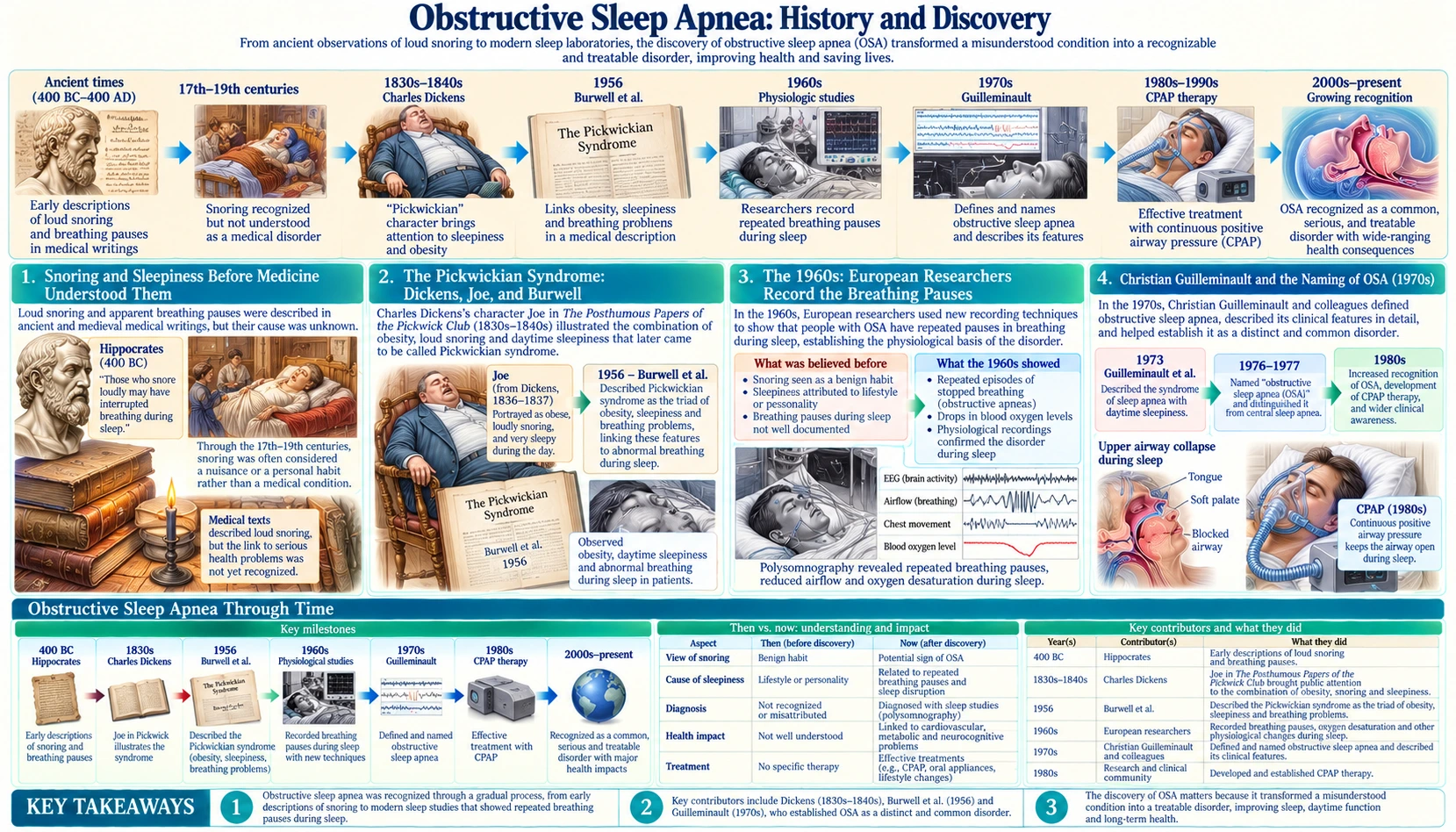
For centuries, loud snoring punctuated by silences and crushing daytime drowsiness was noticed by everyone and understood by no one. The story of obstructive sleep apnea (OSA) is really three stories braided together: a literary era, in which a fat, perpetually dozing boy in a Dickens novel lent his name to the obese, sleepy patient; a clinical era in the 1960s and 1970s, in which European and then American researchers finally recorded the breathing actually stopping during sleep and named the disorder; and a treatment era that began in 1981, when a simple machine in Sydney learned to splint the airway open with nothing but pressurized air. This page traces that arc — from Pickwickian folklore to the modern sleep laboratory — and is a companion to the main Obstructive Sleep Apnea article.
Table of Contents
- Snoring and Sleepiness Before Medicine Understood Them
- The Pickwickian Syndrome: Dickens, Joe, and Burwell (1956)
- The 1960s: European Researchers Record the Breathing Pauses
- Christian Guilleminault and the Naming of OSA (1970s)
- Polysomnography: Building the Sleep Study
- Colin Sullivan and the CPAP Revolution (1980–1981)
- Recognizing the Heart and Blood-Pressure Connection
- OSA and the Obesity Epidemic
- Key Research Papers
- Connections
- Featured Videos
Snoring and Sleepiness Before Medicine Understood Them
Loud, choking snoring and an irresistible urge to sleep during the day are among the oldest complaints in the human record, yet for most of history no one connected the two or grasped that the breathing itself was failing. Ancient writers occasionally noted that very heavy, ruddy-faced people tended to fall asleep at inappropriate moments — a description that, with hindsight, fits severe sleep-disordered breathing — but they had no way to observe what happens to a sleeping person from the inside. Snoring was treated as a nuisance, a moral failing, or a sign of deep, untroubled rest, rather than as a symptom of a body fighting to breathe.
The obstacle was fundamental: the decisive events of sleep apnea happen during sleep, when the patient is unconscious and unaware, and the most dangerous sign — the complete cessation of airflow — is a silence, easily missed by a bystander focused on the noise. A spouse might notice that the snoring stopped, the chest still heaved, and then a gasp restarted the cycle, but without instruments to measure airflow, effort, blood oxygen, and brain state simultaneously, the phenomenon could not be studied. Daytime sleepiness, the most disabling consequence for the patient, looked like laziness rather than the predictable result of a night shattered into hundreds of fragments.
For these reasons the genuine medical history of OSA is short and almost entirely modern. The condition could not be discovered until two things existed together: a vivid clinical picture that doctors could recognize and a name they could share — which arrived, surprisingly, by way of a novel — and the technology to watch breathing and brain activity through a whole night of sleep. The first arrived in the 1950s, the second in the 1960s, and the two met to create sleep medicine.
The Pickwickian Syndrome: Dickens, Joe, and Burwell (1956)
The modern story begins, improbably, in fiction. In The Posthumous Papers of the Pickwick Club — The Pickwick Papers — which Charles Dickens published in monthly instalments beginning in 1836 (and as a book in 1837), there appears a minor but unforgettable character: Joe, "the fat boy," a grossly overweight servant who is forever falling asleep, even mid-task and mid-sentence, and snoring loudly when he does. Dickens, a brilliant observer of real human types, had sketched — without any medical intent — a near-perfect portrait of a patient with severe obesity, hypoventilation, and overwhelming daytime sleepiness.
More than a century later, in 1956, the Harvard cardiologist Charles Sidney Burwell and his colleagues borrowed Joe's literary fame to name a real clinical syndrome. Their case report, "Extreme obesity associated with alveolar hypoventilation — a Pickwickian syndrome," described an obese patient who was chronically sleepy, who under-breathed even while awake (retaining carbon dioxide and running low on oxygen), and who had developed the downstream consequences of chronic hypoxia: a thickened blood, pulmonary hypertension, and strain on the right side of the heart. Burwell did not discover the syndrome so much as name and frame it, giving physicians a memorable label and a recognizable picture.
It is important to be precise about what "Pickwickian syndrome" did and did not mean, because the terms are often blurred. What Burwell described is today called obesity hypoventilation syndrome (OHS) — a disorder of daytime under-breathing in obese people. This is related to, but not the same as, obstructive sleep apnea, in which the airway repeatedly collapses during sleep. Many Pickwickian patients had severe OSA as well, and the two conditions frequently coexist, but the crucial insight that the breathing was being obstructed during sleep — rather than simply being too shallow — still lay ahead. The Pickwickian label, however, did something essential: it made the sleepy, hypoventilating, obese patient a subject worth investigating, and it set researchers looking closely at what was happening to such patients overnight.
The 1960s: European Researchers Record the Breathing Pauses
The decisive step — actually watching the breathing stop during sleep — was taken in Europe in the mid-1960s by neurophysiologists who already knew how to record the sleeping brain with the electroencephalogram (EEG). In France, the eminent Marseille neurologist Henri Gastaut, together with Carlo Alberto Tassinari and Bernard Duron, applied continuous overnight "polygraphic" recording — brain waves plus breathing and other channels — to a Pickwickian patient. Their report, published in the journal Brain Research in 1966 (the work carried out the previous winter), documented something startling: repeated respiratory pauses during sleep. Crucially, they distinguished different kinds of pauses, including ones in which respiratory effort continued but airflow was blocked — that is, true obstructive apneas, in which the airway closes while the patient still struggles to breathe.
At almost the same moment, in Germany, Richard Jung and Wolfgang Kuhlo independently published neurophysiological studies of abnormal night sleep in the Pickwickian syndrome (1965). Working from electroencephalogram-based sleep recordings, they too captured the apneic events and, importantly, helped overturn a tidy but wrong assumption of the day. It had been supposed that the daytime sleepiness of these patients was a kind of carbon-dioxide narcosis — drowsiness caused directly by too much CO₂ in the blood. Jung and Kuhlo's data showed that hypersomnolence could occur even in patients whose blood-gas values were normal while awake, pointing instead toward the fragmentation of sleep itself by the repeated breathing interruptions as the real cause of the daytime collapse.
Together, the French and German groups accomplished what two thousand years of bedside observation could not: they made the invisible visible. The breathing pauses were no longer an anecdote about a snorer who "stopped breathing for a moment" — they were now recorded, repeatable, classifiable physiological events. This European work of 1965–1966 is the true scientific birth of sleep apnea as a measurable disorder, and it set the stage for the American researcher who would give the obstructive form its enduring name.
Christian Guilleminault and the Naming of OSA (1970s)
The figure who turned these scattered observations into a coherent clinical field was Christian Guilleminault (1938–2019), a French-trained physician who came to Stanford University in California in 1972 and spent the rest of his long career there. Building on the European recordings and on the rapidly maturing science of sleep at Stanford, Guilleminault recognized that the repetitive obstruction of the upper airway during sleep was not a curiosity confined to a few enormously obese "Pickwickian" patients, but a distinct and far more common disorder in its own right — one that could affect people who were only moderately overweight, or even of normal weight.
In 1976 Guilleminault, with Ara Tilkian and the pioneering sleep scientist William C. Dement, coined and popularized the term "obstructive sleep apnea syndrome," defining the disorder in operational, measurable terms. Their influential paper "The Sleep Apnea Syndromes" (Annual Review of Medicine, 1976) defined an apnea as a cessation of airflow lasting at least ten seconds and proposed a threshold — on the order of dozens of such events per night — for diagnosing the syndrome. By separating the obstructive form (the airway collapses despite continued effort to breathe) from the central form (the brain briefly stops driving the breath) and from mixed events, Guilleminault gave the field a precise vocabulary that clinicians and researchers could share.
This was the conceptual turning point. After 1976 there was a named disease with diagnostic criteria, a recognized mechanism (upper-airway collapse), and a method of measurement. Sleep apnea moved out of the shadow of the Pickwickian anecdote and became a mainstream medical diagnosis — one that physicians could look for, quantify, and, before long, treat. Guilleminault would go on to co-author hundreds of papers and is widely regarded as one of the principal founders of modern sleep medicine.
Polysomnography: Building the Sleep Study
None of this would have been possible without a way to watch a person sleep in objective detail, and that tool is polysomnography — the overnight sleep study. Its foundations were laid earlier in the twentieth century: the discovery that the brain's electrical activity could be recorded from the scalp (the electroencephalogram, developed by Hans Berger in the 1920s) made it possible to tell sleep from wakefulness and to distinguish the stages of sleep. The further discovery of rapid-eye-movement (REM) sleep in the early 1950s, by Eugene Aserinsky and Nathaniel Kleitman in Chicago — work in which William Dement also took part — revealed that sleep was not a uniform blank but a structured, cyclical process with its own physiology.
A modern sleep study assembles several of these measurements into a single synchronized recording: the electroencephalogram to stage sleep, eye-movement and chin-muscle channels to identify REM sleep, airflow sensors at the nose and mouth, bands around the chest and abdomen to register breathing effort, an oximeter on the fingertip to track blood-oxygen saturation, and an electrocardiogram for heart rhythm. It is precisely this combination that makes obstructive apnea unmistakable: airflow falls to nothing while the chest and belly bands keep heaving (proving the patient is still trying to breathe), the oxygen level sags, and a brief burst of brain arousal snaps the airway back open. Run hundreds of times a night, these events are counted into the apnea–hypopnea index (AHI), the number of apneas and partial obstructions per hour of sleep, which became the standard measure of severity.
Through the 1970s and 1980s polysomnography became the diagnostic gold standard for OSA, and dedicated sleep laboratories spread through hospitals worldwide. The sleep study did for sleep apnea what the stethoscope did for the heart and the X-ray for the lung: it converted a hidden internal event into a readable trace that any trained clinician could interpret. (In recent decades simpler home sleep-apnea tests have made screening more accessible, but attended in-laboratory polysomnography remains the reference standard for complex cases.)
Colin Sullivan and the CPAP Revolution (1980–1981)
Naming and measuring a disease is one thing; treating it is another, and through the 1970s the options for severe OSA were grim. The one reliably effective treatment was tracheostomy — surgically creating a permanent opening in the windpipe below the level of the collapsing throat, bypassing the obstruction entirely. It worked, but at an enormous cost in disfigurement, complications, and quality of life, and few patients or doctors welcomed it. What was needed was something that could hold the airway open from the outside, gently, without surgery.
That breakthrough came from Sydney, Australia. In 1980–1981, the respiratory physician Colin Sullivan and his team at the University of Sydney and Royal Prince Alfred Hospital reasoned that if the upper airway was collapsing inward like a floppy tube, then a steady stream of mildly pressurized air, delivered through the nose, might act as a pneumatic splint — an invisible cushion of pressure propping the airway open from within. In an often-told detail of the story, the first prototypes were improvised from a blower motor (a vacuum-cleaner-type fan) connected by tubing to a mask sealed over the patient's nose. The principle, named continuous positive airway pressure (CPAP), was elegant precisely because it was so simple: not a drug, not an operation, just enough constant pressure to keep a soft tube from buckling shut.
Sullivan's landmark report — "Reversal of obstructive sleep apnoea by continuous positive airway pressure applied through the nares," published in The Lancet in 1981 — described five patients with severe OSA in whom low levels of nasal pressure (roughly 4.5 to 10 cm of water) completely abolished the airway obstruction during sleep. The apneas vanished, the oxygen levels held steady, and sleep became continuous again. It is difficult to overstate what this meant: an incurable, exhausting, dangerous condition that had previously demanded a hole in the throat could now be controlled by a bedside machine and a mask. CPAP transformed the care of sleep apnea and, by making effective non-surgical treatment possible, gave the whole young field of sleep medicine a powerful reason to grow.
In the decades that followed, CPAP was refined from a hand-built laboratory rig into the quiet, automatic, widely prescribed home devices used by millions today, and the technology spawned an entire industry. It remains the first-line treatment for moderate-to-severe OSA, complemented by oral appliances, positional therapy, weight management, surgical options, and — more recently — implantable nerve-stimulation devices. But the conceptual heart of treatment still traces directly back to Sullivan's simple, decisive insight of 1981.
Recognizing the Heart and Blood-Pressure Connection
As sleep medicine matured, it became clear that OSA was not merely a problem of snoring and sleepiness but a genuine cardiovascular stressor — a thread, in fact, that runs all the way back to Burwell's original Pickwickian patient, who already showed pulmonary hypertension and right-heart strain. Each obstructive event is a small physiological emergency: as the airway shuts and oxygen falls, the body responds with a surge of stress hormones, a spike in blood pressure, and a jolt to the heart, repeated dozens or hundreds of times every night, year after year. Researchers came to understand that this nightly battering does lasting damage to the circulation.
By the 1990s and 2000s, large epidemiological studies — among them the influential Wisconsin Sleep Cohort and the multicenter Sleep Heart Health Study — established that OSA is independently associated with hypertension (especially the hard-to-control and night-time varieties), and with elevated risks of heart failure, abnormal heart rhythms such as atrial fibrillation, coronary artery disease, and stroke. OSA also disturbs glucose metabolism and is intertwined with metabolic syndrome. Treating the apnea, particularly with CPAP, can improve blood-pressure control and relieve cardiac strain, although exactly how much hard cardiovascular benefit treatment delivers, and in whom, remains an active area of clinical research.
This recognition reframed OSA from a quality-of-life nuisance into a serious chronic disease with whole-body consequences, and it forged the close clinical links between sleep medicine, cardiology, and endocrinology that define the field today. The sleepy snorer of folklore turned out to be carrying a measurable cardiovascular risk — which is why screening for sleep apnea is now routine in the care of conditions such as resistant hypertension and atrial fibrillation.
OSA and the Obesity Epidemic
The final chapter of OSA's history is demographic. From the start — in Dickens' fat boy, in Burwell's Pickwickian patient, in Gastaut's overnight recordings — obesity sat at the center of the picture, and for good reason: excess soft tissue around the neck and throat narrows the airway and makes it more prone to collapse, while abdominal fat reduces the lung volumes that help hold the airway stiff. Body weight is the single strongest modifiable risk factor for obstructive sleep apnea, and weight gain reliably worsens it while weight loss can substantially improve or even resolve it.
As rates of obesity climbed steeply across the United States and much of the world from the late twentieth century onward, the prevalence of OSA rose with them, transforming a once-obscure diagnosis into one of the most common chronic conditions in respiratory and sleep medicine. Modern population studies suggest that a large fraction of middle-aged adults have at least some degree of sleep-disordered breathing, and that a great many cases remain undiagnosed. What was, in 1956, a single memorable case report named after a comic novel had become, by the 2000s, a public-health concern affecting hundreds of millions of people worldwide.
The arc is striking. A condition that medicine could not even see for most of human history was, within a single lifetime, given a name from literature, made visible in the sleep laboratory, defined and quantified, treated by an ingeniously simple machine, linked to the leading causes of death, and then amplified by the global rise in body weight. The history of obstructive sleep apnea is, in the end, a compact lesson in how a disease becomes real: it needs a picture, a measurement, a treatment, and a reason to care — and OSA acquired all four in the space of about fifty years.
Key Research Papers
The references below combine the landmark primary papers in the history of obstructive sleep apnea — Burwell's naming of the Pickwickian syndrome, the European polygraphic studies of the 1960s, Guilleminault's definition of the syndrome, and Sullivan's introduction of CPAP — with curated PubMed topic-search links into the historical and epidemiological literature. Where a confident, verified identifier exists it is given as a direct DOI or PMID link; broader themes are provided as PubMed topic searches. Each link opens in a new tab.
- Burwell CS, Robin ED, Whaley RD, Bickelmann AG. Extreme obesity associated with alveolar hypoventilation — a Pickwickian syndrome. The American Journal of Medicine. 1956;21(5):811-818. — PubMed PMID: 16353591
- Gastaut H, Tassinari CA, Duron B. Polygraphic study of the episodic diurnal and nocturnal (hypnic and respiratory) manifestations of the Pickwick syndrome. Brain Research. 1966;1(2):167-186. — PubMed PMID: 5923125
- Jung R, Kuhlo W. Neurophysiological studies of abnormal night sleep and the Pickwickian syndrome. Progress in Brain Research. 1965;18:140-159. — PubMed PMID: 14329033
- Guilleminault C, Tilkian A, Dement WC. The sleep apnea syndromes. Annual Review of Medicine. 1976;27:465-484. — doi:10.1146/annurev.me.27.020176.002341
- Sullivan CE, Issa FG, Berthon-Jones M, Eves L. Reversal of obstructive sleep apnoea by continuous positive airway pressure applied through the nares. The Lancet. 1981;1(8225):862-865. — doi:10.1016/S0140-6736(81)92140-1
- History and nomenclature of obstructive sleep apnea syndrome — PubMed: history of obstructive sleep apnea
- Pickwickian syndrome and obesity hypoventilation syndrome — historical perspective — PubMed: Pickwickian / obesity hypoventilation syndrome
- Polysomnography — development and history of the sleep study — PubMed: history of polysomnography
- Aserinsky E, Kleitman N — discovery of rapid eye movement (REM) sleep — PubMed: Aserinsky & Kleitman REM sleep
- CPAP for obstructive sleep apnea — development and evolution of therapy — PubMed: CPAP for obstructive sleep apnea
- Obstructive sleep apnea and hypertension — PubMed: OSA and hypertension / cardiovascular risk
- Wisconsin Sleep Cohort — prevalence of sleep-disordered breathing — PubMed: Wisconsin Sleep Cohort
- Sleep Heart Health Study — OSA and cardiovascular disease — PubMed: Sleep Heart Health Study
- Obesity epidemic and the rising prevalence of obstructive sleep apnea — PubMed: obesity and OSA prevalence
External Authoritative Resources
Connections
- Pulmonology
- Obstructive Sleep Apnea (OSA)
- Sleep Apnea — general overview of obstructive and central forms.
- All Conditions
- Insomnia & Sleep Disorders
- Obesity
- Hypertension
- Cardiovascular Disease
- Pulmonary Hypertension