Trichomonas vaginalis Treatment: Metronidazole, Tinidazole, and Partner Therapy
Metronidazole & Tinidazole
CDC 2021 regimens, mechanism, side effects, pregnancy safety, the alcohol label warnings, and resistance.
Read the deep dive →Partner Treatment & Reinfection
Expedited partner therapy, simultaneous treatment, test-of-cure at 3 months, and managing nitroimidazole resistance.
Read the deep dive →Prevention & Screening
Condom use, screening guidance, and health disparities.
Read the deep dive →- Cure and Repeat Infection
- The Only Drug Class With Demonstrated Efficacy
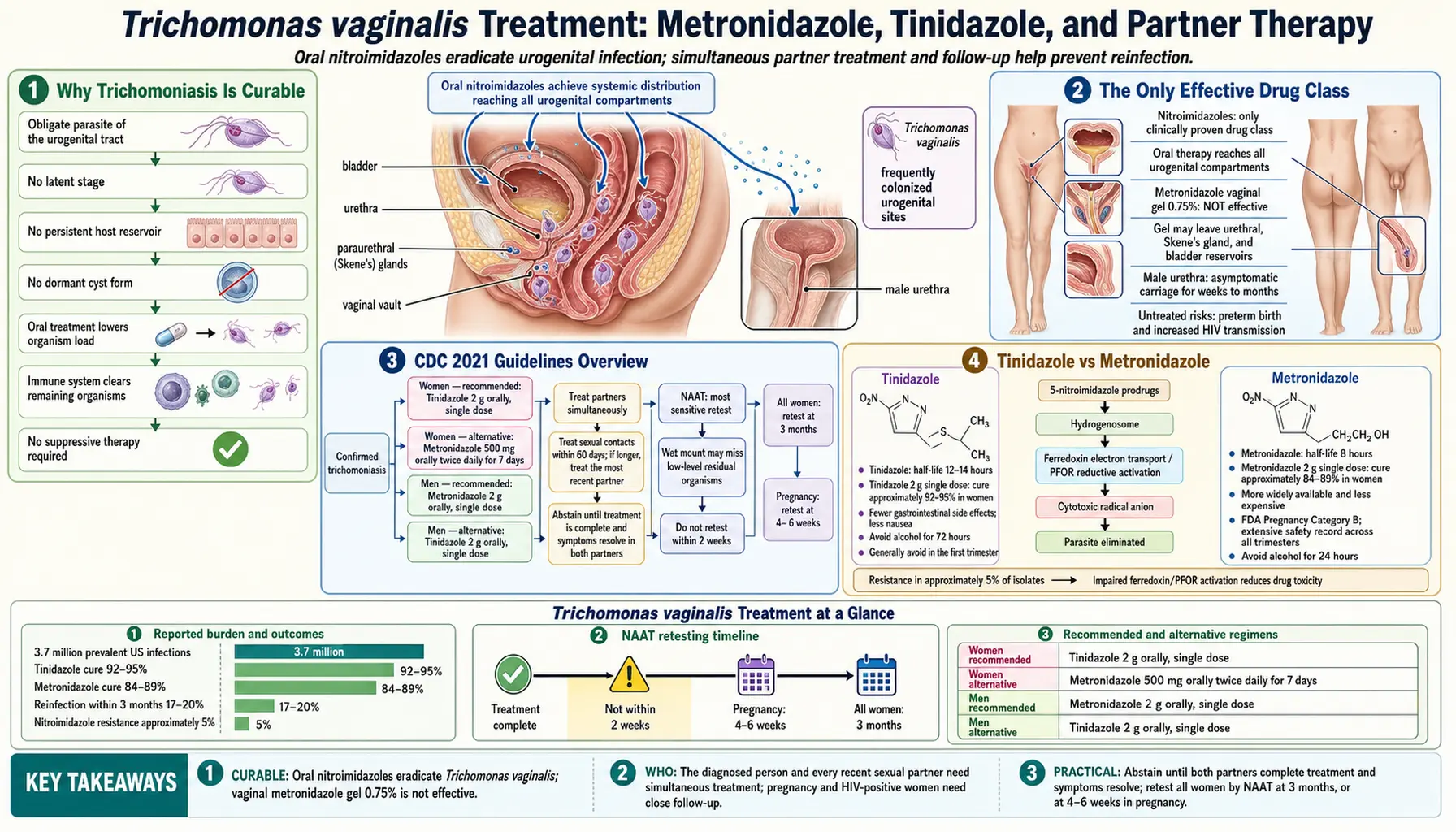
- CDC 2021 Guidelines Overview
- Tinidazole vs Metronidazole
- Partner Treatment
- Retesting After Treatment
- Nitroimidazole Resistance
- Special Populations
- Key Research Papers
- Connections
Cure and Repeat Infection
The 2021 CDC guideline states that treatment reduces the symptoms and signs of T. vaginalis infection, cures infection, and might reduce transmission, and that untreated infections might last from months to years (CDC 2021, PubMed PMID: 34292926).
Repeat positive tests after treatment are nonetheless common. A review reports repeat infection rates of 5–31% in the studies it cites, from reinfection by an untreated partner, infection from a new partner, or treatment failure; it gives treatment failure as 7–10%, and higher among women with HIV (Kissinger 2015, PubMed PMID: 26242185). The guideline states that most recurrent infections likely result from reinfection (CDC 2021, PubMed PMID: 34292926).
The Only Drug Class With Demonstrated Efficacy
The guideline states that the nitroimidazoles are the only class of medications with clinically demonstrated efficacy against T. vaginalis infections (CDC 2021, PubMed PMID: 34292926). T. vaginalis is an amitochondrial anaerobe with hydrogenosomes, and the hydrogenosomal pathway linked to ferredoxin-mediated electron transport is responsible for activating 5-nitroimidazole drugs such as metronidazole inside the parasite (Kulda 1999, PubMed PMID: 10221623).
Topical preparations: the guideline states that metronidazole gel does not reach therapeutic levels in the urethra and perivaginal glands and, because it is less efficacious than oral metronidazole, is not recommended. It lists intravaginal povidone-iodine, clotrimazole, acetic acid, furazolidone, gentian violet, nonoxynol-9 and potassium permanganate as topically applied agents with minimal success (under 50%) that are not recommended, and states that no other topical microbicide has been reported to be effective (CDC 2021, PubMed PMID: 34292926).
Boric acid and nitazoxanide: in persistent infection, the guideline states that clinical improvement has been reported with intravaginal boric acid but not with nitazoxanide (CDC 2021, PubMed PMID: 34292926). These reports concern resistant or refractory infection, not first-line comparisons with oral nitroimidazoles.
CDC 2021 Guidelines Overview
The current US guidance is the CDC's Sexually Transmitted Infections Treatment Guidelines, 2021 (MMWR 2021;70[No. RR-4]:1-187). Its regimens are (CDC 2021, PubMed PMID: 34292926):
- Women (recommended): metronidazole 500 mg orally twice daily for 7 days
- Men (recommended): metronidazole 2 g orally in a single dose
- Women and men (alternative): tinidazole 2 g orally in a single dose
The guideline bases the recommendation for women on a meta-analysis and a multicentre randomized trial of mostly symptomatic women without HIV, in which the 7-day metronidazole course halved the proportion of women retesting positive at a 1-month test-of-cure visit compared with the 2 g single dose; it states that no published randomized trials compare these doses among men (CDC 2021, PubMed PMID: 34292926). In that trial, among 623 HIV-uninfected, non-pregnant women at three US sexual health clinics, 11% (34 of 312) in the 7-day group were positive at test of cure 4 weeks after treatment, compared with 19% (58 of 311) after a single dose (relative risk 0.55) (Kissinger 2018, PubMed PMID: 30297322). The guideline lists the same 7-day metronidazole regimen for women with HIV (CDC 2021, PubMed PMID: 34292926).
The guideline also states that persons with T. vaginalis should be advised to abstain from sex until they and their sex partners are treated and any symptoms have resolved, and that testing for other STIs, including HIV, syphilis, gonorrhea and chlamydia, should be performed (CDC 2021, PubMed PMID: 34292926).
Tinidazole vs Metronidazole
Both drugs are 5-nitroimidazoles (Kulda 1999, PubMed PMID: 10221623). The guideline describes tinidazole as usually more expensive, reaching higher levels in serum and the genitourinary tract, with a longer half-life than metronidazole (12.5 versus 7.3 hours) and fewer gastrointestinal side effects. In randomized trials, recommended metronidazole regimens have produced cure rates of approximately 84%–98% and the recommended tinidazole regimen approximately 92%–100%; trials comparing single 2 g doses indicated that tinidazole is equivalent or superior to metronidazole in parasitologic cure and symptom resolution (CDC 2021, PubMed PMID: 34292926). The current US tinidazole label gives a plasma half-life of approximately 12–14 hours; the metronidazole label gives an average elimination half-life of eight hours in healthy subjects.
Alcohol: both US labels carry the same window. The metronidazole label lists stopping alcohol and products containing propylene glycol during and for at least three days after therapy because of a disulfiram-like reaction; the tinidazole label gives the same three days. The evidence behind the warning is reviewed on the Metronidazole and Tinidazole page.
Pregnancy: the guideline states that although metronidazole crosses the placenta, data indicate it poses a low risk to the developing fetus, and that tinidazole should be avoided for pregnant women because human data are limited and animal data indicate moderate risk (CDC 2021, PubMed PMID: 34292926). A current US metronidazole tablet label lists metronidazole as contraindicated during the first trimester of pregnancy in patients with trichomoniasis.
Partner Treatment
The guideline states that concurrent treatment of all sex partners is vital for preventing reinfections, that current partners should be referred for presumptive therapy, and that partners should be advised to abstain from intercourse until they and their partners have been treated and any symptoms have resolved (CDC 2021, PubMed PMID: 34292926).
Expedited partner therapy (EPT) means giving the patient medication or a prescription to pass to a partner without the partner being examined. For trichomoniasis, the guideline states that EPT might have a role and can be used in states where permissible by law, and that no partner management intervention has been demonstrated to be superior in reducing reinfection rates (CDC 2021, PubMed PMID: 34292926). A review describes one randomized trial in which partner treatment with 2 g tinidazole gave a more than 4-fold reduction in repeat infections among infected women, while two studies using 2 g metronidazole for male partners found no effect or a borderline effect (Kissinger 2015, PubMed PMID: 26242185).
The guideline notes that transmission occurs through penile-vaginal sex and through infected vaginal fluids or fomites among women who have sex with women (CDC 2021, PubMed PMID: 34292926).
Retesting After Treatment
Because of the high rate of reinfection among women, the guideline recommends retesting all sexually active women approximately 3 months after initial treatment (wording as corrected by the 2023 erratum), regardless of whether they believe their sex partners were treated; if retesting at 3 months is not possible, it describes retesting whenever they next seek care within 12 months. It states that data are insufficient to support retesting men after treatment (CDC 2021, PubMed PMID: 34292926).
For persistent or recurrent infection, the guideline describes culture as the preferred retest and states that a NAAT should not be done before 3 weeks after treatment completion because it can detect residual nucleic acid that is not clinically relevant. For women with HIV, it recommends retesting 3 months after treatment and encourages NAAT because of its higher sensitivity (CDC 2021, PubMed PMID: 34292926).
Nitroimidazole Resistance
The guideline states that metronidazole resistance occurs in 4%–10% of cases of vaginal trichomoniasis, that tinidazole resistance is less well studied but was present in 1% of infections in one study, and that more isolates have shown susceptibility to tinidazole than to metronidazole (CDC 2021, PubMed PMID: 34292926). A 2004 review states that at least 5% of clinical cases are caused by parasites resistant to metronidazole (Cudmore 2004, PubMed PMID: 15489348).
In laboratory work, the key event in the development of resistance is a progressive decrease and eventual loss of pyruvate:ferredoxin oxidoreductase, so that the drug-activating process is averted; in T. vaginalis it is also accompanied by decreased expression of ferredoxin, and the parasite has a second drug-activating system that must be eliminated before full resistance is acquired (Kulda 1999, PubMed PMID: 10221623).
For treatment failure, the guideline describes a repeat 7-day metronidazole course for a woman re-exposed to an untreated partner, and metronidazole or tinidazole 2 g once daily for 7 days if no re-exposure occurred; for a man after a failed single dose, a repeat 2 g dose if re-exposed, otherwise metronidazole 500 mg twice daily for 7 days. For persistent infection not attributable to re-exposure, it describes clinicians requesting a kit from CDC for drug-resistance testing. After failure of the 7-day high-dose regimen, it lists high-dose oral tinidazole 2 g daily plus intravaginal tinidazole 500 mg twice daily for 14 days, and if that fails, oral tinidazole 1 g three times daily plus intravaginal paromomycin (4 g of 6.25% cream nightly) for 14 days (CDC 2021, PubMed PMID: 34292926).
Special Populations
Pregnancy: the guideline states that T. vaginalis infection in pregnancy is associated with premature rupture of membranes, preterm delivery and small-for-gestational-age infants, and that symptomatic pregnant women, regardless of pregnancy stage, should be tested and treated; it states that the benefit of routine screening of asymptomatic pregnant women has not been established (CDC 2021, PubMed PMID: 34292926). In a randomized trial of 617 pregnant women with asymptomatic trichomoniasis, two 2 g doses of metronidazole 48 hours apart at 16–23 weeks, repeated at 24–29 weeks, cleared infection in 92.6% versus 35.4% with placebo, but delivery before 37 weeks occurred in 19.0% versus 10.7% (relative risk 1.8); the authors concluded that treatment of asymptomatic pregnant women does not prevent preterm delivery (Klebanoff 2001, PubMed PMID: 11519502). The guideline notes that trial's limitations, including an atypical metronidazole regimen (CDC 2021, PubMed PMID: 34292926).
Women with HIV: the guideline states that up to 53% of women with HIV have T. vaginalis infection, recommends routine screening at entry to care and at least annually thereafter, and lists metronidazole 500 mg twice daily for 7 days, citing a randomized trial in which a single 2 g dose was less effective in women with HIV. Among women who are not virally suppressed, treatment is associated with decreases in genital tract HIV viral load and shedding (CDC 2021, PubMed PMID: 34292926); in one New Orleans study, women effectively treated were less likely to shed HIV vaginally 3 months after treatment than at baseline (relative risk 0.34) (Kissinger 2009, PubMed PMID: 19008776). Men with HIV follow the same guidance as men without HIV (CDC 2021, PubMed PMID: 34292926).
Breastfeeding: the guideline states that metronidazole is secreted in breast milk at doses lower than those used to treat infants, that clinicians sometimes advise deferring breastfeeding for 12–24 hours after maternal metronidazole, and that breastfeeding should be deferred for 72 hours after a single 2 g dose of tinidazole (CDC 2021, PubMed PMID: 34292926).
Allergy: the guideline describes metronidazole desensitization, in consultation with an allergy specialist, for people with an IgE-mediated hypersensitivity reaction to 5-nitroimidazoles (CDC 2021, PubMed PMID: 34292926); a CDC consultation series describes this approach (Helms 2008, PubMed PMID: 18221927).
Key Research Papers
- Kissinger P, Muzny CA, Mena LA, et al. Single-dose versus 7-day-dose metronidazole for the treatment of trichomoniasis in women: an open-label, randomised controlled trial. Lancet Infect Dis. 2018;18(11):1251-1259. — PubMed PMID: 30297322
- Workowski KA, Bachmann LH, Chan PA, et al. Sexually Transmitted Infections Treatment Guidelines, 2021. MMWR Recomm Rep. 2021;70(4):1-187. — PubMed PMID: 34292926
- Schwebke JR, Burgess D. Trichomoniasis. Clin Microbiol Rev. 2004;17(4):794-803. — PubMed PMID: 15489349
- Klebanoff MA, Carey JC, Hauth JC, et al. Failure of metronidazole to prevent preterm delivery among pregnant women with asymptomatic Trichomonas vaginalis infection. N Engl J Med. 2001;345(7):487-493. — PubMed PMID: 11519502
- Huppert JS, Mortensen JE, Reed JL, et al. Rapid antigen testing compares favorably with transcription-mediated amplification assay for the detection of Trichomonas vaginalis in young women. Clin Infect Dis. 2007;45(2):194-198. — PubMed PMID: 17578778
- Wendel KA, Workowski KA. Trichomoniasis: challenges to appropriate management. Clin Infect Dis. 2007;44(Suppl 3):S123-S129. — PubMed PMID: 17342665
- Swygard H, Sena AC, Hobbs MM, Cohen MS. Trichomoniasis: clinical manifestations, diagnosis and management. Sex Transm Infect. 2004;80(2):91-95. — PubMed PMID: 15054166
- Cudmore SL, Delgaty KL, Hayward-McClelland SF, et al. Treatment of infections caused by metronidazole-resistant Trichomonas vaginalis. Clin Microbiol Rev. 2004;17(4):783-793. — PubMed PMID: 15489348
- Kissinger P, Amedee A, Clark RA, et al. Trichomonas vaginalis treatment reduces vaginal HIV-1 shedding. Sex Transm Dis. 2009;36(1):11-16. — PubMed PMID: 19008776
- Helms DJ, Mosure DJ, Secor WE, Workowski KA. Management of Trichomonas vaginalis in women with suspected metronidazole hypersensitivity. Am J Obstet Gynecol. 2008;198(4):370.e1-7. — PubMed PMID: 18221927
- Kissinger P. Trichomonas vaginalis: a review of epidemiologic, clinical and treatment issues. BMC Infect Dis. 2015;15:307. — PubMed PMID: 26242185
- Kulda J. Trichomonads, hydrogenosomes and drug resistance. Int J Parasitol. 1999;29(2):199-212. — PubMed PMID: 10221623