Trichomonas vaginalis Symptoms: Overview and Clinical Presentations
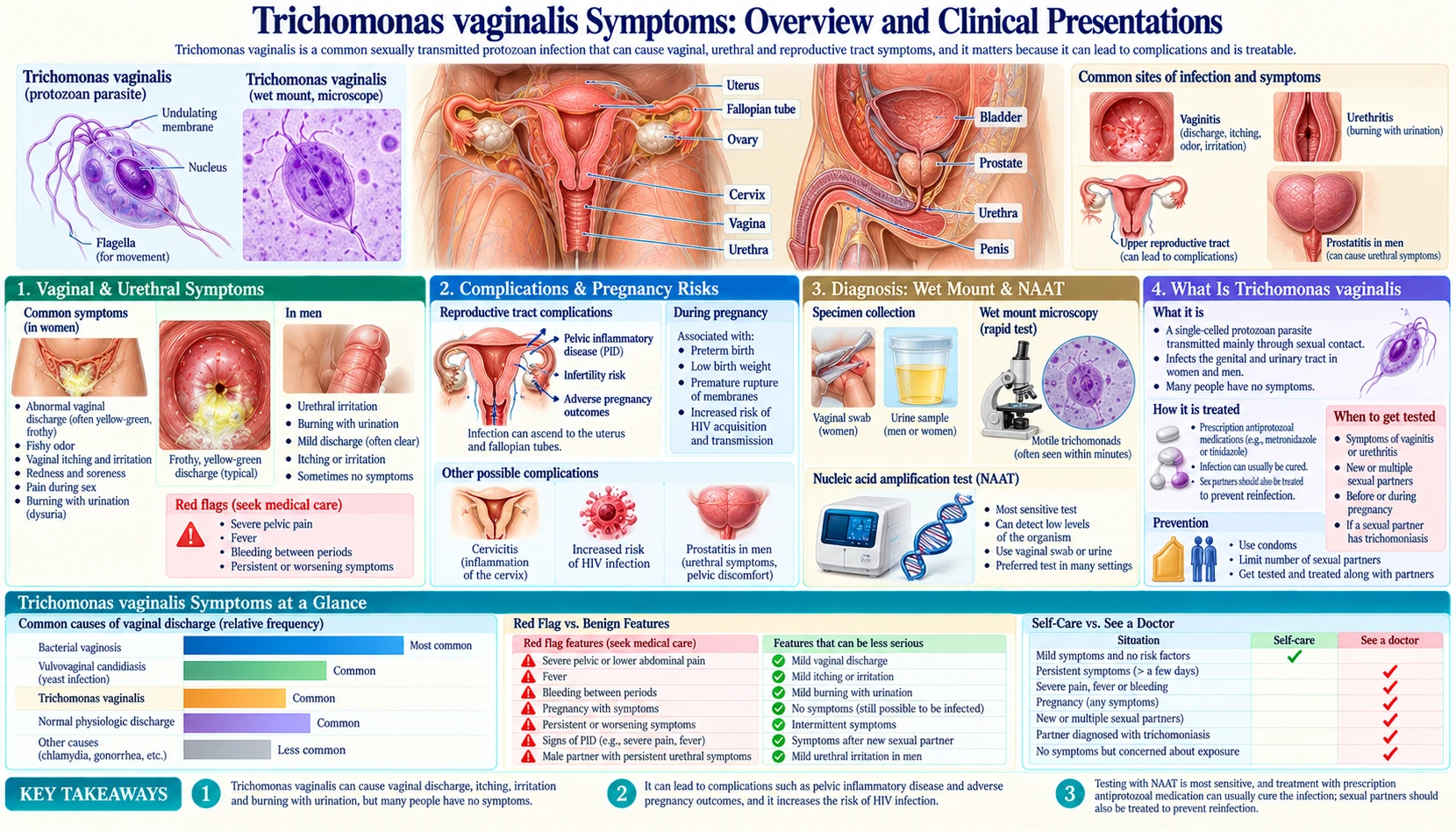
Vaginal & Urethral Symptoms
Discharge, itching, burning, dysuria, "strawberry cervix" — what trichomoniasis looks and feels like in women and men.
Read the deep dive →Complications & Pregnancy Risks
HIV acquisition, preterm birth, low birth weight, BV co-infection, and male fertility impacts.
Read the deep dive →Diagnosis: Wet Mount & NAAT
Microscopy, nucleic acid amplification, rapid antigen tests, culture — how trichomoniasis is confirmed.
Read the deep dive →- What Is T. vaginalis
- The 70% Asymptomatic Problem
- Transmission
- Symptoms by Sex
- Racial Disparities in Prevalence
- Why It Goes Undiagnosed
- HIV and Pregnancy Links
- When to Get Tested
- Key Research Papers
- Connections
What Is Trichomonas vaginalis
Trichomonas vaginalis is a flagellated protozoan parasite classified within the phylum Parabasalia. Unlike many other parasites, it exists exclusively as a trophozoite — the active, feeding, and reproducing form. There is no cyst stage, which means the organism cannot survive prolonged periods in the external environment. Studies show that T. vaginalis trophozoites survive less than 45 minutes outside a human host under typical conditions, making transmission through fomites (towels, toilet seats, shared undergarments) theoretically possible but clinically insignificant.
The organism is pear-shaped (pyriform), measuring roughly 10–20 micrometers in length. It has four anterior flagella that provide the rapid, tumbling motility that makes it recognizable under a microscope. It also has a single posterior flagellum incorporated into an undulating membrane along the body surface. T. vaginalis feeds on bacteria, cellular debris, and vaginal epithelial cells, and it replicates by binary fission every 8–12 hours under favorable conditions.
The parasite colonizes the squamous epithelium of the vagina, urethra, cervix, and — in men — the urethra, prostate, and epididymis. It does not infect the upper reproductive tract (uterus, fallopian tubes) under normal circumstances, though ascending infection has been documented. The organism is among the most common non-viral sexually transmitted infections globally, with the World Health Organization estimating 156–276 million new infections per year worldwide.
The 70% Asymptomatic Problem
Perhaps the most clinically important fact about trichomoniasis is how often it causes no symptoms at all. Approximately 70–85% of infected individuals — both women and men — report no symptoms at the time of diagnosis. This is not a matter of mild symptoms being overlooked; many infected people have genuinely no awareness that anything is wrong. They feel completely normal, yet they harbor a living parasite and can transmit it to partners.
This high rate of asymptomatic infection drives the epidemic. A person who doesn't feel sick doesn't seek testing. They don't get treated. They continue having sex. Their partners get infected and, if they are also asymptomatic, the cycle continues silently. Modeling studies suggest that the majority of T. vaginalis transmission events occur through asymptomatic carriers — people who have no idea they are infected ( Search PubMed).
Asymptomatic carriers are just as infectious as symptomatic individuals. The organism replicates equally in both groups; the difference lies in the host's inflammatory response. Some women mount a robust vaginal immune response producing cytokines and inflammatory infiltrate that causes itching, discharge, and irritation. Others tolerate the organism with a more muted immune reaction, experiencing no discomfort even while carrying millions of organisms. The reasons for this variability in host response are not fully understood but likely involve differences in vaginal microbiome composition, immune genetics, and local mucosal immunity.
Importantly, asymptomatic infection does not mean harmless infection. Even in the absence of symptoms, T. vaginalis causes mucosal inflammation and epithelial damage that increases susceptibility to HIV and other STIs, and it contributes to adverse pregnancy outcomes in pregnant women who have no idea they are infected.
Transmission
Trichomonas vaginalis is transmitted almost exclusively through sexual contact. The primary routes are penile-vaginal intercourse and vulvar-to-vulvar contact (tribadism) between women. The organism is transferred in vaginal secretions and genital skin-to-skin contact. Oral-genital transmission is theoretically possible but has not been documented as a clinically significant route, and rectal infection does not appear to occur — the organism is adapted to urogenital squamous epithelium.
Incubation period — the time between exposure and the development of symptoms in those who become symptomatic — ranges from 4 to 28 days, with most symptomatic cases presenting within 5–28 days. Because most people are asymptomatic, the infection can persist for months to years without being detected. Untreated infections are thought to persist indefinitely; spontaneous clearance does occur but is not reliable or well-documented.
A single sexual exposure carries a high transmission probability. Studies suggest that approximately 70% of sexual partners of infected individuals become infected themselves if untreated, making T. vaginalis highly efficient at transmission compared with some other STIs. This efficiency, combined with the high asymptomatic rate, explains why prevalence is so much higher than clinicians often expect.
Theoretical non-sexual routes — sharing wet towels, sitting on contaminated toilet seats, touching shared sex toys — are discussed in the literature but have not been documented as epidemiologically important. The instability of trophozoites outside the body makes sustained environmental transmission unlikely. The practical clinical message is: trichomoniasis is a sexually transmitted infection.
Symptoms by Sex
When symptoms do occur, they differ between women and men in both frequency and character.
In women, the most common symptoms are:
- Vaginal discharge — classically described as yellow-green, frothy, and malodorous. In practice, discharge is variable in color and consistency and may not have the classic frothy appearance. Any change in discharge quality is worth investigating.
- Vulvovaginal itching and irritation — often described as intense and persistent, worse with activity or heat.
- Dyspareunia — pain during intercourse, resulting from vaginal inflammation and edema.
- Dysuria — burning or pain with urination, which can mimic a urinary tract infection and lead to misdiagnosis.
- Vulvar edema and erythema — visible redness and swelling of the external genitalia.
- Strawberry cervix (colpitis macularis) — punctate hemorrhagic spots on the cervix giving it a strawberry-like appearance. This finding is pathognomonic (specific) for trichomoniasis but is only visible in approximately 2% of infected women on direct inspection; it is more commonly detected colposcopically (in up to 45% of cases). Because it is rarely seen without magnification, clinical diagnosis based on appearance alone is unreliable ( Search PubMed).
- Elevated vaginal pH — consistently above 4.5 in trichomoniasis, compared to the normal acidic vaginal environment of pH 3.8–4.5. This alkaline shift reflects the loss of Lactobacillus dominance and often co-occurs with bacterial vaginosis.
In men, fewer than 30% of infected individuals develop any symptoms. When symptoms occur, they include:
- Urethral discharge — typically clear or white, less copious than gonococcal urethritis.
- Dysuria — burning with urination.
- Urethral pruritus — itching inside or at the opening of the urethra.
- Prostatitis symptoms — pelvic discomfort, perineal pressure; T. vaginalis has been isolated from prostatic fluid and biopsy specimens.
- Epididymitis — rare, but documented in case reports.
Men are more likely than women to clear the infection spontaneously, though the organism can persist for weeks to months even in the absence of symptoms ( Search PubMed).
Racial Disparities in Prevalence
Among the most striking epidemiological features of T. vaginalis infection in the United States is the pronounced racial disparity in prevalence. National survey data from NHANES and STI surveillance programs consistently show that the prevalence among Black women in the US is approximately 13%, compared to approximately 1.8–2.1% among non-Hispanic white women ( Search PubMed). This six- to seven-fold difference is one of the largest racial disparities documented for any STI in the United States.
It is critically important to understand what drives this disparity and what does not. The elevated prevalence in Black communities is not explained by differences in sexual behavior. When studies control for number of partners, condom use frequency, and other behavioral variables, racial disparities persist. The drivers are structural and societal: differential access to healthcare and STI screening, residential segregation concentrating sexual networks within demographic groups, economic barriers to care, historical underinvestment in healthcare infrastructure in predominantly Black communities, and the downstream consequences of systemic racism on health outcomes.
Some public health researchers have emphasized "assortative mixing" — the tendency for sexual partnerships to form within social networks that share demographic characteristics, including race in a racially segregated society — as a mathematical amplifier of STI disparities within groups. When prevalence is higher in a network due to historical underscreening and undertreatment, new infections occur more frequently regardless of individual behavior. Breaking this cycle requires structural interventions: accessible testing, expedited partner therapy, community-based screening, and elimination of cost barriers.
High rates are also seen in correctional populations (estimated 25–35%), HIV+ individuals, and patients presenting to STI clinics. These populations share characteristics of reduced access to routine preventive care, higher partner turnover due to incarceration, and other structural disadvantages.
Why It Goes Undiagnosed
Trichomonas vaginalis is persistently underdiagnosed for several interconnected reasons. First, most infected people have no symptoms. Second, even symptomatic individuals often assume their symptoms are due to a yeast infection or bacterial vaginosis and self-treat without testing.
Third — and critically — T. vaginalis is not included in routine STI panel testing in most clinical settings. When a clinician orders "STI testing," this typically includes gonorrhea, chlamydia, syphilis serology, and HIV — but not T. vaginalis. Clinicians must specifically request TV testing, and many do not. Patients who ask "can you test me for everything?" are routinely not tested for trichomoniasis ( Search PubMed).
Fourth, USPSTF screening recommendations for T. vaginalis — while recently strengthened — have historically been less robust than for chlamydia and gonorrhea, meaning clinicians in screening mode have been less likely to include it. The 2020 USPSTF recommendation for TV screening in high-prevalence populations and sexually active women was a significant step, but implementation lags.
Fifth, the most widely available point-of-care test — wet mount microscopy — has only 50–70% sensitivity. Clinicians who use a negative wet mount to rule out TV are missing a substantial fraction of infections. The highly sensitive NAAT tests that now exist are not universally available in point-of-care settings.
The result of all these factors together is a massive reservoir of undiagnosed, untreated infection — especially in women of reproductive age, pregnant women, HIV-positive individuals, and incarcerated individuals — who remain at risk for complications and continue transmitting to partners.
HIV and Pregnancy Links
Trichomonas vaginalis infection substantially increases the risk of HIV acquisition and transmission, and it is associated with serious adverse pregnancy outcomes. These consequences persist even in asymptomatic women, making screening and treatment important beyond just treating discomfort.
HIV acquisition risk: Women infected with T. vaginalis are 1.5–3 times more likely to acquire HIV if exposed, compared to uninfected women. The mechanism is biological: T. vaginalis causes mucosal inflammation and epithelial disruption in the vaginal lining, reducing the natural barrier to HIV entry. The inflammatory response recruits CD4+ T cells and macrophages — the very cells HIV infects — to the genital mucosa, increasing the density of HIV target cells at the site of exposure ( Search PubMed). In HIV-positive women, T. vaginalis infection increases the amount of HIV shed in vaginal secretions, increasing transmission risk to male partners.
Pregnancy outcomes: Studies consistently show associations between T. vaginalis infection in pregnancy and preterm birth (odds ratio approximately 1.3–1.8 across observational studies), premature rupture of membranes (PPROM), and low birth weight. The proposed mechanism involves ascending infection triggering release of prostaglandins and inflammatory cytokines (IL-1β, IL-6, TNF-α) that can initiate premature uterine contractions and cervical ripening ( Search PubMed). Whether treatment of TV in pregnancy prevents these outcomes has been studied, but results are mixed — one large randomized trial ( Search PubMed) found that treatment in asymptomatic pregnant women did not reduce preterm birth, possibly due to the inflammatory cascade already being triggered before the parasite is cleared.
Despite this uncertainty about treatment preventing preterm birth, symptomatic pregnant women should be treated for symptom relief, and their partners should be treated to prevent reinfection. Metronidazole is safe in pregnancy across all trimesters.
When to Get Tested
Given the high asymptomatic rate and serious consequences of untreated infection, the question of who should be tested is important. Current guidelines from the CDC (2021 STI Treatment Guidelines) and USPSTF recommend T. vaginalis testing in the following situations:
- Any person presenting for STI evaluation, regardless of specific symptoms
- Symptomatic women with vaginal discharge, vulvovaginal irritation, or dysuria
- Pregnant women — particularly those at higher risk (history of STI, multiple partners, low socioeconomic status)
- HIV-positive women — annual screening is recommended, as co-infection amplifies HIV shedding
- Women entering correctional facilities or presenting in correctional health settings
- Anyone with a new partner or partners untested for STIs
- Women with recurrent BV — TV and BV frequently co-occur and share risk factors
- Men with urethritis symptoms or urethral discharge that does not resolve with treatment for gonorrhea/chlamydia
After treatment, test of cure (TOC) by NAAT can be considered at 3 months because reinfection from untreated partners is common. Positive tests at 3 months may represent either treatment failure (rare) or, more commonly, reinfection from an untreated partner. Simultaneous partner treatment (expedited partner therapy) is essential to break the reinfection cycle ( Search PubMed; Search PubMed).
Key Research Papers
- Sutton M, et al. "Prevalence of Trichomonas vaginalis infection among females in the United States, 2001-2004." Clin Infect Dis. 2007;45(10):1319-1326. — PubMed PMID: 17968828
- Schwebke JR, Burgess D. "Trichomoniasis." Clin Microbiol Rev. 2004;17(4):794-803. — PubMed PMID: 15489349
- Kissinger P. "Trichomonas vaginalis: a review of epidemiologic, clinical and treatment issues." BMC Infect Dis. 2015;15:307. — PubMed PMID: 26242185
- Dize L, et al. "Comparison of self-obtained penile-meatal swabs to healthcare worker-collected urogenital swabs for the detection of Chlamydomonas trachomatis, Neisseria gonorrhoeae, Trichomonas vaginalis, and Mycoplasma genitalium." Sex Transm Dis. 2013. — Search PubMed
- Workowski KA, Bolan GA. "Sexually Transmitted Diseases Treatment Guidelines, 2015." MMWR Recomm Rep. 2015;64(RR-03):1-137. — Search PubMed
- Van Der Pol B, et al. "Clinical and laboratory testing for Trichomonas vaginalis infection." J Clin Microbiol. 2016;54(7):1832-1840. — PubMed PMID: 26491181
- Muzny CA, et al. "Trichomoniasis in women and its treatment." Best Pract Res Clin Obstet Gynaecol. 2019;55:2-9. — Search PubMed
- Klebanoff MA, et al. "Failure of metronidazole to prevent preterm delivery among pregnant women with asymptomatic Trichomonas vaginalis infection." N Engl J Med. 2001;345(7):487-493. — PubMed PMID: 11519502
- Kissinger P, et al. "Patient-delivered partner treatment for Trichomonas vaginalis infection: a randomized controlled trial." Sex Transm Dis. 2006;33(7):445-450. — PubMed PMID: 20502393
- Meites E, et al. "A review of evidence-based care of symptomatic trichomoniasis and asymptomatic Trichomonas vaginalis infections." Clin Infect Dis. 2015;61(Suppl 8):S837-S848. — PubMed PMID: 26602621