⚠ Evidence warning: Clinical trials or other evidence do not support the claims that cannabis helps a majority of fibromyalgia patients who try it, that 1 to 2.5 mg tetrahydrocannabinol microdosing is the sweet spot for many patients, and that full-spectrum products work better through an entourage effect. This page keeps it as a report of what people, websites or other media say.
Cannabis, Cannabidiol & Medical Marijuana for Fibromyalgia
If you have fibromyalgia, you have almost certainly wondered whether cannabis — cannabidiol (CBD) oil, medical marijuana, a tetrahydrocannabinol (THC) gummy your cousin swears by — could actually help. The short answer is: probably, for some symptoms, in some people, at the right dose. The longer answer is what this article is for. We will walk through the endocannabinoid deficiency hypothesis that underlies the rationale, the real (and limited) evidence base, how tetrahydrocannabinol and cannabidiol differ, which ratios and forms make sense, how to dose without spending three days on the couch, and the drug interactions, legal issues, and long-term risks that rarely get mentioned in dispensary brochures.
Cannabis does not cure fibromyalgia, and no treatment does. Practitioners who use it describe it as an addition to a treatment plan that already includes low-dose naltrexone, serotonin-norepinephrine reuptake inhibitors (SNRIs) such as duloxetine, serious sleep repair, and graded movement.
Table of Contents
- The Endocannabinoid Deficiency Hypothesis
- What the Evidence Actually Says
- Tetrahydrocannabinol vs Cannabidiol — Two Very Different Drugs
- Ratios: 1:1, High-CBD, and Microdosing
- Forms and Kinetics: Tinctures, Flower, Edibles
- Dosing Strategy: Low and Slow
- The Entourage Effect: Full-Spectrum vs Isolate
- Drug Interactions and Side Effects
- Legality, Driving, Work, and Pharmaceuticals
- Cannabidiol Purity and the Certificate of Analysis
- If You Are on Opioids, Selective Serotonin Reuptake Inhibitors, or Warfarin
- Key Research Papers
- PubMed Topic Searches
- Connections
- Featured Videos
The Endocannabinoid Deficiency Hypothesis
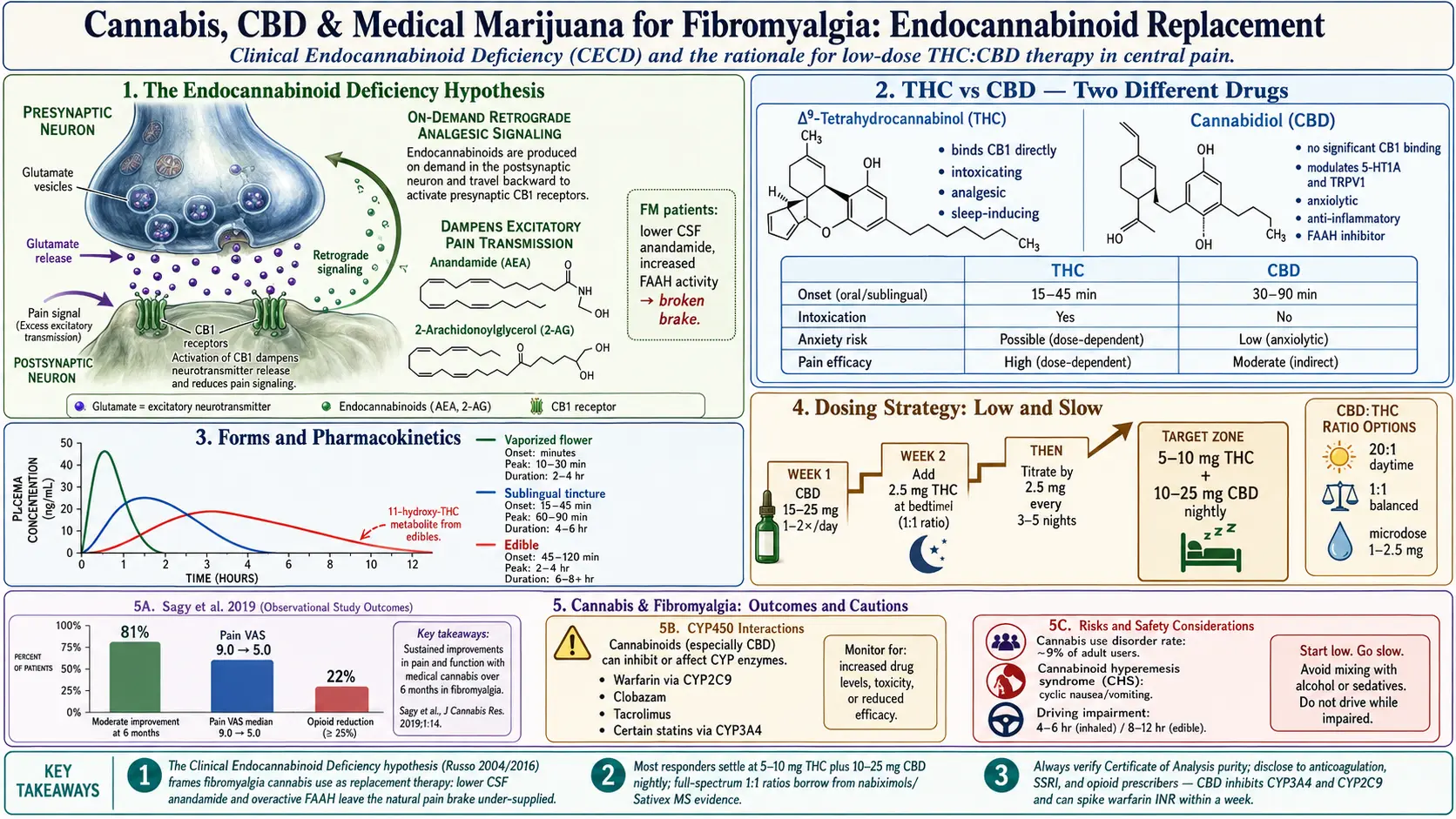
In 2001, cannabinoid researcher Ethan Russo first proposed that fibromyalgia, migraine, and irritable bowel syndrome share an underlying feature he called Clinical Endocannabinoid Deficiency (CECD). He returned to the theory in later papers and updated it in 2016 with the research gathered since. The idea: your body makes its own cannabis-like molecules — anandamide and 2-arachidonoylglycerol (2-AG) — that act on CB1 and CB2 receptors to dampen pain signalling, regulate sleep, and calm inflammation. The theory holds that in fibromyalgia this system runs low. The firmest measurement so far comes from migraine: Russo’s 2016 review reports statistically significant differences in cerebrospinal-fluid anandamide levels in people with migraine. Enzymes that break down endocannabinoids may be more active. In fibromyalgia itself, a 2026 randomized trial in 24 women found that an oral 1:1 tetrahydrocannabinol:cannabidiol oil, taken over a 16-week study, did not change blood levels of three endocannabinoid-related molecules (palmitoylethanolamide, oleoylethanolamide and stearoylethanolamide) compared with placebo; anandamide and 2-arachidonoylglycerol were too low in blood to measure. The net effect is an amplified pain system with one of its natural brakes missing.
If CECD is real, supplying outside cannabinoids is not recreational — it is replacement therapy, conceptually similar to giving thyroid hormone to a hypothyroid patient. The analogy is imperfect (we cannot measure an "endocannabinoid level" at a commercial lab), but it reframes the conversation away from "drug use" and toward physiology.
What the Evidence Actually Says
The evidence base for cannabis in fibromyalgia is suggestive, not definitive. A quick tour:
- Fiz et al. 2011 (PLoS ONE). A Spanish cross-sectional study of 56 fibromyalgia patients: 28 cannabis users and 28 non-users. Two hours after using cannabis, users rated their pain and stiffness significantly lower on visual scales and reported more relaxation, sleepiness and well-being. Compared with non-users, users scored higher only on the mental-health summary of a quality-of-life survey (the Short Form 36); there were no significant differences on the Fibromyalgia Impact Questionnaire (FIQ) or on sleep quality (the Pittsburgh Sleep Quality Index).
- Sagy et al. 2019 (Journal of Clinical Medicine). A prospective six-month Israeli cohort of 367 fibromyalgia patients using medical cannabis. At six months, 194 of the 239 patients who answered the six-month questionnaire or had stopped treatment (81.1%) reported at least moderate improvement, pain intensity dropped from a median 9.0 to 5.0 on a 0–10 scale, and 28 of the 126 patients taking opioids at the start (22.2%) had stopped or reduced them. The most common side effects were mild: dizziness (7.9%), dry mouth (6.7%) and gastrointestinal symptoms (5.4%). What the study cannot show: it was observational, with no placebo group; 70.8% of patients answered at six months; and being over 60 or having concerns about cannabis treatment before starting were linked to a poorer response.
- Ste-Marie et al. 2012 (Arthritis Care & Research). Found that 13% of 457 patients referred to a Canadian pain centre with a fibromyalgia diagnosis were using cannabinoids. Herbal cannabis use was linked to current unstable mental illness (36% vs 23%) and opioid drug-seeking behaviour (17% vs 4%), with a trend toward unemployment and disability payments; when only the 302 patients whose fibromyalgia diagnosis was confirmed were analysed, the significant links were lost, though trends remained — a warning that self-medication patterns can signal unmet need, not success.
- Earlier multiple sclerosis-era trials of nabiximols — a 1:1 tetrahydrocannabinol:cannabidiol oromucosal spray — established that tetrahydrocannabinol/cannabidiol combinations reduce central neuropathic pain and spasticity in multiple sclerosis. Those data are the single strongest mechanistic bridge to fibromyalgia, because both conditions involve central sensitization.
- Rasmussen et al. 2026 (Annals of the Rheumatic Diseases). A Danish double-blind trial gave 200 people with fibromyalgia 50 mg of plant-derived cannabidiol or placebo tablets daily for 24 weeks. Pain fell by 0.4 points (0–10 scale) with cannabidiol and by 1.1 points with placebo, a difference of 0.7 points favouring placebo, and the authors concluded the findings “do not support CBD 50 mg daily as an analgesic supplement”. Side effects were generally mild and evenly spread between the groups.
- Lam et al. 2026 (Pain Physician). A meta-analysis of 12 studies (2 randomized trials and 10 observational studies; 1,248 patients) found that cannabinoids lowered fibromyalgia pain (standardized mean difference −1.41) and were linked to better sleep, anxiety, depression and quality of life. The authors rated the evidence low quality, with considerable differences between studies and few randomized-trial data. Common side effects were dizziness, dry mouth and drowsiness; serious ones were rare.
- What is missing: large, placebo-controlled, double-blind randomized trials of tetrahydrocannabinol-containing cannabis in fibromyalgia specifically. Most published work is observational, short, or uses heterogeneous products. Publication bias favors positive results.
Practitioners and observational patient surveys describe cannabis as helping a majority of fibromyalgia patients who try it; the effect size is modest, responders are hard to predict in advance, and rigorous evidence is thinner than the cultural enthusiasm suggests.
Tetrahydrocannabinol vs Cannabidiol — Two Very Different Drugs
"Cannabis" is shorthand for a plant that produces more than a hundred cannabinoids. Two dominate the conversation.
Tetrahydrocannabinol (delta-9-tetrahydrocannabinol) is the intoxicating compound. It binds CB1 receptors in the brain directly, producing the "high," sedation, appetite, and — relevant here — genuine analgesia and improved sleep onset. Downsides for fibromyalgia patients: next-day cognitive fog (already a fibro problem), anxiety or panic at higher doses, tachycardia, and in susceptible people, worsening of pre-existing anxiety or depression. Tetrahydrocannabinol tolerance develops quickly.
Cannabidiol is non-intoxicating. It does not meaningfully activate CB1. It modulates anxiety circuits (serotonin 5-HT1A receptors and transient receptor potential vanilloid 1 (TRPV1) channels), damps down pro-inflammatory cytokines, and may slow the breakdown of anandamide by inhibiting fatty acid amide hydrolase (FAAH). Used alone, cannabidiol is a mild-to-moderate anxiolytic and sleep aid, with modest direct pain effects. Most rigorous cannabidiol-alone trials in chronic pain have been underwhelming — it helps, but less than marketing suggests.
For fibromyalgia, the practical implication is that cannabidiol alone is safer but weaker, while tetrahydrocannabinol adds real pain and sleep benefit at the cost of intoxication, next-day function, and anxiety risk. Most successful fibromyalgia regimens use some tetrahydrocannabinol, usually a small amount, usually at night.
Ratios: 1:1, High-CBD, and Microdosing
Dispensaries label products by the cannabidiol:tetrahydrocannabinol ratio. A few common patterns:
- 1:1 balanced (e.g., 5 mg cannabidiol : 5 mg tetrahydrocannabinol). The ratio used in nabiximols and the multiple sclerosis (MS) trials. Cannabidiol blunts tetrahydrocannabinol's anxiety and cognitive side effects while preserving most of the pain benefit. Practitioners often describe it as a starting point for fibromyalgia patients who want meaningful relief and accept mild intoxication.
- High-CBD (e.g., 20:1 or 10:1). Daytime option. Most of the calming and anti-inflammatory effect, very little high. Used for anxiety and daytime pain without the cognitive trade-off.
- Tetrahydrocannabinol-dominant (e.g., 1:2 or tetrahydrocannabinol-only). Better for severe nighttime pain or insomnia, but high anxiety and tolerance risk. Typically used at bedtime.
- Microdosing. Using very small tetrahydrocannabinol doses — 1 to 2.5 mg — often with cannabidiol. Many fibromyalgia patients report this as the sweet spot: measurable pain and sleep benefit without feeling stoned the next morning.
A first-month plan commonly described in patient guides pairs a high-CBD product by day (20 to 40 mg cannabidiol once or twice) with a 1:1 or low-THC product at bedtime, starting at 2.5 mg tetrahydrocannabinol and adjusted according to what actually changes.
A 2026 Australian pilot randomized trial tested a 1:1 tetrahydrocannabinol:cannabidiol oil (10 mg/mL of each) against placebo in 24 adults with fibromyalgia, with 4 weeks of dose adjustment followed by 12 weeks at a steady dose. The oil was well tolerated, with mostly mild side effects and no serious events. At week 12, 70% of the cannabis group and 40% of the placebo group reported at least 30% less pain, and 40% vs 10% reached a clinically meaningful improvement in fibromyalgia impact; fatigue and anxiety/depression did not change. The authors call these preliminary signals that need larger trials.
Forms and Kinetics: Tinctures, Flower, Edibles
The form matters as much as the dose because absorption kinetics differ enormously.
- Sublingual tinctures (oil under the tongue). Onset 15 to 45 minutes, peak at 60 to 90 minutes, duration 4 to 6 hours. Easy to dose precisely by the drop or milliliter. Often described as the easiest form to start with.
- Vaporized flower or concentrate. Onset within minutes, peak at 10 to 30 minutes, duration 2 to 4 hours. Fast relief for flare pain; less total tetrahydrocannabinol exposure than combustion; easier to titrate in real time. Smoking (combustion) adds tar and respiratory irritation; vaporizing heats the plant without burning it.
- Edibles (gummies, capsules, baked goods). Onset 45 to 120 minutes, peak at 2 to 4 hours, duration 6 to 8 hours and occasionally longer. The hepatic first pass converts some delta-9 tetrahydrocannabinol to 11-hydroxy-THC, a more potent metabolite — which is why edibles feel stronger than their mg number suggests and why overshooting is easy. Used mainly for nighttime sleep coverage, where conservative dosing matters because overshooting is easy.
- Topicals. Cannabidiol and tetrahydrocannabinol creams can help localized joint or muscle pain without systemic absorption. Used as an add-on; unlikely to treat diffuse fibromyalgia pain on their own.
Dosing Strategy: Low and Slow
Patient guides and cannabis-prescribing clinicians describe a bad experience from taking too much, too fast as the most common reason fibromyalgia patients give up on cannabis. The conservative approach they commonly describe runs as follows:
- Cannabidiol alone for the first week. 15 to 25 mg once or twice daily, a week used to establish tolerance and watch for side effects.
- Tetrahydrocannabinol added at night, 2.5 mg. Usually as a 1:1 tincture or low-dose edible, taken 60 to 90 minutes before bedtime on a night with no driving or early work the next morning.
- The same dose held for 3 to 5 nights. Judged by sleep quality, morning pain, and next-day clarity — not just the first night.
- Increases in 2.5 mg steps. Most fibromyalgia responders are described as settling between 5 and 10 mg tetrahydrocannabinol at night, often paired with 10 to 25 mg cannabidiol.
- A review every 4 to 6 weeks. Tolerance can creep in; when more is needed for the same effect, the approach described is a 48-hour break before any increase.
When a dose brings anxiety, paranoia or a racing heart (tachycardia), patient guides describe taking extra cannabidiol (50 to 200 mg by mouth), drinking water and resting somewhere safe until it passes. Cannabidiol is described as countering acute tetrahydrocannabinol anxiety, and the experience as unpleasant but not dangerous in an otherwise healthy adult.
The Entourage Effect: Full-Spectrum vs Isolate
The entourage effect is the hypothesis that cannabis works better when its minor cannabinoids (cannabigerol (CBG), cannabinol (CBN), cannabichromene (CBC) and tetrahydrocannabivarin (THCV)) and terpenes (myrcene, linalool, beta-caryophyllene) are present alongside the major ones. Full-spectrum products contain the full plant profile including trace tetrahydrocannabinol; broad-spectrum removes tetrahydrocannabinol but keeps the rest; isolate is purified cannabidiol alone.
Evidence for the entourage effect is mostly preclinical and anecdotal; even so, many practitioners present full-spectrum products as the default choice where they are legal. Isolate is the form commonly chosen by people subject to tetrahydrocannabinol drug testing or unusually sensitive to tetrahydrocannabinol.
Drug Interactions and Side Effects
Cannabinoids — particularly cannabidiol at higher doses — inhibit several cytochrome P450 liver enzymes, notably cytochrome P450 3A4 (CYP3A4) and cytochrome P450 2C9 (CYP2C9). This raises blood levels of many drugs:
- Warfarin (CYP2C9). Cannabidiol can push international normalized ratio (INR) dangerously high. Anticoagulation clinics track this rise with international normalized ratio checks, which are typically more frequent in the first month after cannabidiol is started.
- Selective serotonin reuptake inhibitors (SSRIs) and serotonin-norepinephrine reuptake inhibitors. Combined sedation, mild serotonergic effects, possible increased selective serotonin reuptake inhibitor (SSRI) levels. Usually manageable, though side effects cannot be traced to the right drug when the prescriber does not know about the cannabis.
- Benzodiazepines, opioids, z-drugs (zolpidem), gabapentinoids. Additive sedation and respiratory depression. Many fibromyalgia patients end up taking several of these at once; cannabis on top is where falls and next-morning hangovers appear.
- Clobazam, tacrolimus, certain statins, amiodarone. Significant interactions. The prescription cannabidiol label reports that cannabidiol raises blood levels of clobazam’s active breakdown product (N-desmethylclobazam), and that it may raise blood levels of tacrolimus, for which it lists drug-level monitoring and dose reduction.
- Alcohol. Multiplies intoxication unpredictably.
The U.S. Food and Drug Administration label of prescription cannabidiol oral solution, which is approved for specific seizure disorders (DailyMed label), warns of liver injury: at the seizure-treatment doses (10 and 20 mg per kg of body weight per day), the liver enzyme alanine aminotransferase (ALT) rose above three times the upper limit of normal in 30% of patients also taking valproate and clobazam, 21% with valproate alone, 4% with clobazam alone and 3% with neither. The label calls for liver blood tests (transaminases and bilirubin) before treatment starts. It also lists sleepiness and sedation: 32% of treated patients versus 11% on placebo, and more often with clobazam (46% versus 16% without it).
Common side effects include dry mouth, dizziness, orthostatic drops in blood pressure (especially at first), appetite changes, fatigue, and mild cognitive slowing. Long-term risks: tolerance, cannabis use disorder in roughly 9% of adult users (higher with daily use), worsened anxiety or depression in a minority, and cannabinoid hyperemesis syndrome, a paradoxical cyclic vomiting illness that only resolves with complete cessation. It is less rare among heavy users than often assumed: in a 2018 survey in a United States public-hospital emergency department, 32.9% (95% confidence interval 25.5% to 40.3%) of patients aged 18 to 49 who smoked cannabis on at least 20 days a month met the study’s criteria for having experienced it. Recurring bouts of nausea and vomiting eased by hot showers are the typical pattern described (more on the cannabis hyperemesis syndrome page).
Legality, Driving, Work, and Pharmaceuticals
Legal status in the United States remains a patchwork. Hemp-derived cannabidiol (under 0.3% tetrahydrocannabinol) has been federally legal, though U.S. Food and Drug Administration (FDA) enforcement against unapproved health claims continues. A federal law signed on 12 November 2025 (Public Law 119-37, section 781) rewrites the definition of hemp, effective 365 days after enactment: a finished hemp-derived cannabinoid product is no longer hemp if it contains more than 0.4 milligrams per container of total tetrahydrocannabinols combined with similar-acting cannabinoids, or cannabinoids the plant cannot make naturally or that were synthesized outside the plant. A September 2026 law (Public Law 119-103, section 2019) limits the new definition, until 11 December 2026, to products containing cannabinoids the plant cannot make naturally. Tetrahydrocannabinol-containing cannabis is legal for medical use in most states and adult use in a growing majority. Under a federal final rule effective 28 April 2026 (91 Federal Register 22714), FDA-approved drug products containing marijuana and marijuana held under a state medical-marijuana license are in Schedule III; any other form of marijuana remains a Schedule I controlled substance, and the rule does not authorize non-medical use. Consequences that matter in daily life:
- Driving. Tetrahydrocannabinol impairs reaction time and judgement. Per se tetrahydrocannabinol limits vary by state; any detectable tetrahydrocannabinol can be grounds for a driving under the influence (DUI) charge in zero-tolerance states. Commonly cited guidance puts the impairment window at 4 to 6 hours after inhaled tetrahydrocannabinol and 8 to 12 hours after edibles.
- Work. Safety-sensitive jobs (commercial driving, aviation, healthcare, federal employment) commonly test for tetrahydrocannabinol, and tetrahydrocannabinol metabolites linger in urine for days to weeks. Cannabidiol isolate is technically safer but contamination is common — see the purity section.
- Firearms. Federal Bureau of Alcohol, Tobacco, Firearms and Explosives (ATF) forms still ask about "unlawful use of marijuana" regardless of state legality. Honest answers can affect firearm purchases.
- International travel. State legalization does not cover carrying cannabis across international borders, or by air even to another state where it is legal.
- Prescription alternatives. Nabilone is a synthetic tetrahydrocannabinol-analog pill, U.S. Food and Drug Administration-approved for chemotherapy nausea but prescribed off-label for fibromyalgia pain and sleep in some clinics. In a 40-patient placebo-controlled trial, 4 weeks of nabilone lowered pain and Fibromyalgia Impact Questionnaire scores (Skrabek 2008); in a 31-person trial against amitriptyline (29 completed), 0.5 to 1.0 mg of nabilone at bedtime improved sleep more than amitriptyline, but “no effects on pain, mood, or quality of life were observed”, and dizziness, nausea and dry mouth were its most common side effects (Ware 2010). Nabiximols is approved in the UK, Canada, and elsewhere for multiple sclerosis spasticity and is used off-label for chronic pain; not U.S. Food and Drug Administration-approved in the US. Prescription cannabidiol oral solution is purified pharmaceutical cannabidiol, approved only for specific seizure disorders. These pharmaceutical options come with consistent dosing and insurance coverage (sometimes), but at a higher cost than dispensary products.
Cannabidiol Purity and the Certificate of Analysis
The cannabidiol market is loosely regulated. Independent testing has repeatedly found products that contain less cannabidiol than labelled, more tetrahydrocannabinol than labelled, or contaminants — pesticides, heavy metals, residual solvents, and occasionally synthetic cannabinoids. The protection is the Certificate of Analysis (COA), a third-party lab report for the specific batch you are buying.
What a complete COA shows:
- Batch number matches the product in your hand.
- Potency panel confirms the cannabidiol and tetrahydrocannabinol milligrams per bottle match the label.
- Contaminant panels pass: pesticides, heavy metals (lead, cadmium, mercury, arsenic), microbials, mycotoxins, residual solvents.
- Lab name and date are visible, and the lab is accredited to ISO/IEC 17025, the international standard for testing laboratories.
A vendor that cannot produce a current COA for the batch leaves the buyer with no independent check of what is in the bottle. This matters most for people subject to drug testing — "tetrahydrocannabinol-free" cannabidiol isolates have failed plenty of workplace drug screens because the actual product contained traces of tetrahydrocannabinol.
If You Are on Opioids, Selective Serotonin Reuptake Inhibitors, or Warfarin
Many fibromyalgia patients on opioids report that cannabis lets them reduce their opioid dose over months, and large observational series report this too. Opioid-cannabis combinations increase sedation and fall risk, and tapering opioids without the prescriber’s knowledge is unsafe and can cost the patient the prescription. Pain clinics differ: most in legal states now have policies that accommodate medical cannabis use, and some still do not.
With selective serotonin reuptake inhibitors or serotonin-norepinephrine reuptake inhibitors, the combination is usually not dangerous, but side effects cannot be traced to the right drug when the prescriber does not know about the cannabis. With warfarin, the international normalized ratio can jump within a week of starting a cannabinoid product. With clobazam, the prescription cannabidiol label reports higher levels of clobazam’s active breakdown product and more sleepiness; with tacrolimus, it lists possible higher tacrolimus levels and drug-level monitoring.
Practitioners describe cannabis as an addition to, not a replacement for, the core fibromyalgia toolkit: low dose naltrexone (LDN), serotonin-norepinephrine reuptake inhibitors where tolerated, serious sleep repair, graded movement, and correction of nutrient gaps. The outcome they describe as realistic is a 20 to 40% reduction in pain and meaningful improvement in sleep — not a cure.
Key Research Papers
- Sagy I, et al. Safety and Efficacy of Medical Cannabis in Fibromyalgia. J Clin Med. 2019;8(6):807. — doi:10.3390/jcm8060807
- Fiz J, et al. Cannabis Use in Patients with Fibromyalgia: Effect on Symptoms Relief and Health-Related Quality of Life. PLoS ONE. 2011;6(4):e18440. — doi:10.1371/journal.pone.0018440
- Russo EB. Clinical Endocannabinoid Deficiency Reconsidered: Current Research Supports the Theory in Migraine, Fibromyalgia, Irritable Bowel, and Other Treatment-Resistant Syndromes. Cannabis Cannabinoid Res. 2016;1(1):154–165. — doi:10.1089/can.2016.0009
- Ste-Marie PA, et al. Association of Herbal Cannabis Use With Negative Psychosocial Parameters in Patients With Fibromyalgia. Arthritis Care Res. 2012;64(8):1202–1208. — doi:10.1002/acr.21732
- Skrabek RQ, Galimova L, Ethans K, Perry D. Nabilone for the treatment of pain in fibromyalgia. J Pain. 2008;9(2):164–173. — doi:10.1016/j.jpain.2007.09.002
- Ware MA, et al. The effects of nabilone on sleep in fibromyalgia: results of a randomized controlled trial. Anesth Analg. 2010;110(2):604–610. — doi:10.1213/ane.0b013e3181c76f70
- Habboushe J, et al. The Prevalence of Cannabinoid Hyperemesis Syndrome Among Regular Marijuana Smokers in an Urban Public Hospital. Basic Clin Pharmacol Toxicol. 2018;122(6):660–662. — doi:10.1111/bcpt.12962
- Rasmussen MU, Christensen R, Wæhrens EE, Henriksen M, Duhn PH, Bliddal H, Amris K. Cannabidiol versus placebo in patients with fibromyalgia: a randomised, double-blind, placebo-controlled, parallel-group, single-centre trial. Ann Rheum Dis. 2026;85(3):566–574. — doi:10.1016/j.ard.2025.07.008
- Lam PM, Wang F, Shing CH, Ho HC, Russo M, Ching Wong SS. Analgesic Effect of Cannabinoids for Fibromyalgia: A Systematic Review and Meta-Analysis. Pain Physician. 2026;29(2):95–107. — PubMed PMID: 42013320
- Kurlyandchik I, Tiralongo E, Lauche R, Tracey G, Ng J, Schloss J. Feasibility, Safety and Preliminary Efficacy of 1:1 THC:CBD Cannabis Oil for Fibromyalgia Symptoms: Results From a Randomised, Double-Blind, Placebo-Controlled Pilot Trial. Pain Res Manag. 2026;2026(1):e7311235. — doi:10.1155/prm/7311235
- Kurlyandchik I, Van Crugten J, Lauche R, Tiralongo E, Schloss J. Oral Medicinal Cannabis Does Not Alter Plasma Levels of Endocannabinoid-Related N-Acylethanolamines in Fibromyalgia Patients: Findings from a Randomized Placebo-Controlled Trial. Cannabis Cannabinoid Res. 2026. — doi:10.1177/25785125261469541
PubMed Topic Searches
For current peer-reviewed work, the following searches return live PubMed results:
- Cannabis and fibromyalgia
- CBD and fibromyalgia
- Clinical endocannabinoid deficiency
- Nabilone and fibromyalgia
- Nabiximols and chronic pain
- THC:CBD ratio in chronic pain
- Cannabidiol drug interactions and CYP enzymes
- Cannabinoid hyperemesis syndrome
- Medical cannabis and opioid reduction
- Cannabis and central sensitization
Connections
- Orthopedics
- Fibromyalgia Overview
- Nutrient Gaps in Fibromyalgia
- Low-Dose Naltrexone for Fibromyalgia
- Sleep and Non-Restorative Sleep
- Exercise Pacing and Graded Movement
- Chronic Pain
- Insomnia
- Fibromyalgia and Myalgic Encephalomyelitis/Chronic Fatigue Syndrome Overlap
- ACR 2016 Diagnostic Criteria
- Central Sensitization Explained
- Small-Fiber Neuropathy Overlap
- Anxiety
- Depression
- Fatigue
- Low-Dose Naltrexone
- Arthritis