Head and Neck Cancer
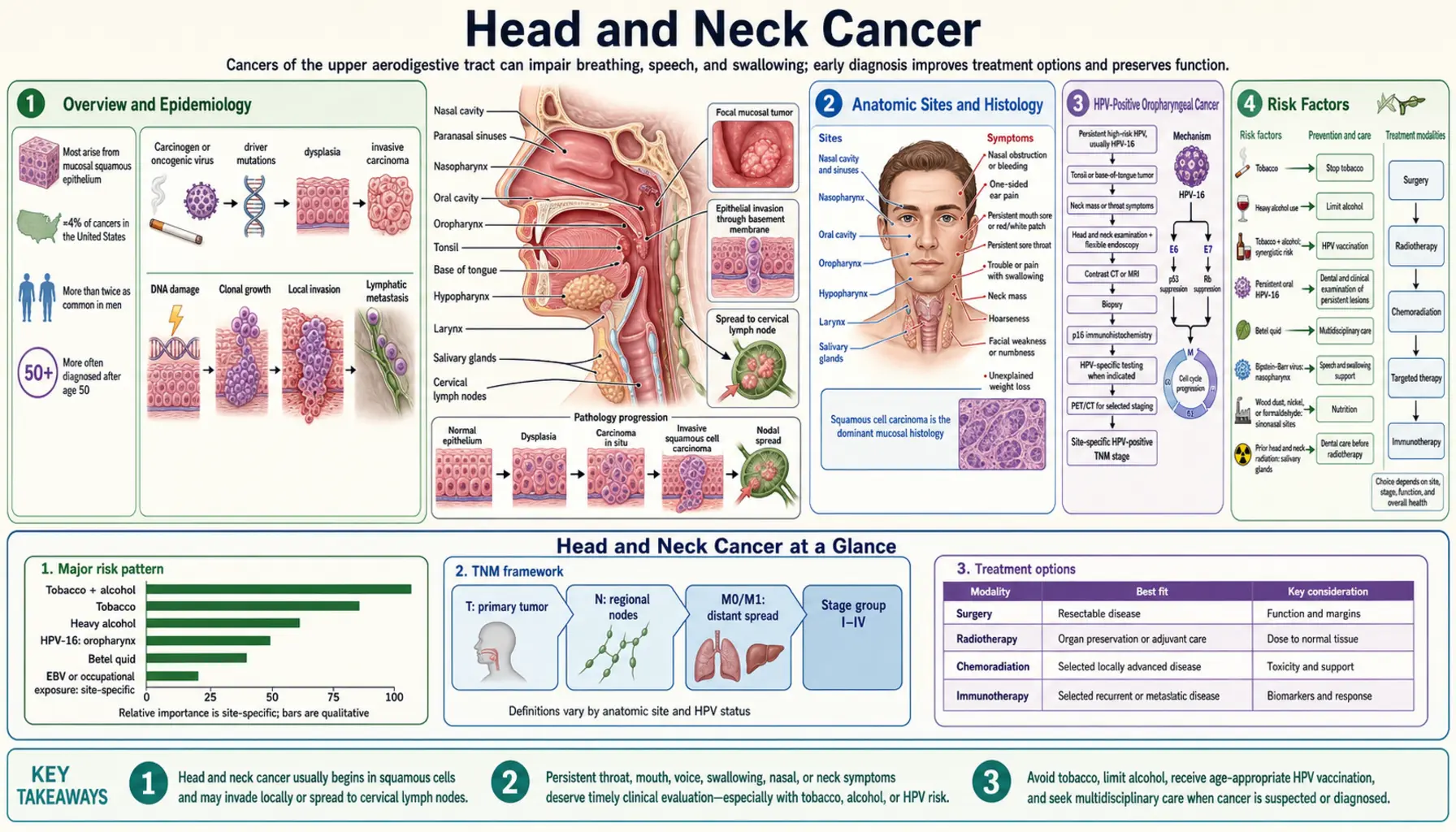
Table of Contents
Overview and Epidemiology
Head and neck cancers (HNCs) are a diverse group of malignancies that arise from the mucosal surfaces lining the oral cavity, pharynx, larynx, and salivary glands. Think of the entire passageway from the lips to the voice box — any cancer arising from the inner lining of those structures falls under this umbrella. For the United States in 2026, the National Cancer Institute's SEER program estimates 60,480 new cases and 13,150 deaths from cancers of the oral cavity and pharynx (SEER Cancer Stat Facts: Oral Cavity and Pharynx Cancer), and a further 12,290 new cases and 3,960 deaths from laryngeal cancer (SEER Cancer Stat Facts: Laryngeal Cancer).
Men are affected more often than women. A 2020 review reports that the male:female ratio for HPV-positive head and neck squamous cell carcinoma ranges from 3 to 6, and that the high ratios for HPV-negative disease reflect sex differences in tobacco, smokeless tobacco, areca nut, betel quid and alcohol use (Johnson 2020, PubMed PMID: 33243986). One of the most significant developments in cancer medicine over the past two decades is the HPV shift in head and neck cancer. Human papillomavirus — primarily HPV type 16 — is associated with most oropharyngeal cancers (more than 70%, per the same review). A 2013 meta-analysis found HPV in 72.2% of oropharyngeal cancers in studies from 2005–2009, up from 40.5% before 2000, with 69.7% in North America (Mehanna 2013, PubMed PMID: 22267298). These tumors are biologically distinct from tobacco-related cancers: the median age at diagnosis is about 53 years for HPV-associated oropharyngeal cancer versus 66 years for non-virally associated head and neck cancer (Johnson 2020), and they carry a markedly better prognosis (Ang 2010, below).
The overall picture in HNC epidemiology is mixed. The incidence of smoking-related head and neck cancer continues to decline worldwide, while that of HPV-positive disease is rising (Johnson 2020). This creates two almost separate diseases within the same anatomic neighborhood — one driven by viral infection with a comparatively favorable prognosis, the other driven by tobacco and alcohol. HPV status affects staging, prognosis and the direction of treatment research.
Anatomic Sites and Histology
Head and neck cancer is not one disease — it is an anatomic category covering several distinct tumor locations, each with its own behavior and treatment approach.
Oral Cavity
The oral cavity includes the lips, the mobile (oral) tongue (the front two-thirds), the floor of the mouth, the hard palate, the alveolar ridges, the inner lining of the cheeks (buccal mucosa), and the retromolar trigone (the small triangle of tissue behind the last lower molar). Oral cavity cancers are generally associated with tobacco, alcohol or both, and treatment is generally surgery followed, where indicated, by radiation or chemoradiation (Johnson 2020).
Oropharynx
The oropharynx is the middle part of the throat and includes the base of the tongue (the back one-third, which cannot easily be seen), the tonsils, the soft palate, and the posterior pharyngeal wall. This is the HPV epicenter. Patients with HPV-related oropharyngeal cancer most commonly present with a new, painless neck mass in the upper jugular (level II) lymph nodes and a primary tumor that causes no symptoms (Johnson 2020).
Hypopharynx
The hypopharynx surrounds the larynx (voice box) and connects the throat to the esophagus. It includes the pyriform sinuses (the two pockets on either side of the larynx), the posterior pharyngeal wall, and the postcricoid region. Because of their hidden location, tumors of the oropharynx and hypopharynx typically become symptomatic at a later stage (Johnson 2020).
Larynx
The larynx (voice box) has three regions: the supraglottis (above the vocal cords), the glottis (the vocal cords themselves), and the subglottis (below the cords). Laryngeal cancers frequently present with voice changes or hoarseness, which leads to diagnosis at an early stage in many patients (Johnson 2020).
Salivary Glands
Salivary gland tumors arise in the major glands (parotid, submandibular, sublingual) or in the minor salivary glands scattered throughout the mouth and throat. Salivary gland cancers span a wide range of histologic types — mucoepidermoid carcinoma, adenoid cystic carcinoma, acinic cell carcinoma, salivary duct carcinoma and more — each with different behavior.
Nasopharynx: A Separate Disease
Nasopharyngeal carcinoma (NPC), which arises from the uppermost part of the throat behind the nasal cavity, is biologically distinct from the other head and neck cancers. Persistent Epstein-Barr virus (EBV) infection is its recognized viral risk factor, and EBV-positive NPC is endemic in east and southeast Asia (Johnson 2020). It has its own staging system and treatment protocols and is not covered in depth here.
Histology
Head and neck squamous cell carcinomas (HNSCC) — malignancies arising from the flat, scale-like cells that line the mucosal surfaces — are the most common malignancies of the head and neck (Johnson 2020). Other types include adenocarcinomas (mostly from salivary glands), lymphomas, melanomas, sarcomas, and others. Discussions of head and neck cancer treatment protocols almost always refer to HNSCC.
HPV-Positive Oropharyngeal Cancer
HPV-positive oropharyngeal squamous cell carcinoma (OPSCC) has transformed the landscape of head and neck oncology. It is described separately from tobacco-related HNC because its staging, prognosis, and the direction of treatment research differ.
The Virus and How It Causes Cancer
HPV type 16 is the primary causative type; other high-risk types, including HPV-18, -31, -33 and -52, are found in a small percentage of patients (Johnson 2020). The infection that leads to these cancers is mainly transmitted by oral sex, and lifetime number of sexual partners and male sex are the dominant risk factors (Johnson 2020). Unlike cervical cancer, no screening strategy for head and neck cancer has proved effective; careful physical examination remains the primary approach to early detection (Johnson 2020).
The p16 Marker
HPV status in oropharyngeal tumors is commonly determined by p16 immunohistochemistry (IHC). The HPV E7 protein disrupts the retinoblastoma (RB1) pathway, which leads to a feedback upregulation of p16 (Johnson 2020). The 2018 College of American Pathologists (CAP) guideline recommends testing newly diagnosed oropharyngeal squamous cell carcinomas for high-risk HPV, from the primary tumor or from neck node metastases, using p16 IHC with a 70% nuclear and cytoplasmic staining cutoff; it does not recommend routine testing of non-oropharyngeal carcinomas (Lewis 2018, PubMed PMID: 29251996).
Separate Staging: AJCC 8th Edition
The AJCC 8th edition created a separate staging algorithm for HPV-associated oropharyngeal cancer (Lydiatt 2017, PubMed PMID: 28128848). Its basis was the ICON-S study of 1,907 patients with HPV-positive oropharyngeal cancer, in which 5-year overall survival was similar across 7th-edition stages I, II, III and IVA (88%, 82%, 84% and 81%) and lower only for stage IVB (60%) (O'Sullivan 2016, PubMed PMID: 26936027). Key features of the ICON-S proposal:
- T-stage: because 5-year survival was similar for T4a and T4b, T4 is no longer subdivided.
- N-stage (clinical): N0 = no lymph nodes; N1 = ipsilateral lymph nodes; N2 = bilateral or contralateral nodes; N3 = nodes larger than 6 cm. Survival did not differ among the old N1, N2a and N2b groups.
- Stage groups: stage I = T1–T2 N0–N1; stage II = T1–T2 N2 or T3 N0–N2; stage III = T4 or N3; stage IV = distant metastasis.
Better Prognosis
In the RTOG 0129 analysis by Ang et al. (NEJM 2010, PubMed PMID: 20530316), 63.8% of patients with stage III–IV oropharyngeal cancer had HPV-positive tumors. The 3-year overall survival for HPV-positive patients was 82.4% versus 57.1% for HPV-negative patients; after adjustment, HPV positivity carried a 58% lower risk of death (hazard ratio 0.42). The authors concluded that tumor HPV status is a strong and independent prognostic factor, and that the risk of death rose with each additional pack-year of smoking. In the later RTOG 1016 trial of HPV-positive patients, estimated 5-year overall survival with radiotherapy plus cisplatin was 84.6% (Gillison 2019, PubMed PMID: 30449625).
The De-Escalation Movement
Because HPV+ OPSCC is so responsive to treatment, researchers are asking whether the same cure rates can be achieved with less treatment. Combined-modality therapy carries substantial acute and late toxicities, including chronic dysphagia with a risk of aspiration pneumonia (Johnson 2020). Trials have explored reduced radiation doses, replacing cisplatin, or surgery (transoral robotic surgery, TORS) followed by reduced adjuvant therapy:
- ECOG-ACRIN E3311 (Ferris 2022, PubMed PMID: 34699271): after transoral surgery, patients were assigned by pathologic risk — low risk to observation (arm A), intermediate risk randomized to 50 Gy (arm B) or 60 Gy (arm C), and high risk to 66 Gy plus weekly cisplatin (arm D). Two-year progression-free survival was 96.9%, 94.9%, 96.0% and 90.7% respectively. The authors concluded that primary transoral surgery and reduced postoperative radiation give outstanding oncologic and favorable functional outcomes in intermediate-risk HPV+ disease.
- PATHOS (UK) (Owadally 2015 protocol, PubMed PMID: 26311526): after transoral surgery, low-risk patients receive no adjuvant treatment, intermediate-risk patients are randomized to standard-dose or reduced-dose radiotherapy, and high-risk patients to chemoradiotherapy or radiotherapy alone; the phase II primary outcome is swallowing function (MD Anderson Dysphagia Inventory) at 12 months.
- NRG HN002 (Yom 2021, PubMed PMID: 33507809): in 306 low-smoking-history patients, 60 Gy with weekly cisplatin gave a 2-year progression-free survival of 90.5% and 60 Gy alone 87.6%; only the cisplatin arm met both prespecified endpoints for advancing to a phase III trial.
- Replacing cisplatin with cetuximab failed: in De-ESCALaTE HPV and RTOG 1016, cetuximab gave worse survival and tumor control than cisplatin without reducing toxicity (details under Treatment).
After these results, both the De-ESCALaTE and RTOG 1016 investigators described radiotherapy plus cisplatin as the standard of care for HPV-positive patients able to receive cisplatin (Mehanna 2019, PubMed PMID: 30449623; Gillison 2019).
Typical Presentation
Many patients with HPV+ OPSCC present with a painless neck mass as the first sign, with a small primary tumor in the tonsil or base of tongue that causes no symptoms. A 2020 review notes that in adults a new neck mass is considered malignant until demonstrated otherwise, and that diagnostic transoral robotic surgery, including tonsillectomy, identified about 70% of primary tumors in patients presenting with an unknown primary (Johnson 2020). The CAP guideline allows HPV/p16 testing on cervical node metastases as well as on the primary tumor (Lewis 2018).
Risk Factors
Head and neck cancer risk factors vary by anatomic subsite, but the following are the major drivers:
Tobacco
Tobacco use — both smokeless (chew, snuff) and combustible (cigarettes, cigars, pipes) — is a major modifiable risk factor, and cancers of the oral cavity and larynx are still primarily associated with smoking (Johnson 2020). In smokeless tobacco, nitrosamines are the dominant carcinogen. Smoking also matters after diagnosis: in the Ang 2010 analysis, the risk of death rose with each additional pack-year.
Alcohol
The behavioural risk factors of combustible tobacco and alcohol are multiplicative at the larynx and other HPV-negative sites (Johnson 2020). Alcohol is metabolized to acetaldehyde, which is known to form DNA adducts (Johnson 2020).
HPV-16 Sexual Exposure
Transmission of HPV-16 through oral sex is the main route to HPV-positive oropharyngeal cancer, and lifetime number of sexual partners is a dominant risk factor (Johnson 2020). The review's authors note that HPV-16 and HPV-18 are covered by current HPV vaccines and that HPV-positive head and neck cancer could feasibly be prevented by vaccination.
Epstein-Barr Virus (EBV)
Persistent EBV infection is a recognized risk factor for nasopharyngeal carcinoma (Johnson 2020). It is not a significant risk factor for the other HNC subsites discussed here.
Betel Quid and Areca Nut
Chewing areca nut products, including betel quid (a mixture of areca nut, betel leaf, slaked lime and/or tobacco), is associated with oral cavity cancer in some Asia-Pacific populations; areca nut is the carcinogen source. Its use is linked to particularly high rates of oral cavity cancer in India, Taiwan and some provinces of mainland China (Johnson 2020).
Radiation Exposure
Prior radiotherapy raises the risk of salivary gland carcinoma. Among 11,047 Hodgkin lymphoma survivors in SEER who received radiotherapy, salivary gland carcinoma occurred 16.9 times more often than expected; the excess was highest in those treated before age 20, persisted for at least two decades, and was most marked for mucoepidermoid carcinoma (Boukheris 2008, PubMed PMID: 18823043).
Plummer-Vinson Syndrome
This rare syndrome — dysphagia with esophageal webs, usually with long-standing iron-deficiency anemia — has been associated with head and neck cancer. A 2025 systematic review of case reports found these cancers mainly in the pharynx and tongue borders, with younger patients notably affected (Silva 2025, PubMed PMID: 39760192).
Immunosuppression
A 2024 meta-analysis of population-based registry studies found increased rates of HPV-associated cancers in both people living with HIV and solid organ transplant recipients (Jin 2024, PubMed PMID: 38936380).
Occupational Exposures
A pooled reanalysis of 12 case-control studies found a strong association between wood dust exposure and adenocarcinoma of the nasal cavity and paranasal sinuses (sinonasal cancer), which borders the HNC spectrum; among men in the highest-exposure jobs the odds ratio was 45.5. The evidence for squamous cell carcinoma was ambiguous (Demers 1995, PubMed PMID: 8585514).
Presentation and Diagnosis
The symptoms of head and neck cancer depend on the anatomic site, and stage at diagnosis is closely tied to outcome (see Prognosis).
Warning Signs by Site
- Oral cavity: Cancers of the mobile tongue, floor of mouth, buccal mucosa, alveolar ridges, retromolar trigone and hard palate classically present with a non-healing mouth sore or ulcer (Johnson 2020). Oral premalignant lesions appear as white patches (leukoplakia) or red patches (erythroplakia); they are associated with increased risk, although most do not transform into invasive cancer, and most patients present without a known premalignant lesion (Johnson 2020).
- Oropharynx: Most commonly a painless neck mass. When present, symptoms such as difficulty swallowing (dysphagia), pain on swallowing (odynophagia) or ear pain (otalgia) often herald a more advanced tumor (Johnson 2020).
- Larynx: Voice changes or hoarseness are frequent presenting symptoms, which leads to early-stage diagnosis in many patients (Johnson 2020). Stridor (a high-pitched breathing noise) and difficulty breathing suggest advanced disease with airway compromise.
- Hypopharynx: A persistent sensation of something stuck in the throat, dysphagia, voice changes, and unexplained weight loss. Because these symptoms are vague, hypopharyngeal cancers typically become symptomatic at a later stage (Johnson 2020).
Diagnostic Workup
Panendoscopy under anesthesia — direct laryngoscopy, esophagoscopy and bronchoscopy — is described for tobacco-related HNSCC because of the risk of a second tobacco-related primary tumor of the upper aerodigestive tract; it can be omitted in most HPV-positive or EBV-positive cases, which rarely develop second primaries (Johnson 2020).
For a neck mass, the review describes fine-needle aspiration (FNA) cytology as the standard approach. The review states that excisional biopsy of a neck mass is not recommended unless FNA has been persistently non-diagnostic, no primary site has been found on imaging or panendoscopy, and/or lymphoma is suspected (Johnson 2020).
Imaging
Staging includes a complete head and neck examination, cross-sectional imaging of the head and neck by CT or MRI to establish locoregional extent, and chest imaging; where available, PET-CT is preferred for distant staging in patients with locally advanced tumors or nodal disease (Johnson 2020). Ultrasound is used to guide FNA of neck nodes.
HPV Testing
The 2018 CAP guideline recommends high-risk HPV testing for all new oropharyngeal squamous cell carcinomas, using p16 IHC, and does not recommend routine testing for other head and neck carcinomas (Lewis 2018). The result determines which oropharyngeal staging system applies.
Dental Evaluation
Patients are commonly advised to have teeth with a poor prognosis extracted before radiotherapy to reduce the risk of osteoradionecrosis of the jaw (ORN), a complication in which irradiated bone dies. A 2026 meta-analysis of eight retrospective cohorts (47,527 patients) found no overall association between the extraction-to-radiotherapy interval and ORN, but in Western populations starting radiotherapy less than 7 or less than 14 days after extraction was associated with higher ORN risk (odds ratios 3.07 and 2.01) (Liu 2026, PubMed PMID: 42500079).
Staging (AJCC 8th Edition)
Head and neck cancer staging uses the standard TNM system (Tumor size/extension, Nodal involvement, Metastasis), but with one critical twist introduced in the AJCC 8th edition: oropharyngeal cancer is staged differently depending on HPV (p16) status (Lydiatt 2017).
Oropharyngeal Cancer — HPV-Positive (p16+)
The HPV-positive staging system was designed to correct the problem that, under the 7th edition, stages I to IVA had similar survival in HPV+ patients, so many curable patients were categorized as "Stage IV" (O'Sullivan 2016). The ICON-S categories adopted for the 8th edition:
- T: T4 is no longer subdivided into T4a and T4b.
- N (clinical): N1 = ipsilateral nodes; N2 = bilateral or contralateral nodes; N3 = nodes larger than 6 cm.
- Stage: I = T1–T2 N0–N1; II = T1–T2 N2 or T3 N0–N2; III = T4 or N3; IV = M1.
Oropharyngeal Cancer — HPV-Negative AND All Other HNC Sites
For HPV-negative oropharyngeal SCC and for oral cavity, laryngeal and hypopharyngeal cancers, the traditional T categories (based on tumor size and invasion of critical structures) and N categories (based on node size, number and side) apply. The 8th edition also changed the T categories for oral cavity cancer and added extranodal extension (ENE) — tumor growing out through the lymph node capsule — to the N category in all head and neck sites except the virus-related cancers and mucosal melanoma (Lydiatt 2017).
Distant Metastases
In SEER data, 12% of oral cavity and pharynx cancers and 15% of laryngeal cancers are diagnosed at the distant (metastatic) stage (SEER Cancer Stat Facts: Oral Cavity and Pharynx Cancer; SEER Cancer Stat Facts: Laryngeal Cancer).
Why Staging Matters for Treatment Planning
Stage largely determines whether a patient receives single-modality treatment or combined therapy. Early-stage oral cavity cancers are treated with surgery alone and early larynx cancers with surgery or radiation alone, while the majority of HNSCC cases require multimodality treatment (Johnson 2020). After surgery, ENE and microscopically involved margins were the only risk factors for which adding cisplatin to postoperative radiotherapy gave a significant benefit in both the EORTC 22931 and RTOG 9501 trials (Bernier 2005, PubMed PMID: 16161069).
Treatment
Treatment of head and neck cancer is highly site-specific and stage-specific. The major treatment modalities are surgery, radiation therapy (RT), chemotherapy, and — increasingly — immunotherapy. Most patients with locally advanced disease receive some combination of these. In the MACH-NC individual-patient meta-analysis (87 trials, 16,485 patients in the main comparison), adding chemotherapy to local treatment reduced the risk of death (hazard ratio 0.88; absolute benefit 4.5% at 5 years), with a larger effect for chemotherapy given concurrently with radiation (hazard ratio 0.81; absolute benefit 6.5%) than for induction chemotherapy (Pignon 2009, PubMed PMID: 19446902).
Oral Cavity Cancer
Treatment for oral cavity cancer is generally surgery followed, where pathology indicates, by radiation or chemoradiation (Johnson 2020). Key elements:
- Resection of the primary tumor with clear margins; tumors involving or approaching the mandible may require removal of part of the jaw bone (marginal or segmental mandibulectomy).
- Reconstruction: large defects can be rebuilt with tissue transferred from elsewhere in the body (microvascular free flaps from the forearm, fibula or thigh).
- Elective neck dissection: in a randomized trial of 500 patients with lateralized T1–T2, node-negative oral squamous cell carcinoma, neck dissection at the time of primary surgery gave a 3-year overall survival of 80.0% versus 67.5% with watchful waiting and dissection only on nodal relapse (hazard ratio 0.64) (D'Cruz 2015, PubMed PMID: 26027881).
- Adjuvant therapy: in EORTC 22931, adding cisplatin to postoperative radiotherapy raised 5-year overall survival from 40% to 53% (Bernier 2004, PubMed PMID: 15128894); in RTOG 9501 it improved locoregional control and disease-free survival but not overall survival, with more severe acute toxicity (Cooper 2004, PubMed PMID: 15128893). The pooled analysis found the benefit concentrated in patients with ENE and/or microscopically involved margins (Bernier 2005).
Larynx and Hypopharynx: Organ Preservation
The landmark RTOG 91-11 trial (Forastiere et al., NEJM 2003, PubMed PMID: 14645636) randomized 547 patients with locally advanced laryngeal cancer to induction cisplatin plus fluorouracil followed by radiotherapy, radiotherapy with concurrent cisplatin, or radiotherapy alone. At 2 years, the larynx was intact in 88% of patients after concurrent cisplatin and radiotherapy, versus 75% after induction chemotherapy and 70% after radiotherapy alone; locoregional control was also better with the concurrent regimen, but overall survival was similar in all three groups, and high-grade toxicity was more frequent with both chemotherapy regimens.
- Long-term results (10.8 years median follow-up; Forastiere 2013, PubMed PMID: 23182993): both chemotherapy regimens improved laryngectomy-free survival compared with radiotherapy alone, concurrent cisplatin still gave the best larynx preservation, overall survival did not differ significantly, and deaths not attributed to the cancer or its treatment were more frequent after concurrent chemotherapy (30.8% vs 20.8% with induction and 16.9% with RT alone).
- Total laryngectomy (surgical removal of the entire larynx) is the alternative when the larynx cannot be preserved; patients with T4 laryngeal cancer were historically excluded from larynx-preservation trials (Johnson 2020). After laryngectomy, patients breathe through a permanent neck stoma and need voice rehabilitation (see Supportive Care).
Oropharyngeal Cancer: Chemoradiation or Surgery
For pharyngeal cancers, the usual definitive treatment is primary chemoradiation (Johnson 2020):
- Cisplatin schedules: trials have used cisplatin 100 mg/m² every 3 weeks (De-ESCALaTE, RTOG 1016). In JCOG1008, in the postoperative high-risk setting, weekly cisplatin 40 mg/m² was non-inferior to the 3-weekly schedule for overall survival (5-year overall survival 71.2% weekly vs 58.7% 3-weekly) (Tahara 2026, PubMed PMID: 42361282).
- Cetuximab + RT: In the Bonner trial (NEJM 2006, PubMed PMID: 16467544), adding cetuximab (an antibody against the epidermal growth factor receptor) to high-dose radiotherapy improved median locoregional control (24.4 vs 14.9 months) and median overall survival (49.0 vs 29.3 months) compared with radiotherapy alone. In HPV-positive disease, two 2019 trials then compared cetuximab with cisplatin directly: in De-ESCALaTE HPV (334 low-risk patients), cetuximab did not reduce severe toxicity and gave lower 2-year overall survival (89.4% vs 97.5%) and more recurrence (16.1% vs 6.0%) (Mehanna 2019, PubMed PMID: 30449623); in RTOG 1016 (849 patients), cetuximab failed the non-inferiority test, with 5-year overall survival 77.9% vs 84.6% and similar toxicity (Gillison 2019, PubMed PMID: 30449625). A 2020 review notes that cetuximab, although inferior to cisplatin in HPV-associated disease, is often used in patients who cannot receive cisplatin (Johnson 2020).
- Transoral robotic surgery (TORS) or transoral laser microsurgery allows resection of oropharyngeal tumors through the mouth, avoiding external incisions; advances in these techniques have extended the indications for primary surgery in high-volume centers (Johnson 2020). TORS followed by risk-stratified adjuvant therapy is being evaluated in de-escalation trials (E3311, PATHOS) to reduce long-term toxicity in HPV+ patients.
Salivary Gland Cancers
Salivary gland malignancies are treated primarily with surgery — parotidectomy, submandibular gland excision, or excision of minor salivary gland tumors — with radiation added in selected cases. For advanced disease, some subtypes have shown responses to targeted treatment in phase II trials:
- HER2-positive salivary duct carcinoma: in a single-arm phase II trial of 57 patients, trastuzumab plus docetaxel gave an overall response rate of 70.2% and a median overall survival of 39.7 months (Takahashi 2019, PubMed PMID: 30452336).
- Androgen receptor (AR)-positive salivary gland cancer: after progression on androgen-deprivation therapy, abiraterone plus a luteinizing hormone-releasing hormone agonist gave a 21% response rate in a 24-patient phase II trial (Locati 2021, PubMed PMID: 34597119).
Recurrent and Metastatic HNSCC
For patients with recurrent or metastatic (R/M) HNSCC — disease that cannot be cured with local therapy — systemic treatment is the mainstay:
- EXTREME regimen (Vermorken JB et al., NEJM 2008, PubMed PMID: 18784101): adding cetuximab to cisplatin or carboplatin + 5-fluorouracil (5-FU) extended median overall survival from 7.4 months to 10.1 months as first-line treatment for R/M HNSCC. It was the comparator arm in KEYNOTE-048.
- Pembrolizumab (KEYNOTE-048, Burtness B et al., Lancet 2019, PubMed PMID: 31679945): 882 patients were randomized to pembrolizumab (a PD-1 immune checkpoint inhibitor) alone, pembrolizumab with platinum/5-FU, or the EXTREME regimen. Key findings:
- Pembrolizumab alone improved overall survival over EXTREME in patients with a PD-L1 combined positive score (CPS) ≥20 (median 14.9 vs 10.7 months) and CPS ≥1 (12.3 vs 10.3 months), and was non-inferior in the total population (11.6 vs 10.7 months).
- Pembrolizumab with chemotherapy improved overall survival over EXTREME in the total population (13.0 vs 10.7 months), in CPS ≥20 (14.7 vs 11.0 months) and in CPS ≥1 (13.6 vs 10.4 months).
- Neither pembrolizumab arm improved progression-free survival. Grade 3 or worse adverse events occurred in 55% (pembrolizumab alone), 85% (with chemotherapy) and 83% (EXTREME).
- The investigators concluded that pembrolizumab plus platinum and 5-FU is an appropriate first-line treatment for R/M HNSCC, and pembrolizumab alone an appropriate first-line treatment for PD-L1-positive disease.
- Nivolumab (CheckMate 141, Ferris RL et al., NEJM 2016, PubMed PMID: 27718784): in 361 patients whose disease progressed within 6 months of platinum chemotherapy, nivolumab (another PD-1 inhibitor) gave a median overall survival of 7.5 months versus 5.1 months with single-agent methotrexate, docetaxel or cetuximab, with fewer grade 3–4 treatment-related adverse events (13.1% vs 35.1%).
Supportive Care and Quality of Life
Head and neck cancer treatment — particularly combined chemoradiation — can profoundly affect quality of life. Many of the structures treated are essential for speaking, swallowing, breathing, and basic comfort. A 2020 review describes expert multidisciplinary care, symptom management and swallowing rehabilitation as crucial to functional recovery (Johnson 2020).
Xerostomia (Dry Mouth)
Radiation damage to the salivary glands is the most common late side effect of head and neck radiotherapy. In the PARSPORT randomized trial, parotid-sparing intensity-modulated radiation therapy (IMRT) reduced grade 2 or worse xerostomia at 12 months from 74% with conventional radiotherapy to 38%, and at 24 months from 83% to 29%, with recovery of saliva secretion and better dry-mouth quality of life; locoregional control and overall survival did not differ (Nutting 2011, PubMed PMID: 21236730). For established dry mouth, a Cochrane review found limited evidence that pilocarpine (a parasympathomimetic drug) is more effective than placebo and at least as effective as artificial saliva, with about half of patients responding and side effects often problematic (Davies 2015, PubMed PMID: 26436597).
Dysphagia and Swallowing Rehabilitation
Combined-modality therapy is associated with chronic dysphagia and a risk of aspiration pneumonia, and adding chemoradiation after surgery (tri-modality therapy) is known to increase these late toxicities (Johnson 2020). Approaches used include:
- Swallowing exercises performed during and after radiotherapy.
- Gastrostomy (PEG) tube: used when patients cannot maintain adequate oral nutrition, either placed before treatment (prophylactic) or when needed (reactive).
- Late stricture or fibrosis of the pharynx, which can occur months to years after treatment and may be treated with dilation.
Mucositis
Oral mucositis — painful inflammation and ulceration of the mucous membranes — is a debilitating toxicity of chemoradiotherapy for head and neck cancer. In a placebo-controlled trial of 188 patients receiving cisplatin-based chemoradiation, palifermin (a keratinocyte growth factor) reduced severe mucositis from 69% to 54%, but did not change opioid use or soreness scores, and the authors concluded that its role remained to be elucidated (Le 2011, PubMed PMID: 21670453).
Hypothyroidism
Radiation to the neck that includes the thyroid gland frequently causes hypothyroidism: a systematic review found an incidence of 23–53% across five studies, much higher than expected in non-irradiated people, without a clear threshold dose (Boomsma 2011, PubMed PMID: 21459468).
Trismus (Jaw Stiffness)
Radiation fibrosis of the chewing muscles and temporomandibular joint can cause progressive difficulty opening the mouth (trismus). This makes dental hygiene difficult, limits nutritional intake, and can complicate future dental procedures. Jaw-stretching devices and exercises are used during and after radiotherapy.
Lymphedema
Disruption of lymphatic drainage — by surgery, radiation, or both — can cause persistent swelling of the face, neck, and submental region, including internal pharyngeal swelling that can worsen dysphagia. Specialized lymphedema therapy and compression garments are used.
Voice Rehabilitation After Laryngectomy
Patients who undergo total laryngectomy lose their natural voice. Three main options for voice rehabilitation exist:
- Tracheoesophageal puncture (TEP) with voice prosthesis: A small one-way valve placed surgically between the trachea and esophagus allows air from the lungs to be redirected through the esophagus to produce voice.
- Electrolarynx: A handheld vibrating device held against the neck or cheek that produces a monotone sound, shaped into words by normal articulation.
- Esophageal speech: Air is swallowed and released in controlled bursts to vibrate the esophagus. No external device is required, but it takes significant practice and is not achievable by all patients.
Return to Oral Nutrition
After treatment, a multidisciplinary team including speech-language pathologists, dietitians, and oncology nurses works with patients on returning to oral nutrition. Modified textures and swallowing technique training are standard components of recovery. Some patients require long-term tube feeding.
Prevention
A 2020 review states that most cases of head and neck squamous cell carcinoma would be preventable with successful global elimination of tobacco use and implementation of HPV vaccination (Johnson 2020).
HPV Vaccination
HPV-16 and HPV-18, the most common oncogenic types, are covered by current HPV vaccines. The same review notes two doses for children aged 15 or younger and three doses for those older than 15, and that widespread vaccination has the potential to eliminate HPV-positive HNSCC, but that low vaccination rates and the rapid rise in incidence among US males mean herd immunity is at least a generation away (Johnson 2020).
Tobacco Cessation
Evidence-based cessation interventions described in the review include behavioural and psychological support programs, and first-line medicines including nicotine replacement therapy (patch, gum, lozenge, nasal spray or inhaler), bupropion and varenicline, with which quit attempts are more likely to succeed (Johnson 2020). The review notes that, unlike tobacco, no global policy exists for the control of areca nut or betel quid use.
Alcohol
Alcohol is a modifiable risk factor whose effect multiplies with that of tobacco at the larynx and other HPV-negative sites (Johnson 2020).
Dental Care Before Radiation
Extraction of teeth with a poor prognosis before radiotherapy is the usual approach to lowering the risk of osteoradionecrosis of the jaw (ORN); the timing evidence is summarized under Diagnosis (Liu 2026).
Oral Cancer Screening
According to the 2020 review, no screening strategy has proved effective, and careful physical examination remains the primary approach to early detection (Johnson 2020). Leukoplakia and erythroplakia are recognized premalignant lesions, although most do not progress to invasive cancer.
Prognosis
Prognosis in head and neck cancer varies enormously depending on primary site, stage, HPV status, and histologic type. Stage at diagnosis is a major determinant: in both SEER categories below, 5-year relative survival falls from localized to distant disease.
5-Year Relative Survival (SEER, 2016–2022)
- Oral cavity and pharynx (all): 69.9% overall; 88.7% localized, 69.7% regional, 36.0% distant (SEER Cancer Stat Facts: Oral Cavity and Pharynx Cancer).
- Larynx: 62.5% overall; 79.8% localized, 49.4% regional, 36.0% distant (SEER Cancer Stat Facts: Laryngeal Cancer).
- Oropharynx, HPV-positive: estimated 5-year overall survival 84.6% with radiotherapy plus cisplatin in RTOG 1016 (Gillison 2019).
- Oropharynx, HPV-negative: 3-year overall survival 57.1% in the Ang 2010 analysis, versus 82.4% for HPV-positive disease.
- Salivary gland cancers: outcomes vary widely by histologic type and grade.
A 2020 review notes that, across SEER, 5-year survival for head and neck cancer rose from 55% (1992–1996) to 66% (2002–2006), improving at all sites except the larynx, and that the improvement is partly attributable to the emergence of HPV-associated disease rather than to treatment advances (Johnson 2020).
Key Prognostic Factors
Beyond stage, factors associated with prognosis include: HPV/p16 status (a strong and independent prognostic factor in oropharyngeal cancer; Ang 2010), smoking history (risk of death rising with each pack-year; Ang 2010), and, after surgery, extranodal extension and microscopically involved margins, the most significant factors for poor outcome in the pooled EORTC/RTOG analysis (Bernier 2005).
Recurrence Patterns
Locoregional recurrence (at the original site or regional nodes) can sometimes be treated with salvage surgery if the patient was initially treated with radiation, or with re-irradiation in highly selected cases. Recurrent or metastatic disease that cannot be cured locally is treated with systemic therapy (pembrolizumab, platinum-based chemotherapy, cetuximab, nivolumab), as in the trials described under Treatment.
Key Research Papers
- Ang KK, Harris J, Wheeler R, et al. Human papillomavirus and survival of patients with oropharyngeal cancer. N Engl J Med. 2010;363(1):24–35. — Retrospective analysis of RTOG 0129: HPV status a strong and independent prognostic factor; defined low-, intermediate-, and high-risk groups. — PubMed PMID: 20530316
- Forastiere AA, Zhang Q, Weber RS, et al. Long-term results of RTOG 91-11: a comparison of three nonsurgical treatment strategies to preserve the larynx in patients with locally advanced larynx cancer. J Clin Oncol. 2013;31(7):845–852. (Original NEJM publication 2003, listed below.) — 10-year results: concurrent cisplatin + RT gave the best larynx preservation and locoregional control; laryngectomy-free survival similar for the two chemotherapy arms; overall survival not significantly different. — PubMed PMID: 23182993
- Burtness B, Harrington KJ, Greil R, et al. Pembrolizumab alone or with chemotherapy versus cetuximab with chemotherapy for recurrent or metastatic squamous cell carcinoma of the head and neck (KEYNOTE-048): a randomised, open-label, phase 3 study. Lancet. 2019;394(10212):1915–1928. — Pembrolizumab alone (PD-L1-positive disease) or with platinum/5-FU improved overall survival versus cetuximab with chemotherapy as first-line treatment for R/M HNSCC. — PubMed PMID: 31679945
- Ferris RL, Blumenschein G Jr, Fayette J, et al. Nivolumab for recurrent squamous-cell carcinoma of the head and neck. N Engl J Med. 2016;375(19):1856–1867. — CheckMate 141: nivolumab improved overall survival versus single-agent standard therapy in platinum-refractory recurrent HNSCC. — PubMed PMID: 27718784
- Vermorken JB, Mesia R, Rivera F, et al. Platinum-based chemotherapy plus cetuximab in head and neck cancer. N Engl J Med. 2008;359(11):1116–1127. — EXTREME trial: cetuximab added to platinum/5-FU improved overall survival as first-line treatment for R/M HNSCC. — PubMed PMID: 18784101
- Bonner JA, Harari PM, Giralt J, et al. Radiotherapy plus cetuximab for squamous-cell carcinoma of the head and neck. N Engl J Med. 2006;354(6):567–578. — Demonstrated improved locoregional control and OS with cetuximab added to RT vs RT alone in locally advanced HNSCC. — PubMed PMID: 16467544
- Mehanna H, Beech T, Nicholson T, et al. Prevalence of human papillomavirus in oropharyngeal and nonoropharyngeal head and neck cancer — systematic review and meta-analysis of trends by time and region. Head Neck. 2013;35(5):747–755. — Comprehensive meta-analysis of HPV prevalence and temporal trends in oropharyngeal cancer. — PubMed PMID: 22267298
- Siegel RL, Giaquinto AN, Jemal A. Cancer statistics, 2024. CA Cancer J Clin. 2024;74(1):12–49. — US incidence and mortality projections for 2024 (an erratum was published, PMID 38363123); the page now quotes the newer SEER 2026 estimates. — PubMed PMID: 38230766
- O'Sullivan B, Huang SH, Su J, et al. Development and validation of a staging system for HPV-related oropharyngeal cancer by the International Collaboration on Oropharyngeal cancer Network for Staging (ICON-S). Lancet Oncol. 2016;17(4):440–451. — Foundation work for the separate AJCC 8th edition HPV+ oropharyngeal staging system. — PubMed PMID: 26936027
- Fu KK, Pajak TF, Trotti A, et al. A Radiation Therapy Oncology Group (RTOG) phase III randomized study to compare hyperfractionation and two variants of accelerated fractionation to standard fractionation radiotherapy for head and neck squamous cell carcinomas: first report of RTOG 9003. Int J Radiat Oncol Biol Phys. 2000;48(1):7–16. — RTOG 9003: compared hyperfractionation and two accelerated fractionation schedules with standard fractionation radiotherapy. — PubMed PMID: 10924966
- Cognetti DM, Weber RS, Lai SY. Head and neck cancer: an evolving treatment paradigm. Cancer. 2008;113(7 Suppl):1911–1932. — Review of evolving HNC treatment paradigms including organ preservation and molecular targeted therapy. — PubMed PMID: 18798532
- National Comprehensive Cancer Network (NCCN). NCCN Clinical Practice Guidelines in Oncology: Head and Neck Cancers. Version 2.2024. NCCN Guidelines — Head and Neck Cancers — US clinical practice guideline covering subsites, staging, treatment algorithms, and supportive care (free registration required).
- Forastiere AA, Goepfert H, Maor M, et al. Concurrent chemotherapy and radiotherapy for organ preservation in advanced laryngeal cancer. N Engl J Med. 2003;349(22):2091–8. — RTOG 91-11 original report: at 2 years the larynx was intact in 88% with concurrent cisplatin + RT vs 75% (induction) and 70% (RT alone); overall survival similar. — PubMed PMID: 14645636
- Mehanna H, Robinson M, Hartley A, et al. Radiotherapy plus cisplatin or cetuximab in low-risk human papillomavirus-positive oropharyngeal cancer (De-ESCALaTE HPV): an open-label randomised controlled phase 3 trial. Lancet. 2019;393(10166):51–60. — De-ESCALaTE HPV: cetuximab instead of cisplatin did not reduce toxicity and worsened 2-year survival and recurrence in low-risk HPV-positive oropharyngeal cancer. — PubMed PMID: 30449623
- Gillison ML, Trotti AM, Harris J, et al. Radiotherapy plus cetuximab or cisplatin in human papillomavirus-positive oropharyngeal cancer (NRG Oncology RTOG 1016): a randomised, multicentre, non-inferiority trial. Lancet. 2019;393(10166):40–50. — NRG Oncology RTOG 1016: cetuximab inferior to cisplatin for overall and progression-free survival in HPV-positive oropharyngeal cancer (an erratum was published). — PubMed PMID: 30449625
- Pignon JP, le Maître A, Maillard E, et al. Meta-analysis of chemotherapy in head and neck cancer (MACH-NC): an update on 93 randomised trials and 17,346 patients. Radiother Oncol. 2009;92(1):4–14. — MACH-NC individual patient data meta-analysis: benefit of concomitant chemotherapy greater than that of induction chemotherapy. — PubMed PMID: 19446902
- Bernier J, Domenge C, Ozsahin M, et al. Postoperative irradiation with or without concomitant chemotherapy for locally advanced head and neck cancer. N Engl J Med. 2004;350(19):1945–52. — EORTC 22931: postoperative cisplatin + RT improved progression-free and overall survival over RT alone. — PubMed PMID: 15128894
- Cooper JS, Pajak TF, Forastiere AA, et al. Postoperative concurrent radiotherapy and chemotherapy for high-risk squamous-cell carcinoma of the head and neck. N Engl J Med. 2004;350(19):1937–44. — RTOG 9501: postoperative cisplatin + RT improved locoregional control and disease-free survival, not overall survival, with more acute toxicity. — PubMed PMID: 15128893
- Bernier J, Cooper JS, Pajak TF, et al. Defining risk levels in locally advanced head and neck cancers: a comparative analysis of concurrent postoperative radiation plus chemotherapy trials of the EORTC (#22931) and RTOG (# 9501). Head Neck. 2005;27(10):843–50. — Pooled EORTC/RTOG analysis: extracapsular extension and involved margins were the risk factors with a significant chemotherapy benefit in both trials. — PubMed PMID: 16161069
- D'Cruz AK, Vaish R, Kapre N, et al. Elective versus Therapeutic Neck Dissection in Node-Negative Oral Cancer. N Engl J Med. 2015;373(6):521–9. — Elective vs therapeutic neck dissection in node-negative early oral cancer: elective dissection improved overall and disease-free survival. — PubMed PMID: 26027881
- Tahara M, Kiyota N, Kodaira T, et al. Long-Term Follow-Up of JCOG1008, a Randomized Phase II/III Trial of Chemoradiotherapy Comparing 3-Weekly Cisplatin With Weekly Cisplatin in Postoperative Head and Neck Cancer. J Clin Oncol. 2026;44(27):2574–2581. — JCOG1008 long-term results: weekly cisplatin non-inferior to 3-weekly cisplatin for overall survival in postoperative high-risk HNSCC. — PubMed PMID: 42361282
- Ferris RL, Flamand Y, Weinstein GS, et al. Phase II Randomized Trial of Transoral Surgery and Low-Dose Intensity Modulated Radiation Therapy in Resectable p16+ Locally Advanced Oropharynx Cancer: An ECOG-ACRIN Cancer Research Group Trial (E3311). J Clin Oncol. 2022;40(2):138–149. — ECOG-ACRIN E3311: transoral surgery and reduced-dose postoperative radiotherapy in HPV-positive oropharyngeal cancer. — PubMed PMID: 34699271
- Yom SS, Torres-Saavedra P, Caudell JJ, et al. Reduced-Dose Radiation Therapy for HPV-Associated Oropharyngeal Carcinoma (NRG Oncology HN002). J Clin Oncol. 2021;39(9):956–965. — NRG HN002: reduced-dose (60 Gy) radiotherapy with or without weekly cisplatin in low-risk HPV-positive oropharyngeal cancer. — PubMed PMID: 33507809
- Owadally W, Hurt C, Timmins H, et al. PATHOS: a phase II/III trial of risk-stratified, reduced intensity adjuvant treatment in patients undergoing transoral surgery for Human papillomavirus (HPV) positive oropharyngeal cancer. BMC Cancer. 2015;15:602. — PATHOS trial protocol: risk-stratified, reduced-intensity adjuvant treatment after transoral surgery. — PubMed PMID: 26311526
- Lewis JS Jr, Beadle B, Bishop JA, et al. Human Papillomavirus Testing in Head and Neck Carcinomas: Guideline From the College of American Pathologists. Arch Pathol Lab Med. 2018;142(5):559–597. — CAP guideline: p16 IHC with a 70% cutoff for all new oropharyngeal squamous cell carcinomas; no routine testing of other sites. — PubMed PMID: 29251996
- Lydiatt WM, Patel SG, O'Sullivan B, et al. Head and Neck cancers-major changes in the American Joint Committee on cancer eighth edition cancer staging manual. CA Cancer J Clin. 2017;67(2):122–137. — Major changes in the AJCC 8th edition head and neck staging, including a separate algorithm for HPV-associated oropharyngeal cancer and ENE in the N category. — PubMed PMID: 28128848
- Nutting CM, Morden JP, Harrington KJ, et al. Parotid-sparing intensity modulated versus conventional radiotherapy in head and neck cancer (PARSPORT): a phase 3 multicentre randomised controlled trial. Lancet Oncol. 2011;12(2):127–36. — PARSPORT: parotid-sparing IMRT reduced xerostomia compared with conventional radiotherapy. — PubMed PMID: 21236730
- Le QT, Kim HE, Schneider CJ, et al. Palifermin reduces severe mucositis in definitive chemoradiotherapy of locally advanced head and neck cancer: a randomized, placebo-controlled study. J Clin Oncol. 2011;29(20):2808–14. — Palifermin reduced severe oral mucositis during cisplatin chemoradiotherapy; role not established. — PubMed PMID: 21670453
- Davies AN, Thompson J. Parasympathomimetic drugs for the treatment of salivary gland dysfunction due to radiotherapy. Cochrane Database Syst Rev. 2015;2015(10):CD003782. — Cochrane review: limited evidence for pilocarpine in radiation-induced xerostomia. — PubMed PMID: 26436597
- Boomsma MJ, Bijl HP, Langendijk JA. Radiation-induced hypothyroidism in head and neck cancer patients: a systematic review. Radiother Oncol. 2011;99(1):1–5. — Systematic review of radiation-induced hypothyroidism: 23–53% incidence across included studies. — PubMed PMID: 21459468
- Takahashi H, Tada Y, Saotome T, et al. Phase II Trial of Trastuzumab and Docetaxel in Patients With Human Epidermal Growth Factor Receptor 2-Positive Salivary Duct Carcinoma. J Clin Oncol. 2019;37(2):125–134. — Phase II trial of trastuzumab and docetaxel in HER2-positive salivary duct carcinoma. — PubMed PMID: 30452336
- Locati LD, Cavalieri S, Bergamini C, et al. Abiraterone Acetate in Patients With Castration-Resistant, Androgen Receptor-Expressing Salivary Gland Cancer: A Phase II Trial. J Clin Oncol. 2021;39(36):4061–4068. — Phase II trial of abiraterone in castration-resistant, androgen receptor-expressing salivary gland cancer. — PubMed PMID: 34597119
- Boukheris H, Ron E, Dores GM, et al. Risk of radiation-related salivary gland carcinomas among survivors of Hodgkin lymphoma: a population-based analysis. Cancer. 2008;113(11):3153–9. — SEER analysis: radiotherapy for Hodgkin lymphoma increased the risk of salivary gland carcinoma. — PubMed PMID: 18823043
- Jin F, Vajdic CM, Poynten IM, et al. Cancer risk in people living with HIV and solid organ transplant recipients: a systematic review and meta-analysis. Lancet Oncol. 2024;25(7):933–944. — Meta-analysis of cancer risk in people living with HIV and solid organ transplant recipients. — PubMed PMID: 38936380
- Silva BSF, Souza DP, Fernandes ACA, et al. Manifestations of Head and Neck Cancer in Patients With Plummer-Vinson Syndrome: A Systematic Review. Oral Dis. 2025;31(6):1539–1545. — Systematic review of case reports of head and neck cancer in Plummer-Vinson syndrome. — PubMed PMID: 39760192
- Demers PA, Kogevinas M, Boffetta P, et al. Wood dust and sino-nasal cancer: pooled reanalysis of twelve case-control studies. Am J Ind Med. 1995;28(2):151–66. — Pooled reanalysis of 12 case-control studies: wood dust and sinonasal adenocarcinoma. — PubMed PMID: 8585514
- Liu NZ, Liu YX, Li Z, et al. Timing for Radiotherapy Initiation After Dental Extraction and Risk of Osteoradionecrosis in Head and Neck Cancer Patients: A Systematic Review and Meta-Analysis. World J Otorhinolaryngol Head Neck Surg. 2026:. — Meta-analysis of the interval between pre-radiotherapy dental extraction and osteoradionecrosis. — PubMed PMID: 42500079
- Johnson DE, Burtness B, Leemans CR, et al. Head and neck squamous cell carcinoma. Nat Rev Dis Primers. 2020;6(1):92. — Comprehensive review of HNSCC epidemiology, risk factors, diagnosis, treatment and prevention (an author correction was published). — PubMed PMID: 33243986
- National Cancer Institute, Surveillance, Epidemiology, and End Results (SEER) Program. Cancer Stat Facts: Oral Cavity and Pharynx Cancer; Cancer Stat Facts: Laryngeal Cancer (accessed 2026-10-14). — 2026 US estimates of new cases and deaths, stage distribution and 5-year relative survival. — SEER Cancer Stat Facts: Oral Cavity and Pharynx Cancer; SEER Cancer Stat Facts: Laryngeal Cancer