Cancer: History and Discovery
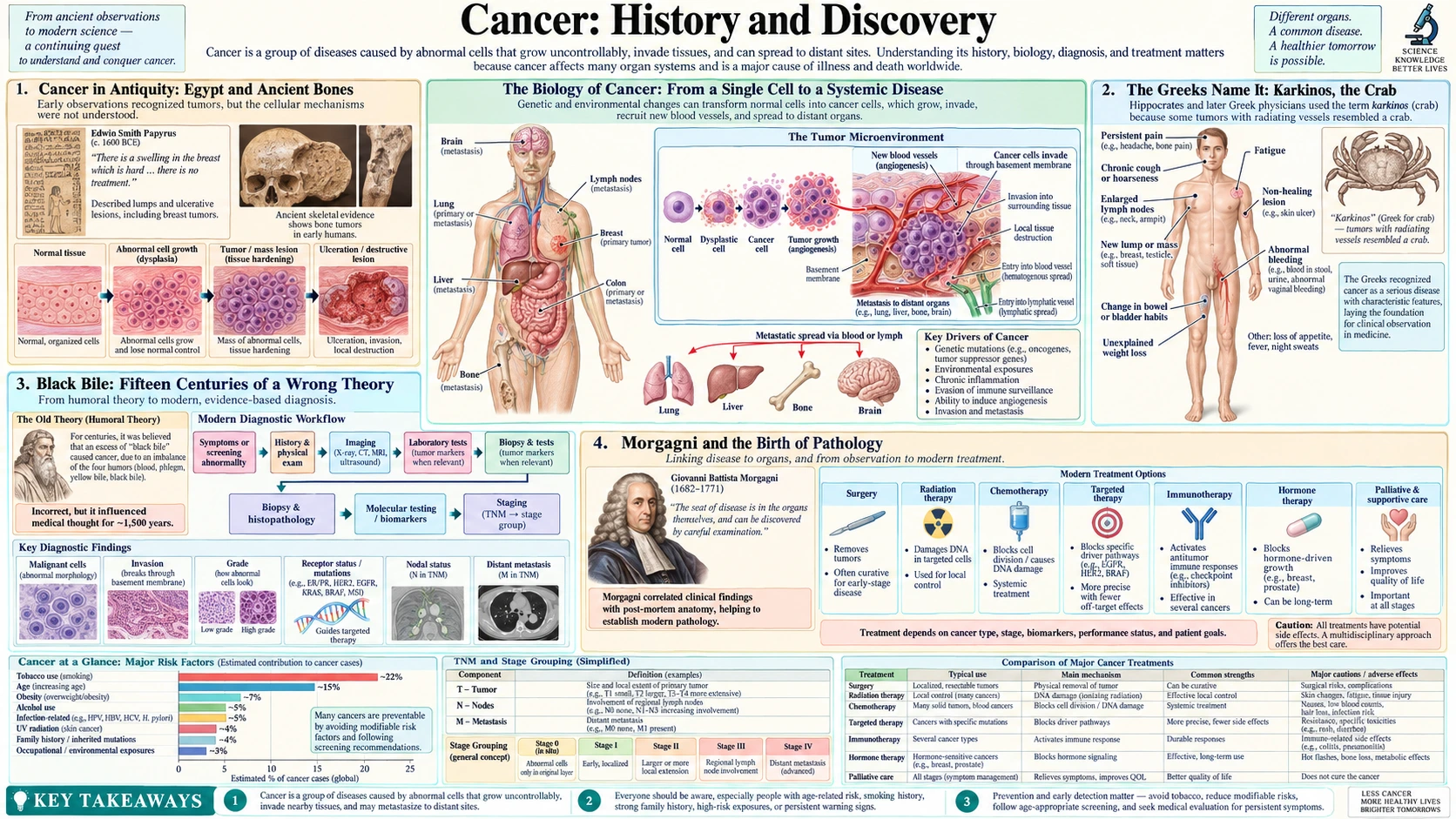
Cancer is not a modern disease, and it was not discovered by any single person. It is one of the oldest afflictions known to humankind — written about by Egyptian physicians more than three and a half thousand years ago, named by the Greeks for the crab, and explained, wrongly, for fifteen centuries as an excess of “black bile.” What follows is the story of how a family of diseases that has always been with us was gradually understood: from ancient observation, through the birth of pathology and the first proof that something in the environment could cause it, to the cellular and genetic revolutions of the nineteenth and twentieth centuries. Each milestone added a piece; none was the whole. Throughout, this page tries to be careful about the difference between giving cancer a name, proposing a cause, and finally seeing what cancer actually is — a disease of the cell's own genes.
Table of Contents
- Cancer in Antiquity: Egypt and Ancient Bones
- The Greeks Name It: Karkinos, the Crab
- Black Bile: Fifteen Centuries of a Wrong Theory
- Morgagni and the Birth of Pathology
- Percivall Pott and the First Known Carcinogen
- Virchow and the Cellular Origin of Cancer
- Peyton Rous and the Idea of a Tumor Virus
- Oncogenes, DNA, and the Genetic Revolution
- The Hallmarks of Cancer and the Modern View
- Key Research Papers
- Connections
- Featured Videos
Cancer in Antiquity: Egypt and Ancient Bones
The written record of cancer reaches back to ancient Egypt. The Edwin Smith Papyrus — named for the antiquities dealer who purchased it in 1862, and the oldest surviving surgical treatise in the world — is a copy dated to roughly 1600 BCE, during Egypt's Second Intermediate Period, of a far older text whose composition is usually placed centuries earlier still. Among its forty-eight case studies of injuries and ailments, one (Case 45) describes bulging tumors of the breast: cool, hard, and spreading masses. The Egyptian author set them down with striking clinical honesty, noting under treatment simply that there is none. That sober verdict — a recognizable, examinable disease for which nothing could be done — is the earliest known medical description of what we would now call cancer.
The disease is older than any papyrus. Tumors leave marks, and some leave them in bone, which survives. Paleopathologists studying ancient human and pre-human remains have found lesions consistent with bone tumors — both benign growths such as osteomas and, more rarely, changes consistent with malignant disease — in skeletons many thousands of years old, and even in far older hominin fossils. Cancer, in other words, is not a creation of the industrial age or of modern lifespans; it is a deep feature of multicellular life that humans have carried, and occasionally recorded, since prehistory. Modern living has changed which cancers are common and at what age they strike, but the disease itself is ancient.
It is worth being clear about what these ancient peoples did and did not know. They could see and describe tumors with real care, distinguish some kinds from others, and offer a prognosis. What they could not do was explain the cause or see the microscopic reality beneath the lump. The story of cancer's discovery is largely the story of slowly closing that gap — and the first great step in closing it was simply giving the thing a name.
The Greeks Name It: Karkinos, the Crab
Around 400 BCE, the Greek physician Hippocrates — later called the father of medicine — gave the disease the name that, in altered form, we still use. He called these growths karkinos and karkinoma, from the Greek word for crab. The reasons usually given are vivid and physical: a hard tumor sending out swollen veins and finger-like projections into the surrounding flesh was said to resemble a crab with its legs splayed out, dug in and difficult to pry loose. Whether Hippocrates was struck by the shape, the way an advanced tumor clings, or both, the crab imagery stuck, and the name has outlived every theory of cause that has accompanied it.
About five centuries later the Roman encyclopedist Aulus Cornelius Celsus (first century CE), in his medical work De Medicina, rendered the Greek term into Latin as cancer — the Latin word for crab — which is the direct ancestor of the English word. A little later the great physician Galen of Pergamon (second century CE) wrote extensively about tumors and used the Greek term onkos, a word meaning a mass, bulk, or swelling. It is from onkos that the modern word oncology — the study and treatment of cancer — ultimately descends. (Historians note that the very earliest use of onkos in this medical sense is debated and is sometimes traced to earlier Greek writers as well; what is not in doubt is that the word is the root of “oncology.”)
This naming layer matters because the names long outran the understanding. “Cancer,” “carcinoma,” and “oncology” were all coined before anyone knew that a tumor was made of cells, let alone that those cells carried damaged genes. For nearly two thousand years, physicians had an excellent vocabulary for cancer and an almost entirely mistaken idea of what it was — an idea inherited, like the names themselves, from the Greeks.
Black Bile: Fifteen Centuries of a Wrong Theory
The dominant ancient explanation for cancer was the humoral theory. Greek medicine, systematized by Hippocratic writers and elaborated by Galen, held that the body was governed by four fluids, or humors — blood, phlegm, yellow bile, and black bile (Greek melan chole) — and that disease arose when these fell out of balance. Cancer was attributed specifically to a local excess or stagnation of black bile. The theory had a certain internal logic for its time: it accounted for cancer's hard, dark, and seemingly congealed character and for its tendency to recur after removal, since the underlying humoral imbalance was thought to remain.
Through Galen's enormous authority, the black-bile account of cancer became orthodoxy and held its place for roughly fifteen hundred years, across the Roman, Byzantine, Islamic, and medieval European medical worlds. Because cancer was believed to be a systemic imbalance of a body-wide fluid, surgery was often viewed with pessimism — cutting out a local tumor could not, on this view, remove the deeper cause, and might even provoke it. This single idea shaped how the disease was understood and treated, or left untreated, for longer than any theory that has succeeded it.
It should be said plainly that the humoral theory of cancer was wrong: there is no “black bile,” and cancer is not caused by a surplus of any such humor. We present it here not as medicine but as history — the long-reigning hypothesis that had to be dislodged before a truer account could take hold. Its overthrow did not come from a better fluid theory but from a completely different way of looking: opening bodies after death and asking, organ by organ, where disease actually sat. That shift begins in the eighteenth century with the birth of pathology.
Morgagni and the Birth of Pathology
The modern study of disease as something seated in organs and tissues — rather than in invisible humors — is conventionally dated to 1761, when the Italian anatomist Giovanni Battista Morgagni (1682–1771) published De Sedibus et Causis Morborum per Anatomen Indagatis (“On the Seats and Causes of Diseases Investigated by Anatomy”). Drawing on roughly seven hundred autopsies he had performed or overseen, Morgagni did something deceptively simple and revolutionary: he correlated the symptoms a patient had shown in life with the lesions found in their body after death. Disease, he argued, has a location — a specific organ or tissue where the damage lies — and that location explains the symptoms.
For cancer, the consequences were profound. If a tumor was a definite thing growing in a definite place, with definite effects on the surrounding organ, then the old picture of a diffuse humoral imbalance began to look not just unprovable but unnecessary. Morgagni's method — the anatomico-clinical correlation — turned the autopsy into an instrument of discovery and made him widely regarded as the founder of pathological anatomy. Cancer could now be studied as a localized, physical disease of tissue, which is the indispensable groundwork for everything that follows.
Morgagni did not, and could not, see the microscopic structure of a tumor; the achromatic microscope and the cell theory still lay decades ahead. What he provided was the correct frame: look in the body, find where the disease sits, and reason from there. Within a few years of his work, that frame would yield the first hard evidence that something outside the body — in a person's occupation and environment — could actually cause a cancer.
Percivall Pott and the First Known Carcinogen
In 1775, the English surgeon Percivall Pott (1714–1788) of St. Bartholomew's Hospital in London published an observation that is generally regarded as the first identification of an occupational, environmental cause of cancer. In his Chirurgical Observations, Pott noted that chimney sweeps — very often boys, sent up flues to clean them — suffered an unusually high rate of cancer of the scrotum. He linked this directly to their chronic exposure to soot lodged in the skin, the residue of the chimneys they cleaned. The condition became known as chimney sweeps' carcinoma.
The importance of Pott's insight is hard to overstate. For the first time, a specific cancer was tied not to an internal imbalance or a vague constitution but to a particular substance encountered in a particular job — a true carcinogen, in modern terms, identified more than a century and a half before anyone could explain at the chemical or genetic level how soot damages cells. Pott also observed that the young sweeps were especially vulnerable, and his work is rightly remembered as the foundation of occupational medicine and of cancer prevention through controlling exposures. It helped prompt early protective measures for sweeps in Britain.
Pott's discovery reframed a key question. If a thing in the outside world could cause cancer, then cancer was not simply fate or imbalance; it had causes that might be found, and avoided. The scientific challenge then became: by what route does an external agent like soot produce a tumor in the tissue beneath the skin? Answering that required understanding what a tumor is built from — and that answer arrived in the middle of the nineteenth century with the cell.
Virchow and the Cellular Origin of Cancer
The decisive conceptual leap came from the German physician Rudolf Virchow (1821–1902), widely called the father of cellular pathology. In his landmark work Cellular Pathology (Die Cellularpathologie, 1858), and in the cancer studies he pursued through the 1860s, Virchow advanced and championed the principle captured in the Latin aphorism omnis cellula e cellula — “every cell comes from a cell.” Cells, he argued, do not arise spontaneously from formless matter; they come only from the division of pre-existing cells. From this he drew the conclusion that transformed oncology: a tumor is not a deposit of bad humor but an abnormal growth of the body's own cells, descended from normal cells that had begun to multiply without restraint.
In fairness to the historical record, the aphorism itself was not original to Virchow — the phrase had appeared earlier (it is often traced to François-Vincent Raspail in the 1820s), and the broader principle that cells arise only from other cells owes much to the work of Robert Remak, Virchow's contemporary. What Virchow did was to place the cell at the center of disease, marshal it into a complete pathological system, and apply it forcefully to cancer. After Virchow, cancer could finally be defined for what it is: a disease of cells gone wrong. The black-bile theory, already weakened by pathology, was now obsolete.
This cellular view is the true hinge of cancer's history. It quietly poses the modern question that the twentieth century would spend itself answering: if cancer is normal cells multiplying out of control, what is it that goes wrong inside those cells to release the brakes? The first famous clue would come not from human tumors but from a chicken — and it would take more than half a century to be believed.
Peyton Rous and the Idea of a Tumor Virus
In 1911, the American pathologist Peyton Rous (1879–1970), working at the Rockefeller Institute in New York, reported a startling experiment. He had taken a solid tumor (a sarcoma) from a hen, ground it up, and passed the extract through a fine filter able to hold back cells and even bacteria. When he injected the resulting cell-free filtrate into healthy chickens of the same stock, they developed the same sarcoma. Something far smaller than a cell — a submicroscopic, filterable agent — could transmit cancer. The agent is now known as the Rous sarcoma virus, and it was among the first of the viruses later classed as retroviruses.
Rous's claim — that a virus could cause a tumor — was so at odds with the thinking of his day that it was largely dismissed or ignored for decades, and Rous himself set the work aside for years. Vindication came slowly as other tumor viruses were found, and recognition came late and emphatically: Rous was awarded the Nobel Prize in Physiology or Medicine in 1966, fifty-five years after the original experiment — one of the longest such intervals in the history of the prize. It is important to keep this in proportion: the discovery proved that, in certain animals and certain cancers, a virus can be a cause. It did not mean that cancer in general, or human cancer, is a contagious viral disease — most cancers are not caused by viruses.
The deepest significance of Rous's work lay hidden inside the virus and would not be understood for another sixty-five years. The Rous sarcoma virus could transform a normal cell into a cancer cell, which implied it carried a specific cancer-causing gene. Identifying that gene, and discovering where it truly came from, would finally connect Virchow's wayward cell to its molecular cause — and reveal that the enemy was, astonishingly, partly ourselves.
Oncogenes, DNA, and the Genetic Revolution
The molecular era of cancer opened in 1976. J. Michael Bishop and Harold Varmus, working at the University of California, San Francisco, with their colleagues Dominique Stehelin and Peter Vogt, asked where the Rous sarcoma virus's cancer-causing gene (called src) had come from. The expectation was that it was a purely viral gene. What they found instead, reported in Nature in 1976, overturned that expectation: a closely related src sequence was already present in the normal DNA of healthy chickens — and, it soon emerged, in the DNA of many other animals, including humans. The virus had not invented the cancer gene; it had picked up a normal cellular gene at some point in its history and carried it along in a damaged, overactive form.
This was a profound reframing. The cancer-causing genes carried by tumor viruses (oncogenes) turned out to have normal counterparts built into our own genomes — genes that, in their healthy state, help control how cells grow and divide. In their normal form these are called proto-oncogenes; damaged or switched permanently “on” by mutation, they become oncogenes that drive uncontrolled growth. Cancer, in this light, is fundamentally a disease of our own genes going wrong — whether the damage is caused by a virus, by a carcinogen such as Pott's soot, by radiation, by inherited predisposition, or by the random errors of cell division. For this discovery of the cellular origin of retroviral oncogenes, Bishop and Varmus received the Nobel Prize in Physiology or Medicine in 1989.
The oncogene discovery, together with the subsequent identification of tumor suppressor genes — the cell's natural brakes, such as TP53 and RB1, whose loss also promotes cancer — established the modern genetic (somatic mutation) understanding of cancer: tumors arise as cells accumulate mutations that switch growth-promoting genes on and growth-restraining genes off. This framework united every earlier thread. Pott's carcinogen, Virchow's rogue cell, and Rous's virus were revealed as different routes to the same end point — damaged DNA in a cell that has lost control of its own multiplication.
The Hallmarks of Cancer and the Modern View
By the close of the twentieth century, cancer research had generated an enormous and sometimes bewildering body of detail about the many genes and pathways that can go wrong. In 2000, two influential cancer biologists, Douglas Hanahan and Robert Weinberg, published a landmark synthesis in the journal Cell titled “The Hallmarks of Cancer.” They proposed that the bewildering diversity of cancers could be organized around a small set of shared capabilities a normal cell must acquire to become malignant — including sustaining its own growth signals, ignoring signals that would tell it to stop, evading programmed cell death (apoptosis), achieving limitless replicative potential, inducing new blood-vessel growth (angiogenesis), and invading tissue and spreading (metastasis). It became one of the most-cited papers in the history of biology.
The framework was not frozen. In a 2011 update, “Hallmarks of Cancer: The Next Generation,” Hanahan and Weinberg added further capabilities — such as reprogramming the cell's energy metabolism and evading destruction by the immune system — and identified enabling conditions like genome instability and tumor-promoting inflammation. The hallmarks approach is valuable precisely because it is honest about complexity: it does not pretend cancer is one disease with one cause, but offers a common logic for understanding a whole family of diseases, and a map for designing treatments aimed at each capability.
Seen across its whole history, the discovery of cancer is a story of accumulation, not of a single inventor. The Egyptians described it; the Greeks named it and proposed a cause that was wrong; Morgagni located it in organs; Pott showed it could be caused from outside; Virchow showed it was a disease of cells; Rous showed a virus could trigger it; Bishop, Varmus, and their colleagues showed its roots lay in our own genes; and Hanahan and Weinberg drew the pieces into a unifying picture. Each generation handed the next a sharper question. Cancer was never discovered once and for all — it has been, and still is, understood by degrees, which is exactly why research continues today.
Key Research Papers
The references below combine peer-reviewed historical and scientific papers — with real DOIs or PubMed identifiers (PMIDs) where available — with curated PubMed topic-search links into the broader literature. Ancient and early-modern primary texts (the Edwin Smith Papyrus; the Hippocratic writings; Celsus's De Medicina; Galen's works; Morgagni's De Sedibus, 1761; Pott's Chirurgical Observations, 1775; and Virchow's Cellularpathologie, 1858) are named in the article as historical sources rather than as modern citations. Each external link opens in a new tab.
- Hanahan D, Weinberg RA. The hallmarks of cancer. Cell. 2000;100(1):57–70. — PubMed PMID: 10647931 · doi:10.1016/S0092-8674(00)81683-9
- Hanahan D, Weinberg RA. Hallmarks of cancer: the next generation. Cell. 2011;144(5):646–674. — doi:10.1016/j.cell.2011.02.013
- Stehelin D, Varmus HE, Bishop JM, Vogt PK. DNA related to the transforming gene(s) of avian sarcoma viruses is present in normal avian DNA. Nature. 1976;260(5547):170–173. — PubMed PMID: 176594 · doi:10.1038/260170a0
- Panegyres PK. The story of how cancer got its name. Cancer. 2024. — doi:10.1002/cncr.35428
- The Edwin Smith Papyrus and the earliest descriptions of cancer (history of oncology) — PubMed: Edwin Smith Papyrus and the history of cancer
- Giovanni Battista Morgagni and the birth of pathological anatomy (De Sedibus, 1761) — Morgagni, father of pathologic anatomy. — Search PubMed
- Percivall Pott, soot, and the first description of an occupational cancer — PubMed: Pott and the first occupational carcinogen
- Rudolf Virchow and the founding of cellular pathology. — PubMed PMID: 32239122
- Peyton Rous and the discovery of the tumor virus (Rous sarcoma virus) — PubMed PMID: 33710257
- The discovery of oncogenes and proto-oncogenes (Bishop and Varmus; 1989 Nobel Prize) — PubMed: cellular origin of oncogenes
- Tumor suppressor genes and the somatic mutation theory of cancer — PubMed: tumor suppressor genes and cancer
- The history of the four-humors theory and the “black bile” account of disease — PubMed: humoral theory and black bile in the history of medicine. — Search PubMed
- Paleopathology: evidence of cancer and tumors in ancient human remains — PubMed: paleopathology of cancer in ancient remains
- The etymology and history of the terms “cancer,” “carcinoma,” and “oncology” PubMed: history of cancer terminology
External Authoritative Resources
Connections
- Oncology
- Cancer (Overview)
- All Conditions
- Leukemia
- Lymphoma
- Metastatic Cancers
- Sarcoma
- Multiple Myeloma