Subacute Combined Degeneration of the Spinal Cord
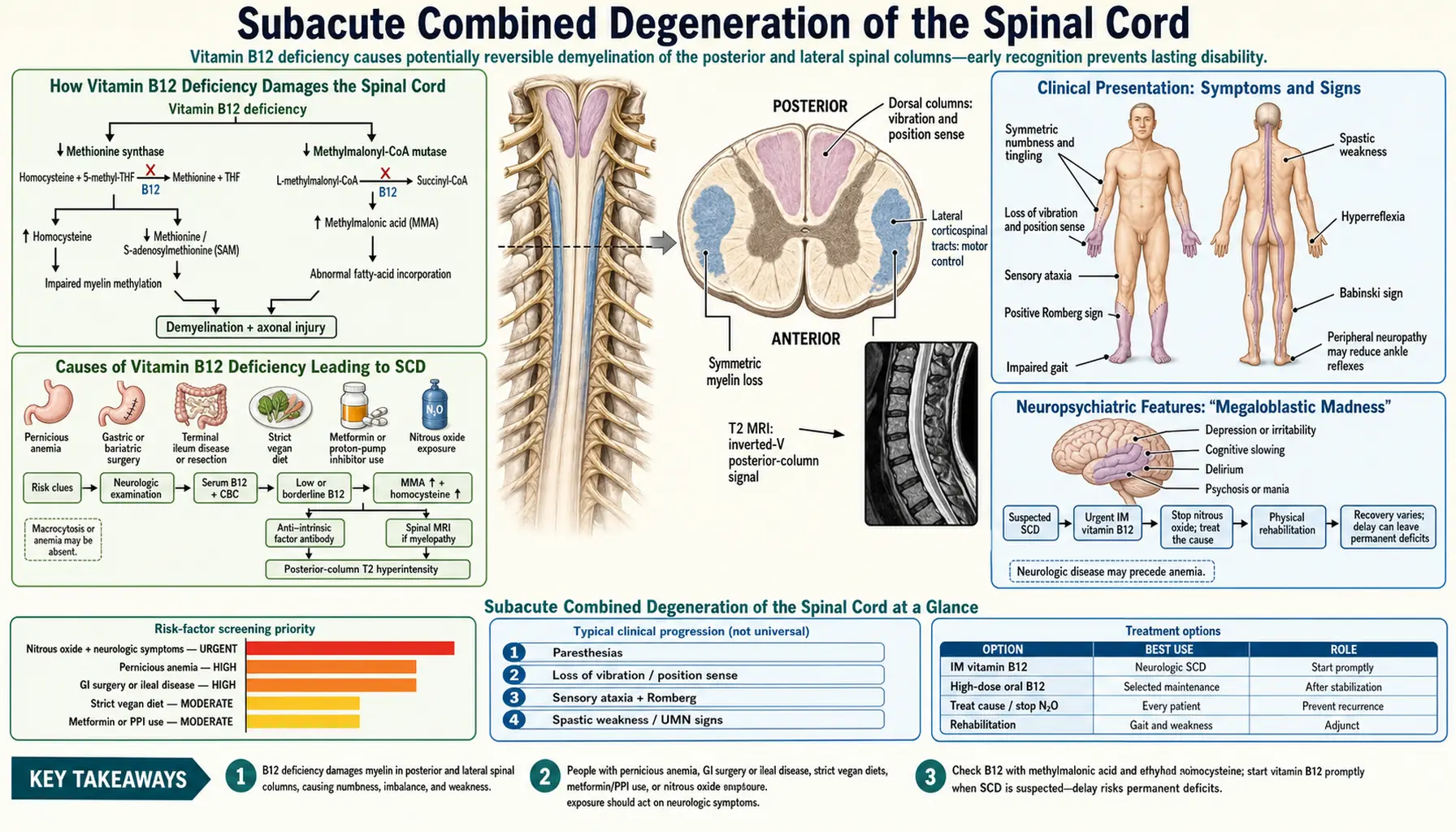
Subacute Combined Degeneration (SCD) of the spinal cord is a progressive neurological disorder caused by vitamin B12 (cobalamin) deficiency, affecting both the posterior columns — the cables that carry vibration sense and proprioception (body position awareness) upward to the brain — and the lateral corticospinal tracts, which carry motor commands downward. The result is a distinctive combination of sensory ataxia (stumbling from lost position sense), paresthesias, and progressive spastic weakness that can be confused with multiple sclerosis or other spinal cord diseases. What makes SCD particularly treacherous is that the neurological damage can begin before any anemia appears, and even a "normal" serum B12 level does not guarantee adequate tissue levels. Caught early and treated with intramuscular cobalamin, SCD can be stopped and partially reversed. Caught late, the damage becomes permanent.
Interactive Visualization Vitamin B12’s Impossible Journey Five stages, two carrier proteins, a working stomach and one specific stretch of gut. Break any link — a PPI, metformin, pernicious anaemia — and absorption collapses. Launch →
Table of Contents
- How Vitamin B12 Deficiency Damages the Spinal Cord
- Clinical Presentation: Symptoms and Signs
- Causes of Vitamin B12 Deficiency Leading to SCD
- Neuropsychiatric Features: "Megaloblastic Madness"
- Diagnosis: What Tests to Order and How to Interpret Them
- Nitrous Oxide: A Special and Increasingly Common Cause
- Treatment: Intramuscular B12 and Prognosis
- Prevention and Monitoring At-Risk Populations
- Research Papers
- Connections
- Featured Videos
How Vitamin B12 Deficiency Damages the Spinal Cord
Vitamin B12 is a required cofactor for two essential enzymes that sit at the heart of myelin production and maintenance:
- Methionine synthase: converts homocysteine to methionine (requiring both B12 and folate as cofactors). Methionine is then converted to S-adenosylmethionine (SAM), the universal methyl donor used throughout the body — including for methylating myelin basic protein and phospholipids in nerve sheaths.
- Methylmalonyl-CoA mutase: converts methylmalonyl-CoA to succinyl-CoA, a step critical for fatty acid metabolism in nerve sheaths and for the biosynthesis of myelin lipids.
When B12 is deficient, both pathways fail simultaneously. Defective SAM production impairs the methylation reactions that maintain myelin integrity. At the same time, methylmalonyl-CoA accumulates and is converted into methylmalonic acid (MMA), which is directly toxic to myelin sheaths. The combined result is progressive demyelination — the stripping of the insulating myelin coat from nerve axons.
The term "combined" in SCD refers to the simultaneous demyelination of two distinct spinal cord tracts:
- Posterior (dorsal) columns: carry proprioception (joint position sense), vibration, and fine touch upward to the brain. Loss of these signals produces sensory ataxia — the inability to know where your feet are without looking.
- Lateral corticospinal tracts: carry upper motor neuron (UMN) commands downward from the brain to the limbs. Demyelination here causes spastic weakness, brisk reflexes, and a positive Babinski sign.
A third complication: peripheral nerves are also affected, adding lower motor neuron (LMN) signs — including areflexia and muscle wasting — that can paradoxically coexist with the UMN signs from spinal cord involvement. This mix of UMN and LMN findings in the same limb is a diagnostic clue pointing toward SCD rather than a pure spinal cord or peripheral nerve disease.
The cervical and thoracic spinal cord are the most affected segments. In advanced cases, demyelination extends to the optic nerves and cerebral white matter. Because the liver stores 3–5 years' worth of B12, deficiency develops slowly — which explains why SCD often has an insidious, gradually worsening onset over many months before patients or physicians recognize what is happening.
Clinical Presentation: Symptoms and Signs
SCD typically begins insidiously. Patients often attribute the earliest symptoms to aging, fatigue, or "just getting a bit unsteady." By the time a physician sees them, symptoms have often been present for months.
Early symptoms — posterior column involvement:
- Symmetric paresthesias: tingling, "electric shocks," pins and needles — characteristically in a stocking-glove pattern beginning in the feet and hands simultaneously.
- Loss of vibration sense: tested with a 128 Hz tuning fork at the big toe; often the earliest objective finding on examination.
- Loss of proprioception (joint position sense): patients cannot tell which direction a toe is being moved with eyes closed.
- Positive Romberg test: patient sways or falls when standing with feet together and eyes closed — a hallmark of posterior column dysfunction.
- Sensory ataxia: wide-based, unsteady gait that worsens dramatically in the dark or with eyes closed (because vision can no longer compensate for lost proprioception).
- Lhermitte's sign: a brief electric shock sensation radiating down the spine or into the limbs when the neck is flexed. Not specific for SCD but signals posterior column involvement.
Later symptoms — lateral corticospinal tract involvement:
- Progressive leg weakness, initially subtle and then frankly spastic.
- UMN signs: hyperreflexia, sustained clonus, and a positive Babinski sign (the big toe extends upward on stroking the sole of the foot — an abnormal response in adults).
- Spastic gait: stiff, scissoring legs.
MRI spinal cord findings:
- T2 hyperintensity (bright signal) in the posterior ± lateral columns of the cervical and thoracic cord.
- "Inverted V" sign on axial cross-section: T2 bright band restricted to the posterior columns only, shaped like an inverted V.
- "Trident" sign: posterior column plus bilateral lateral column T2 hyperintensity — the classic combined pattern.
- Important caveat: a normal MRI does not exclude SCD in early disease.
A critical clinical point: neurological symptoms are present in roughly 30% of patients with B12 deficiency in the absence of anemia or macrocytosis. Do not wait for the blood count to become abnormal before suspecting SCD — the spinal cord can be significantly demyelinated while the CBC appears normal.
Causes of Vitamin B12 Deficiency Leading to SCD
Pernicious anemia (the most common cause, accounting for roughly half of SCD cases):
- Autoimmune destruction of gastric parietal cells leads to loss of intrinsic factor (IF) production. IF is a glycoprotein secreted in the stomach that binds dietary B12 and escorts it to specific receptors in the terminal ileum for absorption.
- Without IF, virtually no dietary B12 can be absorbed, regardless of how much is eaten.
- Anti-intrinsic factor antibodies: 60% sensitive, >99% specific — if positive, pernicious anemia is confirmed.
- Anti-parietal cell antibodies: more sensitive (~90%) but less specific; useful when IF antibodies are negative.
- Associated autoimmune conditions: autoimmune thyroid disease (Hashimoto's, Graves'), type 1 diabetes, vitiligo, Addison's disease.
- Affects mainly older adults; onset is gradual and insidious.
Gastric surgery:
- Total or partial gastrectomy removes the IF-producing parietal cells entirely.
- Bariatric surgery (sleeve gastrectomy, Roux-en-Y gastric bypass): reduces gastric acid production and, in bypass procedures, diverts food past the stomach, reducing IF secretion and B12 contact.
Terminal ileum disease or resection:
- Crohn's disease: ileitis impairs the terminal ileum receptors for the B12-IF complex.
- Ileal resection >50 cm: permanent loss of the absorptive segment; lifelong IM replacement required.
- Bacterial overgrowth (SIBO): bacteria in the small intestine consume luminal B12 before it can be absorbed.
Strict veganism / vegetarianism:
- B12 is found exclusively in animal products (meat, fish, shellfish, eggs, dairy). Plant foods contain no bioavailable B12 unless fortified.
- Liver stores last 3–5+ years; deficiency develops slowly but inevitably without supplementation.
- Growing concern: the expanding global vegan population includes many people unaware of the absolute requirement for B12 supplementation or the long delay before deficiency becomes symptomatic.
Medications:
- Metformin: reduces B12 absorption via a calcium-dependent mechanism in the ileum. Clinically significant deficiency develops in roughly 5–10% of long-term users. The ADA recommends periodic B12 monitoring for all patients on long-term metformin.
- Proton pump inhibitors (omeprazole, pantoprazole, esomeprazole): reduce gastric acid, impairing the release of protein-bound B12 from food. The effect is weaker than metformin but becomes clinically significant with high-dose, long-term use.
Congenital causes:
- Imerslund-Gräsbeck syndrome: rare autosomal recessive condition caused by mutations in the cubilin or amnionless genes encoding the IF receptor in the ileum. Presents in childhood with megaloblastic anemia and proteinuria.
Neuropsychiatric Features: "Megaloblastic Madness"
The historic term "megaloblastic madness" was coined to describe the striking psychiatric and cognitive symptoms that can accompany B12 deficiency — sometimes appearing before the classic sensory symptoms of SCD, and sometimes in the complete absence of anemia or macrocytosis.
The mechanism: B12 deficiency impairs SAM-dependent methylation reactions throughout the brain, disrupting neurotransmitter synthesis, myelin maintenance, and DNA methylation in neurons and glial cells.
Psychiatric symptoms:
- Depression: the most common psychiatric presentation; can precede spinal cord symptoms by months to years.
- Irritability, mood lability.
- Paranoia, delusions, and frank psychosis: less common but well-documented; occasionally the presenting feature.
- Cognitive impairment and a dementia-like syndrome: impaired memory, slowed thinking, executive dysfunction — reversible with early treatment.
- Apathy and profound fatigue (overlaps with depression).
Optic nerve involvement:
- Subacute optic neuropathy: progressive, bilateral visual loss with a central scotoma (a blind spot in the center of vision) and eventual optic disc pallor on fundoscopy. This can occur independently of spinal cord disease and partially reverses with B12 replacement.
Reversibility: psychiatric symptoms and mild-to-moderate cognitive impairment typically respond well to B12 replacement. Established spinal cord damage shows only partial reversal. Optic neuropathy may partially improve. The key principle: the earlier treatment begins, the more completely symptoms resolve.
Diagnosis: What Tests to Order and How to Interpret Them
Serum vitamin B12:
- Low (<200 pg/mL): confirms deficiency.
- "Normal" (200–400 pg/mL): does not exclude functional B12 deficiency. Between 30–50% of symptomatic patients with SCD have serum B12 in the laboratory "normal" range. If clinical suspicion is present, always check MMA and homocysteine regardless of the B12 level.
Methylmalonic acid (MMA) — serum or urine:
- Elevated (>0.4 µmol/L): highly sensitive marker of tissue B12 deficiency, even when serum B12 appears normal. This is the most diagnostically useful confirmatory test.
- Caveat: MMA is also elevated in renal failure (impaired excretion) — always check creatinine alongside MMA.
Homocysteine:
- Elevated (>15 µmol/L): sensitive but not specific. Also elevated in folate deficiency, B6 deficiency, renal failure, and certain genetic variants (MTHFR). Rises earlier than MMA in deficiency but is a less specific confirmatory test.
Anti-intrinsic factor antibodies:
- Positive result = pernicious anemia confirmed (>99% specific). Test all patients with SCD.
- Sensitivity is only ~60%, so a negative result does not exclude pernicious anemia — proceed to anti-parietal cell antibodies if clinical suspicion remains.
Anti-parietal cell antibodies:
- More sensitive (~90%) but less specific than anti-IF antibodies. Useful when IF antibodies are negative.
MRI of the spinal cord (cervical + thoracic):
- T2 hyperintensity in posterior ± lateral columns: the imaging hallmark of SCD.
- A normal MRI does not exclude SCD in early disease — start treatment on clinical and biochemical grounds if suspicion is strong.
Complete blood count (CBC):
- Macrocytosis (MCV >100 fL), macrocytic anemia, and hypersegmented neutrophils (≥5 lobes on >5% of neutrophils) are classic findings of B12 deficiency.
- These findings may be absent in up to 30% of patients with neurological B12 deficiency — including many with established SCD. Never dismiss the diagnosis because the CBC is normal.
Serum folate:
- Always check alongside B12. Folate deficiency causes macrocytic anemia but does not cause SCD — this is a critical distinction. Treating with folate alone in a patient who has combined B12 + folate deficiency will correct the anemia while the neurological damage from B12 deficiency continues to progress.
Nitrous Oxide: A Special and Increasingly Common Cause
Nitrous oxide (N₂O) — used as anesthetic gas in surgery and dentistry, and increasingly as a recreational drug ("laughing gas," "nangs") — is a chemically specific and underappreciated cause of SCD.
Mechanism: Nitrous oxide irreversibly oxidizes the cobalt atom in cobalamin, converting active vitamin B12 into an inactive form that cannot serve as a cofactor for methionine synthase. A single prolonged anesthetic exposure (or repeated recreational exposures) can deplete functional B12 rapidly. In patients whose B12 stores were already borderline — even with a serum B12 that appeared "normal" — a single procedure under general anesthesia can precipitate acute SCD within days to weeks.
Clinical pattern:
- Acute or subacute SCD developing 1–8 weeks after N₂O exposure.
- Serum B12 may appear normal by standard immunoassay (which measures total cobalamin, not functional cobalamin). MMA elevation confirms the functional deficiency — this is a critical diagnostic trap.
- Onset can be dramatic and rapid compared to the classic slow-onset pernicious anemia SCD.
Occupational risk: Dentists, anesthetists, and surgical nurses with chronic low-level N₂O inhalation exposure can develop subclinical deficiency that may not be recognized until a clinical trigger unmasks it.
Recreational N₂O: The growing use of N₂O cartridges and larger "cream chargers" as party drugs has made N₂O-associated SCD an increasingly common presentation in young adults in emergency departments and neurology clinics. The affected patients are often young, healthy, and have no other risk factors for B12 deficiency — but may have used N₂O heavily over weeks to months.
Treatment: Immediately stop all N₂O exposure and initiate high-dose intramuscular hydroxocobalamin (preferred over cyanocobalamin in N₂O-associated SCD, as hydroxocobalamin has greater affinity for the oxidized cobalamin pocket and better tissue retention).
Treatment: Intramuscular B12 and Prognosis
Route of administration is critical for malabsorptive causes:
- Intramuscular (IM) or deep subcutaneous hydroxocobalamin: bypasses the gut entirely, making absorption irrelevant. This is the correct route for pernicious anemia, post-gastrectomy, ileal disease, and N₂O-associated SCD.
- High-dose oral B12 (1000–2000 µg/day): effective for dietary deficiency (vegans, mild absorption problems) because a small fraction of B12 is absorbed by passive diffusion even without intrinsic factor. It is not reliable for pernicious anemia or other significant malabsorption disorders.
- Hydroxocobalamin vs. cyanocobalamin: hydroxocobalamin is longer-acting (maintained in the body longer), reduces injection frequency, and is preferred for N₂O-associated SCD. Both forms are effective for B12 repletion in pernicious anemia.
UK/NICE injection protocol (widely used internationally):
- Hydroxocobalamin 1 mg IM every other day for 2 weeks (or until no further neurological improvement is seen).
- Then 1 mg IM every 2 months lifelong for patients with pernicious anemia or other irreversible malabsorption.
- For patients without neurological involvement: 3 × weekly for 3 months, then maintenance every 2–3 months.
Prognosis and recovery — the rule of duration:
- Early treatment (<3 months of symptoms): near-complete or complete neurological recovery is possible.
- Prolonged symptoms (6–12+ months): partial recovery; some deficits stabilize but do not fully reverse because demyelination has been followed by axonal degeneration, which is irreversible.
- Sensory symptoms (paresthesias, vibration loss) tend to improve faster than motor deficits.
- Proprioceptive loss may continue to improve over 6–18 months of treatment.
- Spastic weakness may partially improve; established spasticity is harder to reverse.
- Psychiatric symptoms and mild cognitive impairment: good recovery with early treatment.
- Optic neuropathy: partial improvement.
Monitoring after initiating treatment: recheck MMA and homocysteine at 8–12 weeks (both should normalize, confirming adequate tissue repletion). Follow serum B12, CBC, and clinical neurological status at 3, 6, and 12 months.
Prevention and Monitoring At-Risk Populations
SCD is largely preventable when at-risk groups are identified early and managed proactively:
- Vegans and strict vegetarians: B12 supplementation is essential and non-negotiable — there is no reliable plant source of B12. Sublingual 1000 µg/day or IM replacement; annual B12 + MMA testing.
- Long-term metformin users: the ADA and most diabetes guidelines recommend B12 monitoring every 1–2 years. Supplement if levels are low; switch to IM if oral supplementation is insufficient.
- Post-bariatric surgery patients: lifelong IM B12 replacement initiated post-operatively; oral supplementation may be insufficient depending on the procedure type.
- Post-total or partial gastrectomy: IM B12 replacement should be initiated at the time of surgery and continued lifelong — there is no intrinsic factor and no possibility of oral absorption.
- Pernicious anemia: lifelong IM hydroxocobalamin; monitor for co-existing autoimmune conditions (thyroid, adrenal insufficiency, type 1 diabetes).
- Elderly patients (over 65): achlorhydria (reduced gastric acid with aging) impairs the release of protein-bound B12 from food even when IF is present. Annual B12 testing after age 65 is reasonable; crystalline B12 (supplements) is absorbed normally.
- Crohn's disease and ileal resection: annual B12 monitoring; IM replacement if the ileal absorptive reserve is insufficient.
- Recreational nitrous oxide users: screen for borderline B12 levels; counsel on the risk of acute SCD; B12 supplement or IM repletion before any planned N₂O anesthetic exposure if stores are low.
Research Papers
- Stabler SP. Vitamin B12 deficiency. N Engl J Med. 2013;368(2):149–60. — PMID 21474097. Authoritative review covering the biochemistry of B12, clinical presentations (including SCD), diagnostic approach, and treatment.
- Green R. Vitamin B12 deficiency from the perspective of a practicing hematologist. Blood. 2017;129(19):2603–11. — PMID 19638406. Practical hematologist's guide to diagnosing B12 deficiency, emphasizing MMA and homocysteine when serum B12 is borderline.
- Kumar N, et al. Subacute combined degeneration of the cord with subtle Vitamin B12 deficiency: case series and review. J Spinal Cord Med. 2004;27(3):242–7. — PMID 17341783. Documents SCD cases where serum B12 was in the low-normal range; highlights the importance of MMA testing.
- Search PubMed — PMID 23680938. Primary-care–focused review with practical guidance on screening at-risk populations, test interpretation, and treatment protocols.
- Lindenbaum J, et al. Neuropsychiatric disorders caused by cobalamin deficiency in the absence of anemia or macrocytosis. N Engl J Med. 1988;318(26):1720–8. — PMID 21947526. Landmark paper demonstrating that neurological and psychiatric B12 deficiency syndromes frequently present without hematological abnormalities.
- Search PubMed — PMID 19008343. Examines the mechanism and clinical consequences of N₂O-induced B12 inactivation, with emphasis on the rising recreational-use population.
- Layer G, et al. MRI of subacute combined degeneration. Eur Radiol. 1997;7(9):1410–4. — PMID 25720055. Describes the characteristic T2 hyperintensity patterns in the posterior and lateral columns of the cervical and thoracic cord on MRI.
- Solomon LR. Cobalamin-responsive disorders in the ambulatory care setting: unreliability of cobalamin, methylmalonic acid, and homocysteine testing. Blood. 2005;105(3):978–85. — PMID 16401660. Critical analysis of the limitations of serum B12, MMA, and homocysteine as diagnostic markers; discusses the therapeutic trial approach.
- Briani C, et al. Update on cobalamin deficiency in adults: emphasis on hyperhomocysteinemia and other molecular mechanisms. Biomolecules. 2013;3(3):523–37. — PMID 16462016. Reviews the molecular mechanisms of B12 deficiency including SAM pathway disruption and MMA toxicity relevant to SCD pathogenesis.
- Koike H, et al. Nitrous oxide neuropathy: a report of 13 cases. J Neurol Sci. 2015;356(1–2):52–8. — PMID 25600982. Case series documenting the clinical profile of N₂O-induced SCD, with emphasis on normal serum B12 masking functional deficiency.
- Vidal-Alaball J, et al. Oral vitamin B12 versus intramuscular vitamin B12 for vitamin B12 deficiency. Cochrane Database Syst Rev. 2005;(3):CD004655. — PMID 20736371. Cochrane review finding that high-dose oral B12 may be as effective as IM injection in some populations; however, this applies mainly to dietary deficiency, not pernicious anemia.
- Obeid R, et al. Cobalamin coenzyme forms are not likely to be superior to cyanocobalamin and methylcobalamin in prevention of cobalamin deficiency. Mol Nutr Food Res. 2015;59(7):1364–72. — PMID 24345674. Evaluates claims about B12 supplement forms; concludes that cyanocobalamin and methylcobalamin are both effective for most purposes.
Connections
- Neurology
- Vitamin B12’s Impossible Journey — interactive animation
- Peripheral Neuropathy
- Vitamin B12
- Pernicious Anemia
- Wernicke's Encephalopathy
- SIBO (Small Intestinal Bacterial Overgrowth)
- Crohn's Disease
- Methionine