Immunology
Conditions
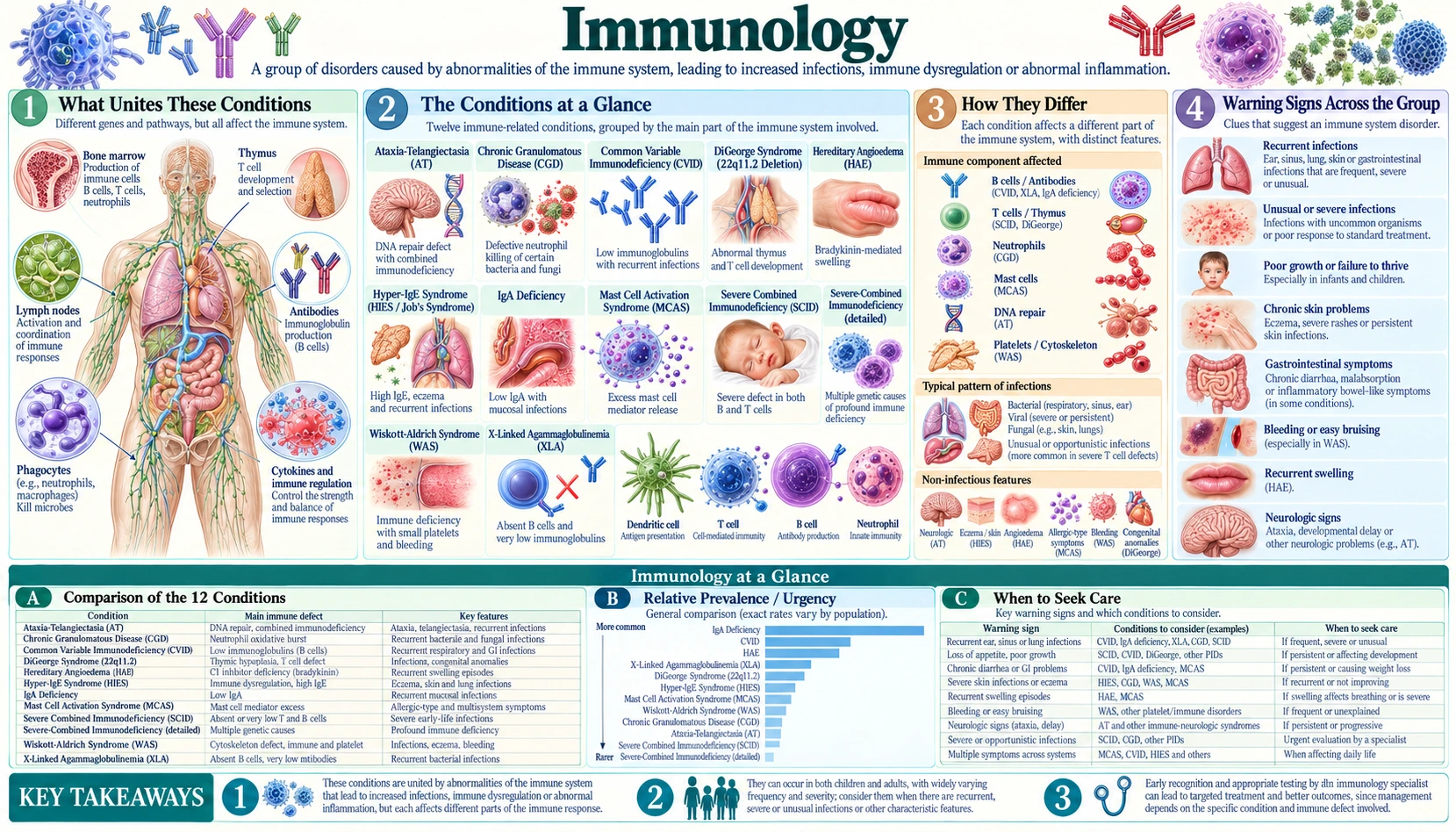
Immunology covers primary immunodeficiency diseases — inherited or acquired defects in the immune system's ability to defend against infection, regulate inflammation, or prevent autoimmunity.
About Primary Immunodeficiency Diseases
Primary immunodeficiency diseases (PIDs) are a group of more than 450 distinct genetic disorders in which one or more components of the immune system fail to function correctly. They differ fundamentally from secondary immunodeficiencies (caused by HIV, chemotherapy, or malnutrition) in that the defect is inherited — present from birth in the genome, even if symptoms do not appear until later in childhood or adulthood.
PIDs span a wide spectrum of severity, from selective IgA deficiency (affecting 1 in 500 people, often without symptoms) to severe combined immunodeficiency (SCID), which is incompatible with normal life without stem cell transplantation. What unites them is that the immune system's ability to do one or more of its core jobs — recognizing pathogens, killing bacteria and fungi, clearing viruses, regulating inflammation, or distinguishing self from non-self — is impaired.
The Five Arms of Immunity and Their Defects
Understanding which arm of immunity is affected tells you almost everything about which infections a patient will suffer:
- Antibody deficiency (B-cell disorders): Susceptibility to encapsulated bacteria — Streptococcus pneumoniae, Haemophilus influenzae, Neisseria meningitidis — and to enteroviruses. Examples: CVID, XLA, IgA deficiency.
- T-cell deficiency: Susceptibility to viral infections, fungi, Mycobacteria, Pneumocystis jirovecii, and intracellular pathogens. SCID combines T-cell and B-cell failure.
- Phagocyte defects: Susceptibility to catalase-positive bacteria (Staphylococcus aureus, Burkholderia, Serratia) and fungi (Aspergillus). Example: Chronic Granulomatous Disease.
- Complement deficiency: Susceptibility to encapsulated bacteria (early complement) or Neisseria meningitis (terminal complement). Example: Hereditary Angioedema (C1-INH deficiency).
- Immune dysregulation: Paradoxically, both too little immunity (infection susceptibility) and too much (autoimmunity, lymphoproliferation). Examples: AT, HIES, WAS.
The Diagnostic Delay Problem
The average time from first symptoms to confirmed PID diagnosis is 10–15 years for many conditions. This delay causes preventable organ damage — bronchiectasis, neurological deterioration, liver disease — that could be minimized with early diagnosis and treatment. The Jeffrey Modell Foundation's "10 Warning Signs of Primary Immunodeficiency" has been widely distributed to raise awareness among both patients and primary care physicians.
Treatment Principles
Treatment depends on the specific defect. Antibody deficiencies are treated with immunoglobulin replacement therapy (IVIG or SCIG), which provides passive protection against the infections the patient cannot prevent. SCID and some cases of Wiskott-Aldrich Syndrome are treated with hematopoietic stem cell transplantation (HSCT), which can be curative. DOCK8-deficient AR-HIES responds particularly well to HSCT. Newer treatments include gene therapy (approved for ADA-SCID) and targeted small-molecule therapies for specific genetic defects.
Connections
- All Conditions
- How Vaccines Train Your Immune System — interactive animation
- The Lymphatic System: Your Body’s Drainage & Surveillance — interactive animation
- The Complement System: Your Blood’s Silent Army — interactive animation
- Histamine, Mast Cells & Allergy — interactive animation
- Immune Response — interactive animation
- DiGeorge Syndrome
- Mast Cell Activation Syndrome
- Anemia
- Thrombocytopenia
- Bronchiectasis
- Giardiasis
- Lymphoma
- Immunoglobulin Lab Tests
- Élie Metchnikoff — phagocytes and the birth of cellular immunology
- Paul Ehrlich — antibodies, receptors, and the humoral side of immunity's founding Nobel
- Allison & Honjo — the immune brakes that checkpoint drugs release
- Regulatory T Cells — the 2025 Nobel: the immune system's own brakes, and why "balanced" beats "boosted"
- Finding HIV — the 1983 discovery, U=U, PrEP, and the cost of denialism
- Susumu Tonegawa — Nobel 1987, the genetic principle behind antibody diversity
- Herbs covered on this site that discuss conditions in this specialty: Elephant's Foot (Elephantopus scaber) · Astragalus (Astragalus membranaceus) · Boneset · Boswellia · Cleavers · Noni (Morinda citrifolia)
All Immunology Articles A–Z
Every article in this specialty, listed alphabetically.
- Ataxia-Telangiectasia (AT)
- Chronic Granulomatous Disease (CGD)
- Common Variable Immunodeficiency (CVID)
- Genetic Susceptibility to Vaccine Adverse Reactions
- Hereditary Angioedema (HAE)
- Hyper-IgE Syndrome (HIES)
- IgA Deficiency (Selective IgA Deficiency)
- SCID (Severe Combined Immunodeficiency)
- Severe Combined Immunodeficiency (SCID)
- Wiskott-Aldrich Syndrome (WAS)
- X-Linked Agammaglobulinemia (Bruton's Agammaglobulinemia)