⚠ Evidence warning: Clinical trials or other evidence do not support the claim that boneset's polysaccharides activate immune cells in the laboratory. This page keeps it as a report of what people, websites or other media say.
Boneset
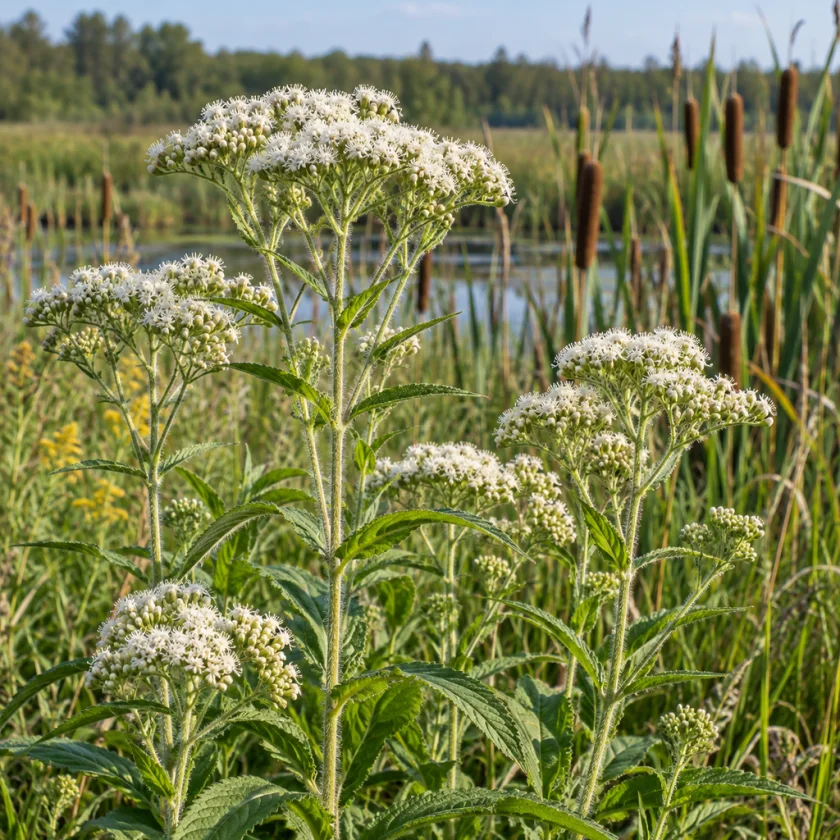
Boneset (Eupatorium perfoliatum) is a tall, white-flowered wildflower of North American wet meadows, marsh edges, and ditches — and for roughly two centuries it was one of the most trusted fever-and-flu remedies on the continent. Native American nations used it, colonists adopted it, and the nineteenth-century Eclectic physicians made it a household staple. Here is the first thing worth clearing up: despite the alarming name, boneset was not a remedy for mending broken bones. The name comes from its use against "break-bone fever" — the old term for dengue and other fevers that leave you aching so deeply it feels as if your bones themselves hurt. This page explains what the plant is, how it was used, what its chemistry looks like, and — honestly — what modern science has and has not confirmed. The short version: boneset is a genuinely storied traditional herb with intriguing laboratory findings on anti-inflammatory and antiviral activity, but essentially no rigorous modern human trials, and it carries a real safety caution because it contains liver-damaging alkaloids.
Table of Contents
What Boneset Is
Boneset is a hardy perennial in the daisy family (Asteraceae), native across eastern and central North America. It grows three to five feet tall on a single hairy stem, topped in late summer and early autumn by broad, flat clusters of small, fuzzy, off-white flowers that hoverflies and butterflies adore. You will find it in damp places — wet meadows, the shoulders of ponds and streams, roadside ditches, and marsh margins — which is why some old texts call it a "wetland" or "swamp" herb.
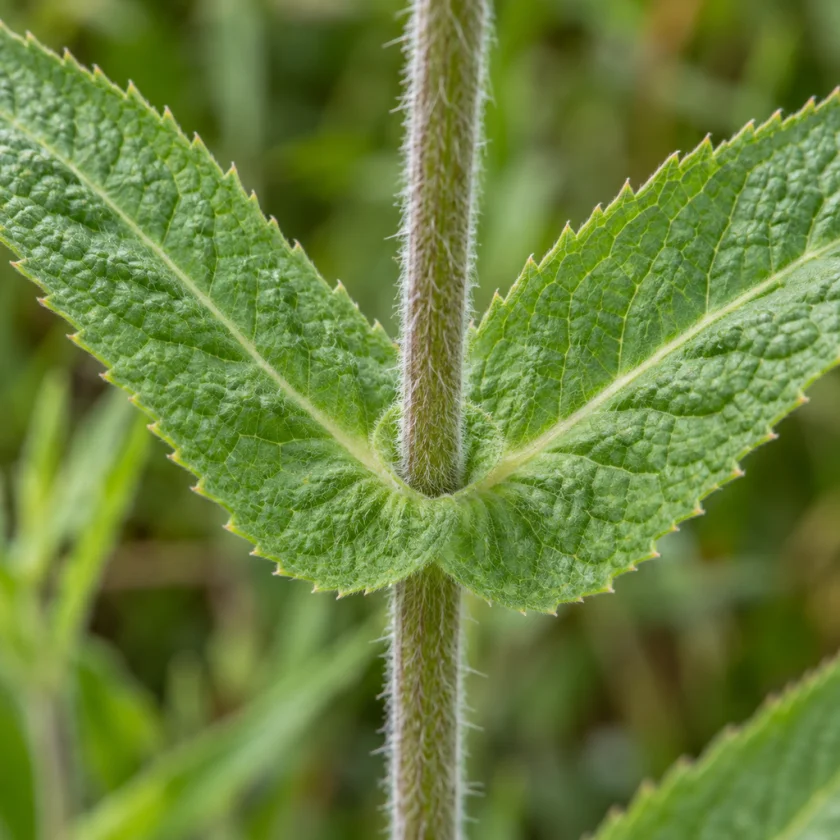
Its most striking feature, and the key to identifying it, is the leaves. They are long, wrinkled, and tapering, and they grow in opposite pairs that are fused together at the base so that the stem appears to pass directly through a single continuous leaf. Botanists call this arrangement perfoliate — literally "through the leaf" — and it gives the plant its species name, perfoliatum. Run your eye up the stem and you see it skewering one long leaf after another, like beads on a string. Older common names such as thoroughwort ("through-wort") describe exactly the same thing.
For the peoples who first used it and the settlers who followed, boneset was not a minor herb. It was a frontline domestic medicine — the sort of plant a household kept dried in the rafters for the inevitable winter fevers. In the 1800s the Eclectic physicians (a reform-minded American school of doctors who leaned heavily on plant medicines) wrote about boneset at length, and it earned entries in the official United States Pharmacopoeia and later dispensatories. Understanding that history is the best way to understand why the plant still carries such a strong reputation today, long after the fevers it treated became far less common.
The Name: "Break-Bone Fever," Not Broken Bones
The name "boneset" trips almost everyone the first time. It sounds like something a bonesetter — a traditional joint-and-fracture healer — would use. It is not. Boneset was never a remedy for knitting fractures.
The name instead points to a symptom. Certain fevers, most famously dengue, cause such intense, deep aching in the muscles and joints that sufferers said it felt as though their bones were breaking. The nineteenth-century nickname for dengue was, quite literally, break-bone fever. Boneset was the herb people reached for to ease exactly that kind of illness — a hot, achy, feverish state — and so "boneset" came to mean "the herb for break-bone fever," not "the herb that sets bones." It is one of those delightful pieces of etymology where the plain reading is completely misleading.
You may also see the older spelling and companion names — thoroughwort, feverwort, agueweed, sweating-plant, and Indian sage. Every one of those names is about fevers, sweating, and chills-and-fever ("ague" was the old word for malarial-type intermittent fever). Read the names together and the plant's entire traditional job description is written right into them.
Not to Be Confused With: White Snakeroot & Joe-Pye Weed
Two relatives deserve a clear warning, because confusing them matters.
The dangerous look-alike is white snakeroot (Ageratina altissima, formerly classed as Eupatorium rugosum). It also grows in eastern North America and also carries clusters of small white flowers in late summer, so a careless glance can mix the two up. But white snakeroot is genuinely toxic: it contains the poison tremetol, which passes into the milk of grazing cows. In the early 1800s this caused "milk sickness," an often-fatal poisoning of frontier families who drank the milk — Abraham Lincoln's mother, Nancy Hanks Lincoln, is traditionally believed to have died of it. The two plants are easy to tell apart once you know the trick: boneset has those distinctive perfoliate leaves the stem pierces, while white snakeroot has ordinary heart-shaped, stalked leaves that are clearly separate from the stem. A plant without the pierced, fused leaves is not boneset, and white snakeroot is poisonous.
The friendlier relatives are the Joe-Pye weeds (now placed in the genus Eutrochium, once lumped into Eupatorium), tall wetland cousins with whorled leaves and dusky mauve-pink flower heads rather than boneset's flat white clusters. They are not the same herb and were used differently in tradition, so recipes and cautions for one do not automatically transfer to the other. The practical lesson: boneset has close cousins that range from harmless to poisonous, so correct identification is not optional.
Traditional Uses
Boneset's flagship traditional role, by a wide margin, was as a fever, flu, and cold remedy. When someone came down with a feverish, achy respiratory illness — chills, a high temperature, that bone-deep soreness, a heavy cold settling in the chest — a hot infusion of boneset was the classic response across Native American and later colonial and Eclectic practice.
The way it was given mattered. The tea was drunk hot and in fairly generous amounts, specifically to make the patient sweat. Herbalists call this a diaphoretic action — encouraging perspiration — and the old logic was that a good sweat helped "break" a fever and carry the illness out through the skin, while easing the muscle and joint aches along the way. A warm boneset infusion at the first shivery onset of flu was, for generations, one of the most common home treatments in North America.
Boneset had a couple of secondary uses as well:
- A bitter digestive tonic. The plant is intensely bitter, and taken cold in small amounts it was used as a bitter to rouse a sluggish appetite and digestion — the traditional role of many bitter herbs.
- An emetic and laxative in large doses. This is the same plant simply used more aggressively. A large, strong dose of boneset reliably causes vomiting and loosens the bowels, and it was sometimes deliberately used that way as a "cleansing" purge. This is important to remember, because it means the line between a therapeutic dose and an unpleasant, gut-emptying one is not very wide.
Across all of these, the through-line is the same: boneset was a hot-tea herb for feverish, achy, congested illness, valued for making people sweat.
The Active Compounds
Modern phytochemistry has taken boneset apart in reasonable detail, and the plant turns out to be chemically busy. The main groups of compounds are:
- Sesquiterpene lactones. These bitter, often anti-inflammatory molecules are the plant's signature constituents. Boneset yields a family of them with names drawn from the plant itself — euperfolin, euperfolitin and eufoliatin among others. The intense bitterness of the tea comes largely from this group, and several of these compounds are the focus of the plant's laboratory pharmacology.
- Flavonoids. Boneset contains a range of flavonoids (plant pigments and antioxidants) such as eupatorin, the flavone eupafolin, kaempferol, and quercetin derivatives, along with caffeic-acid derivatives — the same broad class of phenolic antioxidants found across many medicinal plants.
- Polysaccharides. Like several plants in its family, boneset produces large sugar molecules (polysaccharides). A 1986 laboratory report described them as immune-active, and they are the constituents most often invoked for the herb's traditional use as an immune remedy; later laboratory tests (2011) that included isolated boneset polysaccharides found no immune-stimulating activity.
- Pyrrolizidine alkaloids (PAs). This one is not a selling point but a caution, and it belongs in any honest description of the plant's chemistry. Boneset contains pyrrolizidine alkaloids — a class of compounds that, at sufficient exposure, can be toxic to the liver. A 2018 survey found these alkaloids in all 49 boneset samples tested, at 0.0002–0.07% by weight (a wide range), with high amounts in hot-water teas and alcohol tinctures. Their presence is the single most important safety issue with the plant. It is covered in full in the Safety section below.
What the Evidence Shows
Here is where honesty matters most. Boneset's reputation rests on two legs: a very long tradition, and a modest but genuinely interesting body of laboratory research. What it almost entirely lacks is the third leg — rigorous modern clinical trials in people.
The laboratory findings are real and intriguing
In cell and test-tube studies, boneset extracts and their isolated compounds have shown several activities that line up neatly with the plant's cold-and-flu reputation:
- Immune stimulation: a traditional claim not confirmed in the laboratory. Boneset has been used traditionally, and is used in Europe today, as an immune-stimulating remedy, and a 1986 report described immune-active polysaccharides in the plant. The plant's polysaccharides have been shown to activate immune cells in the laboratory, one of the classic mechanisms proposed for herbs used against respiratory infection. A 2011 laboratory study that tested extracts, isolated polysaccharides, sesquiterpene lactones and flavonoids found no stimulating effect on lymphocytes, on the cell-eating activity (phagocytosis) of macrophages, or on their nitric-oxide output; the authors and a 2011 review both state that the postulated immune-stimulating properties have not been confirmed.
- Anti-inflammatory activity. Boneset extracts and specific sesquiterpene lactones (and the flavone eupafolin) have inhibited inflammatory signalling in cell models — for example, suppressing the enzyme iNOS and modulating inflammatory cytokines. In the 2011 mouse-macrophage study, eupafolin and a dimeric guaianolide blocked nitric-oxide release at half-maximal concentrations (IC50) of 6 and 16 micromolar; the extracts lowered the signalling proteins CSF-3, IL-1 alpha, IL-1 beta, CCL2, CCL22 and CXCL10, while TNF fell only moderately (17%). These are cell results, not human ones. That is a plausible partial explanation for why a feverish, achy illness might feel more bearable.
- Antiviral activity against influenza. A laboratory study found that a hydroalcoholic boneset extract interfered with the attachment of influenza A virus to cells. In that 2016 study the water-alcohol extract blocked two H1N1 influenza A strains at half-maximal concentrations of 7 and 14 micrograms per millilitre, was also active against an oseltamivir-resistant strain, and the active compounds were large polyphenols that could not be isolated, while the plant's common flavonoids did not contribute — a striking result given that "flu" is precisely what the herb was traditionally used for. This is early, cell-level work, not proof of a clinical effect, but it is the kind of finding that makes researchers keep looking.
- Antiviral activity against dengue in cells. A 2022 cell study found a boneset extract had marked antiviral activity against dengue virus type 2 in human liver cells (HepG2) when given before infection, with quercetin the most active of the components tested — notable because the herb's name comes from “break-bone fever” (dengue). This is cell-level work only.
- Antioxidant activity. The plant's phenolic and flavonoid content gives its extracts measurable free-radical-scavenging (antioxidant) activity in the standard laboratory assays.
What is missing
The honest counterweight is simple: there are essentially no rigorous, modern, controlled human clinical trials showing that drinking boneset tea shortens a cold, breaks a fever faster, or prevents the flu. The best-known human study, from 1981, randomly assigned 53 outpatients with a common cold to either aspirin (acetylsalicylic acid) or a low-potency homeopathic boneset preparation (D2); symptoms, body temperature and laboratory results did not differ between the groups, and there was no placebo group, so it does not show what the actual herb does. A 2011 review judged that the clinical data on boneset do not meet modern Good Clinical Practice standards, though they indicate positive tendencies for alcohol extracts in common colds; it also notes that the long-postulated immune-stimulating effect has not been confirmed in laboratory data. Whether boneset tea or tincture changes the course of a cold, flu or dengue in people is not known. So while the traditional record is deep and the preclinical science is promising, the leap from "active in a dish" to "works in a sick person" has not been made with real evidence. Boneset's fever-and-flu use today stands on tradition plus laboratory plausibility — not on clinical proof.
Forms & How It Was Used
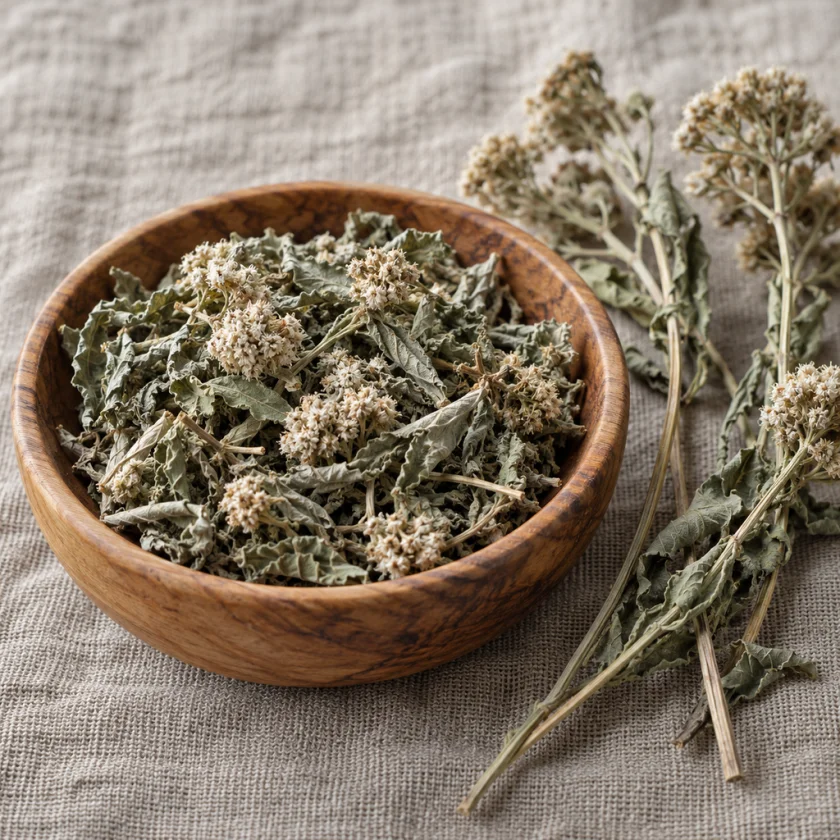
Traditionally boneset was prepared from the dried above-ground parts — the leaves and flowering tops, harvested as the plant came into bloom. The common forms were:
- Hot infusion (tea), taken warm. This was the standard fever preparation. Dried herb was steeped in just-boiled water, and the resulting bitter tea was sipped warm and fairly freely to encourage sweating. The warmth of the drink was considered part of the medicine, working with the herb's diaphoretic action.
- Cold infusion or small bitter doses. Taken cool and in small amounts, the same tea was used purely as a digestive bitter rather than a sweat-inducing fever remedy.
- Tincture. An alcohol extract of the herb, used by drops, was the concentrated form favored by many nineteenth-century practitioners and by some modern herbalists.
A practical note runs through all of these: less is more. Boneset's traditional guidance consistently warns that large or strong doses cross over into causing nausea, vomiting, and purging — so the herb was used in modest amounts for short stretches, not brewed strong or taken for weeks on end.
Safety & Cautions
Boneset is a plant to respect, not to use casually. There are two distinct safety issues, and both are genuine.
1. Pyrrolizidine alkaloids and the liver
Boneset contains pyrrolizidine alkaloids. Pyrrolizidine alkaloids are a well-studied class of plant compounds that are associated with liver disease in humans; with enough cumulative exposure they damage the liver — specifically the small hepatic veins — and long-term, low-level or intermittent exposure is an international concern. A 2018 survey by United States government and pharmacopoeia scientists found them in all 49 boneset samples tested (0.0002–0.07% by weight), mostly lycopsamine and intermedine, and found high amounts in alcohol tinctures and in hot-water teas and decoctions — so the tea is not a low-exposure form. The authors concluded that these concerns “provide a compelling reason for preclusive caution until further research can better define the toxicity and carcinogenicity” of boneset's alkaloids. The amounts varied widely between samples; the authors name sampling issues, low- and high-alkaloid plant types and hybridization between species as possible causes. The groups this caution applies to most:
- Traditional practice used boneset short-term and in moderation — for the acute days of an illness, not as a daily long-term tonic; the liver risk from these alkaloids grows with cumulative exposure.
- Pregnancy and breastfeeding. Pyrrolizidine alkaloids can cross to the fetus and into breast milk, carrying the liver risk to the baby.
- Infants and young children are more vulnerable to pyrrolizidine-alkaloid liver toxicity.
- Liver disease and other liver stresses. Existing liver disease, medicines that stress the liver, and other herbs containing pyrrolizidine alkaloids (such as comfrey or coltsfoot) add to the same liver burden.
2. It is an emetic in large doses
This is the same fact from the traditional-use section, now framed as a warning. A strong or large dose of boneset causes nausea, vomiting, and diarrhea — it was deliberately used as a purge for exactly this reason. That means overdoing the tea, even accidentally by brewing it too strong, can make you genuinely sick to your stomach. The line between the traditional dose and a purging one is narrow.
3. Daisy-family allergy
Because boneset is a member of the Asteraceae (daisy/aster) family, people who are allergic to related plants — ragweed, chrysanthemums, marigolds, chamomile, echinacea — may react to it as well.
Put together, these cautions do not make boneset a "dangerous" herb in the way its toxic cousin white snakeroot is — but every boneset sample tested in 2018 contained liver-toxic pyrrolizidine alkaloids, teas and tinctures included, and the risk is greatest in pregnancy, in breastfeeding, in childhood, in liver disease, and with long or repeated use.
The Honest Bottom Line
Boneset is a genuinely storied North American fever-and-flu herb — a plant carried from Native American medicine into the everyday life of frontier and nineteenth-century America, valued above all for a hot, sweat-inducing tea given at the achy, feverish onset of respiratory illness. Its name is a charming trap: it is about "break-bone fever," not broken bones. Modern laboratories have found real and interesting activity in its extracts — anti-inflammatory, antioxidant, and even anti-influenza and anti-dengue effects at the cellular level, though the long-claimed immune stimulation was not confirmed — which makes its long reputation feel less like folklore and more like a lead worth following. Yet the honest verdict is that rigorous human trials simply do not exist, so the fever-and-flu use still rests on tradition plus promising preclinical science, not on proof. And because boneset carries liver-toxic pyrrolizidine alkaloids, found in every sample tested in 2018, it was traditionally used short-term and in moderation, and the liver risk is greatest in pregnancy, in breastfeeding, in children, and for anyone with liver disease. A fascinating piece of living herbal history — used with respect and a clear head about what we do and don't yet know.
Key Research Papers
- Hensel A, Maas M, Sendker J, Lechtenberg M, Petereit F, Deters A, et al. Eupatorium perfoliatum L.: Phytochemistry, traditional use and current applications. Journal of Ethnopharmacology. 2011;138(3):641–651. — the comprehensive modern review of boneset's chemistry, traditional use, and pharmacology; the single best reference on the plant. — doi:10.1016/j.jep.2011.10.002
- Derksen A, Kühn J, Hafezi W, Sendker J, Ehrhardt C, Ludwig S, Hensel A. Antiviral activity of hydroalcoholic extract from Eupatorium perfoliatum L. against the attachment of influenza A virus. Journal of Ethnopharmacology. 2016;188:144–152. — a boneset extract interfered with influenza A virus attaching to cells in the laboratory, matching the herb's flu reputation. — doi:10.1016/j.jep.2016.05.016
- Maas M, Deters AM, Hensel A. Anti-inflammatory activity of Eupatorium perfoliatum L. extracts, eupafolin, and dimeric guaianolide via iNOS inhibitory activity and modulation of inflammation-related cytokines and chemokines. Journal of Ethnopharmacology. 2011;137(1):371–381. — identified anti-inflammatory activity of the extract and specific constituents in cell models. — doi:10.1016/j.jep.2011.05.040
- Maas M, Hensel A, Batista da Costa F, Brun R, Kaiser M, Schmidt TJ. An unusual dimeric guaianolide with antiprotozoal activity and further sesquiterpene lactones from Eupatorium perfoliatum. Phytochemistry. 2011;72(7):635–644. — isolated and characterized sesquiterpene lactones, the plant's signature bitter compounds. — doi:10.1016/j.phytochem.2011.01.025
- Vollmar A, Schäfer W, Wagner H. Immunologically active polysaccharides of Eupatorium cannabinum and Eupatorium perfoliatum. Phytochemistry. 1986;25(2):377–381. — early report of immune-active polysaccharides, a proposed basis for the herb's cold-and-flu use (later laboratory tests did not confirm immune stimulation). — doi:10.1016/S0031-9422(00)85484-9
- Maas M, Petereit F, Hensel A. Caffeic acid derivatives from Eupatorium perfoliatum L. Molecules. 2008;14(1):36–45. — characterized the plant's phenolic (caffeic acid) antioxidant constituents. — PubMed PMID: 19104484
- Habtemariam S, Macpherson AM. Cytotoxicity and antibacterial activity of ethanol extract from leaves of a herbal drug, boneset (Eupatorium perfoliatum). Phytotherapy Research. 2000;14(7):575–577. — tested biological activity of a boneset leaf extract. — PubMed PMID: 11054857
- Herz W, Kalyanaraman PS, Ramakrishnan G, Blount JF. Sesquiterpene lactones of Eupatorium perfoliatum. Journal of Organic Chemistry. 1977;42(13):2264–2271. — the foundational chemistry paper isolating euperfolin and euperfolitin from the plant. — PubMed PMID: 874606
- Colegate SM, Upton R, Gardner DR, Panter KE, Betz JM. Potentially toxic pyrrolizidine alkaloids in Eupatorium perfoliatum and three related species. Implications for herbal use as boneset. Phytochemical Analysis. 2018;29(6):613–626. — found dehydropyrrolizidine alkaloids in all 49 boneset samples (0.0002–0.07% w/w), with high amounts in teas and tinctures, underpinning the liver-safety caution. — PubMed PMID: 29968391
- Kalantar-zadeh M, Williamson EM. Pyrrolizidine alkaloids in herbal medicines and food: a public health issue. In: Pharmacovigilance for Herbal and Traditional Medicines. Springer; 2022:27–40. — a review of pyrrolizidine alkaloids in herbal medicines and food as a public health issue. — doi:10.1007/978-3-031-07275-8_3
- Peebles JF. Eupatorium perfoliatum in epidemic influenza. The American Journal of the Medical Sciences. 1844;7(14):362–367. — a nineteenth-century clinical account documenting boneset's use in feverish, achy epidemic illness. — doi:10.1097/00000441-184404000-00009
- Gassinger CA, Wünstel G, Netter P. [A controlled clinical trial for testing the efficacy of the homeopathic drug eupatorium perfoliatum D2 in the treatment of common cold]. Arzneimittelforschung. 1981;31(4):732–736. — 53 outpatients with a common cold randomised to aspirin or homeopathic boneset D2; no significant differences between groups. — PubMed PMID: 7195723
- Sinha M, Chakraborty U, Kool A, Chakravarti M, Das S, Ghosh S, Thakur L, Khuranna A, Nayak D, Basu B, Kar S, Ray R, Das S. In-vitro antiviral action of Eupatorium perfoliatum against dengue virus infection: Modulation of mTOR signaling and autophagy. Journal of Ethnopharmacology. 2022;282:114627. — boneset extract showed antiviral activity against dengue virus type 2 in liver cells when given before infection; quercetin was the most active component. — PubMed PMID: 34509603
Connections
- All Herbs
- Elderberry
- Echinacea
- Yarrow
- Andrographis
- Ginger
- Peppermint
- Thyme
- Sage
- Astragalus
- Infectious Disease
- Pulmonology (Respiratory Health)
- Conditions on this site that reference this page: Immunology · Influenza · Jaundice · Joint Pain