Neurofibromatosis Type 1
Overview and Epidemiology
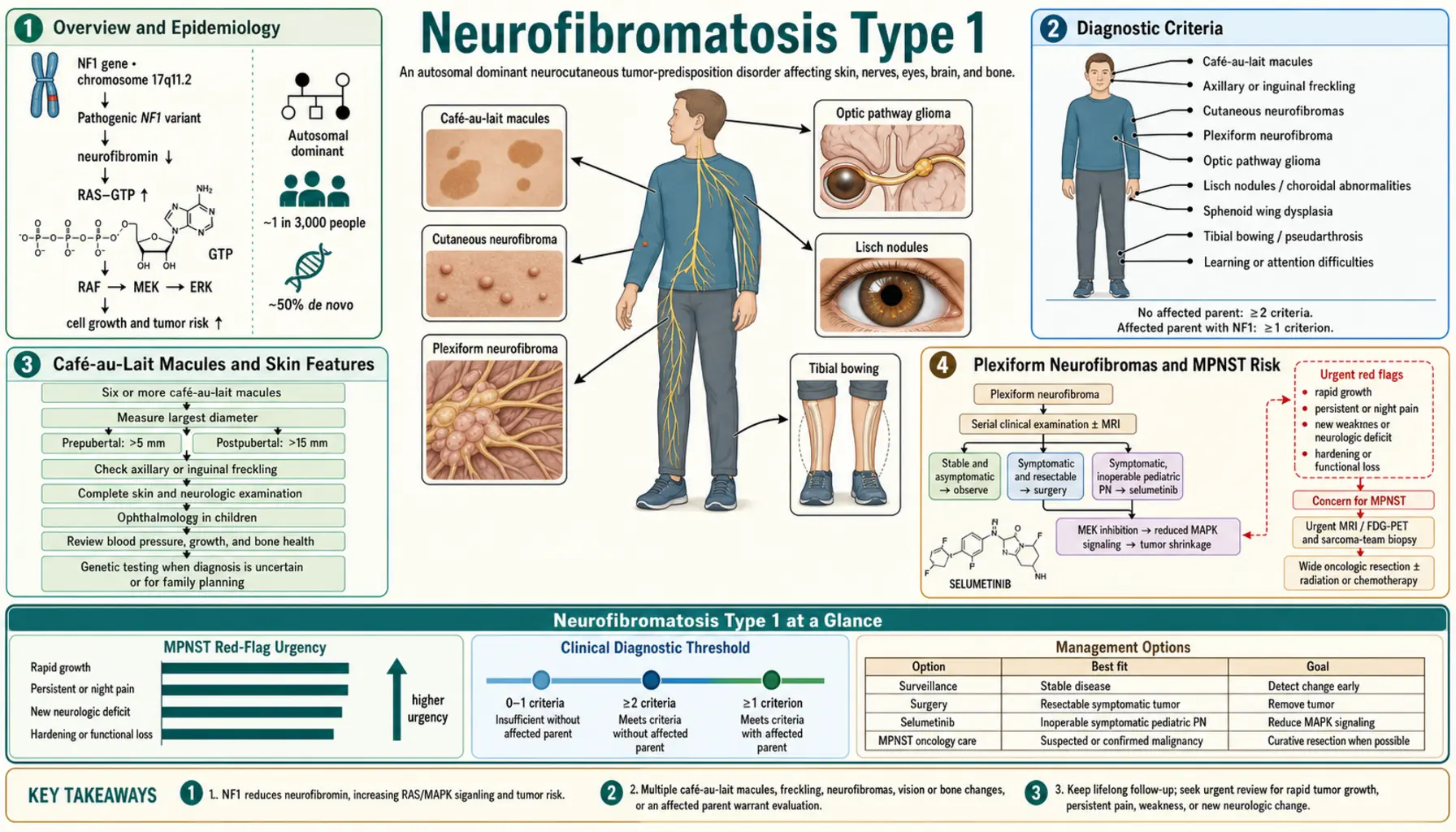
Neurofibromatosis Type 1 (NF1) — historically called von Recklinghausen disease after the German pathologist Friedrich von Recklinghausen who described it in 1882 — is one of the most common single-gene disorders in the world, affecting approximately 1 in 3,000 people across every ethnicity, nationality, and socioeconomic group. With an estimated prevalence of 1 in 3,000 births, NF1 is more common than cystic fibrosis, Huntington's disease, and Duchenne muscular dystrophy combined. It results from loss-of-function mutations in the NF1 gene located on chromosome 17q11.2, which encodes neurofibromin — a GTPase-activating protein (RAS-GAP) that is central to cellular growth control.
The molecular mechanism of NF1 hinges on RAS signaling. In normal cells, neurofibromin stimulates RAS to hydrolyze GTP to GDP, keeping RAS in its inactive, GDP-bound "off" state. When neurofibromin is absent or non-functional, RAS remains constitutively locked in its active, GTP-bound "on" state, continuously signaling downstream through the MAPK/ERK and PI3K/mTOR pathways — the same pathways that drive cancer when mutated. This unrelenting proliferative signaling explains the hallmark tumor predisposition in NF1: neurofibromas of the peripheral nerves, optic pathway gliomas, and, in a small but critical percentage, malignant peripheral nerve sheath tumors (MPNSTs).
NF1 is inherited in an autosomal dominant pattern: a single pathogenic variant in one copy of the NF1 gene is sufficient to cause disease. However, approximately 50% of all NF1 cases arise from de novo mutations — pathogenic variants that appear for the first time in that individual, with neither parent being affected. This extremely high de novo mutation rate is explained by the unusual size of the NF1 gene: spanning 2.8 megabases of genomic DNA and containing 57 introns, it is among the largest known genes in the human genome, presenting an enormous mutational target. More than 3,500 distinct pathogenic NF1 variants have been identified, including point mutations, small insertions/deletions, splice-site changes, and large intragenic deletions. The high mutation rate means that a normal family history does not exclude NF1 — clinicians who rely on family history to screen for this diagnosis will miss a substantial proportion of affected patients.
The clinical hallmarks of NF1 include café-au-lait macules (flat, coffee-colored skin spots), cutaneous and plexiform neurofibromas (benign peripheral nerve sheath tumors), Lisch nodules (iris hamartomas visible on slit-lamp), axillary and inguinal freckling, optic pathway gliomas, skeletal dysplasias including sphenoid wing dysplasia and tibial pseudoarthrosis, learning disabilities and attention difficulties, and elevated lifetime risk of malignant transformation in plexiform neurofibromas to MPNST. The disease is highly variable in expression — even identical twins with the same NF1 mutation can differ substantially in their specific manifestations and severity — making NF1 one of the most phenotypically diverse single-gene conditions in medicine.
Diagnostic Criteria
The diagnosis of NF1 was codified by the NIH Consensus Development Conference in 1987 and has been the foundation of clinical diagnosis for decades. The 1987 NIH criteria require that an individual meet at least two of the following seven features: (a) six or more café-au-lait macules (CALMs) measuring at least 5 mm in greatest diameter before puberty, or at least 15 mm after puberty; (b) two or more neurofibromas of any type, or one or more plexiform neurofibromas; (c) axillary or inguinal freckling (Crowe's sign); (d) optic pathway glioma; (e) two or more Lisch nodules (iris hamartomas); (f) a distinctive osseous lesion such as sphenoid wing dysplasia, cortical thinning of long bone cortex with or without pseudoarthrosis, or anterolateral tibial bowing; and (g) a first-degree relative (parent, sibling, or child) with NF1 meeting the above criteria.
The 2021 revised diagnostic criteria, published by Legius and colleagues on behalf of an international expert group, updated the 1987 framework to incorporate modern molecular genetic capabilities and refined the ophthalmological component. Key additions include: recognition of NF1-associated optic pathway glioma confirmed by ophthalmological examination as a standalone criterion independent of MRI; allowance for a confirmed germline pathogenic or likely pathogenic NF1 variant to serve as a criterion in its own right; and refinement of the CALM criterion to acknowledge that six or more CALMs in an otherwise well child is highly suggestive of NF1 even without other features, though the differential (Legius syndrome, McCune-Albright, other RASopathies) must be excluded. The 2021 criteria are particularly important for young children who frequently cannot yet meet the classic 1987 requirements because some features — neurofibromas, Lisch nodules, axillary freckling — do not appear until later childhood.
In children under eight years of age who have multiple CALMs but do not yet satisfy two criteria, NF1 gene panel testing (full sequencing plus deletion/duplication analysis) provides a definitive molecular diagnosis. This is particularly valuable for guiding surveillance planning, genetic counseling of parents regarding recurrence risk, and informing family members about the need for their own evaluation. Molecular testing also identifies individuals with the NF1 total deletion syndrome — a microdeletion of chromosome 17q11.2 encompassing the entire NF1 gene and multiple flanking genes, present in approximately 5% of NF1 patients. These individuals experience a substantially more severe phenotype: a higher burden of neurofibromas, more pronounced cognitive difficulties (intellectual disability in some), facial dysmorphism, cardiovascular malformations, elevated risk of MPNST, and earlier neurofibroma onset. Recognition of total deletion syndrome has critical prognostic and surveillance implications.
Segmental NF1 — in which café-au-lait spots and neurofibromas are confined to one body region — results from post-zygotic somatic mosaicism: an NF1 mutation that arises after fertilization and is present in only a subset of cells. These individuals have milder generalized manifestations but retain a reproductive transmission risk that is lower than (but not zero): germline mosaicism means some gametes may carry the mutation, and an affected offspring can express the full NF1 phenotype. Genetic counseling for segmental NF1 requires careful discussion of this nuance. The differential diagnosis for NF1 includes: Legius syndrome (SPRED1 mutations) — multiple CALMs and axillary freckling without neurofibromas; McCune-Albright syndrome — CALMs with fibrous dysplasia and endocrinopathy; constitutional mismatch repair deficiency (CMMRD) — multiple CALMs plus childhood cancer; and other RASopathies including Noonan syndrome with multiple lentigines.
Café-au-Lait Macules and Skin Features
Café-au-lait macules are the most recognizable and earliest manifestation of NF1, present in over 95% of affected individuals and often the very first sign noticed by parents or pediatricians. The name is French for "coffee with milk" — a description of their characteristic light-tan to medium-brown color, which reflects increased melanin in basal keratinocytes and enlarged melanosomes (macromelanosomes) visible on electron microscopy. CALMs appear as flat, sharply demarcated, oval or irregular macules with smooth borders ("coast of California" borders, as opposed to the jagged "coast of Maine" borders seen in McCune-Albright syndrome). They range from a few millimeters to several centimeters in diameter, can number from just a few to hundreds, and are distributed on the trunk, limbs, and buttocks — generally sparing the face, palms, and soles.
CALMs typically appear within the first two years of life and are often the first finding that leads to diagnostic evaluation. In the newborn period, CALMs can be surprisingly subtle and may not reach the diagnostic threshold of six until the child is two to four years old. The sun-independent distribution and uniformity of pigmentation (no hair follicle involvement, no central darkening) distinguish CALMs from other pigmented lesions. The six-or-more criterion for NF1 diagnosis is highly specific: while isolated CALMs (one to five) are present in approximately 10–15% of the general population, six or more meeting the size criteria is unusual outside of NF1 and related conditions.
Axillary and inguinal freckling (Crowe's sign) is one of the most specific cutaneous signs of NF1. These are clusters of tiny, 1–3 mm hyperpigmented macules confined to skin folds: the armpits, groin, and often the inframammary region. They appear between ages three and five years, after the CALMs but before most neurofibromas. Unlike axillary freckles seen in fair-skinned sun-exposed individuals (which are larger and more irregular), Crowe's freckling is clustered, small, and anatomically restricted to intertriginous zones where sun exposure does not occur — making it a meaningful diagnostic sign when present.
Cutaneous neurofibromas begin appearing in late childhood and adolescence, typically accelerating dramatically in young adulthood and during and after pregnancy. They present as soft, flesh-colored or slightly pink, dome-shaped or pedunculated papules or nodules attached to peripheral nerves in the dermis. A classic feature is the "buttonhole" sign — applying gentle pressure to a cutaneous neurofibroma causes it to invaginate into the dermis and then "pop" back out when pressure is released, reflecting its attachment to a nerve fascicle within soft tissue. Cutaneous neurofibromas can number from a handful to many thousands. While benign and not pre-malignant, they cause significant cosmetic distress, pruritus (especially on the scalp and trunk), pain when bumped, and substantial psychological burden. Pregnancy accelerates neurofibroma growth — estrogen and progesterone receptors have been identified on neurofibromas, and many women with NF1 report dramatic increases in number and size with each pregnancy. Subcutaneous neurofibromas are firm, palpable nodules along the course of peripheral nerves, deeper than cutaneous lesions; they may cause pain, paresthesia, or local nerve dysfunction when they impinge on the nerve.
Plexiform Neurofibromas and MPNST Risk
Plexiform neurofibromas (PNFs) are among the most serious and complex complications of NF1. Unlike the small, discrete cutaneous neurofibromas, PNFs are large, diffuse tumors that infiltrate along and around multiple nerve fascicles and extend into surrounding connective tissue — their name refers to this plexus-like, intertwining growth pattern. They can involve major nerve trunks (sciatic nerve, brachial plexus, cranial nerves), deep retroperitoneal nerves, or superficial cutaneous nerves, and can attain enormous size — in some patients occupying a large portion of an extremity or the face and neck. On clinical examination, superficial PNFs have a characteristic "bag of worms" texture, feeling like multiple rope-like cords beneath the skin.
PNFs are congenital — present from birth — in approximately 30% of NF1 patients, though they may not be clinically apparent until childhood when they enlarge enough to be detected. The biology of PNF formation follows a classic tumor suppressor "two-hit" model: although every somatic cell in an NF1 patient carries one germline NF1 mutation, PNFs arise when a second somatic mutation occurs specifically in NF1-haploinsufficient Schwann cells, producing cells with complete biallelic loss of neurofibromin. This drives maximal, unchecked RAS signaling in Schwann cells and their surrounding mast cells (which amplify Schwann cell proliferation through c-KIT–mediated signaling), producing the tumor mass. The requirement for a somatic second hit explains why PNFs are focal and stochastic rather than occurring throughout the body.
The most feared complication of PNFs is malignant transformation to malignant peripheral nerve sheath tumor (MPNST) — a highly aggressive soft tissue sarcoma. The lifetime risk of MPNST in NF1 is 8–13%, compared to less than 0.001% in the general population. MPNST is the leading cause of premature death in NF1, with a five-year survival rate of 25–50% depending on stage at diagnosis, resectability, and presence of NF1 vs. sporadic origin. MPNST arising in the setting of NF1 tends to occur at younger ages (fourth to fifth decade), involves larger tumors, and has a worse prognosis than sporadic MPNST. High-grade MPNST in NF1 often carries additional somatic mutations in CDKN2A/B, TP53, and polycomb repressor complex 2 (PRC2) components (EED, SUZ12) that cooperate with biallelic NF1 loss to drive malignant transformation.
Recognizing malignant transformation early is critical and clinically challenging because MPNST arises within a PNF — the background of benign tumor makes it difficult to detect the malignant focus. Red flags for MPNST transformation in a known PNF: (1) rapid, accelerating growth over weeks to months; (2) new or worsening pain in a previously painless tumor, especially constant, nocturnal, or awakening pain; (3) change in texture — hardening or a firm nodule within a previously soft tumor; (4) new neurological deficit (weakness, numbness, foot drop) in the territory of the affected nerve. Any of these features demands urgent imaging. FDG-PET/CT is the preferred modality for detecting malignant transformation — MPNSTs are highly metabolically active and demonstrate markedly elevated fluorodeoxyglucose uptake. A maximum standardized uptake value (SUVmax) of more than 3.5 correlates with high-grade transformation. Whole-body MRI is used for comprehensive surveillance of internal PNFs in high-risk patients.
Selumetinib (Koselugo), an oral MEK1/2 inhibitor, represents a landmark advance in NF1 treatment. In the SPRINT phase II trial (Gross AM et al., NEJM 2020), selumetinib produced confirmed partial responses (≥20% tumor volume reduction) in 70% of children with inoperable symptomatic PNFs, with functional improvements in pain, disfigurement, and quality of life. The FDA approved selumetinib in April 2020 for pediatric patients aged two years and older with NF1 who have symptomatic, inoperable PNFs — the first FDA-approved medical treatment specifically for NF1. The drug works by blocking MEK downstream of the constitutively active RAS signal, reducing Schwann cell and mast cell proliferation within PNFs. Responses are maintained with continued therapy; tumor regrowth typically occurs after discontinuation. Ongoing trials are examining selumetinib for additional NF1 indications including OPGs and cutaneous neurofibromas. Surgical resection remains the primary treatment for PNFs causing immediate functional impairment (airway compromise, vision loss, limb dysfunction), though complete resection is usually impossible due to the infiltrative growth pattern and proximity to critical nerves and vessels.
Optic Pathway Gliomas and Neurological Features
Optic pathway gliomas (OPGs) are the most common intracranial tumor in NF1, occurring in 15–20% of patients. They are low-grade astrocytomas — typically WHO grade 1 pilocytic astrocytoma — that arise along the optic nerves, optic chiasm, optic tracts, or optic radiations. The vast majority (approximately 70–75%) of NF1-associated OPGs are asymptomatic and discovered incidentally on brain MRI obtained for other indications. The presence of an OPG on MRI, in the absence of symptoms, does not mandate treatment — most asymptomatic OPGs remain stable or even spontaneously regress without intervention, a biological behavior unique to NF1-associated OPGs compared to sporadic optic gliomas.
Symptomatic OPGs — affecting approximately 5% of all NF1 patients — cause clinically significant consequences depending on anatomical location. Optic nerve OPGs produce proptosis (forward displacement of the eyeball), visual acuity loss, and relative afferent pupillary defect (RAPD). Chiasmal OPGs produce visual field defects (bitemporal hemianopia), nystagmus, and in young children may present as head bobbing or abnormal visual behavior. OPGs involving the hypothalamus or thalamus can cause diencephalic syndrome in infants — a devastating condition of profound failure to thrive, emaciation, and hyperalertness despite normal caloric intake, caused by hypothalamic disruption. Precocious puberty (central, GnRH-dependent) is a recognized complication of hypothalamic OPG, as the tumor disrupts the normal hypothalamic restraint of gonadotropin secretion. Annual ophthalmological evaluation — including visual acuity, color vision, visual fields, and dilated fundus examination — is recommended for all NF1 children from diagnosis until at least age 8 (or later in some guidelines), since the window of greatest risk for developing symptomatic OPG appears to be the first decade of life.
For symptomatic, progressive OPGs, treatment is now evolving rapidly. Traditional first-line chemotherapy in NF1 children has been carboplatin-vincristine combination chemotherapy, which stabilizes or reduces tumor volume in approximately 50–60% of treated patients. MEK inhibitors — particularly selumetinib and binimetinib — have demonstrated striking response rates in NF1-associated OPGs in early trials, including tumor volume reduction and, critically, visual improvement. The FIREFLY-1 trial (MEK162 — binimetinib) and ongoing selumetinib trials for OPG are among the most anticipated clinical investigations in NF1 research. Radiation therapy is generally avoided in NF1 children due to elevated risks of radiation-induced secondary malignancies (MPNSTs and other tumors) and vascular complications (moyamoya-like vasculopathy at the radiation field margins).
Beyond OPGs, NF1 confers elevated risk for other intracranial and spinal cord tumors: low-grade gliomas can arise throughout the brain parenchyma, brainstem (particularly the pons), and spinal cord. Brain MRI should be obtained at diagnosis to establish a baseline and is indicated for any new neurological symptoms. A characteristic and diagnostically important finding on brain MRI in NF1 children is the presence of "UBOs" — unidentified bright objects, also termed focal areas of signal intensity (FASIs). These are T2/FLAIR hyperintensities in the basal ganglia, thalami, brainstem, and cerebellar peduncles, present in 60–80% of NF1 children. On conventional MRI they appear as well-circumscribed T2-bright, T1-isointense, non-enhancing, and non-mass-effect lesions. Their pathological substrate is believed to be focal areas of myelin dysplasia or vacuolar change, not true gliomas. Critically, UBOs do not require treatment; they tend to fade and disappear spontaneously through adolescence and early adulthood. Their clinical significance is as a marker of NF1 but not a direct therapeutic target, though some studies have correlated higher UBO burden with greater cognitive difficulty.
Cognitive, Learning, and Behavioral Features
Cognitive and behavioral difficulties are the most common manifestation affecting quality of life in NF1, touching the majority of patients and families yet frequently underestimated or inadequately addressed in clinical practice. While NF1 is not primarily an intellectual disability syndrome — mean full-scale IQ is approximately 90–95, about 10 points below the population mean — the cognitive phenotype is broad, heterogeneous, and significantly impairs academic achievement, social functioning, and self-esteem across the lifespan. Approximately 50–80% of children with NF1 experience clinically meaningful cognitive challenges.
The most common specific learning disabilities in NF1 involve reading (dyslexia-like), written expression (dysgraphia), and mathematics. These are often compounded by visuospatial processing deficits — difficulty with copying geometric figures, map reading, mental rotation, and spatial reasoning — which reflect disruption in the dorsal visual stream and white matter connectivity. Attention-deficit/hyperactivity disorder (ADHD) is present in 38–50% of NF1 children, predominantly the inattentive subtype, and responds to standard stimulant medications (methylphenidate or amphetamine salts) with effect sizes comparable to those seen in idiopathic ADHD. Executive dysfunction — difficulty with working memory, cognitive flexibility, planning, and inhibition — is pervasive even in children without a full ADHD diagnosis and affects the ability to manage academic demands and multistep tasks independently.
Autism spectrum disorder (ASD) features are present in approximately 25–30% of NF1 patients — a substantially elevated prevalence compared to the general population rate of approximately 3%. Social communication difficulties in NF1 may reflect impaired theory of mind, literal interpretation of language, poor pragmatic social skills, and difficulty reading nonverbal cues. Some NF1 individuals meet full DSM-5 criteria for ASD; many more have subthreshold autistic traits that nonetheless impair social relationships and require targeted support. Anxiety is highly prevalent in NF1, both as an intrinsic feature of the neurocognitive profile and as an understandable psychological response to a chronic, visible, and medically complex condition.
The biological basis of NF1 cognitive difficulties is increasingly well understood. Animal models demonstrate that NF1 heterozygosity in GABAergic interneurons — specifically in the hippocampus and prefrontal cortex — leads to increased inhibitory neurotransmission that suppresses long-term potentiation (LTP), the synaptic plasticity mechanism that underlies learning and memory. Elevated RAS/MAPK/ERK signaling in interneurons causes excessive gamma-aminobutyric acid (GABA) release, "noise" that overwhelms the signal of learning-related neural activity. This neurobiological mechanism has been validated in NF1 mouse models and has guided pharmacological efforts: lovastatin, by inhibiting the mevalonate pathway and thereby reducing membrane-bound RAS farnesylation, reduces RAS activity and has improved LTP and learning in Nf1 heterozygous mice. However, clinical trials of lovastatin and simvastatin in NF1 children have not consistently demonstrated statistically significant cognitive benefit, highlighting the gap between compelling animal data and human therapeutic translation.
Clinically, early neuropsychological evaluation — ideally by age five to six, before school entry — is essential for all children with NF1 to characterize their specific learning profile and guide interventions. The assessment should include standardized measures of cognitive ability, academic achievement, executive function, language, visuospatial skills, attention, and social cognition. Findings should translate into concrete educational accommodations: individualized education plans (IEPs) or 504 plans, extended time, preferential seating, reduced-distraction testing environments, reading support, organizational aids, and — when appropriate — speech-language therapy, occupational therapy, and social skills training. Schools should be educated that NF1 is a medical condition requiring formal support, not a discipline or effort problem.
Skeletal and Cardiovascular Features
Skeletal dysplasias in NF1 arise from the role of neurofibromin in bone formation and remodeling — NF1 loss in osteoblasts and osteoclasts disrupts bone homeostasis through excessive RAS signaling — and from direct infiltration or mechanical pressure of adjacent neurofibromas on bone. Two skeletal manifestations are particularly diagnostically important as NIH criteria features: sphenoid wing dysplasia and tibial bowing with pseudoarthrosis.
Sphenoid wing dysplasia is absence or hypoplasia of the greater wing of the sphenoid bone, present in approximately 3% of NF1 patients, typically unilateral. In the absence of an overlying PNF, the sphenoid defect allows the temporal lobe to herniate into the orbit, producing a pulsatile proptosis — the clinician can observe the eye rhythmically pulsating with the cardiac cycle (transmitted brain pulsation). CT scan confirms the bony defect. When a PNF of the orbit accompanies sphenoid wing dysplasia, it is called orbital NF1, producing more complex proptosis and visual risk. Surgical repair with bone grafting is considered for progressive proptosis or vision compromise.
Tibial bowing with pseudoarthrosis is the most physically disabling skeletal complication of NF1. It presents as anterolateral (forward and outward) bowing of the lower leg, visible at birth in approximately 1–3% of NF1 patients. The dysplastic tibial cortex is thin, sclerotic (dense on X-ray), and prone to spontaneous fracture — often occurring with minimal trauma. Once fractured, the bone fails to heal due to dysplastic periosteum and abnormal fibrous tissue at the fracture site, producing a "pseudoarthrosis" — a false joint where bony union should have occurred. Management is challenging and requires specialized pediatric orthopedics: intramedullary nail fixation to prevent fracture, bone grafting, recombinant BMP-2, and in refractory cases, free vascularized fibular grafts or, as a last resort, below-knee amputation and prosthetic fitting (which can provide better ambulation than repeated failed limb salvage). The Ilizarov external fixator technique has improved union rates. Complete union is achieved in approximately 50% of patients with modern approaches.
Scoliosis affects 10–26% of NF1 patients and occurs in two forms with very different natural histories. Dystrophic scoliosis is a short-segment, sharply angulated curve involving four to six vertebrae, often thoracic, with associated vertebral body scalloping, rib penciling (thin, tapered ribs), and subpedicular notching on X-ray — reflecting direct bone erosion by adjacent neurofibromas. Dystrophic scoliosis progresses rapidly and unpredictably, regardless of curve magnitude, and almost always requires surgical spinal fusion. Delaying surgery risks severe deformity, spinal cord compression, and loss of the window for safe correction. Non-dystrophic scoliosis is a longer-segment curve resembling idiopathic adolescent scoliosis; it is more amenable to bracing and has a more favorable natural history, though progression monitoring with serial spinal X-rays remains essential.
Cardiovascular complications in NF1 range from common to rare but potentially serious. Hypertension is more prevalent in NF1 patients than in age-matched controls and can arise from two distinct mechanisms: renal artery stenosis (the most important to recognize in children and young adults — caused by NF1-associated vasculopathy of the renal arteries, resulting in renovascular hypertension that is refractory to standard antihypertensive medications and requires revascularization) and essential hypertension (more common in adults). Every hypertensive NF1 patient — especially those with early-onset or treatment-resistant hypertension — should have renal vascular imaging (Doppler ultrasound or MR angiography) to evaluate for renal artery stenosis before attributing hypertension to essential causes. NF1 vasculopathy can also produce arterial aneurysms and stenoses in other vascular beds, including celiac, mesenteric, and intracranial arteries; moyamoya-like cerebrovascular disease (with progressive stenosis of the distal internal carotid arteries and collateral formation) has been reported, particularly in patients who have received radiation therapy to the head.
Congenital heart defects are present in approximately 2–3% of NF1 patients, with pulmonary valve stenosis the most common, followed by atrial septal defect and, less frequently, tetralogy of Fallot. Pulmonary valve stenosis in NF1 can overlap with Noonan syndrome features — both conditions involve RAS/MAPK pathway dysregulation, and the two disorders can occasionally co-occur or be difficult to distinguish. Pheochromocytoma, a catecholamine-secreting adrenal tumor, occurs in approximately 0.1–5.7% of NF1 patients (risk estimates vary by study design), presenting with episodic hypertension, headaches, diaphoresis, and palpitations. All NF1 patients with hypertension should be screened with 24-hour urine catecholamines or plasma metanephrines before pharmacological antihypertensive therapy is initiated.
Surveillance, Management, and Emerging Therapies
NF1 requires lifelong, coordinated multidisciplinary surveillance and management. There is no cure for NF1 at present, and management is primarily directed at early detection of complications before irreversible damage occurs, treatment of symptomatic manifestations, and monitoring for malignant transformation. The emergence of MEK inhibitors as the first class of drugs proven effective for NF1 complications has transformed the treatment landscape over the past five years, and multiple additional molecular targets are under investigation.
Annual surveillance for all NF1 patients should include: (1) Complete skin examination — neurofibroma burden assessment and documentation of any concerning changes in existing PNFs (rapid growth, pain change, texture change); (2) Blood pressure measurement — with low threshold for renal vascular investigation in hypertensive patients; (3) Developmental and neuropsychological assessment — tracking cognitive function, academic progress, attention, behavior, and adaptive function across childhood and adolescence, with referral to neuropsychology when new concerns arise; (4) Ophthalmological evaluation — annually from diagnosis through at least age 8, then as clinically indicated; includes visual acuity, visual fields, color vision, slit-lamp (Lisch nodules), fundoscopy, and OCT (optical coherence tomography) for retinal nerve fiber layer thickness, which is an emerging sensitive biomarker for OPG monitoring; (5) Neurological and functional review — assessing for new headaches, focal deficits, pain, gait change, or bowel/bladder dysfunction that might indicate CNS tumor growth or spinal cord compression; (6) Orthopedic assessment — scoliosis screening (clinical + spinal radiographs if clinically indicated), limb alignment, tibial dysplasia management in affected children.
Brain and spine MRI are not recommended as routine surveillance in asymptomatic NF1 patients but should be obtained promptly for any new neurological symptoms. In children, the initial evaluation typically includes a baseline brain MRI to detect OPGs and UBOs and establish a reference. Whole-body MRI (WB-MRI) is increasingly used for comprehensive surveillance of internal PNFs and for detecting malignant transformation in high-risk patients (NF1 total deletion, prior MPNST, rapidly growing tumors), as it provides a non-ionizing, head-to-toe survey of tumor burden.
MEK inhibitors are the dominant therapeutic advance of the past decade and are now FDA-approved or in late-stage trials for multiple NF1 indications. Selumetinib (Koselugo) is approved for children ≥2 years with NF1 and symptomatic, inoperable PNFs. Binimetinib is in late-phase trials for NF1 OPGs, cutaneous neurofibromas, and cognitive outcomes. Mirdametinib (a next-generation MEK inhibitor) has demonstrated significant reduction in cutaneous neurofibroma volume in adults with NF1 in a Phase 2 trial (ReNeu trial, published 2023 — selumetinib equivalent in Phase 2 setting), representing the first evidence of a systemic treatment for cutaneous neurofibromas. MEK inhibitor side effects include acneiform rash (very common, often dose-limiting), paronychia (nail bed inflammation), mucositis, diarrhea, elevated creatine kinase, and ophthalmic effects (serous retinopathy, reduced visual acuity — requiring ophthalmological monitoring).
mTOR inhibitors (everolimus, sirolimus) have been studied in NF1 — specifically for PNFs and low-grade gliomas — with partial responses in some studies, but results have been less consistent than MEK inhibition and clinical use remains limited outside trials. HDAC inhibitors and CDK4/6 inhibitors are under investigation for MPNST, where standard chemotherapy (ifosfamide/doxorubicin) has a very limited response rate and novel combinations are urgently needed. Immunotherapy with checkpoint inhibitors (PD-1/PD-L1 antibodies) has shown limited activity in MPNST as a single agent, though combinations with targeted agents are being explored. The NF1 Research Roadmap from the Children's Tumor Foundation (CTF) and National Institutes of Health continues to prioritize MPNST drug development as the highest unmet need.
Genetic counseling is an essential component of NF1 care and should be offered at diagnosis and at all major life transitions. NF1 is autosomal dominant with 50% recurrence risk for each pregnancy of an affected parent. De novo cases (50% of NF1) have a very low risk of recurrence in siblings (negligible — gonadal mosaicism risk <1%), but affected individuals will have a 50% risk of transmission to their own children. Preimplantation genetic testing for monogenic disease (PGT-M) allows NF1 couples to test embryos during IVF and select unaffected embryos for transfer. Prenatal testing via chorionic villus sampling (CVS) or amniocentesis is available if the family's specific NF1 pathogenic variant is known. These options should be presented non-directively, respecting parental values and decisions.
Patient support and community organizations play a vital role in NF1 — the Children's Tumor Foundation (ctf.org) provides education, funds research, runs an NF clinical consortium, and hosts an annual symposium. The NF Network and NF Association UK provide family support, camp programs, and advocacy resources. Adults with NF1 benefit from connection to adult-focused NF services through academic medical centers with dedicated NF clinics.
Key Research Papers
- Legius E, et al. Revised diagnostic criteria for neurofibromatosis type 1 and Legius syndrome: an international consensus recommendation. Genet Med. 2021;23(8):1506-1513. PMID: 34012067
- Gross AM, et al. Selumetinib in children with inoperable plexiform neurofibromas. N Engl J Med. 2020;382(15):1430-1442. PMID: 32187457
- Gutmann DH, et al. Neurofibromatosis type 1. Nat Rev Dis Primers. 2017;3:17004. PMID: 28230061
- Evans DG, et al. Malignant peripheral nerve sheath tumours in neurofibromatosis 1. J Med Genet. 2002;39(5):311-314. PMID: 12011145
- Brems H, et al. Mechanisms in the pathogenesis of malignant tumours in neurofibromatosis type 1. Lancet Oncol. 2009;10(5):508-515. PMID: 19410195
- Listernick R, et al. Optic pathway tumors in children: the effect of neurofibromatosis type 1 on clinical manifestations and natural history. J Pediatr. 1994;125(1):63-66 — Search PubMed
- Diggs-Andrews KA, Gutmann DH. Modeling cognitive dysfunction in neurofibromatosis-1. Trends Neurosci. 2013;36(4):237-247 — Search PubMed
- Shilyansky C, et al. Neurofibromin regulates corticostriatal inhibitory networks during working memory performance. Proc Natl Acad Sci USA. 2010;107(29):13141-13146 — Search PubMed
- Ferner RE, et al. Guidelines for the diagnosis and management of individuals with neurofibromatosis 1. J Med Genet. 2007;44(2):81-88. PMID: 17105749
- Jouhilahti EM, et al. Molecular biology of the NF1 gene: the neurofibromin protein and its role in the development of tumours. Hum Mol Genet. 2009;18(R1):R5-R12. PMID: 19297399
- Bergqvist C, Servy A, Valeyrie-Allanore L, et al. Neurofibromatosis 1 French national guidelines based on an extensive literature review since 1966. Orphanet J Rare Dis. 2020;15(1):37 — Search PubMed
- Hirbe AC, Gutmann DH. Neurofibromatosis type 1: a multidisciplinary approach to care. Lancet Neurol. 2014;13(8):834-843. PMID: 25030515
Connections
- Genetics
- Tuberous Sclerosis Complex
- Fragile X Syndrome
- Noonan Syndrome
- Down Syndrome
- Williams Syndrome
- Neurology
- Oncology
- Cardiology
- Lab Tests