BPPV (Benign Paroxysmal Positional Vertigo)
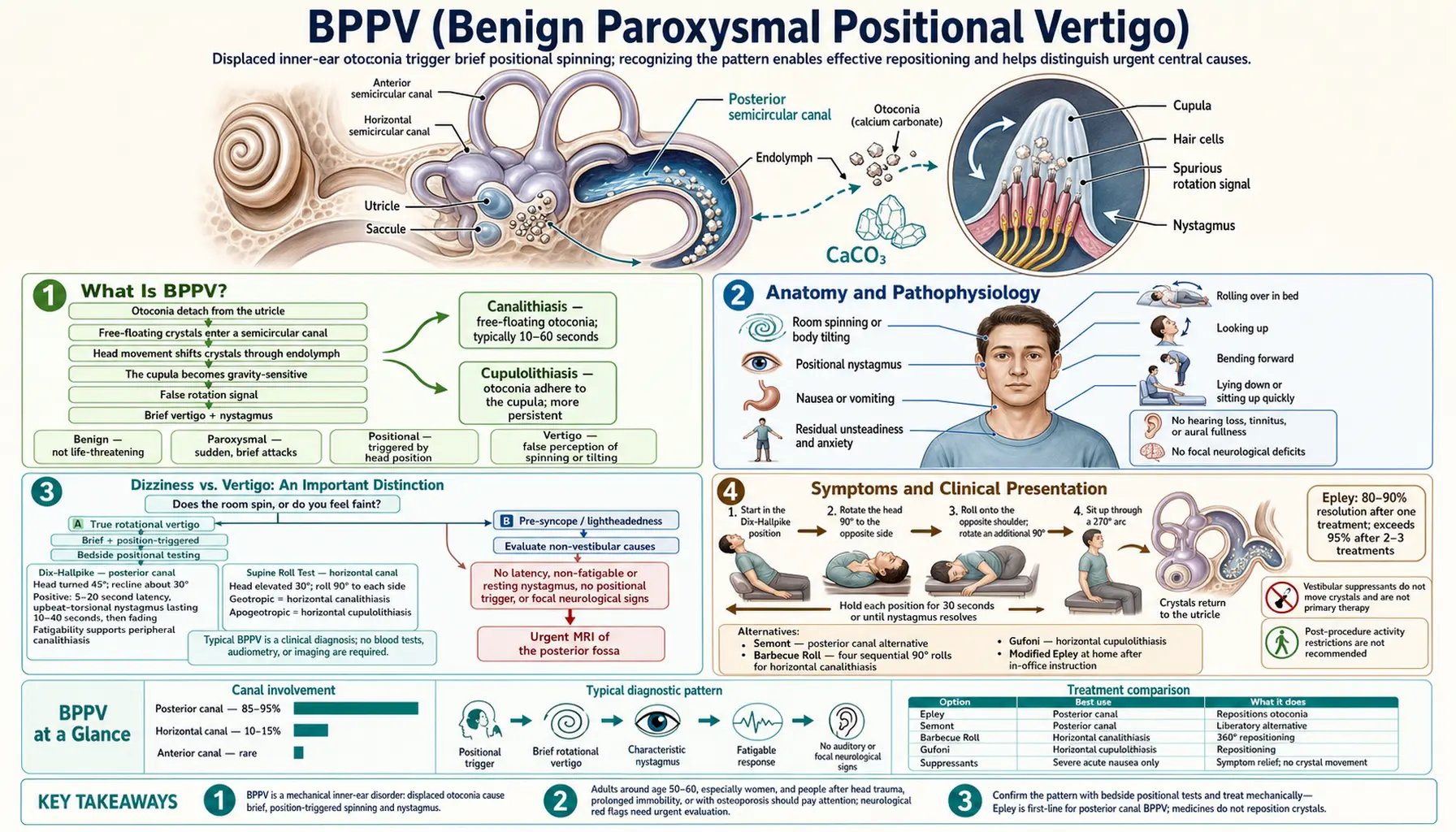
BPPV is the most common cause of vertigo, accounting for approximately 17–42% of all vertigo diagnoses. It arises when calcium carbonate crystals (otoconia, colloquially "ear rocks") that normally reside in the utricle of the vestibular labyrinth become displaced into a semicircular canal, generating spurious signals of rotation with certain head movements. The condition is benign and highly treatable — the Epley maneuver achieves resolution in 80–90% of patients with a single treatment — yet it is frequently misdiagnosed as a more serious condition.
Table of Contents
- What Is BPPV?
- Anatomy and Pathophysiology
- Dizziness vs. Vertigo: An Important Distinction
- Symptoms and Clinical Presentation
- Diagnosis: Dix-Hallpike and Roll Tests
- Central Nervous System Differentials
- Treatment: Canalith Repositioning Procedures
- Natural History and Recurrence
- Vestibular Suppressants: Limitations
- Special Populations
- References & Research
- Featured Videos
What Is BPPV?
The name encodes the entire clinical picture: Benign — not life-threatening; Paroxysmal — sudden, brief attacks; Positional — triggered by changes in head position; Vertigo — the false perception that the room or one's body is spinning or tilting. It is the most common vestibular disorder in adults, with a lifetime prevalence of approximately 2.4% and an annual incidence of around 0.6%.
Peak age of onset is 50–60 years; women are affected 2–3 times more often than men. The cause is idiopathic in 50–70% of cases. Secondary causes include:
- Head trauma — even mild injury can dislodge otoconia
- Prolonged bed rest or immobility — reduces otoconia adhesion to the otolithic membrane
- Viral labyrinthitis — inflammatory damage to the utricle
- Osteoporosis — lower bone mineral density is associated with more fragile otoconia and higher BPPV recurrence rates
- Ménière's disease — co-exists in 12–20% of Ménière's patients
- Inner ear surgery — surgical manipulation can displace crystals
By canal involvement: the posterior semicircular canal is most commonly affected (85–95% of cases); the horizontal canal accounts for roughly 10–15%; anterior canal BPPV is rare.
Anatomy and Pathophysiology
The inner ear labyrinth consists of two compartments: the bony labyrinth (cochlea, vestibule, and three semicircular canals) enclosing the fluid-filled membranous labyrinth. Sensory structures within the vestibule — the utricle and saccule — contain a specialized layer called the otolithic membrane, embedded with calcium carbonate crystals known as otoconia (otoliths). These crystals detect linear acceleration and gravity, bending the underlying hair cell stereocilia to signal head position to the brainstem.
Canalithiasis — the predominant mechanism
When otoconia detach from the utricle, they fall by gravity into the endolymph of a semicircular canal. As the head moves, these free-floating crystals create an abnormal gravitational force on the cupula — the gelatinous sail-like structure housing the canal's hair cells. The cupula is normally gravity-neutral (its density matches the surrounding endolymph); displaced crystals make it gravity-sensitive. The result: the brain receives a spurious rotation signal that does not match input from the eyes or proprioceptors, generating intense vertigo and a characteristic eye movement called nystagmus.
Cupulolithiasis — a less common variant
In this variant, otoconia adhere directly to the cupula rather than floating freely. Because the loaded cupula is now permanently gravity-sensitive, nystagmus is more persistent (lasting longer with each positional change) compared to the self-limiting 10–60 second episodes typical of canalithiasis.
Why the posterior canal?
The posterior semicircular canal occupies the most dependent anatomical position when a person is supine, making it the gravitational trap into which displaced otoconia naturally settle. This explains why 85–95% of cases involve the posterior canal, and why the classic trigger is rolling over in bed or lying down.
Dizziness vs. Vertigo: An Important Distinction
"Dizziness" is an umbrella term patients use to describe four fundamentally different sensations that point to entirely different diagnoses and workups. Collapsing them under one label is a leading cause of misdiagnosis in primary care.
- Vertigo — a false sense of rotational or linear motion of the self or the environment (room spinning, tilting). Caused by peripheral vestibular disorders (BPPV, Ménière's, vestibular neuritis) or, less commonly, by central CNS lesions (stroke, tumor).
- Pre-syncope / lightheadedness — the sensation of impending faint, often with facial pallor and diaphoresis. Caused by orthostatic hypotension, cardiac arrhythmia, vasovagal episodes, or volume depletion.
- Disequilibrium / imbalance — unsteadiness or the sensation of instability without a subjective head sensation. Caused by cerebellar disorders, proprioceptive deficits, peripheral neuropathy, or medication effects.
- Non-specific dizziness — vague floating, wooziness, or "spaciness" often associated with anxiety, hyperventilation, or persistent postural-perceptual dizziness (PPPD).
BPPV produces true rotational vertigo — patients perceive the room spinning or themselves tilting during brief positional changes. The key clinical question is always: "Does the room spin, or do you feel faint?" The answer changes the entire diagnostic pathway.
Symptoms and Clinical Presentation
The clinical picture of BPPV is highly stereotyped, which makes the diagnosis straightforward when the history is taken carefully.
Classic triggers
- Rolling over in bed (most common complaint — many patients describe being woken at night)
- Looking up — "top-shelf vertigo" when reaching overhead
- Bending forward, then straightening up
- Lying down or sitting up quickly
- Tilting the head backward at the dentist's or hairdresser's chair
Episode characteristics
- Duration: typically 10–60 seconds with canalithiasis; may persist longer with cupulolithiasis
- Intensity: ranges from mild imbalance to severe spinning with nausea and vomiting
- Between episodes: patients feel normal or experience mild residual unsteadiness and anxiety
- No auditory symptoms: absence of hearing loss, tinnitus, or aural fullness distinguishes BPPV from Ménière's disease and perilymphatic fistula
- No neurological deficits: focal weakness, diplopia, dysphagia, or facial numbness are red flags for a CNS cause
Functional impact
Although episodes are brief, BPPV significantly impairs quality of life. Patients restrict head movements, avoid driving, and may develop secondary anxiety or avoidance behaviors. In elderly patients, fear of triggering an episode leads to reduced mobility and deconditioning — compounding fall risk.
Diagnosis: Dix-Hallpike and Roll Tests
BPPV is a clinical diagnosis made at the bedside. No blood tests, audiometry, or imaging are required for a typical presentation. The bedside tests reproduce the patient's vertigo and produce a characteristic nystagmus pattern that identifies which canal is affected.
Dix-Hallpike Test — posterior canal BPPV
The Dix-Hallpike maneuver is the gold-standard provocation test:
- Patient sits upright on the examination table, head turned 45° toward the suspected affected ear.
- Clinician rapidly reclines the patient to a head-hanging position approximately 30° below horizontal, maintaining the 45° head turn.
- Positive result: geotropic (toward-the-ground), upbeat-torsional nystagmus appears after a latency of 5–20 seconds (the time for crystals to migrate to the ampulla), lasts typically 10–40 seconds, then fades.
- Fatigability: repeating the maneuver diminishes the nystagmus — a hallmark of peripheral (canalithiasis) rather than central origin.
- On sitting up, a brief reversal nystagmus in the opposite direction is typical.
Supine Roll Test (Pagnini-McClure) — horizontal canal BPPV
With the patient supine and the head elevated 30°, the examiner rapidly rolls the head 90° to each side:
- Geotropic (direction-changing toward earth) = horizontal canalithiasis — stronger nystagmus beats toward the affected (down) ear.
- Apogeotropic (direction-changing away from earth) = horizontal cupulolithiasis — stronger nystagmus beats toward the unaffected ear.
When to image
MRI of the posterior fossa is indicated if any of the following are present: no latency before nystagmus onset, non-fatigable nystagmus, direction-changing nystagmus at rest, nystagmus without a positional trigger, or any focal neurological signs. Videonystagmography (VNG) quantifies nystagmus objectively in diagnostically complex cases.
Central Nervous System Differentials
The most clinically critical question is whether positional dizziness represents benign peripheral BPPV or a dangerous central lesion — particularly posterior fossa stroke. This distinction is urgent because stroke requires immediate intervention while BPPV requires repositioning.
Key differentials
- Posterior fossa stroke or TIA: sudden onset, often without a clear positional trigger; may include other cranial nerve signs, gait ataxia, or limb weakness. The HINTS exam (Head Impulse, Nystagmus type, Test of Skew) is more sensitive than MRI in the first 48 hours for distinguishing peripheral from central acute vertigo — a normal head impulse test, direction-changing nystagmus, or vertical skew deviation indicates CENTRAL cause = stroke until proven otherwise.
- Vestibular migraine: episodic vertigo lasting minutes to hours, often associated with headache; no reproducible Dix-Hallpike pattern; second most common cause of episodic vertigo.
- Posterior fossa tumor: gradual onset over weeks to months; non-fatigable nystagmus; headache from raised intracranial pressure.
- Orthostatic hypotension: lightheadedness on standing (pre-syncope), not rotational vertigo; confirmed by measuring lying/standing blood pressure.
- Vestibular neuritis: acute sustained vertigo lasting days, not brief positional episodes; follows viral illness; positive head impulse test toward the affected side.
Red flags requiring urgent imaging
- First and worst sudden severe headache ("thunderclap")
- Focal neurological deficits: diplopia, dysphagia, facial numbness, limb weakness
- Gait ataxia out of proportion to subjective dizziness
- Nystagmus without positional trigger or that does not fatigue
- Vertical nystagmus or skew deviation
Treatment: Canalith Repositioning Procedures
The treatment of BPPV is mechanical — the goal is to guide displaced otoconia out of the affected semicircular canal and back into the utricle using gravity-assisted head movements. No surgery, no medication, and no vestibular rehabilitation exercises are required for uncomplicated posterior canal BPPV.
Epley Maneuver — gold standard for posterior canal BPPV
The Epley Canalith Repositioning Procedure (CRP), described in 1992, is the most studied and most effective treatment for posterior canal BPPV:
- Patient starts in the Dix-Hallpike position (affected ear down, head hanging).
- Head is slowly rotated 90° to the opposite side (nose now pointing upward).
- Patient rolls onto their shoulder on the opposite side, head rotated an additional 90°.
- Patient sits up, completing the 270° arc that carries crystals through the common crus back into the utricle.
- Each position is held for 30 seconds or until nystagmus resolves.
Efficacy: single treatment success rate 80–90%; after 2–3 treatments, resolution exceeds 95%. The 2017 AAO-HNS and 2022 AAN/AAOHNS Clinical Practice Guidelines both give the Epley maneuver a strong recommendation as first-line treatment. Post-procedure activity restrictions (avoiding lying flat, keeping the head upright) are no longer recommended — evidence shows they do not improve outcomes.
Semont Maneuver
An alternative liberatory maneuver for posterior canal BPPV, delivering the patient rapidly from one side-lying position to the other. Comparable efficacy to Epley; may be preferred when patients cannot tolerate head-hanging positions.
Horizontal canal BPPV — Barbecue Roll (Lempert Maneuver)
For horizontal canalithiasis, the patient performs four sequential 90° rolls in the same direction while supine (a full 360° "barbecue roll"), allowing crystals to exit the horizontal canal into the utricle. The Gufoni maneuver is used for horizontal canal cupulolithiasis.
Home self-treatment
The modified Epley maneuver can be performed at home after in-office instruction — this is recommended for patients with recurrent BPPV. Brandt-Daroff exercises are a gentler habituation approach used when repositioning fails or as prophylaxis in recurrent cases.
Natural History and Recurrence
BPPV is self-limiting — but without treatment, recovery takes weeks to months rather than days. Spontaneous resolution occurs in approximately 25–50% of cases, with a mean resolution time of about 39 days for posterior canal canalithiasis. With the Epley maneuver, most patients are symptom-free within days.
Recurrence
Recurrence is a significant clinical challenge. Approximately 50% of patients experience at least one recurrence within 5 years; the annual recurrence rate is approximately 15%. Factors associated with higher recurrence rates include:
- Osteoporosis and osteopenia — reduced bone mineral density correlates with more fragile otoconia
- Vitamin D deficiency — observational and RCT data link hypovitaminosis D to higher BPPV recurrence; supplementation in deficient patients may reduce recurrence
- Seasonal variation — higher rates in winter, consistent with reduced sun exposure and lower vitamin D levels
- Bilateral BPPV history — predicts future bilateral involvement
- Secondary BPPV (post-traumatic, post-surgical) — tends to be more persistent and recurrent than idiopathic cases
A landmark 2020 randomized trial by Jeong et al. (Neurology, PMID 32641490) demonstrated that vitamin D supplementation in patients with BPPV and vitamin D insufficiency significantly reduced recurrence rates, providing the first strong RCT evidence for a modifiable risk factor in BPPV prevention.
Vestibular Suppressants: Limitations
Vestibular suppressants are among the most commonly prescribed treatments for vertigo in primary care — yet for BPPV specifically, they are largely inappropriate as primary therapy. Understanding why requires recognizing what BPPV actually is: a mechanical disorder of crystal displacement, not a disorder of vestibular nerve excitability.
Commonly prescribed agents
- Meclizine (Antivert) — antihistamine-anticholinergic; reduces nausea and vertigo sensation but does not move crystals. Sedating and anticholinergic, particularly problematic in elderly patients.
- Dimenhydrinate (Dramamine) — similar mechanism and limitations to meclizine.
- Promethazine — phenothiazine antiemetic; reserved for severe acute nausea/vomiting.
- Benzodiazepines (diazepam, lorazepam) — suppress vestibular function centrally; appropriate only for acute severe distress; may delay central compensation.
Why they are contraindicated as primary BPPV therapy
Central vestibular compensation — the brain's adaptive process of recalibrating to the asymmetric vestibular input — depends on receiving and processing the abnormal signals from the affected ear. Vestibular suppressants blunt these signals, potentially delaying recovery rather than accelerating it. The 2017 AAO-HNS guideline includes a strong recommendation against prescribing vestibular suppressants as treatment for BPPV. The 2022 update reaffirms this position.
Appropriate limited use
A 24–48 hour course of antiemetics or meclizine is reasonable during a severe acute episode when nausea and vomiting prevent the patient from undergoing repositioning. Once nausea is controlled, repositioning should proceed without delay.
Special Populations
Elderly patients
BPPV prevalence increases with age; elderly patients with BPPV have a significantly higher risk of falls and fall-related fractures. Effective treatment with canalith repositioning reduces fall risk — this is a strong evidence-based argument for prompt diagnosis and treatment in older adults rather than defaulting to vestibular suppressants. Post-treatment balance rehabilitation may be beneficial in elderly patients with residual unsteadiness after crystal repositioning.
Post-traumatic BPPV
Head injury and whiplash are the most common secondary causes of BPPV. Post-traumatic BPPV often involves multiple canals simultaneously (multi-canal BPPV), has a delayed onset of days to weeks after the injury, and tends to be more resistant to treatment than idiopathic BPPV. Multiple treatment sessions and sometimes combined Epley and Semont techniques are required.
Bilateral BPPV
Approximately 8–10% of BPPV cases are bilateral. Both ears must be assessed and treated sequentially. Bilateral BPPV is more common in patients with osteoporosis and after head trauma.
BPPV co-existing with Ménière's disease
Ménière's disease and BPPV coexist in 12–20% of Ménière's patients. The distinction is clinically important: BPPV episodes last seconds (not the 20-minute to several-hour attacks of Ménière's) and lack the auditory symptoms (fluctuating hearing loss, tinnitus, aural fullness) of Ménière's. Canalith repositioning remains effective for the BPPV component even when Ménière's is the underlying etiology.
Canal conversion
During the Epley maneuver, crystals occasionally migrate from the posterior canal into the horizontal canal rather than returning to the utricle. This "canal conversion" presents as new geotropic horizontal nystagmus during the procedure. Treatment: proceed immediately with the barbecue roll (Lempert maneuver) to clear the horizontal canal. Canal conversion does not indicate treatment failure — it is a manageable variant that resolves with sequential repositioning.
References & Research
- Bhattacharyya N, Gubbels SP, Schwartz SR, et al. Clinical Practice Guideline: Benign Paroxysmal Positional Vertigo (Update). Otolaryngol Head Neck Surg. 2017;156(3_suppl):S1–S47. PMID: 28248609
- Epley JM. The canalith repositioning procedure: for treatment of benign paroxysmal positional vertigo. Otolaryngol Head Neck Surg. 1992;107(3):399–404. — Search PubMed
- Fife TD, Iverson DJ, Lempert T, et al. Practice parameter: therapies for benign paroxysmal positional vertigo. Neurology. 2008;70(22):2067–2074. PMID: 18505980
- Parnes LS, Agrawal SK, Atlas J. Diagnosis and management of benign paroxysmal positional vertigo (BPPV). CMAJ. 2003;169(7):681–693. PMID: 14517129
- Semont A, Freyss G, Vitte E. Curing the BPPV with a liberatory maneuver. Adv Otorhinolaryngol. 1988;42:290–293. — Search PubMed
- Hall SF, Ruby RR, McClure JA. The mechanics of benign paroxysmal vertigo. J Otolaryngol. 1979;8(2):151–158. — Search PubMed
- von Brevern M, Radtke A, Lezius F, et al. Epidemiology of benign paroxysmal positional vertigo: a population based study. J Neurol Neurosurg Psychiatry. 2007;78(7):710–715. PMID: 17135456
- Jeong SH, Kim JS, Kim HJ, et al. Prevention of benign paroxysmal positional vertigo with vitamin D supplementation: a randomized trial. Neurology. 2020;95(9):e1117–e1125. — Search PubMed
- Korres S, Balatsouras DG, Kaberos A, et al. Occurrence of semicircular canal involvement in benign paroxysmal positional vertigo. Otol Neurotol. 2002;23(6):926–932. PMID: 12438857
- Helminski JO, Zee DS, Janssen I, Hain TC. Effectiveness of particle repositioning maneuvers in the treatment of benign paroxysmal positional vertigo: a systematic review. Phys Ther. 2010;90(5):663–678. PMID: 20338918
- Staab JP, Eckhardt-Henn A, Horii A, et al. Diagnostic criteria for persistent postural-perceptual dizziness (PPPD): Consensus document of the Committee for the Classification of Vestibular Disorders. J Vestib Res. 2017;27(4):191–208. PMID: 29036855
- Nuti D, Masini M, Mandala M. Benign paroxysmal positional vertigo and its variants. Handb Clin Neurol. 2016;137:241–256. — Search PubMed
PubMed Topic Searches
- BPPV canalith repositioning Epley maneuver
- Benign paroxysmal positional vertigo diagnosis treatment
- BPPV recurrence prevention vitamin D
- Otoconia vestibular labyrinth pathophysiology
- Dix-Hallpike test posterior canal BPPV
- BPPV horizontal canal Barbecue roll maneuver
- Benign paroxysmal positional vertigo elderly falls
- Vestibular rehabilitation BPPV outcomes
Connections
- ENT
- Vestibular Neuritis
- Ménière's Disease
- Acoustic Neuroma
- Tinnitus
- Hearing Loss
- Stroke
- Nystagmus — the involuntary eye movement that positional testing provokes and reads to identify the affected canal.
- Vitamin D3