Blood Culture
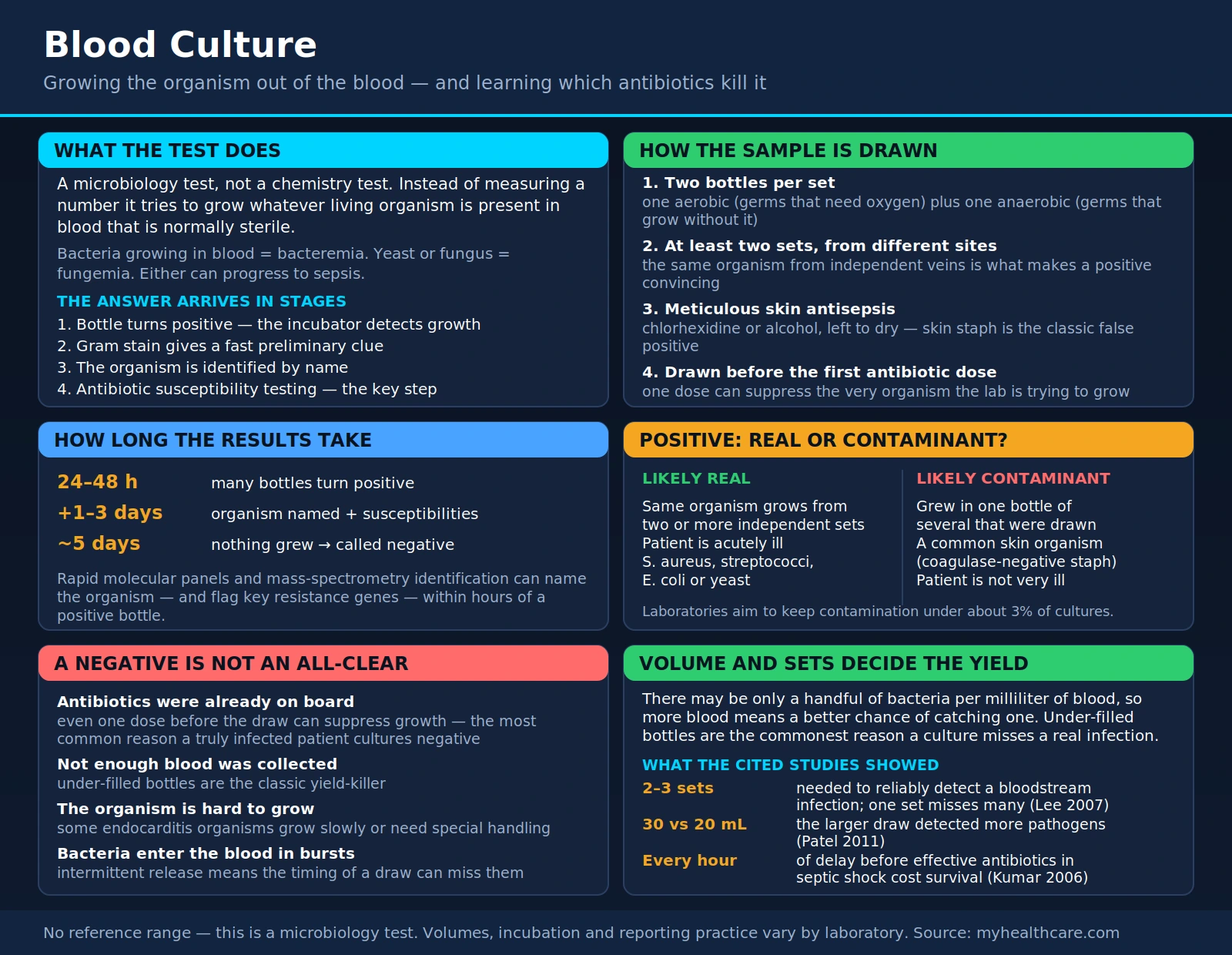
A blood culture is a test that tries to grow living bacteria or fungi from a sample of your blood. Normally, blood is sterile — there is nothing alive floating in it. So if a laboratory can coax an organism to multiply out of your blood sample, that is powerful evidence of a bloodstream infection. The test does two jobs at once: it tells your care team whether germs are in the blood, and it tells them exactly which germ it is and which antibiotics will kill it. That second job is what makes the blood culture one of the most important tests in all of serious-infection medicine.
This page explains, in plain language, what a blood culture actually is, why a doctor orders one, how the sample is drawn (the details here genuinely matter), how long you wait for an answer, and how to make sense of a positive or negative result. Blood cultures are almost always an inpatient or emergency-room test — the situations that call for one, like suspected sepsis, are medical emergencies. If you or someone you love is very sick with fever, this is the test working quietly in the background to steer treatment.
Table of Contents
- What a Blood Culture Is
- Why It's Ordered
- How the Sample Is Collected
- Two or More Sets: The Contamination Problem
- How Long the Results Take
- Making Sense of the Results
- When a Negative Culture Doesn't Rule Out Infection
- Tests That Go Alongside a Blood Culture
- When This Test Matters Most
- Research Papers
- Connections
- Featured Videos
What a Blood Culture Is
A blood culture is a microbiology test, not a chemistry test. Instead of measuring a number, it attempts to grow whatever living microorganism might be present in your blood. A nurse or phlebotomist draws blood and injects it into special sealed bottles filled with a rich nutrient broth — essentially food for germs. The bottles go into an incubator kept at body temperature, and a machine watches them for signs that something inside is alive and multiplying.
When bacteria are found alive in the blood, doctors call it bacteremia. When the culprit is a yeast or other fungus, it is called fungemia. Either can progress to sepsis, the body's dangerous, dysregulated response to infection. A blood culture is how the invading organism is caught in the act.
The test unfolds in stages. First, the bottle "turns positive" — the machine detects growth. Next, the lab looks at a stained smear under the microscope to give a fast preliminary clue (for example, "Gram-positive cocci in clusters," which hints at staph). Then the organism is identified by name, and finally it is tested against a panel of antibiotics to see which ones stop it. That last step, called antibiotic susceptibility testing, is often the single most valuable piece of information the whole test provides.
Why It's Ordered
Doctors order blood cultures when they suspect that an infection has reached the bloodstream, or when knowing the exact organism will change how a serious illness is treated. Common reasons include:
- Suspected sepsis. This is the big one. When someone is acutely ill with signs of a body-wide infection — fast heart rate, fast breathing, confusion, low blood pressure, very high or very low temperature — blood cultures are drawn urgently.
- Unexplained high fever, chills, or rigors. Shaking chills (rigors) often accompany bursts of bacteria entering the blood, and a persistent fever with no obvious source is a classic trigger for culturing.
- Suspected infective endocarditis. An infection of a heart valve seeds bacteria into the blood continuously, so blood cultures are central to diagnosing it — usually several sets over time.
- Any serious infection where the bug and its sensitivities change treatment. Severe pneumonia, kidney infection with high fever, bone or joint infection, meningitis, or an infected IV line — in each case, identifying the organism lets the team switch from broad "cover everything" antibiotics to a precise, effective one.
In short, this is a test for people who are genuinely sick. It is not a routine wellness screen; it is ordered when the stakes are high and the answer will guide care.
How the Sample Is Collected
This is the part worth understanding, because the way the sample is drawn largely decides how useful the result will be. A few practical points do most of the work.
Aerobic and anaerobic bottles
Each "set" of blood cultures usually means two bottles: an aerobic bottle (for germs that need oxygen) and an anaerobic bottle (for germs that grow without it). Splitting the sample this way widens the net so that more kinds of bacteria have a chance to grow.
Two or more sets, from different sites
Best practice is to collect at least two sets, and often more, each drawn from a different vein or site — not all from one spot. Drawing from separate sites is not busywork: it is the main way the lab later tells a true infection apart from a harmless skin germ that snuck in during the draw. If the same organism grows from two independent sites, that is convincing. If it shows up in only one bottle out of several, suspicion shifts toward contamination.
Meticulous skin cleaning
Your skin is covered in harmless bacteria, especially coagulase-negative staphylococci. If any hitch a ride on the needle, they can grow in the bottle and masquerade as a bloodstream infection — a false positive. To prevent this, the person drawing the sample scrubs the skin carefully with an antiseptic (such as chlorhexidine or alcohol) and lets it dry. Good technique here is one of the most important quality steps in the entire test.
Ideally drawn before antibiotics start
Whenever it is safe to do so, blood cultures should be collected before the first dose of antibiotics. Once antibiotics are in the blood, they can suppress the very organism you are trying to grow, and a culture that would have been positive can come back falsely negative. In practice, teams move fast to draw cultures so that starting life-saving antibiotics is not delayed — but they try hard to get the blood in the bottles first.
Adequate blood volume — the single biggest factor
If there is one number that decides whether a blood culture succeeds, it is the volume of blood put into the bottles. In bloodstream infections there may be only a handful of bacteria per milliliter, so more blood means a better chance of capturing at least one. Under-filling the bottles is the most common reason a culture misses a real infection. For adults, guidelines call for filling each bottle to its recommended volume across multiple sets; for infants and children, volumes are scaled to body size. When someone tells you "fill the bottles all the way," that is the science of yield talking.
Two or More Sets: The Contamination Problem
Contamination is the shadow that follows every blood culture. Because the sample passes through skin teeming with bacteria, a small percentage of positive cultures are not real infections at all — they are skin germs that grew in the bottle. This is not a rare footnote; laboratories work hard to keep contamination rates low (a commonly cited target is under about 3% of cultures), because false positives have real costs.
Why does a false positive matter so much? A contaminated culture can lead to unnecessary antibiotics, extra tests, a longer hospital stay, and worry for the patient — all chasing a germ that was never actually causing disease. That is exactly why the "two or more sets from different sites" rule exists. The pattern of growth is the tell:
- Same organism, multiple independent sets → very likely a true bloodstream infection.
- A common skin organism in just one bottle of several → more likely a contaminant, especially if the patient is not very ill.
Interpreting this well takes judgment. The identity of the organism matters too: some germs (like Staphylococcus aureus, certain streptococci, E. coli, or yeast) are almost never "just contaminants" and are treated seriously even from a single bottle, whereas coagulase-negative staph in one bottle of a healthy-appearing person is often dismissed. This is why results are read in the context of how the patient looks, not in isolation.
How Long the Results Take
Blood cultures reward patience, because growing living organisms takes real time. Here is the honest timeline:
- The first 24–48 hours. Many bloodstream infections turn a bottle positive within one to two days — sometimes much sooner for fast-growing bacteria. Modern continuous-monitoring incubators check the bottles around the clock and can flag growth within hours of it beginning, day or night.
- Identification and susceptibilities: 1–3+ more days. Once a bottle flags positive, the lab still needs to identify the organism and test it against antibiotics. Traditionally this adds a day or more. So even a "fast" positive often takes a couple of days to become a fully actionable result with a name and a drug list.
- The final negative call: typically about 5 days. If nothing grows, labs usually incubate for around five days before calling a culture negative, so that slower-growing organisms are not missed.
Faster methods are changing this. Rapid molecular panels and modern identification techniques (such as mass-spectrometry identification) can name an organism — and sometimes flag key resistance genes — within hours of a positive bottle, shaving a day or more off the wait and letting doctors fine-tune antibiotics sooner. Availability varies from hospital to hospital, but the trend is clearly toward faster answers.
Making Sense of the Results
A blood culture result is really a short story, and it is worth reading each part.
A true positive
A genuine positive tells you two things: the organism (its name) and its antibiotic susceptibilities (which drugs work and which it resists). Together these let the team practice targeted therapy — narrowing from broad-spectrum antibiotics to the single best drug. That is better for the patient (fewer side effects, more reliable cure) and better for everyone (less pressure driving antibiotic resistance). It also guides how long to treat and whether to hunt for a source, such as an infected heart valve or IV line.
The contaminant question
As above, not every positive is real. The team weighs the identity of the organism, how many sets and bottles grew it, how quickly it grew, and how sick the patient is. A pathogen growing in multiple sets from an ill patient is acted on immediately; a lone skin germ in an otherwise well person is often watched or repeated rather than treated.
A negative result
A negative culture is reassuring but not absolute. It means nothing grew in the bottles — which is good news — yet it does not by itself prove there is no infection. This is especially true if antibiotics were given before the blood was drawn, if too little blood went into the bottles, or if the organism is a fussy, slow-growing type that standard cultures do not capture well. Doctors read a negative result alongside the whole picture rather than treating it as a final all-clear.
When a Negative Culture Doesn't Rule Out Infection
It is worth dwelling on this, because a negative blood culture can be misleading if taken at face value. Several situations can produce a false negative — a real infection that the culture misses:
- Antibiotics were already on board. Even one dose before the draw can suppress growth. This is the most common reason a truly infected patient has negative cultures.
- Not enough blood was collected. Under-filled bottles are the classic yield-killer, as covered above.
- The organism is hard to grow. Some bacteria that cause endocarditis and other deep infections grow slowly or need special handling, so routine cultures may come back empty even when infection is present.
- The bacteria enter the blood in bursts. In some infections, organisms are released intermittently, so timing can cause a miss.
Because of all this, a very sick patient with negative cultures is not simply declared infection-free. The team may repeat cultures, look harder for a source, or keep treating based on the overall clinical picture. The blood culture is a powerful witness, but it is not the only one.
Tests That Go Alongside a Blood Culture
A blood culture rarely travels alone. In a seriously ill patient it is usually part of a small cluster of tests that together paint the picture of how bad an infection is and where it is coming from:
- Procalcitonin. A blood marker that tends to rise more with bacterial infection than with viral illness, sometimes used to gauge severity and help decide when antibiotics can be stopped.
- Lactate. A rising lactate level is a warning sign in sepsis that tissues are not getting enough oxygen; it helps judge how sick a patient is and whether they are improving.
- Complete Blood Count (CBC). The white-blood-cell count and differential show the body's response to infection — a high (or unusually low) count can signal a serious problem.
- The source cultures. Depending on where the infection is suspected, the team may also culture urine, sputum, spinal fluid, wound drainage, or an IV catheter tip. Matching the organism in the blood to the organism at a specific site helps pinpoint the source.
- Inflammatory markers such as CRP. These general markers of inflammation add context to the trend of an illness, though they are not specific to bloodstream infection.
When This Test Matters Most
Blood cultures belong to the world of acute, inpatient care. You are most likely to encounter one in an emergency department or hospital ward, drawn urgently because someone is seriously unwell. Severe infection — and especially sepsis — is a medical emergency, and time matters: every hour that effective treatment is delayed in septic shock is associated with worse odds, which is why teams draw cultures and start antibiotics quickly and in that order whenever they can.
For a patient or family member, the useful takeaways are simple. First, this test is being done because the situation is being taken seriously. Second, results come in stages — a preliminary Gram-stain clue in a day or so, then the organism's name, then the antibiotic list — so patience is part of the process. Third, the reason nurses seem fussy about cleaning the skin and filling the bottles is that those small steps decide whether the test gives a trustworthy answer. And finally, if cultures come back negative but the person is still sick, that is not necessarily an all-clear; it is one clue among many that the whole care team weighs together.
Research Papers
- Lee A, Mirrett S, Reller LB, Weinstein MP. Detection of Bloodstream Infections in Adults: How Many Blood Cultures Are Needed? Journal of Clinical Microbiology. 2007;45(11):3546–3548. doi:10.1128/JCM.01555-07 — found that two to three sets are usually needed to reliably detect a bloodstream infection; a single set misses many cases.
- Cockerill FR 3rd, Wilson JW, Vetter EA, et al. Optimal Testing Parameters for Blood Cultures. Clinical Infectious Diseases. 2004;38(12):1724–1730. doi:10.1086/421087 — showed that yield rises with the volume of blood cultured and quantified how many sets are needed for high sensitivity.
- Bouza E, Sousa D, Rodríguez-Créixems M, Lechuz JG, Muñoz P. Is the Volume of Blood Cultured Still a Significant Factor in the Diagnosis of Bloodstream Infections? Journal of Clinical Microbiology. 2007;45(9):2765–2769. doi:10.1128/JCM.00140-07 — confirmed with modern automated systems that drawing more blood meaningfully increases the detection of true infections.
- Patel R, Vetter EA, Harmsen WS, Schleck CD, Fadel HJ, Cockerill FR 3rd. Optimized Pathogen Detection with 30- Compared to 20-Milliliter Blood Culture Draws. Journal of Clinical Microbiology. 2011;49(12):4047–4051. doi:10.1128/JCM.01314-11 — demonstrated that increasing the draw volume detected more pathogens, underscoring that volume is the key lever for sensitivity.
- Weinstein MP. Blood Culture Contamination: Persisting Problems and Partial Progress. Journal of Clinical Microbiology. 2003;41(6):2275–2278. doi:10.1128/JCM.41.6.2275-2278.2003 — a foundational review of why contamination happens and the costs of false-positive blood cultures.
- Hall KK, Lyman JA. Updated Review of Blood Culture Contamination. Clinical Microbiology Reviews. 2006;19(4):788–802. doi:10.1128/CMR.00062-05 — a comprehensive review of contamination rates, how to distinguish contaminant from pathogen, and strategies to reduce false positives.
- Doern GV, Carroll KC, Diekema DJ, et al. Practical Guidance for Clinical Microbiology Laboratories: A Comprehensive Update on the Problem of Blood Culture Contamination and a Discussion of Methods for Addressing the Problem. Clinical Microbiology Reviews. 2019;33(1):e00009-19. doi:10.1128/CMR.00009-19 — the modern, detailed roadmap for measuring and lowering contamination, including skin antisepsis and diversion techniques.
- Lamy B, Dargère S, Arendrup MC, Parienti JJ, Tattevin P. How to Optimize the Use of Blood Cultures for the Diagnosis of Bloodstream Infections? A State-of-the-Art. Frontiers in Microbiology. 2016;7:697. doi:10.3389/fmicb.2016.00697 — a practical overview of best practices for collection, volume, timing, and interpretation.
- Baron EJ, Miller JM, Weinstein MP, et al. A Guide to Utilization of the Microbiology Laboratory for Diagnosis of Infectious Diseases: 2013 Recommendations by IDSA and ASM. Clinical Infectious Diseases. 2013;57(4):e22–e121. doi:10.1093/cid/cit278 — authoritative professional guidance on when and how to use blood cultures and other microbiology tests.
- Kumar A, Roberts D, Wood KE, et al. Duration of hypotension before initiation of effective antimicrobial therapy is the critical determinant of survival in human septic shock. Critical Care Medicine. 2006;34(6):1589–1596. doi:10.1097/01.CCM.0000217961.75225.E9 — showed that each hour of delay in effective antibiotics for septic shock was linked to lower survival, explaining the urgency around cultures.
- Evans L, Rhodes A, Alhazzani W, et al. Surviving Sepsis Campaign: International Guidelines for Management of Sepsis and Septic Shock 2021. Intensive Care Medicine. 2021;47(11):1181–1247. doi:10.1007/s00134-021-06506-y — the leading sepsis guideline, recommending blood cultures before antibiotics when it does not substantially delay treatment.
- Habib G, Lancellotti P, Antunes MJ, et al. 2015 ESC Guidelines for the management of infective endocarditis. European Heart Journal. 2015;36(44):3075–3128. doi:10.1093/eurheartj/ehv319 — details the central role of multiple blood culture sets in diagnosing infection of the heart valves.
Connections
- All Lab Tests
- Lactate
- Procalcitonin Test
- Complete Blood Count (CBC)
- Inflammatory Markers
- hs-CRP
- Infectious Disease
- Bacteria
- Diagnosing Salmonella: Stool Culture, Blood Culture, and Rapid Tests
- Diagnosing Listeria: Blood Cultures, CSF, and Food Testing — why blood culture is the gold standard for invasive listeriosis, and when CSF is needed alongside it.