Zeaxanthin & Blue Light Protection
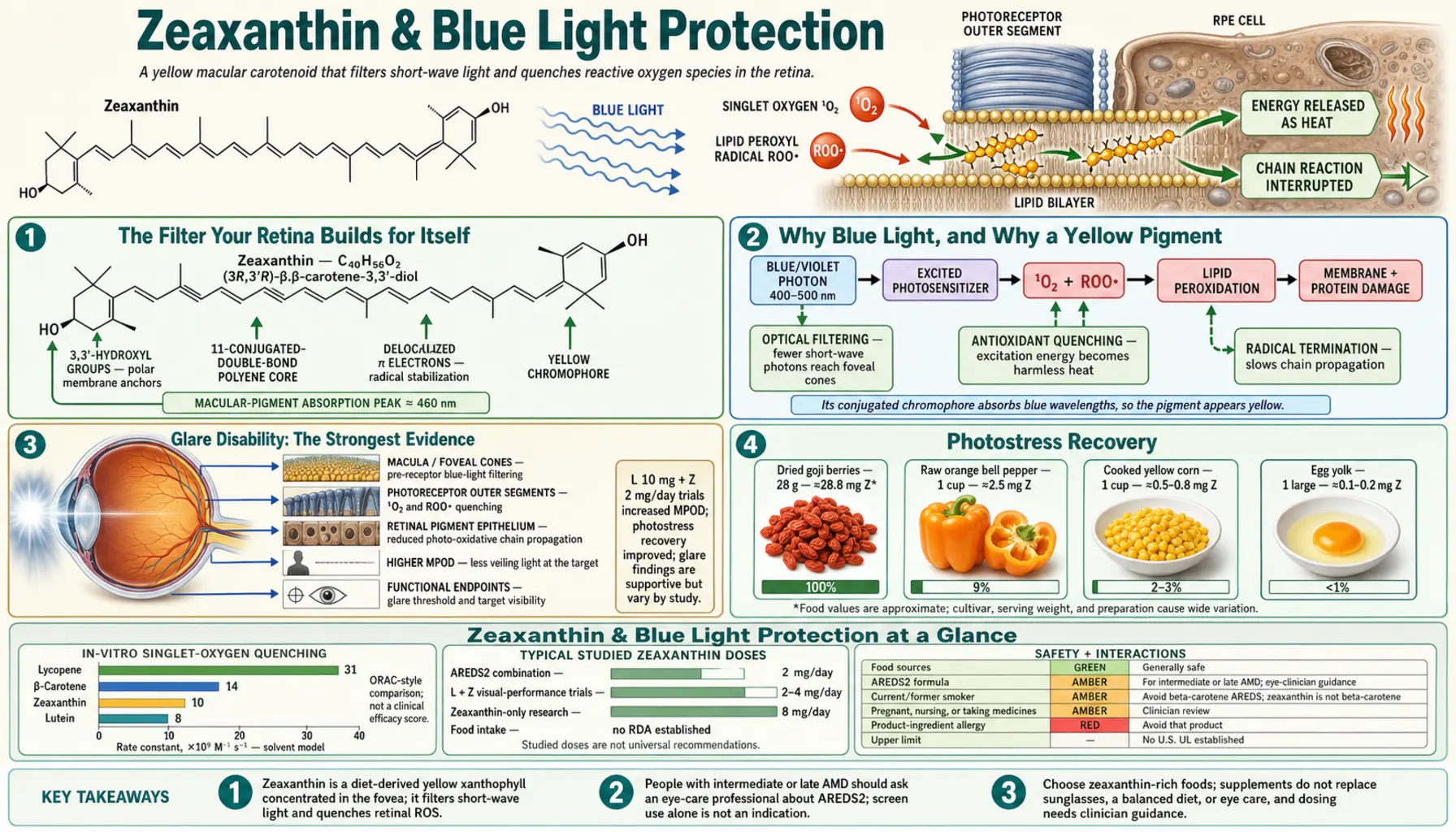
The yellow macular pigment that zeaxanthin builds is, in optical terms, a built-in blue-light filter sitting in front of your most precious photoreceptors. This is genuinely useful physics, and it explains some of zeaxanthin's best-supported benefits: better tolerance of glare, faster recovery after a bright flash, and steadier contrast in demanding light. It is also the part of the zeaxanthin story most distorted by marketing. This page separates what the trials actually show about glare and visual performance from the overstated claims about "screen blue light."
Table of Contents
- The Filter Your Retina Builds for Itself
- Why Blue Light, and Why a Yellow Pigment
- Glare Disability: The Strongest Evidence
- Photostress Recovery
- Contrast Sensitivity and Visual Comfort
- Visual Performance in Demanding Light
- The "Screen Blue Light" Question
- Blue Light, Photo-Oxidation and the Retina
- How to Actually Thicken the Filter
- Honest Limits and Cautions
- Key Research Papers
- Connections
- Featured Videos
The Filter Your Retina Builds for Itself
Sunglasses filter light in front of your eye. The macular pigment filters it inside the eye, at the retina, just before light reaches the photoreceptors of the macula. Zeaxanthin, lutein, and meso-zeaxanthin sit in the inner retinal layers as a translucent yellow screen, and because yellow is the complementary color to blue, that screen preferentially absorbs the short-wavelength blue end of the spectrum. The higher your macular pigment optical density (MPOD), the denser the filter.
Unlike sunglasses, this filter is selective and permanent (until you change your diet), it never gets lost or scratched, and it sits exactly where the vulnerable tissue is. The functional consequences of having a thicker or thinner filter have been measured in a series of controlled trials, and they are the subject of this page.
Why Blue Light, and Why a Yellow Pigment
Not all visible light is equal. Photon energy rises as wavelength shortens, so blue light (roughly 400–500 nm) carries more energy per photon than green or red. Higher-energy photons are more capable of driving photochemical reactions that generate reactive oxygen species in the retina. Blue light also scatters more than longer wavelengths as it passes through the eye's optics, which is a major source of the veiling haze we experience as glare.
The macular pigment absorbs most strongly near 460 nm — right in the blue band that both scatters worst and carries the most photochemical punch. So a single pigment addresses two different problems at once: it reduces the intraocular scatter that degrades the image (a visual-quality benefit you can feel immediately) and it cuts the blue-light dose reaching the photoreceptors and the retinal pigment epithelium (a protective benefit that plays out over years). Zeaxanthin's fully conjugated double-bond structure makes it an efficient absorber in exactly this range.
Glare Disability: The Strongest Evidence
Glare disability is the loss of vision that happens when a bright light source (oncoming headlights, low sun, stadium lights) throws scattered light across the retina and washes out the image you are trying to see. Because the macular pigment absorbs the blue light that scatters most, people with denser pigment should tolerate glare better — and that is what the research finds.
Stringham and Hammond's work at the University of Georgia established the link. Their 2008 study found that macular pigment density predicted visual performance under glare conditions, and their 2011 trial (Stringham 2011) showed that raising macular pigment through supplementation improved several glare-related measures, including how much glare a person could tolerate before vision broke down and how uncomfortable bright light felt. A 2014 double-blind, placebo-controlled study (Hammond 2014) confirmed that lutein and zeaxanthin supplementation improved glare disability alongside photostress recovery and chromatic contrast.
This is arguably zeaxanthin's most robust functional benefit: a measurable, reproducible improvement in how well people see when a bright light is in the field — directly relevant to night driving and any bright-light environment.
Photostress Recovery
Photostress recovery is the time it takes for central vision to return after being briefly blinded by an intense light — think of the lingering blind spot after a camera flash or a glance at the sun. During that interval, the bleached photoreceptors are regenerating their visual pigment, and until they do, you effectively cannot see with the center of your vision. Shorter recovery is safer, especially behind the wheel.
Multiple trials show that higher macular pigment shortens photostress recovery time. Hammond's 2013 work (Hammond 2013) related faster recovery to higher macular pigment and serum lutein and zeaxanthin, and Stringham's 2016 supplementation trial (Stringham 2016) reported improved dynamics of photostress recovery after macular carotenoid supplementation. A 2019 study (Tavazzi 2019) specifically compared recovery after blue versus green photostress and found the macular pigment's protective role was most evident against the blue challenge — consistent with the pigment's blue-absorbing spectrum.
Contrast Sensitivity and Visual Comfort
Contrast sensitivity is the ability to distinguish an object from its background when the difference in brightness is subtle — more relevant to real-world vision than the high-contrast letters on a standard eye chart. The CREST trial (Central Retinal Enrichment Supplementation Trial; Nolan 2016) tested whether enriching macular pigment improves contrast sensitivity in people with healthy retinas and found that it did: supplementation with lutein, zeaxanthin, and meso-zeaxanthin enhanced contrast sensitivity, a benefit attributed partly to reduced blue-light scatter and chromatic aberration.
A 2021 systematic review and meta-analysis (Johnson 2021) examined the broader relationship between MPOD and visual-function outcomes and found associations supporting a functional role for macular pigment in everyday vision, while appropriately noting heterogeneity across studies. Taken together, the visual-performance literature is reasonably consistent: denser macular pigment is linked to better glare handling, faster photostress recovery, and improved contrast — all downstream of the same blue-light-filtering physics.
Visual Performance in Demanding Light
One memorable demonstration extended these findings from the clinic to the ballpark. Hammond and colleagues (Hammond 2012) reported that supplementing lutein and zeaxanthin improved visual performance measures relevant to detecting and tracking a fast-moving target under bright-light conditions — framed around the demands of baseball. The mechanism is the same: reduced glare and scatter, improved contrast, and faster recovery from bright backgrounds make it easier to resolve a small object moving quickly against a bright sky.
The everyday translation is not about sport specifically. It is that the same visual challenges — bright ambient light, high glare, the need to pick out a low-contrast object quickly — occur in driving, cycling, and outdoor work, and denser macular pigment measurably helps with them.
The "Screen Blue Light" Question
Here honesty is essential, because this is where marketing outruns the science. Supplement and eyewear ads often imply that zeaxanthin protects your retina from the blue light emitted by phones, tablets, and computer screens. The reality is more sober:
- Screen blue light is very weak compared with sunlight. The blue-light intensity reaching your eye from a device is a tiny fraction of what you receive outdoors on a bright day. There is no good evidence that ordinary screen use damages the retina.
- "Digital eye strain" is real but is mostly not a blue-light problem. The tired, dry, achy eyes after a long screen session come chiefly from reduced blink rate, sustained focusing effort, and viewing distance — not from photochemical damage. Blue-blocking glasses have not been shown in controlled trials to meaningfully reduce digital eye strain.
- What zeaxanthin plausibly helps with is comfort and glare, not screen "damage." Because denser macular pigment reduces scatter and discomfort glare, some people may find bright displays and bright rooms more comfortable. That is a modest, comfort-level benefit — not protection from a device-induced disease.
The defensible statement is this: the well-supported blue-light benefits of zeaxanthin are about function under bright and glaring conditions and long-term reduction of cumulative high-energy light dose — overwhelmingly a sunlight and outdoor-light story. Framing zeaxanthin as a shield against your phone screen is not supported by strong evidence.
Blue Light, Photo-Oxidation and the Retina
The long-term protective rationale rests on laboratory and mechanistic work rather than on clinical endpoints. As the retina recycles visual pigment, it accumulates bisretinoids such as A2E in the retinal pigment epithelium. When A2E is hit by blue light, it can photo-oxidize into cytotoxic products implicated in retinal aging and AMD. Studies of a retinal-pigment-epithelium model exposed to sunlight-normalized light (Arnault 2013) mapped a phototoxic "action spectrum" peaking in the blue band — precisely the wavelengths the macular pigment absorbs. Reviews of macular pigment and bisretinoid chemistry (Arunkumar 2023) describe how carotenoids can limit this photo-oxidative cascade.
This mechanistic evidence is the scientific basis for the idea that filtering blue light over a lifetime may spare the macula. It is biologically coherent and consistent with the epidemiology, but it should be presented as mechanism plus association — not as a proven, quantified clinical outcome from a randomized blue-light trial, which does not exist.
How to Actually Thicken the Filter
The filter's density is your MPOD, and MPOD responds to intake:
- Eat zeaxanthin-rich foods regularly — orange peppers, corn, egg yolk, goji berries, and leafy greens. See the Sources page for specifics.
- Include dietary fat with those foods; carotenoids are fat-soluble and absorb far better with a little oil, butter, or egg yolk present.
- Consider a lutein/zeaxanthin (and meso-zeaxanthin) supplement if your intake is low; trials consistently show these raise MPOD over 8–24 weeks.
- Be patient. The pigment builds over months, not days, and stays elevated as long as intake continues.
- Keep wearing real sunglasses outdoors. Internal pigment and external UV/blue-blocking lenses address different parts of the problem; they are complementary, not redundant.
Honest Limits and Cautions
- The functional benefits are real but modest. Improved glare tolerance, faster photostress recovery, and better contrast are measurable, but they are refinements of normal vision, not dramatic transformations.
- Screen-damage claims are not supported. Do not buy zeaxanthin (or blue-blocking glasses) expecting protection from your phone; the evidence is not there.
- Most trials combined carotenoids. Zeaxanthin was usually given with lutein and often meso-zeaxanthin, so isolating a zeaxanthin-only effect is not possible from these studies.
- Some laboratory evidence is preclinical. The A2E photo-oxidation work is mechanistic; it supports biological plausibility, not a proven human outcome.
- Sunglasses and UV protection still matter for the front of the eye (cornea, lens) and for total light dose; dietary pigment does not replace them.
Key Research Papers
- Stringham JM, Hammond BR (2008). Macular pigment and visual performance under glare conditions. Optometry and Vision Science. — PMID 18296924
- Stringham JM, Hammond BR (2011). Macular pigment and visual performance in glare: benefits for photostress recovery, disability glare, and visual discomfort. Investigative Ophthalmology & Visual Science. — PMID 21296819
- Hammond BR et al. (2014). A double-blind, placebo-controlled study on the effects of lutein and zeaxanthin on photostress recovery, glare disability, and chromatic contrast. Investigative Ophthalmology & Visual Science. — PMID 25468896
- Hammond BR Jr et al. (2013). Glare disability, photostress recovery, and chromatic contrast: relation to macular pigment and serum lutein and zeaxanthin. Investigative Ophthalmology & Visual Science. — PMID 23211814
- Nolan JM et al. (2016). Enrichment of macular pigment enhances contrast sensitivity in subjects free of retinal disease: CREST Report 1. Investigative Ophthalmology & Visual Science. — PMID 27367585
- Stringham JM et al. (2016). Macular carotenoid supplementation improves disability glare performance and dynamics of photostress recovery. Eye and Vision. — PMID 27857944
- Hammond BR Jr et al. (2012). Influence of the dietary carotenoids lutein and zeaxanthin on visual performance: application to baseball. American Journal of Clinical Nutrition. — PMID 23053558
- Tavazzi S et al. (2019). An investigation of the role of macular pigment in attenuating photostress through comparison between blue and green photostress recovery times. Current Eye Research. — PMID 30512974
- Arnault E et al. (2013). Phototoxic action spectrum on a retinal pigment epithelium model of AMD exposed to sunlight-normalized conditions. PLoS One. — PMID 24058402
- Arunkumar R et al. (2023). Macular pigment carotenoids and bisretinoid A2E. Advances in Experimental Medicine and Biology. — PMID 37440008
- Johnson EJ et al. (2021). The association between macular pigment optical density and visual function outcomes: a systematic review and meta-analysis. Eye (London). — PMID 32792595
PubMed Topic Searches
- PubMed: Macular pigment and glare
- PubMed: Photostress recovery
- PubMed: Contrast sensitivity
- PubMed: Blue-light filtering
- PubMed: Blue light and A2E
External Resources
- American Academy of Ophthalmology — Computers, Digital Devices and Eye Strain
- National Eye Institute — Healthy Vision
- Linus Pauling Institute — Carotenoids
Connections
- Zeaxanthin (Main Page)
- Zeaxanthin Benefits Hub
- Zeaxanthin for Eye Health
- Zeaxanthin Food Sources
- Lutein (Partner Carotenoid)
- Lutein Benefits Hub
- Astaxanthin (Eye Fatigue)
- Macular Degeneration
- Cataracts
- All Eye Conditions
- Vitamin A for Vision
- Eggs
- Kale
- Spinach
- All Antioxidants