Tocotrienols
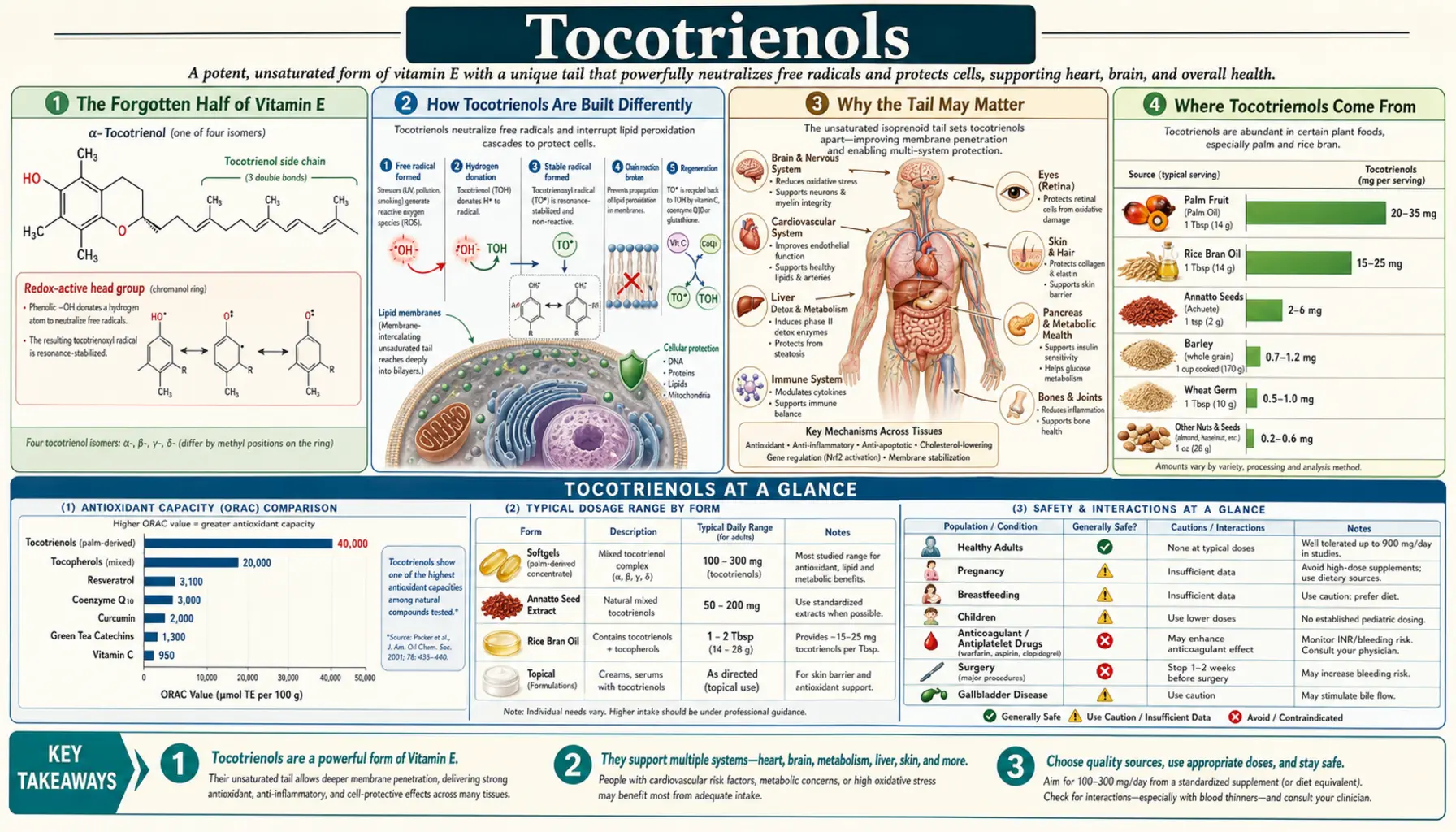
Most people think of vitamin E as a single thing — one nutrient, one softgel on the shelf. It is actually a family of eight related molecules, and the half almost nobody talks about is the tocotrienols. Where the familiar tocopherols get nearly all the attention and nearly all the research money, tocotrienols have quietly built up an intriguing scientific record of their own: they behave a little differently inside our cell membranes, and in laboratory and early clinical studies they have shown hints of lowering cholesterol, protecting brain tissue, and calming a fatty liver. The honest word for that record, though, is promising, not proven. This page explains what tocotrienols are, how they differ from ordinary vitamin E, where they come from in the diet, what the research actually shows (and where it disappoints), and how to think about supplements without over-promising. If you have not yet, it helps to read our Vitamin E page first — tocotrienols only make full sense as the other half of that story.
Table of Contents
- The Forgotten Half of Vitamin E
- How Tocotrienols Are Built Differently
- Why the Tail May Matter
- Where Tocotrienols Come From
- The Research: Cholesterol & Heart
- The Research: Brain, Stroke & Nerves
- The Research: Liver, Bone & Skin
- The Tocopherol Interaction
- Forms & Dosing
- Safety & Cautions
- The Honest Bottom Line
- Key Research Papers
- Connections
- Featured Videos
The Forgotten Half of Vitamin E
Vitamin E is not one compound — it is a category of eight fat-soluble molecules that plants make to protect their own oils from going rancid. They split into two branches of four each:
- Tocopherols — alpha, beta, gamma, and delta. Alpha-tocopherol is the form your body holds onto most tightly, the form used to define the vitamin’s official requirement, and the form in almost every “vitamin E” supplement.
- Tocotrienols — also alpha, beta, gamma, and delta. Same four Greek-letter names, but a different molecular shape (more on that below).
So when a bottle simply says “Vitamin E,” it almost always means alpha-tocopherol alone. That single form has soaked up the overwhelming majority of the last century’s research, funding, and public attention. Tocotrienols — a full four of the eight family members — got left on the sidelines. That is why researchers who study them, including the widely cited reviews by Sen and Khanna, describe tocotrienols as the “other half” or the neglected half of the natural vitamin E family. They are not a fringe supplement invented by marketers; they are a legitimate part of the vitamin your body already recognizes, one that science simply overlooked for decades.
Practically, this means two things. First, if you have only ever taken standard vitamin E, you have probably had very little tocotrienol in your life. Second, the research base is younger and thinner than for tocopherols, so we have to read it carefully and resist the temptation to treat early findings as settled fact.
How Tocotrienols Are Built Differently
Both branches share the same “head” a ring called chromanol that does the actual antioxidant work, neutralizing the reactive molecules that would otherwise damage fats in your membranes. The difference is entirely in the tail, the long carbon chain that anchors the molecule inside a cell membrane.
- Tocopherols have a saturated tail — a straight, fully “filled” chain with no double bonds.
- Tocotrienols have an unsaturated tail — the same length, but with three double bonds in it. (The “-trienol” in the name literally points to those three double bonds.)
It sounds like a trivial chemistry footnote, but it changes how the molecule sits and moves in a membrane. A saturated tail is like a rigid, straight peg. The kinked, unsaturated tocotrienol tail is shorter in effective reach and does not pack as tightly, so the molecule can slide around more freely in the fatty layer of the cell. That extra mobility is the heart of why some scientists suspected tocotrienols might do their job differently — and, in certain lab conditions, better — than their more famous cousins.
Why the Tail May Matter
In the early 1990s, Lester Packer’s laboratory at Berkeley ran careful membrane experiments comparing alpha-tocopherol with alpha-tocotrienol. They reported that the tocotrienol form spread out more evenly in the membrane, was recycled back to its active state more efficiently after quenching a free radical, and — in those particular model membranes — protected against lipid damage more effectively than alpha-tocopherol. The proposed reasons all trace back to that unsaturated tail: better mobility, a more even distribution among the membrane’s fatty acids, and easier “hand-off” of electrons during recycling.
It is worth being precise about what this does and does not mean:
- What it means: In controlled laboratory systems — isolated membranes, cell cultures, test-tube oxidation assays — tocotrienols can be equal to or more potent than tocopherols as antioxidants, and they interact with membranes in a distinctive way.
- What it does not mean: That this laboratory potency automatically translates into greater health benefits in a living human being. The body absorbs tocotrienols less efficiently than alpha-tocopherol, keeps them in the blood for a shorter time, and lacks the special liver transport protein that preferentially recycles alpha-tocopherol. So a molecule that looks stronger in a dish may end up present in smaller amounts, for less time, in a person.
This gap between elegant test-tube findings and messier human outcomes is a running theme in tocotrienol science, and it is the honest lens to keep on everything that follows.
Where Tocotrienols Come From
Tocotrienols are much rarer in the food supply than tocopherols, and they cluster in a handful of plant oils, seeds, and grains. The richest dietary and supplemental sources are:
- Annatto — the seed of the achiote tree, best known as a natural orange-red food coloring. Annatto is unusual and prized because it is almost pure tocotrienol (predominantly delta- and gamma-forms) with essentially no tocopherol. That near-total absence of tocopherol is exactly why annatto has become the preferred raw material for research and for supplements — it lets you study or take tocotrienols without the tocopherol that, as we will see, can interfere with them.
- Palm oil — red palm fruit oil is one of the best-known natural tocotrienol sources and supplies a mix of tocotrienols alongside tocopherol. Most of the older “tocotrienol-rich fraction” (TRF) research used palm-derived material.
- Rice bran oil — another well-studied source; the TRF25 preparation used in several cholesterol studies came from rice bran.
- Barley — historically important: the very first tocotrienol identified as a cholesterol-synthesis inhibitor was isolated from barley in the 1980s.
Smaller amounts turn up in oats, wheat germ, coconut, and some nuts. But because ordinary Western diets lean on tocopherol-rich oils (like sunflower and safflower), most people get very little tocotrienol from food alone — which is the main reason supplements exist at all.
The Research: Cholesterol & Heart
The cholesterol story is where tocotrienols first made their name, and it is also the clearest example of “promising but not settled.”
The idea began with real biochemistry. In 1986, a barley-derived tocotrienol was shown to inhibit HMG-CoA reductase — the same enzyme that statin drugs block to lower cholesterol. Unlike statins, which shut the enzyme down directly, tocotrienols appear to nudge the body to break the enzyme down and make less of it. On paper, that is a genuinely interesting, gentler mechanism.
Early human studies were encouraging. In the 1990s, Qureshi and colleagues reported that tocotrienol preparations lowered total and LDL (“bad”) cholesterol in people with high cholesterol, sometimes by double-digit percentages. Later work suggested the effect was dose-dependent and seemed to peak around a modest daily dose — with higher doses working less well, an unusual pattern that hinted the biology was more complicated than “more is better.”
But the results never fully consolidated. Other trials found little or no cholesterol benefit, and reviews of the human evidence conclude the effect is inconsistent across studies. Two honest caveats explain much of the mess:
- Preparation matters. Palm-derived products contain alpha-tocopherol, which — as the next section explains — can blunt the cholesterol effect. Studies that used tocopherol-heavy material may have quietly undercut their own results.
- Doses and populations differed, making trials hard to compare head-to-head.
Where does that leave a reader? Tocotrienols are a plausible, mechanistically grounded, generally well-tolerated option that may modestly help some people’s lipid numbers — but they are not a proven replacement for diet, exercise, or, where indicated, a statin. Anyone managing cardiovascular risk should treat them as a possible adjunct to discuss with a clinician, not a solved solution. See our Cardiology section for the bigger picture on heart health.
The Research: Brain, Stroke & Nerves
Some of the most intriguing tocotrienol work is in the brain, led largely by Chandan Sen and Savita Khanna’s group. In cell and animal studies, very small amounts of alpha-tocotrienol protected neurons from a specific kind of self-destruction triggered by glutamate — and notably did so at concentrations far too low for a plain antioxidant effect to explain, pointing to a distinct, signaling-based mechanism rather than simple radical mopping.
That laboratory promise led to a genuine human trial. In a two-year randomized study, older adults with pre-existing white-matter lesions (small areas of brain damage linked to stroke risk and cognitive decline) took palm tocotrienols or a placebo. The lesions in the placebo group tended to grow, while the tocotrienol group’s lesions stayed more stable — a modest but real signal that the compound might slow this kind of damage.
Two honest qualifications: this was a single trial of limited size, and it measured a brain-imaging marker rather than hard outcomes like actual strokes or dementia diagnoses. It is a reason for cautious optimism and further study, not a green light to treat or prevent stroke with a supplement. If brain and stroke risk are your concern, our Neurology and Stroke pages give the broader, evidence-based context.
The Research: Liver, Bone & Skin
Beyond cholesterol and the brain, tocotrienols have been explored in several other areas. Each is best read as an early, hopeful thread rather than a finished conclusion.
Liver
Because tocotrienols concentrate in the liver and act as antioxidants there, researchers tested them in non-alcoholic fatty liver disease. In one randomized, placebo-controlled trial, a mixed-tocotrienol supplement improved the ultrasound appearance of fatty livers more than placebo over a year. It is a promising result for a common condition with few drug options — but again, a single modest trial using an imaging marker, not proof of long-term liver protection.
Bone
Rodent studies suggest tocotrienols may help preserve bone by curbing the oxidative stress and inflammation that drive bone loss, with some models showing benefits comparable to standard interventions. The evidence here is still largely pre-clinical; well-designed human bone trials are limited, so this remains a research direction rather than a recommendation.
Skin
Because they distribute well through membranes and reach the skin, tocotrienols have been studied for protecting skin lipids from oxidation and ultraviolet-driven damage, mostly in laboratory and animal work. Interesting, but early.
Other areas
Laboratory and animal studies have also probed tocotrienols in cancer biology, where they appear to affect several cell-growth pathways at once. This is genuinely active research, but it is overwhelmingly pre-clinical — nowhere near a basis for any human claim, and nothing anyone should self-treat with.
The pattern across all of these is the same: a believable mechanism, encouraging early data, and a shortage of the large, long human trials that would turn “interesting” into “established.”
The Tocopherol Interaction
Here is a genuine, easy-to-miss nuance that shapes how tocotrienols should be taken: ordinary alpha-tocopherol can work against them.
In animal studies, adding alpha-tocopherol attenuated the ability of gamma-tocotrienol to suppress the cholesterol-making enzyme — in other words, the common form of vitamin E partly cancelled the tocotrienol’s signature effect. There is also evidence that higher alpha-tocopherol intake can interfere with tocotrienol absorption and how it is handled in the body.
This has two practical consequences:
- It helps explain the mixed cholesterol results: trials using tocopherol-rich palm material may have blunted their own effect, while purer preparations performed better.
- It is a strong argument for annatto-derived, tocopherol-free tocotrienols when the goal is to study or capture the tocotrienol effect specifically — and a reason not to simply swallow a big alpha-tocopherol capsule at the same time as your tocotrienols.
It is a good reminder that within a single vitamin, the members are not interchangeable and can even pull in different directions.
Forms & Dosing
If you decide to try tocotrienols, the label details matter more than usual:
- Annatto tocotrienols — virtually tocopherol-free, typically rich in delta- and gamma-forms. Favored in recent research precisely because there is no alpha-tocopherol to get in the way. This is the cleanest choice if you specifically want a tocotrienol effect.
- Mixed palm or rice-bran tocotrienols (“tocotrienol-rich fraction,” TRF) — provide the full spread of tocotrienols but usually include some alpha-tocopherol. Much of the classic cholesterol research used these.
Study doses have commonly landed in the range of roughly 100–300 mg of tocotrienols per day, and interestingly the cholesterol work suggested a moderate dose could work as well as or better than a higher one. Because tocotrienols are fat-soluble, they are absorbed far better with food, ideally a meal containing some fat. There is no official Daily Value or recommended intake for tocotrienols specifically — the vitamin E requirement is defined only for alpha-tocopherol — so any dose is guided by research studies and product labeling, not a government standard.
Two sensible habits: separate your tocotrienols from any large alpha-tocopherol dose (given the interaction above), and choose reputable brands, since tocotrienol content and purity vary widely between products.
Safety & Cautions
Tocotrienols have a reassuring safety record. In human studies at the doses used, they are generally well tolerated, with side effects that are uncommon and mild — occasional digestive upset being the usual complaint. There is no evidence of the serious toxicity seen with fat-soluble vitamins A or D.
That said, tocotrienols are still vitamin E, and vitamin E in general carries a few sensible cautions:
- Bleeding and blood thinners. At higher doses, vitamin E can have a mild anticoagulant (“blood-thinning”) effect. If you take warfarin, aspirin, clopidogrel, or another blood thinner — or have a bleeding disorder — talk to your clinician first, because the effects can add up.
- Surgery. For the same reason, it is standard advice to stop vitamin E, including tocotrienols, one to two weeks before any scheduled surgery and tell your surgeon you have been taking it.
- Pregnancy, nursing, and medical conditions. Because tocotrienol supplements have not been extensively studied in these groups, err on the side of caution and check with a professional.
None of this makes tocotrienols dangerous in ordinary use — it simply means treating them with the same common-sense respect you would give any fat-soluble supplement that can influence clotting.
The Honest Bottom Line
Tocotrienols are a real, legitimate, and genuinely under-researched branch of the vitamin E family — four of the eight forms your body already knows, and the ones science mostly forgot. Their unsaturated tail gives them a distinctive way of moving through membranes and, in the laboratory, real antioxidant strength. In people, early signals in cholesterol, brain white-matter, and fatty liver are interesting enough to keep researchers busy.
But interesting is not the same as proven. The human trials are still few, often small, frequently measuring markers rather than hard outcomes, and sometimes contradictory. The fair summary is this: tocotrienols are a promising, well-tolerated, mechanistically sensible part of vitamin E that may offer modest benefits for some people — and that deserve more and larger studies before anyone calls them a treatment. If you try them, do it as an informed experiment with realistic expectations, an annatto-based product, food in your stomach, and a heads-up to your clinician if you take blood thinners or have surgery coming up. Read them alongside the fuller Vitamin E story, and keep the healthy skepticism this young science has earned.
Key Research Papers
- Serbinova E, Kagan V, Han D, Packer L. Free radical recycling and intramembrane mobility in the antioxidant properties of alpha-tocopherol and alpha-tocotrienol. Free Radical Biology and Medicine. 1991;10(5):263–275. — the classic membrane study showing alpha-tocotrienol’s greater mobility and, in that model, stronger antioxidant action. — doi:10.1016/0891-5849(91)90033-y
- Qureshi AA, Burger WC, Peterson DM, Elson CE. The structure of an inhibitor of cholesterol biosynthesis isolated from barley. Journal of Biological Chemistry. 1986;261(23):10544–10550. — identified a barley tocotrienol as an inhibitor of cholesterol synthesis, launching the whole lipid line of research. — doi:10.1016/S0021-9258(18)67419-8
- Qureshi AA, Bradlow BA, Brace L, et al. Response of hypercholesterolemic subjects to administration of tocotrienols. Lipids. 1995;30(12):1171–1177. — early human trial reporting reductions in total and LDL cholesterol. — doi:10.1007/BF02536620
- Qureshi AA, Sami SA, Salser WA, Khan FA. Dose-dependent suppression of serum cholesterol by tocotrienol-rich fraction (TRF25) of rice bran in hypercholesterolemic humans. Atherosclerosis. 2002;161(1):199–207. — found a modest dose worked best, with higher doses less effective — an unusual, telling pattern. — doi:10.1016/S0021-9150(01)00619-0
- Qureshi AA, Pearce BC, Nor RM, et al. Dietary alpha-tocopherol attenuates the impact of gamma-tocotrienol on hepatic 3-hydroxy-3-methylglutaryl coenzyme A reductase activity in chickens. The Journal of Nutrition. 1996;126(2):389–394. — direct evidence that alpha-tocopherol blunts the tocotrienol cholesterol effect. — doi:10.1093/jn/126.2.389
- Sen CK, Khanna S, Roy S. Tocotrienols: Vitamin E beyond tocopherols. Life Sciences. 2006;78(18):2088–2098. — influential review framing tocotrienols as the neglected half of vitamin E. — doi:10.1016/j.lfs.2005.12.001
- Sen CK, Khanna S, Roy S. Tocotrienols in health and disease: the other half of the natural vitamin E family. Molecular Aspects of Medicine. 2007;28(5–6):692–728. — comprehensive review of the mechanisms and evidence across organ systems. — doi:10.1016/j.mam.2007.03.001
- Khanna S, Roy S, Slivka A, et al. Neuroprotective properties of the natural vitamin E alpha-tocotrienol. Stroke. 2005;36(10):2258–2264. — showed nanomolar alpha-tocotrienol protects neurons via a signaling mechanism, not just antioxidant action. — doi:10.1161/01.STR.0000181082.70763.22
- Gopalan Y, Shuaib IL, Magosso E, et al. Clinical investigation of the protective effects of palm vitamin E tocotrienols on brain white matter. Stroke. 2014;45(5):1422–1428. — two-year human trial in which tocotrienols helped stabilize brain white-matter lesions. — doi:10.1161/STROKEAHA.113.004449
- Magosso E, Ansari MA, Gopalan Y, et al. Tocotrienols for normalisation of hepatic echogenic response in nonalcoholic fatty liver: a randomised placebo-controlled clinical trial. Nutrition Journal. 2013;12:166. — mixed tocotrienols improved fatty-liver ultrasound findings over one year. — doi:10.1186/1475-2891-12-166
- Chin KY, Ima-Nirwana S. The biological effects of tocotrienol on bone: a review on evidence from rodent models. Drug Design, Development and Therapy. 2015;9:2049–2061. — summarizes the (still largely pre-clinical) bone-protection evidence. — doi:10.2147/DDDT.S79660
- Meganathan P, Fu JY. Biological properties of tocotrienols: evidence in human studies. International Journal of Molecular Sciences. 2016;17(11):1682. — careful review of what the human trials do and do not yet establish. — doi:10.3390/ijms17111682
Connections
- Vitamin E
- Vitamin E: Food Sources
- All Antioxidants
- CoQ10
- Astaxanthin
- Glutathione
- Lycopene
- Cardiology
- Neurology
- Stroke
- Vitamin E: Tocotrienols — how tocotrienols differ from tocopherols, dose by dose.
- Vitamin E and Heart Health — why the alpha-tocopherol trials failed and where tocotrienols fit.