N-acetyl-cysteine (NAC) & Kidney Health
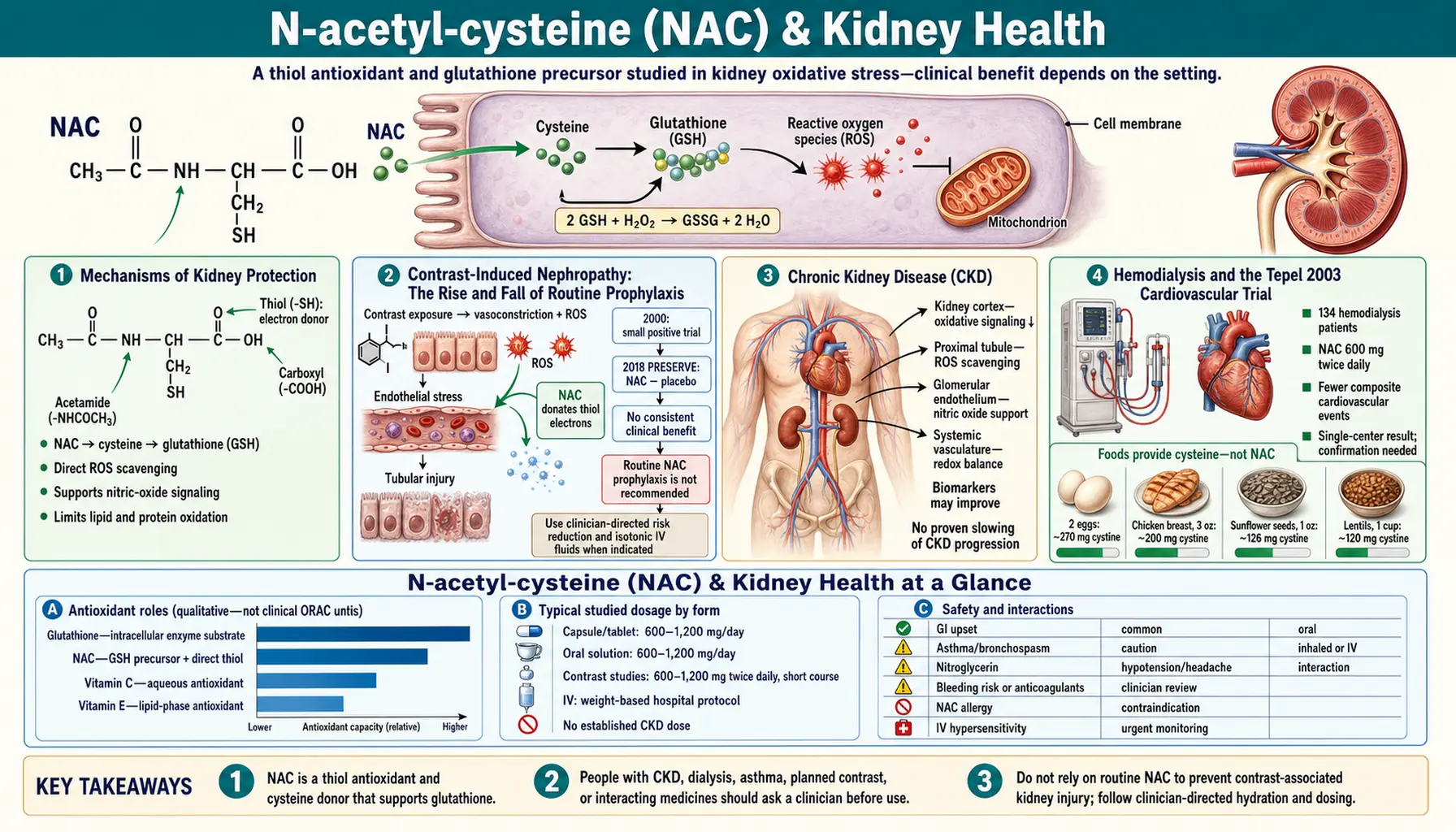
The kidney filters the blood, concentrates many drugs and toxins during their excretion, and relies on glutathione to protect its tubular cells from oxidative damage. Oxidative stress has been proposed as one contributor to kidney injury from iodinated contrast agents, sepsis, surgery and rhabdomyolysis. N-acetylcysteine (NAC), which supplies cysteine for glutathione synthesis, has been tested for kidney protection in many randomized trials — for contrast nephropathy alone, a 2022 review counted more than 70 clinical trials and 23 systematic reviews (Sandilands 2022).
This article covers the NAC kidney research — from the 2000 Tepel paper on contrast nephropathy through the large ACT and PRESERVE trials, to chronic kidney disease, hemodialysis, acute kidney injury, diabetic nephropathy, cystine stones and rhabdomyolysis. The results are mixed: for contrast prophylaxis the two largest trials found no benefit, and for most other kidney uses the evidence comes from small trials, biomarker studies or animal models.
Interactive Visualization Free Radicals & Your Antioxidant Network Follow one superoxide radical down the whole relay — SOD, catalase, glutathione, vitamin E, vitamin C, NADPH — then release free iron and watch a membrane tear itself apart. Launch →Table of Contents
- Mechanisms of Kidney Protection
- Contrast-Induced Nephropathy: The Rise and Fall of Routine Prophylaxis
- Chronic Kidney Disease (CKD)
- Hemodialysis and the Tepel 2003 Cardiovascular Trial
- Acute Kidney Injury (AKI)
- Diabetic Nephropathy
- Cystinuria and Kidney Stone Prevention
- Rhabdomyolysis-Induced AKI
- Evidence Summary Table
- Doses Used in Trials
- Safety Profile and Drug Interactions
- How the Evidence Applies by Situation
- Key Research Papers
- Connections
- Featured Videos
Mechanisms of Kidney Protection
Several overlapping mechanisms have been proposed for how NAC could protect kidney tissue. Most were worked out in cell and animal studies; when two of them were tested directly in people, the results were largely negative (Sandilands 2022, described below).
1. Glutathione Replenishment
NAC is deacetylated to release L-cysteine, which enters glutathione synthesis through glutamate-cysteine ligase, the rate-limiting enzyme. Oral NAC undergoes almost complete first-pass metabolism, and a 2004 review concluded that the drug most likely works through its metabolites, with L-cysteine as a source for glutathione the probable primary mechanism (Fishbane 2004).
2. Direct Free-Radical Scavenging
NAC's free sulfhydryl (–SH) group can react directly with oxidants such as the hydroxyl radical (·OH), hypochlorous acid (HOCl) and peroxynitrite (ONOO–) in laboratory studies. In the 2022 human mechanistic studies, neither intravenous nor oral NAC changed plasma antioxidant status (Sandilands 2022).
3. Renal Vasodilation
In anesthetized rats, intravenous NAC lowered total, cortical and outer-medullary renal vascular resistance by 7 to 10% after vasoconstriction induced by an iodinated contrast agent; the authors concluded that this effect seems to be mediated by mechanisms other than prostaglandins and nitric oxide, and NAC did not protect kidney function or structure in a rat model of selective medullary hypoxic injury (Heyman 2003). In people, intravenous (not oral) NAC increased renal blood flow by 8% in healthy volunteers, but in 66 patients with stage 3 chronic kidney disease undergoing coronary angiography it had no effect on renal blood flow, glomerular filtration rate or markers of kidney injury (Sandilands 2022).
4. NF-kB Suppression and Anti-Inflammatory Effects
Cellular redox state regulates nuclear factor kappa-B (NF-kB), a transcription factor for inflammatory cytokines, and restoring glutathione is proposed to dampen this signaling. In a small placebo-controlled study in peritoneal dialysis patients, eight weeks of oral NAC lowered plasma interleukin-6 but did not significantly change the other inflammatory and oxidative-stress markers measured (Nascimento 2010).
5. Mitochondrial Protection and Ischemic Injury
Mitochondrial glutathione protects the electron-transport chain from the superoxide it generates, and in experimental studies its depletion is linked to opening of the mitochondrial permeability transition pore, release of cytochrome c and apoptosis. In a rat model of ischemic kidney failure, NAC infused before and after the ischemia was followed by a higher glomerular filtration rate at 1 and 7 days and better kidney histology at 7 days, although it did not reduce proximal tubule necrosis at 24 hours; the authors described the mechanism as unknown (DiMari 1997).
Contrast-Induced Nephropathy: The Rise and Fall of Routine Prophylaxis
Contrast-induced nephropathy (CIN), now often called contrast-associated acute kidney injury, is a fall in kidney function after iodinated contrast. Trials have defined it as a rise in serum creatinine of at least 0.5 mg/dL at 48 hours (Tepel 2000) or of at least 25% from baseline (Marenzi 2006; REMEDIAL). Proposed mechanisms include direct tubular toxicity, medullary hypoxia from vasoconstriction and oxidative stress. Before PRESERVE, its investigators described oral acetylcysteine as widely used to prevent kidney injury after angiography without definitive evidence of its efficacy; two large trials then found no benefit.
Tepel 2000 — The Landmark Paper
Tepel and colleagues reported in the New England Journal of Medicine a randomized trial of 83 patients with chronic renal insufficiency (mean serum creatinine 2.4 mg/dL) undergoing computed tomography with a nonionic, low-osmolality contrast agent. Patients received oral NAC 600 mg twice daily plus intravenous 0.45% saline before and after the contrast, or placebo plus saline. A rise in serum creatinine of at least 0.5 mg/dL at 48 hours occurred in 1 of 41 patients on NAC (2%) versus 9 of 42 on placebo (21%) (relative risk 0.1, 95% CI 0.02 to 0.9). The trial was small, and a 2022 review of the field noted that it led to more than 70 further clinical trials (Sandilands 2022).
Marenzi 2006 — High-Dose NAC in Primary Angioplasty
Marenzi and colleagues randomized 354 patients undergoing primary angioplasty for acute myocardial infarction to placebo, standard-dose NAC (a 600 mg intravenous bolus before the procedure, then 600 mg orally twice daily for 48 hours) or high-dose NAC (a 1,200 mg intravenous bolus, then 1,200 mg orally twice daily for 48 hours). A rise in serum creatinine of 25% or more occurred in 33%, 15% and 8% of the three groups, and in-hospital mortality was 11%, 4% and 3% (NEJM 354:2773). The authors concluded that NAC "may prevent" contrast nephropathy with a dose-dependent effect in this setting.
REMEDIAL Trial (Briguori 2007)
REMEDIAL randomized 326 patients with chronic kidney disease undergoing coronary or peripheral procedures to three strategies that all included NAC: saline plus NAC, sodium bicarbonate plus NAC, or saline plus ascorbic acid plus NAC. A 25% or greater rise in creatinine at 48 hours occurred in 9.9%, 1.9% and 10.3% respectively (Circulation 115:1211). The trial compared hydration strategies; it had no arm without NAC and did not compare NAC doses.
Meta-Analyses Before the Large Trials
A 2004 review found the clinical studies "highly mixed": five dramatically positive and eight with no demonstrable efficacy (Fishbane 2004). A 2008 meta-analysis of 41 trials found that NAC reduced the risk of CIN compared with saline alone (relative risk 0.62, 95% CI 0.44 to 0.88), with significant heterogeneity between trials (Kelly 2008). A 2013 meta-analysis of 10 trials of intravenous NAC (1,916 patients) found a nonsignificant trend (risk ratio 0.68, 95% CI 0.46 to 1.02) and judged the research too inconsistent to warrant a conclusion on efficacy (Sun 2013).
ACT Trial 2011 — The First Big Blow
The Acetylcysteine for Contrast-induced nephropathy Trial (ACT Investigators) randomized 2,308 patients undergoing angiography with at least one risk factor (age over 70, renal failure, diabetes, heart failure or hypotension) to oral NAC 1,200 mg or placebo, twice daily for two doses before and two doses after the procedure. CIN occurred in 12.7% of both groups (relative risk 1.00, 95% CI 0.81 to 1.25). Death or need for dialysis at 30 days was 2.2% versus 2.3% (hazard ratio 0.97), and the effects were consistent in all subgroups, including people with renal impairment (Circulation 124:1250).
PRESERVE 2018 — The Definitive Answer
Weisbord and colleagues randomized 5,177 patients at high risk for kidney complications who were scheduled for angiography; 4,993 were included in the modified intention-to-treat analysis. A 2x2 factorial design tested intravenous sodium bicarbonate versus saline, and 5 days of oral NAC versus placebo. The primary end point (death, need for dialysis, or a persistent rise of at least 50% in serum creatinine at 90 days) occurred in 4.6% of NAC patients and 4.5% of placebo patients (odds ratio 1.02, 95% CI 0.78 to 1.33), and there were no significant differences in contrast-associated acute kidney injury. Neither bicarbonate nor NAC showed benefit; the sponsor stopped the trial after a prespecified interim analysis (NEJM 378:603).
A 2022 series of mechanistic studies then found oral NAC at the doses used in prophylaxis trials essentially undetectable in plasma and without kidney-protective effects, and intravenous NAC caused renal vasodilation in healthy volunteers but offered no protection to patients with stage 3 chronic kidney disease receiving contrast. Its authors pointed out that thousands of patients had been recruited to trials without the mechanistic studies being done first (Sandilands 2022).
Where the Contrast Evidence Stands
In the two largest trials, ACT and PRESERVE, oral NAC did not differ from placebo for contrast-associated kidney injury, dialysis or death after angiography. Decisions about preparation for a contrast procedure belong with the treating clinician.
Chronic Kidney Disease (CKD)
CKD is characterized by progressive loss of glomerular filtration, accompanied by systemic oxidative stress, accelerated atherosclerosis and retention of uremic toxins. The NAC-specific trials in CKD described here were small (20 to 30 patients) and lasted 8 weeks.
Nascimento 2010 (Peritoneal Dialysis)
In a placebo-controlled study of 30 peritoneal dialysis patients (22 completed), oral NAC 600 mg twice daily for 8 weeks lowered plasma interleukin-6 (median 9.4 to 7.6 pg/mL), with no such change on placebo. NAC did not significantly affect the other inflammatory and oxidative-stress markers measured, including advanced oxidation protein products, pentosidine, homocysteine and glutathione (Peritoneal Dialysis International 30:336).
Renke 2008
In a randomized, open, crossover study of 20 non-diabetic patients with proteinuria whose ACE-inhibitor and/or angiotensin-receptor-blocker therapy had already been established, NAC 1,200 mg/day added for 8 weeks had no effect on proteinuria or on markers of tubular injury or kidney fibrosis (Kidney and Blood Pressure Research 31:404).
What About eGFR?
In 50 healthy volunteers who received no contrast, four doses of oral NAC 600 mg every 12 hours lowered serum creatinine and raised estimated GFR without changing cystatin C; the authors argued that such direct effects on creatinine must be accounted for before creatinine falls are read as kidney protection (Hoffmann 2004). A 2023 Cochrane review of antioxidants as a group in CKD (95 studies, 10,468 patients, many different agents) found no evidence that antioxidants reduced death, judged that they likely reduce cardiovascular events and progression to kidney failure, and noted possible increases in infections and heart failure; it described most studies as of suboptimal quality and said the variety of interventions hampers conclusions about any individual agent (Colombijn 2023).
Hemodialysis and the Tepel 2003 Cardiovascular Trial
Patients with end-stage kidney failure have increased oxidative stress and elevated cardiovascular mortality, which made them a natural population in which to test an antioxidant (Tepel 2003).
Tepel 2003 — The Positive Outcome Trial
Tepel (the same investigator as the 2000 contrast paper) and colleagues reported in Circulation (107:992) a randomized, placebo-controlled trial of 134 hemodialysis patients (mean age 62) given NAC 600 mg twice daily or placebo, with a median follow-up of 14.5 months. The primary composite end point — fatal and nonfatal myocardial infarction, cardiovascular death, need for coronary angioplasty or bypass surgery, ischemic stroke, peripheral vascular disease with amputation, or need for angioplasty — occurred in 18 of 64 patients on NAC (28%) versus 33 of 70 on placebo (47%) (relative risk 0.60, 95% CI 0.38 to 0.95, P=0.03). No significant differences were detected in the secondary end points, including the individual component outcomes, cardiovascular mortality and total mortality.
What Has Followed
The result rests on a single trial of 134 patients. The 2023 Cochrane review of antioxidants in CKD pooled many different agents and noted that few of its studies included people on dialysis (Colombijn 2023).
Acute Kidney Injury (AKI)
Sepsis-Induced AKI
Sepsis causes AKI through microcirculatory failure, cytokine-driven tubular injury and oxidative stress. Small randomized trials gave mixed results: in 22 patients with early septic shock, an NAC infusion improved oxygenation and shortened ventilation and ICU stay in survivors, with similar mortality (Spapen 1998); in 35 patients with severe sepsis, NAC did not change microalbuminuria, and organ-failure scores, particularly cardiovascular, rose during treatment (Spapen 2005); in 86 intensive-care patients, NAC did not significantly change mortality, and among those admitted to intensive care more than 24 hours after hospital admission, mortality was higher with NAC (61% versus 32%) (Molnár 1999). The 2012 Cochrane review (Szakmany; 41 studies, 2,768 patients) found similar mortality with NAC and placebo (risk ratio 1.06, 95% CI 0.79 to 1.42) and no significant effect on length of stay, duration of mechanical ventilation or new organ failure; it found late use associated with cardiovascular instability and concluded that intravenous NAC is at best ineffective and at worst harmful in this population.
Cardiac Surgery AKI
Acute kidney injury after major surgery is associated with substantial mortality and morbidity. A 2009 meta-analysis (Ho and Morgan) of 10 randomized trials with 1,193 adults undergoing major surgery without radiocontrast — most of them cardiac surgery patients with normal kidney function — found that perioperative NAC did not reduce mortality (odds ratio 1.05), acute renal failure requiring dialysis (odds ratio 1.04) or a creatinine rise of more than 25% (odds ratio 0.84) (American Journal of Kidney Diseases 53:33).
Kidney Transplantation
In a double-blind trial of 50 deceased-donor kidney transplant recipients, NAC 600 mg twice daily on days 0 to 5 was associated with less reduced graft function (21.4% versus 50%) and larger falls in plasma NGAL, a marker of tubular injury (Modarresi 2020). For antioxidants as a group, the 2023 Cochrane review found little or no effect on loss of the transplanted kidney (Colombijn 2023).
Diabetic Nephropathy
Diabetic kidney disease is driven by hyperglycemia-induced mitochondrial superoxide, advanced glycation end-products and podocyte oxidative injury, which is the rationale for testing an antioxidant. In alloxan-diabetic rats, NAC given by injection reduced lipid peroxidation in kidney and liver tissue and restored several oxidative-stress markers (Ribeiro 2011).
Human data are limited. In a randomized trial of 70 patients with type 2 diabetic nephropathy, adding NAC 600 mg twice daily to losartan for 2 months did not reduce proteinuria significantly more than losartan alone (Rasi Hashemi 2012).
Cystinuria and Kidney Stone Prevention
Cystinuria is an autosomal-recessive defect in the SLC3A1/SLC7A9 cystine transporter that causes high urinary cystine excretion. Cystine is poorly soluble, so it crystallizes into stones that recur throughout life. Conventional therapy escalates from hydration and urinary alkalinization to thiol drugs such as tiopronin and D-penicillamine, which cleave cystine disulfides and have well-known adverse-effect profiles.
How NAC Could Act on Cystine
Cystine is the oxidized dimer of cysteine, held together by a disulfide bond. Like other thiol drugs, NAC can in principle exchange with that disulfide bond to form a mixed disulfide that is more soluble than cystine. This is the rationale for testing it in cystinuria.
Evidence
Clinical evidence is limited. In a study of 26 homozygous cystinuric patients, some of whom received D-penicillamine, 2-mercaptopropionylglycine (tiopronin) or NAC, NAC treatment increased the urinary excretion of cyst(e)ine, and the authors concluded that it could not be recommended as stone-preventive therapy (Mårtensson 1990). NAC has also been used as a local dissolving agent: a 1995 case report described complete dissolution of an obstructive cystine stone with NAC delivered through two percutaneous nephrostomy tubes, alongside oral treatment (Benítez Navio 1995).
Calcium Oxalate Stones
Most kidney stones are calcium oxalate rather than cystine; the thiol-disulfide rationale above applies to cystine only.
Rhabdomyolysis-Induced AKI
Rhabdomyolysis releases myoglobin into the circulation; its proposed mechanisms of kidney injury are tubular obstruction, renal vasoconstriction and oxidative stress driven by iron released from heme. The evidence for NAC here is from animal models: in rats with glycerol-induced acute renal failure, NAC increased serum glutathione reductase (total antioxidant status rose but not significantly), and the authors judged that oxidative stress is not the main cause of the tubular necrosis, tubular obstruction and vasoconstriction being more important (Polo-Romero 2004).
Evidence Summary Table
| Indication | Evidence Level | What the Research Shows |
|---|---|---|
| Contrast-induced nephropathy prevention | Negative in the two largest trials (ACT, PRESERVE) | No benefit of oral NAC over placebo |
| Acetaminophen overdose | Strong — FDA-approved antidote | Standard antidote; the evidence concerns liver protection |
| Cystinuria stone prevention | Weak — one unfavorable biochemical study, one case report of local dissolution | Not established |
| CKD oxidative-stress reduction | Small 8-week trials | IL-6 fell in one trial; proteinuria unchanged in another |
| Hemodialysis cardiovascular events | One positive RCT (Tepel 2003, 134 patients) | Fewer composite cardiovascular events; no significant difference in total mortality |
| Sepsis-induced AKI | Negative (Cochrane 2012) | No mortality benefit; late use linked to cardiovascular instability |
| Cardiac-surgery AKI prevention | Negative (2009 meta-analysis) | No reduction in mortality, dialysis or creatinine rise |
| Kidney transplantation | One 50-patient trial | Less reduced graft function; small evidence base |
| Diabetic nephropathy | Weak — animal data; one 70-patient trial negative on proteinuria | Investigational |
| Rhabdomyolysis AKI | Animal data only | Investigational |
Doses Used in Trials
Oral Doses in Kidney Trials
- 600 mg twice daily — Tepel 2000 (around contrast CT), Tepel 2003 (hemodialysis, median 14.5 months) and Nascimento 2010 (peritoneal dialysis, 8 weeks)
- 1,200 mg/day for 8 weeks — Renke 2008 (non-diabetic proteinuric CKD)
- 1,200 mg twice daily, two doses before and two after angiography — ACT 2011; PRESERVE used 5 days of oral NAC
Intravenous Doses in Acute Myocardial Infarction (Marenzi 2006)
- 600 mg or 1,200 mg intravenous bolus before primary angioplasty
- Followed by the same dose orally twice daily for 48 hours
- This was hospital care during acute myocardial infarction
Cystinuria
No trial-established NAC regimen for cystinuria was found; the evidence is summarized above.
Pharmacokinetics
In six healthy volunteers, the oral bioavailability of NAC was 4.0% for reduced NAC and 9.1% for total NAC; the terminal half-life of total NAC was 6.25 hours after an oral dose, and that of reduced NAC 1.95 hours after an intravenous dose (Olsson 1988). In the 2022 mechanistic studies, oral NAC at the doses used in contrast-prophylaxis trials was essentially undetectable in plasma (Sandilands 2022).
Safety Profile and Drug Interactions
Commonly Reported Oral Side Effects
- Nausea, vomiting and diarrhea
- Characteristic sulfurous odor and taste
- Headache and facial flushing, infrequent
IV Anaphylactoid Reactions
Intravenous NAC can cause non-allergic (anaphylactoid) reactions such as rash, flushing, bronchospasm and low blood pressure, along with vomiting. In a randomized trial of 222 patients treated for paracetamol poisoning, severe anaphylactoid reactions were recorded in 31 patients on the standard 20.25-hour intravenous regimen versus 5 on a shorter 12-hour modified regimen (Bateman 2014).
Drug Interactions
- Nitroglycerin: NAC potentiates the vasodilator effects of nitroglycerin. In a trial of 46 patients with severe unstable angina, intravenous NAC plus nitroglycerin was followed by symptomatic hypotension in 7 patients versus 0 with nitroglycerin alone (Horowitz 1988). The research raises a concern for low blood pressure in people taking nitrates.
- Antiplatelets / anticoagulants: a theoretical additive effect has been proposed.
Reported Contraindications and Cautions
- Known NAC hypersensitivity
- Asthma or a history of bronchospasm (a caution on intravenous use)
- Pregnancy — intravenous NAC is used in pregnant women for acetaminophen overdose
How the Evidence Applies by Situation
A summary of what the research shows for common situations:
- Contrast CT or cardiac catheterization: in ACT (2,308 patients) and PRESERVE (4,993 analysed), oral NAC did not reduce kidney injury, dialysis or death compared with placebo.
- Hemodialysis: one 134-patient trial found fewer cardiovascular events with NAC 600 mg twice daily (28% versus 47%), with no significant difference in total mortality.
- CKD not on dialysis: the NAC trials were small and short; one found no effect on proteinuria, and none measured progression to kidney failure.
- Cystinuria: evidence is limited to a biochemical study that found increased cyst(e)ine excretion and a case report of local stone dissolution.
- Diabetes with kidney disease: animal data are positive; a 70-patient trial found no significant added effect on proteinuria when NAC was combined with losartan.
- Nitrate users: the research raises a concern for symptomatic low blood pressure when NAC is combined with nitroglycerin.
The evidence for NAC in kidney health is mixed. Decisions about medicines and supplements belong with a clinician.
Key Research Papers
- Tepel M, van der Giet M, Schwarzfeld C, Laufer U, Liermann D, Zidek W. Prevention of radiographic-contrast-agent-induced reductions in renal function by acetylcysteine. N Engl J Med 2000;343(3):180–4. — PubMed PMID: 10900277
- Marenzi G, Assanelli E, Marana I, Lauri G, Campodonico J, Grazi M, et al. N-acetylcysteine and contrast-induced nephropathy in primary angioplasty. N Engl J Med 2006;354(26):2773–82. — PubMed PMID: 16807414
- Briguori C, Airoldi F, D'Andrea D, Bonizzoni E, Morici N, Focaccio A, et al. Renal Insufficiency Following Contrast Media Administration Trial (REMEDIAL): a randomized comparison of 3 preventive strategies. Circulation 2007;115(10):1211–7. — PubMed PMID: 17309916
- ACT Investigators. Acetylcysteine for prevention of renal outcomes in patients undergoing coronary and peripheral vascular angiography: main results from the randomized Acetylcysteine for Contrast-induced nephropathy Trial (ACT). Circulation 2011;124(11):1250–9. — PubMed PMID: 21859972
- Weisbord SD, Gallagher M, Jneid H, Garcia S, Cass A, Thwin SS, et al. Outcomes after Angiography with Sodium Bicarbonate and Acetylcysteine. N Engl J Med 2018;378(7):603–614. — PubMed PMID: 29130810
- Tepel M, van der Giet M, Statz M, Jankowski J, Zidek W. The antioxidant acetylcysteine reduces cardiovascular events in patients with end-stage renal failure: a randomized, controlled trial. Circulation 2003;107(7):992–5. — PubMed PMID: 12600912
- Ho KM, Morgan DJ. Meta-analysis of N-acetylcysteine to prevent acute renal failure after major surgery. Am J Kidney Dis 2009;53(1):33–40. — PubMed PMID: 18649982
- Kelly AM, Dwamena B, Cronin P, Bernstein SJ, Carlos RC. Meta-analysis: effectiveness of drugs for preventing contrast-induced nephropathy. Ann Intern Med 2008;148(4):284–94. — PubMed PMID: 18283206
- Nascimento MM, Suliman ME, Silva M, Chinaglia T, Marchioro J, Hayashi SY, et al. Effect of oral N-acetylcysteine treatment on plasma inflammatory and oxidative stress markers in peritoneal dialysis patients: a placebo-controlled study. Perit Dial Int 2010;30(3):336–42. — PubMed PMID: 20190028
- Renke M, Tylicki L, Rutkowski P, Larczyński W, Aleksandrowicz E, Lysiak-Szydłowska W, et al. The effect of N-acetylcysteine on proteinuria and markers of tubular injury in non-diabetic patients with chronic kidney disease. A placebo-controlled, randomized, open, cross-over study. Kidney Blood Press Res 2008;31(6):404–10. — PubMed PMID: 19092257
- Heyman SN, Goldfarb M, Shina A, Karmeli F, Rosen S. N-acetylcysteine ameliorates renal microcirculation: studies in rats. Kidney Int 2003;63(2):634–41. — PubMed PMID: 12631128
- DiMari J, Megyesi J, Udvarhelyi N, Price P, Davis R, Safirstein R. N-acetyl cysteine ameliorates ischemic renal failure. Am J Physiol 1997;272(3 Pt 2):F292–8. — PubMed PMID: 9087670
- Sun Z, Fu Q, Cao L, Jin W, Cheng L, Li Z. Intravenous N-acetylcysteine for prevention of contrast-induced nephropathy: a meta-analysis of randomized, controlled trials. PLoS One 2013;8(1):e55124. — PubMed PMID: 23383076
- Colombijn JM, Hooft L, Jun M, Webster AC, Bots ML, Verhaar MC, et al. Antioxidants for adults with chronic kidney disease. Cochrane Database Syst Rev 2023;11(11):CD008176. — PubMed PMID: 37916745
- Fishbane S, Durham JH, Marzo K, Rudnick M. N-acetylcysteine in the prevention of radiocontrast-induced nephropathy. J Am Soc Nephrol 2004;15(2):251–60. — PubMed PMID: 14747371
- Molnár Z, Shearer E, Lowe D. N-Acetylcysteine treatment to prevent the progression of multisystem organ failure: a prospective, randomized, placebo-controlled study. Crit Care Med 1999;27(6):1100–4. — PubMed PMID: 10397212
- Szakmany T, Hauser B, Radermacher P. N-acetylcysteine for sepsis and systemic inflammatory response in adults. Cochrane Database Syst Rev 2012;(9):CD006616. — PubMed PMID: 22972094
- Ribeiro G, Roehrs M, Bairros A, Moro A, Charão M, Araújo F, et al. N-acetylcysteine on oxidative damage in diabetic rats. Drug Chem Toxicol 2011;34(4):467–74. — PubMed PMID: 21770721
- Sandilands EA, Rees JMB, Raja K, Dhaun N, Morrison EE, Hickson K, et al. Acetylcysteine has No Mechanistic Effect in Patients at Risk of Contrast-Induced Nephropathy: A Failure of Academic Clinical Science. Clin Pharmacol Ther 2022;111(6):1222–1238. — PubMed PMID: 35098531
- Hoffmann U, Fischereder M, Krüger B, Drobnik W, Krämer BK. The value of N-acetylcysteine in the prevention of radiocontrast agent-induced nephropathy seems questionable. J Am Soc Nephrol 2004;15(2):407–10. — PubMed PMID: 14747387
- Spapen H, Zhang H, Demanet C, Vleminckx W, Vincent JL, Huyghens L. Does N-acetyl-L-cysteine influence cytokine response during early human septic shock? Chest 1998;113(6):1616–24. — PubMed PMID: 9631802
- Spapen HD, Diltoer MW, Nguyen DN, Hendrickx I, Huyghens LP. Effects of N-acetylcysteine on microalbuminuria and organ failure in acute severe sepsis: results of a pilot study. Chest 2005;127(4):1413–9. — PubMed PMID: 15821223
- Mårtensson J, Denneberg T, Lindell A, Textorius O. Sulfur amino acid metabolism in cystinuria: a biochemical and clinical study of patients. Kidney Int 1990;37(1):143–9. — PubMed PMID: 2299801
- Benítez Navio J, Tudela Pavón P, Laguna Urraca G, Casanueva Luis T, Ruana Encinar M, Mata Guijarro F, et al. [The dissolution of cystine lithiasis with n-acetylcysteine]. Arch Esp Urol 1995;48(9):944–8. — PubMed PMID: 8554400
- Rasi Hashemi S, Noshad H, Tabrizi A, Mobasseri M, Tayebi Khosroshahi H, Heydarnejad M, et al. Angiotensin receptor blocker and N-acetyl cysteine for reduction of proteinuria in patients with type 2 diabetes mellitus. Iran J Kidney Dis 2012;6(1):39–43. — PubMed PMID: 22218118
- Modarresi A, Nafar M, Sahraei Z, Salamzadeh J, Ziaie S. Early Graft Function in Deceased Donor Renal Recipients: Role of N-Acetylcysteine. Iran J Pharm Res 2020;19(1):57–67. — PubMed PMID: 32922469
- Polo-Romero FJ, Fernández-Fúnez A, Broseta Viana L, Atienza MP, Sánchez Gascón F. Effect of N-acetylcysteine on antioxidant status in glycerol-induced acute renal failure in rats. Ren Fail 2004;26(6):613–8. — PubMed PMID: 15600251
- Olsson B, Johansson M, Gabrielsson J, Bolme P. Pharmacokinetics and bioavailability of reduced and oxidized N-acetylcysteine. Eur J Clin Pharmacol 1988;34(1):77–82. — PubMed PMID: 3360052
- Bateman DN, Dear JW, Thanacoody HK, Thomas SH, Eddleston M, Sandilands EA, et al. Reduction of adverse effects from intravenous acetylcysteine treatment for paracetamol poisoning: a randomised controlled trial. Lancet 2014;383(9918):697–704. — PubMed PMID: 24290406
- Horowitz JD, Henry CA, Syrjanen ML, Louis WJ, Fish RD, Smith TW, et al. Combined use of nitroglycerin and N-acetylcysteine in the management of unstable angina pectoris. Circulation 1988;77(4):787–94. — PubMed PMID: 3127076
PubMed Topic Searches
Selected PubMed topic searches relevant to N-acetylcysteine in nephrology, including contrast-induced nephropathy and chronic kidney disease.
- PubMed: NAC and contrast-induced nephropathy
- PubMed: NAC and chronic kidney disease
- PubMed: NAC in hemodialysis patients
- PubMed: NAC and diabetic nephropathy
- PubMed: NAC and cisplatin nephrotoxicity
- PubMed: Glutathione in the renal tubule
- PubMed: NAC in kidney transplant ischemia
- PubMed: NAC and polycystic kidney disease
- PubMed: Homocysteine in CKD
- PubMed: Oxidative stress in CKD
- PubMed: NAC and acute kidney injury
- PubMed: Cystatin C and GFR
Connections
- NAC and Lung Health — the same molecule in the airways instead of the kidney — mucolytic disulfide-bond cleavage, the BRONCUS and PANTHEON COPD trials, IPF, and the Rumack-Matthew acetaminophen protocol.
- NAC and Glutathione Precursors — NAC as a glutathione-raising supplement rather than an organ therapy — the hepatocyte synthesis pathway, the psychiatric and PCOS trials, dosing, and the glycine and selenium cofactors.
- Free Radicals & Your Antioxidant Network — interactive animation
- NAC
- NAC and Glutathione
- NAC and Cardiovascular Health
- NAC and Liver Health
- Kidney Disease
- Acute Kidney Injury
- Kidney Stones
- Glomerulonephritis
- Nephrotic Syndrome
- Cysteine
- Celery Juice
- Kidney Function
- Creatinine
- eGFR
- Sepsis
- Oxidative Stress
- Kidney Injury
- Coffee
- Detox Protocols